- Forecast Value (2035): 10.4 Bn
- CAGR (2035): 4.6%
Aviation Connector Market Outlook (2025 to 2035)
The global aviation connector market is expected to reach USD 10.4 billion by 2035, up from USD 5.9 billion in 2024. During the forecast period 2025 to 2035, the industry is projected to expand at a CAGR of 5.3%.
The aviation connector market is influenced by the rapid expansion of the aviation sector, as both commercial and military aircraft depend on advanced electronic systems for navigation, communication, and safety.
-2025-to-2035.webp "Aviation Connector Market Value (USD Billion) 2025 To 2035")
Aviation Connector Market Value (USD Billion) 2025 To 2035 | Source: Fact.MR
Quick Facts about the Aviation Connector Market
- Industry Value (2025): USD 6.2 Billion
- Projected Value (2035): USD 10.4 Billion
- Forecast CAGR (2025 to 2035): 5.3%
- Leading Segment (2025): Circular (42% Market Share)
- Country Growth Rate (2025 to 2035): China (6.3% CAGR)
- Top Key Players: Fischer Connectors SA, IEH Corporation, Amphenol Corporation, and Smith Group Plc.
Another trend contributing to the demand for high-performance connectors is the integration of next-generation avionics and in-flight entertainment systems. Aircraft manufacturers are focusing on the use of lightweight and durable products, so as to increase their fuel efficiency and minimize emissions. This shift boosts the use of miniaturized and composite connectors.
What are the drivers of the aviation connector market?
The commercial air travel and military modernization initiatives observed globally have led to a steady rise in aircraft production and fleet expansion. This trend is directly causing demand for high-performance, reliable connectors to support critical functions, including power distribution networks, flight control systems and communication networks. The introduction of new types of aircraft also increases market demand due to improved interconnectivity and fail-safe mechanisms.
Advanced avionics are becoming increasingly integral to modern aircraft, which are well equipped with fly-by-wire systems, onboard diagnostic systems, and passenger-oriented systems like in-flight Wi-Fi and entertainment systems. Such systems also incorporate high-speed connectors capable of maintaining signal integrity and consistent power transmission. With airlines continuing to invest in the technological enhancement of their fleets, the demand for advanced connector solutions is steadily increasing.
Reducing aircraft weight remains a key strategy for improving fuel efficiency and lowering emissions. Manufacturers are pursuing weight reduction across various aircraft components, including connectors. This tendency is involved in miniaturized connectors of a composite-based type that are popular due to their low mass and high resistance to extreme conditions. Such inventions are also useful to optimize the spaces and thermal management within the aerospace systems.
What are the regional trends of the aviation connector market?
North America is a leading region owing to its expansive commercial and defense aviation industries that require advanced aerospace electronics. The presence of aircraft manufacturers and MRO centers in the United States continues to drive developments and uptake of connector systems.
The European market shows steady long-term growth, supported by established aerospace manufacturing in France, Germany and the UK. This includes Airbus and state-backed commercial projects, including defense initiatives. The technological alliances are also enhancing connectors in both civil and military aircraft.
Air passenger traffic is increasing rapidly across the Asia Pacific, with a corresponding rise in aircraft deliveries and national aerospace initiatives, particularly in China and India. The local production and regional airlines present the growing demand for cost-efficient connector solutions.
The Middle East shows consistent growth in demand for connectors, supported by substantial aircraft orders by regional carriers and the modernization of airports. Adoption is also being enhanced by the regional preference for air travel regarding premium travel and defense upgrade.
What are the challenges and restraining factors of the aviation connector market?
Compliance with the requirements and rigorous standards required during aerospace certification is also one of the significant challenges to the aviation connector market. The manufacturers must meet demanding performance, durability, and safety criteria to be employed in vital systems. This raises the R&D spending and delays the time taken by companies to develop products in the market, particularly new technologies to market.
The other obstacle involves the issue of continuous innovation to support emerging technologies like unmanned aerial vehicles (UAVs) and more electric aircraft (MEA). Compact, lightweight, high-speed connectors with superior thermo-electromagnetic compatibility are required in these platforms. Providing such solutions while maintaining cost efficiency presents ongoing technical and economic difficulties.
One such limitation imposed by this product in the market is the high price associated with aerospace-grade connectors, making it unaffordable for smaller airlines and regional aircraft operators. These connectors are intended for extreme environments and long-life cycle operation, which contributes to their elevated cost. Budget-conscious buyers tend to delay upgrades or opt for minimal integration, which can affect overall market growth.
Country-Wise Insights
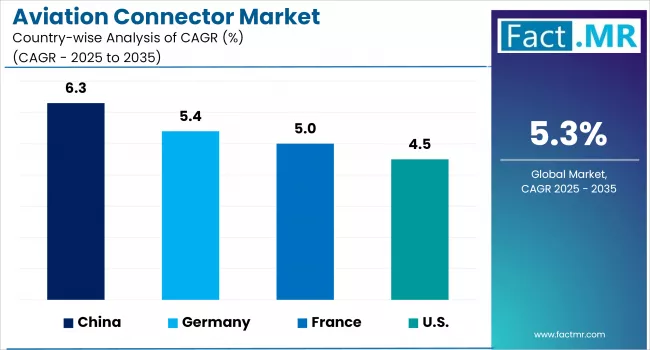
Aviation Connector Market By Company | Source: Fact.MR
Defense digitalization and aerospace modernization anchor USA’s aviation connector market
The American aviation connector market is progressing toward digitalization, guided by federal mandates for advanced avionics integration and military avionics modernization. EMI shielded certified connectors are being promoted throughout commercial airlines, UAVs and defense aviation through government-sponsored programs like NextGen and FAA-compliance.
State initiatives, such as in Washington, Ohio, and Alabama, are investing in connector R&D clusters in thermal resilience, vibration-proof locking mechanisms and signal integrity at high altitude conditions. Joint ventures of Boeing, Raytheon and NASA are experimenting with composite-jacketed and fiber-optic connectors to fulfill the interoperability requirements across multiple platforms.
-2025-to-2035.webp "USA Aviation Connector Market Value (USD Billion) 2025 To 2035")
USA Aviation Connector Market Value (USD Billion) 2025 To 2035 | Source: Fact.MR
Modular interfaces and miniaturized connectors align with mobility standards for military applications and fleet automation in civilian aviation. With DoD innovation grants, local SMEs are growing, with a focus on additive manufacturing and aerospace-grade quality standardization. The focus is shifting toward advanced approaches in adaptive power distribution systems for fighter aircraft, regional jets, and electric aircraft fleets.
Military-grade upgrades and rural mobility goals reshape China’s aviation connector market
China’s aviation connector market is advancing under two national initiatives: aviation infrastructure development in rural areas and defense avionics additions. The adoption of heat-resistant, vibration-durable connectors in light planes and tactical drones is accelerating deployment owing to policy support on satellite-integrated air mobility, UAV logistics, and low-altitude transport.
Provinces such as Guangdong, Shaanxi and Jiangsu are investing in aerospace parks specializing in RF screening, fast release connectors and modular avionics connectors. Combining polymer housing, EMI coatings and in-built diagnostics into next-generation interconnects, a strategic alliance between COMAC, AVIC and labs linked to Beihang University.
Smart cockpit and delivery frameworks based on drones are being synchronized with foldable, flame-resistant arrangements that suit challenging environments. Tax reliefs are used to scale up local suppliers along with government-backed connector certification programs that also involve high-order fabrication training. Intelligent high-reliability connector innovation is taking over mass production to meet the requirements of defense, regional transport, and eVTOL aviation.
Precision engineering and electric aviation goals drive Germany’s aviation connector market
The aviation connector market in Germany is shifting with the imposition of sustainable aviation and the integration of Industry 4.0 in the aerospace industry's manufacturing. The upsurge in the national funding of the electric propulsion apparatus and autonomous flight tests is raising the necessity of lightweight, thermally stable connectors in civil, cargo, and test aircraft.
Aerospace innovation hubs are funded by the states of Bavaria, Baden-Wurttemberg, and Lower Saxony and are focusing on circular connector miniaturization, multipoint redundancy and smart shielding. Collaborations between Lufthansa Technik, Airbus and Fraunhofer institutes are leading to the development of hybrid composite-metal housings that carry embedded sensor diagnostics, in which safety-critical systems are concerned.
To maximize retrofits ahead of Germany's hydrogen aircraft roadmap, foldable locking mechanisms and corrosion-resistant interfaces are being adopted. EU aerospace conformity is adding energy efficiency subsidies to the digital certification channels, as SME suppliers grow. The sector is also transitioning to high-speed and eco-aligned connector systems on electrified, hybrid aviation platforms, replacing the traditional avionics wiring.
Category-Wise Analysis
Miniaturization, signal stability, and board-level precision anchor PCB connectors in aviation
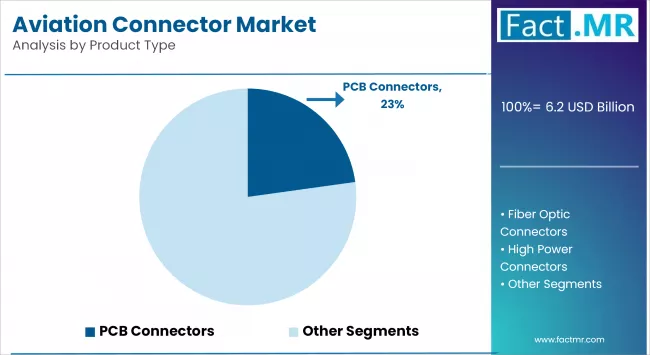
Aviation Connector Market By Product Type | Source: Fact.MR
PCB connectors market occupies a central position in the overall aviation market, as these connectors are compact, high-density and essential to aviation and flight controls. They incorporate connectors that facilitate secure board-to-board and board-to-cable assembly in small spaces in an aerospace electronic module.
They increase reliability in commercial and defense platforms due to their compatibility with miniaturized and encapsulated assemblies and circuit designs. In newly developed aviation products, cost-effective versions tend to be popular in terms of UAVs, whereas, in developed markets, customers are interested in protection against vibrations, multi-pin locking, and thermal insulation.
Since the industry shift toward high-frequency or low profile PCB connector products is steadily growing, manufacturers are focusing on improving contact alignment, signal integrity and other corrosion-resistant features to support the evolving needs of aerospace systems with weight limitations.
Ruggedness, versatility, and locking efficiency position circular connectors at the core of aviation designs
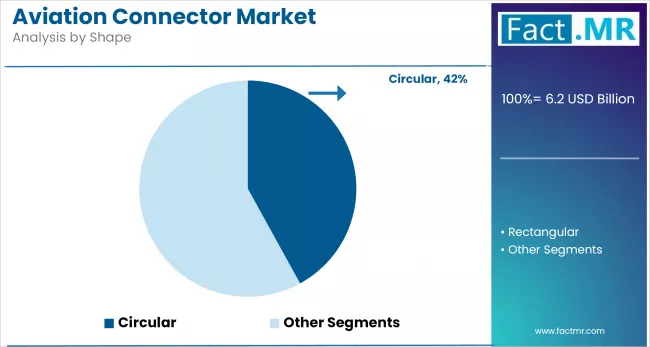
Aviation Connector Market By Shape | Source: Fact.MR
Circular connectors segment holds a central position within the overall connector market in the aviation sector, owing to its sealed construction, mechanical strength, and capacity to house multiple pins.
These connectors are well-suited for high vibration and harsh conditions like engine control systems, cockpit systems and landing gear mechanisms. Their threaded couplings are designed to ensure secure connections and allow for quick removal during maintenance operations.
In lower-end aviation systems, simpler round variants are employed to support reliable low-voltage networks, while advanced aircraft incorporate MIL-spec versions that feature electromagnetic shielding and corrosion resistance.
Ongoing innovations are focused on compact bayonet configurations, gold-plated contacts and metal to composite transitions in response to the growing demands of lighter, faster, safer electrical interfaces in aerospace design.
Fleet expansion, passenger tech, and maintenance demands boost connector adoption
The demand for connectors continues to be influenced by commercial aviation owing to the increased number of fleet and the electrification of aircraft interiors and avionics. Smart seating, LED lighting, touchscreen displays and fly-by-wire are among connectors increasingly being integrated into airlines.
These systems support faster connectorization and utilize quick-disconnect and fault tolerance designs in global hubs. Advancements in in-flight data transmission, heat dissipation and modular interchangeability are also aligning with the broader shift towards more digital, comfortable, and fuel-efficient air travel.
Competitive Analysis
The aviation connectors market places significant emphasis on innovation, customizability, and strict compliance with aerospace-grade performance standards. Key areas of differentiation include effective EMI protection, shrinking, and the capacity to perform under circumstances such as high-vibration environments, elevated temperature, and high-altitude conditions.
With the increasing demand for compact and high-speed connectors, particularly within avionics and on-board systems, suppliers are focusing not only on the performance of the product but also on its reliability.
The high rate of adoption of new technologies, including the electric aircraft, UAVs and smart cockpit architectures, also influences competition. Firms are investing in advanced materials, engineered production lines and simulation-driven design to make their products efficient and reduce time to market.
Some players strategically have an advantage due to their ability to provide modular, light-weight and maintenance-friendly connectors. In addition, access to global logistics infrastructure and certifications aligned with international aviation standards positions them well to deliver services efficiently across both commercial and defense applications.
Key players in the aviation connector industry include Amphenol Corporation, Smith Group Plc, ITT Inc., Apollo Aerospace Components, KYOCERA AVX Components Corporation, and others.
Recent Developments
- In March 2025, Japan Aviation Electronics Industry have launched WP11 and WP12 Series High Current Board-to-board Connectors.
- In July 2024, Smiths Interconnect’s innovative new product, the 'Mini-Lock Connector', enables extremely high frequency operation at a signal of up to 110 GHz one of the highest frequency components on the market currently. This leads to more reliability, faster speed and lower downtime.
Fact.MR has provided detailed information about the price points of key manufacturers of Aviation Connectors Market positioned across regions, sales growth, production capacity, and speculative technological expansion in the recently published report.
Methodology and Industry Tracking Approach
Developed on the perspectives of more than 12,000 aviation professionals in more than 30 countries, the global aviation connector market 2025 report consists of roughly 280 correlated responses by regional segment. These participants were avionics engineers, MRO coordinators, aerospace procurement managers, flight safety regulators, and connector system designers.
The study was done between July 2024 and June 2025 with the support of a methodological questionnaire to which a question of using connectors between types of aircraft, signal and power compatibility, with a question about environmental resistance, and international aerospace standards based on the commercial, defense, and cargo aerospace sectors.
The entire information was based on 280 validated sources such as aerospace compliance manuals, MIL-spec component standards, aircraft system specifications and aviation procurement documents. Segment-level growth and performance were evaluated with the help of quantitative modeling methods that utilized indexed adoption scoring and regression-based forecasting.
The recommendations offered as the strategic steps will be in dealing with connector manufacturers, OEMs, MRO providers, and avionics system integrators to focus on the creation of a miniaturized, EMI-shielded, vibration-resistant and modular connectors to deal with diverse flight conditions and regulatory requirements.
With Fact.MR has been monitoring consumer behavior, product efficacy, industry trends, and market opportunities since 2018, and this report is becoming an authoritative source of information that stakeholders can rely on.
Segmentation of Aviation Connector Market
-
By Product Type :
- PCB Connectors
- Fiber Optic Connectors
- High Power Connectors
- High Speed Connectors
- RF Connectors
- Others
-
By Shape :
- Circular
- Rectangular
-
By Application :
- Commercial
- Business Jets
- Military
- Others
-
By Region :
- North America
- Latin America
- Western Europe
- Eastern Europe
- East Asia
- South Asia & Pacific
- Middle East & Africa