- Base Value(2025): 5.7 Mn
- Estimated Value(2026): 6.0 Mn
- Forecast Value (2036): 10.7 Mn
- CAGR (2026 - 2036): 5.9%
Mooring Connector Equipment Market Analysis and Forecast by Fact.MR
- The Mooring Connector Equipment Market is expected to grow from USD 6.0 million in 2026 to USD 10.7 million by 2036, at a 5.9% CAGR
- Driven by expanding deepwater and ultra-deepwater oil and gas production platform installations, growing floating offshore wind energy mooring demand, and increasing replacement and upgrade requirements for aging mooring systems on existing floating production, storage, and offloading (FPSO) units.
- chain connector systems accounting for 27.8% share and offshore oil and gas contributing 48.3% share as companies invest in fatigue-resistant alloys, rapid-deployment connector mechanisms, and corrosion-resistant coating technologies.
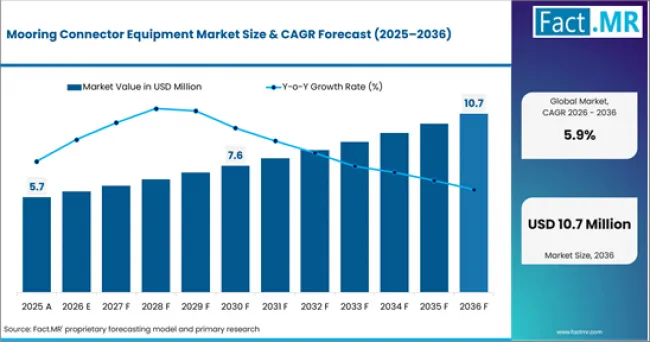
Mooring Connector Equipment Market Value Analysis | Source: Fact.MR
Summary of Mooring Connector Equipment Market
- Market Snapshot
- In 2025, the global Mooring Connector Equipment Market was valued at approximately USD 5.7 million.
- The market is estimated to reach USD 6 million in 2026 and is projected to attain USD 10.7 million by 2036.
- The mooring connector equipment market is likely to expand at a CAGR of 5.9% during the forecast period.
- The market is anticipated to create an absolute dollar opportunity of USD 4.7 million between 2026 and 2036.
- Chain Connector Systems accounts for 27.8% of product segment share in 2026.
- China (7.1%) and India (6.9%) are the key growth markets during the forecast period.
- Demand and Growth Drivers
- Deepwater and ultra-deepwater oil and gas production expansion in West Africa, Brazil pre-salt basins, and Gulf of Mexico is driving mooring system installation and connector procurement.
- Floating offshore wind energy project development in Europe, East Asia, and the U.S. is creating a new demand channel for mooring connector systems designed for turbine platform station-keeping.
- Replacement and upgrade demand from aging FPSO mooring systems that are approaching design life limits generates sustained connector procurement beyond new installation.
- Pre-salt and harsh environment production operations require mooring connectors with enhanced fatigue resistance, corrosion protection, and higher breaking load capacity.
- Floating LNG and floating production platform proliferation is expanding the installed base of moored offshore structures requiring periodic connector inspection and replacement.
- Product and Segment View
- Chain connector systems lead with 27.8% of product share in 2026, reflecting the established role of chain-based mooring systems in deepwater platform station-keeping.
- Mechanical locking systems account for 36.4% of connector mechanism share, supported by field-proven reliability and inspection accessibility.
- Key segmentation includes:
- Product: Chain Connector Systems, Wire Rope Connector Systems, Synthetic Line Connectors, Hybrid Mooring
- Application: Offshore Oil & Gas, Marine Ports & Harbors, Floating Renewable Energy, and Naval & Defense Applications
- Water Depth: Deepwater Mooring Systems, Ultra-Deepwater Mooring Systems, Shallow Water Systems
- These connectors enable:
- Reliable mechanical joining of mooring line segments for floating platform station-keeping in deep and ultra-deepwater environments
- Rapid mooring line connection and disconnection during installation, maintenance, and emergency disconnect operations
- Load transfer across chain-to-wire, chain-to-synthetic, and hybrid mooring line interfaces
- Geography and Competitive Outlook
- China leads at 7.1%, driven by offshore oil and gas development, floating wind pilot projects, and domestic marine equipment manufacturing.
- India at 6.9% and Brazil at 6.8% reflect deepwater production expansion and FPSO fleet growth in their respective offshore basins.
- Norway at 6.5% is supported by North Sea production maintenance, floating wind development, and offshore engineering leadership.
- Major players include Vryhof/DELMAR Systems, SBM Offshore, First Subsea, Balltec, and Mampaey Offshore Industries.
- Analyst Opinion
- Shambhu Nath Jha, Principal Consultant at Fact.MR, says "The mooring connector equipment market is a specialized niche within the broader offshore mooring systems industry. Demand correlates directly with floating production platform installation and maintenance cycles, which are driven by deepwater oil and gas investment and the emerging floating wind energy sector."
Key Growth Drivers, Constraints, and Opportunities
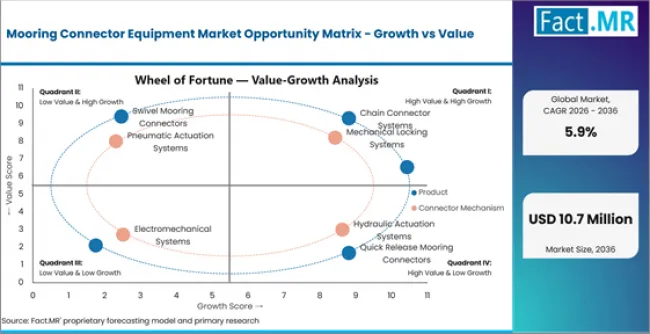
Mooring Connector Equipment Market Opportunity Matrix Growth Vs Value | Source: Fact.MR
Key Factors Driving Growth
- Deepwater oil and gas platform commissioning in West Africa, Brazil, and Gulf of Mexico is the primary installation demand driver for mooring connector systems.
- Floating offshore wind energy development is creating new mooring connector demand for turbine platform station-keeping systems designed for 25+ year service life.
- Aging FPSO mooring system inspection and replacement programs generate recurring connector procurement as installed platforms approach design fatigue life limits.
Key Market Constraints
- Offshore oil and gas capital expenditure cyclicality creates demand volatility that affects mooring equipment procurement timing and volume.
- Long lead times for connector manufacturing, material certification, and third-party testing create supply planning complexity for project-driven demand.
- Harsh subsea operating conditions including corrosion, marine growth, and fatigue loading create inspection and replacement obligations that add lifecycle cost.
Key Opportunity Areas
- Floating offshore wind energy mooring systems require connectors designed for permanent deployment without the disconnection and maintenance access common in oil and gas, creating new design specification requirements.
- Lightweight and rapid-deployment connectors for emergency disconnect applications on turret-moored FPSOs address growing safety requirements in cyclone and hurricane zones.
- Corrosion-resistant coating technologies and cathodic protection integration are extending connector service life, reducing replacement frequency and total lifecycle cost.
Segment-wise Analysis of the Mooring Connector Equipment Market
- Chain connector systems will account for 27.8% of products in 2026, owing to the dominant role of chain-based mooring for deepwater station-keeping.
- Offshore oil and gas is dominant application with 48.3% share led by FPSO, semi-submersible and TLP mooring system requirements
- In terms of water depth share, deepwater mooring systems have a share of 44.1%, which is indicative of the high concentration of floating platform installations in 400 to 1500 meter water depths.
Product, connector mechanism, application, water depth, material, and region are the segments of the market. The top technology by installation volume is chain connectors, while synthetic line connectors are growing in demand due to floating wind and lightweight mooring. Material share of steel mooring connectors is 53.7%.
Which Product Segment Dominates the Mooring Connector Equipment Market?
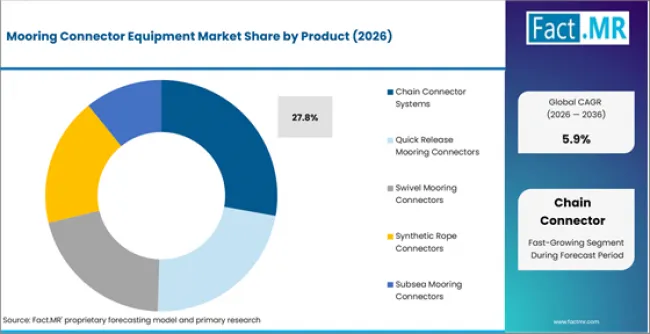
Mooring Connector Equipment Market Analysis By Product | Source: Fact.MR
Chain connector systems to constitute 27.8% of product segment value by 2026. Their leadership reflects the prevalence of studlink and studless chain in the construction of deepwater mooring legs where chain connectors provide the mechanical interface for joining mooring line segments, anchor connections and turret interfaces.
Applications combining chain with wire rope or synthetic fibre sections use wire rope connectors and hybrid mooring connectors. Synthetic line connectors are the fastest growing product category, driven by floating wind and light weight mooring applications where polyester and HMPE fiber ropes replace heavier chain and wire systems.
Which Application Segment Dominates the Mooring Connector Equipment Market?
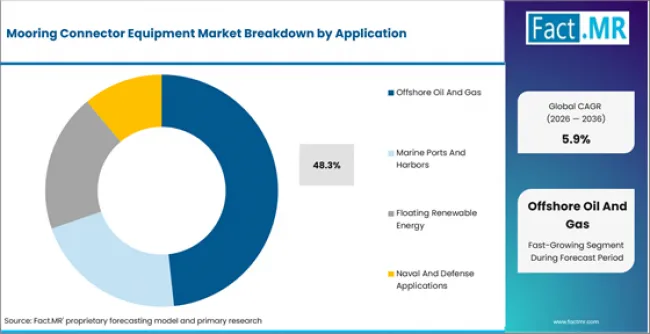
Mooring Connector Equipment Market Analysis By Application | Source: Fact.MR
The application segment for offshore oil and gas is projected to be valued at 48.3% in 2026. The highest demand for mooring connector installation and replacement in deepwater production basins around the globe is generated by FPSOs, semi-submersible production platforms, tension leg platforms and spar buoys.
Floating wind energy is the application segment with the highest growth rate and pilot and pre-commercial floating turbine projects in Europe, East Asia and the U.S. require mooring systems designed for permanent deployment in energetic ocean environments. Other demand channels include marine vessel mooring and offshore construction.
Which Product Trend is Shaping the Next Phase of Growth in the Mooring Connector Equipment Market?
The most significant product development trend influencing future growth will be mooring connectors specifically designed for the station-keeping of floating offshore wind energy. Oil and gas mooring systems are inspected periodically by ROV and diver access but floating wind turbine moorings need to operate reliably for 25+ years with minimal intervention, requiring enhanced fatigue resistance, corrosion protection and load monitoring capability.
The expanding pipeline of floating wind projects in Scotland, Norway, France, Japan, and the U.S. is further evidence of this trend. West Coast, where water depths do not allow fixed-bottom turbine foundations. Companies that develop mooring connector systems that have been validated for floating wind service conditions are well positioned to capitalize on a high-growth application segment.
Regional Outlook Across Key Markets
- China leads at 7.1%, driven by offshore oil and gas development, floating wind pilot projects, and domestic marine equipment manufacturing.
- India at 6.9% and Brazil at 6.8% reflect deepwater production expansion and FPSO fleet growth.
- Norway at 6.5% is supported by North Sea operations, floating wind development, and offshore engineering leadership.
.webp "Top Country Growth Comparison Mooring Connector Equipment Market Cagr (2026 2036)")
Top Country Growth Comparison Mooring Connector Equipment Market Cagr (2026 2036) | Source: Fact.MR
CAGR Table
| Country | CAGR (%) |
|---|---|
| China | 7.1% |
| India | 6.9% |
| Brazil | 6.8% |
| Norway | 6.5% |
| Saudi Arabia | 6.3% |
| USA | 5.7% |
Source: Fact.MR analysis. Updated Jun 17, 2026
Source: Fact.MR analysis, based on proprietary forecasting model and primary research.
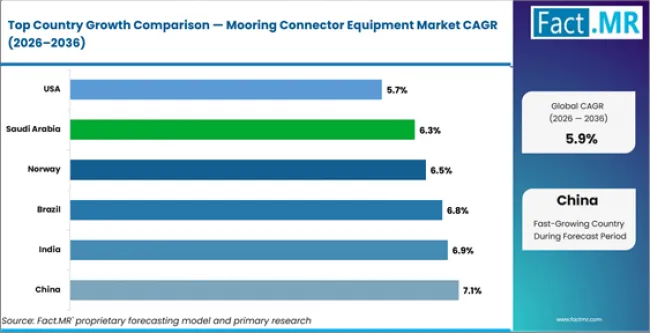
Mooring Connector Equipment Market Cagr Analysis By Country | Source: Fact.MR
Mooring Connector Equipment Demand Analysis in China
China Mooring Connector Equipment Market is expected to grow at a CAGR of 7.1% during the forecast period 2036. Domestic offshore oil and gas development and floating wind pilot projects are driving demand for mooring equipment. Domestic connector production is being developed with government support for self-sufficiency in manufacturing marine equipment.
- Offshore oil and gas platform installations in South China Sea create mooring connector procurement demand.
- Floating wind pilot projects are driving early demand for mooring systems in renewable energy applications.
- Domestic marine equipment manufacturers are working on developing mooring connector products to reduce import dependency.
India Mooring Connector Equipment Market Growth Outlook
India Mooring Connector Equipment Market is projected to grow at a CAGR of 6.9% by 2036. Investment in offshore energy and increasing deepwater exploration activity under the National Infrastructure Pipeline is creating demand for mooring equipment. Marine equipment production to scale domestic manufacturing aided by PLI incentives.
- Deepwater oil and gas exploration activities in Krishna-Godavari and Mumbai offshore basins are driving the mooring systems market growth.
- Incentives for manufacturing under PLI scheme will help develop domestic production of mooring connector and marine equipment.
- Offshore renewable energy targets such as floating wind generate future demand channels for specialist mooring systems.
Mooring Connector Equipment Demand Analysis in Brazil
The Brazil Mooring Connector Equipment Market is projected to grow at a CAGR of 6.8% during the forecast period. Rising pre-salt deepwater and ultra-deepwater oil production is driving the world’s largest FPSO fleet and consistent demand for mooring connectors for newbuild and replacement programs.
- Demand for mooring connector installation is backed by FPSO fleet growth from pre-salt production expansion.
- Replacement programs of FPSO mooring systems for aging platforms in the Santos and Campos basins create recurring procurement.
- Brazilian policies equivalent to IKTVA that encourage local content requirements for the domestic manufacture of mooring equipment.
Mooring Connector Equipment Growth Assessment in Norway
The Norway Mooring Connector Equipment Market is expected to grow at a CAGR of 6.5% during 2036. Norway is a leading demand and technology development center for mooring connector equipment, thanks to its development of floating wind energy, offshore engineering leadership and production maintenance in the North Sea.
- North Sea FPSO and semi-submersible mooring system maintenance will drive replacement connector demand.
- Floating offshore wind development including Hywind and other pilot projects creates new specification requirements for mooring connectors.
- Norway is home to offshore engineering companies offering mooring system design services that set connector specifications worldwide.
Market Outlook for Mooring Connector Equipment in South Korea
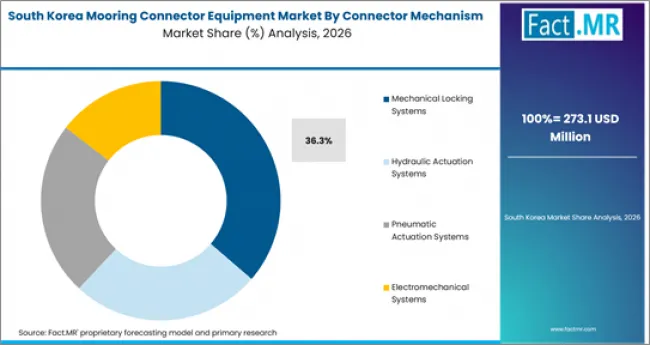
Mooring Connector Equipment Market South Korea Market Share Analysis By Connector Mechanism | Source: Fact.MR
The South Korea Mooring Connector Equipment Market is projected to expand at a CAGR of 5.5% during 2036. Expanding floating wind development, shipbuilding and offshore platform fabrication industry mean both manufacturing and domestic installation demand for mooring connector equipment. Procurement specifications are affected by quality standards.
- Shipbuilding and offshore fabrication yards incorporate mooring systems as part of the platform construction process, resulting in procurement demand during the build phase.
- Rising demand for mooring systems for East Asian ocean conditions due to floating wind development targets.
- The procurement specifications of the mooring connector are influenced by quality certification requirements and standards of marine classification societies.
Competitive Benchmarking and Company Positioning
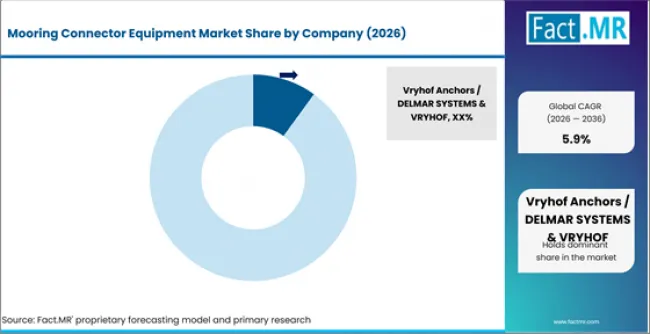
Mooring Connector Equipment Market Analysis By Company | Source: Fact.MR
Mooring Connector Equipment Market Analysis By Company
- Vryhof Anchors/DELMAR Systems leads with approximately 10.0% market share through its comprehensive mooring system portfolio including connectors, anchors, and mooring line products with global offshore installation service capability.
- SBM Offshore competes through its position as a leading FPSO leasing and operating company that specifies and procures mooring systems for its fleet, influencing connector selection through operator procurement decisions.
- First Subsea and Balltec serve specific connector technology niches through specialized mechanical and hydraulic connector designs for chain, wire, and synthetic mooring line applications.
The competitive landscape is fragmented, with no single company controlling more than 10% of the market. Vryhof/DELMAR leads through its integrated mooring system approach, while SBM Offshore influences connector selection through its position as the largest FPSO fleet operator.
First Subsea differentiates through its mechanical chain connector technology, while Balltec serves the rapid-deployment and emergency disconnect connector segment. Mampaey Offshore Industries and other regional specialists serve specific geographic markets and application niches.
Key Companies in the Mooring Connector Equipment Market
Vryhof Anchors / DELMAR SYSTEMS & VRYHOF, SBM Offshore, First Subsea Ltd., Balltec Ltd., Mampaey Offshore Industries, TechnipFMC, VICINAY MOORING CONNECTORS, Acteon Group Ltd., Offspring International Limited, Mooring Systems Inc. are the leading companies.
Recent Industry Developments
- Delmar Systems - Fairlead Locking Bolster Hook Introduction (June 2025)
- In June 2025, Delmar Systems introduced the Fairlead Locking Bolster Hook to improve RAR PLUS efficiency. The auto-engaging hook supports fairlead locking during transit without anchor handling vessel support.
- Delmar Systems - RAR PLUS Mooring Line Release Milestone (May 2025)
- In May 2025, Delmar Systems reported that RAR PLUS surpassed 1,000 successful mooring line releases. The milestone strengthened the system’s position in quick-release mooring operations for offshore rigs.
- SBM Offshore - FSO Trion Disconnectable Turret Mooring Fabrication (May 2025)
- In May 2025, SBM Offshore reported that fabrication had started for the Disconnectable Turret Mooring system on FSO Trion. The project supports demand for specialized mooring connectors and turret systems in offshore floating production.
- SBM Offshore - FSO Chalchi Disconnectable Turret Mooring Fabrication (November 2025)
- In November 2025, SBM Offshore reported that FSO Chalchi construction was progressing with fabrication of the disconnectable turret mooring system. The update confirms continuing project demand for turret mooring and connector equipment.
Key Companies in the Mooring Connector Equipment Market
- TechnipFMC
- SBM Offshore
- Acteon Group Ltd.
- Vicinay Mooring Connectors
- Mampaey Offshore Industries
- Vryhof / DELMAR Systems
Sources and Research References
- DNV. (2025, July 1). Now available: July 2025 edition of DNV class rules and documents for ship and offshore.
- DNV. (n.d.). Floating wind reliability: Planned extension to include tower and substructure.
- SBM Offshore. (n.d.). Floating production solutions & operations.
- SBM Offshore. (2026, February 25). Annual report 2025.
- Yildirim, B., Kamidelivand, M., Nasr, C., Persent, E., Slack, E., Schlanbusch, R., Jiang, Z., & Kolios, A. (2025, August). Failure risk evaluation of floating offshore wind turbines with farm-level implications. IEA Wind TCP Task 49.
This bibliography is provided for reader reference and is not exhaustive. The full report contains the complete reference list and detailed citations.
Key Questions This Report Addresses
- What is the estimated size of the global Mooring Connector Equipment Market in 2026, and how is it projected to grow through 2036?
- What incremental revenue opportunity is the market expected to create between 2026 and 2036?
- Which product segment holds the largest share in 2026, and what mooring system factors support chain connector leadership?
- How is the balance between oil and gas and floating wind applications expected to shift over the forecast period?
- Which water depth segment is projected to generate the most incremental revenue through 2036?
- Which countries are projected to register the highest CAGR, and what offshore energy factors accelerate growth?
- How do demand patterns in Brazil compare with Norway and China in terms of platform count and application mix?
- What capital expenditure cyclicality and lead time constraints could affect mooring connector procurement?
- Who are the leading companies, and how are they differentiating through connector technology, service capability, and application expertise?
- What recent technology and portfolio developments in 2025 are shaping competitive positioning?
- Which connector technology or application trend is driving the next phase of growth?
- How is floating offshore wind energy creating new mooring connector specification requirements?
- What role are fatigue-resistant alloys, corrosion protection, and load monitoring playing in reshaping connector design?
- What demand-side drivers sustain growth, and how do they vary between new installation and replacement procurement?
Mooring Connector Equipment Market Definition
The mooring connector equipment market covers mechanical and hydraulic connection devices used to join mooring lines, chains, and wire rope segments in offshore oil and gas production, floating wind energy, and marine vessel mooring systems across deepwater, ultra-deepwater, and shallow water installation environments.
Mooring Connector Equipment Market Inclusions
- Global and regional market size and forecasts for 2026 to 2036 across product, connector mechanism, application, water depth, material, and region.
- Demand analysis based on floating production platform count, offshore wind installation activity, mooring system replacement cycles, and deepwater development project pipelines.
- Competitive landscape including connector product portfolios, engineering capabilities, and offshore service network strategies of leading companies.
Mooring Connector Equipment Market Exclusions
- Anchoring systems, piles, and seabed foundations not classified as mooring line connectors.
- Mooring chain, wire rope, and synthetic line products sold separately from connector hardware.
- Vessel propulsion, dynamic positioning systems, and other station-keeping methods not reliant on mooring line connections.
Mooring Connector Equipment Market Research Methodology
- Methodology combines secondary research from offshore engineering publications, floating production databases, and oil and gas project tracking services with primary validation.
- Market sizing covers 30+ countries with inputs including floating platform count, deepwater development activity, offshore wind project pipelines, and mooring system replacement schedules.
- Primary validation includes 12+ interviews across mooring equipment manufacturers, offshore engineering firms, FPSO operators, and floating wind energy developers.
Segmentation
Scope of Analysis
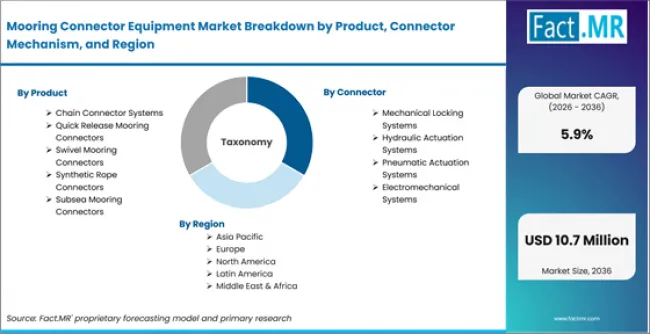
Mooring Connector Equipment Market Breakdown By Product, Connector Mechanism, And Region | Source: Fact.MR
| Parameter | Details |
|---|---|
| Quantitative Units | USD 6 million to USD 10.7 million, at a CAGR of 5.9% |
| Market Definition | The mooring connector equipment market covers mechanical and hydraulic connection devices used to join mooring lines, chains, and wire rope segments in offshore oil and gas production, floating wind energy, and marine vessel mooring systems across deepwater, ultra-deepwater, and shallow water installation environments. |
| Regions Covered | North America, Latin America, Europe, East Asia, South Asia and Pacific, Middle East and Africa |
| Countries Covered | China, India, Brazil, Norway, Saudi Arabia, USA, 30 plus countries |
| Key Companies | Vryhof Anchors / DELMAR SYSTEMS & VRYHOF, SBM Offshore, First Subsea Ltd., Balltec Ltd., Mampaey Offshore Industries, TechnipFMC, VICINAY MOORING CONNECTORS, Acteon Group Ltd. |
| Forecast Period | 2026 to 2036 |
| Approach | Hybrid demand-side and top-down methodology built on floating platform count, deepwater development activity, offshore wind pipelines, and primary interviews |
Source: Fact.MR analysis. Updated Jun 17, 2026
Mooring Connector Equipment Market Segmentation
-
Mooring Connector Equipment Market Segmented by Product:
- Chain Connector Systems
- Kenter Chain Connectors
- Heavy Duty Mooring Applications
- Marine Anchoring Products
- Shackle Based Connector Systems
- Ship Berthing Applications
- Offshore Connection Systems
- Kenter Chain Connectors
- Quick Release Mooring Connectors
- Hydraulic Quick Release Hooks
- Offshore Terminal Applications
- Marine Safety Products
- Pneumatic Release Connector Systems
- Emergency Disconnect Applications
- Port Mooring Systems
- Hydraulic Quick Release Hooks
- Swivel Mooring Connectors
- Single Point Mooring Swivels
- Floating Production Applications
- Offshore Transfer Systems
- Multi Path Fluid Swivel Systems
- Oil And Gas Applications
- Marine Fluid Handling Products
- Single Point Mooring Swivels
- Synthetic Rope Connectors
- Fiber Rope Connector Systems
- Deepwater Applications
- Lightweight Mooring Products
- Hybrid Rope Connector Systems
- Floating Wind Applications
- Marine Tension Systems
- Fiber Rope Connector Systems
- Subsea Mooring Connectors
- Remotely Operated Connectors
- Deepwater Offshore Applications
- Subsea Installation Products
- Automated Locking Connector Systems
- Harsh Environment Applications
- Advanced Marine Systems
- Remotely Operated Connectors
- Chain Connector Systems
-
Mooring Connector Equipment Market Segmented by Connector Mechanism:
- Mechanical Locking Systems
- Pin And Latch Connectors
- Ship Mooring Applications
- Marine Connection Products
- Bolt Secured Connector Systems
- Heavy Load Applications
- Offshore Anchoring Systems
- Pin And Latch Connectors
- Hydraulic Actuation Systems
- Remote Hydraulic Connectors
- Floating Platform Applications
- Offshore Safety Products
- High Pressure Release Systems
- Emergency Disconnection Applications
- Marine Control Systems
- Remote Hydraulic Connectors
- Pneumatic Actuation Systems
- Compressed Air Connector Systems
- Rapid Release Applications
- Port Handling Products
- Automated Pneumatic Connectors
- Marine Berthing Applications
- Docking Safety Systems
- Compressed Air Connector Systems
- Electromechanical Systems
- Sensor Integrated Connectors
- Smart Mooring Applications
- Digital Marine Products
- Remote Monitoring Connector Systems
- Predictive Maintenance Applications
- Advanced Offshore Systems
- Sensor Integrated Connectors
- Mechanical Locking Systems
-
Mooring Connector Equipment Market Segmented by Application:
- Offshore Oil And Gas
- Floating Production Mooring
- FPSO Applications
- Offshore Energy Products
- Tanker Loading Mooring Systems
- Crude Transfer Applications
- Marine Terminal Systems
- Floating Production Mooring
- Marine Ports And Harbors
- Commercial Vessel Mooring
- Port Operations Applications
- Docking Equipment Products
- Container Terminal Mooring
- Cargo Handling Applications
- Marine Infrastructure Systems
- Commercial Vessel Mooring
- Floating Renewable Energy
- Floating Wind Turbine Mooring
- Offshore Renewable Applications
- Marine Energy Products
- Wave Energy Mooring Systems
- Ocean Energy Applications
- Dynamic Connection Systems
- Floating Wind Turbine Mooring
- Naval And Defense Applications
- Naval Vessel Mooring
- Military Port Applications
- Defense Marine Products
- Submarine Mooring Systems
- Secure Docking Applications
- Strategic Marine Systems
- Naval Vessel Mooring
- Offshore Oil And Gas
-
Mooring Connector Equipment Market Segmented by Water Depth:
- Deepwater Mooring Systems
- Dynamic Positioning Connectors
- Offshore Drilling Applications
- Marine Energy Products
- Tension Leg Platform Connectors
- Floating Platform Applications
- Advanced Offshore Systems
- Dynamic Positioning Connectors
- Shallow Water Mooring Systems
- Coastal Connector Systems
- Nearshore Applications
- Marine Infrastructure Products
- Harbor Mooring Connectors
- Port Applications
- Docking Equipment Systems
- Coastal Connector Systems
- Ultra Deepwater Mooring Systems
- High Load Connector Systems
- Extreme Depth Applications
- Subsea Mooring Products
- Remotely Operated Mooring Connectors
- Harsh Environment Applications
- Deepwater Installation Systems
- High Load Connector Systems
- Deepwater Mooring Systems
-
Mooring Connector Equipment Market Segmented by Material:
- Steel Mooring Connectors
- Carbon Steel Connector Systems
- Heavy Duty Applications
- Marine Structural Products
- Stainless Steel Connectors
- Corrosion Resistant Applications
- Offshore Mooring Systems
- Carbon Steel Connector Systems
- Composite Mooring Connectors
- Fiber Reinforced Connector Systems
- Lightweight Applications
- Advanced Marine Products
- Hybrid Composite Connectors
- Floating Renewable Applications
- Marine Durability Systems
- Fiber Reinforced Connector Systems
- Alloy Based Mooring Connectors
- High Strength Alloy Connectors
- Deepwater Applications
- Offshore Load Products
- Corrosion Resistant Alloy Systems
- Saltwater Applications
- Marine Protection Systems
- High Strength Alloy Connectors
- Steel Mooring Connectors
-
Mooring Connector Equipment Market by Region:
- North America
- USA
- Canada
- Mexico
- Latin America
- Brazil
- Chile
- Rest of Latin America
- Western Europe
- Germany
- UK
- Italy
- Spain
- France
- Nordic
- BENELUX
- Rest of Western Europe
- Eastern Europe
- Russia
- Poland
- Hungary
- Balkan & Baltic
- Rest of Eastern Europe
- East Asia
- China
- Japan
- South Korea
- South Asia and Pacific
- India
- ASEAN
- Australia & New Zealand
- Rest of South Asia and Pacific
- Middle East & Africa
- Kingdom of Saudi Arabia
- Other GCC Countries
- Turkiye
- South Africa
- Other African Union
- Rest of Middle East & Africa
- North America
Frequently Asked Questions
How big is the mooring connector equipment market in 2026?
What will be the size of the mooring connector equipment market in 2036?
How much will the mooring connector equipment market grow between 2026 and 2036?
What are the key products in the mooring connector equipment market?
Which connector mechanism segment is expected to contribute a significant share in the mooring connector equipment market in 2026?
Who worked on this report


Preview the report firsthand - request a free sample
Free SampleGet the brochure for pricing and purchase details
Download PDF