- Market Value (2025): USD 1.39 Bn
- Estimated Value (2026): USD 1.47 Bn
- Forecast Value (2036): USD 2.59 Bn
- CAGR (2026-2036): 5.8%
What is the 4K Cinema Projectors Market forecast to be worth by 2036?
USD 1.5 billion in 2026 to USD 2.6 billion by 2036, at a 5.8% CAGR.
- As per Fact.MR analysis, the 4K cinema projectors market reached USD 1.39 billion in 2025.
- Global sales are projected to reach USD 1.47 billion in 2026 to USD 2.59 billion by 2036 as cinema operators replace projectors and home theater buyers choose higher-resolution equipment.
- The market is forecast to record a 5.8% CAGR during 2026 to 2036, reflecting investment in commercial screening rooms and premium viewing spaces.
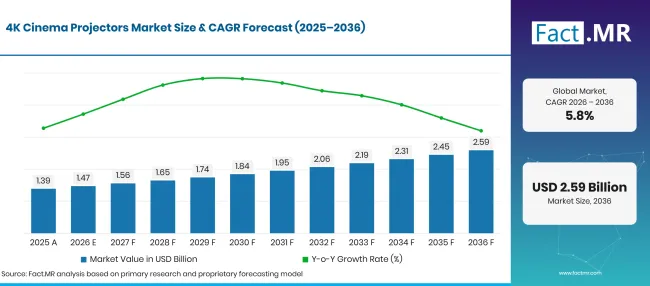
4K Cinema Projectors Market Forecast Global | Source: Fact.MR
| Year | Basis | Market Value (USD billion) |
|---|---|---|
| 2025 | Actual | 1.39 |
| 2026 | Estimate | 147 |
| 2036 | Forecast | 259 |
| CAGR 2026 to 2036 | Forecast period | 5.8% |
Source: Fact.MR analysis. Updated Oct 22, 2026
What are the defining numbers behind 4K Cinema Projectors Market growth?
USD 1.1 billion absolute opportunity between 2026 and 2036, with DLP and commercial installations forming major purchasing groups.
- Demand Drivers in the Market
- Cinema operators replacing older projection systems examine brightness consistency and maintenance needs before approving capital spending.
- Multiplex chains require predictable projector operation during long screening schedules.
- Home theater installers compare screen size and installation distance when choosing a 4K unit. Epson introduced its Pro Cinema LS9000 4K HDR 3LCD laser model in July 2025 [4].
- Independent cinemas weigh the cost of projection upgrades against audience traffic and ticket revenue. The European Audiovisual Observatory reported 796 million cinema admissions across Europe in 2025 [1].
- Key Segments Analyzed
- By Product Type: DLP accounts for 44.2% share in 2026 as its mirror-based projection design suits bright screening environments.
- By Application: Commercial holds 42.5% share in 2026 since cinema operators manage dedicated projection budgets.
- By Resolution: 4K UHD leads with 58.3% share in 2026 as buyers compare detailed images across large screens.
- By Distribution Channel: Offline captures 71.4% share in 2026 because complex installations benefit from specialist demonstration and setup.
- By End-User: Cinemas represent 38.7% share in 2026 due to theatrical operators replace equipment across scheduled screening rooms.
- Analyst Opinion at Fact.MR
- Shambhu Nath Jha, Principal Consultant at Fact.MR, states, “Cinema chains need projectors that maintain picture quality through years of scheduled screenings. Using the same model across several locations can make repairs and staff training easier. Buyers therefore assess brightness, screen coverage, and service support alongside the advertised resolution.”
- Strategic Implications
- Cinema chains should match projector brightness to individual screen sizes before scheduling replacements, so equipment specifications fit actual auditorium conditions.
- Projector manufacturers should maintain clear information about light-source life and service parts because operators need predictable long-term operating budgets.
- Specialist dealers should assess throw distance and room layout before recommending home theater units, reducing installation changes after purchase.
- Content venues should review playback compatibility and support arrangements alongside the projector price when planning a multi-room upgrade.
The United Kingdom is forecast to record a 6.9% CAGR as major cinema operators modernize projection fleets. Japan follows at 6.2% amid active domestic theatrical exhibition. Germany carries a 5.8% outlook, while the United States is projected at 4.5% and Brazil at 4.1%. Each country combines cinema investment with a different pattern of home projection sales.
How does the 4K Cinema Projectors Market break down by segment?
DLP holds 44.2%; Commercial account for 42.5%; 4K UHD leads with 58.3%; Offline represents 71.4%; Cinemas capture 38.7% in 2026.
Which Product Type dominates?
DLP accounts for 44.2% share in 2026.
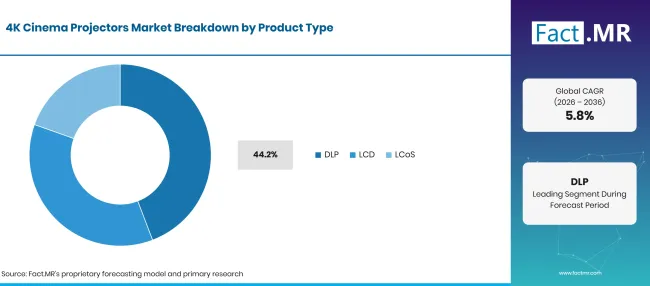
4K Cinema Projectors Market Breakdown Product Type | Source: Fact.MR
| Product Type | Share (2026) |
|---|---|
| DLP (Leading segment) | 44.2% |
| Other segments combined | 55.8% |
| Total | 100.0% |
Source: Fact.MR analysis. Updated Oct 22, 2026
DLP projectors use a micro-mirror system to create detailed images while accommodating high-brightness applications. Cinema operators look closely at brightness across the full screen and stable projection during long show schedules. LCD alternatives appeal to venues that evaluate color output and purchase costs through a different equipment design. LCoS models serve buyers interested in fine image detail and contrast, particularly in specialist theater installations.
What leads the Application segment?
Commercial holds 42.5% share in 2026.
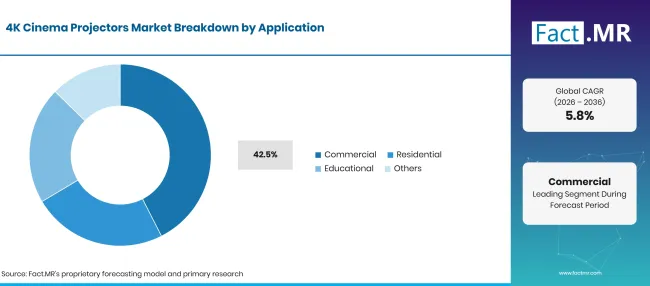
4K Cinema Projectors Market Breakdown Application | Source: Fact.MR
| Application | Share (2026) |
|---|---|
| Commercial (Leading segment) | 42.5% |
| Other segments combined | 57.5% |
| Total | 100.0% |
Source: Fact.MR analysis. Updated Oct 22, 2026
Commercial use covers auditorium installations and other managed viewing facilities where projectors serve paying audiences or scheduled events. Film exhibitors usually plan replacement budgets around screen size and the remaining life of existing systems. Residential demand relates to home cinema rooms and media spaces, where installation distance and noise influence purchasing decisions. Educational applications serve large teaching rooms when high-resolution projection is part of the approved equipment plan.
How does Resolution shape purchases?
4K UHD captures 58.3% share in 2026.
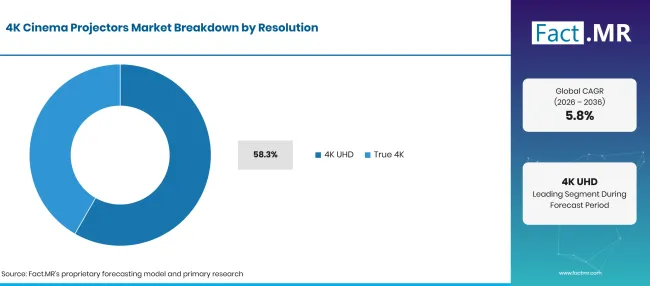
4K Cinema Projectors Market Breakdown Resolution | Source: Fact.MR
| Resolution | Share (2026) |
|---|---|
| 4K UHD (Leading segment) | 58.3% |
| Other segments combined | 41.7% |
| Total | 100.0% |
Source: Fact.MR analysis. Updated Oct 22, 2026
4K UHD equipment offers a common route to detailed large-screen viewing in the broader projector category. Buyers compare resolution labels with the actual imaging method because pixel-shifting designs and native-resolution systems work differently. True 4K units appeal to customers who place weight on native pixel structure and detailed image reproduction.
Which Distribution Channel serves the larger share?
Offline represents 71.4% share in 2026.
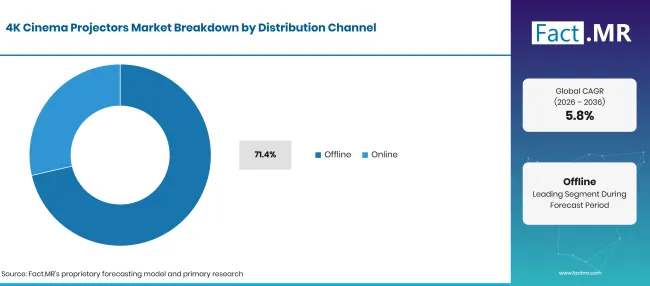
4K Cinema Projectors Market Breakdown Distribution Channel | Source: Fact.MR
| Distribution Channel | Share (2026) |
|---|---|
| Offline (Leading segment) | 71.4% |
| Other segments combined | 28.6% |
| Total | 100.0% |
Source: Fact.MR analysis. Updated Oct 22, 2026
Offline purchases remain practical for commercial projector projects because dealers can examine room requirements before specifying the equipment. Online channels suit more standardized residential projector purchases, particularly when shoppers already understand lens position and connection requirements. Installer-led sales are especially useful where projector placement has to match an existing ceiling mount.
Which End-User group accounts for the largest share?
Cinemas lead with 38.7% share in 2026.
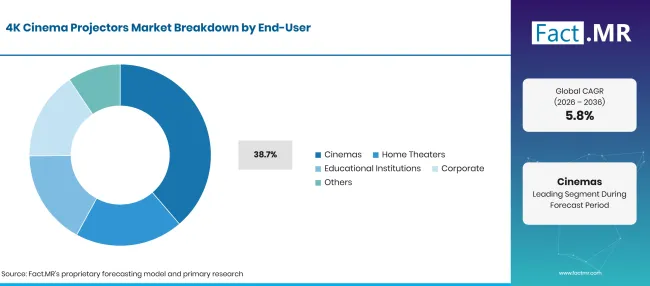
4K Cinema Projectors Market Breakdown End User | Source: Fact.MR
| End-User | Share (2026) |
|---|---|
| Cinemas (Leading segment) | 38.7% |
| Other segments combined | 61.3% |
| Total | 100.0% |
Source: Fact.MR analysis. Updated Oct 22, 2026
Cinema operators operate projection equipment repeatedly throughout the week and typically assess service access before investing in a new model. Home theater users make a different calculation involving room brightness and screen size. Educational institutions often prioritize straightforward operation for teaching spaces, while corporate sites assess meeting-room compatibility.
What is accelerating 4K Cinema Projectors Market adoption, and what is holding it back?
Multi-screen upgrades and clearer images support purchases, while initial equipment cost and auditorium downtime influence investment decisions.
Drivers Impact Analysis
| DRIVER | (~) % IMPACT ON CAGR | GEOGRAPHIC RELEVANCE | IMPACT TIMELINE |
|---|---|---|---|
| Cinema modernization | +1.0% | United States, Europe | Medium term (2–4 years) |
| Laser projector replacement | +0.8% | Global | Medium term (2–4 years) |
| Higher-resolution programming | +0.7% | Global | Long term (>= 4 years) |
| Home theater installations | +0.5% | Japan, United States | Medium term (2–4 years) |
| Equipment standardization | +0.4% | Multiplex markets | Long term (>= 4 years) |
Source: Fact.MR analysis. Updated Oct 22, 2026
Opportunity Impact Analysis
| OPPORTUNITY | (~) % IMPACT ON CAGR | GEOGRAPHIC RELEVANCE | IMPACT TIMELINE |
|---|---|---|---|
| Multi-site projector programs | +0.8% | United Kingdom, Germany | Medium term (2–4 years) |
| Home cinema upgrades | +0.6% | Global | Medium term (2–4 years) |
| Technical support packages | +0.5% | Global | Short term (<= 2 years) |
| Auditorium refurbishment | +0.4% | Major cinema markets | Long term (>= 4 years) |
Source: Fact.MR analysis. Updated Oct 22, 2026
Restraints Impact Analysis
| RESTRAINT | (~) % IMPACT ON CAGR | GEOGRAPHIC RELEVANCE | IMPACT TIMELINE |
|---|---|---|---|
| High initial equipment expense | -0.8% | Global | Short term (<= 2 years) |
| Installation downtime | -0.6% | Multi-screen cinemas | Short term (<= 2 years) |
| Uneven audience recovery | -0.5% | Europe, Brazil | Medium term (2–4 years) |
| Model compatibility checks | -0.4% | Global | Medium term (2–4 years) |
Source: Fact.MR analysis. Updated Oct 22, 2026
Which countries are scaling the 4K Cinema Projectors Market through 2036?
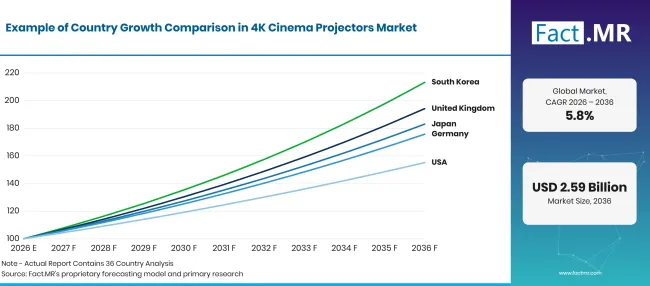
4K Cinema Projectors Market Growth Index | Source: Fact.MR
| Country | CAGR (2026–2036) |
|---|---|
| United Kingdom | 6.9% |
| Japan | 6.2% |
| Germany | 5.8% |
| United States | 4.5% |
| Brazil | 4.1% |
Source: Fact.MR analysis. Updated Oct 22, 2026
How is the United Kingdom upgrading cinema projection?
6.9% CAGR, linked to major-chain equipment replacement.
British Film Institute figures published in February 2026 recorded 123.5 million UK cinema admissions during 2025 [8]. Cinemas therefore have a substantial installed viewing base where routine maintenance and scheduled projector replacement remain relevant. Barco announced its Vue cinema equipment agreement in March 2025 [3]. Operators are expected to weigh image quality against installation schedules and the support available across several sites.
Why is Japan an active 4K projection market?
6.2% CAGR, shaped by cinema footfall and screen upgrades.
Japanese exhibitors operate a wide network of cinemas where screen quality and reliable equipment influence replacement decisions. In January 2026, the Motion Picture Producers Association of Japan published national cinema statistics for 2025, including data on operating cinema screens [7]. For commercial operators, a projector change involves testing the image on the actual screen and allowing technicians time to complete the installation.
What is supporting Germany’s projector purchases?
5.8% CAGR, associated with cinema renovation decisions.
Germany’s established cinema network gives projection specialists a continuing base of equipment to service and replace. The Filmförderungsanstalt reported in May 2026 that 23.4 million people visited a German cinema at least once during 2025 [5]. Cinemas considering refurbishment are expected to match projector brightness to screen size and compare service options before purchasing.
How do U.S. customers evaluate 4K projection?
4.5% CAGR, influenced by theater chains and home cinema buying.
U.S. theater chains are expected to assess cinema projector upgrades across several screens instead of treating each purchase as a separate project. Barco announced in January 2025 that its Regal Cineworld agreement covered a planned international rollout to 4,000 screens by 2030 [2]. Operators can gain practical advantages from consistent models and service routines across locations.
Why is Brazil’s projection market developing steadily?
4.1% CAGR, linked to cinema-screen activity.
Brazil has a broad commercial exhibition base where operators must plan upgrades around cinema attendance and available investment funds. Agência Nacional do Cinema reported in August 2026 that Brazil ended 2025 with 3,544 operating cinema screens [6]. That network gives specialist installers a clear base for projector servicing and selective replacement.
Who leads the 4K Cinema Projectors Market?
Barco NV and Christie Digital Systems USA Inc. supply digital cinema projection equipment aimed at commercial screens. Their relevance rests on cinema-specific projection systems and service arrangements for exhibitors.
Product comparisons should distinguish commercial DCI cinema systems from residential models that use 4K UHD imaging. None of these differences implies a single company-wide market share.
Which companies are the key providers?
Companies assessed in the 4K projector market include Appotronics Corporation Limited; Barco NV; Christie Digital Systems USA Inc.; Digital Projection International; Cinemeccanica S.p.A.
- Appotronics Corporation Limited
- Barco NV
- Christie Digital Systems USA Inc.
- Digital Projection International
- Cinemeccanica S.p.A.
Bibliography
- [1] European Audiovisual Observatory. (2026, February 13). European cinema attendance dropped by 5.5% in 2025, with stable box-office figures.
- [2] Barco. (2025, January 16). Regal Cineworld inks global deal with cinema technology leader Barco to bring Laser by Barco to 4,000 screens by 2030.
- [3] Barco. (2025, March 27). Vue signs major deal with leading cinema technology provider Barco.
- [4] Epson America. (2025, July 31). Epson expands Pro Cinema lineup with new 4K HDR laser projector under $4,000.
- [5] Filmförderungsanstalt. (2026, May 28). FFA-Studie „Kinobesucherinnen 2025“: Mehr Publikum – Wachstum vor allem bei Älteren.*
- [6] Agência Nacional do Cinema. (2026, August 31). Anuário Estatístico do Audiovisual Brasileiro 2025.
- [7] Motion Picture Producers Association of Japan. (2026, January). 2025[2025 national film industry statistics].
- [8] British Film Institute. (2026, February 5). Official BFI statistics reveal £6.8 billion film and high-end TV production spend in the UK.
- [9] Barco. (2026). Barco Series 4. Barco.
- [10] Christie Digital Systems. (2025, January 17). Xenon lamp illumination: Where tradition meets innovation. Christie.
This Report Answers
- The report compares product selection across DLP, LCD and LCoS projection systems.
- Commercial and residential applications are assessed against their different installation and service needs.
- Country analysis considers cinema attendance and the schedule of projector replacement investments.
- The competitive review distinguishes cinema-specific projector suppliers from home theater brands.
- Distribution analysis discusses the role of specialist dealers and installer-led purchasing.
What does the 4K Cinema Projectors Market cover?
The market covers projectors capable of displaying 4K images for commercial film exhibition and selected large-screen uses. It distinguishes DLP, LCD and LCoS products while accounting for differences between native 4K imaging and 4K UHD projection approaches. Cinema operators evaluate the complete viewing result, including light output and compatibility with their existing equipment. Related viewing systems include 3D projector systems and home theater equipment.
What is included in the scope?
The scope includes 4K projectors sold for commercial cinemas, specialist residential theater rooms and relevant institutional installations.
Projector product sales are compared by product type and end user. Dedicated cinemas form a distinct customer group because they require equipment that operates reliably during scheduled film screenings. Home theater products remain within the broader scope when the 4K image specification matches the stated resolution categories. Product comparisons may also reference interactive projection technology and portable mini projectors.
What is excluded from the scope?
The report excludes televisions and LED cinema walls because they are direct-view displays rather than projectors.
Standalone cinema ticket revenue and unrelated audio equipment are outside projector sales. Standard-resolution devices fall outside the 4K scope even when marketed for entertainment use. Cinema construction expenses are not counted as projector revenue. Replacement parts such as projector lamp replacement remain outside finished 4K projector sales.
How Was the Analysis Built?
The analysis draws on 120+ sources, 35+ company portfolios, 25+ countries, and more than 20 industry interviews.
- Primary Research: Primary research includes discussions with manufacturers, service providers, technology developers, distributors, end users, and subject-matter experts. These conversations examine purchasing priorities, product adoption, operational challenges, approval requirements, competitive positioning, and the factors that influence wider market acceptance.
- Desk Research: Desk research covers government statistics, regulatory publications, company filings, trade data, technical studies, industry associations, standards, public policy, and other authoritative sources. Every source used in the analysis is documented in the bibliography.
- Market Sizing and Forecasting: Market estimates combine historical performance, demand indicators, pricing and volume trends, segment shares, company participation, country-level growth, adoption patterns, investment activity, and barriers to market expansion.
- Data Validation and Update Cycle: Findings are validated by comparing primary interviews with public data, company activity, regulatory changes, trade patterns, and industry developments. Regular updates review new product launches, capacity changes, partnerships, approvals, and shifts in commercial adoption.
Segmentation
What is the report’s scope and coverage?
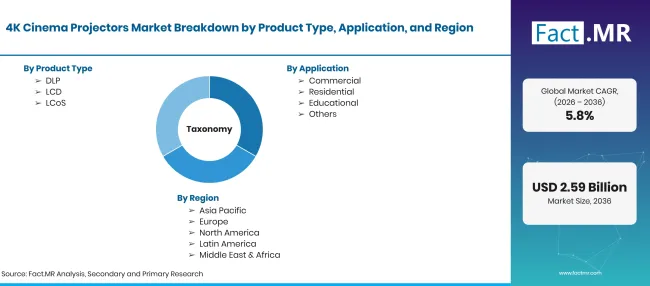
4K Cinema Projectors Market Taxonomy | Source: Fact.MR
| Attribute | Details |
|---|---|
| Quantitative Units | USD billion in 2026 to USD billion in 2036, at CAGR |
| Market Definition | 4K image projection equipment sold for cinemas and related large-screen viewing applications. |
| Product Type | DLP; LCD; LCoS |
| Application | Commercial; Residential; Educational; Others |
| Resolution | 4K UHD; True 4K |
| Distribution Channel | Offline; Online |
| End-User | Cinemas; Home Theaters; Educational Institutions; Corporate; Others |
| Regions Covered | North America; Latin America; Western Europe; Eastern Europe; East Asia; South Asia & Pacific; Middle East & Africa |
| Countries Covered | Germany; Brazil; United States; United Kingdom; Japan |
| Companies Profiled | Appotronics Corporation Limited; Barco NV; Christie Digital Systems USA Inc.; Digital Projection International; Cinemeccanica S.p.A. |
| Forecast Period | 2026 to 2036 |
| Approach | Cinema-sector indicators; supplier product checks; segmentation and country comparison |
Source: Fact.MR analysis. Updated Oct 22, 2026
How is the market segmented?
-
By Product Type
- DLP
- LCD
- LCoS
-
By Application
- Commercial
- Residential
- Educational
- Others
-
By Resolution
- 4K UHD
- True 4K
-
By Distribution Channel
- Offline
- Online
-
By End-User
- Cinemas
- Home Theaters
- Educational Institutions
- Corporate
- Others
-
By Region
- North America
- Latin America
- Western Europe
- Eastern Europe
- East Asia
- South Asia & Pacific
- Middle East & Africa
Frequently Asked Questions
How big is the 4K cinema projectors market in 2026?
What is the CAGR from 2026 to 2036?
Which projector product type leads?
Which application has the main share?
Who are the companies in the 4K cinema projectors market?
Who worked on this report


Preview the report firsthand - request a free sample
Free SampleGet the brochure for pricing and purchase details
Download PDF