- Market Value (2025): USD 5.8 Bn
- Estimated Value (2026): USD 6.2 Bn
- Forecast Value (2036): USD 11.7 Bn
- CAGR (2026-2036): 6.6%
What is the Hatchery Product Market forecast to be worth by 2036?
USD 6.2 billion in 2026 to USD 11.7 billion by 2036, at 6.6% CAGR.
- The hatchery product market reached USD 5.8 billion in 2025 as poultry producers upgraded incubation, chick handling and monitoring systems.
- Demand is projected to increase from USD 6.2 billion in 2026 to USD 11.7 billion by 2036.
- The market is forecast to record a 6.6% CAGR from 2026 to 2036 as commercial hatcheries, broiler operations and breeder programs tighten hatchability control.
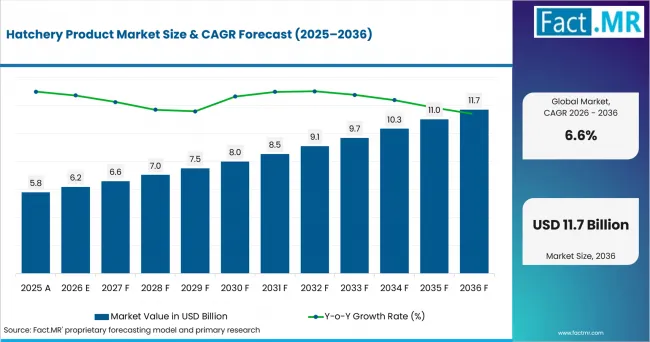
Hatchery Product Market Value Analysis | Source: Fact.MR
What are the defining numbers behind Hatchery Product Market growth?
USD 5.5 billion absolute opportunity by 2036, led by Hatchery Equipment Systems, Automated Incubation Technology and Commercial Hatcheries.
- Demand Drivers in the Market
- Commercial hatcheries need larger setter and hatcher capacity because flock placement schedules leave little room for late chick supply.
- Poultry farming companies need monitoring and control systems to keep temperature, humidity and turning cycles within planned ranges.
- Breeding companies need clean hatchery workflows so parent stock, broiler chicks and specialty birds move through controlled programs.
- Equipment dealers need direct service access as integrated projects rely on installation support, spares and operator training.
- Key Segments Analyzed
- By Product: Hatchery Equipment Systems are expected to hold 62.80% share in 2026 due to their central role in incubation, egg turning and chick transfer.
- By Application: Poultry Production Hatcheries are projected to account for 48.50% share in 2026 as broiler and layer output requires scheduled hatching.
- By End Use: Commercial Hatcheries are anticipated to capture 69.30% share in 2026 owing to their high egg volumes and repeat replacement needs.
- By Technology: Automated Incubation Technology is estimated to represent 57.60% share in 2026 as operators move away from manual environmental checks.
- By Formulation: Integrated Hatchery System Packages are forecast to hold 41.90% share in 2026 since projects often bundle setters, hatchers and support modules.
- By Distribution Channel: Direct Sales are expected to account for 53.40% share in 2026 because large hatcheries prefer manufacturer-led design and aftersales contact.
- Analyst Opinion at Fact.MR
- Shambhu Nath Jha,Principal Consultant at Fact.MR, states, "Hatchery products draw attention when flock planners need predictable chick supply from a fixed breeder base. Tool selection is expected to depend on stable hatch windows and clean transfer steps. Suppliers should combine incubation reliability with local service and simple operator training."
- Strategic Implications
- Hatchery managers should map setter use, transfer timing and hatch pull schedules before selecting system packages.
- Equipment providers should support installation with calibration records, sanitation guidance and spare-part availability.
- Breeding companies should connect hatchery monitoring data with fertility, hatchability and chick-quality checks.
- Dealers should build service coverage near poultry clusters where downtime affects weekly chick placement.
Germany is forecast to post 7.6% CAGR through 2036. Brazil follows at 6.9%, ahead of the USA at 6.3%. The UK records 5.6%, while Japan reaches 5.0% as poultry clusters invest carefully around disease risk.
How does the Hatchery Product Market break down by segment?
Hatchery Equipment Systems lead at 62.80%; Automated Incubation Technology leads at 57.60%.
Which product dominates?
Hatchery Equipment Systems hold 62.8% share in 2026.
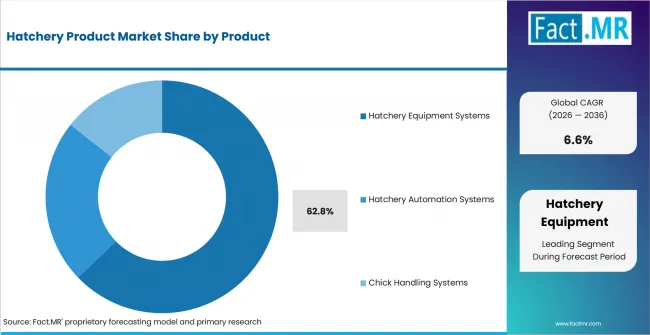
Hatchery Product Market Analysis By Product | Source: Fact.MR
Hatchery Equipment Systems are expected to lead Product in 2026 due to their role in every hatch cycle. Egg incubation systems, egg turning systems and climate controls keep fertilized eggs inside safe operating windows. USDA NASS reported in April 2026 that U.S. chicken hatchery capacity reached 1.00 billion eggs on January 1, 2026.
What leads the Application segment?
Poultry Production Hatcheries account for 48.5% share in 2026.
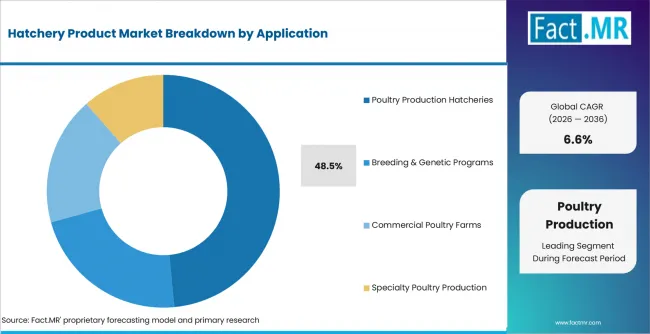
Hatchery Product Market Analysis By Application | Source: Fact.MR
Poultry Production Hatcheries are projected to lead Application in 2026 as broiler and layer systems rely on routine chick placement. Broiler hatcheries require weekly output planning, while layer hatcheries need stable pullet schedules. USDA NASS reported in April 2026 that U.S. broiler-type chicks hatched totaled 10.3 billion during 2025, up 1% from 2024.
How does End Use shape demand?
Commercial Hatcheries capture 69.3% share in 2026.
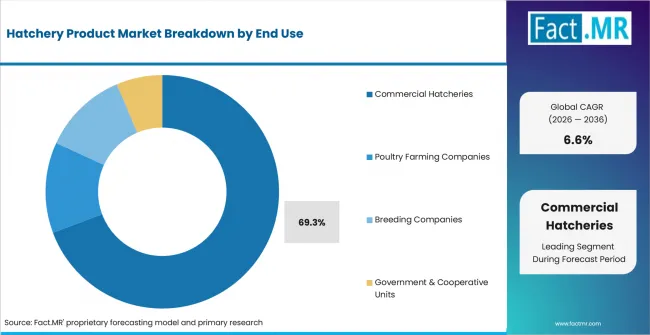
Hatchery Product Market Analysis By End Use | Source: Fact.MR
Commercial Hatcheries are anticipated to lead End Use in 2026 because they buy systems against measured uptime and hatchability. Industrial operators and contract services often require supplier-led layouts. Cobb Europe achieved Great Britain compartment status across production farms and hatchery in October 2025. The status confirms that Cobb’s covered production farms and hatchery met Great Britain compartment biosecurity and disease-monitoring requirements.
What supports Technology adoption?
Automated Incubation Technology represents 57.6% share in 2026.
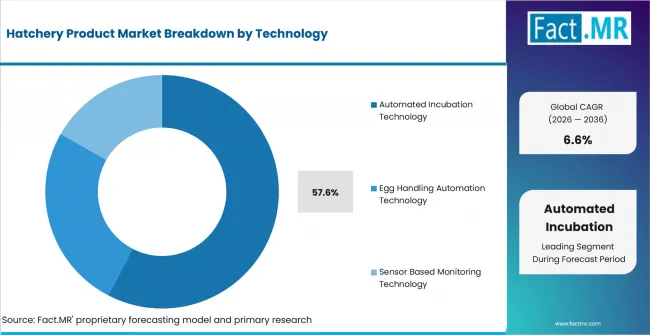
Hatchery Product Market Analysis By Technology | Source: Fact.MR
Automated Incubation Technology is estimated to lead Technology in 2026 as operators seek tighter control of temperature and humidity. Digital controls reduce manual checks, while egg handling automation lowers transfer damage. GOV.UK reported in July 2026 that UK broiler chick placings reached 97.1 million in June 2026, up 1.7% from June 2025.
Which Formulation type is preferred?
Integrated Hatchery System Packages hold 41.9% share in 2026.
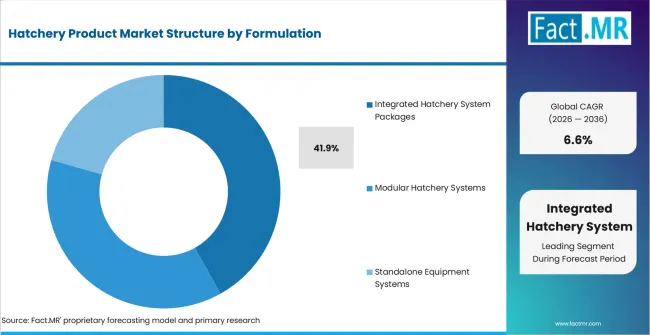
Hatchery Product Market Analysis By Formulation | Source: Fact.MR
Hatchery Equipment Systems link closely with Integrated Hatchery System Packages, which are forecast to lead Formulation in 2026. Operators often want one supplier accountable for room layout and commissioning. Fully automated and semi-automated packages suit larger projects. Modular hatchery systems support phased capacity expansion.
How do sales channels shape purchasing?
Direct Sales account for 53.4% share in 2026.
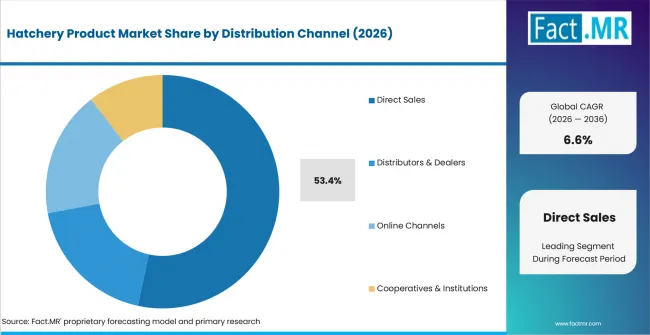
Hatchery Product Market Analysis By Distribution Channel | Source: Fact.MR
Direct Sales are expected to lead Distribution Channel in 2026 because large hatcheries need manufacturer contact during design, installation and troubleshooting. Adjacent poultry processing equipment and animal feed mixer purchases often follow similar project-based contact patterns.
What is accelerating Hatchery Product Market adoption, and what is holding it back?
Automation, biosecurity and capacity planning drive adoption; disease disruption and ownership cost restrain it.
Drivers Impact Analysis
| Driver | (~) % Impact on CAGR | Geographic Relevance | Impact Timeline |
|---|---|---|---|
| Automated incubation control | +1.7% | USA, Germany, UK | Short term (<= 2 years) |
| Commercial hatchery capacity | +1.4% | USA, Brazil, Germany | Short term (<= 2 years) |
| Biosecurity documentation | +1.1% | UK, Japan, USA | Medium term (2-4 years) |
| Integrated system packages | +0.9% | Brazil, USA, Germany | Medium term (2-4 years) |
| Dealer and service depth | +0.6% | Japan and regional clusters | Long term (>= 4 years) |
- Automated incubation control: Hatchery operators are replacing manual checks with sensor-linked routines. Recorded deviations help managers correct weak rooms faster.
- Commercial hatchery capacity: Larger hatcheries need equipment that handles weekly egg flow without delay. USDA NASS reported in April 2026 that the United States had 269 chicken hatcheries at the start of 2026, compared with 263 a year earlier.
- Integrated system packages: Project teams prefer packages when airflow, sanitation and chick take-off must be designed together. Modular upgrades are anticipated to gain use as smaller operators expand.
- Dealer and service depth: Regional dealers remain useful where hatcheries cannot wait for distant technicians. Service depth affects spare parts, calibration and staff training.
Opportunity Impact Analysis
| Opportunity | (~) % Impact on CAGR | Geographic Relevance | Impact Timeline |
|---|---|---|---|
| Predictive monitoring | +0.8% | USA, UK, Japan | Medium term (2-4 years) |
| Modular expansion | +0.7% | Brazil and Germany | Medium term (2-4 years) |
| Direct service contracts | +0.6% | Large commercial hatcheries | Short term (<= 2 years) |
| Specialty poultry hatcheries | +0.4% | UK, Japan, Germany | Long term (>= 4 years) |
- Predictive monitoring: Sensor data creates an opportunity to spot weak hatches before chick quality falls. Clear data outputs are expected to support repeat orders.
- Modular expansion: Modular hatchery systems allow operators to add capacity without rebuilding the full site. The approach also reduces upfront capital pressure.
- Direct service contracts: Direct sales can turn into service agreements covering calibration, training and spare parts. Equipment makers are projected to package service with new system orders.
- Specialty poultry hatcheries: Organic and premium poultry programs need smaller but controlled hatchery runs. They require clean separation, precise records and flexible equipment.
Restraints Impact Analysis
| Restraint | (~) % Impact on CAGR | Geographic Relevance | Impact Timeline |
|---|---|---|---|
| Avian disease disruption | -1.0% | Global poultry clusters | Short term (<= 2 years) |
| High project cost | -0.8% | Medium-size operators | Short term (<= 2 years) |
| Maintenance skill gaps | -0.6% | Brazil, Japan, regional sites | Medium term (2-4 years) |
| Procurement delays | -0.4% | Cooperatives and public units | Long term (>= 4 years) |
- Avian disease disruption: Disease outbreaks interrupt hatching, chick movement and breeder flock planning. MAFF confirmed in April 2026 Japan’s 24th domestic HPAI case of the 2025-2026 season. MAFF reported that movements of poultry and related items at the affected farm were restricted following notification of the suspected outbreak.
- High project cost: Integrated packages require room design, installation and operator training. Financing pressure is expected to hold back some standalone farms.
- Maintenance skill gaps: Automated systems need technicians who can read alarms and service controls. Local dealer training remains a practical barrier.
- Procurement delays: Cooperatives and public programs often buy through formal tenders. Long purchase cycles can limit demand when urgent repairs are needed.
Which countries are scaling Hatchery Product Market fastest?
- The country comparison spans 2.6 percentage points and forms three practical growth bands across the forecast period.
- Germany remains 0.7 percentage point above Brazil through egg production scale and controlled poultry housing.
- Brazil remains 0.6 percentage point above the USA as broiler slaughter and egg output support commercial hatchery runs.
- The USA remains 0.7 percentage point above the UK through hatchery capacity and weekly broiler placement systems.
- The UK remains 0.6 percentage point above Japan as broiler chick placements and biosecurity reporting shape procurement.
- Japan closes the displayed range through poultry clusters and selective equipment modernization.
Comparable CAGRs can create different entry conditions due to hatchery scale and disease controls. Local service coverage also changes how quickly operators accept new systems. Full report coverage includes Europe and Latin America. North America and East Asia complete the regional view.
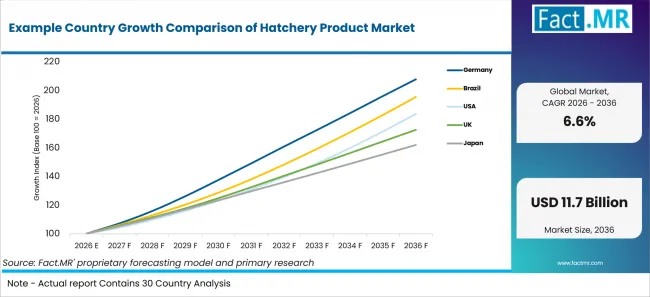
Example Country Growth Comparison Of Hatchery Product Market | Source: Fact.MR
| Country | CAGR (2026-2036) |
|---|---|
| Germany | 7.6% |
| Brazil | 6.9% |
| USA | 6.3% |
| UK | 5.6% |
| Japan | 5.0% |
What supports Germany adoption?
7.6% CAGR, supported by egg production scale and controlled poultry housing.
Germany’s hatchery product outlook is tied to steady egg production and stricter climate-control expectations inside poultry housing. Destatis reported in March 2026 that German enterprises produced 13.7 billion eggs in 2025 and kept an annual average of 45.2 million laying hens. Commercial hatcheries are expected to buy automated incubation and monitoring systems where managers need cleaner temperature records and faster service evidence.
What supports Brazil adoption?
6.9% CAGR, led by broiler scale and rising egg production.
Brazil’s growth is tied to high chicken volumes and the need for predictable chick supply across integrated poultry operations. IBGE reported in March 2026 that Brazil slaughtered 6.69 billion chickens in 2025 and preliminarily estimated hen-egg production at approximately 4.953 billion dozen. Hatchery products are expected to gain where automation reduces losses during incubation, transfer and chick handling.
What supports USA adoption?
6.3% CAGR, backed by large hatchery capacity and broiler placements.
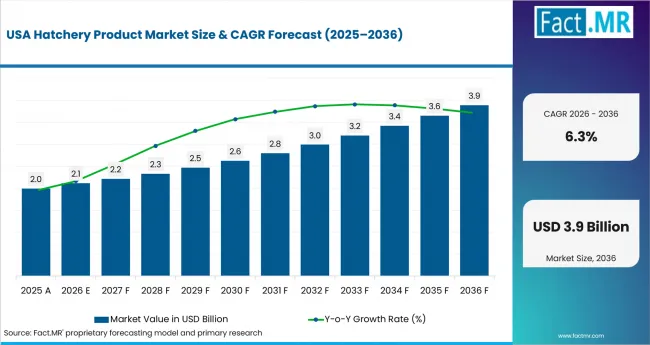
Hatchery Product Market Country Value Analysis | Source: Fact.MR
The USA is a mature but sizable market where operators replace systems to protect placement schedules. USDA NASS reported in April 2026 that leading U.S. breeders had intended placements of 102 million broiler-type pullet chicks for future domestic hatchery supply flocks during 2025. Equipment demand is expected to remain tied to calibration, uptime and room-level documentation.
What supports UK adoption?
5.6% CAGR, supported by broiler chick placings and biosecurity-led procurement.
UK growth is shaped by a compact poultry base and frequent hatchery reporting. DEFRA reported in March 2026 that the UK poultry population increased 4.1% to 183 million birds in 2025. Operators are expected to prioritize automation where disease controls require clearer sanitation logs, smoother egg flow and more reliable service support.
What supports Japan adoption?
5.0% CAGR, supported by poultry clusters and cautious modernization.
Japan’s growth is selective because poultry production is concentrated in specific prefectures. Hatchery equipment purchases are expected to focus on reliability, compact layouts and dealer support near regional poultry clusters.
Who leads the Hatchery Product Market?
Cobb-Vantress Inc. and Hendrix Genetics B.V. show the clearest direct relevance.
Cobb-Vantress Inc. is active in broiler genetics and hatchery technical resources. It also supports compartment-backed breeding stock supply. Cobb East Africa opened a grandparent facility with Irvine’s Group in Tanzania in June 2026. Hendrix Genetics B.V. is active in layers, turkeys and traditional poultry genetics. Both companies connect hatchery products with parent stock planning and chick-quality support.
Which companies are the key providers?
Key companies include Cobb-Vantress Inc. and Hendrix Genetics B.V.
- Cobb-Vantress Inc.
- Hendrix Genetics B.V.
- Aviagen
- Hy-Line International
- Lohmann Breeders GmbH
Bibliography
- Cobb-Vantress, LLC. (2025, October 20). GB compartment status is achieved by Cobb Europe.
- Cobb-Vantress, LLC. (2026, June 10). Cobb East Africa officially opens new Grandparent Facility in Tanzania.
- Department for Environment, Food & Rural Affairs. (2026, July 23). Monthly statistics on the activity of UK hatcheries and UK poultry slaughterhouses (data for June 2026).
- Department for Environment, Food & Rural Affairs. (2026, March 26). Livestock populations in the United Kingdom at 1 June 2025.
- Hendrix Genetics. (2025, August 18). Hendrix Genetics strengthens its poultry innovation with strategic investment.
- Instituto Brasileiro de Geografia e Estatística. (2026, March 18). In 2025, Brazil registers the highest production of milk, leather and eggs in history; slaughter of cattle, chickens and pigs also hits record.
- U.S. Department of Agriculture, National Agricultural Statistics Service. (2026, April 7). Hatchery Production 2025 Summary.
This Report Answers
- The report provides strategic intelligence on Hatchery Product Market across Product and Application choices that shape commercial hatchery purchasing.
- Segment analysis covers Hatchery Equipment Systems and Automated Incubation Technology as the share leaders within the 2026 market.
- Country outlook evaluates Germany and Brazil alongside the USA, the UK and Japan across the listed growth range.
- Competitive analysis profiles Cobb-Vantress Inc. and Hendrix Genetics B.V. as active companies with direct poultry genetics and hatchery relevance.
- Technology assessment covers automated incubation, digital temperature control and sensor-based monitoring alongside egg handling automation.
What does the Hatchery Product Market cover?
The Hatchery Product Market covers systems used for egg setting and incubation.
It also includes transfer, hatching and chick handling. Coverage includes hardware, automation and controls. System packages and distribution channels are included when they serve hatchery operations.
What is included in the scope?
Hatchery Equipment Systems are included when they support hatching operations.
The scope includes Product, Application, End Use, Technology, Formulation and Distribution Channel. It covers hatchery systems, incubation controls, chick handling and project channels used in poultry production.
What is excluded from the scope?
Poultry processing equipment is excluded unless bundled with hatchery systems.
General farm equipment, feed, vaccines, genetics revenue, live birds, broiler meat, table eggs and farm construction are also excluded.
How Was the Analysis Built?
The analysis draws on 120+ sources, 35+ company portfolios, 25+ countries and 20+ industry interviews.
- Primary Research: Interviews with manufacturers, dealers and hatchery operators examine purchase criteria. Discussions with poultry producers and procurement teams cover installation needs, biosecurity barriers and service expectations.
- Desk Research: Research covers government statistics, company announcements and regulatory publications. Selected public statistics, company announcements and regulatory references used in this summary are documented in the bibliography.
- Market Sizing and Forecasting: Market estimates combine historical values, capacity indicators and poultry output. Chick placement patterns, segment shares and country CAGRs are reviewed alongside company participation.
- Data Validation and Update Cycle: Findings are checked against official statistics, company activity and disease-control updates. Updates review investments, approvals and launches alongside procurement shifts.
What is the report’s scope and coverage?
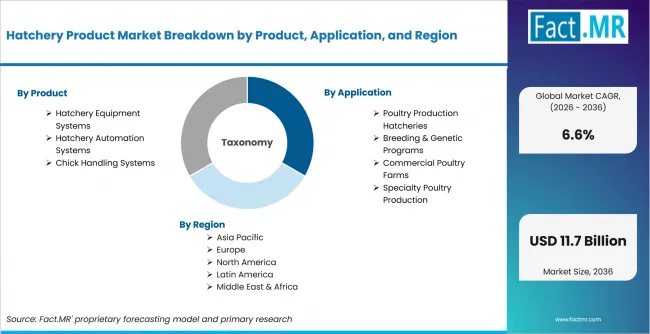
Hatchery Product Market Breakdown By Product, Application, And Region | Source: Fact.MR
| Attribute | Details |
|---|---|
| Quantitative Units | USD Billion |
| Market Definition | Equipment, automation, monitoring systems and packages used to convert hatching eggs into reliable chick output |
| Product | Hatchery Equipment Systems; Egg Incubation Systems; Egg Turning Systems; Hatchery Automation Systems; Climate Control Systems; Chick Handling Systems |
| Application | Poultry Production Hatcheries; Broiler Hatcheries; Layer Hatcheries; Breeding and Genetic Programs; Commercial Poultry Farms |
| End Use | Commercial Hatcheries; Industrial Hatchery Operators; Contract Hatchery Services; Poultry Farming Companies; Breeding Companies |
| Technology | Automated Incubation Technology; Digital Temperature Control Systems; Humidity Control Technology; Egg Handling Automation Technology; Sensor Based Monitoring Technology |
| Formulation | Integrated Hatchery System Packages; Fully Automated System Packages; Semi Automated System Packages; Modular Hatchery Systems |
| Distribution Channel | Direct Sales; Manufacturer Direct Supply; Project Based Sales; Distributors and Dealers; Online Channels |
| Regions Covered | North America; Latin America; Europe; East Asia; South Asia and Pacific; Middle East and Africa |
| Countries Covered | Germany; Brazil; USA; UK; Japan |
| Key Companies Profiled | Cobb-Vantress Inc.; Hendrix Genetics B.V.; Aviagen, Hy-Line International, Lohmann Breeders GmbH |
| Forecast Period | 2026 to 2036 |
| Approach | Hybrid top-down and bottom-up approach using hatchery capacity, poultry output, chick placements, country growth and company checks |
How is the market segmented?
-
By Product
- Hatchery Equipment Systems
- Egg Incubation Systems
- Egg Turning Systems
- Hatchery Automation Systems
- Climate Control Systems
- Monitoring & Control Systems
- Chick Handling Systems
- Hatchery Transfer Equipment
- Post Hatch Processing Systems
- Hatchery Equipment Systems
-
By Application
- Poultry Production Hatcheries
- Broiler Hatcheries
- Layer Hatcheries
- Breeding & Genetic Programs
- Genetic Improvement Programs
- Parent Stock Hatcheries
- Commercial Poultry Farms
- Large Scale Poultry Operations
- Medium Scale Poultry Farms
- Specialty Poultry Production
- Organic Poultry Hatcheries
- Premium Poultry Segments
- Poultry Production Hatcheries
-
By End Use
- Commercial Hatcheries
- Industrial Hatchery Operators
- Contract Hatchery Services
- Poultry Farming Companies
- Integrated Poultry Producers
- Independent Poultry Farms
- Breeding Companies
- Genetic Stock Providers
- Research Breeding Institutions
- Government & Cooperative Units
- Public Poultry Programs
- Cooperative Farming Units
- Commercial Hatcheries
-
By Technology
- Automated Incubation Technology
- Digital Temperature Control Systems
- Humidity Control Technology
- Egg Handling Automation Technology
- Robotic Egg Handling Systems
- Mechanical Handling Systems
- Sensor Based Monitoring Technology
- IoT Enabled Hatchery Systems
- Predictive Monitoring Systems
- Automated Incubation Technology
-
By Formulation
- Integrated Hatchery System Packages
- Fully Automated System Packages
- Semi Automated System Packages
- Modular Hatchery Systems
- Expandable System Modules
- Custom Configurable Systems
- Standalone Equipment Systems
- Independent Incubation Units
- Support Equipment Modules
- Integrated Hatchery System Packages
-
By Distribution Channel
- Direct Sales
- Manufacturer Direct Supply
- Project Based Sales
- Distributors & Dealers
- Regional Equipment Distributors
- Specialized Hatchery Dealers
- Online Channels
- B2B Agricultural Platforms
- Manufacturer Online Stores
- Cooperatives & Institutions
- Farmer Cooperatives
- Government Procurement
- Direct Sales
-
By Region
- North America
- Latin America
- Western Europe
- Eastern Europe
- East Asia
- South Asia and Pacific
- Middle East & Africa