- Market Value (2025): USD 1.4 Bn
- Estimated Value (2026): USD 1.5 Bn
- Forecast Value (2036): USD 2.5 Bn
- CAGR (2026-2036): 5.1%
What is the Industrial Motor Brakes Market forecast to be worth by 2036?
USD 1.5 billion in 2026 to USD 2.5 billion by 2036, at 5.1% CAGR.
- The industrial motor brakes market crossed a valuation of USD 1.4 billion in 2025.
- Demand is projected to increase from USD 1.5 billion in 2026 to USD 2.5 billion by 2036.
- The market is forecast to record 5.1% CAGR from 2026 to 2036 as plant operators replace basic stopping devices with fail-safe holding and controlled deceleration.
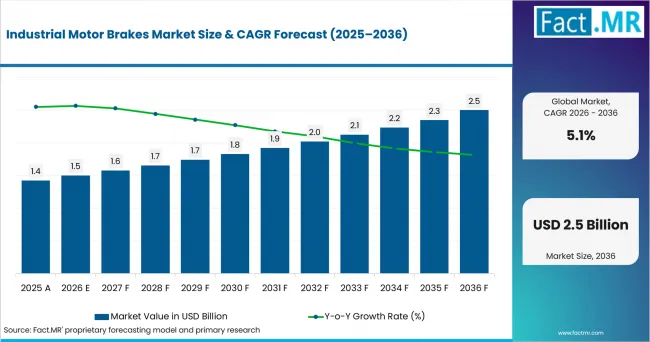
Industrial Motor Brakes Market Value Analysis | Source: Fact.MR
What are the defining numbers behind Industrial Motor Brakes Market growth?
USD 1.0 billion absolute opportunity by 2036, led by DC Motor Brakes, Holding Braking and Regenerative Braking.
- Demand Drivers in the Market
- Plant maintenance teams need spring-applied braking that keeps equipment stopped during power loss and service work.
- Crane and hoist operators need static holding brakes since suspended loads require position control before restart.
- Mining engineers need sealed brake designs owing to dust, vibration and long duty cycles in extraction equipment. The U.S. Geological Survey reported in February 2026 that the value of U.S. mineral production increased 5.6% to USD 112 billion in 2025, reinforcing the scale of mining activity that relies on heavy-duty motorized equipment.
- Factory automation teams need compact motor brakes as conveyors and assembly stations move to tighter machine layouts.
- Key Segments Analyzed
- By Type: DC Motor Brakes are expected to hold 28.70% share in 2026 due to their use in compact drives and fail-safe power-off designs.
- By Braking Mode: Holding Braking is projected to account for 32.10% share in 2026 as hoists and vertical axes require load position control.
- By Application: Regenerative Braking is anticipated to capture 42.50% share in 2026 owing to energy recovery needs in frequent-stop equipment.
- By End Use: Metals and Mining is estimated to represent 35.90% share in 2026 since heavy loads require controlled starts and reliable stops.
- Analyst Opinion at Fact.MR
- Shambhu Nath Jha, Principal Consultant at Fact.MR, states, “Industrial motor brakes are drawing attention because plants now treat stopping reliability as part of machine availability. Supplier selection is expected to depend on torque proof, release response and fit with older motor frames. Strong contenders should combine sealed designs, clear validation data and dependable retrofit support.”
- Strategic Implications
- Plant managers should map brake duty cycles before approving replacement parts for hoists, conveyors and lifting axes.
- Equipment builders should document holding torque and release response so safety approval is easier for end users.
- Component suppliers should support cross-reference work where older motors need replacement brakes without machine redesign.
- Service partners should stock wear parts for spring-applied brakes used in high-cycle material handling equipment.
Germany is projected to record 6.3% CAGR through 2036 supported by machinery production and safety upgrades. Japan is anticipated to post 5.6% CAGR through precision machinery. France is forecast to advance at 5.1% CAGR as manufacturing and processing plants maintain drive systems. South Korea is expected to reach 4.5% CAGR due to machinery orders and factory automation. The USA is estimated to record 4.0% CAGR owing to industrial replacement and selective manufacturing investment.
How does the Industrial Motor Brakes Market break down by segment?
DC Motor Brakes lead Type at 28.7%; Holding Braking leads Braking Mode at 32.1%.
Which type dominates?
DC Motor Brakes hold 28.7% share in 2026.
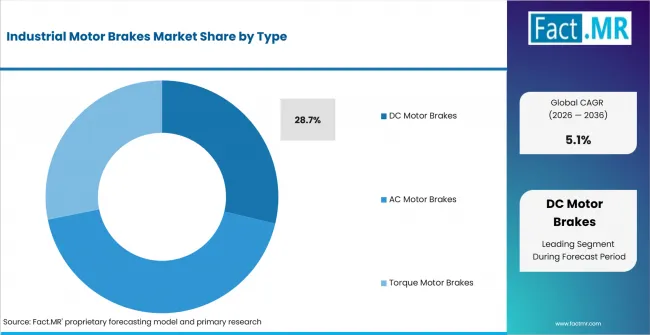
Industrial Motor Brakes Market Analysis By Type | Source: Fact.MR
DC Motor Brakes are expected to lead Type because compact drives need power-off stopping and simple electrical release. Spring-applied DC brakes support cranes and hoists where fail-safe holding is required. Permanent magnet DC brakes suit servo motors that need short length and low backlash.
What leads the Braking Mode segment?
Holding Braking leads with 32.1% share in 2026.
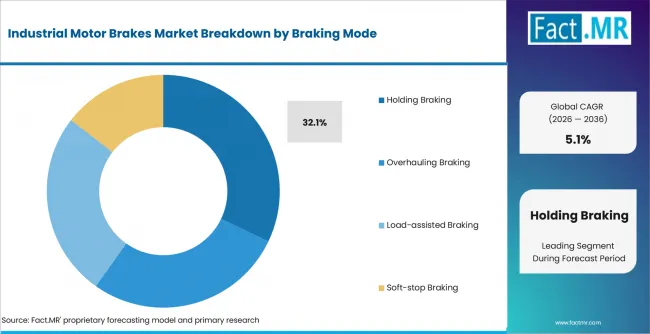
Industrial Motor Brakes Market Analysis By Braking Mode | Source: Fact.MR
Holding Braking is projected to lead Braking Mode as plants place more value on stopped-position security. Static holding brakes keep loads fixed during pauses and emergency stops. Position holding systems are used where vertical axes must remain steady before restart. Spring-applied designs remain practical when load holding must continue after power loss. Kendrion reported in January 2026 that its BFK552-12 holding brake delivers 60 Nm of braking torque in a 43.7 mm-high design.
How does Application shape demand?
Regenerative Braking accounts for 42.5% share in 2026.
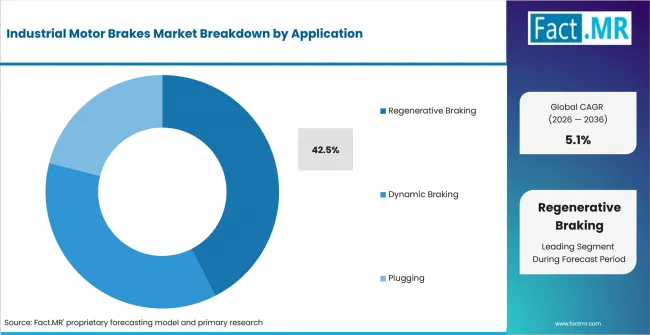
Industrial Motor Brakes Market Analysis By Application | Source: Fact.MR
Regenerative Braking is anticipated to lead Application due to repeated acceleration and deceleration in conveyors. Energy recovery systems are attractive where braking heat affects drive performance. Dynamic braking remains suited to controlled stops in heavy equipment.
What supports Metals and Mining within End Use?
Metals and Mining represents 35.9% share in 2026.
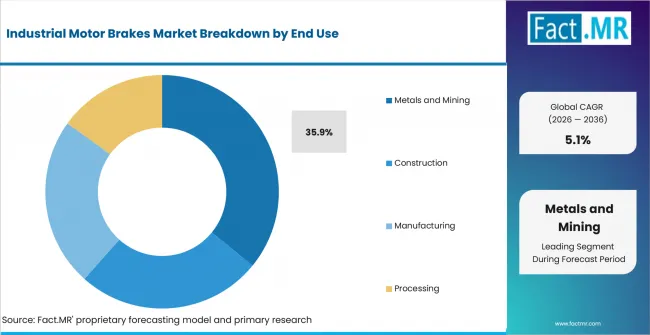
Industrial Motor Brakes Market Analysis By End Use | Source: Fact.MR
Metals and Mining is estimated to lead End Use since motors operate under heavy loads and harsh duty cycles. Mining equipment needs brakes that tolerate dust and repeated holding. Metal processing equipment relies on holding brakes during roll changes and load transfer.
What is accelerating Industrial Motor Brakes Market adoption, and what is holding it back?
Controlled stopping drives it; retrofit fit and ownership cost restrain it.
Drivers Impact Analysis
| DRIVER | (~) % IMPACT ON CAGR | GEOGRAPHIC RELEVANCE | IMPACT TIMELINE |
|---|---|---|---|
| High-cycle automation | +1.1% | Germany, Japan, South Korea | Short term (<= 2 years) |
| Fail-safe holding requirements | +0.9% | USA, Germany, France | Short term (<= 2 years) |
| Mining and metals duty cycles | +0.8% | USA, Germany, South Korea | Medium term (2-4 years) |
| Regenerative drive integration | +0.7% | Japan, France, South Korea | Medium term (2-4 years) |
| Brake condition monitoring | +0.4% | Global machine builders | Long term (>= 4 years) |
- High-cycle automation: Automated conveyors and assembly lines stop and restart many times each shift. Brake life affects uptime and maintenance planning. The driver favors DC and permanent magnet brakes that fit compact motors.
- Mining and metals duty cycles: Mining equipment and metal processing lines expose brakes to heat, dust and shock. Plant teams prefer designs that handle repeated holding. Demand is expected to remain concentrated in sealed and torque-rated assemblies.
- Regenerative drive integration: Frequent-stop equipment uses drive controls that recover or manage braking energy. The application is anticipated to grow where conveyors must limit heat during deceleration. Brake suppliers need to prove drive-control compatibility.
Opportunity Impact Analysis
| OPPORTUNITY | (~) % IMPACT ON CAGR | GEOGRAPHIC RELEVANCE | IMPACT TIMELINE |
|---|---|---|---|
| Smart brake monitoring | +0.5% | Germany and Japan | Medium term (2-4 years) |
| Compact DC brakes | +0.4% | Automation clusters | Short term (<= 2 years) |
| Retrofit holding brakes | +0.3% | USA and France | Medium term (2-4 years) |
| Local application engineering | +0.2% | South Korea and Germany | Long term (>= 4 years) |
- Smart brake monitoring: Connected brake modules allow maintenance teams to check switching condition without separate sensors. Monitoring features are expected to appeal to plants that want proof of brake condition before restart.
- Compact DC brakes: Machine builders keep shortening motor envelopes in robotics and light material handling. Compact brake platforms are expected to lower redesign work across servo motor families.
- Retrofit holding brakes: Older cranes, hoists and conveyors often need replacement brakes before the full motor system is changed. Retrofit kits can lower downtime when bolt patterns and torque ratings match installed machines.
Restraints Impact Analysis
| RESTRAINT | (~) % IMPACT ON CAGR | GEOGRAPHIC RELEVANCE | IMPACT TIMELINE |
|---|---|---|---|
| Retrofit compatibility limits | -0.5% | Older plants | Short term (<= 2 years) |
| Price pressure on motors | -0.4% | USA and Europe | Short term (<= 2 years) |
| Maintenance skill gaps | -0.3% | Processing plants | Medium term (2-4 years) |
| Heat and enclosure constraints | -0.2% | Mining and metals | Medium term (2-4 years) |
- Retrofit compatibility limits: Brake replacements are not always simple when older motors have unusual mounting dimensions. Engineering checks can delay procurement and shift some demand toward repair.
- Price pressure on motors: Motor and component prices affect the brake budget on small machines. Higher channel costs are expected to push some operators toward repair before replacement. The restraint is sharper where equipment builders compete on compact standard motor packages.
- Maintenance skill gaps: Industrial brakes require correct air-gap checks and wear inspection. Plants with limited maintenance staff can delay replacement until failure risk is obvious.
- Heat and enclosure constraints: High-load brakes must manage heat while protecting internal parts from dust and fluid ingress. Larger enclosed designs can create fit issues around compact motors.
Which countries are scaling Industrial Motor Brakes Market fastest?
- The country comparison spans 2.3 percentage points and forms three practical growth bands across the forecast period.
- Germany remains 0.7 percentage point above Japan through machinery production, factory automation and safety-focused equipment upgrades.
- Japan remains 0.5 percentage point above France as precision machinery and compact factory automation support motor brake demand.
- France remains 0.6 percentage point above South Korea through manufacturing activity and processing-plant maintenance requirements.
- South Korea remains 0.5 percentage point above the USA as machinery orders and industrial automation support repetitive-stop applications.
- The USA closes the displayed range through industrial replacement demand, material-handling retrofits and selective manufacturing investment.
Comparable CAGRs can create different entry conditions due to machinery production, automation depth, retrofit requirements and local application-engineering needs. Full report coverage includes North America, Europe, East Asia, South Asia and Pacific, Middle East and Africa.
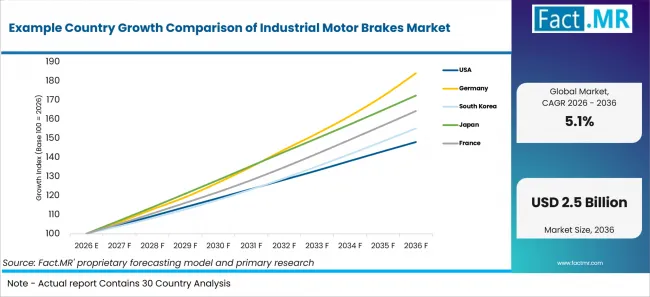
Example Country Growth Comparison Of Industrial Motor Brakes Market | Source: Fact.MR
| COUNTRY | CAGR (2026-2036) |
|---|---|
| Germany | 6.3% |
| Japan | 5.6% |
| France | 5.1% |
| South Korea | 4.5% |
| USA | 4.0% |
How is Germany scaling Industrial Motor Brakes demand?
6.3% CAGR through 2036, driven by machinery production and safety-focused factory upgrades.
Germany’s growth reflects machinery production, metal processing and continued factory automation that support demand for safer stopping and holding systems. Destatis reported in February 2026 that Germany's manufacturing order stock was 7.0% higher year on year in December 2025 and represented 8.2 months of production. Construction equipment maintenance adds demand, while weaker industrial output, restrained capital spending and custom fitment requirements can slow replacement activity.
What supports Japan adoption?
5.6% CAGR through 2036, supported by production machinery and precision factory automation.
Japan’s growth is supported by production machinery, servo-driven equipment and compact factory automation where brake response and motor size both influence design. Processing plants add demand, while input-price pressure, long qualification cycles and tight machine envelopes can raise retrofit costs.
What underpins France growth?
5.1% CAGR through 2036, led by manufacturing recovery and processing-plant maintenance needs.
France’s growth reflects manufacturing recovery, processing-plant maintenance and material handling requirements where controlled stopping supports worker safety and product flow. Demand may still be moderated by monthly machinery output declines, repair-focused spending and distributor delays when older motor frames require exact replacements.
How is South Korea developing demand?
4.5% CAGR through 2036, driven by machinery orders and industrial automation depth.
South Korea’s growth is supported by machinery orders, automated material handling and repetitive-stop requirements across metal and machinery production. Export-linked demand volatility, weaker equipment investment and price sensitivity among machine builders can restrain adoption of more advanced brake systems.
What shapes the USA outlook?
4.0% CAGR through 2036, backed by industrial replacement and selective manufacturing investment.
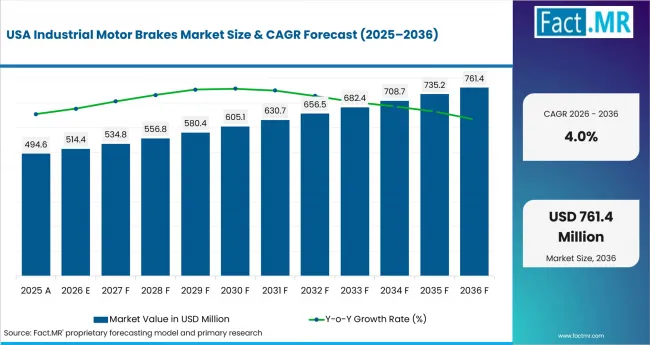
Industrial Motor Brakes Market Country Value Analysis | Source: Fact.MR
The USA’s growth reflects material handling retrofits, motor protection programs and selective manufacturing investment that keep replacement demand active across factories and warehouses. Cautious replacement cycles, higher channel margins and lead-time pressure for specialized parts can slow purchasing.
Who leads the Industrial Motor Brakes Market?
Regal Rexnord and Mayr lead direct brake coverage, while Ogura and Kendrion strengthen electromagnetic and servo-brake supply.
Regal Rexnord participates through Warner Electric and related motion-control brands that supply brakes for industrial power transmission. Mayr brings safety brakes used in vertical axes and machine tools. Ogura supports electromagnetic brake applications where compact holding torque is required. In April 2026, Mayr presented the ROBA-stop M motor brake together with sensorless ROBA brake-checker and Ethernet-connected ROBA gateway monitoring for test-bench applications.
Which companies are the key providers?
Regal Rexnord and Mayr are key providers. Ogura Industrial Corp. and Eaton are also profiled. Force Control Industries and Kendrion complete the company set.
- Regal Rexnord Corporation (Warner Electric)
- Chr. Mayr GmbH + Co. KG
- Ogura Industrial Corp.
- Eaton Corporation
- Force Control Industries
- Kendrion N.V.
How is the market segmented?
-
By Type
- DC Motor Brakes
- Spring Applied DC Brakes
- Permanent Magnet DC Brakes
- AC Motor Brakes
- AC Electromagnetic Brakes
- AC Hydraulic Brakes
- Torque Motor Brakes
- Adjustable Torque Brakes
- High Torque Brakes
- DC Motor Brakes
-
By Braking Mode
- Holding Braking
- Static Holding Brakes
- Position Holding Systems
- Overhauling Braking
- Gravity Load Braking
- Backdrive Protection
- Load-assisted Braking
- Load Responsive Brakes
- Automated Load Braking
- Soft-stop Braking
- Controlled Deceleration Brakes
- Precision Stop Brakes
- Holding Braking
-
By Application
- Regenerative Braking
- Energy Recovery Systems
- Power Feedback Systems
- Dynamic Braking
- Resistor Based Braking
- Electrical Dynamic Braking
- Plugging
- Reverse Current Braking
- Instant Stop Braking
- Regenerative Braking
-
By End Use
- Metals and Mining
- Mining Equipment
- Metal Processing Equipment
- Construction
- Cranes and Hoists
- Heavy Construction Equipment
- Manufacturing
- Assembly Line Systems
- Material Handling Equipment
- Processing
- Chemical Processing Equipment
- Food and Beverage Processing
- Metals and Mining
-
By Region
- North America
- Latin America
- Western Europe
- Eastern Europe
- East Asia
- South Asia and Pacific
- Middle East & Africa
Bibliography
- Bank of Japan. (2026, July 1). Tankan outline (June 2026).
- Board of Governors of the Federal Reserve System. (2026, July 17). Industrial production and capacity utilization—G.17.
- U.S. Bureau of Labor Statistics. (2026, January 30). Producer Price Indexes—December 2025.
- Economic and Social Research Institute, Cabinet Office. (2026, July 15). Machinery orders in May 2026.
- Statistisches Bundesamt (Destatis). (2025, December 8). Production in October 2025: +1.8% on the previous month.
- Eurostat. (2026, July 15). Industrial production down by 0.2% in the euro area and by 0.1% in the EU.
- Federal Ministry for Economic Affairs and Energy. (2025, May 14). The economic situation in Germany in May 2025.
This Report Addresses
- The report provides strategic intelligence on the Industrial Motor Brakes Market across Type and Braking Mode choices that shape machine safety programs.
- Segment analysis covers DC Motor Brakes and Holding Braking as the share leaders within the 2026 market.
- Country outlook evaluates Germany and Japan alongside France, South Korea and the USA.
- Competitive analysis profiles Regal Rexnord and Mayr alongside Ogura, Eaton, Force Control Industries and Kendrion.
- Application assessment covers Regenerative Braking, Dynamic Braking and Plugging across metals, mining, construction, manufacturing and processing uses.
What does the Industrial Motor Brakes Market cover?
Industrial motor brakes are used to stop, hold or control motor-driven equipment where uncontrolled motion can damage machinery or create safety risk.
The Industrial Motor Brakes Market covers DC and AC motor brakes used in hoists, cranes, conveyors and processing lines. It includes regenerative, dynamic and plugging applications tied to industrial motor control.
What is included in the scope?
The scope includes brakes sold with new equipment and as replacement units. It covers service demand where brake wear, holding torque and stopping response influence uptime. The analysis includes mining material handling equipment, conveyor systems and underground mining equipment where brakes operate under load. It also covers motor protection devices when brake and motor protection plans are reviewed together.
What is excluded from the scope?
Automotive wheel brakes, rail braking systems and consumer appliance brakes remain outside the scope. General motor sales are excluded unless the brake is part of a safety function. The scope also excludes unrelated industrial engines, pure drive software and brake parts not used with industrial motors. Port systems and port material handling vehicles are included only when tied to an industrial motor package.
How Was the Analysis Built?
The analysis draws on 120+ sources, 35+ company portfolios, 25+ countries, and more than 20 industry interviews.
- Primary Research: Primary research includes discussions with brake manufacturers, distributors, equipment builders, plant maintenance teams and application engineers. These conversations examine purchasing priorities, replacement triggers and safety documentation.
- Desk Research: Desk research covers government statistics, official industrial output data, company product pages, standards bodies and company announcements. Every source used in the analysis is documented in the bibliography.
- Market Sizing and Forecasting: Market estimates combine country manufacturing activity, segment shares, application fit, pricing behavior, replacement cycles and adoption barriers.
- Data Validation and Update Cycle: Findings are validated by comparing interviews with public data, company activity and product availability. Regular updates review brake launches, standards changes and replacement cycles.
What is the report’s scope and coverage?
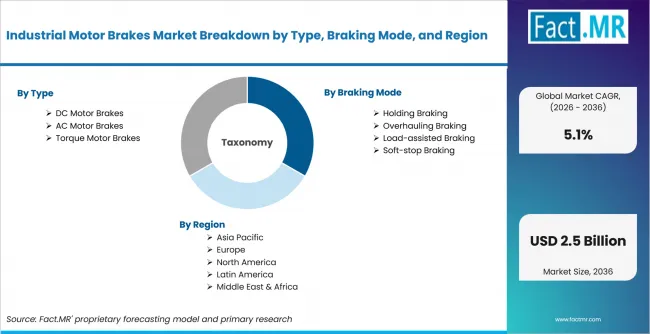
Industrial Motor Brakes Market Breakdown By Type, Braking Mode, And Region | Source: Fact.MR
| ATTRIBUTE | DETAILS |
|---|---|
| Quantitative Units | USD billion in 2026 to USD billion by 2036 at CAGR |
| Market Definition | Brakes fitted to industrial motors or motor-driven equipment for controlled stopping, emergency stopping, load holding and controlled deceleration where machinery safety and uptime depend on reliable motion control |
| Type | DC Motor Brakes; Spring Applied DC Brakes; Permanent Magnet DC Brakes; AC Motor Brakes; Torque Motor Brakes |
| Braking Mode | Holding Braking; Static Holding Brakes; Position Holding Systems; Overhauling Braking; Load-assisted Braking; Soft-stop Braking |
| Application | Regenerative Braking; Energy Recovery Systems; Power Feedback Systems; Dynamic Braking; Plugging |
| End Use | Metals and Mining; Mining Equipment; Metal Processing Equipment; Construction; Manufacturing; Processing |
| Regions Covered | North America; Europe; East Asia; South Asia and Pacific; Middle East and Africa |
| Countries Covered | Germany; Japan; France; South Korea; USA |
| Key Companies Profiled | Regal Rexnord Corporation; Chr. Mayr GmbH + Co. KG; Ogura Industrial Corp.; Eaton Corporation; Force Control Industries; Kendrion N.V. |
| Forecast Period | 2026 to 2036 |
| Approach | Hybrid top-down and bottom-up approach using industrial production indicators; machinery orders; mining and metals equipment demand; brake type and application shares; country-level growth patterns; replacement cycles; retrofit limits; supplier portfolios and company development review |