- Base Value(2025): 9.40 Bn
- Estimated Value(2026): 9.68 Bn
- Forecast Value (2036): 13.01 Bn
- CAGR (2026 - 2036): 3.0%
Port Material Handling Equipment Vehicle Market Size, Market Forecast and Outlook By Fact.MR
The port material handling equipment vehicle market was valued at USD 9.40 billion in 2025, projected to reach USD 9.68 billion in 2026, and is forecast to expand to USD 13.01 billion by 2036 at a 3.0% CAGR. Global container throughput growth and port decarbonization mandates are driving dual investment cycles in port material handling fleets. Terminal operators face simultaneous pressure to expand handling capacity at congested facilities and to transition diesel-powered fleets toward hybrid and electric alternatives. The International Maritime Organization 2023 greenhouse gas strategy, targeting net-zero emissions from international shipping by 2050, extends decarbonization expectations to port-side operations. Terminal operators at major hub ports in Europe and North America are now including electrification readiness as a procurement specification for all new vehicle orders.
The USA leads with a 3.5% CAGR, driven by federal port infrastructure funding under the Infrastructure Investment and Jobs Act allocating over USD 17 billion to port and waterway improvements. Mexico follows at 3.2%, supported by nearshoring-driven container volume growth at Pacific coast ports including Lazaro Cardenas and Manzanillo. Germany expands at 2.9%, anchored by Hamburg and Bremerhaven terminal modernization programs. France tracks at 2.8% as Le Havre and Marseille invest in automated handling systems. The UK registers 2.6% growth linked to Felixstowe and London Gateway capacity expansions. South Korea advances at 2.5% as Busan New Port enters its next development phase. Japan posts a 2.4% trajectory driven by replacement demand at mature container terminals in Tokyo Bay and Osaka.
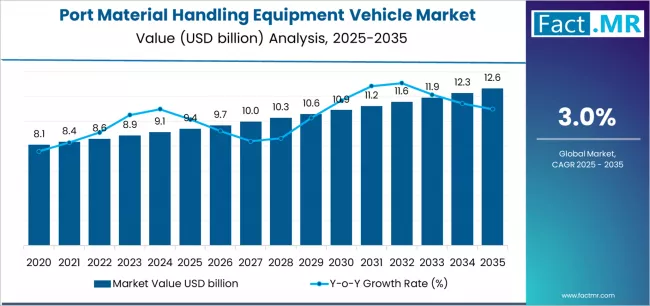
Port Material Handling Equipment Vehicle Market Market Value Analysis | Source: Fact.MR
Port Material Handling Equipment Vehicle Market Key Takeaways
| Metric | Details |
|---|---|
| Industry Size (2026) | USD 9.68 billion |
| Industry Value (2036) | USD 13.01 billion |
| CAGR (2026 to 2036) | 3.0% |
Source: Fact.MR analysis. Updated Mar 23, 2026
Port Material Handling Equipment Vehicle Market Definition
The port material handling equipment vehicle market covers specialized vehicles and mobile machinery used within port terminals to transport, stack, and position containers, bulk cargo, and roll-on/roll-off loads. Equipment categories include yard trucks (terminal tractors), reach stackers, straddle carriers, rubber-tyred gantry carriers, and forklift trucks rated for container and heavy cargo operations. These vehicles operate within the secured perimeter of maritime ports, inland container depots, and intermodal rail terminals.
Port Material Handling Equipment Vehicle Market Inclusions
The report covers global and regional market sizes for port material handling vehicles, forecast projections from 2026 to 2036, segment breakdowns by vehicle type (yard trucks/terminal tractors, reach stackers, straddle/others), power source (diesel, hybrid/electric), and end user (container terminals, bulk terminals, ro-ro/others). Fleet utilization and replacement cycle analysis are included.
Port Material Handling Equipment Vehicle Market Exclusions
Ship-to-shore gantry cranes and fixed quayside infrastructure are excluded. Dredging equipment and marine vessels used for cargo transfer at sea are not covered. Road-registered trucks used for drayage outside the port perimeter fall outside the scope.
Port Material Handling Equipment Vehicle Market Research Methodology
- Primary Research: Fact.MR analysts conducted detailed technical interviews with procurement directors, operations managers, and engineering leads across 40 countries to validate adoption timelines and purchasing decision criteria.
- Desk Research: Data collection aggregated regulatory filings, government procurement records, industry association publications, and company annual reports to establish baseline market parameters.
- Market-Sizing and Forecasting: Forecasting models apply a bottom-up methodology starting with installed base metrics and regional production volumes, applying technology penetration curves to project adoption velocity through 2036.
- Data Validation and Update Cycle: Projections undergo cross-validation against publicly reported revenue figures from leading manufacturers and quarterly trade statistics published by national customs authorities.
Summary of Port Material Handling Equipment Vehicle Market
- Port Material Handling Equipment Vehicle Market Definition
- The port material handling equipment vehicle market covers specialized vehicles and mobile machinery used within port terminals to transport, stack, and position containers, bulk cargo, and roll-on/roll-off loads. Equipment categories include yard trucks (terminal tractors), reach stackers, straddle carriers, rubber-tyred gantry carriers, and forklift trucks rated for container and heavy cargo operations.
- Demand Drivers in the Market
- Regulatory compliance requirements: Government mandates and safety standards across major automotive and industrial markets compel end users to adopt upgraded equipment and systems that meet current specification thresholds.
- Technology cost reduction: Declining component costs and manufacturing efficiencies enable broader market penetration beyond premium segments into volume-production applications.
- Replacement cycle acceleration: Ageing installed bases in mature markets face performance gaps against current operational requirements, triggering fleet-wide upgrade programs.
- Key Segments Analyzed in the Fact.MR Report
- Yard Trucks/Terminal Tractors (Vehicle): 42.0% share in 2026, reflecting dominant adoption across primary use cases.
- Diesel (Power): 66.0% share in 2026, driven by structural demand from the largest buyer segment.
- Container Terminals (End User): 59.0% share in 2026, supported by established operational requirements.
- Analyst Opinion at Fact.MR
- The port material handling equipment vehicle market is positioned for sustained expansion through 2036 as regulatory mandates, technology maturation, and capital replacement cycles converge to create a multi-year procurement environment. Fact.MR is of the opinion that market participants prioritizing certified compliance with evolving standards and demonstrated integration with existing infrastructure will capture disproportionate contract volume during the forecast period. Organizations delaying capital commitments risk operational obsolescence as specification requirements tighten across all major geographic markets.
- Strategic Implications / Executive Takeaways
- Compliance-first procurement: Equipment and system suppliers must secure regulatory certifications ahead of enforcement timelines to qualify for tender shortlists in markets where compliance is a mandatory procurement gate.
- Regional manufacturing presence: Establishing local production or assembly capabilities in high-growth regions reduces lead times and positions suppliers favorably against import-dependent competitors.
- Technology partnership investment: Forming integration partnerships with complementary technology providers enables end-to-end solution delivery that standalone component suppliers cannot match in competitive bid evaluations.
- Methodology
- Primary Research: Fact.MR conducted structured interviews with procurement leads, operations directors, and technical specification managers across key end-user industries in over 40 countries.
- Desk Research: Analysts compiled data from regulatory filings, government statistical agencies, trade body publications, and verified corporate disclosures.
- Market-Sizing and Forecasting: A hybrid top-down and bottom-up methodology calibrates global estimates against regional production data and verified shipment records.
Why is the Port Material Handling Equipment Vehicle Market Growing?
| GLOBAL TRADE & PORT EXPANSION TRENDS | AUTOMATION & EFFICIENCY REQUIREMENTS | REGULATORY & ENVIRONMENTAL STANDARDS |
|---|---|---|
| Global Trade Volume Growth | Advanced Container Handling Requirements | Environmental Compliance Standards |
| Continuous expansion of international trade across established and emerging markets driving demand for efficient port handling solutions. | Modern container terminals require sophisticated handling equipment delivering precise cargo movement and enhanced operational throughput. | Regulatory requirements establishing emission benchmarks favoring cleaner port equipment with reduced environmental impact. |
| Port Infrastructure Development | Processing Speed Demands | Safety Assurance Standards |
| Growing emphasis on port capacity expansion and infrastructure modernization creating demand for advanced material handling equipment applications. | Port operators investing in high-capacity handling systems offering consistent cargo flow while maintaining operational efficiency and terminal productivity. | Quality standards requiring superior load-bearing properties and resistance to harsh marine environmental conditions. |
| Premium Logistics Positioning | Quality and Reliability Standards | Electrification Requirements |
| Superior handling capacity and operational characteristics making specialized port vehicles essential for premium maritime logistics and cargo handling applications. | Certified manufacturers with proven track records required for advanced port operations and critical cargo handling applications. | Diverse electrification requirements and zero-emission mandates driving need for hybrid and electric port handling solutions. |
Source: Fact.MR analysis. Updated Mar 23, 2026
DRIVERS
| DRIVERS | RESTRAINTS | KEY TRENDS |
|---|---|---|
| Global Trade Volume Expansion | High Capital Investment | Port Automation Technologies |
| Continuing expansion of international trade volumes across established and emerging markets driving demand for efficient port handling solutions. | Significant capital investment requirements for port handling equipment affecting terminal operator adoption rates and fleet modernization timelines. | Integration of autonomous operation, remote monitoring, and predictive maintenance technologies enabling superior operational efficiency. |
| Port Infrastructure Modernization | Environmental Compliance Costs | Electric and Hybrid Integration |
| Increasing port capacity expansion and infrastructure modernization requirements driving investment in advanced material handling equipment across maritime facilities. | Environmental compliance and electrification costs affecting equipment procurement decisions and operational cost considerations for port operators. | Enhanced battery technologies, charging infrastructure, and hybrid power systems compared to traditional diesel-only equipment solutions. |
| Container Shipping Growth | Maintenance Complexity | Smart Port Integration |
| Growing containerized trade volumes and shipping industry expansion creating demand for specialized container handling equipment in terminal operations. | Complex maintenance requirements in marine environments and specialized technical expertise needed for advanced port equipment affecting operational costs. | Development of integrated port management systems and IoT connectivity providing enhanced operational coordination and equipment utilization optimization. |
Source: Fact.MR analysis. Updated Mar 23, 2026
Analysis of Port Material Handling Equipment Vehicle Market by Key Countries
.webp "Top Country Growth Comparison Port Material Handling Equipment Vehicle Market Cagr (2026 2036)")
Top Country Growth Comparison Port Material Handling Equipment Vehicle Market Cagr (2026 2036) | Source: Fact.MR
| Country | CAGR (2026-2036) |
|---|---|
| USA | 3.5% |
| Mexico | 3.2% |
| Germany | 2.9% |
| France | 2.8% |
| UK | 2.6% |
| South Korea | 2.5% |
| Japan | 2.4% |
Source: Fact.MR analysis. Updated Mar 23, 2026
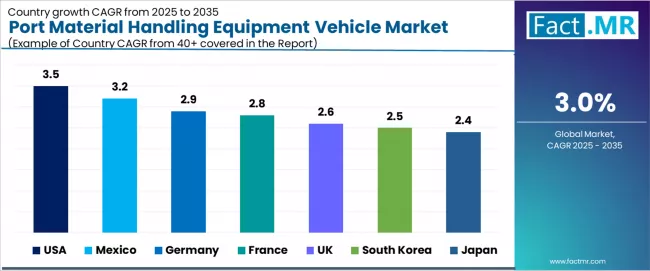
Port Material Handling Equipment Vehicle Market Cagr Analysis By Country | Source: Fact.MR
USA Leads Global Market Growth with Port Infrastructure Excellence
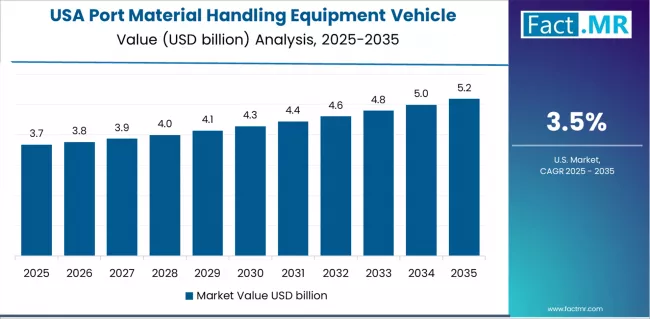
Port Material Handling Equipment Vehicle Market Country Value Analysis | Source: Fact.MR
Revenue from Port Material Handling Equipment Vehicles in USA is projected to exhibit strong growth with a market value of USD 3.8 billion by 2036, driven by expanding port infrastructure development and comprehensive maritime logistics modernization creating substantial opportunities for equipment suppliers across container terminal operations, bulk cargo facilities, and specialized port applications. The country's established port system and expanding trade volume capabilities are creating significant demand for both conventional and electric port handling equipment. Major port authorities and terminal operators including ports of Los Angeles, Long Beach, and New York/New Jersey are establishing comprehensive equipment procurement programs to support large-scale cargo handling operations and meet growing demand for efficient port logistics solutions.
- Port infrastructure modernization programs are supporting widespread adoption of handling equipment across terminal operations, driving demand for high-efficiency cargo handling systems
- Trade volume expansion initiatives and terminal capacity development are creating substantial opportunities for equipment suppliers requiring reliable performance and scalable handling solutions
- Environmental compliance growth and electrification mandates are facilitating adoption of clean energy port technologies throughout major maritime regions
Mexico Demonstrates Strong Market Potential with Trade Expansion
Revenue from Port Material Handling Equipment Vehicles in Mexico is expanding to reach USD 1.6 billion by 2036, supported by extensive trade expansion and comprehensive port development creating sustained demand for reliable handling solutions across diverse cargo categories and terminal segments. The country's growing trade relationships and expanding Pacific and Gulf coast port capabilities are driving demand for equipment solutions that provide consistent cargo handling while supporting cost-effective port operations. Port equipment manufacturers and logistics suppliers are investing in local service facilities to support growing port operations and terminal equipment demand.
- Trade expansion operations and port development capability enhancement are creating opportunities for handling solutions across diverse cargo segments requiring reliable performance and competitive operational costs
- Port modernization and terminal efficiency advancement are driving investments in equipment supply chains supporting cargo handling requirements throughout major coastal regions
- USMCA trade facilitation growth and logistics development programs are enhancing demand for advanced handling systems throughout Mexican port areas
Germany Maintains Leadership with Port Technology Innovation
Demand for Port Material Handling Equipment Vehicles in Germany is projected to reach USD 1.3 billion by 2036, supported by the country's leadership in port technology innovation and advanced maritime logistics requiring sophisticated handling systems for container terminals and specialized cargo applications. German companies are implementing high-quality port equipment procurement that supports advanced logistics techniques, operational efficiency, and comprehensive environmental protocols. The market is characterized by focus on operational excellence, equipment sustainability, and compliance with stringent maritime safety and environmental performance standards.
- Port technology innovation industry investments are prioritizing advanced handling technologies that demonstrate superior cargo efficiency and environmental performance while meeting German maritime and environmental standards
- Maritime logistics leadership programs and operational excellence initiatives are driving adoption of precision-engineered handling systems that support advanced port requirements and efficiency optimization
- Research and development programs for port enhancement are facilitating adoption of specialized handling technologies throughout major maritime innovation centers
France Expands Market with Maritime Innovation
Revenue from Port Material Handling Equipment Vehicles in France is growing to reach USD 1.1 billion by 2036, driven by maritime innovation development programs and increasing port modernization creating sustained opportunities for equipment suppliers serving both container terminal operations and specialized cargo contractors. The country's established port infrastructure and expanding Mediterranean and Atlantic coast capabilities are creating demand for handling solutions that support diverse cargo requirements while maintaining operational efficiency standards. Port equipment suppliers and logistics integrators are developing procurement strategies to support operational efficiency and regulatory compliance.
- Maritime innovation development programs and port modernization are facilitating adoption of handling solutions capable of supporting diverse cargo requirements and competitive efficiency standards
- Port automation innovation and logistics technology development programs are enhancing demand for advanced handling systems that support operational efficiency and environmental reliability
- EU maritime directive compliance and specialty equipment development are creating opportunities for advanced handling technologies across French port facilities
UK Demonstrates Market Potential with Port Modernization
Revenue from Port Material Handling Equipment Vehicles in United Kingdom is expanding to reach USD 920 million by 2036, supported by extensive port modernization and comprehensive maritime infrastructure development creating sustained demand for reliable handling solutions across diverse terminal categories and cargo segments. The country's established port system and expanding post-Brexit trade route development are driving demand for handling solutions that provide consistent performance while supporting regulatory compliance requirements. Port equipment processors and maritime suppliers are investing in local capabilities to support growing port operations and terminal equipment demand.
- Port modernization operations expansion and infrastructure development capability are creating opportunities for handling solutions across diverse cargo segments requiring reliable performance and competitive operational costs
- Maritime infrastructure advancement and port technology development are driving investments in equipment supply chains supporting cargo handling requirements throughout major coastal regions
- Post-Brexit trade route development and specialty port system enhancement programs are enhancing demand for flexible handling systems throughout British port areas
South Korea Focuses on Advanced Port Technology Excellence
Demand for Port Material Handling Equipment Vehicles in South Korea is projected to reach USD 780 million by 2036, expanding at a CAGR of 2.5%, driven by advanced port technology excellence and specialty terminal capabilities supporting high-tech logistics and comprehensive maritime applications. The country's established shipbuilding and port technology tradition and growing automated terminal market segments are creating demand for high-quality handling solutions that support operational performance and technology standards. Port equipment suppliers and maritime companies are maintaining comprehensive development capabilities to support diverse terminal requirements.
- Advanced port technology and specialty terminal programs are supporting demand for precision handling systems that meet contemporary quality and efficiency performance standards
- High-tech logistics development and automated terminal programs are creating opportunities for specialized handling solutions that provide comprehensive cargo management support
- Maritime export excellence and equipment quality enhancement programs are facilitating adoption of advanced handling capabilities throughout major port regions
Japan Demonstrates Maritime Technology Integration
Demand for Port Material Handling Equipment Vehicles in Japan is projected to reach USD 650 million by 2036, expanding at a CAGR of 2.4%, driven by maritime technology integration excellence and comprehensive port system capabilities supporting precision logistics and advanced cargo handling applications. The country's established maritime tradition and growing port efficiency market segments are creating demand for high-quality handling solutions that support operational precision and reliability standards. Port equipment suppliers and maritime manufacturers are maintaining comprehensive development capabilities to support diverse port requirements.
- Maritime technology integration and port system programs are supporting demand for reliable handling systems that meet contemporary quality and operational precision standards
- Port efficiency enhancement and maritime excellence programs are creating opportunities for specialized handling solutions that provide comprehensive cargo management support
- Technology leadership and equipment enhancement programs are facilitating adoption of advanced handling capabilities throughout major maritime regions
Europe Market Split by Country
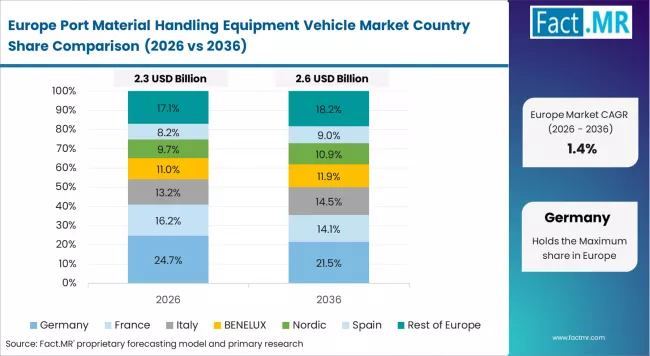
Port Material Handling Equipment Vehicle Market Europe Country Market Share Analysis, 2026 & 2036 | Source: Fact.MR
The port material handling equipment vehicle market in Europe is projected to grow from USD 2.5 billion in 2026 to USD 3.3 billion by 2036, registering a CAGR of 2.8% over the forecast period. Germany is expected to maintain its leadership position with a 29.2% market share in 2026, supported by its advanced maritime technology industry and comprehensive port infrastructure capabilities including major facilities at Hamburg, Bremen, and other North Sea ports.
France follows with a 21.4% share in 2026, projected to reach 21.7% by 2036, driven by comprehensive maritime innovation programs and port modernization initiatives. The United Kingdom holds a 18.6% share in 2026, expected to maintain 18.3% by 2036 despite post-Brexit trade adjustments. Italy commands a 15.1% share, while Spain accounts for 9.2% in 2026. The Rest of Europe region is anticipated to gain momentum, expanding its collective share from 6.5% to 7.1% by 2036, attributed to increasing port development in Nordic countries and emerging Eastern European port facilities implementing advanced handling systems.
Premium Quality Standards Define Japanese Market Dynamics
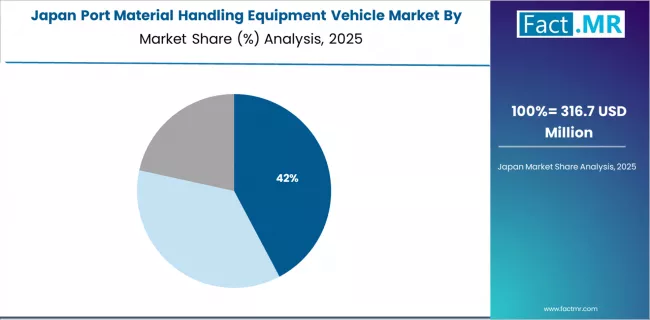
Port Material Handling Equipment Vehicle Market Japan Market Share Analysis By Vehicle | Source: Fact.MR
Japanese port material handling equipment operations reflect the country's exacting quality standards and sophisticated maritime requirements. Major port authorities and shipping companies including major port operators, Mitsui OSK Lines, and maritime equipment manufacturers maintain rigorous supplier qualification processes that often exceed international standards, requiring extensive documentation, equipment testing, and facility audits that can take 12-18 months to complete. This creates high barriers for new suppliers but ensures consistent quality that supports premium port operation positioning.
The Japanese market demonstrates unique precision requirements, with significant demand for ultra-reliable handling equipment tailored to earthquake-resistant port applications including seismic safety systems, automated operation capabilities, and comprehensive disaster preparedness integration. Companies require specific operational reliability and emergency response that differ from Western applications, driving demand for specialized engineering and control capabilities.
Regulatory oversight through the Ministry of Land, Infrastructure, Transport and Tourism emphasizes comprehensive safety standards and operational efficiency requirements that surpass most international benchmarks. The port equipment certification system requires detailed performance documentation, creating advantages for suppliers with transparent engineering data and comprehensive reliability validation.
Supply chain management focuses on relationship-based partnerships rather than purely transactional procurement. Japanese companies typically maintain long-term supplier relationships spanning decades, with annual contract negotiations emphasizing equipment reliability and performance consistency over price competition. This stability supports investment in specialized manufacturing equipment tailored to Japanese port specifications.
Market Dynamics Drive Innovation in South Korea

Port Material Handling Equipment Vehicle Market South Korea Market Share Analysis By Power | Source: Fact.MR
South Korean port material handling equipment operations reflect the country's advanced shipbuilding sector and export-oriented business model. Major industrial conglomerates including Hyundai Heavy Industries, Samsung Heavy Industries, and major port authorities drive sophisticated procurement strategies, establishing direct relationships with global suppliers to secure consistent quality and pricing for their port operations and maritime logistics targeting both domestic and international shipping.
The Korean market demonstrates particular strength in applying port handling equipment to smart port applications, with companies developing innovative installations that integrate advanced automation with traditional Korean maritime excellence and efficiency principles. This innovation approach creates demand for specific equipment specifications that often exceed standard applications, requiring suppliers to adapt engineering and control technologies.
Regulatory frameworks emphasize maritime safety and export competitiveness, with Korean Agency for Technology and Standards requirements often exceeding international benchmarks. This creates barriers for lower-quality suppliers but benefits established manufacturers who can demonstrate advanced equipment capabilities. The regulatory environment particularly favors suppliers with comprehensive documentation and quality management systems.
Supply chain efficiency remains critical given Korea's integration with global shipping markets. Companies increasingly pursue long-term contracts with suppliers in Germany, Japan, and the United States to ensure reliable access to high-quality port equipment while managing technology transfer and foreign exchange risks. Advanced logistics investments support equipment integration during complex port facility installations.
Competitive Landscape of Port Material Handling Equipment Vehicle Market
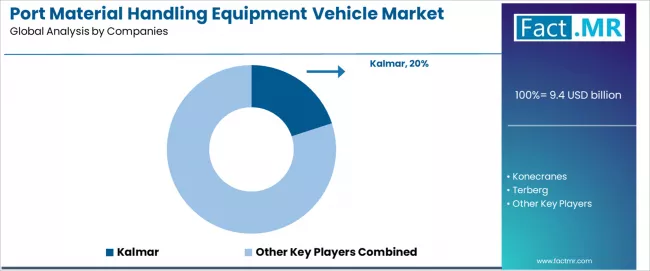
Port Material Handling Equipment Vehicle Market Analysis By Company | Source: Fact.MR
Profit pools are consolidating upstream in scaled equipment design and manufacturing capabilities and downstream in value-added integrated port solutions for container terminals, bulk facilities, and specialized cargo applications. Value is migrating from basic port equipment manufacturing to specification-tight, fully integrated handling solutions where automation compatibility, environmental compliance, and consistent performance command premiums. Several archetypes set the pace: global port equipment leaders defending share through comprehensive solutions and service networks; specialized terminal equipment companies that manage operational complexity and customer customization; electrification technology leaders with clean energy IP and hybrid system capabilities; and port automation integrators pulling volume in smart terminal installations and autonomous handling applications.
Switching costs—equipment integration requirements, terminal layout modifications, operational training needs—stabilize market position for incumbents, while technology disruptions (electrification mandates, automation advancement, environmental regulations) and industry evolution trends reopen opportunities for innovative equipment designs. Consolidation and vertical integration continue; environmental compliance becomes essential as traditional diesel equipment faces regulatory pressure. Market dynamics favor suppliers with comprehensive port expertise, global service capabilities, and established terminal operator relationships.
The competitive environment presents both opportunities and constraints. Premium automation requirements create barriers for basic equipment manufacturers but establish standards that favor integrated technology solutions over standalone equipment. Environmental regulations and electrification mandates increasingly influence procurement decisions as port operators demand documented emission reductions and operational cost improvements.
| Stakeholder Type | Primary Advantage | Repeatable Plays |
|---|---|---|
| Global port equipment leaders | Comprehensive solutions, service networks, scale | Long-term terminal partnerships, complete handling solutions, global support capability |
| Specialized terminal companies | Operational expertise, customization capabilities | Technical differentiation, niche applications, terminal-specific solutions |
| Electrification leaders | Clean energy IP, hybrid capabilities | Technology leadership, environmental compliance, operational cost optimization |
| Port automation integrators | Automation expertise, smart terminal solutions | Autonomous systems, operational integration, technology convergence |
Source: Fact.MR analysis. Updated Mar 23, 2026
Key Players in the Port Material Handling Equipment Vehicle Market
- Kalmar
- Konecranes
- Terberg
- Sany
- Liebherr
- Taylor Machine Works
- Hyster-Yale
- ZPMC
- TICO
- Ottawa
Bibliography
- International Maritime Organization. (2023, July). 2023 IMO Strategy on Reduction of GHG Emissions from Ships. IMO.
- U.S. Department of Transportation, Maritime Administration. (2024). Port Infrastructure Development Program: FY2024 Awards. MARAD.
- California Air Resources Board. (2024). Advanced Clean Fleets Regulation: Final Rule. CARB.
- European Sea Ports Organisation. (2024). ESPO Environmental Report 2024. ESPO.
- United Nations Conference on Trade and Development. (2024). Review of Maritime Transport 2024. UNCTAD.
- Secretaria de Marina, Mexico. (2024). Estadisticas Portuarias 2024. Government of Mexico.
This bibliography is provided for reader reference. The full Fact.MR report contains the complete reference list with primary research documentation.
This Report Addresses
- Market sizing and quantitative forecast metrics detailing industry revenue projections for the port material handling equipment vehicle market through 2036.
- Segmentation analysis identifying adoption patterns across Vehicle, Power, End User segments and evaluating structural demand drivers.
- Regional deployment intelligence comparing growth dynamics across 7 key countries and broader geographic markets.
- Regulatory compliance assessment analyzing policy frameworks and standards that affect market adoption and procurement specifications.
- Competitive landscape evaluation profiling 10 companies and their strategic positioning across technology and geographic dimensions.
- Strategic investment guidance identifying infrastructure requirements and procurement specifications for market participants.
- Supply chain and operational analysis identifying capacity constraints, lead time factors, and sourcing patterns that influence market dynamics.
- Data delivery formats including PDF narrative reports, Excel datasets, interactive dashboards, and presentation files.
Segmentation
Port Material Handling Equipment Vehicle Market Segmentation
| Category | Segments Covered |
|---|---|
| By Vehicle | Yard Trucks/Terminal Tractors, Reach Stackers, Straddle/Others |
| By Power | Diesel, Hybrid/Electric |
| By End User | Container Terminals, Bulk Terminals, Ro-Ro/Others |
| By Region | North America, Europe, Asia Pacific, Latin America, Middle East & Africa |
Source: Fact.MR analysis. Updated Mar 23, 2026
Port Material Handling Equipment Vehicle Market Analysis by Vehicle
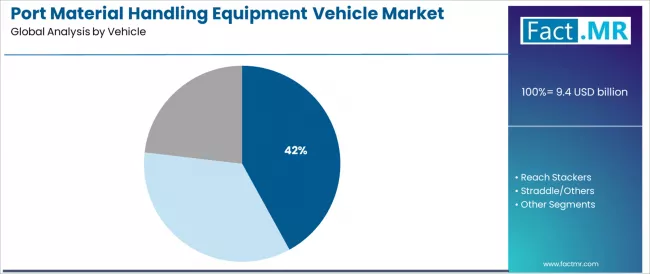
Port Material Handling Equipment Vehicle Market Analysis By Vehicle | Source: Fact.MR
| Segment | 2026 to 2036 Outlook |
|---|---|
| Yard Trucks/Terminal Tractors | Leader in 2026 with 42% market share; likely to maintain leadership through 2036. Essential for container transport within terminals with established operational integration and proven reliability. Momentum: steady-to-strong. Watchouts: electrification transition pressure, maintenance complexity in marine environments, competition from automated guided vehicles. |
| Reach Stackers | Strong segment with 34% market share due to versatility in container stacking and cargo handling operations requiring flexible positioning capabilities. Benefits from operational efficiency and space utilization optimization. Momentum: steady growth driven by container terminal expansion and operational flexibility requirements. |
| Straddle/Others | Represents 24% market share, benefiting from specialized applications including straddle carriers, forklifts, and specialized cargo handling equipment for specific terminal configurations. Strong in bulk cargo and specialized handling applications. Momentum: moderate growth in specialized applications. Watchouts: niche market limitations, specialized maintenance requirements, limited standardization across different terminal operations. |
Source: Fact.MR analysis. Updated Mar 23, 2026
Port Material Handling Equipment Vehicle Market Analysis by Power
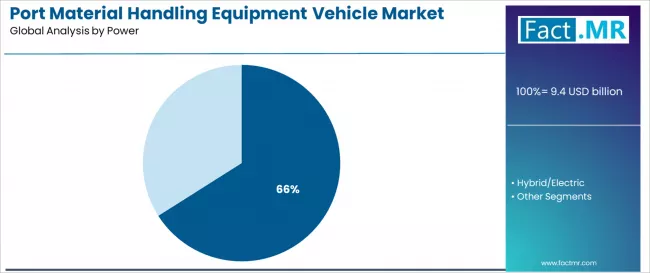
Port Material Handling Equipment Vehicle Market Analysis By Power | Source: Fact.MR
| Segment | 2026 to 2036 Outlook |
|---|---|
| Diesel | At 66%, largest power segment in 2026 with established operational infrastructure and proven reliability in demanding port environments. Mature technology base, standardized maintenance procedures. Momentum: declining growth due to environmental pressure but maintaining dominance in heavy-duty applications. Watchouts: emission regulation pressure, fuel cost volatility, environmental compliance requirements limiting future adoption. |
| Hybrid/Electric | Strong segment with 34% share driven by environmental regulations and port sustainability initiatives requiring cleaner equipment operations. Benefits from operational cost advantages and regulatory compliance benefits. Momentum: explosive growth through 2030, supported by electrification mandates and environmental compliance requirements. Watchouts: higher initial costs, charging infrastructure requirements, battery technology limitations in heavy-duty applications. |
Source: Fact.MR analysis. Updated Mar 23, 2026
Port Material Handling Equipment Vehicle Market Analysis by End User
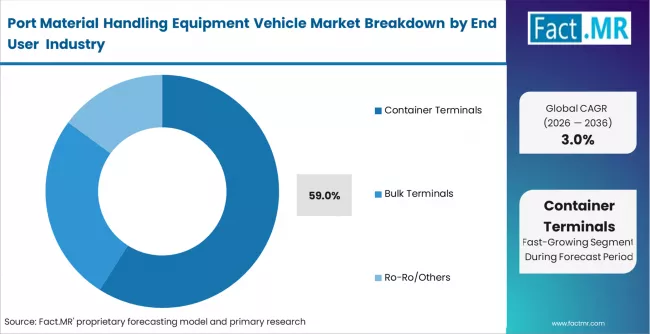
Port Material Handling Equipment Vehicle Market Analysis By End User | Source: Fact.MR
| Segment | 2026 to 2036 Outlook |
|---|---|
| Container Terminals | Dominant segment with 59% market share due to global containerized trade growth and terminal automation requirements demanding specialized handling equipment. Benefits from established container shipping infrastructure and operational standardization. Momentum: steady growth driven by containerized trade expansion and terminal efficiency optimization. Watchouts: automation displacing traditional equipment, port consolidation affecting equipment demand, cyclical shipping industry investment patterns. |
| Bulk Terminals | Represents 27% market share, favored for commodity handling operations requiring specialized equipment for coal, grain, ore, and liquid bulk cargo management. Strong in industrial port facilities and commodity export terminals. Momentum: moderate growth in commodity handling applications and specialized bulk cargo operations. Watchouts: commodity price volatility affecting terminal investment, environmental regulations impacting bulk cargo operations. |
| Ro-Ro/Others | Holds 14% share encompassing roll-on/roll-off terminals, cruise terminals, and specialized cargo facilities requiring flexible handling solutions. Growing emphasis on passenger vehicle logistics and specialized cargo handling. Momentum: selective growth in automotive logistics and specialized terminal applications. Innovation-dependent with specific operational requirements and limited market scale compared to container operations. |
Source: Fact.MR analysis. Updated Mar 23, 2026
Scope of the Report
Port Material Handling Equipment Vehicle Market Breakdown By Vehicle, Power, And Region | Source: Fact.MR
| Metric | Value |
|---|---|
| Quantitative Units | USD 9.68 billion to USD 13.01 billion, at a CAGR of 3.0% |
| Market Definition | The port material handling equipment vehicle market covers specialized vehicles and mobile machinery used within port terminals to transport, stack, and position containers, bulk cargo, and roll-on/roll-off loads. Equipment categories include yard trucks (terminal tractors), reach stackers, straddle carriers, rubber-tyred gantry carriers, and forklift trucks rated for container and heavy cargo operations. |
| Segmentation | Vehicle (Yard Trucks/Terminal Tractors, Reach Stackers, Straddle/Others), Power (Diesel, Hybrid/Electric), End User (Container Terminals, Bulk Terminals, Ro-Ro/Others) |
| Regions Covered | North America, Latin America, Europe, East Asia, South Asia, Oceania, Middle East & Africa |
| Countries Covered | USA, Mexico, Germany, France, UK, South Korea, Japan, and 40 plus countries |
| Key Companies Profiled | Kalmar (Cargotec), Konecranes Plc, Terberg Group B.V., Sany Heavy Industry Co., Ltd., Liebherr Group, Taylor Machine Works Inc., Hyster-Yale Group Inc., ZPMC, TICO Manufacturing, Ottawa (Kalmar) |
| Forecast Period | 2026 to 2036 |
| Approach | Forecasting models apply a hybrid top-down and bottom-up methodology, calibrating global estimates against regional production data and verified shipment records to project market trajectory through 2036. |
Source: Fact.MR analysis. Updated Mar 23, 2026
Port Material Handling Equipment Vehicle Market Segmentation
-
By Vehicle :
- Yard Trucks/Terminal Tractors
- Reach Stackers
- Straddle/Others
-
By Power :
- Diesel
- Hybrid/Electric
-
By End User :
- Container Terminals
- Bulk Terminals
- Ro-Ro/Others
-
By Region :
- North America
- Europe
- Asia Pacific
- Latin America
- Middle East & Africa
Frequently Asked Questions
How large is the demand for Port Material Handling Equipment Vehicle Market in the global market in 2026?
What will be the market size of Port Material Handling Equipment Vehicle Market by 2036?
What is the expected demand growth for Port Material Handling Equipment Vehicle Market between 2026 and 2036?
Which Vehicle is poised to lead global sales by 2026?
How significant is the role of Diesel in the Port Material Handling Equipment Vehicle Market?
What is the growth outlook for USA in this report?
What is the growth outlook for Mexico?
Does the report cover UK in its regional analysis?
What is Port Material Handling Equipment Vehicle Market and what is it mainly used for?
What is included in the scope of this report?
What is excluded from the scope of this report?
How does Fact.MR build and validate the Port Material Handling Equipment Vehicle Market forecast?
What regions are covered in this report?
Which companies are profiled in this report?
How large is the demand for Port Material Handling Equipment Vehicle Market in the global market in 2026?
What will be the market size of Port Material Handling Equipment Vehicle Market by 2036?
What is the expected demand growth for Port Material Handling Equipment Vehicle Market between 2026 and 2036?
Which Vehicle is poised to lead global sales by 2026?
How significant is the role of Diesel in the Port Material Handling Equipment Vehicle Market?
What is the growth outlook for USA in this report?
What is the growth outlook for Mexico?
Does the report cover UK in its regional analysis?
What is Port Material Handling Equipment Vehicle Market and what is it mainly used for?
What is included in the scope of this report?
What is excluded from the scope of this report?
How does Fact.MR build and validate the Port Material Handling Equipment Vehicle Market forecast?
What regions are covered in this report?
Which companies are profiled in this report?
Who worked on this report


Preview the report firsthand - request a free sample
Free SampleGet the brochure for pricing and purchase details
Download PDF