- Market Value (2025): USD 1.7 Bn
- Estimated Value (2026): USD 1.8 Bn
- Forecast Value (2036): USD 2.8 Bn
- CAGR (2026-2036): 4.9%
What is the Industrial Refractory Maintenance Services Market forecast to be worth by 2036?
USD 1.8 billion in 2026 to USD 2.8 billion by 2036 at 4.9% CAGR.
- The industrial refractory maintenance services market was valued at USD 1.7 billion in 2025, with scheduled steel and kiln relining activity included among the demand indicators.
- Demand is projected to increase from USD 1.8 billion in 2026 to USD 2.8 billion by 2036.
- The market is forecast to record 4.9% CAGR from 2026 to 2036 owing to furnace uptime targets and safer shutdown execution.
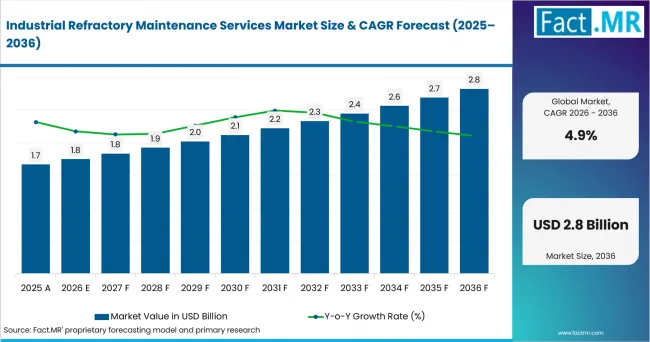
Industrial Refractory Maintenance Services Market Value Analysis | Source: Fact.MR
What are the defining numbers behind Industrial Refractory Maintenance Services Market growth?
USD 1.1 billion absolute opportunity by 2036, led by Installation & relining, Monolithics/castables and Iron & steel.
- Demand Drivers in the Market
- Steel plant operators need refractory crews that protect converter and EAF availability during planned campaign work.
- Cement producers require relining windows that shorten kiln downtime and keep clinker output stable.
- Glass manufacturers rely on inspection and hot repair support because furnace access is costly during campaigns.
- Petrochem and non-ferrous sites are expected to prioritize documented repair records for safety audits.
- Key Segments Analyzed
- By Service: Installation & relining is expected to hold 38.0% share in 2026 due to planned furnace rebuild cycles.
- By Refractory Type: Monolithics/castables are projected to account for 47.0% share in 2026 owing to flexible repair placement.
- By End-Use Industry: Iron & steel is anticipated to capture 36.0% share in 2026 supported by vessel wear and campaign checks.
- Analyst Opinion at Fact.MR
- Shambhu Nath Jha, Principal Consultant at Fact.MR, states, “Refractory maintenance is now purchased as risk control, not only as brick replacement. Demand is expected to favor crews that prove lining quality before heat-up and document the job after restart. Providers should combine inspection, installation discipline and dry-out support in one shutdown package.”
- Strategic Implications
- Steel producers should match repair packages to converter wear maps before a shutdown date is fixed.
- Cement operators should link castable selection to kiln-zone temperature and dry-out time.
- Service providers should train crews on gunning consistency because poor rebound raises waste and repeat work.
- Investors should separate recurring maintenance exposure from one-off refractory product sales.
Brazil is expected to record 7.0% CAGR through 2036, driven by steel and mining-linked repair work. South Korea is projected to post 5.9% CAGR owing to steel and non-ferrous processing depth. The United States is forecast to advance at 5.6% CAGR supported by steel and cement capacity. Italy is anticipated to reach 4.7% CAGR due to steel, glass and kiln-service demand. Germany is estimated to register 4.4% CAGR because energy-intensive plants keep lining reliability under review. Japan is projected to record 4.3% CAGR shaped by steel, ceramics and careful furnace upkeep.
How does the Industrial Refractory Maintenance Services Market break down by segment?
Installation & relining leads at 38.0%; Monolithics/castables lead at 47.0%.
Which service dominates?
Installation & relining is projected to account for 38.0% share in 2026.
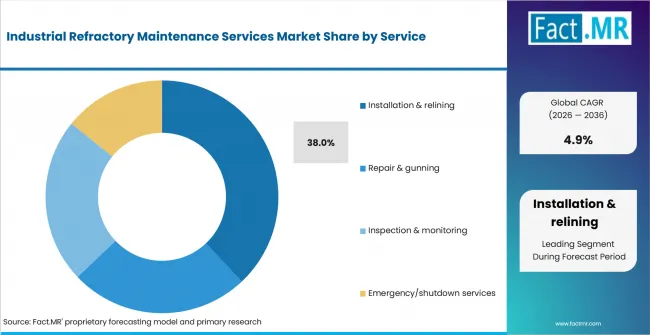
Industrial Refractory Maintenance Services Market Analysis By Service | Source: Fact.MR
Installation & relining is expected to lead Service with 38.0% share in 2026 because full lining work is closely tied to planned furnace uptime and maintenance cycles. Operators rely on scheduled relining to restore refractory integrity, reduce unexpected failures and support reliable restart conditions across high-temperature industrial operations.
What leads the Refractory Type segment?
Monolithics/castables are expected to hold 47.0% share in 2026.
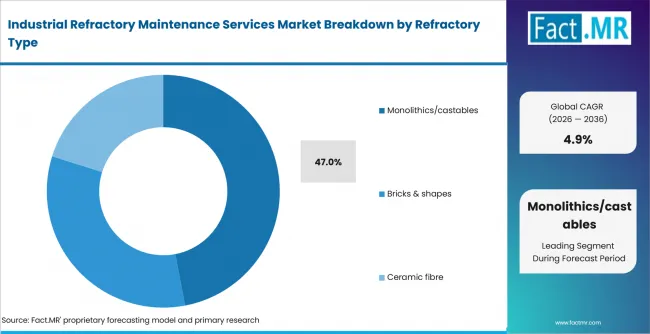
Industrial Refractory Maintenance Services Market Analysis By Refractory Type | Source: Fact.MR
Monolithics/castables are projected to lead Refractory Type with 47.0% share in 2026 because they support gunning, casting and rapid repair placement across furnace environments. Calderys reported in March 2026 that locally manufactured CAPES basic monolithics support steel-industry refractory repair applications while providing a more reliable local supply.
How does End-Use Industry shape demand?
Iron & steel is anticipated to lead with 36.0% share in 2026.
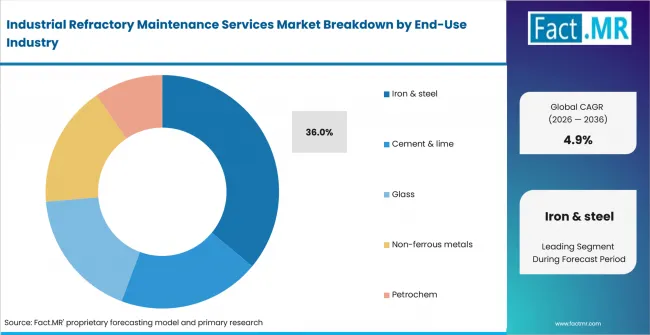
Industrial Refractory Maintenance Services Market Analysis By End Use Industry | Source: Fact.MR
Iron & steel is anticipated to lead End-Use Industry with 36.0% share in 2026 because converters, ladles and electric arc furnaces experience recurring refractory wear and require planned maintenance. Worldsteel reported global crude steel production of 1,849.4 Mt in 2025, indicating a substantial steelmaking operating base for refractory-service demand.
What is accelerating Industrial Refractory Maintenance Services Market adoption, and what is holding it back?
Furnace uptime drives it; shutdown and material-cost pressure restrain it.
Drivers Impact Analysis
| DRIVER | (~) % IMPACT ON CAGR | GEOGRAPHIC RELEVANCE | IMPACT TIMELINE |
|---|---|---|---|
| Steel furnace relining cycles | +1.4% | United States, South Korea, Japan | Short term (<= 2 years) |
| Cement and lime kiln maintenance | +1.0% | United States, Italy, Brazil | Short term (<= 2 years) |
| Monolithic castable conversion | +0.8% | Global steel and cement sites | Medium term (2-4 years) |
| Shutdown and emergency repair planning | +0.6% | Process industries | Medium term (2-4 years) |
| Inspection-led maintenance records | +0.4% | Safety-sensitive plants | Long term (>= 4 years) |
Source: Fact.MR analysis. Updated Aug 19, 2026
- Monolithic castable conversion: Monolithic mixes are expected to gain use where crews need rapid placement. Clear material traceability is projected to support faster replenishment for steel repair work.
- Shutdown and emergency repair planning: Short outages reward teams that mobilize quickly and reduce idle time. Service contracts are projected to bundle inspection, tear-out and installation around restart certainty.
- Inspection-led maintenance records: Wear maps reduce guesswork before relining work begins. Plants are expected to request documented lining condition before committing to full replacement.
Opportunity Impact Analysis
| OPPORTUNITY | (~) % IMPACT ON CAGR | GEOGRAPHIC RELEVANCE | IMPACT TIMELINE |
|---|---|---|---|
| Multi-site maintenance contracts | +0.7% | Steel and cement groups | Medium term (2-4 years) |
| Faster hot gunning systems | +0.5% | EAF and BOF shops | Short term (<= 2 years) |
| Localized monolithics supply | +0.4% | Brazil, India, United States | Medium term (2-4 years) |
| Robotic maintenance tools | +0.3% | Japan and safety-led plants | Long term (>= 4 years) |
Source: Fact.MR analysis. Updated Aug 19, 2026
- Multi-site maintenance contracts: Industrial groups use repeat service standards to control safety and repair quality. Contract depth is anticipated to rise where sites share shutdown calendars.
- Faster hot gunning systems: Hot gunning is expected to extend vessel campaigns when downtime cost exceeds material savings. Calderys launched CALDE MAG GUN VELOCITY in February 2026 for BOF and EAF repair work.
- Localized monolithics supply: Local production lowers lead-time risk before outages. Inventory close to steel and cement sites is expected to improve emergency repair readiness.
- Robotic maintenance tools: Automation is projected to gain attention where plants want fewer manual exposure hours. Service providers are expected to evaluate robotic tools for repeatable refractory exchange work.
Restraints Impact Analysis
| RESTRAINT | (~) % IMPACT ON CAGR | GEOGRAPHIC RELEVANCE | IMPACT TIMELINE |
|---|---|---|---|
| Skilled refractory crew shortages | -0.6% | Global | Short term (<= 2 years) |
| Energy and metal price pressure | -0.5% | Europe and Japan | Short term (<= 2 years) |
| Narrow shutdown windows | -0.4% | Steel and cement sites | Medium term (2-4 years) |
| Material qualification delays | -0.3% | Safety-sensitive plants | Long term (>= 4 years) |
Source: Fact.MR analysis. Updated Aug 19, 2026
- Skilled refractory crew shortages: Maintenance quality depends on experienced installers and safe hot-work routines. Service buyers are expected to favor providers that prove crew depth before contract award.
- Energy and metal price pressure: Refractory work competes with other maintenance needs when input costs rise. Destatis reported German metal prices were 11.8% higher year over year in June 2026.
- Narrow shutdown windows: Delays in tear-out or dry-out spill into restart schedules. Plants therefore avoid untested repair systems during short outages.
- Material qualification delays: New mixes require trials before safety-sensitive plants approve wider use. Documentation needs are anticipated to slow switching even when products promise faster placement.
Which countries are scaling Industrial Refractory Maintenance Services Market fastest?
- The country comparison spans 2.70 percentage points across the forecast period.
- Brazil remains 1.06 percentage points above South Korea due to steel, mining and kiln-service needs.
- South Korea stays 0.30 percentage point above the United States because steel and non-ferrous exports support service depth.
- The United States remains 0.90 percentage point above Italy through steel, cement and mineral-products activity.
- Italy stays 0.26 percentage point above Germany as industrial output stabilizes furnace-service schedules.
- Germany remains 0.18 percentage point above Japan due to energy-intensive plants and price discipline.
- Japan closes the displayed range through steel, ceramics and careful furnace upkeep.
Industrial Refractory Maintenance Services Market is segmented into North America, Latin America, Europe, East Asia, South Asia and Pacific, Middle East and Africa.
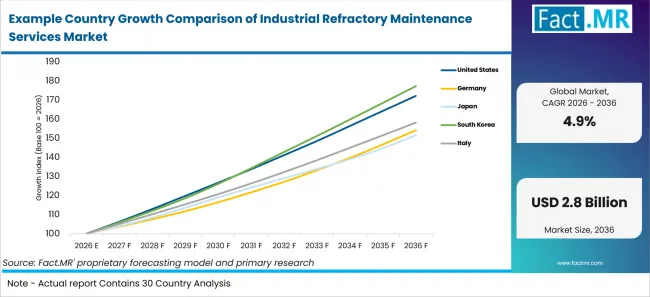
Example Country Growth Comparison Of Industrial Refractory Maintenance Services Market | Source: Fact.MR
| Country | CAGR (2026-2036) |
|---|---|
| Brazil | 7.0% |
| South Korea | 5.9% |
| United States | 5.6% |
| Italy | 4.7% |
| Germany | 4.4% |
| Japan | 4.3% |
Source: Fact.MR analysis. Updated Aug 19, 2026
What is powering Brazil’s lead?
7.0% CAGR, driven by steel, mining and kiln-service activity.
Brazil’s growth is supported by strong mining and steel activity. IBGE reported that Brazil’s mining and quarrying output increased 7.9% month over month in May 2026, while Worldsteel recorded 33.3 Mt of Brazilian crude steel production in 2025. Relining demand benefits from high-temperature assets, although crew scheduling and imported-material lead times may constrain shutdown work.
How is South Korea scaling demand?
5.9% CAGR, supported by steel exports and machinery investment.
South Korea’s growth reflects a large steel base and strengthening machinery activity. Worldsteel reported that South Korea produced 61.9 Mt of crude steel in 2025, while the Ministry of Data and Statistics reported that domestic machinery orders increased 25.9% year over year in May 2026. Gunning and inspection services support maintenance, although lower capacity utilization and demanding documentation requirements may slow approvals.
What underpins United States growth?
5.6% CAGR, driven by steel, cement and mineral-products capacity.
United States growth is supported by substantial cement and steel-related industrial capacity. USGS reported 100 million tons of cement shipments in 2025, while Federal Reserve data showed the iron and steel products index at 113.8448 in June 2026. Emergency mobilization costs, competing capital projects and capacity utilization may constrain refractory-service spending.
What supports Italy’s outlook?
4.7% CAGR, shaped by steel output and industrial production recovery.
Italy’s growth is supported by steel production and recovering industrial activity. Worldsteel reported 20.7 Mt of crude steel output in 2025, while Istat recorded a 4.6% month-over-month increase in energy output in May 2026. Relining demand remains steady, although producer-price inflation, short shutdown windows and rising operating costs may restrict projects.
How does Germany perform?
4.4% CAGR, supported by energy-intensive industries and price-controlled maintenance.
Germany’s growth reflects steel production and maintenance needs across cement, lime and glass facilities. Worldsteel reported 34.1 Mt of crude steel output in 2025, while Destatis recorded a 0.9% monthly increase in industrial production in May 2026. Higher metal prices, energy costs and lengthy qualification processes may constrain refractory-system changes.
What supports Japan’s growth?
4.3% CAGR, driven by steel, ceramics and careful furnace upkeep.
Japan’s growth is supported by its large steel base and disciplined furnace-maintenance practices. Worldsteel reported that Japan produced 80.7 Mt of crude steel in 2025, while METI’s revised data showed industrial production increased 0.1% month over month in May 2026. Automation supports repair work, although declining steel output, older furnaces and labor constraints may limit rapid expansion.
Who leads the Industrial Refractory Maintenance Services Market?
RHI Magnesita and Vesuvius show the clearest competitive prominence, while Calderys strengthens the refractory repair, gunning and monolithics landscape. Krosaki Harima adds automation capability, with Saint-Gobain Performance Ceramics & Refractories and Alfran extending the wider service-provider field.
RHI Magnesita and Vesuvius anchor the profiled competitive set across industrial refractory maintenance services. Calderys supports faster BOF and EAF repair through CALDE MAG GUN VELOCITY and strengthens monolithics availability for steel maintenance applications. Krosaki Harima contributes robotic refractory-maintenance capability through its REX-ROBO commercial deployment. Saint-Gobain Performance Ceramics & Refractories and Alfran broaden competition across installation, relining and high-temperature maintenance services.
Which companies are the key providers?
Key companies include RHI Magnesita, Vesuvius, Calderys, Krosaki Harima Corporation, Saint-Gobain Performance Ceramics & Refractories and Alfran in the company set.
- RHI Magnesita
- Vesuvius
- Calderys
- Krosaki Harima Corporation
- Saint-Gobain Performance Ceramics & Refractories
- Alfran
Bibliography
- Calderys. (2026, February 17). CALDE® MAG GUN VELOCITY helps steelmakers reduce downtime with fast refractory gunning repairs.
- Calderys. (2026, March 11). HWI, a member of Calderys, officially opens state-of-the-art Fulton lightweight monolithics facility.
- Federal Statistical Office (Destatis). (2026, July 7). Production in May 2026: +0.9% on the previous month.
- Federal Statistical Office (Destatis). (2026, July 20). Producer prices in June 2026: +1.8% on June 2025.
- Board of Governors of the Federal Reserve System. (2026, July 17). Industrial production and capacity utilization – G.17.
- Board of Governors of the Federal Reserve System. (2026, July 17). Industrial production: Manufacturing: Durable goods: Iron and steel products (NAICS = 3311,2) [Data series IPG3311A2S]. FRED, Federal Reserve Bank of St. Louis.
- Brazilian Institute of Geography and Statistics. (2026, June 30). Producer Price Index (IPP) is -0.30% in May. IBGE News Agency.
- Brazilian Institute of Geography and Statistics. (2026, July 3). Industry changes -0.2% in May; interrupts four rises in a row. IBGE News Agency.
- Istat. (2026, June 30). Industrial and construction producer prices – May 2026.
- Istat. (2026, July 10). Industrial production – May 2026.
- Krosaki Harima Corporation. (2025, August 25). New Product | First Commercial REX-ROBO™ Shipped!.
- Ministry of Economy, Trade and Industry. (2026, June 30). Indices of industrial production: Preliminary report for May 2026.
- U.S. Geological Survey. (2026, February 6). Mineral commodity summaries 2026.
- World Steel Association. (2026, January 23). December 2025 crude steel production and 2025 global crude steel production totals.
This Report Answers
- The report provides strategic intelligence on the Industrial Refractory Maintenance Services Market across Service and Refractory Type choices that shape furnace repair programs.
- Segment analysis covers Installation & relining and Monolithics/castables as the share leaders within the 2026 market.
- Country outlook evaluates Brazil and South Korea alongside the United States, Italy, Germany and Japan.
- Competitive analysis profiles RHI Magnesita and Vesuvius alongside Calderys and Krosaki Harima Corporation. Saint-Gobain Performance Ceramics & Refractories and Alfran complete the provider set.
- Service assessment covers Installation & relining and Repair & gunning. Inspection & monitoring and Emergency/shutdown services complete the service view.
- Refractory assessment covers Monolithics/castables, Bricks & shapes and Ceramic fibre across steel, cement, glass and petrochemical assets.
What does the Industrial Refractory Maintenance Services Market cover?
Installation, relining, repair, gunning and inspection services used for high-temperature process equipment.
The market covers contracted refractory work that protects furnace integrity during industrial heat processing. It includes inspection, installation, relining, repair and emergency support where refractory products are selected, installed or restored as part of a service job.
Coverage differs from material sales alone. The boundary includes service labor and site execution tied to furnace maintenance consumables, furnace tapping materials and adjacent hot-end repair packages when those materials are installed under a maintenance contract.
What is included in the scope?
Industrial refractory services used in furnaces, kilns, ladles, converters and heat-processing units.
The scope includes scheduled relining, repair gunning, shutdown services and inspection programs across steel, cement, lime, glass, non-ferrous metals and petrochemicals. Coverage includes work around fired heaters, thermal ceramics and electric arc furnaces when refractory maintenance is part of plant uptime planning. It also includes industrial insulation interfaces where heat-loss control affects lining work.
The market also covers service programs attached to metal casting operations and foundry chemicals when the project involves refractory coating repair, ladle lining or furnace-area maintenance. Inspection inputs from machine condition monitoring are included only when they feed refractory job planning.
What is excluded from the scope?
Standalone refractory product sales and unrelated construction services are outside the scope.
The scope excludes refractory bricks, castables and ceramic fibres sold without installation or maintenance labor. It also excludes general insulation work, civil concrete restoration and boiler cleaning unless the project directly maintains a high-temperature refractory lining. Furnace purchases are outside the scope unless the contract separately includes refractory installation or scheduled maintenance.
How Was the Analysis Built?
The analysis draws on 120+ sources, 35+ company portfolios, 25+ countries, and more than 20 industry interviews.
- Primary Research: Primary research includes discussions with manufacturers, service providers, technology developers, distributors, end users, procurement teams, and subject-matter experts. These conversations examine purchasing priorities, product adoption, operational challenges, approval requirements, competitive positioning, and the factors that influence wider market acceptance.
- Desk Research: Desk research covers government statistics, regulatory publications, company filings, trade data, technical studies, industry associations, standards, public policy, and other authoritative sources. Every source used in the analysis is documented in the bibliography.
- Market Sizing and Forecasting: Market estimates combine historical performance, demand indicators, pricing and volume trends, segment shares, company participation, country-level growth, adoption patterns, investment activity, and barriers to market expansion.
- Data Validation and Update Cycle: Findings are validated by comparing primary interviews with public data, company activity, regulatory changes, trade patterns, and industry developments. Regular updates review new product launches, capacity changes, partnerships, approvals, procurement trends, and shifts in commercial adoption.
Segmentation
What is the report’s scope and coverage?
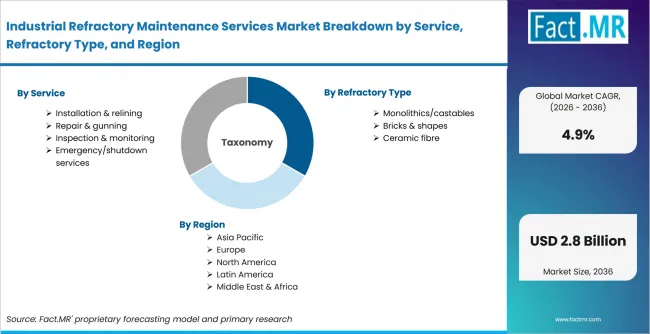
Industrial Refractory Maintenance Services Market Breakdown By Service, Refractory Type, And Region | Source: Fact.MR
| Attribute | Details |
|---|---|
| Quantitative Units | USD billion in 2026 to USD billion by 2036 at CAGR |
| Market Definition | Contracted refractory inspection, repair, relining, gunning, shutdown and emergency services used to maintain industrial furnaces, kilns, converters and heat-processing units. |
| Service | Installation & relining; Repair & gunning; Inspection & monitoring; Emergency/shutdown services |
| Refractory Type | Monolithics/castables; Bricks & shapes; Ceramic fibre |
| End-Use Industry | Iron & steel; Cement & lime; Glass; Non-ferrous metals; Petrochem |
| Regions Covered | North America; Latin America; Europe; East Asia; South Asia and Pacific; Middle East and Africa |
| Countries Covered | Brazil; South Korea; United States; Italy; Germany; Japan |
| Key Companies Profiled | RHI Magnesita; Vesuvius; Calderys; Krosaki Harima Corporation; Saint-Gobain Performance Ceramics & Refractories; Alfran |
| Forecast Period | 2026 to 2036 |
| Approach | Hybrid top-down and bottom-up approach using furnace installed base, steel and cement production indicators, shutdown cycles, refractory mix selection, labor depth, country adoption patterns and provider portfolio checks |
Source: Fact.MR analysis. Updated Aug 19, 2026
How is the market segmented?
-
By Service
- Installation & relining
- Repair & gunning
- Inspection & monitoring
- Emergency/shutdown services
-
By Refractory Type
- Monolithics/castables
- Bricks & shapes
- Ceramic fibre
-
By End-Use Industry
- Iron & steel
- Cement & lime
- Glass
- Non-ferrous metals
- Petrochem
-
By Region
- North America
- Latin America
- Europe
- East Asia
- South Asia and Pacific
- Middle East and Africa
Frequently Asked Questions
How big is the industrial refractory maintenance services market in 2026?
What is the CAGR of the industrial refractory maintenance services market from 2026 to 2036?
Which service leads the industrial refractory maintenance services market?
Which refractory type leads the industrial refractory maintenance services market?
Who are the leading companies in the industrial refractory maintenance services market?
Who worked on this report


Preview the report firsthand - request a free sample
Free SampleGet the brochure for pricing and purchase details
Download PDF