- Base Value(2025): 720.1 Mn
- Estimated Value(2026): 761.1 Mn
- Forecast Value (2036): 1325.0 Mn
- CAGR (2026 - 2036): 5.7%
Thermoelectric Refrigerator Analysis and Forecast by Fact.MR
- The Thermoelectric Refrigerator Market is expected to grow from USD 761.1 million in 2026 to USD 1325.0 million by 2036, at a 5.7% CAGR.
- Driven by growing outdoor recreation and road travel demand for silent portable cooling, medical and laboratory cold-chain requirements for compact refrigerant-free units, and automotive accessory integration expanding Peltier-based cabin cooling, with Portable Thermoelectric Refrigerators accounting for 54.2% share.
- Consumer Applications contributing 62.5% share as consumers prioritize portability, silent operation, energy efficiency, and convenience across outdoor recreation and travel applications.
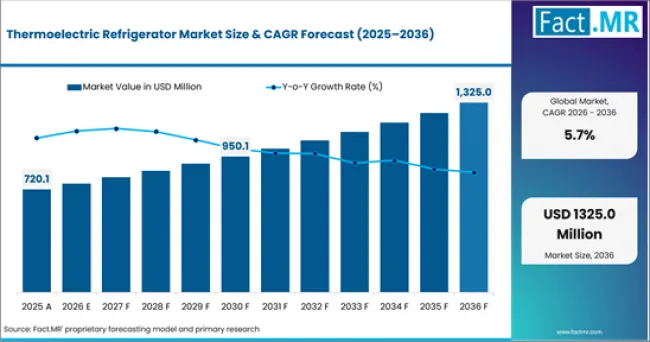
Thermoelectric Refrigerator Market Value Analysis | Source: Fact.MR
Summary of Thermoelectric Refrigerator Market
- Market Snapshot
- In 2025, the global Thermoelectric Refrigerator Market was valued at approximately USD 720.1 million.
- The market is estimated to reach USD 761.1 million in 2026 and is projected to attain USD 1325.0 million by 2036.
- The market is likely to expand at a CAGR of 5.7% during the forecast period.
- The market is anticipated to create an absolute dollar opportunity of USD 563.9 million between 2026 and 2036.
- Portable Thermoelectric Refrigerators account for 54.2% of product share in 2026.
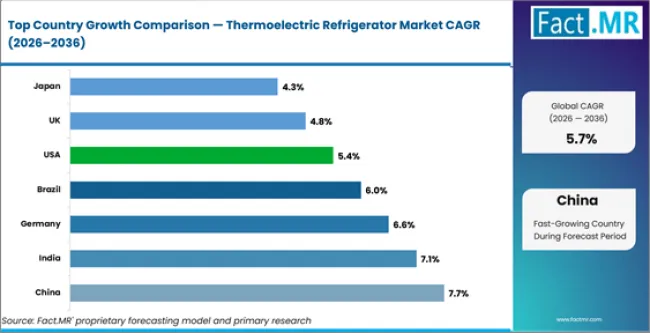
- China (7.7%) and India (7.1%) are the key growth markets during the forecast period.
- Demand and Growth Drivers
- Growing interest in outdoor recreation, road travel, and van-life culture is fueling demand for portable thermoelectric refrigerators with silent, vibration-free operation.
- Medical and laboratory cold-chain requirements for compact, reliable cooling without refrigerant gases sustain demand for thermoelectric units in healthcare and research settings.
- Automotive accessory integration is expanding as vehicle manufacturers and aftermarket suppliers incorporate thermoelectric cooling into premium cabin features.
- IoT-integrated smart cooling systems with app-based temperature control create differentiation in connected consumer and medical applications.
- Solar-powered thermoelectric units address energy-conscious and off-grid demand in outdoor and remote settings.
- Product and Segment View
- Portable Thermoelectric Refrigerators accounts for 54.2% of the product segment in 2026, emerging as the leading category.
- Consumer Applications account for 62.5% of the application segment in 2026, making it the dominant use setting.
- Key segmentation includes:
- Product: Portable Thermoelectric Refrigerators, Built In Thermoelectric Refrigerators, Automotive Thermoelectric Refrigerators, Medical Thermoelectric Refrigerators
- Application: Consumer Applications, Automotive Applications, Medical & Healthcare Applications, Laboratory Applications
- End Use: Residential Users, Automotive Industry, Healthcare Sector, Industrial & Laboratory Sector
- Technology: Thermoelectric Cooling Modules, Heat Dissipation Technology, Power Management Technology
- Formulation: Compact Integrated Cooling Systems, High Efficiency Cooling Systems, Hybrid Cooling Systems
- Distribution Channel: OEM Direct Sales, Retail Distribution, Online Channels
- These systems enable:
- Silent, vibration-free portable cooling
- Compact medical and laboratory cold-chain support
- IoT-connected temperature monitoring and control
- Geography and Competitive Outlook
- North America leads on outdoor recreation culture, automotive accessory spending, and established retail and online distribution for portable coolers.
- Europe demand reflects van-life and camping culture, medical cold-chain needs, and energy-efficiency awareness shaping product specification.
- Asia Pacific posts the steepest growth, with consumer electronics adoption and automotive accessory expansion in China and India widening thermoelectric demand.
- China (7.7%) and India (7.1%) lead country growth, with other major markets showing steady demand.
- Key companies include Dometic Group, Koolatron International Limited, Whynter LLC, Engel (Sawafuji Electric Co., Ltd.)
- Analyst Opinion
- Shambhu Nath Jha, Principal Consultant at Fact.MR, says "Thermoelectric cooling occupies a specific niche where silent, vibration-free operation matters more than raw cooling power. Portable models lead on volume, but the real growth edge is smart integration and medical cold-chain, where Peltier modules offer compact, refrigerant-free solutions. Compressor-based alternatives set the performance bar, so thermoelectric stays relevant only where convenience and form factor outweigh efficiency. China anchors manufacturing supply while India widens the consumer base. The suppliers best positioned combine reliable Peltier module performance with IoT-connected features and broad channel access, since pure-price competition against compressor models erodes margin quickly."
Key Growth Drivers, Constraints, and Opportunities
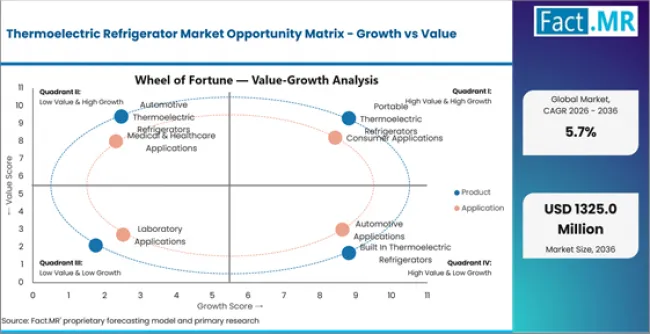
Thermoelectric Refrigerator Market Opportunity Matrix Growth Vs Value | Source: Fact.MR
Key Factors Driving Growth
- Growing interest in outdoor recreation, road travel, and van-life culture is fueling demand for portable thermoelectric refrigerators with silent, vibration-free operation.
- Medical and laboratory cold-chain requirements for compact, reliable cooling without refrigerant gases sustain demand for thermoelectric units in healthcare and research settings.
- Automotive accessory integration is expanding as vehicle manufacturers and aftermarket suppliers incorporate thermoelectric cooling into premium cabin features.
Key Market Constraints
- Lower cooling capacity relative to compressor-based systems limits thermoelectric suitability in high-ambient-temperature conditions.
- Higher energy consumption per unit of cooling compared to vapour-compression alternatives constrains adoption where power supply is limited.
- Price pressure from compressor-based portable refrigerators with superior cooling performance narrows the thermoelectric value proposition in some segments.
Key Opportunity Areas
- IoT-integrated smart cooling systems with app-based temperature control create differentiation in connected consumer and medical applications.
- Solar-powered thermoelectric units address energy-conscious and off-grid demand in outdoor and remote settings.
- Peltier module efficiency improvements through advanced semiconductor materials widen the performance envelope.
Segment-wise Analysis of the Thermoelectric Refrigerator
- Portable Thermoelectric Refrigerators holds 54.2% of the product segment in 2026, supported by broad consumer adoption and distribution scale.
- Consumer Applications represents 62.5% of the application segment in 2026, anchored by its dominant consumer-use application.
The Thermoelectric Refrigerator Market is segmented by product, application, end use, technology, formulation, distribution channel. Demand is shaped by outdoor recreation trends, consumer spending, automotive integration, and distribution-channel expansion.
Which Product Segment Dominates the Thermoelectric Refrigerator?
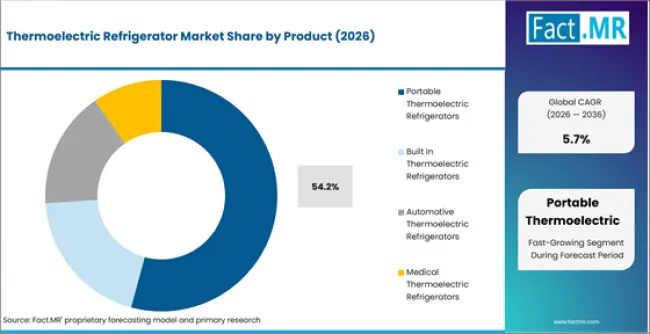
Thermoelectric Refrigerator Market Analysis By Product | Source: Fact.MR
Portable Thermoelectric Refrigerators lead the product segment with 54.2% share in 2026, reflecting strong demand from outdoor recreation, road travel, and van-life consumers who value silent, vibration-free cooling in compact, mobile formats.
The segment is expected to retain leadership as outdoor recreation and travel trends sustain portable demand. Built-in, automotive, and medical thermoelectric formats grow through integration and cold-chain applications, but portable models hold the largest share through their established consumer base.
Which Application Segment Dominates the Thermoelectric Refrigerator?
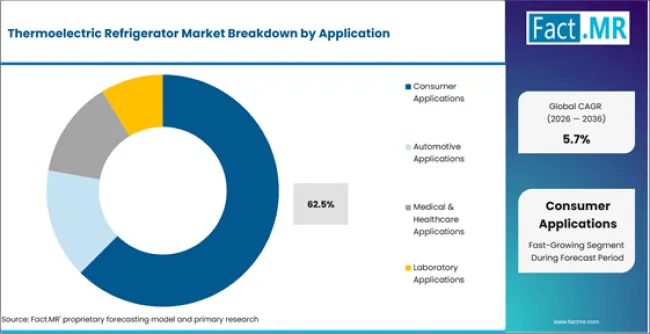
Thermoelectric Refrigerator Market Analysis By Application | Source: Fact.MR
Consumer Applications lead the application segment with 62.5% share in 2026, driven by camping, road travel, and personal cooling demand where thermoelectric convenience and portability outweigh compressor-level performance requirements.
The application is likely to hold its lead as consumer spending on outdoor recreation sustains demand. Automotive, medical, and laboratory applications grow through integration and cold-chain needs, but consumer use anchors the largest application channel.
Which Product Trend is Shaping the Next Phase of Growth in the Thermoelectric Refrigerator?
Portable Thermoelectric Refrigerators lead the product segment at 54.2%, and the defining dynamic is the balance between convenience and cooling performance. Thermoelectric cooling modules anchor the largest technology share, valued for silent, vibration-free operation that suits personal, automotive, and medical use cases where compressor noise and moving parts are disadvantages.
The most consequential shift is smart integration. IoT-connected cooling with app-based monitoring is moving thermoelectric systems from basic coolers toward data-enabled platforms, supported by compact integrated cooling systems that combine Peltier modules with power management. Consumer applications anchor the largest demand pool, while automotive and medical segments drive premium growth.
Regional Outlook Across Key Markets
- North America leads on outdoor recreation culture, automotive accessory spending, and established retail and online distribution for portable coolers.
- Europe demand reflects van-life and camping culture, medical cold-chain needs, and energy-efficiency awareness shaping product specification.
- Asia Pacific posts the steepest growth, with consumer electronics adoption and automotive accessory expansion in China and India widening thermoelectric demand.
- Japan shows steady demand anchored in advanced Peltier module technology and compact consumer electronics.
.webp "Top Country Growth Comparison Thermoelectric Refrigerator Market Cagr (2026 2036)")
Top Country Growth Comparison Thermoelectric Refrigerator Market Cagr (2026 2036) | Source: Fact.MR
CAGR Table
| Country | CAGR (%) |
|---|---|
| China | 7.7% |
| India | 7.1% |
| Germany | 6.6% |
| Brazil | 6.0% |
| U.S. | 5.4% |
| UK | 4.8% |
| Japan | 4.3% |
Source: Fact.MR analysis, based on proprietary forecasting model and primary research.
Thermoelectric Refrigerator Market Cagr Analysis By Country | Source: Fact.MR
Market Outlook for Thermoelectric Refrigerator in China
The China Thermoelectric Refrigerator market is projected to grow at a CAGR of 7.7% through 2036. Domestic thermoelectric module and cooler manufacturing capacity gives local producers cost advantages across portable and automotive formats. Consumer electronics adoption and e-commerce distribution widen demand for compact integrated cooling systems, while export channels serve global OEM and retail buyers.
- Domestic manufacturing capacity gives cost advantages in portable thermoelectric cooler production.
- E-commerce distribution widens consumer access to compact integrated cooling systems.
India Thermoelectric Refrigerator Demand Trends
The India Thermoelectric Refrigerator market is projected to grow at a CAGR of 7.1% through 2036. Demand is shaped by growing automotive accessory adoption and expanding organized retail and online channels that bring portable thermoelectric coolers to a wider consumer base. Cost-effectiveness favors compact integrated systems, while medical cold-chain applications gain traction in urban healthcare settings.
- Automotive accessory adoption is expanding demand for built-in thermoelectric coolers.
- Organized retail and online channels widen access to portable thermoelectric units.
Thermoelectric Refrigerator Growth Assessment in Germany
The Germany Thermoelectric Refrigerator market is projected to grow at a CAGR of 6.6% through 2036. EU energy-efficiency labeling and environmental regulation shape product specification across German manufacturers and retailers, favoring high-efficiency cooling systems. Strong camping and outdoor culture sustains consumer demand for portable thermoelectric refrigerators, while medical cold-chain requirements support healthcare-sector procurement.
- EU energy-efficiency standards shape thermoelectric cooler specification and labeling.
- Camping and outdoor culture sustains demand for portable thermoelectric refrigerators.
United States Thermoelectric Refrigerator Market Opportunity Outlook
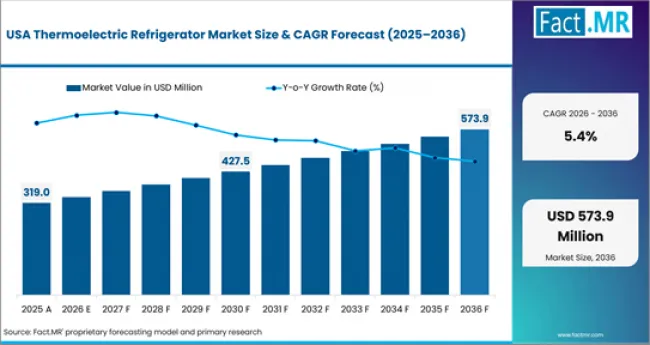
Thermoelectric Refrigerator Market Country Value Analysis | Source: Fact.MR
The United States Thermoelectric Refrigerator market is projected to grow at a CAGR of 5.4% through 2036. The portable cooler market is mature with strong outdoor recreation and RV culture, so growth is led by smart-connected upgrades and automotive integration rather than first-time adoption. Established retail and online channels sustain demand for portable thermoelectric refrigerators, while medical and laboratory applications support premium-tier growth.
- Outdoor recreation and RV culture sustain replacement and upgrade demand for portable coolers.
- Medical cold-chain applications support premium thermoelectric unit procurement.
Thermoelectric Refrigerator Demand Analysis in Japan
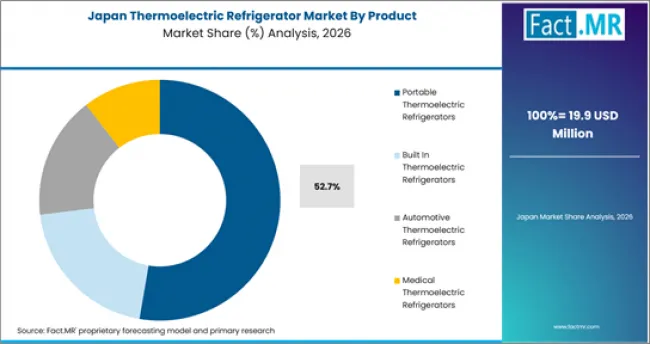
Thermoelectric Refrigerator Market Japan Market Share Analysis By Product | Source: Fact.MR
The Japan Thermoelectric Refrigerator market is projected to grow at a CAGR of 4.3% through 2036. Advanced Peltier module technology and domestic semiconductor manufacturing sustain thermoelectric innovation. Compact consumer electronics demand and preference for silent, vibration-free cooling support adoption, while medical and laboratory applications maintain steady institutional procurement.
- Advanced Peltier module technology sustains domestic thermoelectric innovation.
- Compact consumer electronics demand supports silent thermoelectric cooling adoption.
Competitive Benchmarking and Company Positioning
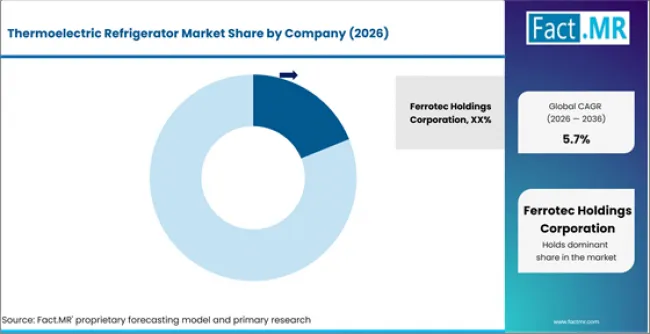
Thermoelectric Refrigerator Market Analysis By Company | Source: Fact.MR
Thermoelectric Refrigerator Analysis By Company
- Dometic, Koolatron, and Whynter hold leading positions in portable thermoelectric cooling, supported by strong brand recognition among outdoor, RV, and van-life consumers and broad retail and online distribution.
- Specialists including Indel B, Mobicool, and Thermoelectric Cooling America anchor medical, hospitality, and OEM niches where silent operation and compact form factor define buyer preference.
The competitive landscape is moderately fragmented, with differentiation driven by cooling performance, portability, and channel reach. Dometic, Koolatron, and Whynter lead through established consumer brands, broad product lines, and strong online and specialty-retail presence.
Below the leaders, Engel and Mobicool maintain positions across specific end-use segments and geographies. Competition turns on energy efficiency, ambient-temperature performance, and price relative to compressor alternatives.
Smart and connected cooling is an emerging competitive frontier, with IoT-integrated models offering app-based monitoring and temperature control. Suppliers that combine reliable Peltier module performance with smart features and broad channel access are positioned to capture upgrade and premium demand.
Key Companies in the Thermoelectric Refrigerator
- Leading companies in the thermoelectric refrigerator market include Dometic Group, Koolatron International Limited, Whynter LLC, Engel (Sawafuji Electric Co., Ltd.), which hold strong positions through portfolio breadth, product innovation, brand recognition, and broad distribution
- Indel B S.p.A., Mobicool International (Ezetil) maintain established positions across specific segments and channels, competing on cooling performance, energy efficiency, service, and regional reach.
- Wagan Corporation, Thermoelectric Cooling America Corporation and other specialists compete through focused offerings and niche strength, reinforcing relevance in a competitive but evolving market.
Recent Industry Developments
Samsung Develops Next-Generation Peltier Cooling Technology with Johns Hopkins Applied Physics Laboratory (2025)
- Samsung announced the development of next-generation Peltier cooling technology in collaboration with the Johns Hopkins Applied Physics Laboratory (APL). The research demonstrated a high-performance thermoelectric refrigerator using nano-engineered thin-film thermoelectric materials that significantly improve cooling efficiency while eliminating the need for conventional refrigerants.
Coherent Launches CT-Series Thermoelectric Coolers for Enhanced Thermal Management Applications (2025)
- Coherent Corp. launched its CT-Series thermoelectric coolers, expanding its solid-state thermal management portfolio. The new modules provide enhanced temperature differentials and improved reliability for cooling applications, supporting broader adoption of thermoelectric refrigeration technologies.
Phononic Announces Exclusive Cold Chain Licensing Agreement with Peltier, Inc. (2025)
- Phononic entered an exclusive licensing agreement with Peltier Technology, Inc. to commercialize its Active Cooling Solutions (ACS™) platform for cold-chain applications. The ACS platform uses solid-state thermoelectric cooling technology and includes refrigeration systems, freezer units, portable cooling totes, docking stations, and IoT-enabled temperature monitoring solutions.
Leading Companies Shaping the Thermoelectric Refrigerator
- Dometic Group
- Koolatron International Limited
- Whynter LLC
- Indel B S.p.A.
- Wagan Corporation
Sources and Research References
- Samsung Electronics Co., Ltd. (2025). Samsung develops next-generation Peltier cooling technology with Johns Hopkins APL. Samsung Newsroom.
- Coherent Corp. (2025). CT-Series thermoelectric coolers. Coherent.
- Phononic, Inc. (2025). Phononic announces exclusive cold chain licensing agreement with Peltier, Inc. Yahoo Finance.
This bibliography is provided for reader reference and is not exhaustive. The full report contains the complete reference list and detailed citations.
Key Questions This Report Addresses
- What is the current and future size of the Thermoelectric Refrigerator Market?
- How fast is the Thermoelectric Refrigerator Market expected to grow between 2026 and 2036?
- Which product segment is likely to lead the market by 2026?
- Which application segment is expected to account for the highest demand by 2026?
- What factors are driving demand in the thermoelectric refrigerator market globally?
- Which countries are projected to show the fastest growth through 2036?
- What is driving market expansion in China and India?
- Who are the key companies active in the thermoelectric refrigerator market?
- How does thermoelectric cooling performance compare to compressor-based alternatives?
- What role does IoT integration play in thermoelectric product differentiation?
- How does Fact.MR estimate and validate the thermoelectric refrigerator market forecast?
Thermoelectric Refrigerator Market Definition
The thermoelectric refrigerator market covers portable, built-in, automotive, and medical thermoelectric cooling units based on Peltier-effect semiconductor modules. It spans consumer, automotive, medical, and laboratory applications delivered through compact integrated, high-efficiency, and hybrid cooling system formats across residential users, automotive, healthcare, and industrial sectors.
Thermoelectric Refrigerator Market Inclusions
- The scope covers global and regional market size and forecasts for 2026 to 2036 across product type, application, end use, technology, formulation, and distribution channel.
- It includes demand tied to outdoor recreation, RV and van life culture, medical cold-chain requirements, and automotive accessory adoption.
- Pricing analysis spans entry-level portable coolers to high-specification medical and laboratory units across OEM, retail, and online channels.
- Coverage includes thermoelectric module efficiency improvements and IoT-integrated smart cooling systems.
Thermoelectric Refrigerator Market Exclusions
- The scope excludes compressor-based portable refrigerators and absorption cooling systems outside the thermoelectric definition.
- It excludes large-scale commercial refrigeration and industrial cooling equipment.
- Thermoelectric modules sold as components without finished refrigerator assembly are excluded.
- Non-cooling applications of Peltier technology are excluded.
Thermoelectric Refrigerator Market Research Methodology
- The methodology combines secondary research, primary interviews, and demand-side modeling.
- It draws on 100 plus secondary sources and benchmarks 40 plus product portfolios.
- Market sizing covers 30 plus countries through a consumer-electronics and cold-chain adoption model with top-down validation.
- Key inputs include outdoor recreation participation, vehicle accessory spending, medical cold-chain requirements, and thermoelectric module pricing.
- The model cross-checks unit demand with retail shipments, OEM integration rates, and online sales data.
- Primary validation includes 20 plus interviews across OEMs, retailers, distributors, and end users.
- Final estimates pass through channel reconciliation and sensitivity testing.
Scope of Analysis
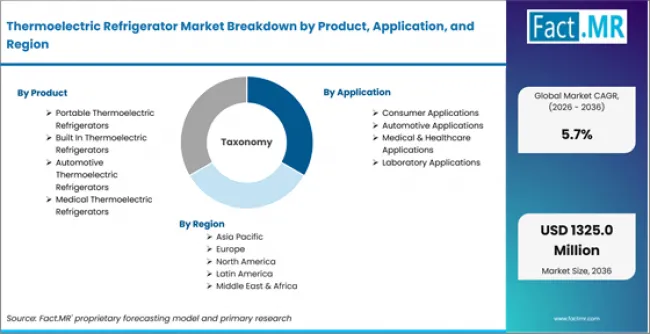
Thermoelectric Refrigerator Market Breakdown By Product, Application, And Region | Source: Fact.MR
| Parameter | Details |
|---|---|
| Quantitative Units | USD 761.1 million to USD 1325.0 million, at a CAGR of 5.7% |
| Market Definition | The thermoelectric refrigerator market covers Peltier-based portable, built-in, automotive, and medical cooling units across consumer, automotive, healthcare, and laboratory applications. |
| Regions Covered | North America, Latin America, Europe, East Asia, South Asia and Pacific, Middle East and Africa |
| Countries Covered | China, India, Germany, Brazil, U.S., UK, Japan, 30 plus countries |
| Key Companies | Dometic Group, Koolatron International Limited, Whynter LLC, Engel (Sawafuji Electric Co., Ltd.), Electrolux AB, Haier Group, Indel B S.p.A., Mobicool International (Ezetil), Wagan Corporation, Thermoelectric Cooling America Corporation |
| Forecast Period | 2026 to 2036 |
| Approach | Hybrid demand-side and top-down methodology built on country-level demand, product and technology benchmarking, pricing analysis, shipment validation, and primary interviews across OEMs, retailers, distributors, and end users |
Thermoelectric Refrigerator Segmentation
-
Thermoelectric Refrigerator Market Segmented by Product:
- Portable Thermoelectric Refrigerators
- Personal Cooling Units
- Mini Travel Refrigerators
- Car Mounted Cooling Boxes
- Outdoor Portable Units
- Camping Cooling Systems
- Portable Medical Coolers
- Personal Cooling Units
- Built In Thermoelectric Refrigerators
- Home Integrated Systems
- Kitchen Drawer Cooling Units
- Compact Wall Mounted Units
- Commercial Embedded Units
- Hotel Room Mini Bars
- Office Integrated Cooling Drawers
- Home Integrated Systems
- Automotive Thermoelectric Refrigerators
- Passenger Vehicle Units
- Dashboard Cooling Compartments
- Rear Seat Cooling Boxes
- Commercial Vehicle Units
- Truck Driver Cooling Units
- Fleet Refrigeration Modules
- Passenger Vehicle Units
- Medical Thermoelectric Refrigerators
- Laboratory Cooling Systems
- Sample Storage Refrigerators
- Portable Vaccine Coolers
- Pharmaceutical Storage Units
- Drug Stability Cooling Systems
- Clinical Trial Storage Units
- Laboratory Cooling Systems
- Portable Thermoelectric Refrigerators
-
Thermoelectric Refrigerator Market Segmented by Application:
- Consumer Applications
- Household Cooling Needs
- Personal Beverage Cooling
- Small Food Storage Units
- Travel & Mobility Applications
- Road Trip Cooling Solutions
- Portable Outdoor Refrigeration
- Household Cooling Needs
- Automotive Applications
- Passenger Vehicle Cooling
- Car Cabin Beverage Cooling
- Personal Vehicle Storage Units
- Commercial Vehicle Cooling
- Truck Cabin Refrigeration
- Fleet Driver Cooling Systems
- Passenger Vehicle Cooling
- Medical & Healthcare Applications
- Hospital Cold Storage
- Blood Sample Preservation Units
- Vaccine Transport Cooling
- Emergency Medical Applications
- Ambulance Cooling Systems
- Field Medical Refrigeration
- Hospital Cold Storage
- Laboratory Applications
- Research Laboratory Storage
- Biological Sample Preservation
- Chemical Stability Storage Units
- Industrial Laboratory Systems
- Quality Testing Cooling Units
- Material Testing Refrigeration
- Research Laboratory Storage
- Consumer Applications
-
Thermoelectric Refrigerator Market Segmented by End Use:
- Residential Users
- Urban Households
- Apartment Cooling Systems
- Compact Kitchen Units
- Rural Households
- Off Grid Cooling Systems
- Low Power Refrigeration Units
- Urban Households
- Automotive Industry
- Passenger Vehicle Manufacturers
- Car Interior System Integrators
- Luxury Vehicle Cooling Systems
- Commercial Vehicle Manufacturers
- Truck OEM Cooling Solutions
- Fleet Management Systems
- Passenger Vehicle Manufacturers
- Healthcare Sector
- Hospitals & Clinics
- Emergency Care Units
- Diagnostic Centers
- Pharmaceutical Companies
- Drug Storage Facilities
- Cold Chain Logistics Units
- Hospitals & Clinics
- Industrial & Laboratory Sector
- Research Institutions
- Material Testing Labs
- Chemical Research Facilities
- Manufacturing Units
- Electronics Cooling Applications
- Precision Equipment Storage
- Research Institutions
- Residential Users
-
Thermoelectric Refrigerator Market Segmented by Technology:
- Thermoelectric Cooling Modules
- Peltier Effect Systems
- Solid State Cooling Plates
- Micro Thermoelectric Chips
- Multi Stage Cooling Modules
- Cascade Cooling Systems
- High Efficiency Heat Pumps
- Peltier Effect Systems
- Heat Dissipation Technology
- Passive Cooling Systems
- Heat Sink Based Cooling Units
- Graphite Thermal Spreaders
- Active Cooling Systems
- Fan Assisted Heat Removal
- Liquid Assisted Thermal Control
- Passive Cooling Systems
- Power Management Technology
- Low Power Consumption Systems
- Battery Optimized Cooling Circuits
- Energy Efficient Controllers
- Smart Power Regulation
- Adaptive Cooling Algorithms
- Load Based Power Adjustment Systems
- Low Power Consumption Systems
- Thermoelectric Cooling Modules
-
Thermoelectric Refrigerator Market Segmented by Formulation:
- Compact Integrated Cooling Systems
- Miniaturized Cooling Modules
- Chip Level Cooling Units
- Portable Module Assemblies
- Space Optimized Systems
- Thin Wall Refrigeration Units
- Lightweight Cooling Structures
- Miniaturized Cooling Modules
- High Efficiency Cooling Systems
- Advanced Thermal Conversion Units
- High COP Thermoelectric Modules
- Enhanced Heat Transfer Systems
- Low Energy Consumption Systems
- Battery Saver Cooling Circuits
- Eco Efficient Cooling Designs
- Advanced Thermal Conversion Units
- Hybrid Cooling Systems
- Thermoelectric + Compressor Hybrid
- Dual Mode Cooling Systems
- Adaptive Cooling Mode Controllers
- Thermal Storage Hybrid Systems
- Phase Change Material Integration
- Thermal Buffer Storage Units
- Thermoelectric + Compressor Hybrid
- Compact Integrated Cooling Systems
-
Thermoelectric Refrigerator Market Segmented by Distribution Channel:
- OEM Direct Sales
- Appliance Manufacturer Contracts
- Refrigeration Equipment OEM Deals
- Automotive OEM Partnerships
- Healthcare OEM Supply Chains
- Medical Equipment Manufacturer Contracts
- Pharmaceutical Supply Agreements
- Appliance Manufacturer Contracts
- Retail Distribution
- Consumer Electronics Retailers
- Home Appliance Stores
- Specialty Cooling Equipment Shops
- Hypermarkets & Supermarkets
- Mass Retail Appliance Chains
- Urban Retail Distribution Networks
- Consumer Electronics Retailers
- Online Channels
- E Commerce Platforms
- Global Online Marketplaces
- Direct Brand Websites
- B2B Online Platforms
- Industrial Procurement Portals
- Healthcare Supply Platforms
- E Commerce Platforms
- OEM Direct Sales
-
Thermoelectric Refrigerator Market by Region:
- North America
- USA
- Canada
- Mexico
- Latin America
- Brazil
- Chile
- Rest of Latin America
- Western Europe
- Germany
- UK
- Italy
- Spain
- France
- Nordic
- BENELUX
- Rest of Western Europe
- Eastern Europe
- Russia
- Poland
- Hungary
- Balkan & Baltic
- Rest of Eastern Europe
- East Asia
- China
- Japan
- South Korea
- South Asia and Pacific
- India
- ASEAN
- Australia & New Zealand
- Rest of South Asia and Pacific
- Middle East & Africa
- Kingdom of Saudi Arabia
- Other GCC Countries
- Turkiye
- South Africa
- Other African Union
- Rest of Middle East & Africa
- North America