- Base Value(2020): 2.5 Bn
- Forecast Value (2035): 6.7 Bn
- CAGR (2035): 8.4%
Outdoor Hot Tub Market Outlook 2025 to 2035
The global outdoor hot tub market is projected to reach USD 6.7 billion by 2035, rising from USD 3.0 billion in 2025, reflecting a CAGR of 8.4% during the forecast period. Outdoor hot tubs are increasingly being perceived as more than a luxury item, with consumers recognizing their potential to enhance health, provide private leisure, and support year-round entertainment.
Advancements in product innovation including simplified installation, smarter water management, and improved energy efficiency along with expanded distribution channels and stronger dealer networks, have made outdoor hot tubs more accessible and affordable for a wider consumer base.
Shifts in consumer lifestyle preferences, emphasizing experiential outdoor spaces over conventional appliances, coupled with rising demand from boutique wellness centers and hospitality venues, are further propelling market growth. These factors highlight the evolving role of outdoor hot tubs as both a lifestyle and wellness investment, creating opportunities for manufacturers and distributors across global markets.
Quick Stats of Outdoor Hot Tub Market
- Outdoor Hot Tub Market Size (2025): USD 3.0 billion
- Projected Outdoor Hot Tub Market Size (2035): USD 6.7 billion
- Forecast CAGR of Outdoor Hot Tub Market (2025 to 2035): 8.4%
- Leading Product Type Segment of Outdoor Hot Tub Market: Portable (60%)
- Leading Material Segment of Outdoor Hot Tub Market: Acrylic (55%)
- Key Growth Regions of Outdoor Hot Tub Market: United States, China, United Kingdom
- Prominent Players in the Outdoor Hot Tub Market: Jacuzzi, Hot Spring Spas, Sundance® Spas, Caldera Spas, and Bullfrog Spas
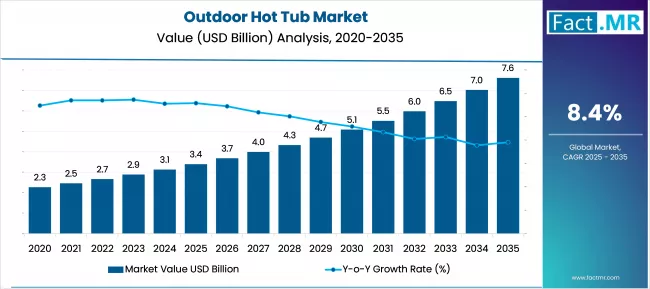
Outdoor Hot Tub Market Market Value Analysis | Source: Fact.MR
| Metric | Value |
|---|---|
| Industry Size (2025E) | USD 3.0 billion |
| Industry Size (2035F) | USD 6.7 billion |
| CAGR (2025-2035) | 8.4% |
Source: Fact.MR analysis. Updated Oct 11, 2025
The global outdoor hot tub market has experienced steady growth over the past decade and is projected to continue expanding through 2035. In 2020, the market was valued at USD 2.5 billion and demonstrated consistent year-on-year growth, reaching USD 3.2 billion by 2024.
This growth was driven by increasing consumer awareness of wellness and luxury home amenities, as well as a growing preference for private relaxation spaces amid lifestyle changes and health-conscious trends. The period between 2020 and 2024 also saw moderate adoption in emerging markets, where rising disposable incomes and urbanization fueled demand.
Entering the forecast period, the market is expected to expand at a CAGR of 8.4% from 2025 to 2035. By 2035, the market is projected to reach USD 6.7 billion. The forecast growth reflects both the increasing popularity of outdoor leisure products and the continuous innovation in hot tub features, including energy-efficient designs, smart controls, and premium customization options.
North America and Europe remain key markets due to established consumer bases and high penetration of luxury home products, while the Asia-Pacific region is anticipated to register significant growth, driven by rising urban middle-class populations and expanding e-commerce channels.
Despite the positive outlook, the market faces challenges such as high product costs, seasonal demand fluctuations, and regulatory concerns related to water usage and safety standards. Market players are responding by offering flexible financing options, eco-friendly solutions, and diversified product portfolios to attract new buyers.
Analyzing Key Dynamics of the Outdoor Hot Tub Market
The global outdoor hot tub market has experienced steady growth over the past few years and is poised for further expansion due to rising consumer interest in wellness, luxury home upgrades, and smart home integration.
Growth is driven by rising disposable incomes, increasing demand for relaxation and hydrotherapy solutions, and technological advancements in energy-efficient and low-maintenance hot tubs.
Market participants face challenges such as high product costs, seasonal demand fluctuations, and strict regulatory standards across different regions. Understanding these drivers and challenges is crucial for stakeholders seeking sustainable growth and competitive positioning in this market.
Increasing Consumer Awareness of Wellness and Luxury Lifestyle Driving Outdoor Hot Tub Market Expansion
Rising awareness about wellness, mental health, and relaxation therapies is encouraging households to invest in home-based recreational amenities. Outdoor hot tubs are increasingly seen as a luxury lifestyle addition that combines comfort with hydrotherapy benefits. Busy urban lifestyles and stress-related health concerns have prompted consumers to prioritize products that enhance relaxation, improve sleep quality, and relieve muscle tension.
Residential buyers, second-home owners, and hospitality operators are all contributing to increased adoption. Spa centers, hotels, and wellness resorts are incorporating outdoor hot tubs into their offerings to attract health-conscious clientele and create a premium experience, fueling overall market growth.
Technological Innovations in Energy Efficiency and Smart Features Boosting Market Penetration
Advancements in design, materials, and smart features are making outdoor hot tubs more attractive and convenient for end-users. Energy-efficient heating systems, automated cleaning technologies, and remote-controlled features improve usability while lowering maintenance efforts and operational costs. Users can monitor water quality, adjust temperature, and schedule cleaning cycles via smartphone applications, appealing to tech-savvy consumers.
Manufacturers are introducing durable acrylic, polymer, and wood-based designs that offer long-lasting performance while reducing energy consumption. These innovations are enhancing market penetration and creating opportunities for premium product segments in developed and emerging markets.
High Initial Investment and Maintenance Costs Limiting Market Adoption
Outdoor hot tubs require significant upfront investment, which limits accessibility for middle-income households. The cost includes installation, plumbing, electrical setup, and ongoing maintenance, which may deter potential buyers.
Seasonal demand variations in colder regions affect usage frequency and ROI, creating hesitancy among consumers. Insurance and warranty requirements further add to ownership costs, especially in regions with stringent safety regulations. High costs remain a barrier to mass adoption, particularly in price-sensitive markets.
Seasonal Fluctuations in Demand and Regulatory Hurdles Hindering Market Growth
The outdoor hot tub market is affected by seasonal trends, as colder climates restrict usage to certain months of the year. Demand peaks during spring and summer but declines in winter, leading to inventory and production planning challenges for manufacturers.
Regulatory compliance concerning water safety, electrical installation, and environmental standards varies across countries, requiring significant investment in testing, certification, and adherence to local guidelines. Navigating diverse regulatory landscapes is time-consuming and costly, restricting the ability of smaller players to expand globally.
Consumer Concerns About Water Safety and Maintenance Reducing Adoption Rates
Consumers often associate hot tubs with hygiene issues and waterborne illnesses if not properly maintained. The need for regular chemical treatment, cleaning, and inspection increases the perceived complexity of ownership. Mismanagement can lead to bacterial growth, skin irritations, and other health risks, reducing customer confidence.
Manufacturers must invest in education, user-friendly maintenance tools, and customer support services to mitigate these concerns. These factors collectively slow down market growth and require additional strategic initiatives to maintain adoption momentum.
Regional Trends of the Outdoor Hot Tub Market
Asia-Pacific is the fastest-growing market for outdoor hot tubs, driven by rapid urbanization, rising discretionary income, and a growing preference for healthy and fun lifestyles. Portable and inflatable hot tubs are especially popular in densely populated cities where permanent installations are challenging, while upscale neighborhoods in wealthy coastal cities and inland villages are adopting high-end models. The internet and local specialty stores are accelerating brand growth, helping businesses expand quickly in both urban and suburban markets.
North America continues to lead product variety and dealer networks, with customers valuing strong after-sales support and demonstration centers. The retail and exhibition ecosystem, including specialty showrooms, builder partnerships, and expos, remains a critical influence on purchase decisions. Smart water-care systems and low-maintenance models are particularly popular among suburban homeowners and buyers of second homes.
In Europe, demand remains steady, with consumers focusing on energy efficiency, product certifications, and environmental impact. Built-in and premium models are popular in large outdoor living spaces, though weaker dealer networks encourage local production and collaboration.
Country-Wise Outlook
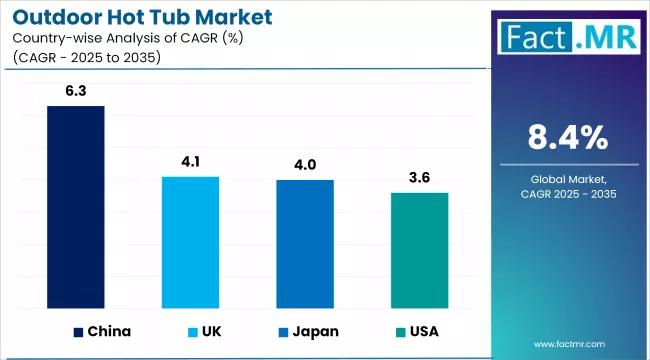
Outdoor Hot Tub Market CAGR Analysis By Country | Source: Fact.MR
| Country | CAGR (2025-2035) |
|---|---|
| United States | 3.6% |
| China | 6.3% |
| United Kingdom | 4.1% |
Source: Fact.MR analysis. Updated Oct 11, 2025
United States Shows Consistent Progress in Response to Increasing Wellness Trends
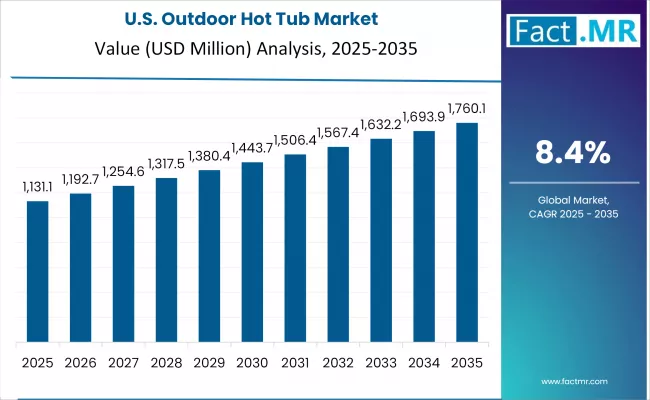
Outdoor Hot Tub Market Country Value Analysis | Source: Fact.MR
The United States outdoor hot tub market is anticipated to expand at a CAGR of 3.6% between 2025 and 2035. This consistent expansion highlights the nation's robust wellness ethos and the rising demand among consumers for relaxation solutions that can be utilized at home.
The demand is especially strong in areas with ideal climates, like California, where hot tubs play a crucial role in outdoor living environments. The increasing popularity of staycations and home-based wellness retreats is driving market growth.
The market is experiencing a transition towards hot tubs that are both energy-efficient and equipped with advanced technology. Businesses are increasingly looking for models that provide features such as smart controls, energy-saving modes, and low-maintenance designs.
This trend resonates with the wider market demand for efficient and eco-friendly solutions in home appliances. As the market evolves, there is an increasing focus on after-sales services, such as maintenance and repair, to guarantee lasting customer satisfaction.
- There is a robust demand in areas characterized by advantageous climates, like California
- Transition to hot tub models that prioritize energy efficiency and incorporate cutting-edge technology
- Increasing focus on post-purchase support, encompassing upkeep and restoration
Demand for Outdoor Hot Tubs in China fuelled by Urbanization
The outdoor hot tub market in China is projected to experience a CAGR of 6.3% from 2025 to 2035. This swift growth is driven by the nation's fast-paced urban development and increasing disposable income levels.
With an increasing number of Chinese consumers prioritizing luxury home features, hot tubs are emerging as a desirable addition in contemporary residences, particularly in major urban centers such as Beijing and Shanghai. The growing emphasis on health and wellness drives this demand, as individuals look for relaxation and therapeutic advantages within their own spaces.
China's manufacturing strengths establish it as a dominant force in the hot tub industry worldwide. The nation exports a substantial quantity of hot tubs, leveraging its competitive cost structure and streamlined manufacturing methods. This export capability not only bolsters domestic market expansion but also amplifies China's presence in the global hot tub sector.
- Swift growth in the market fueled by urban development and increasing disposable income levels
- Heightened emphasis on health and wellness within the consumer base
- Robust standing as an international frontrunner in the manufacturing and distribution of hot tubs
United Kingdom to Emerge as a Premium Market backed by Technological Integration
The United Kingdom's outdoor hot tub market is projected to progress at a CAGR of 4.1% from 2025 to 2035. This growth is underpinned by the country's affluent consumer base and a growing interest in luxury home amenities. British consumers are increasingly investing in high-end hot tubs that offer advanced features such as hydrotherapy jets, LED lighting, and smart connectivity. The trend towards integrating technology into home leisure products is evident, with many hot tubs now compatible with mobile applications for remote control and monitoring.
The market for outdoor hot tubes in the United Kingdom is experiencing a shift towards sustainability. Consumers are showing preference for eco-friendly hot tubs that utilize energy-efficient systems and sustainable materials. This aligns with the broader environmental consciousness prevalent in the country. The market is also witnessing a rise in demand for compact and customizable hot tubs, catering to urban dwellers with limited outdoor space.
- Demand for high-end hot tubs with advanced technological features
- Growing preference for eco-friendly and energy-efficient models
- Increase in demand for compact and customizable hot tubs for urban settings
Category-wise Analysis
Portable Outdoor Hot Tubs Continue to Lead by Product Type
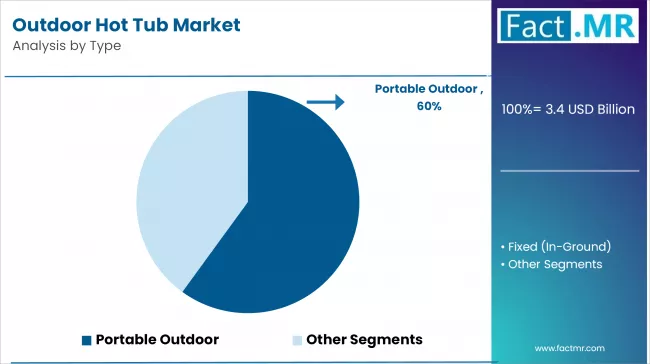
Outdoor Hot Tub Market Analysis By Type | Source: Fact.MR
Portable outdoor hot tubs dominate the product type segment, capturing roughly 60% of the market in 2025. Their appeal is driven by easy installation, flexibility in placement, and relatively lower upfront costs compared to fixed in-ground models.
Consumers increasingly prefer portable units for their ability to be relocated seasonally or stored, aligning with trends in modular outdoor living spaces. Features such as energy-efficient systems and smart controls enhance their attractiveness to health-conscious and tech-savvy buyers seeking year-round relaxation and private leisure.
In-ground hot tubs, while premium in positioning, account for about 40% of the product type segment and are primarily adopted by high-end residential properties and hospitality venues. Their permanent installation requirements and higher maintenance costs limit their adoption.
Acrylic Remains the Preferred Material for Outdoor Hot Tubs, Holding 55% of the Market Share
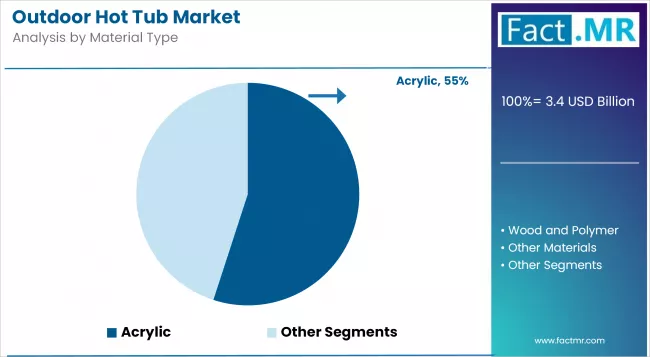
Outdoor Hot Tub Market Analysis By Material Type | Source: Fact.MR
Acrylic is the most widely used material in the outdoor hot tub market, commanding a 55% share in 2025. Its durability, low maintenance, and aesthetic versatility make it highly appealing for residential buyers prioritizing design and comfort.
Acrylic tubs offer superior insulation and energy efficiency, supporting growing demand for eco-friendly outdoor wellness solutions. Customizable shapes and colors further contribute to its dominance, enabling consumers to match tubs with existing backyard or patio aesthetics.
Wood and polymer collectively make up around 40% of the material segment, with wood favored for its rustic appeal and polymer for cost-effectiveness. Other materials represent 5%, primarily for niche installations or specialized design preferences. Acrylic’s combination of durability, energy efficiency, and design flexibility ensures it remains the material of choice for most consumers.
Residential Applications Drive 65% of Outdoor Hot Tub Market Growth Globally
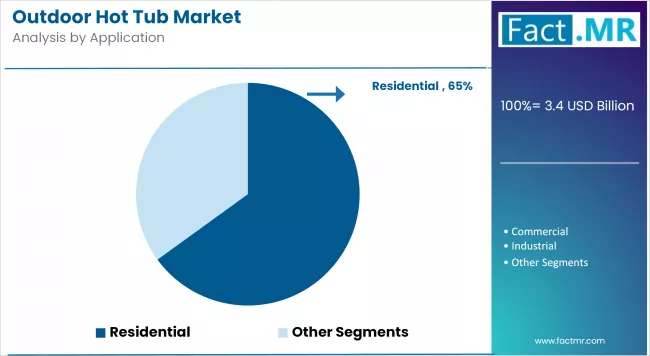
Outdoor Hot Tub Market Analysis By Application | Source: Fact.MR
The residential application sub-segment leads the market, accounting for approximately 65% of the total share in 2025. Homeowners increasingly view outdoor hot tubs as a lifestyle and wellness investment rather than a luxury item.
The popularity of compact portable models, energy-efficient systems, and smart technology enhances accessibility, enabling more households to integrate these units into backyard wellness spaces. The focus on private leisure, health benefits, and experiential outdoor spaces drives continued adoption in this sub-segment.
Commercial and institutional applications make up 35% of the total revenue, with boutique hotels, resorts, and wellness centers leading adoption. These buyers prioritize capacity, durability, and regulatory compliance.
Institutional usage is limited but growing in specialized wellness and rehabilitation centers, where hydrotherapy benefits are increasingly recognized. Residential adoption, however, remains the primary driver of market growth due to its broader reach and lifestyle integration.
Offline Retail Channels Remain the Dominant Route for Outdoor Hot Tub Sales
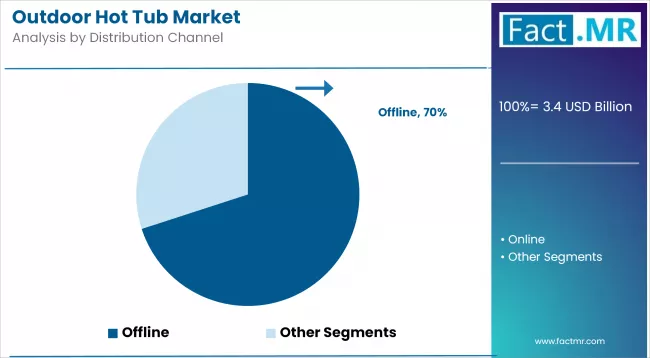
Outdoor Hot Tub Market Analysis By Distribution Channel | Source: Fact.MR
Offline distribution is the leading channel, capturing roughly 70% of the market in 2025. Consumers prefer visiting specialty stores, authorized dealers, and retail showrooms to experience products firsthand, verify quality, and receive installation guidance.
This is particularly crucial for high-value portable and fixed units, where service support and tangible product evaluation are key to purchase decisions. Strong dealer networks and regional showrooms further reinforce offline dominance, especially in North America and Europe.
Online channels account for 30% of the market share but are growing rapidly. E-commerce platforms provide convenience, wider selection, and competitive pricing, particularly for portable models.
The adoption of virtual product demos and augmented reality tools is increasing confidence in online purchases. Nonetheless, offline channels maintain dominance due to the tangible, service-oriented nature of outdoor hot tub sales.
Competitive Analysis
The global outdoor hot tub market is rapidly expanding, driven by rising consumer interest in wellness, relaxation, and home remodelling. This expansion has attracted both known brands and new players, resulting in a competitive landscape in which corporations are constantly striving to differentiate themselves through innovation, strategic collaborations, and customer-centric services.
This market's competitive intensity ranges from moderate to strong. Leading brands like as Jacuzzi®, Hot Spring Spas, and Sundance® Spas maintain their dominance through high brand awareness, substantial dealer networks, and long-term consumer trust.
Leading brands and regional manufacturers are driving up competition by providing distinctive products, competitive prices, and specialized services. The cohabitation of luxury and low-cost products responds to a diverse spectrum of consumer preferences, increasing competitive pressures.
Key players use a range of methods to remain competitive. Product innovation remains a top priority, with firms incorporating cutting-edge technologies including energy-efficient heating systems, smart controls, and enhanced water filtration processes. Sustainability programs are also gaining traction, with businesses emphasizing eco-friendly materials and energy-saving features to appeal to environmentally concerned customers.
Expansion into growing countries through partnerships and regional manufacturing enables companies to capitalize on expanding demand, while improved customer experiences such as tailored services, longer warranties, and extensive after-sales support help build loyalty and differentiation. Market dynamics exert a substantial influence on big players' strategic decisions. Regulatory regulations, such as energy consumption standards, drive innovation in product design and operational efficiency.
Pricing strategies and product offerings are shaped by economic considerations, such as changes in disposable income, to provide accessibility to a wide range of consumer categories. Increasing consumer trends emphasizing health and wellbeing drive the development of features such as hydrotherapy jets and chromotherapy lighting, ensuring that goods meet lifestyle expectations.
To successfully navigate the competitive market, businesses should prioritize technological progress, including smart and energy-efficient features to suit modern consumer demands. Emphasizing sustainability through eco-friendly materials and energy-efficient designs can attract environmentally conscientious customers while also strengthening brand positioning.
Diversifying product offerings to encompass different sizes, shapes, and functionality allows you to reach a wider range of market groups and meet specialized requests. Brand loyalty is strengthened by great customer service, tailored experiences, and extensive after-sales support, ensuring repeat business. Proactive monitoring and adaptation to regulatory changes protects market trust and minimizes disruptions.
Key Players Profiled in the Outdoor Hot Tub Market
- Jacuzzi®
- Hot Spring Spas
- Sundance® Spas
- Caldera Spas
- Bullfrog Spas
- Master Spas
- Wellis Spa
- Canadian Spa Company
- MAAX Spas
- Nordic Hot Tubs™️
Key Developments
- In 2025, Jacuzzi® introduced the J-19DT PowerActive™ and J-19DT PowerPro™ dual-zone swim spas. These models provide distinct hot tub and swimming areas with independent temperature regulation, addressing both relaxation and fitness requirements. The models were introduced in Jacuzzi®'s new swim spa lineup for 2025.
- In April 2025, Hot Spring Spas extended the availability of the FreshWater® Salt System to encompass the Hot Spot® Collection, alongside the previously offered Highlife® and Limelight® Collections. This system enhances water maintenance by autonomously producing chlorine from minimal salt concentrations, ensuring that spa water remains clean, clear, and sanitized for an entire year.
Segmentation
Segmentation of Outdoor Hot Tub Market
-
By Type :
- Portable
- Fixed (In-Ground)
-
By Material Type :
- Acrylic
- Wood
- Polymer
- Others
-
By Application :
- Residential
- Commercial
- Institutional
-
By Distribution Channel :
- Offline
- Online
-
By Region :
- North America
- Latin America
- Western Europe
- Eastern Europe
- East Asia
- South Asia & Pacific
- Middle East & Africa
Frequently Asked Questions
What is the Global Outdoor Hot Tub Market size in 2025?
Who are the Major Players Operating in the Outdoor Hot Tub Market?
What is the Estimated Valuation of the Outdoor Hot Tub Market by 2035?
At what CAGR is the Outdoor Hot Tub Market slated to grow during the study period?
Who worked on this report


Preview the report firsthand - request a free sample
Free SampleGet the brochure for pricing and purchase details
Download PDF