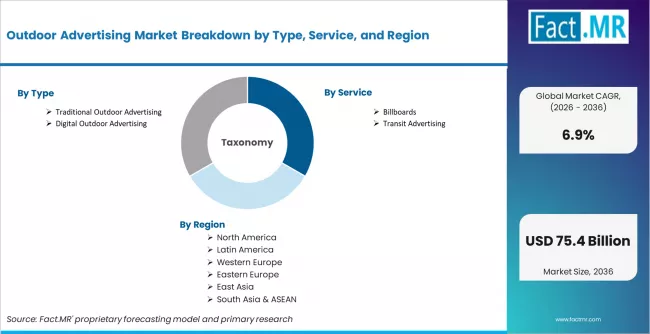
Outdoor Advertising Market Size, Share, Growth and Forecast (2026 - 2036)

The Outdoor Advertising Market is segmented by Type (Traditional Outdoor Advertising and Digital Outdoor Advertising), Service (Billboards, Transit Advertising, Street Furniture Advertising, Place-Based Advertising, and Airport Advertising), Format (Static Displays, Digital Screens, Programmatic OOH, Mobile OOH, and Experiential Displays), End-use Industry (Retail and Consumer Goods, BFSI, Media and Entertainment, Healthcare, Hospitality, and Transportation), and Buying Model (Direct Sales, Agency-Based Buying, Programmatic Buying, and Managed Campaign Contracts). Forecast for 2026 to 2036.

Fact.MR analysis indicates that the outdoor advertising market is moving through a location-value and audience-measurement cycle. Advertisers continue to use outdoor formats where physical visibility supports brand recall, store traffic, and campaign reach. Digital screens are improving creative flexibility, but site quality and verified audience exposure remain central to media buying decisions.

Outdoor Advertising Market Forecast and Outlook By FACT MR

  • The outdoor advertising market was valued at USD 33.9 billion in 2025. According to Fact.MR, demand is projected to reach USD 36.2 billion in 2026 and expand to USD 70.5 billion by 2036, reflecting a CAGR of 6.9% during the forecast period.
  • The market is expected to generate an absolute opportunity of USD 34.3 billion between 2026 and 2036, supported by continued evolution in media formats.
  • Growth is being driven by digital screen deployment, increasing urban mobility, and advertiser preference for high-visibility media channels. Data from Out of Home Advertising Association of America indicates strong revenue performance in U.S. out-of-home advertising, reinforcing advertiser confidence in the format.
  • Digital OOH is gaining share as it allows rapid creative updates and time-sensitive campaign alignment, making outdoor advertising more flexible and responsive to changing marketing needs. 
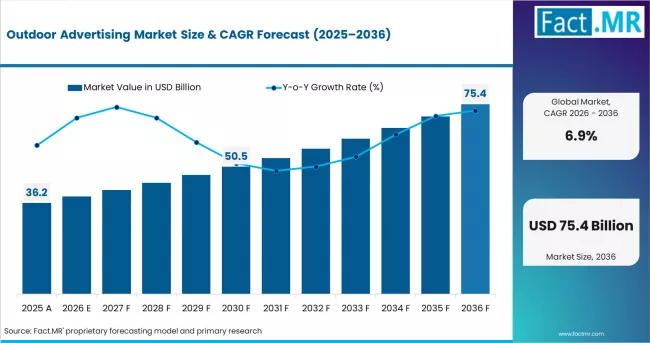
Outdoor Advertising Market Market Value Analysis

Summary of Outdoor Advertising Market

  • Market Definition
    • The market includes paid advertising displayed across outdoor and public locations to support brand visibility and campaign reach.
  • Demand Drivers
    • Brand managers use outdoor media to build broad visibility in high-traffic locations.
    • Retail advertisers rely on roadside and transit media to influence store visits.
    • Agencies use digital OOH where campaign timing and creative rotation matter.
  • Key Segments Analyzed
    • By Type: Traditional outdoor advertising is estimated to lead with 58.0% share in 2026, supported by billboard scale and broad inventory availability.
    • By Service: Billboards are expected to account for 68.0% share in 2026 because roadside visibility and location coverage remain strong.
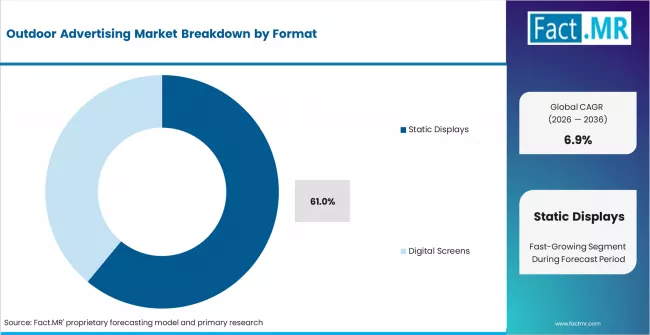
    • By Format: Static displays are projected to hold 61.0% share in 2026 due to broad installed inventory and lower production complexity.
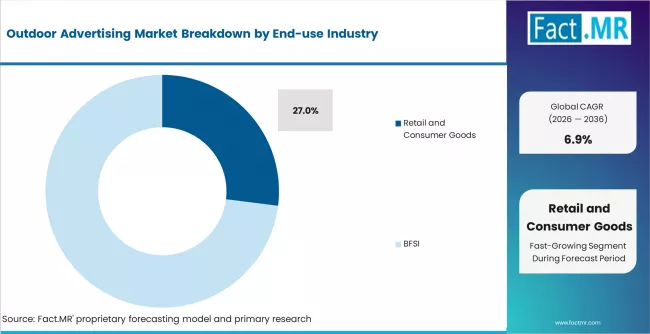
    • By End-use Industry: Retail and consumer goods are expected to hold 27.0% share in 2026, supported by store traffic and brand promotion.
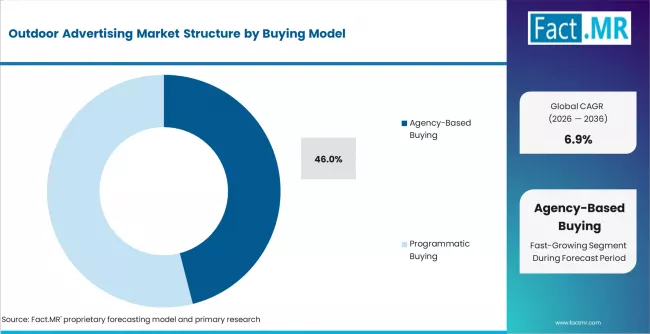
    • By Buying Model: Agency-based buying is projected to account for 46.0% share in 2026 because large campaigns need planning, negotiation, and reporting support.
  • Analyst Opinion at Fact.MR
    • Shambhu Nath Jha, Senior Analyst at Fact.MR, notes, “Outdoor advertising growth depends on the quality of locations and the proof behind audience exposure. Digital screens help, but advertisers still judge campaigns by visibility, route relevance, and measurable media value. Operators that combine strong sites with better reporting will gain more than firms selling space alone.”
  • Strategic Implications
    • Media owners should upgrade high-traffic sites with stronger measurement and creative flexibility.
    • Agencies need better location planning to connect outdoor exposure with campaign objectives.
    • Regional players should focus on transit corridors and retail zones with repeat advertiser demand.
  • Methodology
    • Sizing Base: Market sizing uses media owner revenue, occupancy levels, campaign pricing, and display inventory.
    • Evidence Inputs: Analysis includes OAAA data, company annual reports, public advertising rules, and programmatic OOH documentation.
    • Forecast Design: Forecasts account for digital screen rollout, urban mobility, retail advertising demand, and site-level monetization.
Metric Value
Estimated Value in 2026 USD 36.2 billion
Forecast Value in 2036 USD 70.5 billion
Forecast CAGR (2026 to 2036) 6.9%

Regulation and measurement standards remain important. Billboard placement in the United States is affected by the Highway Beautification Act, which governs outdoor advertising along certain federal-aid highways [2]. Privacy rules also matter where digital outdoor advertising uses data-enabled planning or audience measurement. Buyers now expect site-level proof, transparent campaign reporting, and compliant data practices before increasing outdoor budgets.

India is projected to grow at 8.1% CAGR through 2036. China follows at 7.5% CAGR, supported by urban retail activity and transit media demand. Brazil grows at 7.0% CAGR, led by retail advertising and mobility corridors. The United States records 6.8% CAGR, supported by digital billboard networks and programmatic buying. Germany grows at 5.9% CAGR, linked to transit and street furniture media. Japan advances at 5.5% CAGR, supported by dense urban transport locations.

Segmental Analysis

Outdoor Advertising Market Analysis by Type
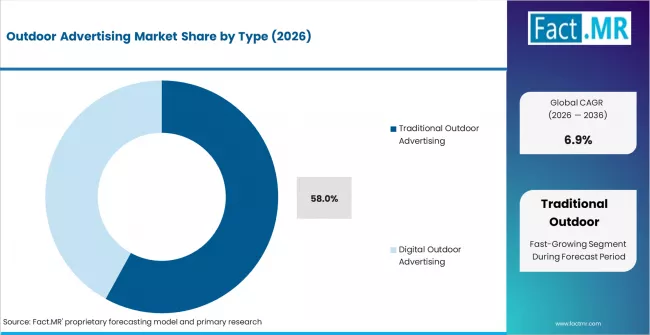
Outdoor Advertising Market Analysis By Type

Traditional outdoor advertising is estimated to hold 58.0% share in 2026, because static billboards and printed displays have broad inventory coverage across highways, city roads, and commercial districts. Traditional formats are familiar to advertisers and often carry lower production complexity than digital screens. Digital outdoor advertising is expanding faster because media owners can rotate creative and sell time-based inventory. Advertisers use digital panels when campaigns need flexibility across dayparts or local events. Traditional formats keep the lead because site availability and established buying habits remain strong across many countries.

  • Inventory Breadth: Traditional outdoor media benefits from large installed billboard networks.
  • Creative Flexibility: Digital outdoor formats support timed messaging and campaign refreshes.
  • Location Value: Strong sites protect demand even when media formats change.

Outdoor Advertising Market Analysis by Service
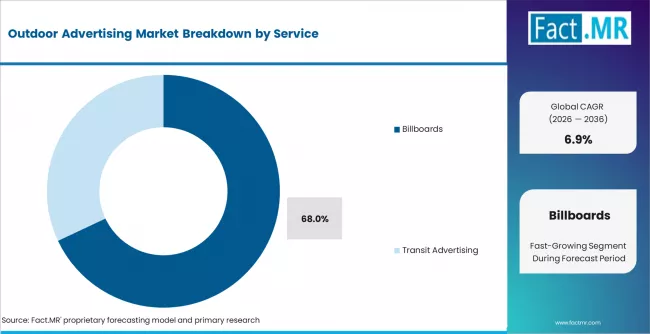
Outdoor Advertising Market Analysis By Service

Billboards remain the core service line in outdoor advertising. The segment is expected to account for 68.0% share over the forecast period because roadside visibility continues to attract brand advertisers and local businesses. Large-format panels work well where traffic flow and repeated exposure support campaign recall. Transit advertising serves bus, metro, and rail passengers in dense cities. Street furniture helps brands reach pedestrians near retail and office locations. Place-based media supports malls, campuses, and entertainment venues. Billboards lead because they combine scale, visibility, and simple campaign execution.

  • Roadside Reach: Billboards deliver repeated exposure along commuting routes.
  • Transit Access: Transit media connects brands with daily passenger movement.
  • Place-Based Targeting: Venue media helps advertisers reach defined audience clusters.

Outdoor Advertising Market Analysis by Format
Outdoor Advertising Market Analysis By Format

Static displays are projected to hold 61.0% share in 2026, as printed posters and painted displays remain widely available and cost-efficient for long-duration campaigns. Static media works well for brand awareness, retail promotion, and political advertising where messages do not need frequent changes. Digital screens are growing in premium urban locations and transport hubs. Programmatic OOH is gaining attention because buyers can activate campaigns through automated platforms. Mobile OOH and experiential displays remain smaller because they require higher coordination. Static displays keep the lead due to affordability and broad physical coverage.

  • Cost Control: Static displays support longer campaigns with predictable pricing.
  • Digital Rotation: Screens allow faster creative changes across selected locations.
  • Automated Buying: Programmatic OOH improves campaign activation speed.

Outdoor Advertising Market Analysis by End-use Industry
Outdoor Advertising Market Analysis By End Use Industry

Retail and consumer goods are expected to hold 27.0% share in 2026. This end-use group leads because outdoor media helps brands build visibility near stores, roads, and transit corridors. Retailers use outdoor campaigns for new launches, seasonal offers, and location-based promotions. BFSI advertisers use outdoor media for brand trust and branch visibility. Media and entertainment companies rely on outdoor displays for releases and events. Healthcare advertisers use it for hospitals and clinic awareness. Hospitality brands use outdoor media near airports, malls, and tourist zones. Retail leads because it connects visibility with local consumer action.

  • Store Traffic: Retail advertisers use outdoor sites near buying locations.
  • Brand Trust: BFSI campaigns use outdoor media for broad visibility.
  • Release Promotion: Media companies use outdoor formats for launches and events.

Outdoor Advertising Market Analysis by Buying Model
Outdoor Advertising Market Analysis By Buying Model

Agency-based buying is projected to account for 46.0% share in 2026, because outdoor campaigns need site selection, pricing review, creative adaptation, and performance reporting. Direct sales remain important for local businesses that buy roadside billboards or city-level placements. Programmatic buying is expanding where digital screens and planning platforms are available. Managed campaign contracts are used when advertisers want planning, execution, and reporting under one arrangement. Agency-based buying leads because national and regional campaigns need planning depth and media negotiation skills.

  • Planning Depth: Agencies support site selection and campaign coordination.
  • Local Direct Sales: Direct buying suits smaller advertisers with defined locations.
  • Platform Activation: Programmatic buying helps advertisers manage digital screen inventory.

Outdoor Advertising Market Drivers, Restraints, and Opportunities
Outdoor Advertising Market Opportunity Matrix Growth Vs Value

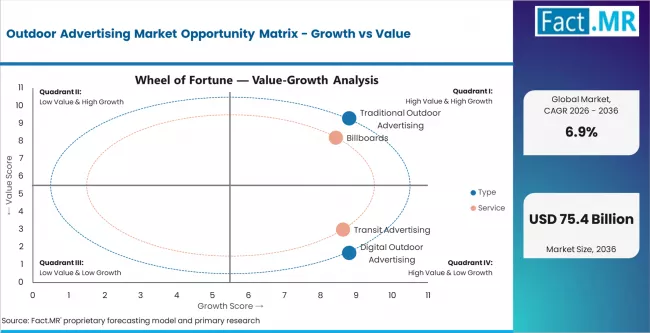
Fact.MR analysts observe that outdoor advertising demand is supported by physical visibility in high-traffic locations and better digital screen monetization. OAAA reported record U.S. out-of-home revenue in 2025, which signals advertiser confidence in the medium. JCDecaux reported strong digital out-of-home growth in 2024 and highlighted programmatic momentum across its network. These signals show how outdoor media is moving from static exposure toward more flexible campaign delivery.

Regulation and site restrictions remain the main restraints. Billboard placement can be limited by highway rules, municipal permits, and visual pollution concerns. The U.S. Highway Beautification Act remains an important reference point for outdoor advertising control along selected highways. Digital OOH also faces scrutiny where audience measurement uses mobility or device data. Operators need compliant data practices, safe display placement, and stronger reporting to protect advertiser trust.

Opportunities in the Outdoor Advertising Market

  • Digital Screen Upgrades: Media owners can lift yield by converting premium static sites into digital inventory.
  • Programmatic Access: Buyers can use automated platforms to activate campaigns with better timing control.
  • Transit Media Growth: Dense commuting routes create value for advertisers seeking repeated audience exposure.

Regional Analysis

Top Country Growth Comparison Outdoor Advertising Market Cagr (2026 2036)

The outdoor advertising market is assessed across North America, Europe, Asia Pacific, Latin America, and Middle East and Africa, covering 40+ countries with demand profiles shaped by urban mobility, billboard regulation, retail activity, and digital screen adoption.

Country CAGR (2026 to 2036)
India 8.1%
China 7.5%
Brazil 7.0%
USA 6.8%
Germany 5.9%
Japan 5.5%

Source: Fact.MR analysis, based on proprietary forecasting model and primary research
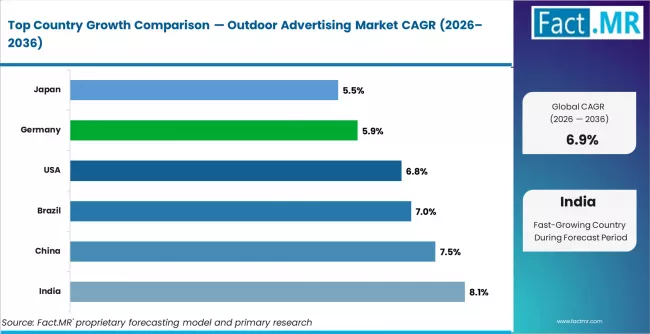
Outdoor Advertising Market Cagr Analysis By Country

Asia Pacific Outdoor Advertising Market Analysis
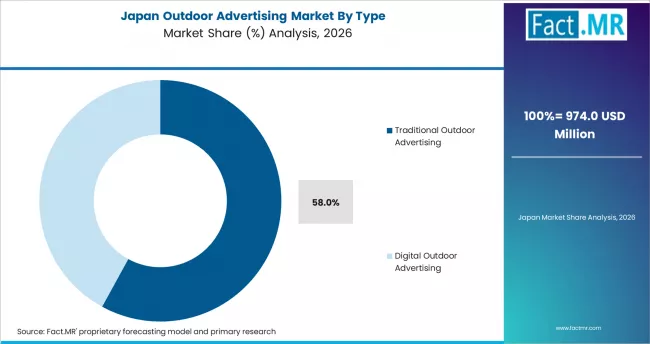
Outdoor Advertising Market Japan Market Share Analysis By Type

Asia Pacific records faster growth because urban movement and retail expansion support billboard, transit, and mall media. India benefits from road traffic, metro expansion, and local brand spending. China supports demand through digital screens and commercial building media. Japan grows at a slower rate because outdoor advertising inventory is already well developed in major cities. Regional growth depends on site quality, city permits, and advertiser demand for measurable reach.

  • India: Outdoor advertising demand in India is projected to grow at 8.1% CAGR from 2026 to 2036. Metro expansion, retail corridors, and highway visibility support billboard and transit media. Local brands use outdoor campaigns to build recall in crowded urban markets. Digital screens are gaining attention in malls and transport hubs. Media owners with strong city permits and reliable site maintenance can gain repeat advertisers across large metros.
  • China: China’s outdoor advertising demand is linked to urban commercial districts and digital screen networks. Retail brands, food service chains, and financial service advertisers use high-traffic locations for visibility. The market is projected to expand at 7.5% CAGR through 2036. Building media and transit panels support campaigns in large cities. Operators with digital inventory and audience reporting are better placed to serve national advertisers.
  • Japan: Japan has dense urban locations that support transit and station-based advertising. Growth is slower because large cities already have established outdoor media systems. Outdoor advertising in Japan is expected to register 5.5% CAGR by 2036. Demand comes from retail launches, entertainment campaigns, and corporate branding. Media owners compete through premium locations, visual quality, and reliable display operations.

North America Outdoor Advertising Market Analysis
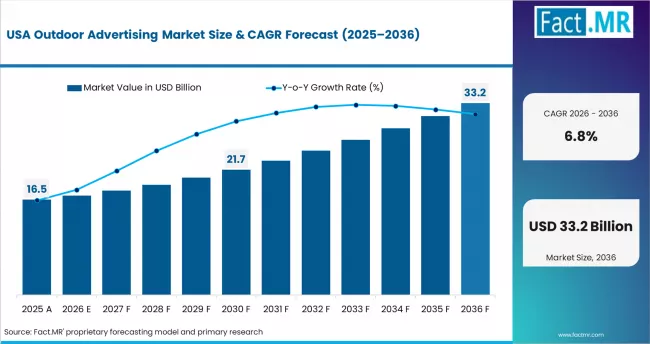
Outdoor Advertising Market Country Value Analysis

North America remains a high-value region because advertisers use outdoor media for brand reach, local activation, and digital campaign extension. The United States leads regional demand due to mature billboard networks and rising digital OOH adoption. OAAA reported record U.S. OOH revenue in 2025, indicating stable advertiser use of the medium. Regulation and site control keep inventory quality important.

  • USA: The U.S. outdoor advertising market is forecast to grow at 6.8% CAGR over the study period. Billboard networks and digital panels support both national and local campaigns. Highway advertising rules shape placement decisions and site availability. Digital screens help advertisers rotate messages and improve campaign timing. Media owners gain advantage through premium locations, compliant displays, and stronger measurement support for agencies.

Europe Outdoor Advertising Market Analysis
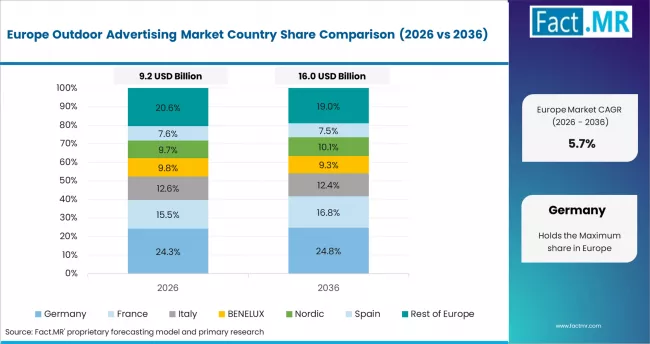
Outdoor Advertising Market Europe Country Market Share Analysis, 2026 & 2036

Europe grows through transit media, street furniture networks, and digital screen upgrades. Germany leads regional demand because advertisers value well-managed urban sites and controlled visual environments. Privacy rules influence how digital OOH audience measurement is handled, especially where mobility data is used [3]. Media owners need strong documentation and transparent campaign reporting to support advertiser confidence.

  • Germany: Germany’s outdoor advertising demand is supported by transit networks and structured city media. Retailers, automotive brands, and service advertisers use outdoor sites to support broad visibility. The market is projected to record 5.9% CAGR by to 2036. Digital OOH growth depends on city approvals and advertiser confidence in reporting. Operators with compliant data practices and reliable street furniture assets can protect premium pricing.

Latin America Outdoor Advertising Market Analysis

Latin America grows through retail advertising, roadside visibility, and event-driven campaigns. Brazil remains the key country because large urban centers support billboards, mall media, and transit advertising. Cost sensitivity influences buying decisions, so media owners need packages that offer reach without complex pricing. Digital upgrades are concentrated in premium areas.

  • Brazil: Brazil’s demand is tied to retail campaigns, urban mobility, and brand visibility in major cities. Outdoor media is used by consumer brands and local businesses seeking repeated exposure. The market is expected to expand at 7.0% CAGR from 2026 to 2036. Digital billboards are gaining traction in premium corridors. Media owners with strong local permits and dependable display maintenance are better placed to win repeat campaigns.

Competitive Aligners for Market Players
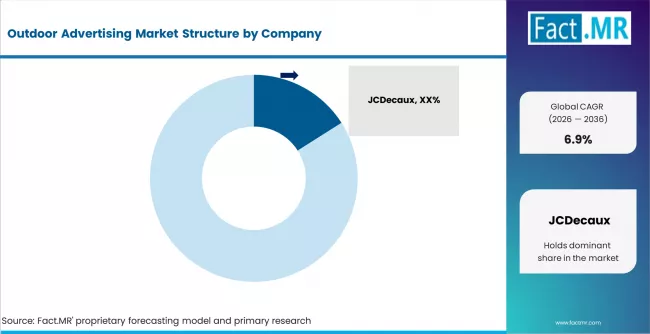
Outdoor Advertising Market Analysis By Company

The outdoor advertising market is moderately fragmented at the local level and more consolidated across large-format networks. Global and regional media owners compete through site portfolios, municipal contracts, digital screen coverage, and agency relationships. JCDecaux, Lamar, Clear Channel Outdoor, OUTFRONT Media, and Ströer remain visible because they operate large outdoor networks across major markets. [4]

Competitive advantage depends on location control and measurement credibility. A media owner with premium sites can protect pricing, but advertisers increasingly ask for exposure proof and campaign reporting. Digital screens improve yield where operators can sell multiple creative slots without weakening viewer experience. Programmatic platforms add value when inventory quality and campaign timing are well managed.

The market is divided between traditional billboard operators and digital OOH networks. Billboard operators compete on site coverage and lease control. Digital networks compete on screen quality, audience data, and automated buying access. Operators that combine compliant locations with credible measurement are positioned to win larger campaigns. [5]

Key Players in Outdoor Advertising Market

  • JCDecaux
  • Clear Channel Outdoor
  • Lamar Advertising Company
  • OUTFRONT Media
  • Ströer SE & Co. KGaA
  • Focus Media
  • oOh!media
  • Asiaray Media Group
  • APG|SGA
  • Global Media & Entertainment
  • Al Arabia Outdoor Advertising
  • Intersection
  • Ocean Outdoor
  • Clear Media
  • Insite Street Media

Bibliography

  • [1]. Out of Home Advertising Association of America. Out of Home Advertising Revenue Reaches Record USD 9.46 Billion. OAAA.
  • [2]. U.S. Department of Transportation, Federal Highway Administration. Highway Beautification Act. FHWA.
  • [3]. European Union. General Data Protection Regulation. EUR-Lex.
  • [4]. JCDecaux. Full-Year 2024 Results. JCDecaux.
  • [5]. DPAA. Programmatic DOOH Resources. DPAA.

This Report Addresses

  • Strategic intelligence on outdoor advertising demand across billboards, transit media, street furniture, place-based displays, airport advertising, and digital outdoor screens.
  • Market forecast from USD 36.2 billion in 2026 to USD 70.5 billion by 2036 at a CAGR of 6.9%.
  • Segment analysis by type, service, format, end-use industry, and buying model, covering traditional outdoor advertising, billboards, static displays, retail and consumer goods, and agency-based buying.
  • Growth opportunity mapping across India, China, Brazil, the USA, Germany, and Japan. India is projected to record the fastest growth at 8.1% CAGR through 2036, followed by China at 7.5% CAGR.
  • Regional outlook covering Asia Pacific urban mobility and retail expansion, North America digital billboard networks, Europe transit and street furniture media, and Latin America roadside visibility demand.
  • Competitive analysis of JCDecaux, Clear Channel Outdoor, Lamar Advertising Company, OUTFRONT Media, Ströer, Focus Media, oOh!media, Asiaray Media Group, APG|SGA, Global Media & Entertainment, Al Arabia Outdoor Advertising, Intersection, Ocean Outdoor, Clear Media, and Insite Street Media.
  • Report delivered with market sizing, segment forecasts, regional outlook, and competitive assessment. Supported by media owner revenue modeling, site inventory assessment, advertiser interviews, OOH association data, highway advertising rules, company disclosures, and programmatic OOH resources.
  • Strategic intelligence on outdoor advertising demand across billboards, transit media, street furniture, place-based displays, airport advertising, and digital outdoor screens.
  • Market forecast from USD 36.2 billion in 2026 to USD 70.5 billion by 2036 at a CAGR of 6.9%.
  • Segment analysis by type, service, format, end-use industry, and buying model, covering traditional outdoor advertising, billboards, static displays, retail and consumer goods, and agency-based buying.
  • Growth opportunity mapping across India, China, Brazil, the USA, Germany, and Japan. India is projected to record the fastest growth at 8.1% CAGR through 2036, followed by China at 7.5% CAGR.
  • Regional outlook covering Asia Pacific urban mobility and retail expansion, North America digital billboard networks, Europe transit and street furniture media, and Latin America roadside visibility demand.
  • Competitive analysis of JCDecaux, Clear Channel Outdoor, Lamar Advertising Company, OUTFRONT Media, Ströer, Focus Media, oOh!media, Asiaray Media Group, APG|SGA, Global Media & Entertainment, Al Arabia Outdoor Advertising, Intersection, Ocean Outdoor, Clear Media, and Insite Street Media.
  • Report delivered with market sizing, segment forecasts, regional outlook, and competitive assessment. Supported by media owner revenue modeling, site inventory assessment, advertiser interviews, OOH association data, highway advertising rules, company disclosures, and programmatic OOH resources.

Outdoor Advertising Market Definition

The market covers paid advertising displayed in outdoor and public environments to reach audiences outside the home. It includes billboards, transit media, street furniture, place-based displays, airport media, and digital outdoor screens. Scope is limited to physical-location advertising formats placed in public or commercial spaces for brand, retail, institutional, or campaign communication.

Outdoor Advertising Market Inclusions

The market includes traditional and digital outdoor advertising sold through direct contracts, agencies, managed media plans, and programmatic buying systems. It covers static posters, large-format billboards, transit shelters, airport displays, mall screens, roadside digital panels, and location-based campaign packages. Creative production and campaign measurement services are included when sold as part of outdoor advertising programs.

Outdoor Advertising Market Exclusions

The market excludes television advertising, radio advertising, print advertising, mobile-only ads, search ads, and social media advertising. Indoor retail signage owned by stores is outside scope unless sold as third-party advertising inventory. Vehicle branding used only for company identification is excluded because it does not function as purchased outdoor media inventory.

Outdoor Advertising Market Research Methodology

  • Primary Research: Interviews with outdoor media owners, agency media planners, brand marketing heads, mall media operators, and transit advertising managers.
  • Desk Research: Review includes OOH association revenue data, highway advertising rules, company annual reports, programmatic OOH resources, and privacy guidance.
  • Market-Sizing and Forecasting: The model uses media owner revenue, site inventory, average campaign pricing, occupancy rates, and digital screen adoption.
  • Data Validation and Update Cycle: Forecasts are validated using association revenue releases, company disclosures, advertiser interviews, and media planning inputs.

Scope of Report

Outdoor Advertising Market Breakdown By Type, Service, And Region

Attribute Details
Quantitative Units USD 36.2 billion (2026) to USD 70.5 billion (2036), at a CAGR of 6.9%
Market Definition Paid advertising displayed across outdoor and public locations to support brand visibility, retail promotion, and campaign reach.
Type Segmentation Traditional Outdoor Advertising, Digital Outdoor Advertising
Service Segmentation Billboards, Transit Advertising, Street Furniture Advertising, Place-Based Advertising, Airport Advertising
Format Segmentation Static Displays, Digital Screens, Programmatic OOH, Mobile OOH, Experiential Displays
End-use Industry Segmentation Retail and Consumer Goods, BFSI, Media and Entertainment, Healthcare, Hospitality, Transportation
Buying Model Segmentation Direct Sales, Agency-Based Buying, Programmatic Buying, Managed Campaign Contracts
Regions Covered North America, Europe, Asia Pacific, Latin America, Middle East and Africa
Countries Covered USA, Canada, Mexico, Germany, UK, France, Italy, Spain, China, Japan, India, ASEAN, Australia and New Zealand, Brazil, GCC, South Africa, and Rest of World
Key Companies Profiled JCDecaux, Clear Channel Outdoor, Lamar Advertising, OUTFRONT Media, Ströer, Focus Media, oOh!media, Asiaray, APG
Forecast Period 2026 to 2036
Approach Hybrid top-down and bottom-up model using media owner revenue, display inventory, occupancy rates, digital screen adoption, and interviews with media buyers.

Outdoor Advertising Market by Segments

  • By Type:

    • Traditional Outdoor Advertising
    • Digital Outdoor Advertising
  • By Service:

    • Billboards
    • Transit Advertising
    • Street Furniture Advertising
    • Place-Based Advertising
    • Airport Advertising
  • By Format:

    • Static Displays
    • Digital Screens
    • Programmatic OOH
    • Mobile OOH
    • Experiential Displays
  • By End-use Industry:

    • Retail and Consumer Goods
    • BFSI
    • Media and Entertainment
    • Healthcare
    • Hospitality
    • Transportation
  • By Buying Model:

    • Direct Sales
    • Agency-Based Buying
    • Programmatic Buying
    • Managed Campaign Contracts
  • By Region:

    • North America
      • United States
      • Canada
      • Mexico
    • Latin America
      • Brazil
      • Argentina
      • Chile
      • Rest of Latin America
    • Western Europe
      • Germany
      • France
      • United Kingdom
      • Italy
      • Spain
      • Nordic Countries
      • BENELUX
      • Rest of Western Europe
    • Eastern Europe
      • Russia
      • Poland
      • Hungary
      • Balkan and Baltic
      • Rest of Eastern Europe
    • East Asia
      • China
      • Japan
      • South Korea
    • South Asia and Pacific
      • India
      • ASEAN
      • Australia and New Zealand
      • Rest of South Asia and Pacific
    • Middle East and Africa
      • Kingdom of Saudi Arabia
      • Other GCC Countries
      • Turkey
      • South Africa
      • Rest of Middle East and Africa

- Frequently Asked Questions -

How large is the outdoor advertising market in 2026?

The market is estimated to reach USD 36.2 billion in 2026.

What will the outdoor advertising market be valued at by 2036?

The market is forecast to reach USD 70.5 billion by 2036.

What CAGR is projected from 2026 to 2036?

The market is projected to grow at a 6.9% CAGR during the forecast period.

Which type leads the market?

Traditional outdoor advertising leads with an estimated 58.0% share in 2026.

Which service segment leads demand?

Billboards lead with an estimated 68.0% share in 2026.

Which format holds the largest share?

Static displays lead with an estimated 61.0% share in 2026.

Which end-use industry leads outdoor advertising demand?

Retail and consumer goods lead with an estimated 27.0% share in 2026.

Which buying model leads the market?

Agency-based buying leads with an estimated 46.0% share in 2026.

Which country grows fastest through 2036?

India leads with a projected 8.1% CAGR through 2036.

Why do billboards lead outdoor advertising demand?

Billboards lead because they offer broad visibility across roads and commercial corridors.

Why is digital outdoor advertising growing?

Digital outdoor advertising grows because advertisers can change creative quickly.

Why do static displays still hold a large share?

Static displays hold a large share because installed inventory remains broad and affordable.

What is the main restraint for the market?

Site restrictions and municipal approvals can slow outdoor advertising expansion.

How does regulation affect billboard placement?

Regulation affects placement through highway controls, permits, and local visual standards.

Why is retail a major end-use industry?

Retailers use outdoor media to build visibility near stores and traffic corridors.

Why is programmatic OOH gaining attention?

Programmatic OOH helps buyers activate campaigns faster across digital screen networks.

Why is India growing faster than mature markets?

India is growing faster because urban mobility and retail expansion support outdoor media demand.

Why is Japan growing at a slower rate?

Japan grows slower because outdoor media inventory is already established in major cities.

What shapes supplier success in this market?

Supplier success depends on site quality, measurement credibility, and campaign reporting.

How do digital screens change outdoor advertising?

Digital screens improve creative rotation and allow better timing control.

Why are transit locations important?

Transit locations reach repeat commuters across stations, buses, and rail networks.

What does the report measure across segments?

The report measures demand by type, service, format, end-use industry, buying model, and region.

Table of Content

  1. Executive Summary
    • Global Market Outlook
    • Demand to side Trends
    • Supply to side Trends
    • Technology Roadmap Analysis
    • Analysis and Recommendations
  2. Market Overview
    • Market Coverage / Taxonomy
    • Market Definition / Scope / Limitations
  3. Research Methodology
    • Chapter Orientation
    • Analytical Lens and Working Hypotheses
      • Market Structure, Signals, and Trend Drivers
      • Benchmarking and Cross-market Comparability
      • Market Sizing, Forecasting, and Opportunity Mapping
    • Research Design and Evidence Framework
      • Desk Research Programme (Secondary Evidence)
        • Company Annual and Sustainability Reports
        • Peer-reviewed Journals and Academic Literature
        • Corporate Websites, Product Literature, and Technical Notes
        • Earnings Decks and Investor Briefings
        • Statutory Filings and Regulatory Disclosures
        • Technical White Papers and Standards Notes
        • Trade Journals, Industry Magazines, and Analyst Briefs
        • Conference Proceedings, Webinars, and Seminar Materials
        • Government Statistics Portals and Public Data Releases
        • Press Releases and Reputable Media Coverage
        • Specialist Newsletters and Curated Briefings
        • Sector Databases and Reference Repositories
        • Fact.MR Internal Proprietary Databases and Historical Market Datasets
        • Subscription Datasets and Paid Sources
        • Social Channels, Communities, and Digital Listening Inputs
        • Additional Desk Sources
      • Expert Input and Fieldwork (Primary Evidence)
        • Primary Modes
          • Qualitative Interviews and Expert Elicitation
          • Quantitative Surveys and Structured Data Capture
          • Blended Approach
        • Why Primary Evidence is Used
        • Field Techniques
          • Interviews
          • Surveys
          • Focus Groups
          • Observational and In-context Research
          • Social and Community Interactions
        • Stakeholder Universe Engaged
          • C-suite Leaders
          • Board Members
          • Presidents and Vice Presidents
          • R&D and Innovation Heads
          • Technical Specialists
          • Domain Subject-matter Experts
          • Scientists
          • Physicians and Other Healthcare Professionals
        • Governance, Ethics, and Data Stewardship
          • Research Ethics
          • Data Integrity and Handling
      • Tooling, Models, and Reference Databases
    • Data Engineering and Model Build
      • Data Acquisition and Ingestion
      • Cleaning, Normalisation, and Verification
      • Synthesis, Triangulation, and Analysis
    • Quality Assurance and Audit Trail
  4. Market Background
    • Market Dynamics
      • Drivers
      • Restraints
      • Opportunity
      • Trends
    • Scenario Forecast
      • Demand in Optimistic Scenario
      • Demand in Likely Scenario
      • Demand in Conservative Scenario
    • Opportunity Map Analysis
    • Product Life Cycle Analysis
    • Supply Chain Analysis
    • Investment Feasibility Matrix
    • Value Chain Analysis
    • PESTLE and Porter’s Analysis
    • Regulatory Landscape
    • Regional Parent Market Outlook
    • Production and Consumption Statistics
    • Import and Export Statistics
  5. Global Market Analysis 2021 to 2025 and Forecast, 2026 to 2036
    • Historical Market Size Value (USD Million) Analysis, 2021 to 2025
    • Current and Future Market Size Value (USD Million) Projections, 2026 to 2036
      • Y to o to Y Growth Trend Analysis
      • Absolute $ Opportunity Analysis
  6. Global Market Pricing Analysis 2021 to 2025 and Forecast 2026 to 2036
  7. Global Market Analysis 2021 to 2025 and Forecast 2026 to 2036, By Product Type
    • Introduction / Key Findings
    • Historical Market Size Value (USD Million) Analysis By Product Type , 2021 to 2025
    • Current and Future Market Size Value (USD Million) Analysis and Forecast By Product Type , 2026 to 2036
      • Sleep Apnea Devices
      • Sleep Diagnostics and Monitoring Devices
      • Mattresses and Pillows
    • Y to o to Y Growth Trend Analysis By Product Type , 2021 to 2025
    • Absolute $ Opportunity Analysis By Product Type , 2026 to 2036
  8. Global Market Analysis 2021 to 2025 and Forecast 2026 to 2036, By Indication
    • Introduction / Key Findings
    • Historical Market Size Value (USD Million) Analysis By Indication, 2021 to 2025
    • Current and Future Market Size Value (USD Million) Analysis and Forecast By Indication, 2026 to 2036
      • Insomnia
      • Sleep Apnea
      • Sleep Deprivation
    • Y to o to Y Growth Trend Analysis By Indication, 2021 to 2025
    • Absolute $ Opportunity Analysis By Indication, 2026 to 2036
  9. Global Market Analysis 2021 to 2025 and Forecast 2026 to 2036, By Distribution Channel
    • Introduction / Key Findings
    • Historical Market Size Value (USD Million) Analysis By Distribution Channel, 2021 to 2025
    • Current and Future Market Size Value (USD Million) Analysis and Forecast By Distribution Channel, 2026 to 2036
      • Hospital Pharmacies
      • Retail Pharmacies
      • Online Pharmacies
    • Y to o to Y Growth Trend Analysis By Distribution Channel, 2021 to 2025
    • Absolute $ Opportunity Analysis By Distribution Channel, 2026 to 2036
  10. Global Market Analysis 2021 to 2025 and Forecast 2026 to 2036, By End User
    • Introduction / Key Findings
    • Historical Market Size Value (USD Million) Analysis By End User, 2021 to 2025
    • Current and Future Market Size Value (USD Million) Analysis and Forecast By End User, 2026 to 2036
      • Adult
      • Geriatric Patients
      • Shift Workers
    • Y to o to Y Growth Trend Analysis By End User, 2021 to 2025
    • Absolute $ Opportunity Analysis By End User, 2026 to 2036
  11. Global Market Analysis 2021 to 2025 and Forecast 2026 to 2036, By Care Setting
    • Introduction / Key Findings
    • Historical Market Size Value (USD Million) Analysis By Care Setting, 2021 to 2025
    • Current and Future Market Size Value (USD Million) Analysis and Forecast By Care Setting, 2026 to 2036
      • Homecare Settings
      • Wellness Centers
      • Specialty Clinics
    • Y to o to Y Growth Trend Analysis By Care Setting, 2021 to 2025
    • Absolute $ Opportunity Analysis By Care Setting, 2026 to 2036
  12. Global Market Analysis 2021 to 2025 and Forecast 2026 to 2036, By Region
    • Introduction
    • Historical Market Size Value (USD Million) Analysis By Region, 2021 to 2025
    • Current Market Size Value (USD Million) Analysis and Forecast By Region, 2026 to 2036
      • North America
      • Latin America
      • Western Europe
      • Eastern Europe
      • East Asia
      • South Asia and Pacific
      • Middle East & Africa
    • Market Attractiveness Analysis By Region
  13. North America Market Analysis 2021 to 2025 and Forecast 2026 to 2036, By Country
    • Historical Market Size Value (USD Million) Trend Analysis By Market Taxonomy, 2021 to 2025
    • Market Size Value (USD Million) Forecast By Market Taxonomy, 2026 to 2036
      • By Country
        • USA
        • Canada
        • Mexico
      • By Product Type
      • By Indication
      • By Distribution Channel
      • By End User
      • By Care Setting
    • Market Attractiveness Analysis
      • By Country
      • By Product Type
      • By Indication
      • By Distribution Channel
      • By End User
      • By Care Setting
    • Key Takeaways
  14. Latin America Market Analysis 2021 to 2025 and Forecast 2026 to 2036, By Country
    • Historical Market Size Value (USD Million) Trend Analysis By Market Taxonomy, 2021 to 2025
    • Market Size Value (USD Million) Forecast By Market Taxonomy, 2026 to 2036
      • By Country
        • Brazil
        • Chile
        • Rest of Latin America
      • By Product Type
      • By Indication
      • By Distribution Channel
      • By End User
      • By Care Setting
    • Market Attractiveness Analysis
      • By Country
      • By Product Type
      • By Indication
      • By Distribution Channel
      • By End User
      • By Care Setting
    • Key Takeaways
  15. Western Europe Market Analysis 2021 to 2025 and Forecast 2026 to 2036, By Country
    • Historical Market Size Value (USD Million) Trend Analysis By Market Taxonomy, 2021 to 2025
    • Market Size Value (USD Million) Forecast By Market Taxonomy, 2026 to 2036
      • By Country
        • Germany
        • UK
        • Italy
        • Spain
        • France
        • Nordic
        • BENELUX
        • Rest of Western Europe
      • By Product Type
      • By Indication
      • By Distribution Channel
      • By End User
      • By Care Setting
    • Market Attractiveness Analysis
      • By Country
      • By Product Type
      • By Indication
      • By Distribution Channel
      • By End User
      • By Care Setting
    • Key Takeaways
  16. Eastern Europe Market Analysis 2021 to 2025 and Forecast 2026 to 2036, By Country
    • Historical Market Size Value (USD Million) Trend Analysis By Market Taxonomy, 2021 to 2025
    • Market Size Value (USD Million) Forecast By Market Taxonomy, 2026 to 2036
      • By Country
        • Russia
        • Poland
        • Hungary
        • Balkan & Baltic
        • Rest of Eastern Europe
      • By Product Type
      • By Indication
      • By Distribution Channel
      • By End User
      • By Care Setting
    • Market Attractiveness Analysis
      • By Country
      • By Product Type
      • By Indication
      • By Distribution Channel
      • By End User
      • By Care Setting
    • Key Takeaways
  17. East Asia Market Analysis 2021 to 2025 and Forecast 2026 to 2036, By Country
    • Historical Market Size Value (USD Million) Trend Analysis By Market Taxonomy, 2021 to 2025
    • Market Size Value (USD Million) Forecast By Market Taxonomy, 2026 to 2036
      • By Country
        • China
        • Japan
        • South Korea
      • By Product Type
      • By Indication
      • By Distribution Channel
      • By End User
      • By Care Setting
    • Market Attractiveness Analysis
      • By Country
      • By Product Type
      • By Indication
      • By Distribution Channel
      • By End User
      • By Care Setting
    • Key Takeaways
  18. South Asia and Pacific Market Analysis 2021 to 2025 and Forecast 2026 to 2036, By Country
    • Historical Market Size Value (USD Million) Trend Analysis By Market Taxonomy, 2021 to 2025
    • Market Size Value (USD Million) Forecast By Market Taxonomy, 2026 to 2036
      • By Country
        • India
        • ASEAN
        • Australia & New Zealand
        • Rest of South Asia and Pacific
      • By Product Type
      • By Indication
      • By Distribution Channel
      • By End User
      • By Care Setting
    • Market Attractiveness Analysis
      • By Country
      • By Product Type
      • By Indication
      • By Distribution Channel
      • By End User
      • By Care Setting
    • Key Takeaways
  19. Middle East & Africa Market Analysis 2021 to 2025 and Forecast 2026 to 2036, By Country
    • Historical Market Size Value (USD Million) Trend Analysis By Market Taxonomy, 2021 to 2025
    • Market Size Value (USD Million) Forecast By Market Taxonomy, 2026 to 2036
      • By Country
        • Kingdom of Saudi Arabia
        • Other GCC Countries
        • Turkiye
        • South Africa
        • Other African Union
        • Rest of Middle East & Africa
      • By Product Type
      • By Indication
      • By Distribution Channel
      • By End User
      • By Care Setting
    • Market Attractiveness Analysis
      • By Country
      • By Product Type
      • By Indication
      • By Distribution Channel
      • By End User
      • By Care Setting
    • Key Takeaways
  20. Key Countries Market Analysis
    • USA
      • Pricing Analysis
      • Market Share Analysis, 2025
        • By Product Type
        • By Indication
        • By Distribution Channel
        • By End User
        • By Care Setting
    • Canada
      • Pricing Analysis
      • Market Share Analysis, 2025
        • By Product Type
        • By Indication
        • By Distribution Channel
        • By End User
        • By Care Setting
    • Mexico
      • Pricing Analysis
      • Market Share Analysis, 2025
        • By Product Type
        • By Indication
        • By Distribution Channel
        • By End User
        • By Care Setting
    • Brazil
      • Pricing Analysis
      • Market Share Analysis, 2025
        • By Product Type
        • By Indication
        • By Distribution Channel
        • By End User
        • By Care Setting
    • Chile
      • Pricing Analysis
      • Market Share Analysis, 2025
        • By Product Type
        • By Indication
        • By Distribution Channel
        • By End User
        • By Care Setting
    • Germany
      • Pricing Analysis
      • Market Share Analysis, 2025
        • By Product Type
        • By Indication
        • By Distribution Channel
        • By End User
        • By Care Setting
    • UK
      • Pricing Analysis
      • Market Share Analysis, 2025
        • By Product Type
        • By Indication
        • By Distribution Channel
        • By End User
        • By Care Setting
    • Italy
      • Pricing Analysis
      • Market Share Analysis, 2025
        • By Product Type
        • By Indication
        • By Distribution Channel
        • By End User
        • By Care Setting
    • Spain
      • Pricing Analysis
      • Market Share Analysis, 2025
        • By Product Type
        • By Indication
        • By Distribution Channel
        • By End User
        • By Care Setting
    • France
      • Pricing Analysis
      • Market Share Analysis, 2025
        • By Product Type
        • By Indication
        • By Distribution Channel
        • By End User
        • By Care Setting
    • India
      • Pricing Analysis
      • Market Share Analysis, 2025
        • By Product Type
        • By Indication
        • By Distribution Channel
        • By End User
        • By Care Setting
    • ASEAN
      • Pricing Analysis
      • Market Share Analysis, 2025
        • By Product Type
        • By Indication
        • By Distribution Channel
        • By End User
        • By Care Setting
    • Australia & New Zealand
      • Pricing Analysis
      • Market Share Analysis, 2025
        • By Product Type
        • By Indication
        • By Distribution Channel
        • By End User
        • By Care Setting
    • China
      • Pricing Analysis
      • Market Share Analysis, 2025
        • By Product Type
        • By Indication
        • By Distribution Channel
        • By End User
        • By Care Setting
    • Japan
      • Pricing Analysis
      • Market Share Analysis, 2025
        • By Product Type
        • By Indication
        • By Distribution Channel
        • By End User
        • By Care Setting
    • South Korea
      • Pricing Analysis
      • Market Share Analysis, 2025
        • By Product Type
        • By Indication
        • By Distribution Channel
        • By End User
        • By Care Setting
    • Russia
      • Pricing Analysis
      • Market Share Analysis, 2025
        • By Product Type
        • By Indication
        • By Distribution Channel
        • By End User
        • By Care Setting
    • Poland
      • Pricing Analysis
      • Market Share Analysis, 2025
        • By Product Type
        • By Indication
        • By Distribution Channel
        • By End User
        • By Care Setting
    • Hungary
      • Pricing Analysis
      • Market Share Analysis, 2025
        • By Product Type
        • By Indication
        • By Distribution Channel
        • By End User
        • By Care Setting
    • Kingdom of Saudi Arabia
      • Pricing Analysis
      • Market Share Analysis, 2025
        • By Product Type
        • By Indication
        • By Distribution Channel
        • By End User
        • By Care Setting
    • Turkiye
      • Pricing Analysis
      • Market Share Analysis, 2025
        • By Product Type
        • By Indication
        • By Distribution Channel
        • By End User
        • By Care Setting
    • South Africa
      • Pricing Analysis
      • Market Share Analysis, 2025
        • By Product Type
        • By Indication
        • By Distribution Channel
        • By End User
        • By Care Setting
  21. Market Structure Analysis
    • Competition Dashboard
    • Competition Benchmarking
    • Market Share Analysis of Top Players
      • By Regional
      • By Product Type
      • By Indication
      • By Distribution Channel
      • By End User
      • By Care Setting
  22. Competition Analysis
    • Competition Deep Dive
      • Koninklijke Philips N.V.
        • Overview
        • Product Portfolio
        • Profitability by Market Segments (Product/Age /Sales Channel/Region)
        • Sales Footprint
        • Strategy Overview
          • Marketing Strategy
          • Product Strategy
          • Channel Strategy
      • ResMed Inc.
      • Fisher & Paykel Healthcare
      • Merck & Co., Inc.
      • Eisai Co., Ltd.
      • Pfizer Inc.
  23. Assumptions & Acronyms Used

List Of Table

  • Table 1: Global Market Value (USD Million) Forecast by Region, 2021 to 2036
  • Table 2: Global Market Value (USD Million) Forecast by Product Type , 2021 to 2036
  • Table 3: Global Market Value (USD Million) Forecast by Indication, 2021 to 2036
  • Table 4: Global Market Value (USD Million) Forecast by Distribution Channel, 2021 to 2036
  • Table 5: Global Market Value (USD Million) Forecast by End User, 2021 to 2036
  • Table 6: Global Market Value (USD Million) Forecast by Care Setting, 2021 to 2036
  • Table 7: North America Market Value (USD Million) Forecast by Country, 2021 to 2036
  • Table 8: North America Market Value (USD Million) Forecast by Product Type , 2021 to 2036
  • Table 9: North America Market Value (USD Million) Forecast by Indication, 2021 to 2036
  • Table 10: North America Market Value (USD Million) Forecast by Distribution Channel, 2021 to 2036
  • Table 11: North America Market Value (USD Million) Forecast by End User, 2021 to 2036
  • Table 12: North America Market Value (USD Million) Forecast by Care Setting, 2021 to 2036
  • Table 13: Latin America Market Value (USD Million) Forecast by Country, 2021 to 2036
  • Table 14: Latin America Market Value (USD Million) Forecast by Product Type , 2021 to 2036
  • Table 15: Latin America Market Value (USD Million) Forecast by Indication, 2021 to 2036
  • Table 16: Latin America Market Value (USD Million) Forecast by Distribution Channel, 2021 to 2036
  • Table 17: Latin America Market Value (USD Million) Forecast by End User, 2021 to 2036
  • Table 18: Latin America Market Value (USD Million) Forecast by Care Setting, 2021 to 2036
  • Table 19: Western Europe Market Value (USD Million) Forecast by Country, 2021 to 2036
  • Table 20: Western Europe Market Value (USD Million) Forecast by Product Type , 2021 to 2036
  • Table 21: Western Europe Market Value (USD Million) Forecast by Indication, 2021 to 2036
  • Table 22: Western Europe Market Value (USD Million) Forecast by Distribution Channel, 2021 to 2036
  • Table 23: Western Europe Market Value (USD Million) Forecast by End User, 2021 to 2036
  • Table 24: Western Europe Market Value (USD Million) Forecast by Care Setting, 2021 to 2036
  • Table 25: Eastern Europe Market Value (USD Million) Forecast by Country, 2021 to 2036
  • Table 26: Eastern Europe Market Value (USD Million) Forecast by Product Type , 2021 to 2036
  • Table 27: Eastern Europe Market Value (USD Million) Forecast by Indication, 2021 to 2036
  • Table 28: Eastern Europe Market Value (USD Million) Forecast by Distribution Channel, 2021 to 2036
  • Table 29: Eastern Europe Market Value (USD Million) Forecast by End User, 2021 to 2036
  • Table 30: Eastern Europe Market Value (USD Million) Forecast by Care Setting, 2021 to 2036
  • Table 31: East Asia Market Value (USD Million) Forecast by Country, 2021 to 2036
  • Table 32: East Asia Market Value (USD Million) Forecast by Product Type , 2021 to 2036
  • Table 33: East Asia Market Value (USD Million) Forecast by Indication, 2021 to 2036
  • Table 34: East Asia Market Value (USD Million) Forecast by Distribution Channel, 2021 to 2036
  • Table 35: East Asia Market Value (USD Million) Forecast by End User, 2021 to 2036
  • Table 36: East Asia Market Value (USD Million) Forecast by Care Setting, 2021 to 2036
  • Table 37: South Asia and Pacific Market Value (USD Million) Forecast by Country, 2021 to 2036
  • Table 38: South Asia and Pacific Market Value (USD Million) Forecast by Product Type , 2021 to 2036
  • Table 39: South Asia and Pacific Market Value (USD Million) Forecast by Indication, 2021 to 2036
  • Table 40: South Asia and Pacific Market Value (USD Million) Forecast by Distribution Channel, 2021 to 2036
  • Table 41: South Asia and Pacific Market Value (USD Million) Forecast by End User, 2021 to 2036
  • Table 42: South Asia and Pacific Market Value (USD Million) Forecast by Care Setting, 2021 to 2036
  • Table 43: Middle East & Africa Market Value (USD Million) Forecast by Country, 2021 to 2036
  • Table 44: Middle East & Africa Market Value (USD Million) Forecast by Product Type , 2021 to 2036
  • Table 45: Middle East & Africa Market Value (USD Million) Forecast by Indication, 2021 to 2036
  • Table 46: Middle East & Africa Market Value (USD Million) Forecast by Distribution Channel, 2021 to 2036
  • Table 47: Middle East & Africa Market Value (USD Million) Forecast by End User, 2021 to 2036
  • Table 48: Middle East & Africa Market Value (USD Million) Forecast by Care Setting, 2021 to 2036

List Of Figures

  • Figure 1: Global Market Pricing Analysis
  • Figure 2: Global Market Value (USD Million) Forecast 2021-2036
  • Figure 3: Global Market Value Share and BPS Analysis by Product Type, 2026 and 2036
  • Figure 4: Global Market Y-o-Y Growth Comparison by Product Type,2026 to 2036
  • Figure 5: Global Market Attractiveness Analysis by Product Type
  • Figure 6: Global Market Value Share and BPS Analysis by Indication, 2026 and 2036
  • Figure 7: Global Market Y-o-Y Growth Comparison by Indication,2026 to 2036
  • Figure 8: Global Market Attractiveness Analysis by Indication
  • Figure 9: Global Market Value Share and BPS Analysis by Distribution Channel, 2026 and 2036
  • Figure 10: Global Market Y-o-Y Growth Comparison by Distribution Channel,2026 to 2036
  • Figure 11: Global Market Attractiveness Analysis by Distribution Channel
  • Figure 12: Global Market Value Share and BPS Analysis by End User, 2026 and 2036
  • Figure 13: Global Market Y-o-Y Growth Comparison by End User,2026 to 2036
  • Figure 14: Global Market Attractiveness Analysis by End User
  • Figure 15: Global Market Value Share and BPS Analysis by Care Setting, 2026 and 2036
  • Figure 16: Global Market Y-o-Y Growth Comparison by Care Setting,2026 to 2036
  • Figure 17: Global Market Attractiveness Analysis by Care Setting
  • Figure 18: Global Market Value (USD Million) Share and BPS Analysis by Region, 2026 and 2036
  • Figure 19: Global Market Y-o-Y Growth Comparison by Region,2026 to 2036
  • Figure 20: Global Market Attractiveness Analysis by Region
  • Figure 21: North America Market Incremental Dollar Opportunity,2026 to 2036
  • Figure 22: Latin America Market Incremental Dollar Opportunity,2026 to 2036
  • Figure 23: Western Europe Market Incremental Dollar Opportunity,2026 to 2036
  • Figure 24: Eastern Europe Market Incremental Dollar Opportunity,2026 to 2036
  • Figure 25: East Asia Market Incremental Dollar Opportunity,2026 to 2036
  • Figure 26: South Asia and Pacific Market Incremental Dollar Opportunity,2026 to 2036
  • Figure 27: Middle East & Africa Market Incremental Dollar Opportunity,2026 to 2036
  • Figure 28: North America Market Value Share and BPS Analysis by Country, 2026 and 2036
  • Figure 29: North America Market Value Share and BPS Analysis by Product Type, 2026 and 2036
  • Figure 30: North America Market Y-o-Y Growth Comparison by Product Type,2026 to 2036
  • Figure 31: North America Market Attractiveness Analysis by Product Type
  • Figure 32: North America Market Value Share and BPS Analysis by Indication, 2026 and 2036
  • Figure 33: North America Market Y-o-Y Growth Comparison by Indication,2026 to 2036
  • Figure 34: North America Market Attractiveness Analysis by Indication
  • Figure 35: North America Market Value Share and BPS Analysis by Distribution Channel, 2026 and 2036
  • Figure 36: North America Market Y-o-Y Growth Comparison by Distribution Channel,2026 to 2036
  • Figure 37: North America Market Attractiveness Analysis by Distribution Channel
  • Figure 38: North America Market Value Share and BPS Analysis by End User, 2026 and 2036
  • Figure 39: North America Market Y-o-Y Growth Comparison by End User,2026 to 2036
  • Figure 40: North America Market Attractiveness Analysis by End User
  • Figure 41: North America Market Value Share and BPS Analysis by Care Setting, 2026 and 2036
  • Figure 42: North America Market Y-o-Y Growth Comparison by Care Setting,2026 to 2036
  • Figure 43: North America Market Attractiveness Analysis by Care Setting
  • Figure 44: Latin America Market Value Share and BPS Analysis by Country, 2026 and 2036
  • Figure 45: Latin America Market Value Share and BPS Analysis by Product Type, 2026 and 2036
  • Figure 46: Latin America Market Y-o-Y Growth Comparison by Product Type,2026 to 2036
  • Figure 47: Latin America Market Attractiveness Analysis by Product Type
  • Figure 48: Latin America Market Value Share and BPS Analysis by Indication, 2026 and 2036
  • Figure 49: Latin America Market Y-o-Y Growth Comparison by Indication,2026 to 2036
  • Figure 50: Latin America Market Attractiveness Analysis by Indication
  • Figure 51: Latin America Market Value Share and BPS Analysis by Distribution Channel, 2026 and 2036
  • Figure 52: Latin America Market Y-o-Y Growth Comparison by Distribution Channel,2026 to 2036
  • Figure 53: Latin America Market Attractiveness Analysis by Distribution Channel
  • Figure 54: Latin America Market Value Share and BPS Analysis by End User, 2026 and 2036
  • Figure 55: Latin America Market Y-o-Y Growth Comparison by End User,2026 to 2036
  • Figure 56: Latin America Market Attractiveness Analysis by End User
  • Figure 57: Latin America Market Value Share and BPS Analysis by Care Setting, 2026 and 2036
  • Figure 58: Latin America Market Y-o-Y Growth Comparison by Care Setting,2026 to 2036
  • Figure 59: Latin America Market Attractiveness Analysis by Care Setting
  • Figure 60: Western Europe Market Value Share and BPS Analysis by Country, 2026 and 2036
  • Figure 61: Western Europe Market Value Share and BPS Analysis by Product Type, 2026 and 2036
  • Figure 62: Western Europe Market Y-o-Y Growth Comparison by Product Type,2026 to 2036
  • Figure 63: Western Europe Market Attractiveness Analysis by Product Type
  • Figure 64: Western Europe Market Value Share and BPS Analysis by Indication, 2026 and 2036
  • Figure 65: Western Europe Market Y-o-Y Growth Comparison by Indication,2026 to 2036
  • Figure 66: Western Europe Market Attractiveness Analysis by Indication
  • Figure 67: Western Europe Market Value Share and BPS Analysis by Distribution Channel, 2026 and 2036
  • Figure 68: Western Europe Market Y-o-Y Growth Comparison by Distribution Channel,2026 to 2036
  • Figure 69: Western Europe Market Attractiveness Analysis by Distribution Channel
  • Figure 70: Western Europe Market Value Share and BPS Analysis by End User, 2026 and 2036
  • Figure 71: Western Europe Market Y-o-Y Growth Comparison by End User,2026 to 2036
  • Figure 72: Western Europe Market Attractiveness Analysis by End User
  • Figure 73: Western Europe Market Value Share and BPS Analysis by Care Setting, 2026 and 2036
  • Figure 74: Western Europe Market Y-o-Y Growth Comparison by Care Setting,2026 to 2036
  • Figure 75: Western Europe Market Attractiveness Analysis by Care Setting
  • Figure 76: Eastern Europe Market Value Share and BPS Analysis by Country, 2026 and 2036
  • Figure 77: Eastern Europe Market Value Share and BPS Analysis by Product Type, 2026 and 2036
  • Figure 78: Eastern Europe Market Y-o-Y Growth Comparison by Product Type,2026 to 2036
  • Figure 79: Eastern Europe Market Attractiveness Analysis by Product Type
  • Figure 80: Eastern Europe Market Value Share and BPS Analysis by Indication, 2026 and 2036
  • Figure 81: Eastern Europe Market Y-o-Y Growth Comparison by Indication,2026 to 2036
  • Figure 82: Eastern Europe Market Attractiveness Analysis by Indication
  • Figure 83: Eastern Europe Market Value Share and BPS Analysis by Distribution Channel, 2026 and 2036
  • Figure 84: Eastern Europe Market Y-o-Y Growth Comparison by Distribution Channel,2026 to 2036
  • Figure 85: Eastern Europe Market Attractiveness Analysis by Distribution Channel
  • Figure 86: Eastern Europe Market Value Share and BPS Analysis by End User, 2026 and 2036
  • Figure 87: Eastern Europe Market Y-o-Y Growth Comparison by End User,2026 to 2036
  • Figure 88: Eastern Europe Market Attractiveness Analysis by End User
  • Figure 89: Eastern Europe Market Value Share and BPS Analysis by Care Setting, 2026 and 2036
  • Figure 90: Eastern Europe Market Y-o-Y Growth Comparison by Care Setting,2026 to 2036
  • Figure 91: Eastern Europe Market Attractiveness Analysis by Care Setting
  • Figure 92: East Asia Market Value Share and BPS Analysis by Country, 2026 and 2036
  • Figure 93: East Asia Market Value Share and BPS Analysis by Product Type, 2026 and 2036
  • Figure 94: East Asia Market Y-o-Y Growth Comparison by Product Type,2026 to 2036
  • Figure 95: East Asia Market Attractiveness Analysis by Product Type
  • Figure 96: East Asia Market Value Share and BPS Analysis by Indication, 2026 and 2036
  • Figure 97: East Asia Market Y-o-Y Growth Comparison by Indication,2026 to 2036
  • Figure 98: East Asia Market Attractiveness Analysis by Indication
  • Figure 99: East Asia Market Value Share and BPS Analysis by Distribution Channel, 2026 and 2036
  • Figure 100: East Asia Market Y-o-Y Growth Comparison by Distribution Channel,2026 to 2036
  • Figure 101: East Asia Market Attractiveness Analysis by Distribution Channel
  • Figure 102: East Asia Market Value Share and BPS Analysis by End User, 2026 and 2036
  • Figure 103: East Asia Market Y-o-Y Growth Comparison by End User,2026 to 2036
  • Figure 104: East Asia Market Attractiveness Analysis by End User
  • Figure 105: East Asia Market Value Share and BPS Analysis by Care Setting, 2026 and 2036
  • Figure 106: East Asia Market Y-o-Y Growth Comparison by Care Setting,2026 to 2036
  • Figure 107: East Asia Market Attractiveness Analysis by Care Setting
  • Figure 108: South Asia and Pacific Market Value Share and BPS Analysis by Country, 2026 and 2036
  • Figure 109: South Asia and Pacific Market Value Share and BPS Analysis by Product Type, 2026 and 2036
  • Figure 110: South Asia and Pacific Market Y-o-Y Growth Comparison by Product Type,2026 to 2036
  • Figure 111: South Asia and Pacific Market Attractiveness Analysis by Product Type
  • Figure 112: South Asia and Pacific Market Value Share and BPS Analysis by Indication, 2026 and 2036
  • Figure 113: South Asia and Pacific Market Y-o-Y Growth Comparison by Indication,2026 to 2036
  • Figure 114: South Asia and Pacific Market Attractiveness Analysis by Indication
  • Figure 115: South Asia and Pacific Market Value Share and BPS Analysis by Distribution Channel, 2026 and 2036
  • Figure 116: South Asia and Pacific Market Y-o-Y Growth Comparison by Distribution Channel,2026 to 2036
  • Figure 117: South Asia and Pacific Market Attractiveness Analysis by Distribution Channel
  • Figure 118: South Asia and Pacific Market Value Share and BPS Analysis by End User, 2026 and 2036
  • Figure 119: South Asia and Pacific Market Y-o-Y Growth Comparison by End User,2026 to 2036
  • Figure 120: South Asia and Pacific Market Attractiveness Analysis by End User
  • Figure 121: South Asia and Pacific Market Value Share and BPS Analysis by Care Setting, 2026 and 2036
  • Figure 122: South Asia and Pacific Market Y-o-Y Growth Comparison by Care Setting,2026 to 2036
  • Figure 123: South Asia and Pacific Market Attractiveness Analysis by Care Setting
  • Figure 124: Middle East & Africa Market Value Share and BPS Analysis by Country, 2026 and 2036
  • Figure 125: Middle East & Africa Market Value Share and BPS Analysis by Product Type, 2026 and 2036
  • Figure 126: Middle East & Africa Market Y-o-Y Growth Comparison by Product Type,2026 to 2036
  • Figure 127: Middle East & Africa Market Attractiveness Analysis by Product Type
  • Figure 128: Middle East & Africa Market Value Share and BPS Analysis by Indication, 2026 and 2036
  • Figure 129: Middle East & Africa Market Y-o-Y Growth Comparison by Indication,2026 to 2036
  • Figure 130: Middle East & Africa Market Attractiveness Analysis by Indication
  • Figure 131: Middle East & Africa Market Value Share and BPS Analysis by Distribution Channel, 2026 and 2036
  • Figure 132: Middle East & Africa Market Y-o-Y Growth Comparison by Distribution Channel,2026 to 2036
  • Figure 133: Middle East & Africa Market Attractiveness Analysis by Distribution Channel
  • Figure 134: Middle East & Africa Market Value Share and BPS Analysis by End User, 2026 and 2036
  • Figure 135: Middle East & Africa Market Y-o-Y Growth Comparison by End User,2026 to 2036
  • Figure 136: Middle East & Africa Market Attractiveness Analysis by End User
  • Figure 137: Middle East & Africa Market Value Share and BPS Analysis by Care Setting, 2026 and 2036
  • Figure 138: Middle East & Africa Market Y-o-Y Growth Comparison by Care Setting,2026 to 2036
  • Figure 139: Middle East & Africa Market Attractiveness Analysis by Care Setting
  • Figure 140: Global Market - Tier Structure Analysis
  • Figure 141: Global Market - Company Share Analysis

Outdoor Advertising Market