- Market Value (2025): USD 7.7 Bn
- Estimated Value (2026): USD 8.6 Bn
- Forecast Value (2036): USD 24.4 Bn
- CAGR (2026-2036): 11.0%
What is the Acrylates Copolymer Market forecast to be worth by 2036?
USD 8.6 billion in 2026 to USD 24.4 billion by 2036 at 11.0% CAGR.
- The acrylates copolymer market crossed a valuation of USD 7.7 billion in 2025 as paint and adhesive formulators expanded waterborne binder qualification.
- Demand is projected to increase from USD 8.6 billion in 2026 to USD 24.4 billion by 2036.
- The market is forecast to record 11.0% CAGR from 2026 to 2036 as coating manufacturers and adhesive producers shift toward lower-VOC systems.
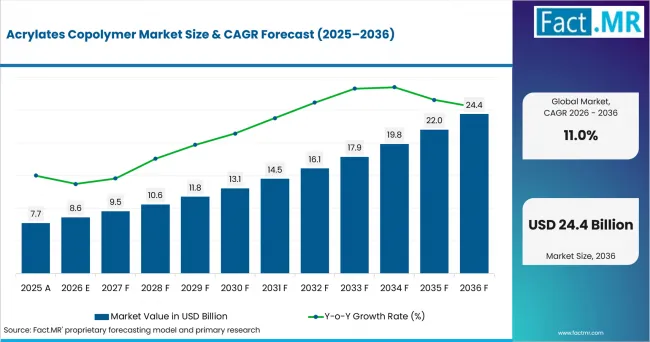
Acrylates Copolymer Market Value Analysis | Source: Fact.MR
What are the defining numbers behind Acrylates Copolymer Market growth?
USD 15.8 billion absolute opportunity by 2036, led by Emulsion Acrylates Copolymer, Paints & Coatings Applications and Waterborne Acrylates Copolymer.
- Demand Drivers in the Market
- Paint formulators need acrylic binders that maintain film strength while lowering solvent dependence.
- Adhesive producers use acrylates copolymers where tack and wet-aging stability must remain consistent.
- Packaging converters rely on acrylic systems where coatings require clean application and stable drying.
- Textile finishers select specialty acrylic systems where treatment must balance feel and durability.
- Key Segments Analyzed
- By Product: Emulsion Acrylates Copolymer is expected to hold 77.6% share in 2026 owing to waterborne paint and adhesive use.
- By Application: Paints & Coatings Applications is projected to hold 42.8% share in 2026 due to acrylic binder use.
- By End Use: Paints & Coatings Industry is anticipated to hold 63.9% share in 2026 supported by decorative and protective coatings.
- By Technology: Emulsion Polymerization Technology is estimated to hold 55.4% share in 2026 due to latex process fit.
- By Formulation: Waterborne Acrylates Copolymer is forecast to hold 71.2% share in 2026 shaped by low-solvent coating recipes.
- By Distribution Channel: Direct Industrial Sales is expected to hold 48.7% share in 2026 led by large formulators needing service.
- Analyst Opinion at Fact.MR
- Shambhu Nath Jha, Principal Consultant at Fact.MR, states, "Acrylates copolymer suppliers are being judged on formulation reliability. Buyers are expected to ask for lower-VOC performance and stable batch quality before changing binders. Coating lab support is expected to defend long-term supply positions."
- Strategic Implications
- Coating manufacturers should qualify waterborne acrylic systems early because gloss testing is expected to slow reformulation.
- Adhesive producers should compare emulsion stability before shifting from solvent based acrylate systems.
- Distributors should prioritize support because formulators need troubleshooting before regional supply changes.
- Investors should separate direct copolymer exposure from broader monomer or coatings revenue.
Germany is projected to record 12.7% CAGR through 2036, supported by rehabilitation and coating reformulation. Brazil is anticipated to post 11.6% CAGR as housing programs raise coating use. The USA is forecast to hold 10.5% CAGR owing to construction spending. The UK is estimated to reach 9.4% CAGR as repair work supports repainting. Japan is expected to record 8.3% CAGR as quality housing supports resin selection.
How does the Acrylates Copolymer Market break down by segment?
Emulsion Acrylates Copolymer leads Product at 77.6%; Paints & Coatings Applications leads Application at 42.8%.
Which product dominates?
Emulsion Acrylates Copolymer holds 77.6% share in 2026.
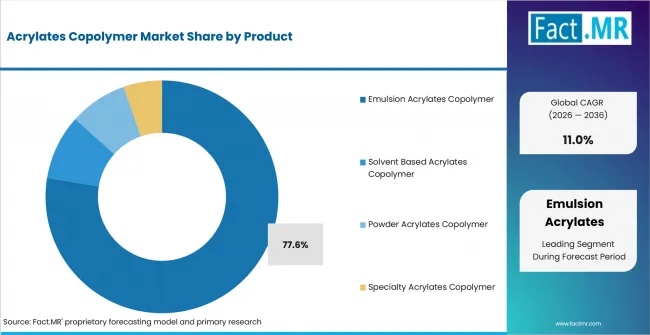
Acrylates Copolymer Market Analysis By Product | Source: Fact.MR
Emulsion acrylates copolymer is expected to lead because it fits waterborne paint and adhesive production. Solvent based, powder and specialty systems serve narrower performance uses. Arkema launched ENCOR bio-based waterborne dispersions in January 2025 for textile printing and finishing, with up to 30% bio-based content and up to 40% lower carbon footprint.
What leads the Application segment?
Paints & Coatings Applications hold 42.8% share in 2026.
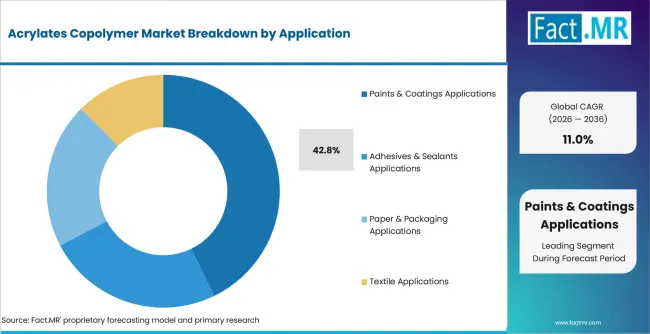
Acrylates Copolymer Market Analysis By Application | Source: Fact.MR
Paints & Coatings Applications are projected to lead with 42.8% share in 2026 as acrylic binders support adhesion, gloss and film formation across decorative and industrial finishes. Adhesives, paper and textile applications contribute additional demand, but their use remains more specialized and application-specific.
How does End Use shape demand?
Paints & Coatings Industry leads with 63.9% share in 2026.
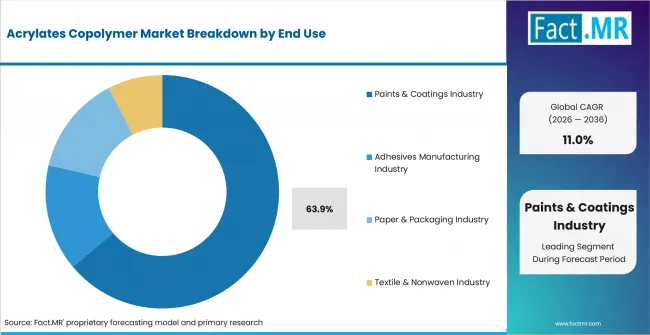
Acrylates Copolymer Market Analysis By End Use | Source: Fact.MR
The Paints & Coatings Industry is anticipated to lead with 63.9% share in 2026 because acrylic systems help improve surface finish, adhesion and durability across multiple coating formulations. Adhesive and packaging users add further demand, although their consumption remains narrower than large-scale coatings applications.
What supports Technology demand?
Emulsion Polymerization Technology leads with 55.4% share in 2026.
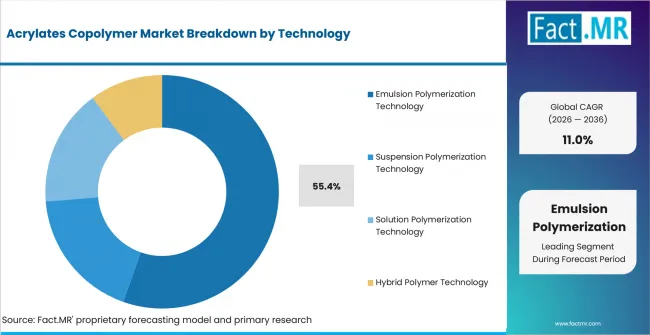
Acrylates Copolymer Market Analysis By Technology | Source: Fact.MR
Emulsion polymerization technology is estimated to lead because it produces latex systems for waterborne coatings. Batch, suspension and solution routes meet narrower resin needs.
Which Formulation leads?
Waterborne Acrylates Copolymer holds 71.2% share in 2026.
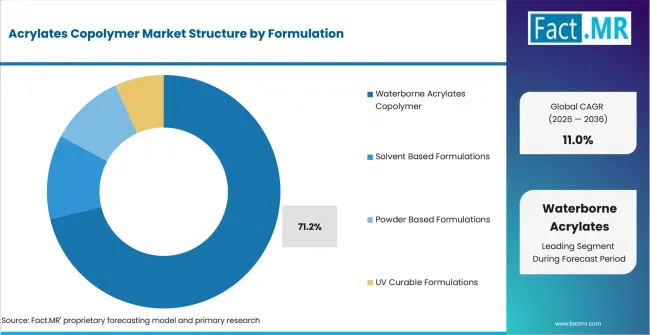
Acrylates Copolymer Market Analysis By Formulation | Source: Fact.MR
Waterborne acrylates copolymer is forecast to lead as formulators reduce solvent load. Solvent based, powder and UV curable systems cover specialized uses. BASF introduced its Near-Zero SVOC dispersion for interior coatings in January 2026, supporting lower-emission waterborne formulations.
What leads Distribution Channel demand?
Direct Industrial Sales hold 48.7% share in 2026.
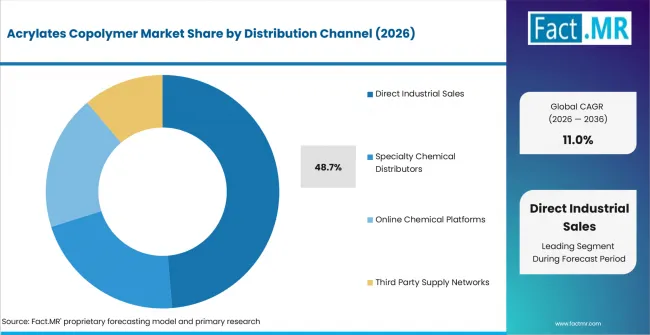
Acrylates Copolymer Market Analysis By Distribution Channel | Source: Fact.MR
Direct industrial sales are expected to lead because large customers need supply assurance and support. Distributors and online platforms serve smaller-volume needs.
What is accelerating Acrylates Copolymer Market adoption, and what is holding it back?
Waterborne coating reformulation drives it; raw-material and compliance pressure restrain it.
Drivers Impact Analysis
| DRIVER | (~) % IMPACT ON CAGR | GEOGRAPHIC RELEVANCE | IMPACT TIMELINE |
|---|---|---|---|
| Waterborne coating shift | +2.6% | USA, Germany, UK | Short term (<= 2 years) |
| Architectural repainting cycles | +2.2% | Brazil, USA, UK | Short term (<= 2 years) |
| Adhesive and sealant performance | +1.8% | Germany, Japan, USA | Medium term (2-4 years) |
| Packaging coating demand | +1.4% | Brazil, Japan, Europe | Medium term (2-4 years) |
| Technical service and direct sales | +1.0% | Global formulators | Long term (>= 4 years) |
Source: Fact.MR analysis. Updated Aug 12, 2026
- Architectural repainting cycles: Housing repair and construction activity is expected to support wall paints and exterior coatings. Acrylic binders remain useful where contractors need washability and stable dry time.
- Adhesive and sealant performance: Construction adhesives and industrial sealants require tack and moisture resistance. Acrylate copolymers are anticipated to hold demand in low-odor adhesive systems.
- Packaging coating demand: Paper coating and packaging adhesive uses require smooth application. Lubrizol lists Carboset 7490F as an acrylic copolymer emulsion for barrier coatings and packaging uses.
- Technical service and direct sales: Large formulators approve resins after lab support and batch review. Direct sales therefore carry value beyond logistics.
Opportunity Impact Analysis
| OPPORTUNITY | (~) % IMPACT ON CAGR | GEOGRAPHIC RELEVANCE | IMPACT TIMELINE |
|---|---|---|---|
| Bio-attributed acrylic inputs | +1.3% | Germany, USA, Europe | Medium term (2-4 years) |
| Low-VOC architectural systems | +1.1% | USA, UK, Japan | Medium term (2-4 years) |
| Packaging barrier coatings | +0.8% | Brazil, Japan | Long term (>= 4 years) |
| Regional technical distribution | +0.6% | Brazil and specialty users | Long term (>= 4 years) |
Source: Fact.MR analysis. Updated Aug 12, 2026
- Bio-attributed acrylic inputs: Certified acrylic chains create scope for lower-carbon copolymers.
- Low-VOC architectural systems: Regulatory pressure is expected to keep formulators focused on lower-emission coating routes. Waterborne acrylates copolymers fit that need in paint systems.
- Packaging barrier coatings: Paper and packaging applications create room for acrylic systems that improve surface quality. Adoption is expected to depend on line speed and food-contact documentation.
- Regional technical distribution: Smaller formulators still depend on distributors for sampling and troubleshooting. Regional stock improves trial speed where direct contracts are not practical.
Restraints Impact Analysis
| RESTRAINT | (~) % IMPACT ON CAGR | GEOGRAPHIC RELEVANCE | IMPACT TIMELINE |
|---|---|---|---|
| Acrylate raw-material cost swings | -1.3% | Germany, USA, Japan | Short term (<= 2 years) |
| Reformulation qualification time | -1.0% | Coatings and adhesives users | Short term (<= 2 years) |
| VOC and hazard documentation | -0.8% | USA, UK, Germany | Medium term (2-4 years) |
| Distributor margin pressure | -0.5% | Brazil and regional channels | Long term (>= 4 years) |
Source: Fact.MR analysis. Updated Aug 12, 2026
- Acrylate raw-material cost swings: Acrylic acid and ester costs flow into copolymer pricing.
- Reformulation qualification time: Changing a binder affects viscosity, dry time and adhesion. Approval cycles are expected to limit fast supplier replacement in coating lines.
- VOC and hazard documentation: Compliance paperwork adds time to regional sales.
- Distributor margin pressure: Regional distributors carry inventory and service cost for smaller customers. Direct sales are expected to reduce distributor margin where large accounts formalize contracts.
Which countries are scaling Acrylates Copolymer Market fastest?
- The country comparison spans 4.4 percentage points across construction and coating-use conditions.
- Germany remains 1.1 percentage points above Brazil because rehabilitation work supports higher-value formulations.
- Brazil remains 1.1 percentage points above the USA as housing programs support coating use.
- The USA remains 1.1 percentage points above the UK due to construction scale.
- The UK remains 1.1 percentage points above Japan as repair work supports repainting.
- Japan completes the displayed range through quality housing and specialty coatings.
Comparable CAGRs create different entry routes. Full coverage includes North America, Latin America, Europe, East Asia, South Asia and Pacific, and Middle East and Africa.
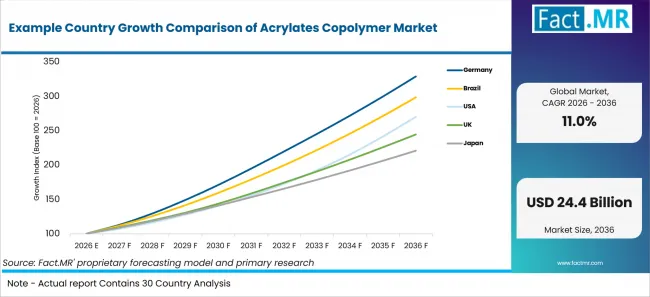
Example Country Growth Comparison Of Acrylates Copolymer Market | Source: Fact.MR
| COUNTRY | CAGR |
|---|---|
| Germany | 12.7% |
| Brazil | 11.6% |
| USA | 10.5% |
| UK | 9.4% |
| Japan | 8.3% |
Source: Fact.MR analysis. Updated Aug 12, 2026
What supports Germany adoption?
12.7% CAGR, supported by building permits, coating demand and raw-material discipline.
Germany’s growth reflects architectural coating demand, local chemical support and careful binder qualification. Direct sales remain important where formulators need batch testing before switching binders, while strict VOC documentation, higher chemical input costs and weaker housing completions can slow adoption.
How is Brazil scaling demand?
11.6% CAGR, driven by housing programs and construction activity.
Brazil’s growth is supported by housing delivery, architectural coatings and specialty distributor access to acrylic resin grades. Repainting and new-build activity support binder demand, while currency pressure, higher construction costs and regional logistics can limit resin availability outside major coating clusters.
How does the USA perform?
10.5% CAGR, backed by construction spending and VOC-led formulation review.
The USA’s growth reflects large construction activity, acrylic paint demand and continued low-solvent formulation review. The U.S. Census Bureau estimated May 2026 construction spending at USD 2,210.2 billion. Large buyers favor direct supply and plant trials, while weaker housing starts, VOC documentation and cautious binder switching can slow new resin approvals.
What supports UK growth?
9.4% CAGR, supported by repair work and official housing delivery.
The UK’s growth is supported by repair activity, housing delivery and technical service for waterborne coating formulations. Homes England reported 40,332 completions in 2025 to 2026. Direct sales and distributors both support formulators, while weaker construction orders, importer documentation and cost-conscious purchasing can delay switching from established binders.
How does Japan develop demand?
8.3% CAGR, led by quality housing and specialty formulation needs.
Japan’s growth reflects high-quality housing requirements and demand for consistent specialty acrylic systems. Coating customers value durability and application consistency, while weaker housing starts, longer performance testing and uneven regional repainting demand can constrain growth.
Who leads the Acrylates Copolymer Market?
BASF SE, Arkema, Celanese Corporation and The Lubrizol Corporation show direct relevance.
BASF SE supports acrylic formulation through acrylate chemistry. Arkema connects acrylic monomers with waterborne resins. Celanese and Lubrizol add binder and emulsion exposure.
Which companies are the key providers?
Companies include BASF SE, Celanese Corporation, Arkema, Nouryon, Novista Chemicals, The Lubrizol Corporation, Dow Inc., Mitsubishi Chemical Corporation, Evonik Industries AG, and Ashland Inc.
- BASF SE
- Celanese Corporation
- Arkema
- Nouryon
- Novista Chemicals
- The Lubrizol Corporation
- Dow Inc.
- Mitsubishi Chemical Corporation
- Evonik Industries AG
- Ashland Inc.
Bibliography
- Arkema. (2026, January 14). Arkema announces the ISCC PLUS certification of more than 70% of its coating facilities worldwide.
- Arkema. (2025, July 29). Arkema completes ISCC PLUS certification for all acrylic monomer facilities worldwide.
- BASF SE. (2025, June 10). BASF’s Rheovis® range transitions to bio-based Ethyl Acrylate (EA).
- Celanese Corporation. (2025, March 4). Baumit and Celanese collaborate to offer façade plaster and paint solutions created with carbon capture technology.
- Eurostat. (2026, July 20). Production in construction up by 0.4% in the euro area and by 0.3% in the EU.
- Homes England. (2026, June 25). New Homes England 2025 to 2026 housebuilding statistics published.
- Office for National Statistics. (2026, May 14). Construction output in Great Britain: March 2026, new orders and Construction Output Price Indices, January to March 2026.
- U.S. Census Bureau, & U.S. Department of Housing and Urban Development. (2026, June 16). Monthly New Residential Construction, May 2026.
This Report Answers
- Segment analysis covers Emulsion Acrylates Copolymer and Paints & Coatings Applications as the share leaders within the 2026 market.
- Country outlook evaluates Germany and Brazil alongside the USA, UK and Japan across the profiled markets.
- Competitive analysis profiles BASF SE and Arkema alongside Celanese Corporation and The Lubrizol Corporation.
- Technology assessment covers Emulsion Polymerization Technology and Suspension Polymerization Technology.
- Scope coverage defines product, application and channel boundaries for acrylates copolymer use.
What does the Acrylates Copolymer Market cover?
Coverage includes paints and coatings formulations, adhesives and sealants formulations, packaging coatings and textile treatment applications. The market includes emulsion, solvent based, powder and specialty copolymers.
Adjacent coverage includes acrylic surface coating systems and coating binder platforms where acrylate copolymer chemistry defines the resin choice.
What is included in the scope?
The scope includes emulsion polymer systems and waterborne acrylic resin formulations used as acrylates copolymer binders or modifiers.
Coverage also includes polymer binder demand, adhesive resin systems and structural adhesive applications when copolymer performance defines selection.
What is excluded from the scope?
Pure acrylic monomers and unrelated coating additives remain outside scope unless sold as part of copolymer systems. Finished paint and adhesive revenue are excluded. Coverage of acrylic film former technologies is limited to acrylates copolymer systems.
How Was the Analysis Built?
The analysis draws on 120+ sources, 35+ company portfolios, 25+ countries, and more than 20 interviews.
- Primary Research: Interviews with manufacturers, retailers, salon operators, and experts examine purchase priorities, adoption, approval requirements, and competitive positioning.
- Desk Research: Desk research covers government statistics, regulatory publications, company filings, trade data, technical studies, industry associations, standards, and public policy.
- Market Sizing and Forecasting: Estimates combine historical performance, demand indicators, pricing, segment shares, company participation, country growth, adoption patterns, and barriers to expansion.
- Data Validation and Update Cycle: Findings are validated against public data, company activity, regulatory changes, product launches, recalls, and adoption shifts.
Segmentation
What is the report’s scope and coverage?
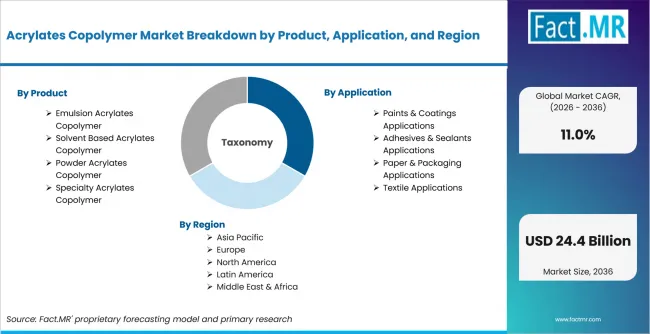
Acrylates Copolymer Market Breakdown By Product, Application, And Region | Source: Fact.MR
| Attribute | Details |
|---|---|
| Quantitative Units | USD billion |
| Market Definition | Acrylate-based copolymer systems used as binders, film formers and modifiers where adhesion, durability and low-VOC processing influence approval |
| Product | Emulsion Acrylates Copolymer; Solvent Based Acrylates Copolymer; Powder Acrylates Copolymer; Specialty Acrylates Copolymer |
| Application | Paints & Coatings Applications; Adhesives & Sealants Applications; Paper & Packaging Applications; Textile Applications |
| End Use | Paints & Coatings Industry; Adhesives Manufacturing Industry; Paper & Packaging Industry; Textile & Nonwoven Industry |
| Technology | Emulsion Polymerization Technology; Suspension Polymerization Technology; Solution Polymerization Technology; Hybrid Polymer Technology |
| Formulation | Waterborne Acrylates Copolymer; Solvent Based Formulations; Powder Based Formulations; UV Curable Formulations |
| Distribution Channel | Direct Industrial Sales; Specialty Chemical Distributors; Online Chemical Platforms; Third Party Supply Networks |
| Regions Covered | North America; Latin America; Europe; East Asia; South Asia and Pacific; Middle East and Africa |
| Countries Covered | Germany; Brazil; USA; UK; Japan |
| Companies Profiled | BASF SE; Celanese Corporation; Arkema; Nouryon; Novista Chemicals; The Lubrizol Corporation; Dow Inc.; Mitsubishi Chemical Corporation; Evonik Industries AG; Ashland Inc. |
| Forecast Period | 2026 to 2036 |
| Approach | Hybrid top-down and bottom-up approach using coatings demand; adhesive formulation activity; construction indicators; waterborne resin use; raw-material cost signals; country adoption patterns and company portfolio review |
Source: Fact.MR analysis. Updated Aug 12, 2026
How is the market segmented?
-
By Product:
- Emulsion Acrylates Copolymer
- Waterborne Emulsion Systems
- Hybrid Emulsion Systems
- Solvent Based Acrylates Copolymer
- Acrylic Resin Solutions
- High Solid Resin Systems
- Powder Acrylates Copolymer
- Thermoplastic Powder Systems
- Reactive Powder Systems
- Specialty Acrylates Copolymer
- Functional Acrylic Systems
- Performance Modified Systems
- Emulsion Acrylates Copolymer
-
By Application:
- Paints & Coatings Applications
- Architectural Coatings
- Industrial Coatings
- Adhesives & Sealants Applications
- Construction Adhesives
- Industrial Sealants
- Paper & Packaging Applications
- Paper Coating Applications
- Packaging Adhesive Applications
- Textile Applications
- Fabric Coating Applications
- Fiber Treatment Applications
- Paints & Coatings Applications
-
By End Use:
- Paints & Coatings Industry
- Architectural Paint Manufacturers
- Industrial Coating Manufacturers
- Adhesives Manufacturing Industry
- Construction Adhesive Producers
- Industrial Adhesive Producers
- Paper & Packaging Industry
- Paper Manufacturing Companies
- Packaging Material Manufacturers
- Textile & Nonwoven Industry
- Technical Textile Manufacturers
- Apparel Textile Manufacturers
- Paints & Coatings Industry
-
By Technology:
- Emulsion Polymerization Technology
- Batch Polymerization Systems
- Continuous Polymerization Systems
- Suspension Polymerization Technology
- Aqueous Suspension Systems
- Organic Suspension Systems
- Solution Polymerization Technology
- Solvent Reaction Systems
- High Solid Systems
- Hybrid Polymer Technology
- Copolymer Blending Systems
- Functional Modification Systems
- Emulsion Polymerization Technology
-
By Formulation:
- Waterborne Acrylates Copolymer
- Low VOC Formulations
- High Stability Water Systems
- Solvent Based Formulations
- Fast Dry Resin Systems
- Durable Solvent Systems
- Powder Based Formulations
- Thermoplastic Powder Systems
- Reactive Powder Systems
- UV Curable Formulations
- Radiation Cure Systems
- Hybrid UV Systems
- Waterborne Acrylates Copolymer
-
By Distribution Channel:
- Direct Industrial Sales
- OEM Supply Agreements
- Enterprise Supply Contracts
- Specialty Chemical Distributors
- Regional Distributors
- Technical Distributors
- Online Chemical Platforms
- B2B E Commerce Platforms
- Manufacturer Direct Portals
- Third Party Supply Networks
- Contract Manufacturers
- Global Trading Companies
- Direct Industrial Sales
-
By Region:
- North America
- Latin America
- Western Europe
- Eastern Europe
- East Asia
- South Asia and Pacific
- Middle East & Africa
Frequently Asked Questions
How big is the acrylates copolymer market in 2026?
What is the CAGR of the acrylates copolymer market from 2026 to 2036?
Which product leads the acrylates copolymer market?
Which application leads the acrylates copolymer market?
Who are the leading companies in the acrylates copolymer market?
Who worked on this report


Preview the report firsthand - request a free sample
Free SampleGet the brochure for pricing and purchase details
Download PDF