- Market Value (2025): USD 1.3 Bn
- Estimated Value (2026): USD 1.5 Bn
- Forecast Value (2036): USD 3.6 Bn
- CAGR (2026-2036): 9.5%
What is the Additive-Free Dairy Powders Market forecast to be worth by 2036?
USD 1.5 billion in 2026 to USD 3.6 billion by 2036, at 9.5% CAGR.
- The Additive-Free Dairy Powders Market reached USD 1.3 billion in 2025.
- Demand is projected to increase from USD 1.5 billion in 2026 to USD 3.6 billion by 2036.
- The market is forecast to record a 9.5% CAGR from 2026 to 2036 as bakery, candy and ready-food teams seek shorter dairy input lists.
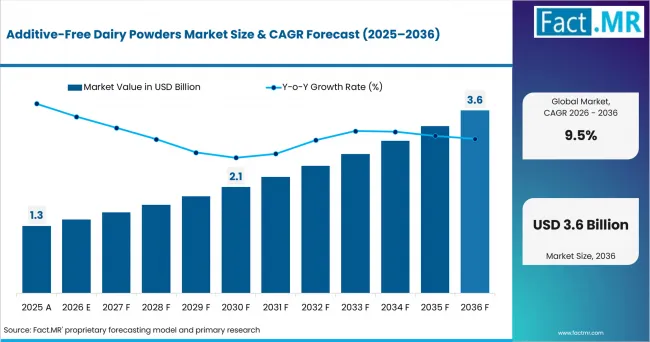
Additive Free Dairy Powders Market Value Analysis | Source: Fact.MR
What are the defining numbers behind Additive-Free Dairy Powders Market growth?
USD 2.2 billion absolute opportunity is expected between 2026 and 2036.
- Demand Drivers in the Market
- Bakery teams need dry dairy that adds milk solids and flavor while keeping carrier use out of the recipe. This lets teams test and track one dry dairy input through each batch.
- Candy makers value a steady milk taste and fat from powders that can go straight into dry recipes. This can keep the milk note clear while limiting the need for an added emulsifier.
- Drink teams need powders that mix with water in a steady way while keeping the recipe simple. A clear powder spec helps them set mix time and water use before scale-up.
- Ready-food makers favor shelf-stable dairy powders because dry handling helps keep each batch steady and reduces the need for chilled liquid inputs.
- Key Segments Analyzed
- By Dairy Powder Base: Whole milk powder is expected to hold 39.0% share in 2026 because it adds milk solids and dairy fat to dry food recipes.
- By Additive-Free Position: No carriers are projected to account for 35.0% share in 2026 since makers can keep the powder close to the base dairy input.
- By Primary Use: Bakery is anticipated to represent 31.0% share in 2026 as dry dairy fits dough, cake, biscuit and filling mixes that already use powders.
- By Fat Band: <5% is estimated to capture 38.0% share in 2026 due to wide use of low-fat dairy solids where milk solids count more than fat.
- Analyst Opinion at Fact.MR
- Shambhu Nath Jha, Principal Consultant at Fact.MR, states, “The main question is whether a dairy powder can supply the needed milk solids with a simple label. The market is expected to favor plants that control powder make-up and handling well enough to reduce the need for carriers or mixing aids. Suppliers that pair steady powder quality with traceable dairy sourcing and use support are better placed for spec-led food work.”
- Strategic Implications
- Dairy plants should state each powder grade clearly so food teams can review carriers, emulsifiers, anti-caking agents and preservatives before tests begin.
- Bakery teams should test powder flow and mixing under their own heat and mix steps. Removing a making aid can change both. Plant trials help set mix time and heat steps before a full run.
- Food brands should match each additive-free claim with the input list used in the target market. The product spec should stay tied to the actual recipe.
- Powder firms should control moisture and particle size so flow and storage stay steady when anti-caking agents are absent. Good pack seals and dry storage help preserve flow from batch to batch.
Japan is forecast to post 9.8% CAGR through 2036 because its milk-powder system supports spec-led food use. The USA is projected to record 9.5% as a large dry-dairy output base supports recipe work. Germany is anticipated to advance at 9.2% owing to sizeable dry-milk output and exports. France is estimated at 8.9% as milk-powder output serves food makers. The UK is forecast at 8.2% while milk volumes remain substantial.
How does the Additive-Free Dairy Powders Market break down by segment?
Whole milk powder leads Dairy Powder Base at 39.0%; No carriers leads Additive-Free Position at 35.0%.
Which Dairy Powder Base leads?
Whole milk powder is expected to hold 39.0% share in 2026.
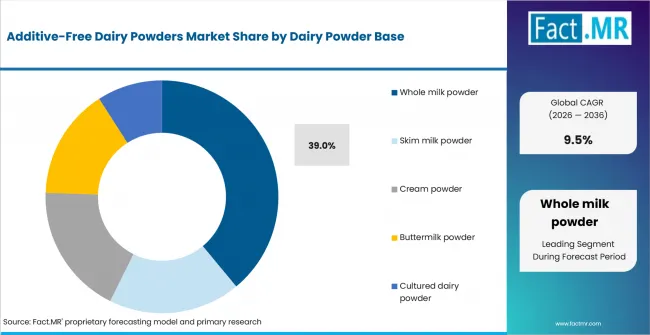
Additive Free Dairy Powders Market Analysis By Dairy Powder Base | Source: Fact.MR
Whole milk powder combines milk solids with dairy fat, which suits bakery, candy and ready foods. Skim milk powder serves lower-fat recipes. Cream, buttermilk and cultured powders serve set fat or taste needs. Food teams can choose the dairy base to match milk solids and richness.
What leads the Additive-Free Position segment?
No carriers is projected to account for 35.0% share in 2026.
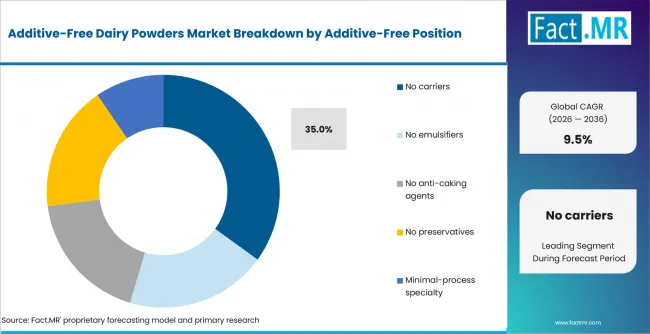
Additive Free Dairy Powders Market Analysis By Additive Free Position | Source: Fact.MR
No-carrier powders lead because a carrier can appear on the input list and weaken a direct dairy identity. Other grades remove emulsifiers, anti-caking agents or preservatives. Flow and mixing still need to meet plant needs after the extra input is removed.
How does Primary Use shape demand?
Bakery is anticipated to represent 31.0% share in 2026.
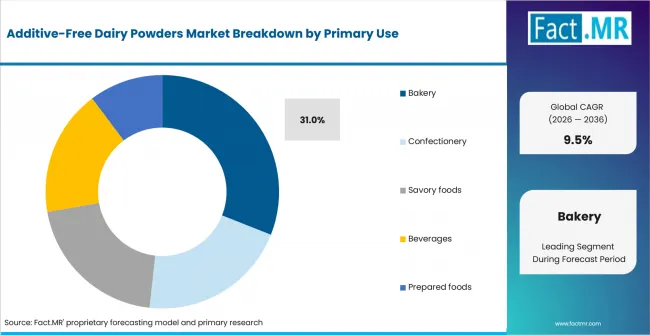
Additive Free Dairy Powders Market Analysis By Primary Use | Source: Fact.MR
Bakery leads because milk powders fit dry-input dosing with no liquid handling. Candy makers use them for milk taste and solids, while savory and ready foods use them in dry mixes. Drinks need tighter water and mix control before a powder moves into routine output.
What supports the <5% Fat Band?
<5% is estimated to capture 38.0% share in 2026.
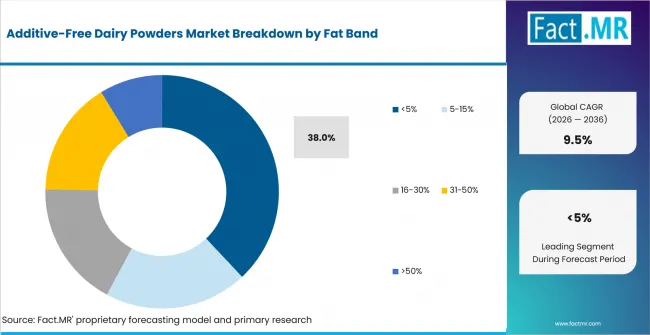
Additive Free Dairy Powders Market Analysis By Fat Band | Source: Fact.MR
The <5% band leads where food makers need dairy solids while milk fat has a smaller role, while higher bands serve richer recipes. USDA FAS’s December 2025 Dairy: World Markets and Trade table listed U.S. nonfat dry milk production at 995,000 metric tons for 2025.
What is accelerating Additive-Free Dairy Powders Market adoption, and what is holding it back?
Simpler input lists support adoption; powder handling and end-use results set the approval threshold.
Drivers Impact Analysis
| DRIVER | (~) % IMPACT ON CAGR | GEOGRAPHIC RELEVANCE | IMPACT TIMELINE |
|---|---|---|---|
| Shorter dairy input lists | +1.8% | North America, Europe | Short term (<= 2 years) |
| Use of powders in dry food systems | +1.4% | Global | Medium term (2-4 years) |
| Large milk-powder making base | +1.1% | USA, Germany, France, Japan | Medium term (2-4 years) |
| Bakery and candy recipe use | +0.9% | Global | Long term (>= 4 years) |
| Spec-led additive removal | +0.7% | North America, Western Europe | Long term (>= 4 years) |
Opportunity Impact Analysis
| OPPORTUNITY | (~) % IMPACT ON CAGR | GEOGRAPHIC RELEVANCE | IMPACT TIMELINE |
|---|---|---|---|
| Carrier-free whole milk powder grades | +1.3% | North America, Europe, Japan | Short term (<= 2 years) |
| Low-fat powder for simple-label foods | +1.0% | Global | Medium term (2-4 years) |
| Bakery powders for set uses | +0.8% | Europe, North America | Medium term (2-4 years) |
| Traceable dairy powders | +0.6% | Global | Long term (>= 4 years) |
Restraints Impact Analysis
| RESTRAINT | (~) % IMPACT ON CAGR | GEOGRAPHIC RELEVANCE | IMPACT TIMELINE |
|---|---|---|---|
| Additive-free flow and caking control | -0.8% | Global | Short term (<= 2 years) |
| Dairy commodity price volatility | -0.6% | North America, Europe | Short term (<= 2 years) |
| Country import controls | -0.5% | Japan, other regulated markets | Medium term (2-4 years) |
| Narrow recipe tolerance | -0.4% | Global | Long term (>= 4 years) |
Which countries are scaling Additive-Free Dairy Powders Market through 2036?
- The five-country comparison spans 1.6 percentage points from Japan at 9.8% CAGR to the UK at 8.2%.
- Japan remains 0.3 percentage point above the USA as domestic skim milk powder supply supports spec-led food work.
- The USA remains 0.3 percentage point above Germany as its large dry-dairy output base supports recipe work.
- Germany remains 0.3 percentage point above France through its established milk-processing base and broad food output.
- France remains 0.7 percentage point above the UK as milk-powder output serves large food plants and recipe work.
- The UK closes the displayed range at 8.2% CAGR as its milk supply supports food makers.
Similar CAGRs can create different market conditions because milk supply, powder capacity and input rules vary by country. Full coverage includes North America, Latin America, Western Europe, Eastern Europe, East Asia, South Asia & Pacific, and Middle East & Africa.
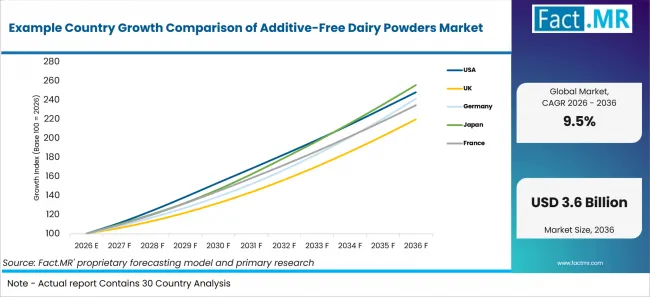
Example Country Growth Comparison Of Additive Free Dairy Powders Market | Source: Fact.MR
| Country | CAGR (2026-2036) |
|---|---|
| Japan | 9.8% |
| United States | 9.5% |
| Germany | 9.2% |
| France | 8.9% |
| United Kingdom | 8.2% |
What supports USA adoption?
9.5% CAGR, supported by a large dry-dairy base and food formulation demand.
The United States has a large dry-dairy base for low-fat powders used in bakery and ready foods. In April 2026, USDA NASS reported 1.658 billion pounds of nonfat dry milk output for human use in 2025. Additive-free grades are expected to compete on clear make-up, steady flow and reliable results across repeat runs.
How is the United Kingdom developing demand?
8.2% CAGR, backed by a substantial milk-processing base and food manufacturing activity.
The United Kingdom combines a sizeable milk pool with broad food-making demand. Defra reported that the volume of milk for human consumption in the UK reached 15.844 billion litres in 2025. Dry dairy inputs therefore serve bakery, candy and ready foods. Additive-free grades are expected to gain attention where product teams want a direct dairy input list and steady handling on current plant lines.
What is supporting Germany’s adoption?
9.2% CAGR, supported by an established dairy-processing and food manufacturing base.
Germany’s milk-processing base supports regular powder tests across large food plants. In November 2025, Eurostat reported that Germany produced 18.8% of the EU’s drinking milk in 2024. Additive-free powder firms are expected to compete on steady make-up, moisture control and use support for bakery and candy makers.
How does France perform?
8.9% CAGR, supported by active milk-powder production and food processing demand.
France has an active milk-powder base that serves large food plants. In September 2026, Agreste reported cumulative French skim milk powder output of 247,723 tonnes through July 2026. Suppliers are expected to compete on steady powder quality and clear make-up while keeping mixing, heat treatment and finished texture consistent.
How is Japan scaling demand?
9.8% CAGR, led by a structured skim milk powder system and quality-focused food manufacturing.
Japan’s food makers work within a structured domestic milk-powder system and pay close attention to mixing quality. In January 2026, Japan’s Ministry of Agriculture, Forestry and Fisheries reported cumulative FY2025 skim milk powder production of 115,972 tonnes through December 2025. That base supports spec-led use in bakery, drinks and ready foods. Additive-free grades are expected to advance where suppliers pair clear make-up with stable mixing and dependable product results.
Who leads the Additive-Free Dairy Powders Market?
Arla Foods Ingredients has the clearest direct connection to dairy-powder supply within the profiled group. Its dairy ingredient activity places it close to applications where food manufacturers require controlled milk solids, dependable powder specifications, and consistent performance in bakery, confectionery, beverages, and prepared foods.
Kerry Group participates through its wider food-ingredient and product-development capabilities. Its biotechnology work adds expertise around formulation, fermentation, enzymes, and scale-up, supporting customers that need to evaluate how dairy inputs perform within broader recipe systems and processing conditions.
Lactalis Ingredients, Fonterra / NZMP, Agropur Ingredients, and EPI Ingredients broaden the supplier set around dairy and food formulation needs. Within this market, buyers compare powder base, additive-free positioning, handling behavior, and end-use fit before selecting grades for dry recipes and production trials.
Competition therefore centers on powder consistency, moisture and particle-size control, clear additive declarations, traceable dairy sourcing, and reliable mixing or flow performance after carriers, emulsifiers, anti-caking agents, or preservatives are removed. Suppliers that can pair stable powder quality with application support are better aligned with specification-driven food programs.
Which companies are the key providers?
Companies profiled include Kerry Group, Lactalis Ingredients, Fonterra / NZMP, Agropur Ingredients, EPI Ingredients, and Arla Foods Ingredients.
- Kerry Group
- Lactalis Ingredients
- Fonterra / NZMP
- Agropur Ingredients
- EPI Ingredients
- Arla Foods Ingredients
Bibliography
- U.S. Department of Agriculture, Foreign Agricultural Service. (2025, December). Dairy: World markets and trade.
- U.S. Department of Agriculture, National Agricultural Statistics Service. (2026, April 24). Dairy products 2025 summary.
- Department for Environment, Food & Rural Affairs. (2026, September 3). Chapter 8: Livestock. In Agriculture in the United Kingdom 2025.
- Office for National Statistics. (2026, July 24). UK manufacturers’ sales by product: 2025.
- Eurostat. (2025, November 20). Milk production reached 161.8 million tonnes in 2024.
- Agreste. (2026, September 15). Lait : Juillet 2026 - la collecte de lait quasi stable.
- Arla Foods Ingredients. (2025, March 3). Arla Foods Ingredients strengthens US foothold with Valley Queen agreement.
- Kerry Group. (2025, September 24). Kerry establishes new biotechnology centre in Leipzig.
This Report Answers
- The report explains how these dairy powders differ by powder base and by the additive-free claim used in food recipes.
- Segment review shows the lead powder base, additive-free position, primary use and fat band. It explains the reason for each 2026 share.
- Country review covers the United States, United Kingdom, Germany, Japan and France. Each country block uses one current public fact.
- Use-case review looks at how carrier removal, emulsifier removal and anti-caking removal affect baking, candy, drinks, savory foods and ready foods.
What does the Additive-Free Dairy Powders Market cover?
The Additive-Free Dairy Powders Market covers food-grade dairy powders sold with one or more additive-free positions in the segmentation. It includes the five listed powder bases used in bakery, confectionery, savory foods, drinks and ready-food recipes.
The market boundary is close to broader dairy products coverage and specialized enriched milk powder research. The scope stays focused on additive-free positions within the defined powder bases.
What is included in the scope?
The scope covers dairy powders sold as no-carrier, no-emulsifier, no-anti-caking-agent, no-preservative or minimal-process grades. It covers the listed uses and fat bands. It also covers handling and testing after an extra input is removed.
Downstream recipe context is informed by adjacent baking ingredient research and functional bakery ingredients. Broader making context is represented by food processing ingredients and food ingredient coverage.
What is excluded from the scope?
The scope excludes dairy powders containing the listed additives when they lack an additive-free spec. Liquid dairy and finished foods fall outside the scope. Non-dairy powder bases and separate processing aids are outside the defined market as well.
The boundary therefore differs from broad dairy nutritional ingredients and from fortified dairy products, which can include nutrient systems and finished recipes outside this powder definition.
How Was the Analysis Built?
The analysis draws on 120+ sources, 35+ company portfolios, 25+ countries, and more than 20 industry interviews.
- Primary Research: Primary research includes discussions with manufacturers, service providers, technology developers, distributors, end users, and subject-matter experts. These conversations examine purchasing priorities, product adoption, operational challenges, approval requirements, competitive positioning, and the factors that influence wider market acceptance.
- Desk Research: Desk research covers government statistics, regulatory publications, company filings, trade data, technical studies, industry associations, standards, public policy, and other authoritative sources. Every source used in the analysis is documented in the bibliography.
- Market Sizing and Forecasting: Market estimates combine historical performance, demand indicators, pricing and volume trends, segment shares, company participation, country-level growth, adoption patterns, investment activity, and barriers to market expansion.
- Data Validation and Update Cycle: Findings are validated by comparing primary interviews with public data, company activity, regulatory changes, trade patterns, and industry developments. Regular updates review new product launches, capacity changes, partnerships, approvals, and shifts in commercial adoption.
What is the report’s scope and coverage?
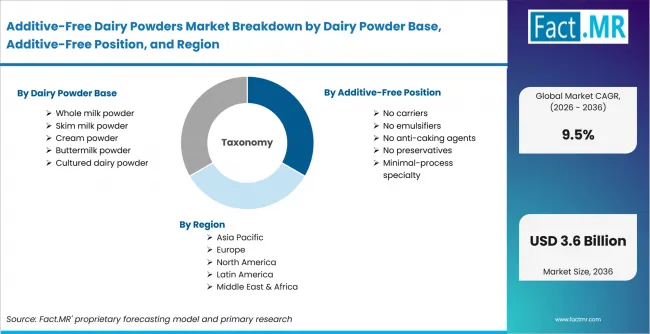
Additive Free Dairy Powders Market Breakdown By Dairy Powder Base, Additive Free Position, And Region | Source: Fact.MR
| Attribute | Details |
|---|---|
| Quantitative Units | USD billion |
| Market Definition | Food-grade dairy powders sold with set additive-free positions such as no carriers, no emulsifiers, no anti-caking agents or no preservatives. They are used in food and drink recipes. |
| Dairy Powder Base | Whole milk powder; Skim milk powder; Cream powder; Buttermilk powder; Cultured dairy powder |
| Additive-Free Position | No carriers; No emulsifiers; No anti-caking agents; No preservatives; Minimal-process specialty |
| Primary Use | Bakery; Confectionery; Savory foods; Beverages; Prepared foods |
| Fat Band | <5%; 5-15%; 16-30%; 31-50%; >50% |
| Regions Covered | North America; Latin America; Western Europe; Eastern Europe; East Asia; South Asia & Pacific; Middle East & Africa |
| Countries Covered | United States; United Kingdom; Germany; Japan; France |
| Key Companies Profiled | Kerry Group; Lactalis Ingredients; Fonterra / NZMP; Agropur Ingredients; EPI Ingredients; Arla Foods Ingredients |
| Forecast Period | 2026 to 2036 |
| Approach | Top-down and bottom-up review using dairy output, milk-powder supply, food demand, segment mix, country data and firm portfolios. |
How is the market segmented?
-
By Dairy Powder Base
- Whole milk powder
- Skim milk powder
- Cream powder
- Buttermilk powder
- Cultured dairy powder
-
By Additive-Free Position
- No carriers
- No emulsifiers
- No anti-caking agents
- No preservatives
- Minimal-process specialty
-
By Primary Use
- Bakery
- Confectionery
- Savory foods
- Drinks
- Prepared foods
-
By Fat Band
- <5%
- 5-15%
- 16-30%
- 31-50%
- >50%
-
By Region
- North America
- Latin America
- Western Europe
- Eastern Europe
- East Asia
- South Asia & Pacific
- Middle East & Africa