- Base Value(2025): 550.4 Bn
- Estimated Value(2025): 550.4 Bn
- Forecast Value (2035): 720.6 Bn
- CAGR (2025 - 2035): 2.7%
Dairy Products Market Forecast and Outlook 2025 to 2035
The global dairy products market is projected to reach USD 720.6 billion by 2035, recording an absolute increase of USD 170.2 billion over the forecast period. The market is valued at USD 550.4 billion in 2025 and is set to rise at a CAGR of 2.7% during the assessment period.
The market is expected to grow by nearly 1.3 times during the same period, supported by increasing demand for protein-rich nutrition and value-added dairy products worldwide, driving demand for specialized dairy processing technologies and increasing investments in cold chain infrastructure and quality assurance initiatives globally.
Quick Stats for Dairy Products Market
- Dairy Products Market Value (2025): USD 550.4 billion
- Dairy Products Market Forecast Value (2035): USD 720.6 billion
- Dairy Products Market Forecast CAGR: 2.7%
- Leading Product Category in Dairy Products Market: Milk
- Key Growth Regions in Dairy Products Market: Asia Pacific, Europe, and North America
- Top Players in Dairy Products Market: Nestlé S.A., Danone S.A., Arla Foods amba, Fonterra Co-operative Group, GCMMF (Amul), Royal FrieslandCampina, The Kraft Heinz Company, Dairy Farmers of America Inc., Meiji Holdings Co. Ltd., DMK Group
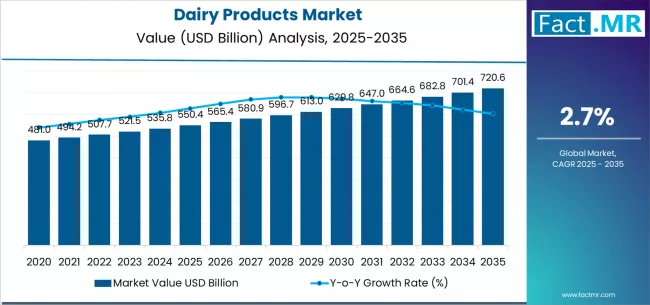
Dairy Products Market Market Value Analysis | Source: Fact.MR
The food and beverage sector faces mounting pressure to meet nutritional requirements while addressing evolving consumer preferences, with modern dairy products providing documented nutritional benefits including essential proteins, calcium, and vitamins compared to alternative food sources, making dairy consumption essential for balanced dietary positioning.
Rising urbanization and expanding retail infrastructure development across emerging economies create substantial opportunities for dairy processors and distribution networks. However, lactose intolerance concerns and competition from plant-based alternatives may pose obstacles to market expansion.
The milk segment dominates market activity with approximately 32.7% share in 2025, driven by the extensive consumer base for fluid milk and dairy beverages requiring nutritional value and affordability across households worldwide. Consumers increasingly recognize the health benefits of dairy consumption, with milk products serving as foundational nutrition sources across all age demographics.
Cheese demonstrates robust growth potential, expanding from 26.3% share in 2025 to 27.1% by 2035, supported by culinary applications and processed cheese adoption in modern food preparations. Online distribution channels emerge as the fastest-growing category, reflecting industry transition toward digital commerce combined with direct-to-consumer delivery benefits. Asia Pacific represents a highly dynamic regional market, driven by expanding middle-class populations and increasing dairy consumption patterns across developing economies.
Regional dynamics show Europe maintaining market leadership with 31.9% share in 2025, supported by established dairy processing infrastructure and premium product development across France, Germany, and Nordic markets. Asia Pacific demonstrates strong market presence with 30.8% share driven by population growth and dietary transition, while North America emphasizes premium dairy categories and protein fortification trends.
India leads country-level growth at 3.4% CAGR through high milk production capacity and rising demand for value-added dairy products, followed by China at 3.2% supported by expanding yogurt consumption and cold chain retail development. The competitive landscape features moderate concentration with Nestlé S.A. holding 11.4% market share, while established players including Danone S.A., Arla Foods amba, and Fonterra Co-operative Group compete through comprehensive product portfolios and advanced processing capabilities across diverse dairy applications.
Dairy Products Market Year-over-Year Forecast (2025-2035)
Between 2025 and 2030, the dairy products market is projected to expand from USD 550.4 billion to USD 628.9 billion, resulting in a value increase of USD 78.5 billion, which represents 46.1% of the total forecast growth for the period.
This phase of development will be shaped by rising demand for value-added dairy products in urban markets, product innovation in yogurt varieties and cheese applications, as well as expanding integration with modern retail channels and cold chain distribution networks.
Companies are establishing competitive positions through investment in specialized dairy processing capabilities, advanced packaging technologies, and strategic market expansion across supermarket chains, e-commerce platforms, and convenience store applications.
From 2030 to 2035, the market is forecast to grow from USD 628.9 billion to USD 720.6 billion, adding another USD 91.7 billion, which constitutes 53.9% of the overall expansion. This period is expected to be characterized by the expansion of specialized dairy applications, including functional dairy beverages and premium cheese varieties tailored for specific consumer requirements, strategic collaborations between dairy processors and retail companies.
This period also involves an enhanced focus on nutritional enhancement and product differentiation. The growing emphasis on protein fortification and lactose-free alternatives will drive demand for comprehensive dairy solutions across diverse consumer applications.
Dairy Products Market Key Takeaways
| Metric | Value |
|---|---|
| Market Value (2025) | USD 550.4 billion |
| Market Forecast Value (2035) | USD 720.6 billion |
| Forecast CAGR (2025-2035) | 2.7% |
Source: Fact.MR analysis. Updated Nov 13, 2025
Why are Dairy Products Remaining Essential for Global Nutrition and Consumer Diets?
The dairy products market grows by enabling consumers and food service providers to access essential nutritional solutions while benefiting from diverse product formats without substantial dietary complexity requirements.
Households and foodservice operators face mounting pressure to provide balanced nutrition and protein intake while managing dietary preferences and health considerations, with dairy products typically providing complete protein profiles and calcium content essential for bone health, making dairy consumption fundamental for nutritional positioning.
The food industry's need for versatile ingredients and ready-to-consume nutrition sources creates demand for comprehensive dairy solutions that can provide superior taste profiles, maintain consistent quality standards, and ensure reliable availability without compromising nutritional value or culinary versatility metrics.
Government initiatives promoting nutritional security and dairy consumption standards drive adoption in retail channels, foodservice establishments, and institutional catering applications, where product quality has a direct impact on consumer health outcomes and dietary compliance.
Lactose intolerance prevalence in certain populations and the increasing availability of plant-based alternatives may limit accessibility among health-conscious consumers and regions with growing demand for dairy-free options.
Segmental Analysis
The market is segmented by product, distribution channel, and region. By product, the market is divided into milk, cheese, yogurt, butter, and other dairy products. Based on distribution channel, the market is categorized into supermarkets/hypermarkets, convenience stores, online platforms, and other retail channels. Regionally, the market is divided into Asia Pacific, Europe, North America, Latin America, and Middle East & Africa.
How does Milk Maintain its Position as the Leading Dairy Product Category?
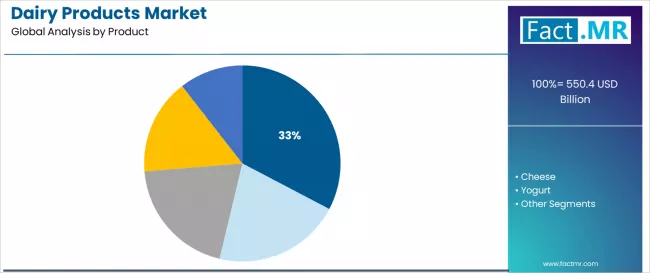
Dairy Products Market Analysis By Product | Source: Fact.MR
The milk segment represents the dominant force in the dairy products market, capturing approximately 32.7% of total market share in 2025. This established product category encompasses solutions featuring fluid milk varieties, fortified milk products, and specialized dairy beverages, including low-fat formulations and skimmed milk options that enable superior nutritional benefits and affordability across all consumer demographics.
Milk’s leadership stems from its foundational nutritional advantages, with solutions capable of addressing diverse dietary requirements while maintaining consistent quality standards and accessibility across all income levels. Within the milk segment, skimmed and low-fat milk varieties account for approximately 41.0% of segment value, driven by health-conscious consumer preferences and weight management trends.
What is the Outlook for Cheese in the Diary Products Landscape?
Cheese maintains a substantial 26.3% market share in 2025, projected to expand to 27.1% by 2035, serving consumers who require versatile culinary ingredients with enhanced flavor characteristics for cooking applications and snacking occasions. Cheese offers diverse texture profiles and aging varieties while providing sufficient flexibility to meet contemporary taste preferences.
The increasing consumption of cheese demonstrates strong growth trajectory, driven by expanding processed cheese adoption and culinary diversification. Within the cheese segment, processed cheese accounts for approximately 46.0% of segment value.
What is the Outlook for Yogurt and Butter Consumption?
The yogurt segment holds 18.4% market share in 2025, expanding to 19.5% by 2035, encompassing probiotic-rich products and convenient nutrition solutions. Within the yogurt segment, flavored and drinkable yogurt varieties account for approximately 58.0% of segment value.
The butter segment represents 14.2% share, with unsalted butter comprising approximately 52.0% of the category. Other dairy products account for 8.4% share, including condensed milk and whey-based ingredients representing approximately 43.0% of the subsegment.
Key market advantages driving the milk segment include:
- Nutritional completeness with essential proteins and calcium that enhance dietary quality and ensure consistent health benefits
- Established consumption patterns allowing universal product acceptance across different cultures without extensive dietary modifications
- Enhanced affordability features enabling accessible nutrition solutions while maintaining household budget compatibility
- Superior versatility providing optimal culinary applications for various food preparation and beverage uses
What makes Supermarkets/Hypermarkets the Preferred Distribution Channel for Purchasing Dairy Products?
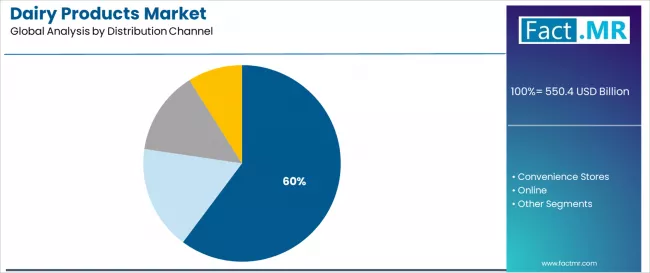
Dairy Products Market Analysis By Distribution Channel | Source: Fact.MR
Supermarkets/hypermarkets dominate the dairy products market with approximately 60.2% market share in 2025, reflecting the critical role of organized retail in supporting comprehensive product assortment and cold chain infrastructure worldwide.
The supermarkets/hypermarkets segment's market leadership is reinforced by convenient shopping experiences, quality assurance standards, and rising needs for one-stop purchasing capabilities in modern retail environments across developed and emerging markets. Within the supermarkets/hypermarkets segment, organized chains including Tesco, Carrefour, and Walmart account for approximately 68.0% of segment value.
Will Dairy Products Sales Increase via Convenience Stores?
The convenience stores segment represents substantial market presence with 18.6% share, demonstrating steady performance through proximity advantages and impulse purchase opportunities in urban locations.
Within the convenience stores segment, urban micro-retail formats account for approximately 53.0% of segment value, driven by last-mile accessibility and neighborhood shopping preferences.
How are Online Distribution Channels Increasing Sales of Dairy Products?
Online dairy products sales are expected to be the fastest-growing distribution category, expanding from 12.3% share in 2025 to 17.5% by 2035 through specialized requirements for home delivery convenience, subscription models, and direct integration with digital commerce platforms.
This segment benefits from growing e-commerce penetration that requires specific cold chain logistics, contactless delivery standards, and digital payment protocols in retail markets. Within the online segment, branded e-commerce platforms and direct-to-consumer apps account for approximately 61.0% of segment value.
Key market dynamics supporting distribution channel growth include:
- Supermarket expansion driven by retail modernization and cold chain investments, requiring comprehensive product portfolios in organized retail formats
- Convenience store optimization trends require accessible, ready-to-consume dairy formats for urban lifestyle differentiation
- Integration of digital commerce technologies enabling direct-to-consumer delivery capabilities and subscription-based purchasing systems
- Growing emphasis on food safety driving demand for temperature-controlled, regulated distribution solutions without traditional market limitations
What are the Key Drivers, Restraints, and Trends Shaping the Dairy Products Market?
Rising protein consumption requirements and health awareness create increasing demand for dairy-based nutrition, with protein intake representing 15-20% of recommended daily nutrition worldwide, requiring comprehensive dairy product availability.
Government initiatives promoting dairy consumption and nutritional security drive increased adoption of fortified dairy products, with many countries implementing school milk programs and dietary guidelines emphasizing calcium intake by 2030.
Technological advancements in processing methods and extended shelf-life packaging enable more efficient and accessible dairy solutions that improve product quality while reducing spoilage rates and distribution costs.
Market restraints include lactose intolerance prevalence and dietary restrictions that can challenge market participants in certain consumer segments, particularly in regions where genetic predisposition to lactose sensitivity remains prevalent and affects consumption patterns.
Competition from plant-based alternatives and dairy substitutes poses another significant challenge, as non-dairy beverages gain market share through environmental messaging and vegan lifestyle adoption, potentially affecting traditional dairy consumption volumes.
Price volatility in raw milk procurement and feed costs create additional operational challenges for dairy processors, demanding ongoing investment in supply chain optimization and cost management initiatives. Key trends indicate accelerated growth in Asia-Pacific markets, particularly India and China, where rising incomes and dietary westernization drive comprehensive dairy product adoption.
Product innovation trends toward functional dairy formulations with probiotic cultures, protein fortification capabilities, and lactose-free alternatives enable efficient nutritional approaches that optimize health benefits and minimize digestive concerns. The market could face disruption if significant advances in cellular agriculture or major changes in dietary guidelines reduce reliance on traditional dairy production methods.
Analysis of the Dairy Products Market by Key Country
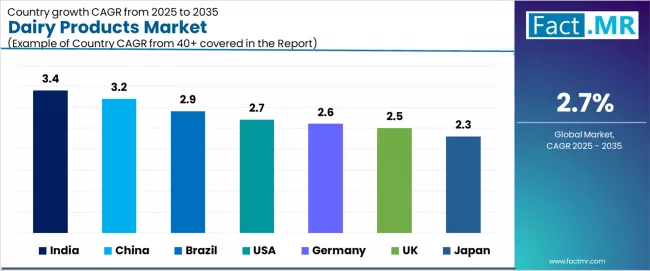
Dairy Products Market Cagr Analysis By Country | Source: Fact.MR
| Country | CAGR (2025-2035) |
|---|---|
| India | 3.4% |
| China | 3.2% |
| Brazil | 2.9% |
| USA | 2.7% |
| Germany | 2.6% |
| UK | 2.5% |
| Japan | 2.3% |
Source: Fact.MR analysis. Updated Nov 13, 2025
The global dairy products market is expanding steadily, with India leading at a 3.4% CAGR through 2035, driven by high milk production capacity, rising demand for value-added dairy products including yogurt and cheese, and expanding cold chain infrastructure. China follows at 3.2%, supported by yogurt consumption growth, cold chain retail development, and increasing protein-focused dietary patterns.
Brazil records 2.9%, reflecting an emerging landscape with growing middle-class demand for processed dairy and protein-rich nutrition. USA grows at 2.7%, anchored by premium dairy positioning and strong protein fortification requirements.
Germany advances at 2.6%, leveraging lactose-free product development and organic dairy format adoption. The UK posts 2.5%, focusing on plant-integrated dairy lines and reduced-fat product innovation, while Japan grows steadily at 2.3%, emphasizing functional dairy beverages for aging population needs.
How is India Leading Global Dairy Products Market Expansion?
India demonstrates the strongest growth potential in the dairy products market with a CAGR of 3.4% through 2035. The country's leadership position stems from the world's highest milk production capacity, expanding value-added dairy processing, and comprehensive cooperative dairy networks driving the adoption of modern dairy solutions.
Growth is concentrated in major urban centers and dairy production regions, including Gujarat, Punjab, Uttar Pradesh, and Maharashtra, where dairy cooperatives and private processors are implementing advanced dairy products for enhanced nutrition delivery and consumer convenience.
Distribution channels through organized retail chains and traditional milk distribution systems expand deployment across urban households and foodservice initiatives. The country's National Dairy Development Board provides policy support for dairy sector modernization, including comprehensive milk quality standards.
Key market factors:
- Dairy cooperative expansion concentrated in milk-producing states and urban consumption centers with comprehensive value-addition programs
- Government support through Operation Flood legacy initiatives and milk production incentives
- Comprehensive dairy supply ecosystem, including established cooperatives with proven processing capabilities
- Product integration featuring flavored milk varieties, traditional dairy sweets, and packaged yogurt technologies
What Makes China an Emerging High-Growth Dairy Market?
In major urban and consumer centers including Beijing, Shanghai, Guangzhou, and Shenzhen, the adoption of comprehensive dairy products is accelerating across modern retail channels and e-commerce platforms, driven by dietary westernization and cold chain modernization programs.
The market demonstrates strong growth momentum with a CAGR of 3.2% through 2035, linked to comprehensive yogurt consumption expansion and increasing focus on protein-rich dietary solutions. Chinese consumers are adopting premium dairy products and functional dairy beverages to enhance nutritional intake while meeting growing demand in expanding middle-class and urban sectors.
The country's Healthy China initiatives create ongoing demand for dairy products, while increasing emphasis on food safety drives adoption of branded dairy solutions from established processors.
Key development areas:
- Urban households and modern retail channels leading dairy adoption with comprehensive refrigerated product programs
- Distribution infrastructure providing integrated cold chain solutions with expanding coverage rates
- Technology partnerships between international dairy companies and domestic processors are expanding market reach
- Integration of ambient-stable dairy formats and comprehensive nutritional enhancement systems
How Does the USA Demonstrate Premium Dairy Leadership?
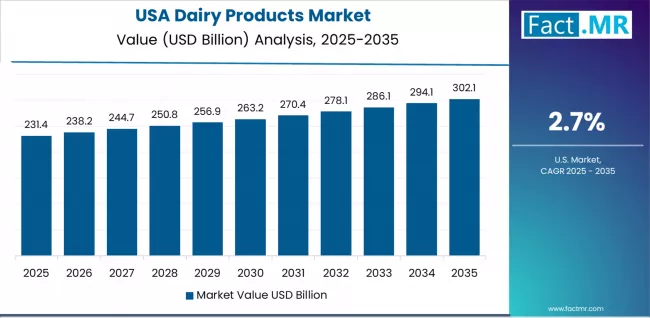
Dairy Products Market Country Value Analysis | Source: Fact.MR
USA market expansion is driven by diverse consumer demand, including organic dairy products in major retail markets and comprehensive premium positioning across multiple dairy categories. The country demonstrates strong growth potential with a CAGR of 2.7% through 2035, supported by USDA dietary guidelines and dairy industry marketing initiatives.
Consumers face product selection challenges related to dietary preferences and lactose-free requirements, requiring strategic product innovation approaches and support from specialized dairy processors. Growing protein consumption pressures and nutritional awareness requirements create compelling consumption cases for dairy product adoption, particularly in sports nutrition applications where dairy protein has a direct impact on muscle recovery and athletic performance.
Market characteristics:
- Retail chains and specialty grocery segments showing robust growth with substantial annual increase in premium dairy product sales
- Regional expansion trends focused on grass-fed dairy and organic certification in major agricultural and consumption regions
- Future projections indicate the need for advanced lactose-free processing infrastructure and sustainable dairy farming programs
- Growing emphasis on clean-label products and nutritional competitiveness in consumer packaged goods operations
Why Does Germany Exemplify Organic and Lactose-Free Dairy Innovation?
The Germany market leads in advanced dairy innovation based on integration with organic agriculture systems and lactose-free processing technologies for enhanced consumer accessibility. The country shows strong potential with a CAGR of 2.6% through 2035, driven by the expansion of organic dairy farming and the adoption of specialized enzyme treatments in major dairy regions, including Bavaria, Lower Saxony, North Rhine-Westphalia, and Baden-Württemberg.
German consumers are adopting sustainable dairy products for environmental alignment and health optimization, particularly in regions with advanced organic certification requirements and dietary applications demanding comprehensive product transparency. Product distribution channels through established supermarket chains and organic specialty stores expand coverage across urban households and health-conscious consumer segments.
Leading market segments:
- Organic dairy production modernization projects in major agricultural regions are implementing comprehensive sustainability programs
- Retail partnerships with organic certification bodies, achieving high consumer trust improvement rates
- Strategic collaborations between dairy cooperatives and processing companies are expanding market presence
- Focus on lactose-free milk varieties and specialized dietary requirement solutions
What Drives UK's Plant-Integrated Dairy Product Development?
In London, Manchester, Birmingham, and other major cities, retail chains are implementing comprehensive dairy product ranges to modernize existing dairy aisles and accommodate dietary diversity, with documented case studies showing substantial improvement in product variety through blended dairy-plant formats. The market shows strong growth potential with a CAGR of 2.5% through 2035, linked to the ongoing evolution of reduced-fat dairy products, plant-integrated dairy lines, and emerging flexitarian dietary programs in major regions.
Consumers are adopting hybrid dairy solutions and low-fat formulations to balance traditional dairy benefits while accommodating standards demanded by the health-conscious and environmentally aware consumer segments. The country's established dairy processing infrastructure creates ongoing demand for product innovation and format diversification solutions that integrate with existing retail distribution systems.
Market development factors:
- Supermarket chains and dairy processors leading product innovation initiatives across UK
- Retail category management programs providing shelf space optimization support for dairy variety and format upgrades
- Strategic partnerships between British dairy brands and plant-based ingredient suppliers are expanding product capabilities
- Emphasis on reduced-fat positioning and dietary flexibility across retail applications
How Does Japan Maintain Functional Dairy Beverage Leadership?
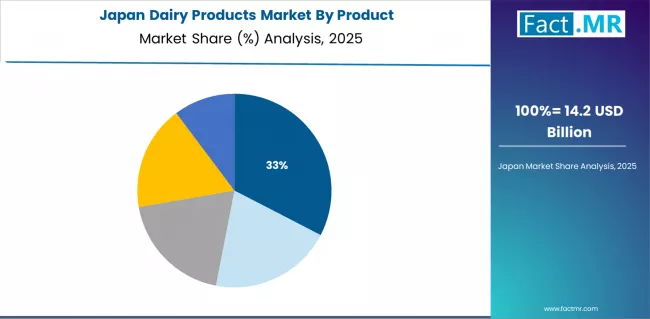
Dairy Products Market Japan Market Share Analysis By Product | Source: Fact.MR
Japan's dairy products market demonstrates sophisticated implementation focused on functional benefits and nutritional precision optimization, with documented integration of probiotic dairy beverages, achieving substantial improvement in digestive health positioning across convenience retail and vending machine facilities.
The country maintains steady growth momentum with a CAGR of 2.3% through 2035, driven by aging population demographics and continuous health-focused product development methodologies that align with Japanese wellness standards applied to dairy consumption.
Major consumer regions, including Kanto, Kansai, Chubu, and Kyushu, showcase advanced deployment of functional dairy products where probiotic beverages integrate seamlessly with daily health routines and comprehensive preventive nutrition programs.
Key market characteristics:
- Convenience retail facilities and vending networks are driving functional dairy requirements with emphasis on digestive health and longevity benefits
- Quality partnerships enabling high product compliance with comprehensive food safety programs
- Innovation collaboration between Japanese dairy companies and probiotic research institutions is expanding product capabilities
- Emphasis on portion-controlled formats and continuous functional benefit optimization methodologies
What Characterizes Brazil's Middle-Class Dairy Consumption Growth?
In major metropolitan and economic centers including São Paulo, Rio de Janeiro, Brasília, and Belo Horizonte, the adoption of processed dairy products is expanding across retail supermarkets and urban households, driven by middle-class expansion and protein-focused dietary growth. The market demonstrates strong growth potential with a CAGR of 2.9% through 2035, linked to comprehensive retail infrastructure development and increasing focus on convenient dairy formats.
Brazilian consumers are implementing regular dairy consumption and premium product exploration to enhance nutritional profiles while meeting growing demand in expanding urban and middle-income sectors. The country's agricultural development initiatives create ongoing demand for dairy products, while increasing emphasis on food quality drives adoption of branded dairy solutions from established processors.
Key development areas:
- Urban retail chains and supermarket networks leading dairy adoption with comprehensive refrigerated category programs
- Distribution infrastructure providing integrated cold chain solutions with expanding regional capabilities
- Market partnerships between international dairy brands and local distribution companies are expanding retail reach
- Integration of UHT milk formats and comprehensive shelf-stable dairy systems
Europe Market Split by Country
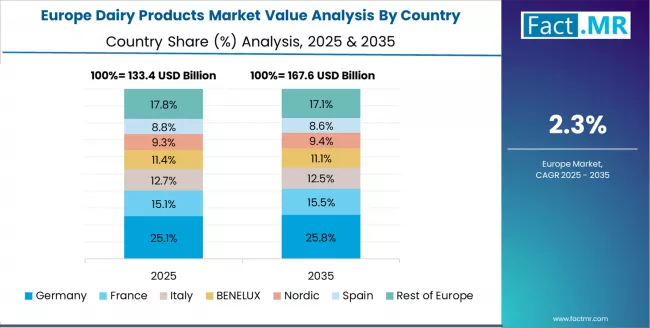
Dairy Products Market Europe Country Market Share Analysis, 2025 & 2035 | Source: Fact.MR
The dairy products market in Europe is projected to grow from USD 175.6 billion in 2025 to USD 229.9 billion by 2035, registering a CAGR of 2.7% over the forecast period. Germany is expected to maintain its leadership position with a 26.0% market share in 2025, declining slightly to 25.5% by 2035, supported by its extensive dairy processing infrastructure, advanced organic dairy production capabilities, and comprehensive retail distribution networks serving major European markets.
UK follows with a 17.5% share in 2025, projected to reach 17.8% by 2035, driven by comprehensive product innovation programs in major retail regions implementing diverse dairy formats. France holds a 15.5% share in 2025, expected to maintain 15.4% by 2035 through the ongoing development of artisanal cheese production and premium dairy product networks.
Italy commands a 12.0% share, while Spain accounts for 10.5% in 2025. The rest of Europe region is anticipated to gain momentum, expanding its collective share from 18.5% to 18.8% by 2035, attributed to increasing dairy consumption in Nordic countries and emerging Eastern Europe markets implementing modern dairy retail programs.
How Does Traditional Dairy Excellence Drive Market Strength in Japanese Retail?
The Japanese dairy products market demonstrates a mature and quality-focused landscape, characterized by sophisticated integration of functional dairy beverages with daily health routines across convenience stores, supermarkets, and vending machine networks. Japan's emphasis on product quality and functional benefits drives demand for scientifically validated dairy solutions that support comprehensive wellness initiatives and aging population requirements in consumer applications.
The market benefits from strong partnerships between international dairy companies like Danone S.A., Meiji Holdings Co. Ltd., and domestic retail chains, including established convenience store operators and supermarket groups, creating comprehensive dairy ecosystems that prioritize product safety and nutritional precision programs. Urban retail environments in major cities showcase advanced dairy merchandising implementations where functional beverages achieve consumption improvements through integrated health communication programs.
What Characterizes Dairy Processor Leadership in South Korean Consumer Markets?
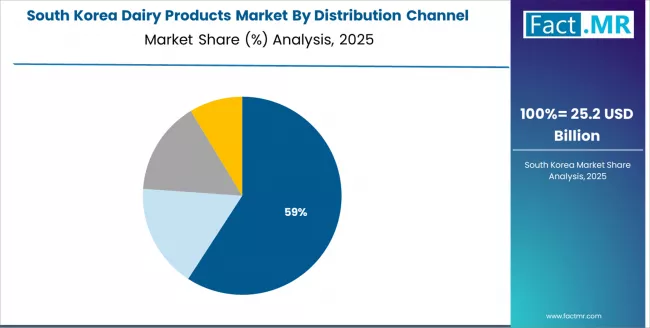
Dairy Products Market South Korea Market Share Analysis By Distribution Channel | Source: Fact.MR
The South Korean dairy products market is characterized by strong domestic and international processor presence, with companies like Danone S.A., Meiji Holdings Co. Ltd., and domestic dairy cooperatives maintaining competitive positions through comprehensive product portfolios and distribution capabilities for retail chains and convenience store applications. The market is demonstrating a growing emphasis on premium positioning and functional dairy innovation, as Korean consumers increasingly demand specialized products that integrate with health-conscious lifestyles and modern dietary patterns deployed across urban households and institutional foodservice.
Local dairy processors and regional distribution companies are gaining market share through strategic partnerships with retail chains, offering specialized products including lactose-free varieties and protein-fortified formats for health-conscious consumers. The competitive landscape shows increasing collaboration between multinational dairy brands and Korean retail specialists, creating integrated distribution models that combine international product expertise with local consumer preference knowledge and retail relationship capabilities.
Competitive Landscape of the Dairy Products Market
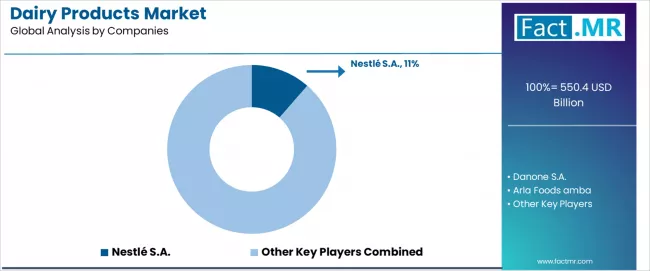
Dairy Products Market Analysis By Company | Source: Fact.MR
The dairy products market features approximately 15-20 meaningful players with moderate concentration, where the top three companies control roughly 30-35% of global market share through established processing facilities and extensive distribution networks. Competition centers on product quality, brand reputation, and distribution reach rather than price competition alone.
Market leaders include Nestlé S.A., Danone S.A., and Arla Foods amba, which maintain competitive advantages through comprehensive dairy product portfolios, advanced processing capabilities, and deep expertise in the global food sector, creating high brand loyalty among consumers. These companies leverage established retail relationships and ongoing product innovation partnerships to defend market positions while expanding into adjacent functional dairy and nutritional supplement applications.
Challengers encompass Fonterra Co-operative Group and GCMMF (Amul), which compete through large-scale production capabilities and strong regional presence in key dairy markets. Dairy specialists, including Royal FrieslandCampina, The Kraft Heinz Company, and Dairy Farmers of America Inc., focus on specific product categories or geographic regions, offering differentiated capabilities in cheese processing, butter production, and cooperative dairy models.
Regional players and emerging dairy processors create competitive pressure through localized production approaches and rapid market responsiveness capabilities, particularly in high-growth markets including India and China, where domestic presence provides advantages in fresh milk procurement and distribution efficiency.
Market dynamics favor companies that combine advanced processing technologies with comprehensive cold chain logistics that address the complete supply chain from farm collection through retail delivery. The competitive landscape demonstrates increasing emphasis on sustainability credentials, with leading processors developing carbon-neutral production facilities and regenerative agriculture programs that position dairy products as environmentally responsible nutrition sources.
Strategic investments in lactose-free processing capabilities and protein fortification technologies are creating differentiated product portfolios that address evolving consumer dietary requirements, with particular focus on health-conscious demographics and specialty nutrition applications. Vertical integration strategies encompassing farm partnerships, processing facilities, and retail distribution networks enable major processors to maintain quality control and cost efficiency advantages across the value chain.
Global Dairy Products Market - Stakeholder Contribution Framework
Dairy products represent a critical nutritional category that enables consumers, foodservice operators, and retail chains to access essential protein and calcium sources without substantial dietary complexity investment, typically providing complete amino acid profiles and bioavailable minerals essential for bone health while ensuring consistent product quality and taste satisfaction.
With the market projected to grow from USD 550.4 billion in 2025 to USD 720.6 billion by 2035 at a 2.7% CAGR, these solutions offer compelling advantages - superior nutritional density, culinary versatility, and established consumption patterns - making them essential for household nutrition (milk segment with 32.7% share), retail operations (supermarkets with 60.2% share), and diverse dietary applications seeking reliable nutrition solutions. Scaling market penetration and product capabilities requires coordinated action across agricultural policy, food safety standards, dairy processors, retail distributors, and nutrition education organizations.
How Could Governments Spur Local Development and Adoption?
- Dairy Development Programs: Include milk production support in agricultural policies, providing targeted subsidies for dairy farming infrastructure and supporting local processors through development grants and quality certification support.
- Tax Policy & Investment Support: Implement favorable taxation schedules for dairy processing investments, provide tax incentives for cold chain infrastructure development and quality assurance technologies, and establish capital equipment accounting standards that encourage modern processing adoption over traditional methods.
- Regulatory Framework Development: Create streamlined quality certification processes for dairy products across retail and foodservice applications, establish clear food safety standards and performance frameworks for dairy processing, and develop international trade protocols that facilitate cross-border dairy commerce.
- Skills Development & Training: Fund vocational programs for dairy farm managers, processing technicians, and quality assurance professionals. Invest in extension services that bridge dairy innovation with farming communities and processing best practices.
- Market Access & Competition: Establish school milk programs that create institutional demand for dairy products, support dairy cooperative development through organizational capacity building, and create regulatory environments that encourage innovation in dairy processing technologies.
How Could Industry Bodies Support Market Development?
- Quality Standards & Certification: Define standardized quality metrics for dairy products across milk, cheese, yogurt, and butter categories, establish universal food safety and processing protocols, and create certification programs for product quality that consumers can rely on.
- Market Education & Best Practices: Lead messaging that demonstrates dairy product advantages, emphasizing complete protein profiles, calcium bioavailability, and superior nutritional density compared to plant-based alternatives.
- Cold Chain Integration Standards: Develop temperature control standards for dairy logistics, retail refrigeration compatibility guidelines, and quality preservation platforms, ensuring consistent product integrity across different distribution environments and storage requirements.
- Professional Development: Run certification programs for dairy technologists, quality managers, and retail handlers on optimizing product freshness, food safety protocols, and nutritional preservation in competitive retail markets.
How Could Dairy Processors and Technology Players Strengthen the Ecosystem?
- Advanced Product Development: Develop next-generation dairy products with enhanced functional benefits, improved lactose-free processing, and format-specific characteristics that enhance nutritional reliability while reducing consumption barriers.
- Quality Assurance Platforms: Provide comprehensive traceability systems that integrate farm-to-retail monitoring, safety testing, shelf-life tracking, and quality optimization, enabling retailers to maximize product freshness and consumer satisfaction effectiveness.
- Distribution & Logistics Networks: Offer flexible cold chain solutions for retail partners and foodservice customers, including temperature-controlled transportation options, inventory management services, and freshness optimization pathways that keep dairy products current with consumption demands.
- Research & Development Networks: Build comprehensive R&D capabilities, collaborative innovation programs, and application development systems that ensure dairy technologies maintain high nutritional standards and consistent sensory quality across diverse consumer environments.
How Could Retailers and Distributors Navigate the Shift?
- Diversified Product Portfolios: Expand dairy offerings across milk applications (32.7% product dominance), cheese varieties (26.3% share), and yogurt formats, with particular focus on online distribution channels (expanding to 17.5% share by 2035) and specialized solutions for convenience retail requirements.
- Geographic Market Development: Establish distribution operations in high-growth markets like India (3.4% CAGR) and China (3.2% CAGR), while strengthening presence in established markets like USA (2.7% CAGR) and Germany (2.6% CAGR) through retail partnership capabilities and regional supply chain optimization.
- Technology-Enabled Logistics: Implement advanced cold chain systems with real-time temperature monitoring, automated inventory rotation, and predictive demand forecasting that differentiate distribution offerings and improve product quality and availability.
- Flexible Retail Models: Develop value, premium, and specialty dairy assortments that accommodate varying consumer needs, from cost-effective basic dairy to high-end organic applications for demanding health-conscious and sustainability requirements.
How Could Investors and Financial Enablers Unlock Value?
- Processing Capacity Expansion Financing: Provide growth capital for established companies like Nestlé S.A., Danone S.A., and Arla Foods amba to expand dairy processing capacity and cold chain capabilities, particularly in emerging markets with growing consumption demands.
- Innovation Investment: Back startups developing advanced functional dairy formulations, next-generation lactose-free technologies, and intelligent packaging solutions that enhance product differentiation and competitive positioning.
- Regional Market Development: Finance market entry and expansion strategies for dairy companies establishing operations in high-growth regions, supporting localization initiatives that optimize supply chains while maintaining quality standards.
- Consolidation & Scale Opportunities: Support strategic acquisitions and market consolidation that create processing economies of scale, improve distribution capabilities, and enhance competitive positioning against fragmented regional processors across multiple geographic markets.
Key Players in the Dairy Products Market
- Nestlé S.A.
- Danone S.A.
- Arla Foods amba
- Fonterra Co-operative Group
- GCMMF (Amul)
- Royal FrieslandCampina
- The Kraft Heinz Company
- Dairy Farmers of America, Inc.
- Meiji Holdings Co., Ltd.
- DMK Group
Segmentation
Scope of the Report
| Items | Values |
|---|---|
| Quantitative Units | USD 550.4 Billion |
| Product | Milk, Cheese, Yogurt, Butter, Others |
| Distribution Channel | Supermarkets/Hypermarkets, Convenience Stores, Online, Others |
| Regions Covered | Asia Pacific, Europe, North America, Latin America, Middle East & Africa |
| Country Covered | India, China, USA, Germany, UK, Japan, Brazil, and 40+ countries |
| Key Companies Profiled | Nestlé S.A., Danone S.A., Arla Foods amba, Fonterra Co-operative Group, GCMMF (Amul), Royal FrieslandCampina, The Kraft Heinz Company, Dairy Farmers of America Inc., Meiji Holdings Co. Ltd., DMK Group |
| Additional Attributes | Dollar sales by product and distribution channel categories, regional consumption trends across Asia Pacific, Europe, and North America, competitive landscape with dairy processors and cooperative organizations, product specifications and nutritional profiles, integration with cold chain infrastructure and retail distribution systems, innovations in dairy processing technology and functional dairy formats, and development of specialized applications with nutritional enhancement and dietary optimization capabilities. |
Source: Fact.MR analysis. Updated Nov 13, 2025
Dairy Products Market by Segments
-
Product :
- Milk
- Cheese
- Yogurt
- Butter
- Others
-
Distribution Channel :
- Supermarkets/Hypermarkets
- Convenience Stores
- Online
- Others
-
Region :
- Asia Pacific
- China
- Japan
- South Korea
- India
- Australia & New Zealand
- ASEAN
- Rest of Asia Pacific
- Europe
- Germany
- UK
- France
- Italy
- Spain
- Nordic
- BENELUX
- Rest of Europe
- North America
- USA
- Canada
- Mexico
- Latin America
- Brazil
- Chile
- Rest of Latin America
- Middle East & Africa
- Kingdom of Saudi Arabia
- Other GCC Countries
- Turkey
- South Africa
- Other African Union
- Rest of Middle East & Africa
- Asia Pacific
Frequently Asked Questions
How big is the dairy products market in 2025?
What will be the size of dairy products market in 2035?
How much will be the dairy products market growth between 2025 and 2035?
What are the key product types in the dairy products market?
Which distribution channel segment to contribute significant share in the dairy products market in 2025?
Who worked on this report


Preview the report firsthand - request a free sample
Free SampleGet the brochure for pricing and purchase details
Download PDF