- Base Value(2025): 6.7 Bn
- Estimated Value(2026): 6.9 Bn
- Forecast Value (2036): 9.4 Bn
- CAGR (2026 - 2036): 3.1%
Advanced Wound Dressing Market Forecast and Outlook By Fact.MR
- The advanced wound dressing market was valued at USD 6.7 billion in 2025. Market size is estimated at USD 6.9 billion in 2026 and is projected to reach USD 9.4 billion by 2036.
- Fact.MR forecasts a 3.1% CAGR from 2026 to 2036.
- An additional USD 2.5 billion in market revenue is expected between 2026 and 2036. Growth is supported by increasing treatment demand for chronic ulcers and non-healing wounds.
- Aging demographics and rising diabetes prevalence are expanding the need for advanced wound care solutions across hospitals and specialty treatment centers.
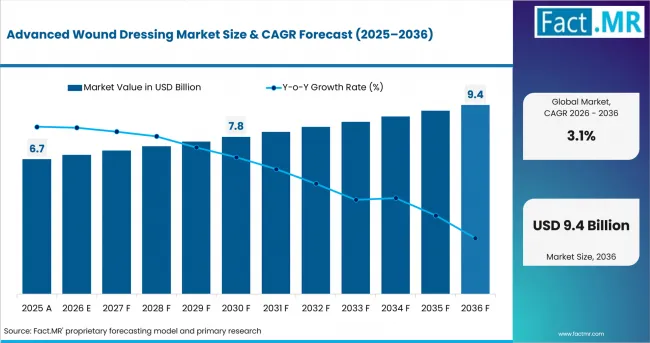
Advanced Wound Dressing Market Value Analysis | Source: Fact.MR
Summary of Advanced Wound Dressing Market
- Demand Drivers
- Diabetes prevalence is increasing demand for advanced wound management products. Chronic ulcer treatment supports product utilization.
- Aging populations are expanding long-term wound care requirements. Treatment duration supports dressing consumption.
- Healthcare providers are increasing focus on wound healing outcomes. Clinical efficiency supports demand growth.
- Key Segments Analyzed
- By Product: Foam Dressings contribute 24.0% share in 2026 due to broad utilization across chronic wound treatment.
- By Indication: Chronic Ulcers generate 68.0% share supported by diabetic and pressure ulcer prevalence.
- By Distribution Channel: Institutional Sales represent 72.0% share in 2026 due to concentration of hospital purchasing activity.
- By Wound Type: Chronic Wounds contribute 64.0% share supported by long treatment duration requirements.
- By End User: Hospitals generate 48.0% share in 2026 due to concentration of advanced wound management services.
- By Geography: India is projected to record 4.8% CAGR through 2036 supported by rising diabetic wound treatment demand.
- Analyst Opinion at Fact.MR
- Shambhu Nath Jha, Principal Consultant at Fact.MR, opines, "Future demand will be driven by chronic ulcer treatment, diabetic wound care, hospital wound programs, and access to advanced dressings. Organizations aligned with specialized wound care programs are positioned to strengthen market presence."
- Strategic Implications
- Manufacturers should expand advanced dressing production capacity. Chronic wound treatment demand supports long-term opportunity.
- Distributors should strengthen hospital and specialty care coverage. Product accessibility improves commercial potential.
- Healthcare providers should strengthen wound management programs. Early intervention improves treatment efficiency.
| Metric | Value |
|---|---|
| Estimated Value in 2026 | USD 6.9 Billion |
| Forecast Value in 2036 | USD 9.4 Billion |
| Forecast CAGR (2026 to 2036) | 3.1% |
Source: Fact.MR analysis. Updated Jun 16, 2026
India is projected to expand at 4.8% CAGR supported by increasing diabetic wound treatment demand. China is expected to grow at 4.4% CAGR driven by hospital infrastructure investment. Brazil is forecast to witness 3.7% CAGR due to expansion of wound management services. The United States is anticipated to register 2.8% CAGR supported by established advanced wound care utilization. Germany is projected to advance at 2.5% CAGR due to stable chronic care treatment demand.
Segmental Analysis
Advanced Wound Dressing Market Analysis by Product
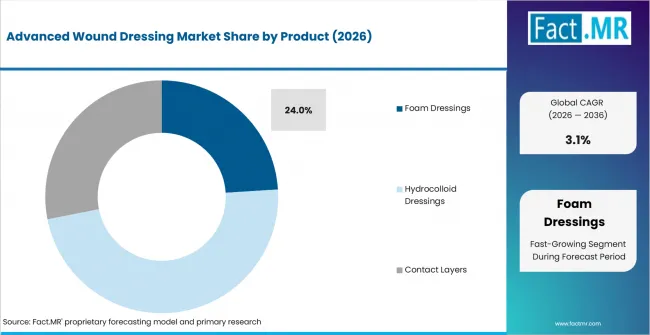
Advanced Wound Dressing Market Analysis By Product | Source: Fact.MR
Foam Dressings are estimated to contribute 24.0% share in 2026. These products combine absorption performance with ease of use across chronic wound treatment programs. Clinical preference supports segment concentration across hospitals and specialty care settings. Convatec received regulatory approval for ConvaNiox™, the first nitric oxide-generating multimodal wound dressing designed to improve outcomes in hard-to-heal diabetic foot ulcers. The advanced dressing combines wound management technology with nitric oxide's antimicrobial and antibiofilm properties and is scheduled for initial European market launches followed by a broader rollout in 2026. [1]
- Exudate Control: Foam dressings manage fluid levels across chronic wounds. Treatment efficiency supports product demand.
- Clinical Adoption: Healthcare providers utilize foam dressings across ulcer management programs. Product versatility strengthens utilization.
- Patient Comfort: Dressing designs improve wear duration and wound protection. Treatment outcomes support segment demand.
Advanced Wound Dressing Market Analysis by Indication
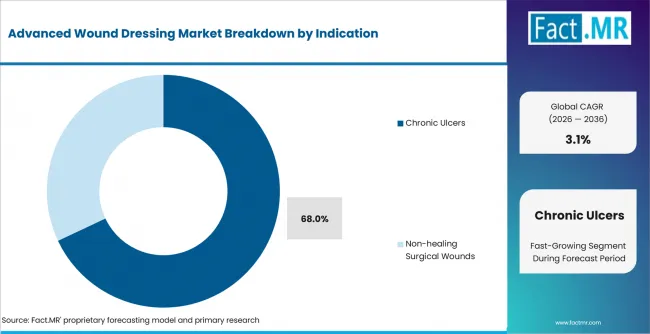
Advanced Wound Dressing Market Analysis By Indication | Source: Fact.MR
Chronic Ulcers are estimated to represent 68.0% share in 2026. Long treatment cycles and recurring care requirements support advanced dressing consumption. Diabetic foot ulcers and pressure ulcers remain major sources of demand. Smith+Nephew announced new clinical and laboratory evidence supporting its ALLEVYN LIFE™ Foam Dressing for pressure injury prevention, demonstrating a novel layer-on-layer sliding mechanism that helps dissipate mechanical forces applied to the skin. The study showed that the dressing's independent, non-bonded layers absorb approximately 30–45% of mechanical energy, helping reduce tissue stress associated with pressure injuries. [3]
- Diabetes Burden: Rising diabetic populations increase ulcer treatment requirements. Healthcare utilization supports product demand.
- Extended Care: Chronic ulcers require prolonged wound management. Treatment duration strengthens consumption.
- Recurrence Risk: Patients often require repeated treatment interventions. Clinical demand supports segment growth.
Advanced Wound Dressing Market Analysis by Distribution Channel
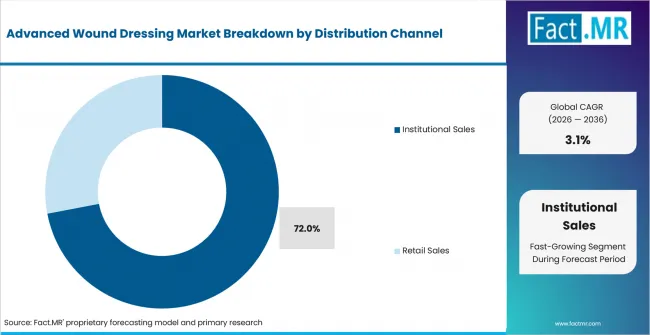
Advanced Wound Dressing Market Analysis By Distribution Channel | Source: Fact.MR
Institutional Sales are projected to generate 72.0% share in 2026. Hospitals and healthcare networks purchase advanced wound care products through centralized procurement systems. Purchasing scale supports segment leadership. The dressing can be applied in less than two minutes and worn for up to seven days, compared with traditional NPWT dressings that often require multiple changes per week. [2]
- Hospital Purchasing: Healthcare facilities procure dressings through institutional channels. Volume concentration supports demand.
- Supply Continuity: Structured procurement programs improve product availability. Distribution efficiency supports utilization.
- Clinical Utilization: Advanced dressings are widely used within inpatient care settings. Treatment activity supports segment demand.
Advanced Wound Dressing Market Analysis by Wound Type
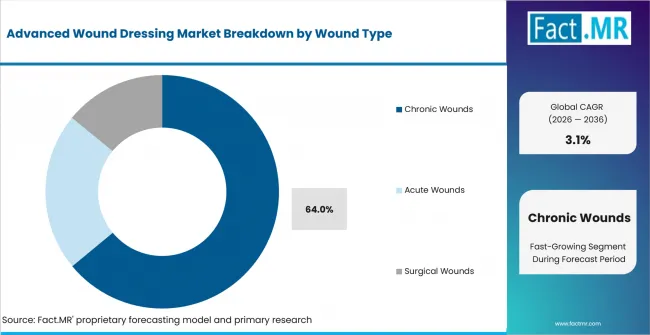
Advanced Wound Dressing Market Analysis By Wound Type | Source: Fact.MR
Chronic Wounds are estimated to contribute 64.0% share in 2026. Treatment requirements extend over longer periods than acute wound management programs. Healthcare demand is concentrated around diabetic and pressure ulcer care.
- Treatment Duration: Chronic wounds require ongoing dressing replacement. Utilization frequency supports demand.
- Aging Population: Older adults face elevated wound healing challenges. Patient demographics strengthen consumption.
- Clinical Monitoring: Long-term treatment programs require advanced wound management solutions. Care requirements support growth.
Advanced Wound Dressing Market Analysis by End User
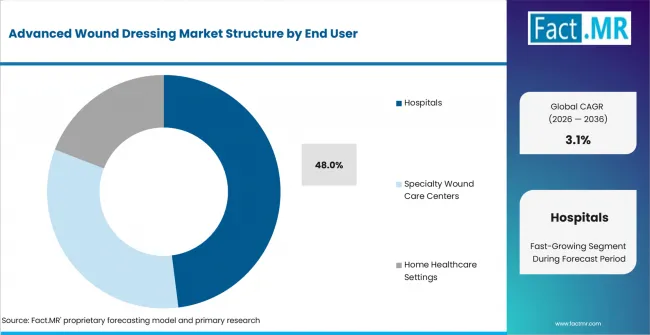
Advanced Wound Dressing Market Analysis By End User | Source: Fact.MR
Hospitals are estimated to account for 48.0% share in 2026. Advanced wound care services are concentrated within inpatient treatment environments. Clinical infrastructure supports segment demand. Kane Biotech received U.S. FDA 510(k) clearance for its revyve® Antimicrobial Skin and Wound Cleanser, expanding its advanced wound care portfolio with a product designed for cleansing, debriding, and removing microorganisms from acute and chronic wounds. The cleanser is indicated for a broad range of wounds, including diabetic foot ulcers, pressure ulcers, venous leg ulcers, burns, and post-surgical wounds. [4]
- Treatment Capacity: Hospitals manage large volumes of wound care cases. Service concentration supports utilization.
- Specialist Access: Dedicated wound care teams operate within hospital settings. Clinical expertise strengthens demand.
- Product Availability: Healthcare facilities maintain access to advanced treatment products. Infrastructure supports consumption.
Drivers, Restraints, and Opportunities
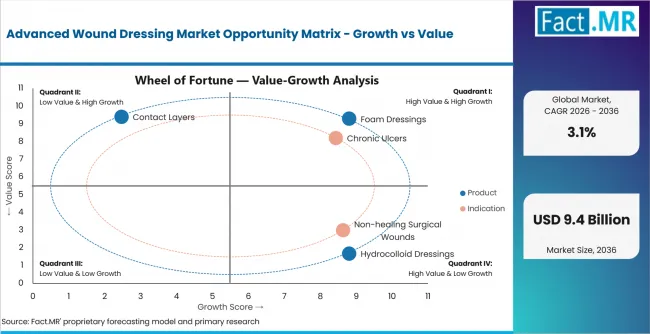
Advanced Wound Dressing Market Opportunity Matrix Growth Vs Value | Source: Fact.MR
The advanced wound dressing market is progressing through a chronic disease management phase. Demand is linked to increasing prevalence of diabetes and age-related wound conditions. Healthcare systems are focusing on treatment approaches that improve healing outcomes and reduce complications. Convatec showcased its latest Advanced Wound Care innovations at the European Wound Management Association (EWMA) 2026 conference, presenting new clinical and real-world evidence across foam dressings, nitric oxide-generating dressings, antimicrobial technologies, and wound hygiene solutions. The company highlighted its expanding portfolio, including ConvaNiox™, Aquacel™ ConvaFiber™, ConvaMatrix™, and ConvaFoam™, supported by 13 scientific abstracts accepted for presentation. [5]
Treatment priorities are shifting toward advanced products that support moisture balance and infection control. Hospitals are increasing focus on reducing wound-related hospital stays. Product adoption reflects the need for improved clinical efficiency across wound management programs.
- Chronic Disease Burden: Demand is driven by increasing incidence of diabetic foot ulcers and pressure injuries. Long-term treatment requirements support dressing utilization.
- Specialized Wound Care Expansion: Healthcare providers are expanding wound management services across hospitals and outpatient facilities. Service availability supports product consumption.
- Reimbursement Pressure: Adoption is constrained by treatment cost concerns and reimbursement limitations across selected healthcare systems. Budget restrictions can influence product selection decisions.
Regional Analysis
The advanced wound dressing market is assessed across North America, Europe, Asia Pacific, and Latin America. The study evaluates chronic wound prevalence, healthcare infrastructure, treatment accessibility, and advanced wound care utilization across major economies.
.webp "Top Country Growth Comparison Advanced Wound Dressing Market Cagr (2026 2036)")
Top Country Growth Comparison Advanced Wound Dressing Market Cagr (2026 2036) | Source: Fact.MR
| Country | CAGR |
|---|---|
| India | 4.8% |
| China | 4.4% |
| Brazil | 3.7% |
| United States | 2.8% |
| Germany | 2.5% |
Source: Fact.MR analysis. Updated Jun 16, 2026
Source: Fact.MR analysis based on proprietary forecasting model and primary research.
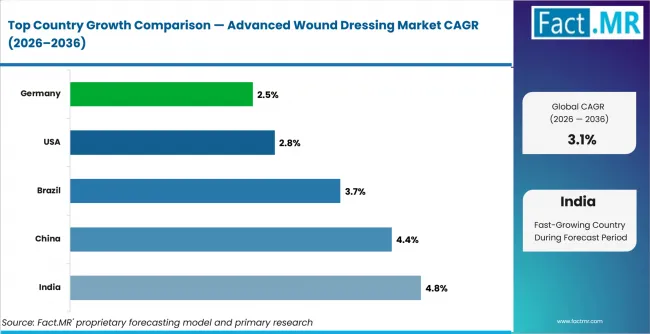
Advanced Wound Dressing Market Cagr Analysis By Country | Source: Fact.MR
Sales Analysis of Advanced Wound Dressing Market in India
India is projected to expand at 4.8% CAGR by 2036 as diabetic foot ulcer treatment volumes increase across hospital networks. Large healthcare providers are expanding specialized wound care services in urban treatment centers. Demand is concentrated in chronic wound management programs linked to diabetes care. Healthcare investment is improving access to advanced treatment products. Growth is attributable to rising chronic disease burden and expanding clinical care capacity.
- Diabetes treatment demand supports advanced wound dressing utilization.
- Hospital expansion improves access to specialized wound management services.
- Chronic wound care programs strengthen product consumption.
Demand Outlook for Advanced Wound Dressing Market in China
China is expected to witness 4.4% CAGR supported by hospital modernization and increasing chronic disease treatment requirements. Healthcare institutions are improving wound management capabilities across major provinces. Demand reflects growing utilization of advanced wound care products in tertiary hospitals. Clinical treatment standards are improving across healthcare networks. Growth is supported by healthcare infrastructure investment and chronic care expansion.
- Hospital modernization programs strengthen product adoption.
- Chronic disease treatment requirements support demand growth.
- Healthcare investment improves wound management capability.
Opportunity Analysis of Advanced Wound Dressing Market in Brazil
Brazil is forecast to grow at 3.7% CAGR as healthcare providers expand wound management services across public and private treatment facilities. Chronic wound treatment demand is increasing due to diabetes prevalence. Advanced dressing utilization is improving within specialized care programs. Growth reflects healthcare service development and wider product availability.
- Public healthcare services support wound treatment demand.
- Diabetes prevalence increases chronic ulcer management requirements.
- Clinical care expansion improves advanced dressing utilization.
In-depth Analysis of Advanced Wound Dressing Market in United States
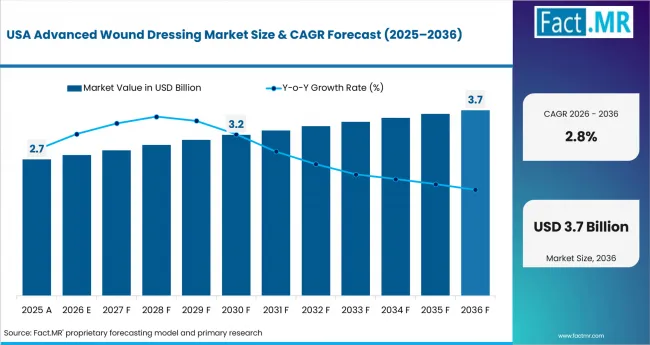
Advanced Wound Dressing Market Country Value Analysis | Source: Fact.MR
The United States is anticipated to register 2.8% CAGR through 2036 due to established utilization of advanced wound care products across hospitals and outpatient facilities. Healthcare providers focus on reducing treatment complications and improving healing outcomes. Demand is concentrated in diabetic ulcer and pressure injury management programs. Growth is attributable to chronic wound treatment requirements and replacement demand.
- Advanced wound care utilization supports stable product demand.
- Chronic ulcer treatment programs drive dressing consumption.
- Healthcare providers prioritize improved healing outcomes.
Demand Assessment of Advanced Wound Dressing Market in Germany
Germany is projected to expand at 2.5% CAGR from 2026 to 2036 supported by growing treatment requirements among older patient populations. Hospitals and long-term care facilities maintain established wound management programs. Demand is concentrated in chronic ulcer and pressure injury treatment. Growth reflects demographic trends and stable healthcare spending.
- Aging populations support long-term wound care demand.
- Established treatment programs sustain advanced dressing utilization.
- Healthcare spending supports product accessibility.
Competitive Aligners for Market Players
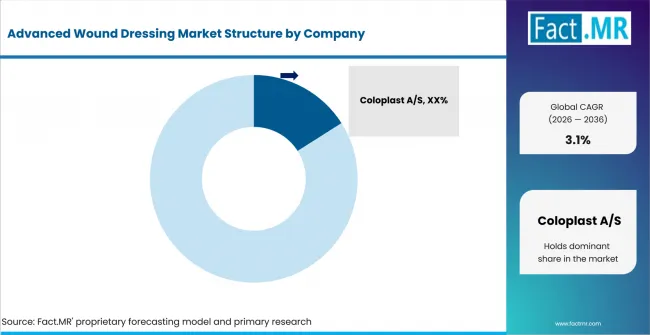
Advanced Wound Dressing Market Analysis By Company | Source: Fact.MR
The advanced wound dressing market reflects competition among established wound care manufacturers and healthcare supply organizations. Product performance influences purchasing decisions across hospitals and specialty wound care facilities. Companies with extensive product portfolios maintain stronger commercial positioning across healthcare networks.
Manufacturers with broad distribution coverage benefit from stronger access to hospitals and long-term care facilities. Clinical evidence supports product adoption across wound management programs. Supply reliability influences purchasing preferences within healthcare systems. Established healthcare relationships strengthen commercial reach. Healthcare providers evaluate suppliers based on treatment performance and product availability. Clinical teams prioritize products that improve wound healing efficiency and patient outcomes. Procurement decisions increasingly focus on treatment value and continuity of supply.
Commercial success is linked to clinical performance and distribution strength. Demand is shifting toward products that support chronic wound management and improved healing outcomes. Product innovation and healthcare access remain important competitive differentiators across regional markets.
Key Players
- Coloplast A/S
- Essity / BSN Medical
- Solventum / 3M legacy
- B. Braun Melsungen AG
- Smith+Nephew plc
Bibliography
- [1] Convatec Group Plc. (2025, April 25). Convatec receives regulatory approval for ConvaNiox™.
- [2] Solventum Corporation. (2024, September 10). Solventum launches all-in-one, extended-wear wound dressing for V.A.C.® Therapy.
- [3] Smith+Nephew plc. (2024, April 18). Smith+Nephew announces new evidence supporting ALLEVYN◊ LIFE Foam Dressing’s role in pressure injury prevention.
- [4] Kane Biotech Inc. (2026, February 17). Kane Biotech announces FDA 510(k) clearance for revyve® Antimicrobial Skin and Wound Cleanser.
- [5] Convatec Group Plc. (2026, May 5). Convatec’s Advanced Wound Care innovation leads the industry at European Wound Management Association (EWMA) 2026.
This Report Addresses
- Analysis of advanced wound dressing demand across chronic wound and surgical wound management applications.
- Market forecast from USD 6.9 Billion in 2026 to USD 9.4 Billion by 2036 at 3.1% CAGR.
- Opportunity assessment across foam dressings, hydrocolloid products, and advanced wound management solutions.
- Segment forecasts covering product, indication, distribution channel, wound type, and end user demand.
- Competitive assessment of advanced wound care manufacturers and healthcare supply organizations.
- Evaluation of chronic wound treatment trends and healthcare service expansion.
- Country-level analysis across India, China, Brazil, the United States, and Germany.
- Report delivery through PDF and Excel formats supported by primary interviews and healthcare industry analysis.
Advanced Wound Dressing Market Definition
The advanced wound dressing market covers specialized wound care products designed to improve healing conditions and manage wound exudate. These dressings support treatment of chronic ulcers, surgical wounds, traumatic injuries, and burn wounds. Products include foam dressings, hydrocolloids, hydrogels, alginates, collagen dressings, and advanced absorbent solutions. Healthcare professionals utilize these products to reduce infection risk and improve wound healing outcomes. Demand originates from hospitals, wound care centers, long-term care facilities, and home healthcare providers managing acute and chronic wound conditions.
Advanced Wound Dressing Market Inclusions
The study covers global and regional forecasts from 2026 to 2036 by product, indication, distribution channel, wound type, and end user. It includes advanced wound dressings utilized across hospitals, specialty wound care centers, home healthcare settings, and ambulatory surgical facilities. The report evaluates treatment utilization trends, healthcare spending patterns, product demand, and distribution activity across major countries.
Advanced Wound Dressing Market Exclusions
The study excludes traditional gauze products, adhesive bandages, wound closure devices, negative pressure wound therapy systems, and surgical sutures. Revenue associated with wound diagnostics and infection monitoring devices is excluded. The report focuses exclusively on advanced wound dressing consumption and related distribution activity.
Advanced Wound Dressing Market Research Methodology
- Primary Research
- Interviews were conducted with wound care specialists, hospital administrators, healthcare distributors, nursing professionals, and wound management consultants.
- Desk Research
- Analysis included healthcare publications, company disclosures, wound care studies, regulatory updates, and healthcare utilization reports published during 2024 and 2025.
- Market-Sizing and Forecasting
- Hybrid top-down and bottom-up model using treatment volume estimates, healthcare expenditure assessments, and wound care utilization trends.
- Data Validation and Update Cycle
- Forecast was validated through specialist interviews, distributor feedback, healthcare utilization assessments, and wound treatment volume analysis.
Segmentation
Scope of Report
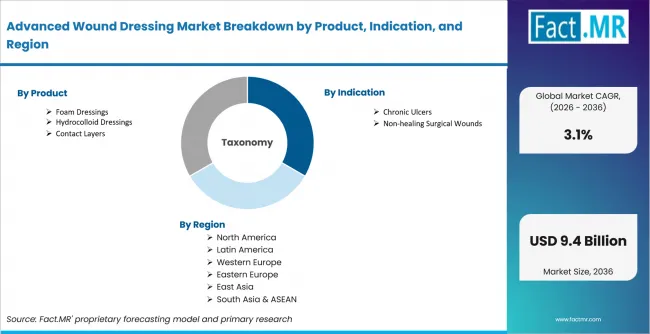
Advanced Wound Dressing Market Breakdown By Product, Indication, And Region | Source: Fact.MR
| Attribute | Details |
|---|---|
| Quantitative Units | USD 6.9 Billion (2026) to USD 9.4 Billion (2036) at a CAGR of 3.1% |
| Market Definition | Covers advanced wound dressings utilized for chronic and acute wound management. |
| Product Segmentation | Hydrogel Dressings, Semi-permeable Film Dressings, Alginate Dressings, Foam Dressings, Hydrocolloid Dressings, Collagen Dressings, Contact Layers, Super Absorbent Dressings, Hydrofibers |
| Indication Segmentation | Chronic Ulcers, Non-healing Surgical Wounds |
| Distribution Channel Segmentation | Institutional Sales, Retail Sales |
| Wound Type Segmentation | Chronic Wounds, Acute Wounds, Surgical Wounds, Traumatic Wounds, Burn Wounds |
| End User Segmentation | Hospitals, Specialty Wound Care Centers, Home Healthcare Settings, Ambulatory Surgical Centers, Long-Term Care Facilities |
| Regions Covered | North America, Europe, Asia Pacific, Latin America |
| Countries Covered | India, China, Brazil, United States, Germany |
| Key Companies Profiled | Coloplast, ConvaTec, Smith & Nephew, B. Braun |
| Forecast Period | 2026 to 2036 |
| Approach | Hybrid top-down and bottom-up model using treatment volume and healthcare utilization analysis. |
Source: Fact.MR analysis. Updated Jun 16, 2026
Advanced Wound Dressing Market by Segment
-
By Product:
- Hydrogel Dressings
- Semi-permeable Film Dressings
- Alginate Dressings
- Foam Dressings
- Hydrocolloid Dressings
- Collagen Dressings
- Contact Layers
- Super Absorbent Dressings
- Hydrofibers
-
By Indication:
- Chronic Ulcers
- Non-healing Surgical Wounds
-
By Distribution Channel:
- Institutional Sales
- Retail Sales
-
By Wound Type:
- Chronic Wounds
- Acute Wounds
- Surgical Wounds
- Traumatic Wounds
- Burn Wounds
-
By End User:
- Hospitals
- Specialty Wound Care Centers
- Home Healthcare Settings
- Ambulatory Surgical Centers
- Long-Term Care Facilities
-
By Region:
- North America
- United States
- Canada
- Mexico
- Latin America
- Brazil
- Argentina
- Rest of Latin America
- Europe
- Germany
- United Kingdom
- France
- Italy
- Spain
- Rest of Europe
- Asia Pacific
- China
- India
- Japan
- South Korea
- ASEAN
- Middle East & Africa
- GCC Countries
- South Africa
- UAE
- Rest of Middle East & Africa
- North America
Frequently Asked Questions
How large is the global advanced wound dressing market in 2025?
What will the advanced wound dressing market size be in 2026?
What is the projected advanced wound dressing market size by 2036?
What is the expected CAGR for the advanced wound dressing market from 2026 to 2036?
Which product segment is expected to contribute prominent demand in 2026?
Which indication segment generates substantial market demand?
Which country records stronger growth through 2036?
Who worked on this report


Preview the report firsthand - request a free sample
Free SampleGet the brochure for pricing and purchase details
Download PDF