Alginate Dressing Market Size, Share, Growth and Forecast (2026 - 2036)

The Alginate Dressing Market is segmented by Type (Antimicrobial Alginate Dressings and Non-Antimicrobial Alginate Dressings), Indication (Chronic Ulcers, Venous Leg Ulcers, Diabetic Foot Ulcers, Pressure Ulcers, Non-Healing Surgical Wounds, Traumatic Wounds, Burn Cases, and Others), End User (Hospitals, Clinics, Home Healthcare, and Others), Product Form (Sheets, Ribbons/Ropes, and Pads), Distribution Channel (Direct Sales, Retail Pharmacies, and Online Channels) and Region. Forecast for 2026 to 2036.

Fact.MR indicates that the alginate dressing market is undergoing a shift from hospital-based care to community settings. Wound care volumes are gradually moving toward home healthcare and outpatient environments. This transition is driven by cost pressures, shorter hospital stays, and growing preference for decentralized care.

Alginate Dressing Market Forecast and Outlook By Fact.MR

  • In 2025, the alginate dressing market was valued at USD 0.6 billion.
  • Based on Fact.MR analysis, demand for alginate dressings is estimated to grow to USD 0.7 billion in 2026 and USD 3.4 billion by 2036.
  • FACT.MR projects a CAGR of 17.0% during the forecast period.
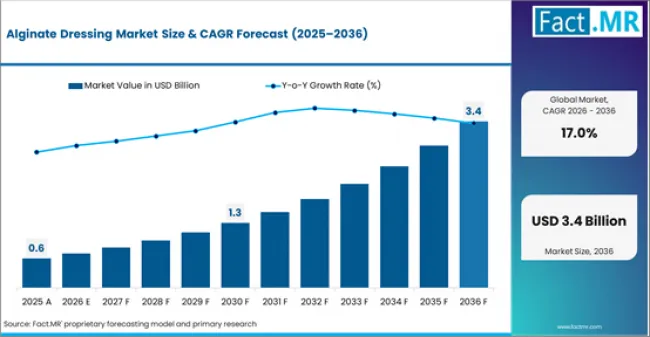
Alginate Dressing Market Market Value Analysis

Metric Value
Estimated Value in 2026 USD 0.7 billion
Forecast Value in 2036 USD 3.4 billion
Forecast CAGR (2026 to 2036) 17.0%

Summary ofAlginate Dressing Market

  • Market Definition
    • Market covers calcium and calcium-sodium alginate fibre dressings managing moderate-to-heavily exuding wounds across chronic ulcers, diabetic foot, pressure injuries, burns, and traumatic wounds in hospital, clinic, and home healthcare settings globally.
  • Demand Drivers
    • Rising diabetes prevalence is increasing chronic wound cases. The International Diabetes Federation estimated 537 million adults with diabetes in 2024, expanding the patient pool for diabetic foot ulcers and long-term wound care.
    • Reimbursement support is strengthening adoption. CMS maintained Medicare coverage for alginate dressings in 2024, supporting steady procurement across U.S. homecare providers and distributors.
    • Growth in home healthcare is accelerating demand. Wound care is shifting to outpatient and home settings, increasing the need for easy-to-use alginate dressings suitable for non-specialist caregivers.
  • Key Segments Analyzed
    • By Type: Non-antimicrobial alginate dressings lead with 65% share in 2026, supported by cost efficiency and wide spread use across standard wound care applications.
    • By Indication: Chronic ulcers dominate with 35% share in 2026, driven by high patient volume and frequent dressing requirements.
    • By End User: Hospitals account for 60% share in 2026, supported by advanced care infrastructure and high treatment volumes.
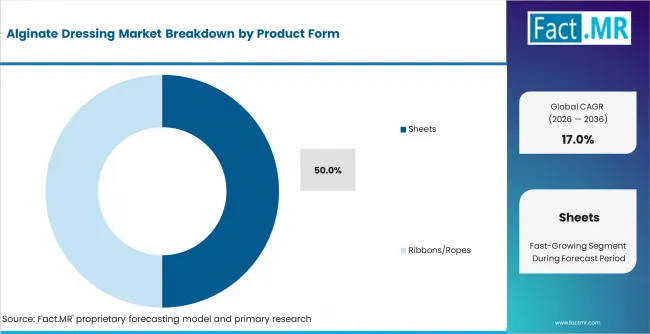
    • By Product Form: Sheets hold 50% share in 2026, preferred for ease of use and adaptability across multiple wound types.
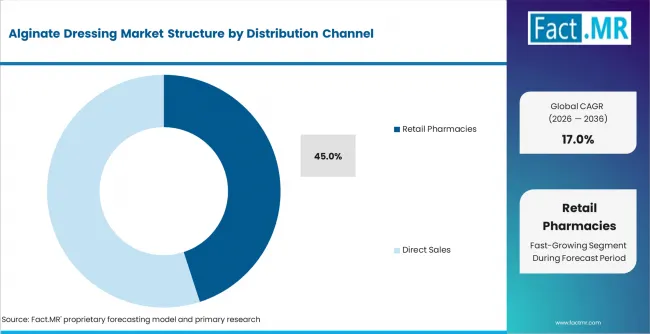
    • By Distribution Channel: Retail pharmacies lead with 45% share in 2026, driven by recurring outpatient and homecare demand.
    • By Geography: India leads with 6.5% CAGR through 2036, supported by expanding diabetes care programs and improving wound care infrastructure.
  • Analyst Opinion at FACT.MR
    • Shambhu Nath Jha, Principal Consultant at Fact.MR, opines, 'CXOs will find that the structural opportunity in alginate dressings is shifting beyond hospital formularies. The market is moving toward community and homecare wound management. Value creation is increasingly tied to distribution reach and reimbursement-aligned product formats.
  • Strategic Implications
    • Focus on antimicrobial alginate dressings for hospital use. Infection-control demand supports premium pricing in United States and Germany.
    • Expand retail and homecare distribution in India and China. Growth is driven by rising outpatient wound care demand.
    • Align products with NHS and CMS reimbursement frameworks in the United Kingdom and United States to secure volume.
  • Methodology
    • Market sizing based on manufacturer revenue and procurement data, supported by diabetes and chronic wound statistics.
    • Analysis includes data from Smith & Nephew, ConvaTec, Mölnlycke Health Care, Coloplast, and Paul Hartmann AG.
    • Forecasts consider diabetes growth, homecare expansion, antimicrobial adoption, and expert inputs.

The market is set to generate an absolute opportunity of USD 2.7 billion between 2026 and 2036. Growth is structurally supported by rising chronic wound prevalence, expanding home healthcare infrastructure, and increasing adoption of advanced moist wound therapy protocols. Expansion is partially constrained by reimbursement variability across payer systems and cost sensitivity in public hospital procurement networks.

Procurement patterns are shifting toward multi-layer combination dressings and antimicrobial silver-alginate formats. Large hospital networks and homecare distributors are consolidating wound care sourcing around clinically validated, protocol-listed products. Smith & Nephew and ConvaTec are embedding alginate dressings into integrated wound management programmes with long-term formulary agreements that limit substitution.

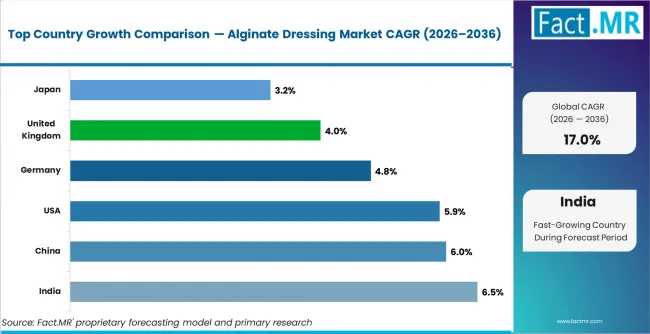
India leads with an estimated CAGR of 6.5% through 2036, driven by rapid expansion of diabetic wound care programmes and improving hospital wound management infrastructure. China follows at 6.0%, anchored by a large and growing diabetic population and increasing advanced wound care adoption across tier-II and tier-III hospitals. The United States records 5.9%, driven by a mature chronic wound patient base and consistent reimbursement through Medicare and Medicaid. Germany records 4.8%, reflecting strong statutory insurance coverage and rising outpatient wound care centre capacity. The United Kingdom records 4.0%, supported by NHS-led community wound care service expansion. Japan records 3.2%, with demand sustained by a heavily aged population, though constrained by conservative hospital formulary cycles and stable rather than transformational volume growth.

Segmental Analysis

Alginate Dressing Market Analysis by Type
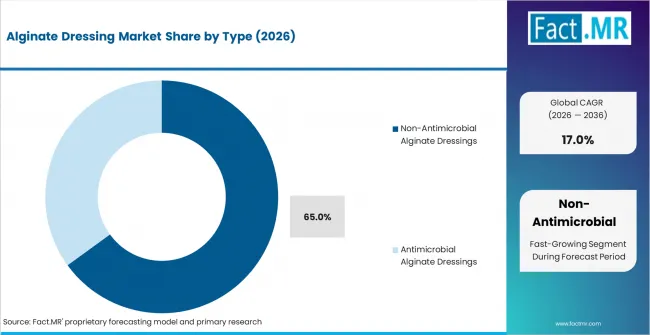
Alginate Dressing Market Analysis By Type

Fact.MR estimates that non-antimicrobial alginate dressings will hold around 65% share in 2026. They lead due to broad applicability across multiple wound types. Their lower cost supports widespread use in hospitals and retail settings. As a result, they remain the preferred formulary option across most regions.

  • Smith & Nephew Portfolio Expansion: Smith & Nephew plc expanded its ALGISITE M calcium alginate dressing range in 2024, adding new size variants targeting moderate-to-heavily exuding chronic ulcers and pressure injuries across NHS-supplied district nursing and hospital wound care programmes in the United Kingdom and Germany. [1]
  • Antimicrobial Product Development: Molnlycke Health Care AB launched an updated Mepitel Ag antimicrobial alginate interface dressing in Q1 2025, incorporating silver-alginate technology targeting burn wound and infected chronic ulcer management in hospital acute wound care settings across European markets. [2]
  • Formulary Inclusion Trend: The Wound Management Innovation CRC 2024 advanced wound care product adoption report documented a 14% increase in alginate dressing formulary inclusions across Australian public hospitals, driven by evidence-based wound care protocol updates recommending calcium alginate for moderate exudate management over traditional gauze. [3]

Alginate Dressing Market Analysis by Indication
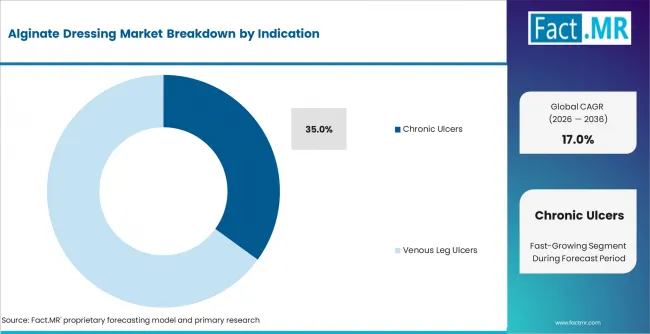
Alginate Dressing Market Analysis By Indication

Based on FACT.MR’s alginate dressing market report, chronic ulcers are estimated to hold approximately 35% share in 2026. Chronic ulcers dominate because they require prolonged, high-frequency dressing changes across diabetic foot, venous leg, and pressure wound subtypes, creating the most consistent and volume-intensive alginate procurement demand globally.

  • ConvaTec Chronic Wound Programme: ConvaTec Group plc reported expanded Aquacel Ag+ Alginate placements in U.S. wound care centres in FY2024, citing rising diabetic foot ulcer patient volumes and CMS reimbursement coverage for advanced alginate dressings in long-term wound management as the primary demand drivers across outpatient wound clinics. [4]
  • Diabetic Foot Ulcer Technology: Paul Hartmann AG launched its Sorbalgon T alginate rope dressing upgrade in 2024, specifically designed for cavity and sinus-type diabetic foot ulcer wounds, incorporating improved tensile integrity for safer removal in clinical settings across European wound care centres. [5]
  • Burn Case Adoption Trend: The European Burns Association 2024 clinical practice update endorsed calcium alginate dressings as a first-line option for partial-thickness burn wound management, citing exudate absorption capacity and non-adherent healing surface as key clinical advantages, expanding alginate use into burn unit procurement across EU member state hospitals. [6]

Alginate Dressing Market Analysis by End User
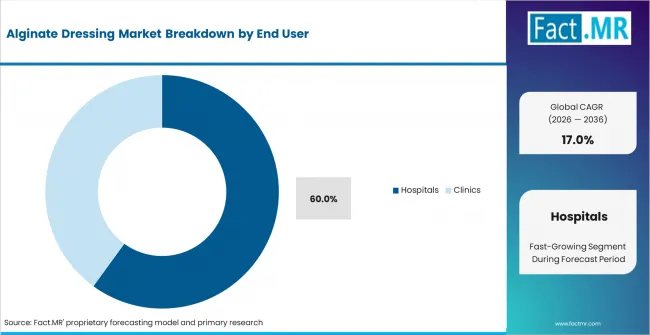
Alginate Dressing Market Analysis By End User

Based on FACT.MR’s alginate dressing market report, hospitals are estimated to hold approximately 60% share in 2026. Hospitals lead because inpatient and outpatient wound care departments generate the highest per-facility alginate dressing volumes, with formulary-based procurement ensuring consistent product-specific ordering cycles independent of individual clinical preference.

  • Hospital Procurement Scale: Cardinal Health reported increased advanced wound care dressing volumes to U.S. acute care hospitals in FY2024, citing expanded wound care service lines and CMS quality reporting requirements that incentivise documented advanced dressing use in chronic wound management pathways across hospital-based outpatient wound clinics. [7]
  • Home Healthcare Development: Coloplast Corp. expanded its SpeediDerm alginate wound care line distribution to U.S. homecare and skilled nursing facility channels in 2024, targeting post-surgical and diabetic wound patients transitioning from inpatient to home-based wound management under Medicare-covered home health programmes. [8]
  • Clinic Channel Growth Trend: 3M Health Care’s 2024 annual report noted increased Tegaderm Alginate dressing adoption across U.S. ambulatory wound care clinics, driven by expanding standalone outpatient wound centre capacity and rising patient preference for clinic-based wound care avoiding full hospital admission. [9]

Alginate Dressing Market Analysis by Product Form
Alginate Dressing Market Analysis By Product Form

Based on FACT.MR’s alginate dressing market report, sheets are estimated to hold approximately 50% share in 2026. Sheets dominate because their flat, ready-to-apply format suits the widest range of wound morphologies, reduces application time for nursing staff, and remains the standard stocked format across hospital, clinic, and retail pharmacy channels globally.

  • Hollister Sheet Format Investment: Hollister Incorporated expanded its Restore Calcium Alginate sheet dressing distribution across U.S. long-term care facilities and home health agencies in 2024, targeting pressure ulcer and venous leg ulcer patients in post-acute settings where sheet-format ease of use is essential for non-specialist caregiver application. [10]
  • Ribbon and Rope Product Development: B. Braun Melsungen AG extended its Askina Sorb alginate rope dressing range in Q3 2024, adding narrower-diameter cavity packing formats designed for tunnelling and undermined chronic wound types, addressing a clinical gap in standard sheet-format product ranges across European hospital wound care departments.
  • Pad Format Adoption Trend: Medline Industries reported growing demand for bordered alginate pad dressings across U.S. retail pharmacy and DME supplier channels in 2024, driven by outpatient wound patients and homecare users preferring self-adhesive pad formats that simplify dressing changes without specialist nursing assistance.

Alginate Dressing Market Analysis by Distribution Channel
Alginate Dressing Market Analysis By Distribution Channel

Based on FACT.MR’s alginate dressing market report, retail pharmacies are estimated to hold approximately 45% share in 2026. Retail pharmacies lead because recurring outpatient and homecare demand for standard alginate formats creates consistent replenishment purchasing, independent of hospital formulary cycles, across both prescription and over-the-counter wound care product categories.

  • Cardinal Health Retail Distribution: Cardinal Health expanded its retail pharmacy wound care product distribution network in 2024, adding alginate dressings to its at-home patient care product line supplied through major U.S. pharmacy chains, targeting outpatient wound care patients managing chronic wounds between clinical visits under Medicare-covered home health orders. [7]
  • Online Channel Development: Medline Industries expanded its direct-to-consumer online wound care product range in 2024, adding multiple alginate dressing SKUs to its e-commerce platform targeting homecare patients and caregivers seeking cost-efficient wound care supply outside traditional pharmacy and medical equipment distributor channels. [12]
  • Direct Sales Channel Trend: Smith & Nephew’s FY2024 annual report confirmed that hospital direct supply contracts for advanced wound care dressings including alginate formats represented the majority of its wound management revenue, with long-term institutional procurement agreements limiting retail price competition in the hospital and acute care facility channel. [1]

Drivers, Restraints, and Opportunities
Alginate Dressing Market Opportunity Matrix Growth Vs Value

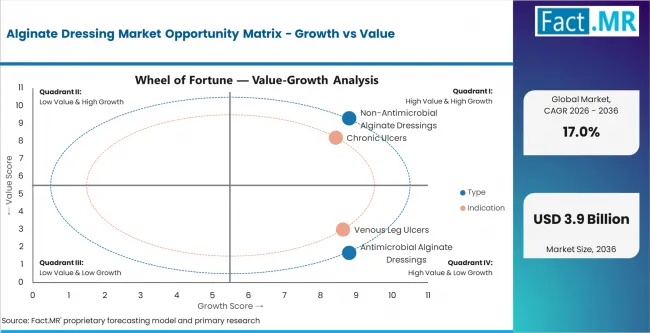
FACT.MR analysts observe that the alginate dressing market at USD 0.7 billion in 2026 reflects consistent guideline-backed procurement anchored by chronic wound management as a growing global healthcare challenge.

The core tension lies between hospital formulary-driven volume and expanding community-based wound care. In institutional settings, alginate procurement follows protocol-listed product cycles. Outside hospitals, reimbursement variability and caregiver training gaps constrain adoption of advanced formats.

  • Diabetic Wound Burden Expansion: Diabetic wound burden is increasing. The International Diabetes Federation reported 537 million adults with diabetes in 2024, driving alginate dressing demand. India and China lead new case growth.
  • NHS Community Wound Care Commissioning: NHS community care is expanding usage. The 2024 framework in United Kingdom includes alginate dressings for chronic wounds. Smith & Nephew and Mölnlycke Health Care increased formulary placements.
  • Home Healthcare Infrastructure Growth: Home healthcare demand is rising. India expanded reimbursement under Ayushman Bharat in 2025. ConvaTec expanded distribution for post-surgical and diabetic care.

Regional Analysis

The alginate dressing market is assessed across Asia Pacific, North America, Europe, Latin America, and Middle East and Africa, covering 40+ countries segmented by chronic wound prevalence, diabetes burden, reimbursement coverage, and advanced wound care adoption rates. The full report offers market attractiveness analysis by region and country.

Top Country Growth Comparison Alginate Dressing Market Cagr (2026 2036)

Country CAGR (2026 to 2036)
India 6.5%
China 6.0%
United States 5.9%
Germany 4.8%
United Kingdom 4.0%
Japan 3.2%

Source: Fact.MR (FACT.MR) analysis, based on proprietary forecasting model and primary research
Alginate Dressing Market Cagr Analysis By Country

Asia Pacific Alginate Dressing Market Analysis

Asia Pacific is the volume growth epicentre for alginate dressings. Rapidly rising diabetes prevalence, expanding hospital infrastructure, and government-backed wound care programme investment are the twin structural drivers. Smith & Nephew and ConvaTec are scaling regional distribution networks to capture institutional and homecare procurement growth.

  • India: India’s market is accelerating through public health programme expansion and growing private hospital standardisation, with growth estimated at around 6.5% CAGR through 2036. The 2024 update to the National Programme for Non-Communicable Diseases prioritised wound care within outpatient services, increasing procurement budgets at district hospitals. The Ayushman Bharat Digital Mission extended reimbursement to homecare providers in 2025, opening a new demand channel for alginate sheets.
  • China: China’s demand is being shaped by large-scale hospital upgrades and clinical guideline reinforcement, progressing at approximately 6.0% CAGR through 2036. The 2024 healthcare infrastructure programme allocated CNY 8 billion toward county-level hospital capability expansion, creating procurement opportunities at tier-II and tier-III facilities. Updated diabetic foot care guidelines formally recommended alginate dressings for infected ulcers, strengthening clinical adoption. Mölnlycke Health Care expanded its regional distribution footprint, while domestic manufacturers are increasing supply, intensifying price competition in standard segments.
  • Japan: Japan’s market reflects steady, replacement-driven demand supported by reimbursement stability, advancing at about 3.2% CAGR through 2036. National Health Insurance coverage for alginate dressings was maintained in 2024, ensuring continued hospital procurement. Clinical societies retained alginate as a standard treatment for exudate-heavy wounds. Growth remains moderate due to stable patient volumes and conservative procurement cycles. Coloplast and Hollister Incorporated maintain distribution through established healthcare networks.

Fact.MR analysis for Asia Pacific includes India, China, and other regional markets, covering healthcare investment trends, reimbursement expansion, and clinical adoption patterns.

North America Alginate Dressing Market Analysis
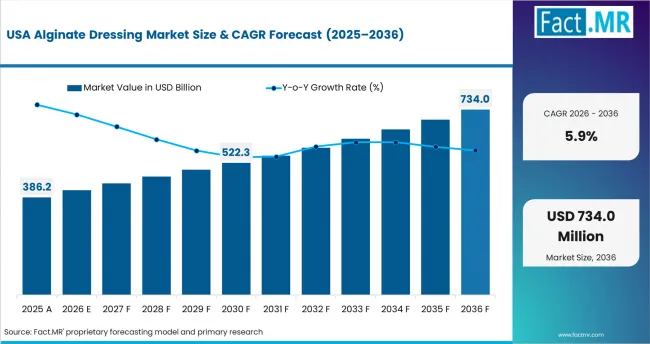
Alginate Dressing Market Country Value Analysis

North America remains the largest revenue contributor, supported by strong reimbursement systems, high chronic wound prevalence, and well-established clinical protocols.

  • United States: The United States market is driven by reimbursement-backed demand and clinical guideline adherence, expanding at an estimated 5.9% CAGR through 2036. CMS maintained Surgical Dressing Benefit coverage in its 2024 update, ensuring consistent procurement across home health agencies and outpatient clinics. Updated guidelines from physician bodies reinforced alginate dressings as a preferred moisture-management solution.

Fact.MR analysis for North America includes the United States and other regional markets, with insights on reimbursement frameworks, distribution systems, and clinical guideline adoption.

Europe Alginate Dressing Market Analysis
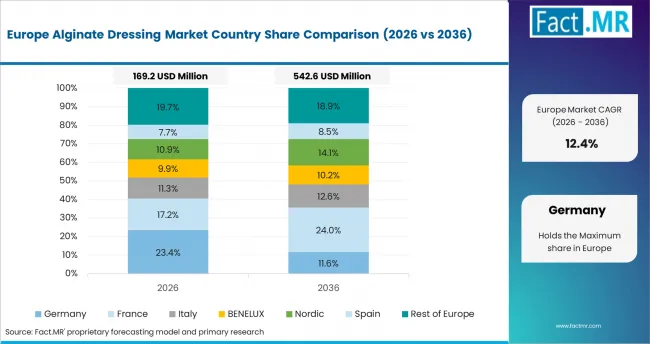
Alginate Dressing Market Europe Country Market Share Analysis, 2026 & 2036

Europe operates as a regulation-driven market where reimbursement systems and clinical standards directly shape product adoption and procurement cycles.

  • Germany: Germany’s market is anchored in statutory insurance coverage and clinical standardisation, growing at around 4.8% CAGR through 2036. The 2024 reimbursement list update confirmed alginate dressings for chronic wound care in outpatient and home settings. Clinical guidelines reinforced calcium alginate as a primary option for exudative wounds. Paul Hartmann AG and B. Braun expanded distribution to outpatient centres, reflecting a shift away from hospital-centric care.
  • United Kingdom: The UK market is evolving through structured NHS commissioning and guideline-driven procurement, progressing at approximately 4.0% CAGR through 2036. The 2024 community wound care framework standardised alginate usage across district nursing services. Updated guidance reinforced their role in managing high-exudate wounds. Smith & Nephew and Mölnlycke Health Care expanded NHS supply agreements, supporting consistent demand across hospital and community channels.

Fact.MR analysis for Europe includes Germany, the United Kingdom, and other regional markets, covering reimbursement structures, clinical standards, and procurement dynamics.

Competitive Aligners for Market Players
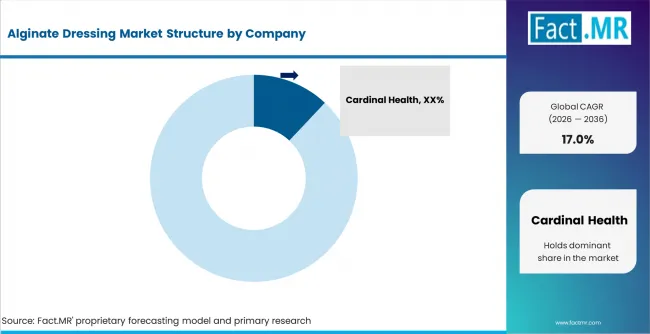
Alginate Dressing Market Analysis By Company

Companies in the alginate dressing market are adjusting to a shift in how and where care is delivered. Demand is no longer centered only in hospitals. More wound care is moving to home and outpatient settings. This is changing how products are designed and distributed.

Ease of use has become important. Dressings that are simple to apply and remove are preferred in homecare. Patients and caregivers are often non-specialists. Products that reduce complexity and improve comfort are gaining traction.

Pricing pressure is also increasing. Standard alginate dressings face competition from low-cost suppliers. This makes differentiation important. Some companies are focusing on antimicrobial or advanced formulations. These products offer better infection control and can support higher margins.

Distribution strategy is evolving. Retail pharmacies and homecare providers are becoming key channels. Companies need stronger partnerships outside hospitals. Reliable supply and availability are critical in these settings. Reimbursement plays a major role. Markets with clear coverage frameworks tend to see higher adoption. Aligning products with reimbursement criteria helps secure consistent demand. It also reduces risk for buyers. Clinical trust remains essential. Hospitals and clinicians still influence product choice. Evidence-based performance and guideline alignment help maintain credibility.

The market is becoming more patient-focused. Success depends on balancing cost, usability, and clinical effectiveness. Companies that adapt to changing care settings are better positioned to grow.

Key Players

  • Cardinal Health
  • Smith & Nephew
  • 3M
  • Coloplast Corp.
  • ConvaTec
  • Paul Hartmann AG
  • B. Braun Melsungen
  • Hollister Incorporated
  • Molnlycke Health Care AB
  • Medline Industries, Inc.

Bibliography

  • [1] Smith & Nephew plc. Annual Report 2024: ALGISITE M Alginate Dressing Range Expansion and NHS Supply Chain and GKV-Contracted Distribution Agreements in the United Kingdom and Germany. March 2025. smith-nephew.com/investor-relations
  • [2] Molnlycke Health Care AB. Product Announcement Q1 2025: Updated Mepitel Ag Antimicrobial Alginate Interface Dressing Launch for Burn and Infected Chronic Ulcer Management Across European Hospital Acute Wound Care Settings. January 2025. molnlycke.com/news
  • [3] Wound Management Innovation CRC. Advanced Wound Care Product Adoption in Australian Public Hospitals 2024: Alginate Dressing Formulary Inclusion Rates and Evidence-Based Protocol Update Data. 2024. woundmanagement.com.au/research
  • [4] ConvaTec Group plc. FY2024 Annual Report: Aquacel Ag+ Alginate Placement Growth in U.S. Wound Care Centres and CMS Reimbursement Coverage Impact on Outpatient Diabetic Foot Ulcer Management. February 2025. convatecgroup.com/investors
  • [5] Paul Hartmann AG. Product Launch Announcement 2024: Sorbalgon T Alginate Rope Dressing Upgrade for Cavity and Sinus-Type Diabetic Foot Ulcer Wounds Across European Wound Care Centres. 2024. hartmann.info/press
  • [6] European Burns Association. Clinical Practice Update 2024: Calcium Alginate Dressings as First-Line Recommendation for Partial-Thickness Burn Wound Management Across EU Hospital Burn Units. 2024. euroburn.org/guidelines
  • [7] Cardinal Health Inc. FY2024 Annual Report: Advanced Wound Care Dressing Volume Growth to U.S. Acute Care Hospitals and Home Health Agencies and Expanded Logistics Network for Alginate Product Distribution. 2024. cardinalhealth.com/investors
  • [8] Coloplast Corp. Company Announcement 2024: SpeediDerm Alginate Wound Care Line Distribution Expansion to U.S. Homecare and Skilled Nursing Facility Channels Targeting Medicare-Covered Post-Surgical and Diabetic Wound Patients. 2024. coloplast.com/news
  • [9] 3M Health Care. Annual Report 2024: Tegaderm Alginate Dressing Adoption Growth Across U.S. Ambulatory Wound Care Clinics and Expanding Standalone Outpatient Wound Centre Procurement. 2024. 3m.com/investor-relations
  • [10] Hollister Incorporated. Company Announcement 2024: Restore Calcium Alginate Sheet Dressing Distribution Expansion to U.S. Long-Term Care Facilities and Home Health Agencies for Pressure Ulcer and Venous Leg Ulcer Management. 2024. hollister.com/news

This Report Addresses

  • Strategic intelligence on alginate dressing demand across antimicrobial and non-antimicrobial types, chronic ulcer, diabetic foot, burn, and surgical wound indications in hospital, clinic, and home healthcare settings globally.
  • Market forecast from USD 0.7 billion in 2026 to USD 3.4 billion by 2036, at a CAGR of 17.0%.
  • Opportunity mapping across India diabetes-driven wound care expansion, China county-hospital infrastructure investment, U.S. CMS Medicare Surgical Dressing Benefit coverage, Germany G-BA reimbursement list inclusion, and UK NHS community wound care commissioning.
  • Segment analysis by type, indication, end user, product form, and distribution channel covering global and regional markets with country-level CAGR forecasts.
  • Regional outlook across Asia Pacific diabetic population-driven volume growth, North America reimbursement-led procurement expansion, and Europe statutory insurer and EWMA guideline-driven advanced wound care adoption.
  • Competitive analysis of Smith & Nephew, ConvaTec, Molnlycke, Coloplast, Paul Hartmann AG, B. Braun Melsungen, Cardinal Health, and Medline Industries covering formulary positioning, distribution depth, and antimicrobial product differentiation strategies.
  • Regulatory analysis covering U.S. CMS Surgical Dressing Benefit criteria, UK NICE wound care product guidance, Germany G-BA Hilfsmittelverzeichnis listing requirements, India Ayushman Bharat wound care reimbursement, and Japan NHI medical device tariff classifications.
  • Report delivered in PDF, Excel datasets, and presentation formats supported by primary interviews, OEM annual reports, national health ministry procurement data, and reimbursement schedule publications.

Alginate Dressing Market Definition

The alginate dressing market covers calcium or calcium-sodium alginate fibre dressings derived from seaweed, used to manage moderate-to-heavily exuding wounds. They absorb wound exudate to form a moist gel, supporting autolytic debridement and tissue healing.

Alginate Dressing Market Inclusions

Covers global and regional forecasts from 2026 to 2036 by type, indication, end user, product form, and distribution channel. Includes antimicrobial and non-antimicrobial alginate sheets, ribbons, ropes, and pads across institutional and home care channels. Covers reimbursement and formulary benchmarks across all five geographic regions.

Alginate Dressing Market Exclusions

Excludes hydrocolloid, foam, and hydrogel dressings not formulated with alginate fibre. Omits wound closure strips, surgical sutures, and tissue adhesives. Excludes alginate used in pharmaceutical drug delivery and food applications.

Alginate Dressing Market Research Methodology

  • Primary Research
    • Interviews with wound care nurses, hospital procurement managers, homecare product distributors, and outpatient wound clinic directors across the United States, Germany, United Kingdom, India, China, and Japan.
  • Desk Research
    • Analysis of Smith & Nephew, ConvaTec, Molnlycke Health Care, and Coloplast public filings, alongside WHO chronic disease burden data, NHS wound care commissioning reports, and 2024–2025 advanced wound care procurement benchmarks.
  • Market-Sizing and Forecasting
    • Hybrid model combining top-down revenue estimates from wound care dressing manufacturers with bottom-up volume estimates by indication type and end user, cross-referenced with average selling prices by product form and distribution channel.
  • Data Validation and Update Cycle
    • Validated through OEM revenue disclosures, national health ministry wound care procurement data, and wound care association clinical adoption benchmarks. Updated annually with earnings data and reimbursement schedule revisions.

Scope of Report

Alginate Dressing Market Breakdown By Type, Indication, And Region

Attribute Details
Quantitative Units USD 0.7 billion (2026) to USD 3.4 billion (2036), at a CAGR of 17.0%
Market Definition Calcium and calcium-sodium alginate fibre wound dressings managing moderate-to-heavily exuding chronic and acute wounds across hospitals, clinics, and home healthcare settings globally.
Type Segmentation Antimicrobial Alginate Dressings, Non-Antimicrobial Alginate Dressings
Indication Segmentation Chronic Ulcers, Venous Leg Ulcers, Diabetic Foot Ulcers, Pressure Ulcers, Non-Healing Surgical Wounds, Traumatic Wounds, Burn Cases, Others
End User Segmentation Hospitals, Clinics, Home Healthcare, Others
Product Form Segmentation Sheets, Ribbons/Ropes, Pads
Distribution Channel Segmentation Direct Sales, Retail Pharmacies, Online Channels
Application Coverage Diabetic foot ulcer management, venous leg ulcer therapy, pressure injury care, post-surgical wound management, partial-thickness burn wound care, and home-based chronic wound maintenance programmes.
Regions Covered North America, Europe, Asia Pacific, Latin America, Middle East and Africa
Countries Covered USA, Canada, Mexico, Germany, UK, France, Italy, Spain, Netherlands, Nordic, BENELUX, China, Japan, South Korea, India, ASEAN, Australia and New Zealand, Brazil, Argentina, Colombia, Saudi Arabia, GCC, Turkey, South Africa, Rest of MEA
Key Companies Profiled Cardinal Health, Smith & Nephew, 3M, Coloplast Corp., ConvaTec, Paul Hartmann AG, B. Braun Melsungen, Hollister Incorporated, Molnlycke Health Care AB, Medline Industries, Inc.
Forecast Period 2026 to 2036
Approach Hybrid top-down and bottom-up model using wound care dressing manufacturer revenues, indication-level patient volume estimates, average selling prices by product form and distribution channel, and primary interviews with wound care nurses, hospital procurement managers, and homecare product distributors.

Alginate Dressing Market By Segment

  • By Type

    • Antimicrobial Alginate Dressings
    • Non-Antimicrobial Alginate Dressings
  • By Indication

    • Chronic Ulcers
    • Venous Leg Ulcers
    • Diabetic Foot Ulcers
    • Pressure Ulcers
    • Non-Healing Surgical Wounds
    • Traumatic Wounds
    • Burn Cases
    • Others
  • By End User

    • Hospitals
    • Clinics
    • Home Healthcare
    • Others
  • By Product Form

    • Sheets
    • Ribbons/Ropes
    • Pads
  • By Distribution Channel

    • Direct Sales
    • Retail Pharmacies
    • Online Channels
  • By Region

    • North America
      • United States
      • Canada
      • Mexico
    • Latin America
      • Brazil
      • Argentina
      • Colombia
      • Rest of Latin America
    • Western Europe
      • Germany
      • United Kingdom
      • France
      • Italy
      • Spain
      • Netherlands
      • Nordic Countries
      • BENELUX
      • Rest of Western Europe
    • Eastern Europe
      • Russia
      • Poland
      • Hungary
      • Balkan and Baltic
      • Rest of Eastern Europe
    • East Asia
      • China
      • Japan
      • South Korea
    • South Asia and Pacific
      • India
      • ASEAN
      • Australia and New Zealand
      • Rest of South Asia and Pacific
    • Middle East and Africa
      • Kingdom of Saudi Arabia
      • Other GCC Countries
      • Turkey
      • South Africa
      • Rest of Middle East and Africa

- Frequently Asked Questions -

How large is the global alginate dressing market in 2025?

The global alginate dressing market was valued at USD 0.6 billion in 2025.

What will the market size be in 2026?

Based on Fact.MR analysis, demand for alginate dressings is estimated to grow to USD 0.7 billion in 2026.

What is the projected market size by 2036?

The market is projected to reach USD 3.4 billion by 2036, generating USD 2.7 billion in absolute dollar opportunity over the forecast period.

What is the expected CAGR from 2026 to 2036?

FACT.MR projects a CAGR of 17.0% for the global alginate dressing market during the 2026 to 2036 forecast period.

Which type segment is poised to lead the market?

Non-antimicrobial alginate dressings lead with approximately 65% share in 2026, driven by cost efficiency and broad applicability across standard chronic and traumatic wound care protocols globally.

Which indication segment holds the largest share?

Chronic ulcers dominate with approximately 35% share in 2026, driven by high patient volume, long treatment durations, and consistent dressing change frequency across diabetic, venous, and pressure wound types.

Which end-user segment leads the market?

Hospitals lead with approximately 60% share in 2026, supported by high patient inflow, formulary-based advanced wound care procurement, and clinician-supervised wound management programmes globally.

Which country shows the fastest growth?

India leads at 6.5% CAGR through 2036, driven by NCD programme wound care expansion, Ayushman Bharat homecare reimbursement extension, and rising diabetic foot ulcer patient volumes across public and private hospital networks.

Table of Content

  1. Executive Summary
    • Global Market Outlook
    • Demand to side Trends
    • Supply to side Trends
    • Technology Roadmap Analysis
    • Analysis and Recommendations
  2. Market Overview
    • Market Coverage / Taxonomy
    • Market Definition / Scope / Limitations
  3. Research Methodology
    • Chapter Orientation
    • Analytical Lens and Working Hypotheses
      • Market Structure, Signals, and Trend Drivers
      • Benchmarking and Cross-market Comparability
      • Market Sizing, Forecasting, and Opportunity Mapping
    • Research Design and Evidence Framework
      • Desk Research Programme (Secondary Evidence)
        • Company Annual and Sustainability Reports
        • Peer-reviewed Journals and Academic Literature
        • Corporate Websites, Product Literature, and Technical Notes
        • Earnings Decks and Investor Briefings
        • Statutory Filings and Regulatory Disclosures
        • Technical White Papers and Standards Notes
        • Trade Journals, Industry Magazines, and Analyst Briefs
        • Conference Proceedings, Webinars, and Seminar Materials
        • Government Statistics Portals and Public Data Releases
        • Press Releases and Reputable Media Coverage
        • Specialist Newsletters and Curated Briefings
        • Sector Databases and Reference Repositories
        • Fact.MR Internal Proprietary Databases and Historical Market Datasets
        • Subscription Datasets and Paid Sources
        • Social Channels, Communities, and Digital Listening Inputs
        • Additional Desk Sources
      • Expert Input and Fieldwork (Primary Evidence)
        • Primary Modes
          • Qualitative Interviews and Expert Elicitation
          • Quantitative Surveys and Structured Data Capture
          • Blended Approach
        • Why Primary Evidence is Used
        • Field Techniques
          • Interviews
          • Surveys
          • Focus Groups
          • Observational and In-context Research
          • Social and Community Interactions
        • Stakeholder Universe Engaged
          • C-suite Leaders
          • Board Members
          • Presidents and Vice Presidents
          • R&D and Innovation Heads
          • Technical Specialists
          • Domain Subject-matter Experts
          • Scientists
          • Physicians and Other Healthcare Professionals
        • Governance, Ethics, and Data Stewardship
          • Research Ethics
          • Data Integrity and Handling
      • Tooling, Models, and Reference Databases
    • Data Engineering and Model Build
      • Data Acquisition and Ingestion
      • Cleaning, Normalisation, and Verification
      • Synthesis, Triangulation, and Analysis
    • Quality Assurance and Audit Trail
  4. Market Background
    • Market Dynamics
      • Drivers
      • Restraints
      • Opportunity
      • Trends
    • Scenario Forecast
      • Demand in Optimistic Scenario
      • Demand in Likely Scenario
      • Demand in Conservative Scenario
    • Opportunity Map Analysis
    • Product Life Cycle Analysis
    • Supply Chain Analysis
    • Investment Feasibility Matrix
    • Value Chain Analysis
    • PESTLE and Porter’s Analysis
    • Regulatory Landscape
    • Regional Parent Market Outlook
    • Production and Consumption Statistics
    • Import and Export Statistics
  5. Global Market Analysis 2021 to 2025 and Forecast, 2026 to 2036
    • Historical Market Size Value (USD Million) Analysis, 2021 to 2025
    • Current and Future Market Size Value (USD Million) Projections, 2026 to 2036
      • Y to o to Y Growth Trend Analysis
      • Absolute $ Opportunity Analysis
  6. Global Market Pricing Analysis 2021 to 2025 and Forecast 2026 to 2036
  7. Global Market Analysis 2021 to 2025 and Forecast 2026 to 2036, By Type
    • Introduction / Key Findings
    • Historical Market Size Value (USD Million) Analysis By Type , 2021 to 2025
    • Current and Future Market Size Value (USD Million) Analysis and Forecast By Type , 2026 to 2036
      • Non-Antimicrobial Alginate Dressings
      • Antimicrobial Alginate Dressings
    • Y to o to Y Growth Trend Analysis By Type , 2021 to 2025
    • Absolute $ Opportunity Analysis By Type , 2026 to 2036
  8. Global Market Analysis 2021 to 2025 and Forecast 2026 to 2036, By Indication
    • Introduction / Key Findings
    • Historical Market Size Value (USD Million) Analysis By Indication, 2021 to 2025
    • Current and Future Market Size Value (USD Million) Analysis and Forecast By Indication, 2026 to 2036
      • Chronic Ulcers
      • Venous Leg Ulcers
      • Diabetic Foot Ulcers
    • Y to o to Y Growth Trend Analysis By Indication, 2021 to 2025
    • Absolute $ Opportunity Analysis By Indication, 2026 to 2036
  9. Global Market Analysis 2021 to 2025 and Forecast 2026 to 2036, By End User
    • Introduction / Key Findings
    • Historical Market Size Value (USD Million) Analysis By End User, 2021 to 2025
    • Current and Future Market Size Value (USD Million) Analysis and Forecast By End User, 2026 to 2036
      • Hospitals
      • Clinics
      • Home Healthcare
    • Y to o to Y Growth Trend Analysis By End User, 2021 to 2025
    • Absolute $ Opportunity Analysis By End User, 2026 to 2036
  10. Global Market Analysis 2021 to 2025 and Forecast 2026 to 2036, By Product Form
    • Introduction / Key Findings
    • Historical Market Size Value (USD Million) Analysis By Product Form, 2021 to 2025
    • Current and Future Market Size Value (USD Million) Analysis and Forecast By Product Form, 2026 to 2036
      • Sheets
      • Ribbons/Ropes
      • Pads
    • Y to o to Y Growth Trend Analysis By Product Form, 2021 to 2025
    • Absolute $ Opportunity Analysis By Product Form, 2026 to 2036
  11. Global Market Analysis 2021 to 2025 and Forecast 2026 to 2036, By Distribution Channel
    • Introduction / Key Findings
    • Historical Market Size Value (USD Million) Analysis By Distribution Channel, 2021 to 2025
    • Current and Future Market Size Value (USD Million) Analysis and Forecast By Distribution Channel, 2026 to 2036
      • Retail Pharmacies
      • Direct Sales
      • Online Channels
    • Y to o to Y Growth Trend Analysis By Distribution Channel, 2021 to 2025
    • Absolute $ Opportunity Analysis By Distribution Channel, 2026 to 2036
  12. Global Market Analysis 2021 to 2025 and Forecast 2026 to 2036, By Region
    • Introduction
    • Historical Market Size Value (USD Million) Analysis By Region, 2021 to 2025
    • Current Market Size Value (USD Million) Analysis and Forecast By Region, 2026 to 2036
      • North America
      • Latin America
      • Western Europe
      • Eastern Europe
      • East Asia
      • South Asia and Pacific
      • Middle East & Africa
    • Market Attractiveness Analysis By Region
  13. North America Market Analysis 2021 to 2025 and Forecast 2026 to 2036, By Country
    • Historical Market Size Value (USD Million) Trend Analysis By Market Taxonomy, 2021 to 2025
    • Market Size Value (USD Million) Forecast By Market Taxonomy, 2026 to 2036
      • By Country
        • USA
        • Canada
        • Mexico
      • By Type
      • By Indication
      • By End User
      • By Product Form
      • By Distribution Channel
    • Market Attractiveness Analysis
      • By Country
      • By Type
      • By Indication
      • By End User
      • By Product Form
      • By Distribution Channel
    • Key Takeaways
  14. Latin America Market Analysis 2021 to 2025 and Forecast 2026 to 2036, By Country
    • Historical Market Size Value (USD Million) Trend Analysis By Market Taxonomy, 2021 to 2025
    • Market Size Value (USD Million) Forecast By Market Taxonomy, 2026 to 2036
      • By Country
        • Brazil
        • Chile
        • Rest of Latin America
      • By Type
      • By Indication
      • By End User
      • By Product Form
      • By Distribution Channel
    • Market Attractiveness Analysis
      • By Country
      • By Type
      • By Indication
      • By End User
      • By Product Form
      • By Distribution Channel
    • Key Takeaways
  15. Western Europe Market Analysis 2021 to 2025 and Forecast 2026 to 2036, By Country
    • Historical Market Size Value (USD Million) Trend Analysis By Market Taxonomy, 2021 to 2025
    • Market Size Value (USD Million) Forecast By Market Taxonomy, 2026 to 2036
      • By Country
        • Germany
        • UK
        • Italy
        • Spain
        • France
        • Nordic
        • BENELUX
        • Rest of Western Europe
      • By Type
      • By Indication
      • By End User
      • By Product Form
      • By Distribution Channel
    • Market Attractiveness Analysis
      • By Country
      • By Type
      • By Indication
      • By End User
      • By Product Form
      • By Distribution Channel
    • Key Takeaways
  16. Eastern Europe Market Analysis 2021 to 2025 and Forecast 2026 to 2036, By Country
    • Historical Market Size Value (USD Million) Trend Analysis By Market Taxonomy, 2021 to 2025
    • Market Size Value (USD Million) Forecast By Market Taxonomy, 2026 to 2036
      • By Country
        • Russia
        • Poland
        • Hungary
        • Balkan & Baltic
        • Rest of Eastern Europe
      • By Type
      • By Indication
      • By End User
      • By Product Form
      • By Distribution Channel
    • Market Attractiveness Analysis
      • By Country
      • By Type
      • By Indication
      • By End User
      • By Product Form
      • By Distribution Channel
    • Key Takeaways
  17. East Asia Market Analysis 2021 to 2025 and Forecast 2026 to 2036, By Country
    • Historical Market Size Value (USD Million) Trend Analysis By Market Taxonomy, 2021 to 2025
    • Market Size Value (USD Million) Forecast By Market Taxonomy, 2026 to 2036
      • By Country
        • China
        • Japan
        • South Korea
      • By Type
      • By Indication
      • By End User
      • By Product Form
      • By Distribution Channel
    • Market Attractiveness Analysis
      • By Country
      • By Type
      • By Indication
      • By End User
      • By Product Form
      • By Distribution Channel
    • Key Takeaways
  18. South Asia and Pacific Market Analysis 2021 to 2025 and Forecast 2026 to 2036, By Country
    • Historical Market Size Value (USD Million) Trend Analysis By Market Taxonomy, 2021 to 2025
    • Market Size Value (USD Million) Forecast By Market Taxonomy, 2026 to 2036
      • By Country
        • India
        • ASEAN
        • Australia & New Zealand
        • Rest of South Asia and Pacific
      • By Type
      • By Indication
      • By End User
      • By Product Form
      • By Distribution Channel
    • Market Attractiveness Analysis
      • By Country
      • By Type
      • By Indication
      • By End User
      • By Product Form
      • By Distribution Channel
    • Key Takeaways
  19. Middle East & Africa Market Analysis 2021 to 2025 and Forecast 2026 to 2036, By Country
    • Historical Market Size Value (USD Million) Trend Analysis By Market Taxonomy, 2021 to 2025
    • Market Size Value (USD Million) Forecast By Market Taxonomy, 2026 to 2036
      • By Country
        • Kingdom of Saudi Arabia
        • Other GCC Countries
        • Turkiye
        • South Africa
        • Other African Union
        • Rest of Middle East & Africa
      • By Type
      • By Indication
      • By End User
      • By Product Form
      • By Distribution Channel
    • Market Attractiveness Analysis
      • By Country
      • By Type
      • By Indication
      • By End User
      • By Product Form
      • By Distribution Channel
    • Key Takeaways
  20. Key Countries Market Analysis
    • USA
      • Pricing Analysis
      • Market Share Analysis, 2025
        • By Type
        • By Indication
        • By End User
        • By Product Form
        • By Distribution Channel
    • Canada
      • Pricing Analysis
      • Market Share Analysis, 2025
        • By Type
        • By Indication
        • By End User
        • By Product Form
        • By Distribution Channel
    • Mexico
      • Pricing Analysis
      • Market Share Analysis, 2025
        • By Type
        • By Indication
        • By End User
        • By Product Form
        • By Distribution Channel
    • Brazil
      • Pricing Analysis
      • Market Share Analysis, 2025
        • By Type
        • By Indication
        • By End User
        • By Product Form
        • By Distribution Channel
    • Chile
      • Pricing Analysis
      • Market Share Analysis, 2025
        • By Type
        • By Indication
        • By End User
        • By Product Form
        • By Distribution Channel
    • Germany
      • Pricing Analysis
      • Market Share Analysis, 2025
        • By Type
        • By Indication
        • By End User
        • By Product Form
        • By Distribution Channel
    • UK
      • Pricing Analysis
      • Market Share Analysis, 2025
        • By Type
        • By Indication
        • By End User
        • By Product Form
        • By Distribution Channel
    • Italy
      • Pricing Analysis
      • Market Share Analysis, 2025
        • By Type
        • By Indication
        • By End User
        • By Product Form
        • By Distribution Channel
    • Spain
      • Pricing Analysis
      • Market Share Analysis, 2025
        • By Type
        • By Indication
        • By End User
        • By Product Form
        • By Distribution Channel
    • France
      • Pricing Analysis
      • Market Share Analysis, 2025
        • By Type
        • By Indication
        • By End User
        • By Product Form
        • By Distribution Channel
    • India
      • Pricing Analysis
      • Market Share Analysis, 2025
        • By Type
        • By Indication
        • By End User
        • By Product Form
        • By Distribution Channel
    • ASEAN
      • Pricing Analysis
      • Market Share Analysis, 2025
        • By Type
        • By Indication
        • By End User
        • By Product Form
        • By Distribution Channel
    • Australia & New Zealand
      • Pricing Analysis
      • Market Share Analysis, 2025
        • By Type
        • By Indication
        • By End User
        • By Product Form
        • By Distribution Channel
    • China
      • Pricing Analysis
      • Market Share Analysis, 2025
        • By Type
        • By Indication
        • By End User
        • By Product Form
        • By Distribution Channel
    • Japan
      • Pricing Analysis
      • Market Share Analysis, 2025
        • By Type
        • By Indication
        • By End User
        • By Product Form
        • By Distribution Channel
    • South Korea
      • Pricing Analysis
      • Market Share Analysis, 2025
        • By Type
        • By Indication
        • By End User
        • By Product Form
        • By Distribution Channel
    • Russia
      • Pricing Analysis
      • Market Share Analysis, 2025
        • By Type
        • By Indication
        • By End User
        • By Product Form
        • By Distribution Channel
    • Poland
      • Pricing Analysis
      • Market Share Analysis, 2025
        • By Type
        • By Indication
        • By End User
        • By Product Form
        • By Distribution Channel
    • Hungary
      • Pricing Analysis
      • Market Share Analysis, 2025
        • By Type
        • By Indication
        • By End User
        • By Product Form
        • By Distribution Channel
    • Kingdom of Saudi Arabia
      • Pricing Analysis
      • Market Share Analysis, 2025
        • By Type
        • By Indication
        • By End User
        • By Product Form
        • By Distribution Channel
    • Turkiye
      • Pricing Analysis
      • Market Share Analysis, 2025
        • By Type
        • By Indication
        • By End User
        • By Product Form
        • By Distribution Channel
    • South Africa
      • Pricing Analysis
      • Market Share Analysis, 2025
        • By Type
        • By Indication
        • By End User
        • By Product Form
        • By Distribution Channel
  21. Market Structure Analysis
    • Competition Dashboard
    • Competition Benchmarking
    • Market Share Analysis of Top Players
      • By Regional
      • By Type
      • By Indication
      • By End User
      • By Product Form
      • By Distribution Channel
  22. Competition Analysis
    • Competition Deep Dive
      • Cardinal Health
        • Overview
        • Product Portfolio
        • Profitability by Market Segments (Product/Age /Sales Channel/Region)
        • Sales Footprint
        • Strategy Overview
          • Marketing Strategy
          • Product Strategy
          • Channel Strategy
      • Smith & Nephew
      • 3M
      • Coloplast Corp.
      • ConvaTec
      • Paul Hartmann AG
      • B. Braun Melsungen
  23. Assumptions & Acronyms Used

List Of Table

  • Table 1: Global Market Value (USD Million) Forecast by Region, 2021 to 2036
  • Table 2: Global Market Value (USD Million) Forecast by Type, 2021 to 2036
  • Table 3: Global Market Value (USD Million) Forecast by Indication, 2021 to 2036
  • Table 4: Global Market Value (USD Million) Forecast by End User, 2021 to 2036
  • Table 5: Global Market Value (USD Million) Forecast by Product Form, 2021 to 2036
  • Table 6: Global Market Value (USD Million) Forecast by Distribution Channel, 2021 to 2036
  • Table 7: North America Market Value (USD Million) Forecast by Country, 2021 to 2036
  • Table 8: North America Market Value (USD Million) Forecast by Type, 2021 to 2036
  • Table 9: North America Market Value (USD Million) Forecast by Indication, 2021 to 2036
  • Table 10: North America Market Value (USD Million) Forecast by End User, 2021 to 2036
  • Table 11: North America Market Value (USD Million) Forecast by Product Form, 2021 to 2036
  • Table 12: North America Market Value (USD Million) Forecast by Distribution Channel, 2021 to 2036
  • Table 13: Latin America Market Value (USD Million) Forecast by Country, 2021 to 2036
  • Table 14: Latin America Market Value (USD Million) Forecast by Type, 2021 to 2036
  • Table 15: Latin America Market Value (USD Million) Forecast by Indication, 2021 to 2036
  • Table 16: Latin America Market Value (USD Million) Forecast by End User, 2021 to 2036
  • Table 17: Latin America Market Value (USD Million) Forecast by Product Form, 2021 to 2036
  • Table 18: Latin America Market Value (USD Million) Forecast by Distribution Channel, 2021 to 2036
  • Table 19: Western Europe Market Value (USD Million) Forecast by Country, 2021 to 2036
  • Table 20: Western Europe Market Value (USD Million) Forecast by Type, 2021 to 2036
  • Table 21: Western Europe Market Value (USD Million) Forecast by Indication, 2021 to 2036
  • Table 22: Western Europe Market Value (USD Million) Forecast by End User, 2021 to 2036
  • Table 23: Western Europe Market Value (USD Million) Forecast by Product Form, 2021 to 2036
  • Table 24: Western Europe Market Value (USD Million) Forecast by Distribution Channel, 2021 to 2036
  • Table 25: Eastern Europe Market Value (USD Million) Forecast by Country, 2021 to 2036
  • Table 26: Eastern Europe Market Value (USD Million) Forecast by Type, 2021 to 2036
  • Table 27: Eastern Europe Market Value (USD Million) Forecast by Indication, 2021 to 2036
  • Table 28: Eastern Europe Market Value (USD Million) Forecast by End User, 2021 to 2036
  • Table 29: Eastern Europe Market Value (USD Million) Forecast by Product Form, 2021 to 2036
  • Table 30: Eastern Europe Market Value (USD Million) Forecast by Distribution Channel, 2021 to 2036
  • Table 31: East Asia Market Value (USD Million) Forecast by Country, 2021 to 2036
  • Table 32: East Asia Market Value (USD Million) Forecast by Type, 2021 to 2036
  • Table 33: East Asia Market Value (USD Million) Forecast by Indication, 2021 to 2036
  • Table 34: East Asia Market Value (USD Million) Forecast by End User, 2021 to 2036
  • Table 35: East Asia Market Value (USD Million) Forecast by Product Form, 2021 to 2036
  • Table 36: East Asia Market Value (USD Million) Forecast by Distribution Channel, 2021 to 2036
  • Table 37: South Asia and Pacific Market Value (USD Million) Forecast by Country, 2021 to 2036
  • Table 38: South Asia and Pacific Market Value (USD Million) Forecast by Type, 2021 to 2036
  • Table 39: South Asia and Pacific Market Value (USD Million) Forecast by Indication, 2021 to 2036
  • Table 40: South Asia and Pacific Market Value (USD Million) Forecast by End User, 2021 to 2036
  • Table 41: South Asia and Pacific Market Value (USD Million) Forecast by Product Form, 2021 to 2036
  • Table 42: South Asia and Pacific Market Value (USD Million) Forecast by Distribution Channel, 2021 to 2036
  • Table 43: Middle East & Africa Market Value (USD Million) Forecast by Country, 2021 to 2036
  • Table 44: Middle East & Africa Market Value (USD Million) Forecast by Type, 2021 to 2036
  • Table 45: Middle East & Africa Market Value (USD Million) Forecast by Indication, 2021 to 2036
  • Table 46: Middle East & Africa Market Value (USD Million) Forecast by End User, 2021 to 2036
  • Table 47: Middle East & Africa Market Value (USD Million) Forecast by Product Form, 2021 to 2036
  • Table 48: Middle East & Africa Market Value (USD Million) Forecast by Distribution Channel, 2021 to 2036

List Of Figures

  • Figure 1: Global Market Pricing Analysis
  • Figure 2: Global Market Value (USD Million) Forecast 2021-2036
  • Figure 3: Global Market Value Share and BPS Analysis byType, 2026 and 2036
  • Figure 4: Global Market Y-o-Y Growth Comparison byType, 2026 to 2036
  • Figure 5: Global Market Attractiveness Analysis by Type
  • Figure 6: Global Market Value Share and BPS Analysis by Indication, 2026 and 2036
  • Figure 7: Global Market Y-o-Y Growth Comparison by Indication, 2026 to 2036
  • Figure 8: Global Market Attractiveness Analysis by Indication
  • Figure 9: Global Market Value Share and BPS Analysis by End User, 2026 and 2036
  • Figure 10: Global Market Y-o-Y Growth Comparison by End User, 2026 to 2036
  • Figure 11: Global Market Attractiveness Analysis by End User
  • Figure 12: Global Market Value Share and BPS Analysis by Product Form, 2026 and 2036
  • Figure 13: Global Market Y-o-Y Growth Comparison by Product Form, 2026 to 2036
  • Figure 14: Global Market Attractiveness Analysis by Product Form
  • Figure 15: Global Market Value Share and BPS Analysis by Distribution Channel, 2026 and 2036
  • Figure 16: Global Market Y-o-Y Growth Comparison by Distribution Channel, 2026 to 2036
  • Figure 17: Global Market Attractiveness Analysis by Distribution Channel
  • Figure 18: Global Market Value (USD Million) Share and BPS Analysis by Region, 2026 and 2036
  • Figure 19: Global Market Y-o-Y Growth Comparison by Region, 2026 to 2036
  • Figure 20: Global Market Attractiveness Analysis by Region
  • Figure 21: North America Market Incremental Dollar Opportunity, 2026 to 2036
  • Figure 22: Latin America Market Incremental Dollar Opportunity, 2026 to 2036
  • Figure 23: Western Europe Market Incremental Dollar Opportunity, 2026 to 2036
  • Figure 24: Eastern Europe Market Incremental Dollar Opportunity, 2026 to 2036
  • Figure 25: East Asia Market Incremental Dollar Opportunity, 2026 to 2036
  • Figure 26: South Asia and Pacific Market Incremental Dollar Opportunity, 2026 to 2036
  • Figure 27: Middle East & Africa Market Incremental Dollar Opportunity, 2026 to 2036
  • Figure 28: North America Market Value Share and BPS Analysis by Country, 2026 and 2036
  • Figure 29: North America Market Value Share and BPS Analysis byType, 2026 and 2036
  • Figure 30: North America Market Y-o-Y Growth Comparison byType, 2026 to 2036
  • Figure 31: North America Market Attractiveness Analysis by Type
  • Figure 32: North America Market Value Share and BPS Analysis by Indication, 2026 and 2036
  • Figure 33: North America Market Y-o-Y Growth Comparison by Indication, 2026 to 2036
  • Figure 34: North America Market Attractiveness Analysis by Indication
  • Figure 35: North America Market Value Share and BPS Analysis by End User, 2026 and 2036
  • Figure 36: North America Market Y-o-Y Growth Comparison by End User, 2026 to 2036
  • Figure 37: North America Market Attractiveness Analysis by End User
  • Figure 38: North America Market Value Share and BPS Analysis by Product Form, 2026 and 2036
  • Figure 39: North America Market Y-o-Y Growth Comparison by Product Form, 2026 to 2036
  • Figure 40: North America Market Attractiveness Analysis by Product Form
  • Figure 41: North America Market Value Share and BPS Analysis by Distribution Channel, 2026 and 2036
  • Figure 42: North America Market Y-o-Y Growth Comparison by Distribution Channel, 2026 to 2036
  • Figure 43: North America Market Attractiveness Analysis by Distribution Channel
  • Figure 44: Latin America Market Value Share and BPS Analysis by Country, 2026 and 2036
  • Figure 45: Latin America Market Value Share and BPS Analysis byType, 2026 and 2036
  • Figure 46: Latin America Market Y-o-Y Growth Comparison byType, 2026 to 2036
  • Figure 47: Latin America Market Attractiveness Analysis by Type
  • Figure 48: Latin America Market Value Share and BPS Analysis by Indication, 2026 and 2036
  • Figure 49: Latin America Market Y-o-Y Growth Comparison by Indication, 2026 to 2036
  • Figure 50: Latin America Market Attractiveness Analysis by Indication
  • Figure 51: Latin America Market Value Share and BPS Analysis by End User, 2026 and 2036
  • Figure 52: Latin America Market Y-o-Y Growth Comparison by End User, 2026 to 2036
  • Figure 53: Latin America Market Attractiveness Analysis by End User
  • Figure 54: Latin America Market Value Share and BPS Analysis by Product Form, 2026 and 2036
  • Figure 55: Latin America Market Y-o-Y Growth Comparison by Product Form, 2026 to 2036
  • Figure 56: Latin America Market Attractiveness Analysis by Product Form
  • Figure 57: Latin America Market Value Share and BPS Analysis by Distribution Channel, 2026 and 2036
  • Figure 58: Latin America Market Y-o-Y Growth Comparison by Distribution Channel, 2026 to 2036
  • Figure 59: Latin America Market Attractiveness Analysis by Distribution Channel
  • Figure 60: Western Europe Market Value Share and BPS Analysis by Country, 2026 and 2036
  • Figure 61: Western Europe Market Value Share and BPS Analysis byType, 2026 and 2036
  • Figure 62: Western Europe Market Y-o-Y Growth Comparison byType, 2026 to 2036
  • Figure 63: Western Europe Market Attractiveness Analysis by Type
  • Figure 64: Western Europe Market Value Share and BPS Analysis by Indication, 2026 and 2036
  • Figure 65: Western Europe Market Y-o-Y Growth Comparison by Indication, 2026 to 2036
  • Figure 66: Western Europe Market Attractiveness Analysis by Indication
  • Figure 67: Western Europe Market Value Share and BPS Analysis by End User, 2026 and 2036
  • Figure 68: Western Europe Market Y-o-Y Growth Comparison by End User, 2026 to 2036
  • Figure 69: Western Europe Market Attractiveness Analysis by End User
  • Figure 70: Western Europe Market Value Share and BPS Analysis by Product Form, 2026 and 2036
  • Figure 71: Western Europe Market Y-o-Y Growth Comparison by Product Form, 2026 to 2036
  • Figure 72: Western Europe Market Attractiveness Analysis by Product Form
  • Figure 73: Western Europe Market Value Share and BPS Analysis by Distribution Channel, 2026 and 2036
  • Figure 74: Western Europe Market Y-o-Y Growth Comparison by Distribution Channel, 2026 to 2036
  • Figure 75: Western Europe Market Attractiveness Analysis by Distribution Channel
  • Figure 76: Eastern Europe Market Value Share and BPS Analysis by Country, 2026 and 2036
  • Figure 77: Eastern Europe Market Value Share and BPS Analysis byType, 2026 and 2036
  • Figure 78: Eastern Europe Market Y-o-Y Growth Comparison byType, 2026 to 2036
  • Figure 79: Eastern Europe Market Attractiveness Analysis by Type
  • Figure 80: Eastern Europe Market Value Share and BPS Analysis by Indication, 2026 and 2036
  • Figure 81: Eastern Europe Market Y-o-Y Growth Comparison by Indication, 2026 to 2036
  • Figure 82: Eastern Europe Market Attractiveness Analysis by Indication
  • Figure 83: Eastern Europe Market Value Share and BPS Analysis by End User, 2026 and 2036
  • Figure 84: Eastern Europe Market Y-o-Y Growth Comparison by End User, 2026 to 2036
  • Figure 85: Eastern Europe Market Attractiveness Analysis by End User
  • Figure 86: Eastern Europe Market Value Share and BPS Analysis by Product Form, 2026 and 2036
  • Figure 87: Eastern Europe Market Y-o-Y Growth Comparison by Product Form, 2026 to 2036
  • Figure 88: Eastern Europe Market Attractiveness Analysis by Product Form
  • Figure 89: Eastern Europe Market Value Share and BPS Analysis by Distribution Channel, 2026 and 2036
  • Figure 90: Eastern Europe Market Y-o-Y Growth Comparison by Distribution Channel, 2026 to 2036
  • Figure 91: Eastern Europe Market Attractiveness Analysis by Distribution Channel
  • Figure 92: East Asia Market Value Share and BPS Analysis by Country, 2026 and 2036
  • Figure 93: East Asia Market Value Share and BPS Analysis byType, 2026 and 2036
  • Figure 94: East Asia Market Y-o-Y Growth Comparison byType, 2026 to 2036
  • Figure 95: East Asia Market Attractiveness Analysis by Type
  • Figure 96: East Asia Market Value Share and BPS Analysis by Indication, 2026 and 2036
  • Figure 97: East Asia Market Y-o-Y Growth Comparison by Indication, 2026 to 2036
  • Figure 98: East Asia Market Attractiveness Analysis by Indication
  • Figure 99: East Asia Market Value Share and BPS Analysis by End User, 2026 and 2036
  • Figure 100: East Asia Market Y-o-Y Growth Comparison by End User, 2026 to 2036
  • Figure 101: East Asia Market Attractiveness Analysis by End User
  • Figure 102: East Asia Market Value Share and BPS Analysis by Product Form, 2026 and 2036
  • Figure 103: East Asia Market Y-o-Y Growth Comparison by Product Form, 2026 to 2036
  • Figure 104: East Asia Market Attractiveness Analysis by Product Form
  • Figure 105: East Asia Market Value Share and BPS Analysis by Distribution Channel, 2026 and 2036
  • Figure 106: East Asia Market Y-o-Y Growth Comparison by Distribution Channel, 2026 to 2036
  • Figure 107: East Asia Market Attractiveness Analysis by Distribution Channel
  • Figure 108: South Asia and Pacific Market Value Share and BPS Analysis by Country, 2026 and 2036
  • Figure 109: South Asia and Pacific Market Value Share and BPS Analysis byType, 2026 and 2036
  • Figure 110: South Asia and Pacific Market Y-o-Y Growth Comparison byType, 2026 to 2036
  • Figure 111: South Asia and Pacific Market Attractiveness Analysis by Type
  • Figure 112: South Asia and Pacific Market Value Share and BPS Analysis by Indication, 2026 and 2036
  • Figure 113: South Asia and Pacific Market Y-o-Y Growth Comparison by Indication, 2026 to 2036
  • Figure 114: South Asia and Pacific Market Attractiveness Analysis by Indication
  • Figure 115: South Asia and Pacific Market Value Share and BPS Analysis by End User, 2026 and 2036
  • Figure 116: South Asia and Pacific Market Y-o-Y Growth Comparison by End User, 2026 to 2036
  • Figure 117: South Asia and Pacific Market Attractiveness Analysis by End User
  • Figure 118: South Asia and Pacific Market Value Share and BPS Analysis by Product Form, 2026 and 2036
  • Figure 119: South Asia and Pacific Market Y-o-Y Growth Comparison by Product Form, 2026 to 2036
  • Figure 120: South Asia and Pacific Market Attractiveness Analysis by Product Form
  • Figure 121: South Asia and Pacific Market Value Share and BPS Analysis by Distribution Channel, 2026 and 2036
  • Figure 122: South Asia and Pacific Market Y-o-Y Growth Comparison by Distribution Channel, 2026 to 2036
  • Figure 123: South Asia and Pacific Market Attractiveness Analysis by Distribution Channel
  • Figure 124: Middle East & Africa Market Value Share and BPS Analysis by Country, 2026 and 2036
  • Figure 125: Middle East & Africa Market Value Share and BPS Analysis byType, 2026 and 2036
  • Figure 126: Middle East & Africa Market Y-o-Y Growth Comparison byType, 2026 to 2036
  • Figure 127: Middle East & Africa Market Attractiveness Analysis by Type
  • Figure 128: Middle East & Africa Market Value Share and BPS Analysis by Indication, 2026 and 2036
  • Figure 129: Middle East & Africa Market Y-o-Y Growth Comparison by Indication, 2026 to 2036
  • Figure 130: Middle East & Africa Market Attractiveness Analysis by Indication
  • Figure 131: Middle East & Africa Market Value Share and BPS Analysis by End User, 2026 and 2036
  • Figure 132: Middle East & Africa Market Y-o-Y Growth Comparison by End User, 2026 to 2036
  • Figure 133: Middle East & Africa Market Attractiveness Analysis by End User
  • Figure 134: Middle East & Africa Market Value Share and BPS Analysis by Product Form, 2026 and 2036
  • Figure 135: Middle East & Africa Market Y-o-Y Growth Comparison by Product Form, 2026 to 2036
  • Figure 136: Middle East & Africa Market Attractiveness Analysis by Product Form
  • Figure 137: Middle East & Africa Market Value Share and BPS Analysis by Distribution Channel, 2026 and 2036
  • Figure 138: Middle East & Africa Market Y-o-Y Growth Comparison by Distribution Channel, 2026 to 2036
  • Figure 139: Middle East & Africa Market Attractiveness Analysis by Distribution Channel
  • Figure 140: Global Market - Tier Structure Analysis
  • Figure 141: Global Market - Company Share Analysis

Alginate Dressing Market