- Market Value (2025): USD 329.9 Mn
- Estimated Value (2026): USD 348.8 Mn
- Forecast Value (2036): USD 607.7 Mn
- CAGR (2026-2036): 5.7%
What is the Aerospace & Defense Nitrogen Generators Market forecast to be worth by 2036?
USD 329.9 million in 2026 to USD 607.7 million by 2036 at a 5.7% CAGR.
- According to Fact.MR analysis, the aerospace & defense nitrogen generators market reached USD 329.9 million in 2025.
- Demand is projected to increase from USD 348.8 million in 2026 to USD 607.7 million by 2036.
- The market is forecast to record a 5.7% CAGR from 2026 to 2036. Aircraft operators and defense fleets are expected to favor local nitrogen where daily use supports a dedicated system.
.webp "Aerospace And Defense Nitrogen Generators Market Card (7)")
Aerospace And Defense Nitrogen Generators Market Card (7) | Source: Fact.MR
What are the defining numbers behind Aerospace & Defense Nitrogen Generators Market growth?
An absolute opportunity of USD 258.9 million is created between 2026 and 2036.
- Demand Drivers in the Market
- Flight-line maintenance requires high-pressure nitrogen near the aircraft for tire and strut servicing. Fact.MR analysis of aircraft engine hoists also shows the wider use of dedicated ground equipment for regular MRO work.
- Aircraft engineers use nitrogen-rich gas during fuel-tank inerting and other system work. Growth in commercial aircraft manufacturing also creates regular use for support equipment and service tools linked with new aircraft programs.
- Mobile nitrogen systems are useful for defense operations where aircraft move between permanent bases and temporary sites. ICAO reported in July 2026 that scheduled airlines carried nearly 5 billion passengers in 2025 [7]. High flight activity keeps aircraft servicing active across many operating locations.
- Airports with steady nitrogen use can produce the gas close to their maintenance areas instead of relying on regular cylinder movement. One fixed generator can supply wheel shops and hangars while giving maintenance staff a more consistent source for routine service work.
- Key Segments Analyzed
- By Product Type: Pressure Swing Adsorption (PSA) Nitrogen Generators are expected to hold 48.3% share in 2026.
- By Application: Aircraft & Avionics is projected to account for 35.8% share in 2026, supported by fuel-system inerting and routine aircraft servicing requirements.
- By Technology: On-Site systems are anticipated to capture 62.4% share in 2026 owing to lower dependence on delivered cylinders at high-use aviation and defense locations.
- By End-User: Commercial Aviation is forecast to represent 42.3% share in 2026 as airlines, MRO facilities and airport operators maintain recurring nitrogen needs around active fleets.
- Analyst Opinion at Fact.MR
- Shambhu Nath Jha, Principal Consultant at Fact.MR states: “Busy maintenance sites can reduce daily handling work by producing nitrogen close to where it is used instead of moving cylinders between service areas. Sales are likely to favor fixed and mobile systems that provide steady pressure and the required gas purity. Suppliers can improve day-to-day use by making servicing easy and providing clear performance records for aviation operating conditions.”
- Strategic Implications
- Mobile units used by defense teams need to move easily between bases and remain simple to maintain in different locations.
- Airports and MRO facilities can choose generator capacity based on the amount of nitrogen used during a normal working day.
- Fixed and mobile systems serve different maintenance routines. A fixed generator suits hangars and workshops with steady nitrogen use, while a mobile unit can follow work across ramps and aircraft.
Brazil is projected to record 7.3% CAGR through 2036 as civil aviation activity supports equipment use. Japan follows at 6.8% through passenger and defense activity. The UK is forecast at 5.7%. Germany is expected at 5.1%. The USA is projected at 4.1%.
How does the Aerospace & Defense Nitrogen Generators Market break down by segment?
Pressure Swing Adsorption leads Product Type at 48.3%; Aircraft & Avionics leads Application at 35.8%; On-Site leads Technology at 62.4%; Commercial Aviation leads End-User at 42.3%.
Which Product Type dominates?
Pressure Swing Adsorption (PSA) Nitrogen Generators hold 48.3% share in 2026.
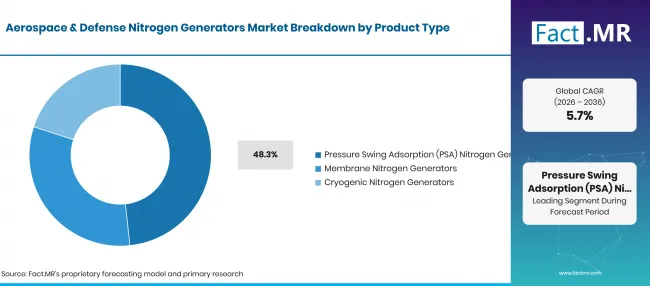
Aerospace And Defense Nitrogen Generators Market Breakdown Product Type | Source: Fact.MR
PSA systems hold a strong position at fixed aerospace and defense sites where nitrogen must be supplied at steady purity and pressure. Membrane systems work well where space is limited and gas flow remains fairly consistent, while cryogenic systems are better suited to larger facilities with much higher nitrogen use.
What leads the Application segment?
Aircraft & Avionics accounts for 35.8% share in 2026.
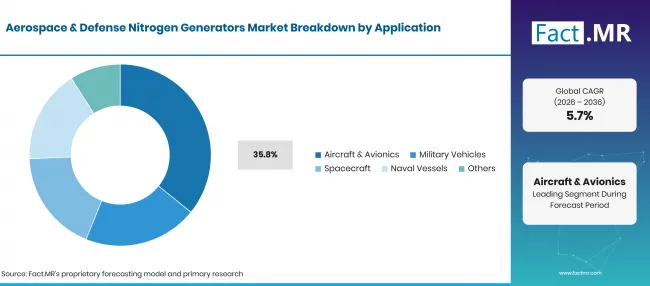
Factmr Aerospace And Defense Nitrogen Generators Market Breakdown Application | Source: Fact.MR
Aircraft and avionics account for the main use of nitrogen generators because nitrogen is needed for fuel-system inerting and regular aircraft servicing. Military vehicles and spacecraft create more specific requirements at defense sites, while naval operations provide another area where controlled gas supply is used. Fact.MR analysis of aircraft cleaning chemicals also shows how civil and military aircraft require a regular supply of maintenance products.
How does Technology shape demand?
On-Site technology captures 62.4% share in 2026.
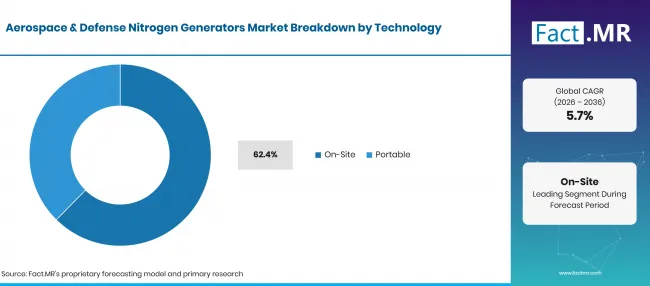
Factmr Aerospace And Defense Nitrogen Generators Market Breakdown Technology | Source: Fact.MR
On-site systems are widely used at busy military bases and MRO centers where nitrogen is needed throughout regular maintenance work. Fixed units provide a steady supply for locations with consistent daily use, while portable systems can move between flight lines or deployed teams as work shifts. The final setup usually depends on how much nitrogen a site uses and how easily the equipment can be reached for regular servicing.
What supports the End-User segment?
Commercial Aviation represents 42.3% share in 2026.
.webp "Aerospace And Defense Nitrogen Generators Market Card (16)")
Aerospace And Defense Nitrogen Generators Market Card (16) | Source: Fact.MR
Commercial aviation accounts for the largest use as airlines and MRO facilities carry out aircraft maintenance throughout the year. Military operations often require nitrogen systems that can move between locations while providing the required pressure for service work. Space programs use controlled gas during ground operations and testing before launch. Across these areas, buyers look closely at gas quality and how easily the equipment can be serviced.
What is accelerating Aerospace & Defense Nitrogen Generators Market adoption, and what is holding it back?
Producing nitrogen close to where it is used reduces cylinder handling and makes gas easier to access during regular aircraft service work. Adoption can slow when the initial equipment cost is high, especially at sites where nitrogen use changes often or remains too low to keep the system running regularly.
Drivers Impact Analysis
| DRIVER | (~) % IMPACT ON CAGR | GEOGRAPHIC RELEVANCE | IMPACT TIMELINE |
|---|---|---|---|
| On-site replacement of cylinder supply | +1.2% | North America, Western Europe | Short term (<= 2 years) |
| Aircraft fuel-tank inerting demand | +0.9% | Global | Medium term (2-4 years) |
| Defense fleet modernization | +0.8% | North America, Europe, East Asia | Medium term (2-4 years) |
| Flight-line mobility requirements | +0.6% | Global | Short term (<= 2 years) |
| MRO fleet servicing volumes | +0.4% | Global | Long term (>= 4 years) |
Opportunity Impact Analysis
| OPPORTUNITY | (~) % IMPACT ON CAGR | GEOGRAPHIC RELEVANCE | IMPACT TIMELINE |
|---|---|---|---|
| Deployable high-pressure systems | +0.7% | North America, Europe | Medium term (2-4 years) |
| Compact membrane units for hangars | +0.5% | Global | Short term (<= 2 years) |
| Integrated storage and monitoring | +0.4% | North America, Western Europe | Medium term (2-4 years) |
| Space and specialist test facilities | +0.3% | North America, East Asia | Long term (>= 4 years) |
Restraints Impact Analysis
| RESTRAINT | (~) % IMPACT ON CAGR | GEOGRAPHIC RELEVANCE | IMPACT TIMELINE |
|---|---|---|---|
| Upfront generator and compressor cost | -0.6% | Global | Short term (<= 2 years) |
| Low utilization at small sites | -0.4% | Global | Medium term (2-4 years) |
| Maintenance skill requirements | -0.3% | Emerging markets | Medium term (2-4 years) |
| Existing cylinder supply contracts | -0.2% | Global | Short term (<= 2 years) |
Which countries are scaling Aerospace & Defense Nitrogen Generators Market through 2036?
- Brazil will remain 0.5 points ahead of Japan, as rising civil aviation activity and continued airport investment create more locations where fixed and mobile nitrogen systems can support aircraft servicing.
- Japan will hold a 1.1-point advantage over the UK, helped by strong passenger traffic and defense aircraft programs that keep maintenance work active at airports and military bases.
- The UK will stay 0.6 points above Germany, supported by heavy airport traffic and regular military flying that create recurring requirements for nitrogen during tire and strut servicing.
- Germany will maintain a 1.0-point lead over the USA, as commercial aviation activity and defense spending support nitrogen-generator use at larger service and military sites.
- The USA will close the five-country range at 4.1% CAGR, with its broad civil and defense aircraft base sustaining regular demand for both fixed generators and portable flight-line systems.
Country growth rates remain relatively close, but the demand setting differs by market because passenger traffic, defense aircraft programs, airport investment, and maintenance activity vary across countries. Full report coverage includes North America, Latin America, Western Europe, Eastern Europe, East Asia, South Asia & Pacific, and Middle East & Africa.
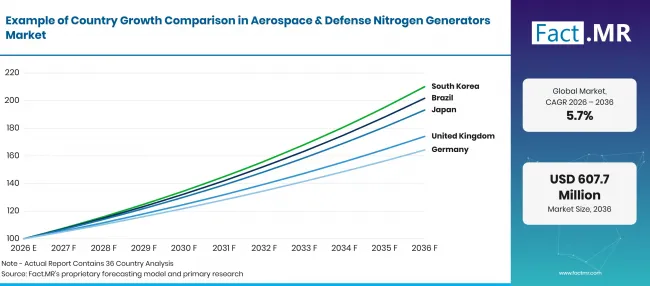
Aerospace And Defense Nitrogen Generators Market Growth Index | Source: Fact.MR
| Country | CAGR (2026-2036) |
|---|---|
| Brazil | 7.3% |
| Japan | 6.8% |
| UK | 5.7% |
| Germany | 5.1% |
| USA | 4.1% |
What supports Brazil adoption?
7.3% CAGR, supported by civil aviation activity and military aircraft programs.
Brazil’s growing airline activity and wide airport network create regular aircraft maintenance work across the country. The Ministry of Ports and Airports reported 129.6 million passengers in 2025 [1]. Higher passenger traffic keeps commercial aircraft in frequent service, creating more opportunities for nitrogen systems used during routine maintenance at airports and aviation service facilities.
How is Japan developing demand?
6.8% CAGR, supported by passenger activity and defense aviation investment.
Japan has steady aircraft service needs from both commercial airlines and defense aviation programs. The country’s transport ministry reported 112.5 million domestic scheduled passengers in FY2025 [2]. Regular passenger flights keep aircraft moving across the domestic network and create ongoing maintenance work, supporting the use of nitrogen systems at airports and service facilities.
What is supporting the UK outlook?
5.7% CAGR, supported by airport throughput and active military flying.
The United Kingdom is projected to grow at a 5.7% CAGR, supported by busy airports and regular military aircraft operations. The UK Civil Aviation Authority recorded 302 million airport passengers in 2025 [3]. High passenger traffic keeps commercial aircraft in regular use, while fixed-wing and rotary-wing military fleets add another source of maintenance activity. Together, these operations support the use of nitrogen systems across airports and defense aviation sites.
What supports Germany adoption?
5.1% CAGR, supported by passenger traffic and defense equipment spending.
Germany is projected to grow at a 5.1% CAGR, with commercial aviation and defense activity creating regular use for aircraft support equipment. Destatis recorded 207.2 million passengers at Germany’s main airports in 2025 [4]. This level of air travel keeps maintenance work active across major airports. Defense programs add another area for nitrogen systems used to support aircraft and other equipment at military sites.
How is the USA scaling demand?
4.1% CAGR, supported by a large civil fleet and continuing defense aircraft investment.
The United States has a large network of airline and defense facilities where aircraft require regular servicing throughout the year. The Bureau of Transportation Statistics reported 81.2 million scheduled-service passengers in December 2025 [5]. This level of passenger travel keeps aircraft operating across many routes and creates steady maintenance activity, supporting nitrogen system sales at airports and aviation service sites.
Who leads the Aerospace & Defense Nitrogen Generators Market?
Parker Hannifin has experience in aerospace fuel-inerting systems, while PCI Gases provides mobile nitrogen equipment for military aviation and flight-line work. The air start unit market shows another area where ground equipment is used close to active aircraft. Atlas Copco and Ingersoll Rand bring wider experience in compressed air systems and on-site nitrogen generation.
On Site Gas Systems, South-Tek Systems, OXYMAT and NOVAIR also supply nitrogen-generation systems for use close to where the gas is needed. In April 2025, NOVAIR announced ISO 14001 and ISO 45001 certifications for its Roissy-en-France and Compans sites [6]. Aircraft production provides another source of business for aviation equipment suppliers. Airbus reported in January 2026 that it delivered 793 commercial aircraft in 2025 [8]. The aerospace adhesives and sealants market also reflects the regular need for products used during aircraft production and ongoing maintenance
Which companies are the key providers?
Key companies include Parker Hannifin Corporation; Air Products and Chemicals Inc.; Atlas Copco AB; Linde plc; Ingersoll Rand Inc.; On Site Gas Systems Inc.; South-Tek Systems; PCI Gases; Oxymat A/S; and NOVAIR SAS.
- Parker Hannifin Corporation
- Air Products and Chemicals Inc.
- Atlas Copco AB
- Linde plc
- Ingersoll Rand Inc.
- On Site Gas Systems Inc.
- South-Tek Systems
- PCI Gases
- Oxymat A/S
- NOVAIR SAS
Bibliography
- [1] Ministry of Ports and Airports, Brazil. (2026, January 19). Aviação civil registra recordes históricos em 2025 e consolida bases para novo ciclo de crescimento em 2026 [Civil aviation records historic results in 2025 and consolidates the basis for a new growth cycle in 2026].
- [2] Ministry of Land, Infrastructure, Transport and Tourism, Japan. (2026, June 30).[Annual Air Transport Statistics Summary for FY2025].
- [3] UK Civil Aviation Authority. (2026, February 24). UK aviation officially breaks records with over 300m passenger journeys in 2025.
- [4] Statistisches Bundesamt (Destatis). (2026, January 29). 3,9 % mehr Fluggäste im Jahr 2025 als im Vorjahr [3.9% more air passengers in 2025 than in the previous year].
- [5] Bureau of Transportation Statistics. (2026, March 13). December 2025 U.S. Airline Traffic Data Down 2.6% from the Same Month Last Year.
- [6] NOVAIR. (2025, April 23). NOVAIR obtains ISO 14001 & ISO 45001 certifications.
- [7] International Civil Aviation Organization. (2026, July 23). International Civil Aviation Organization analysis reveals major priorities for air transport safety.
- [8] Airbus. (2026, January 12). Airbus reports 793 commercial aircraft deliveries in 2025.
This Report Answers
- The report explains how aerospace and defense nitrogen generators are sold by product type and application. It also covers technology and end-user categories.
- Segment analysis identifies the leading PSA and Aircraft & Avionics categories. It also covers On-Site technology and Commercial Aviation end users.
- Country analysis compares Brazil; Japan; the UK; Germany; and the USA. It links each outlook to civil aviation activity and defense aircraft programs.
- Competitive analysis reviews the named generator and industrial-gas suppliers serving aviation and defense users.
- Technology analysis assesses PSA; membrane; and cryogenic systems. It also reviews fixed on-site and portable configurations used around aircraft facilities
What does the Aerospace & Defense Nitrogen Generators Market cover?
The market covers PSA; membrane; and cryogenic equipment used to make nitrogen close to the point of use. Aircraft and defense vehicles form the main application base. Spacecraft and naval uses are included when local generation is part of the operating system.
Revenue covers nitrogen generation packages and the main parts sold with the system. The market boundary includes controls and air treatment when they are part of the finished generator. Bulk nitrogen supply falls outside this revenue base. Stand-alone storage equipment is treated separately when it is sold as its own product.
What is included in the scope?
The scope includes systems for aircraft tire and strut servicing. It also covers fuel-tank inerting support and defense flight-line work.
Hangar systems are included when the generator makes nitrogen on site. Mobile units are included when they are built for aircraft or defense service. Selected space and naval uses are covered when local gas generation is part of the operating setup.
What is excluded from the scope?
Merchant nitrogen sold by cylinder or bulk liquid contract falls outside the market boundary.
Stand-alone compressors and storage vessels are treated as separate equipment when sold on their own. Piping is counted only when it forms part of a finished generator package. General industrial gas systems fall outside the scope when aerospace or defense use is absent.
How Was the Analysis Built?
The analysis draws on 120+ sources, 35+ company portfolios, 25+ countries, and more than 20 industry interviews.
- Primary Research: Primary research includes discussions with manufacturers, service providers, technology developers, distributors, end users, and subject-matter experts. These conversations examine purchasing priorities, product adoption, operational challenges, approval requirements, competitive positioning, and the factors that influence wider market acceptance.
- Desk Research: Desk research covers government statistics, regulatory publications, company filings, trade data, technical studies, industry associations, standards, public policy, and other authoritative sources. Every source used in the analysis is documented in the bibliography.
- Market Sizing and Forecasting: Market estimates combine historical performance, demand indicators, pricing and volume trends, segment shares, company participation, country-level growth, adoption patterns, investment activity, and barriers to market expansion.
- Data Validation and Update Cycle: Findings are validated by comparing primary interviews with public data, company activity, regulatory changes, trade patterns, and industry developments. Regular updates review new product launches, capacity changes, partnerships, approvals, and shifts in commercial adoption.
What is the report’s scope and coverage?
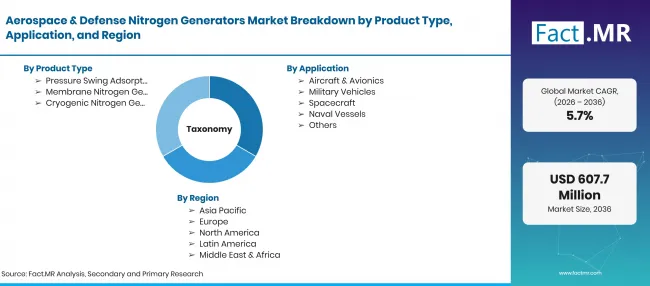
Factmr Aerospace And Defense Nitrogen Generators Market Taxonomy | Source: Fact.MR
| Attribute | Details |
|---|---|
| Quantitative Units | USD million |
| Market Definition | Equipment that generates nitrogen at or near the point of use for aerospace and defense applications, including aircraft servicing, inerting, military support and specialist aviation facilities. |
| Product Type | Pressure Swing Adsorption (PSA) Nitrogen Generators; Membrane Nitrogen Generators; Cryogenic Nitrogen Generators |
| Application | Aircraft & Avionics; Military Vehicles; Spacecraft; Naval Vessels; Others |
| Technology | On-Site; Portable |
| End-User | Commercial Aviation; Military & Defense; Space Exploration |
| Regions Covered | North America; Latin America; Western Europe; Eastern Europe; East Asia; South Asia & Pacific; Middle East & Africa |
| Countries Covered | Brazil; Japan; UK; Germany; USA |
| Key Companies Profiled | Parker Hannifin Corporation; Air Products and Chemicals Inc.; Atlas Copco AB; Linde plc; Ingersoll Rand Inc.; On Site Gas Systems Inc.; South-Tek Systems; PCI Gases; Oxymat A/S; NOVAIR SAS |
| Forecast Period | 2026 to 2036 |
How is the market segmented?
-
By Product Type:
- Pressure Swing Adsorption (PSA) Nitrogen Generators
- Membrane Nitrogen Generators
- Cryogenic Nitrogen Generators
-
By Application:
- Aircraft & Avionics
- Military Vehicles
- Spacecraft
- Naval Vessels
- Others
-
By Technology:
- On-Site
- Portable
-
By End-User:
- Commercial Aviation
- Military & Defense
- Space Exploration
-
By Region:
- North America
- Latin America
- Western Europe
- Eastern Europe
- East Asia
- South Asia & Pacific
- Middle East & Africa