- Base Value(2025): 1.4 Bn
- Estimated Value(2026): 1.5 Bn
- Forecast Value (2036): 2.9 Bn
- CAGR (2026 - 2036): 6.9%
Aircraft Engine Hoists Market Analysis and Forecast by Fact.MR
- The Aircraft Engine Hoists Market is expected to grow from USD 1.5 billion in 2026 to USD 2.9 billion by 2036, at a 6.9% CAGR.
- Driven by expanding commercial aircraft fleet maintenance requirements, increasing MRO facility construction across growth regions, and rising engine removal rates tied to next-generation powerplant maintenance cycles, with hydraulic engine hoists accounting for 77.9% share.
- Commercial aircraft maintenance contributing 32.8% share as MRO providers prioritize operational throughput, technician safety, and equipment readiness for high-demand engine overhaul programs.
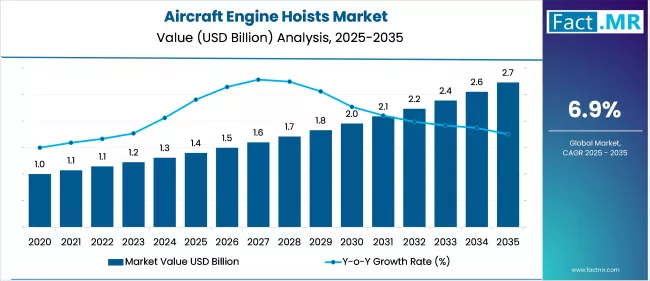
Aircraft Engine Hoists Market Value Analysis | Source: Fact.MR
Summary of Aircraft Engine Hoists Market
- Market Snapshot
- In 2025, the global Aircraft Engine Hoists Market was valued at approximately USD 1.4 billion.
- The market is estimated to reach USD 1.5 billion in 2026 and is projected to attain USD 2.9 billion by 2036.
- The aircraft engine hoists market is likely to expand at a CAGR of 6.9% during the forecast period.
- The market is anticipated to create an absolute dollar opportunity of USD 1.4 billion between 2026 and 2036.
- Hydraulic engine hoists account for 77.9% of product segment share in 2026.
- India (7.5%) and China (7.2%) are the key growth markets during the forecast period.
- Demand and Growth Drivers
- The growth of the commercial aircraft fleet, which is projected to reach almost 90,000 active engines in 2035, is driving corresponding demand for MRO ground support equipment, such as engine hoists with ratings for current and next-generation powerplants.
- MRO capacity growth is fueled by the maintenance cycles of the LEAP and GTF engines. Each new facility requires engine hoist infrastructure capable of supporting the weight and dimensional specifications of these powerplant families.
- The build-out of MRO facilities in India, Southeast Asia and the Middle East is creating a concentrated demand for equipment procurement as these regions ramp up capacity to service increasing regional airline fleets.
- Aging legacy engine fleets like the CFM56 and V2500 are driving demand for engine hoist equipment at existing MRO facilities due to increased shop visit frequency.
- Aviation maintenance heavy lift operations are being driven to modernize and replace aging hoist infrastructure due to safety regulations and OSHA-equivalent standards.
- Product and Segment View
- The hydraulic engine hoists segment has a share of 77.9% in the product segment in 2026 and is preferred for its load capacity, operational precision, and compatibility with commercial aircraft engine weights.
- Commercial aircraft maintenance is expected to command 32.8% of the application segment in 2026, followed by military aircraft maintenance and general aviation servicing.
- Aircraft MRO providers are projected to account for 68.4% of end-use demand in 2026, as engine hoist procurement is largely concentrated within maintenance, repair and overhaul operations.
- Key segmentation includes:
- Product: Hydraulic Engine Hoists, Electric Engine Hoists, Pneumatic Engine Hoists, Hybrid Engine Hoists
- Application: Commercial Aircraft Maintenance, Military Aircraft Maintenance, MRO Facility Operations, Engine Manufacturing Applications
- End Use: Aircraft MRO Providers, Airlines, Defense Organizations, Engine Manufacturers
- Distribution Channel: Direct OEM Sales, Aerospace Equipment Distributors, Government Procurement Programs
- These systems enable:
- Safe removal, transport, and installation of aircraft engines weighing up to 10,000 kg during scheduled and unscheduled maintenance events
- Precision positioning of engines during installation to meet airframe interface alignment specifications
- Load monitoring and controlled descent capabilities that protect both engine assets and maintenance personnel
- Geography and Competitive Outlook
- Asia Pacific is the fastest-growing region, with India at 7.5% and China at 7.2% supported by MRO facility construction and commercial fleet expansion driving ground support equipment procurement.
- North America shows steady growth at 6.4% for the USA, driven by large installed MRO capacity, engine OEM test facility investment, and military maintenance modernization.
- Europe maintains stable demand, with Germany at 6.1% and United Kingdom at 5.8% supported by Airbus MRO operations, engine OEM presence, and defense maintenance requirements.
- Key players include 425 Manufacturing, Aviation Tool Pooling, National Aero Stands, TLD Group, and Tronair / Malabar International.
- Analyst Opinion
- Shambhu Nath Jha, Principal Consultant at Fact.MR, says "The aircraft engine hoists market is experiencing demand concentration driven by two converging factors: fleet growth generating new MRO facility construction, and engine maintenance cycle acceleration creating capacity strain at existing shops. Engine removal rates for LEAP and GTF programs are exceeding initial projections, particularly for GTF engines requiring turbine component inspection. This is pushing MRO providers to invest in additional hoist capacity and modernize aging equipment to maintain throughput. The markets growing fastest are in Asia Pacific, where new MRO facility construction is creating greenfield equipment procurement opportunities that did not exist five years ago."
Key Growth Drivers, Constraints, and Opportunities
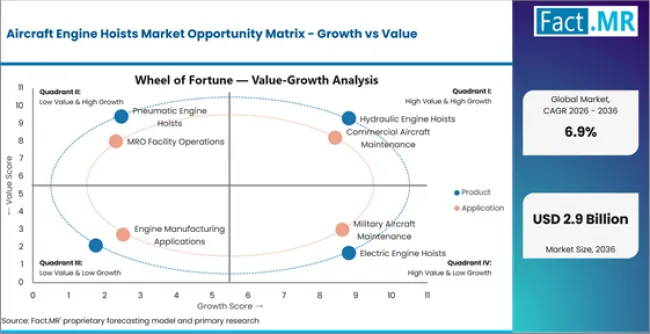
Aircraft Engine Hoists Market Opportunity Matrix Growth Vs Value | Source: Fact.MR
Key Factors Driving Growth
- GTF engine turbine component issues have resulted in over 800 grounded engines globally, spurring accelerated MRO shop visits and pressuring the existing hoist capacity, leading to equipment expansion orders by the end of 2025.
- India’s removal of goods-and-services-tax barriers to MRO operations and 100% FDI allowance for maintenance facilities are encouraging new MRO construction that includes engine hoist infrastructure as standard facility equipment.
Key Market Constraints
- Aerospace-grade ground support equipment (GSE) procurement cycles are lengthy (typically 6-18 months from specification to delivery) and constitute a gap between MRO capacity expansion decisions and equipment installation readiness.
- The certification and compliance requirements for heavy-lift equipment in aviation environments add to the cost and time to qualify equipment, thus limiting the ability of new manufacturers to enter the market quickly.
- Capital expenditure constraints may delay hoist modernization and capacity expansion for smaller MRO operators, particularly during times of compressed airline profitability.
Key Opportunity Areas
- Smart hoist systems with integrated load monitoring, wireless data transmission and predictive maintenance sensors are creating a premium product tier enjoying pricing advantages over conventional hydraulic hoists.
- MRO facility construction in India, Vietnam, Indonesia and Saudi Arabia are creating greenfield procurement opportunities for complete engine handling equipment packages from a single source.
- Engine OEMs are ramping up production programmes, particularly for the LEAP and next generation powerplants and test cell hoist infrastructure is required at engine OEM manufacturing and assembly facilities and not just in the MRO sector.
Segment-wise Analysis of the Aircraft Engine Hoists Market
- Hydraulic engine hoists are expected to have a 77.9% share of the product segment in 2026, with an advantage in load capacity and operational precision for handling commercial aircraft engines ranging from 3,000 to 10,000 kg.
- Commercial aircraft maintenance is projected to hold 32.8% share of the application segment in 2026, owing to the rise in fleet and engine removal rates, and growth in MRO facilities.
- Mobile hoist configurations hold the largest share of the formulation segment with 73.2%. These are preferred due to their ability to move across maintenance bays and adapt to different engine and aircraft platform configurations.
The aircraft engine hoists market is categorized by product type, application, end use, technology, formulation, distribution channel and region. Hydraulic hoists rule, because they can handle the load and have the precision to safely handle commercial aircraft engines.
Which Product Segment Dominates the Aircraft Engine Hoists Market?
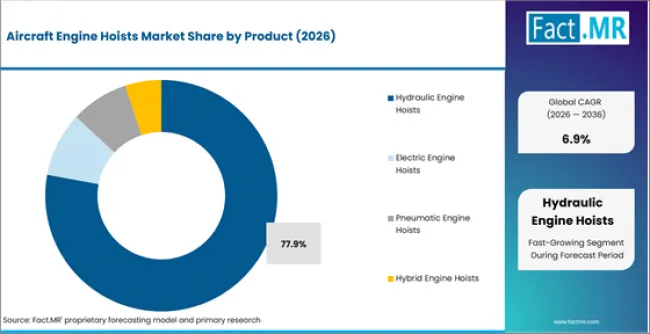
Aircraft Engine Hoists Market Analysis By Product | Source: Fact.MR
In 2026, hydraulic engine hoists will make up 77.9% of the product segment. This dominance is understandable when we consider the heavy load requirements of commercial aircraft engine handling. Engine weights range from 3,000 kg for narrow-body power plants to over 9,000 kg for wide-body engines, and hydraulic systems provide controlled lift, precise positioning, and reliable load holding. Hydraulic hoists provide the required capacity, speed, and operator control to ensure safe removal and installation of engines.
Electric engine hoists are used for lighter general aviation and small turboprop engine applications when the complexity of a hydraulic system is not warranted. Pneumatic hoists satisfy special requirements of clean room and explosive atmosphere conditions in specialized maintenance environments. Commercial aircraft engine weights will continue to define the primary load specification for MRO ground support equipment and hydraulic systems are expected to continue to hold category dominance.
Which Application Segment Dominates the Aircraft Engine Hoists Market?
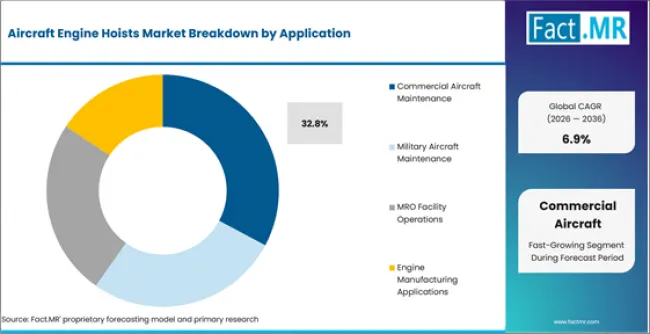
Aircraft Engine Hoists Market Analysis By Application | Source: Fact.MR
Commercial aircraft maintenance will have a dominant share of 32.8% in 2026. The world’s commercial fleet is responsible for the largest share of scheduled and unscheduled engine removals, and that means ongoing demand for hoist equipment at MRO facilities around the world. Existing hoist capacity and engine shop visit rates are being strained by higher than forecast removal frequencies for current generation powerplants, particularly LEAP and GTF engines in their early maintenance cycles.
The second-largest segment is military aircraft maintenance, with defense budgets supporting the modernization of equipment at military overhaul depots. Other demand is from general aviation maintenance, and engine manufacturing and testing. Fleet growth and engine removal rates are still increasing so commercial aircraft maintenance is expected to maintain its leading position.
Which Product Trend is Shaping the Next Phase of Growth in the Aircraft Engine Hoists Market?
The key product trend is smart hoist systems with integrated digital monitoring capabilities. Traditional engine hoists are mechanical lifts with manual load monitoring. Smart hoists integrate load cells, position sensors, wireless data transmission and cloud-connected analytics platforms that record every lift, track structural fatigue buildup and alert maintenance teams to calibration and inspection needs before safety limits are breached.
The commercial impact is two-fold. Smart hoists first reduce operational risk by providing real-time load data that prevents overload conditions and logs compliance with safety regulations. Second, they generate aftermarket service revenue by providing calibration, software updates and data analytics subscriptions that extend the vendor-customer relationship beyond the original equipment sale. This enables large MRO operators with hoist fleets at multiple facilities to have centralized visibility into equipment condition and utilization to support optimized capital expenditure planning for hoist replacement and expansion.
Regional Outlook Across Key Markets
- India leads growth at 7.5%, driven by MRO facility construction including Air India's Bengaluru mega complex, removal of GST barriers, and 100% FDI allowance for maintenance operations.
- China at 7.2% reflects commercial fleet expansion, domestic MRO capacity building, and engine OEM service center investment across multiple provinces.
- The USA at 6.4% is supported by large installed MRO capacity, GE Aerospace's USD 1 billion facility modernization, and defense maintenance equipment procurement.
- Germany at 6.1% and United Kingdom at 5.8% reflect Airbus MRO operations, Rolls-Royce service center presence, and European defense maintenance modernization.
.webp "Top Country Growth Comparison Aircraft Engine Hoists Market Cagr (2026 2036)")
Top Country Growth Comparison Aircraft Engine Hoists Market Cagr (2026 2036) | Source: Fact.MR
| Country | CAGR (%) |
|---|---|
| India | 7.5% |
| China | 7.2% |
| USA | 6.4% |
| Germany | 6.1% |
| United Kingdom | 5.8% |
Source: Fact.MR analysis, based on proprietary forecasting model and primary research.
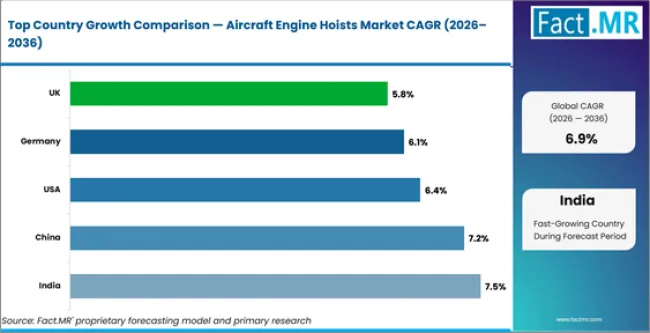
Aircraft Engine Hoists Market Cagr Analysis By Country | Source: Fact.MR
Market Outlook for Aircraft Engine Hoists in the United States
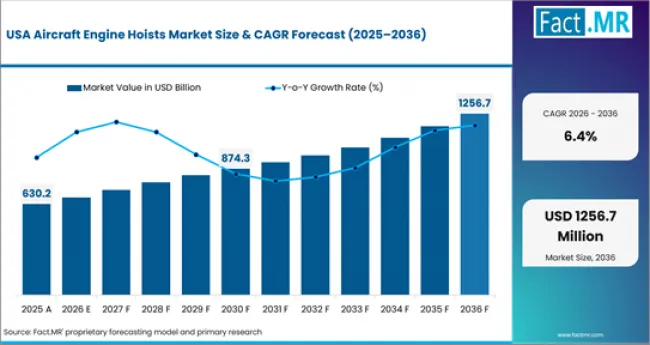
Aircraft Engine Hoists Market Country Value Analysis | Source: Fact.MR
The U.S. aircraft engine hoists market is expected to register a CAGR of 6.4% through 2036. GE Aerospace’s USD 1 billion, five-year MRO facility modernization program is leading to focused equipment purchasing including engine hoist infrastructure for LEAP engine service centers. The military maintenance depot modernization and defense budget allocations support government purchases of heavy-lift engine handling equipment for Air Force, Navy and Army maintenance facilities.
- The modernization program at GE Aerospace’s MRO facility generates multi-year equipment procurement demand for engine hoists rated for LEAP and GE9X powerplant specifications.
- Tinker Air Force Base is one of the many defense maintenance depots that are being modernized to keep the specialized military engine hoist procurement industry for F135, F110 and other military powerplants running.
India Aircraft Engine Hoists Market Growth Assessment
Greenfield engine hoist procurement in India is rising at a 7.5% CAGR through 2036, with 100% FDI allowance and GST barrier removal boosting MRO facility construction. The anchor projects are Air India’s 35-acre MRO complex in Bengaluru planned service centre investment that will drive concentrated equipment demand. The Defence Acquisition Procedure also supports modernization of military MRO facilities including procurement of engine handling equipment.
- Air India’s mega MRO facility LEAP engine service center investment create anchor procurement programs for multiple engine hoist configurations.
- Domestic MRO capacity development provisions under the Defence Acquisition Procedure are driving the procurement of military engine handling equipment.
China Aircraft Engine Hoists Market Demand Trends
Growth in commercial fleet across Chinese carriers and domestic MRO capacity building puts China at 7.2% CAGR through 2036. CFM International and Pratt and Whitney are investing in engine OEM service centers to meet the engine maintenance needs of the Chinese market. Government aviation self-sufficiency programs are promoting the importation of specialist hoist systems along with the manufacture of domestic ground support equipment.
- Engine OEM service center construction drives specification-based demand for hoists rated to LEAP, V2500 and next-generation engine weights and dimensions.
- The Chinese MRO market is growing and the domestic makers of ground support equipment are working on competitive hoist products.
Germany Aircraft Engine Hoists Market Analysis
Germany engine hoist demand is concentrated on account of Lufthansa Technik operations, Rolls-Royce service center presence and Airbus final assembly line support at a 6.1% CAGR through 2036. The EASA certification requirements for ground support equipment lay out safety specs that influence the design and procurement of hoists. The push for Industrie 4.0 integration is leading German MRO facilities to implement smart hoists ahead of other European markets.
- Lufthansa Technik’s MRO operations on multi-engine aircraft require different hoist configurations that are qualified for narrow-body through wide-body powerplant specifications.
- EASA ground support equipment certification standards have set out safety and performance requirements which create quality barriers to entry favouring established hoist manufacturers.
United Kingdom Aircraft Engine Hoists Market Outlook
The United Kingdom engine hoists market is propelled by the Rolls-Royce engine service center operations and military MRO facilities at a CAGR of 5.8% through 2036. Ground support equipment sold in the United Kingdom will need to go through separate certification processes under new post-Brexit regulatory systems. Demand for engine hoist infrastructure comes from investment in commercial MRO facilities focusing on Trent engine maintenance and new narrowbody programs.
- Rolls-Royce Trent engine service operations create a specific demand for wide-body engine hoists with a load capacity exceeding 8,000 kg.
- Post-Brexit equipment certification requirements are also influencing MRO operators’ sourcing decisions for hoist suppliers.
Competitive Benchmarking and Company Positioning
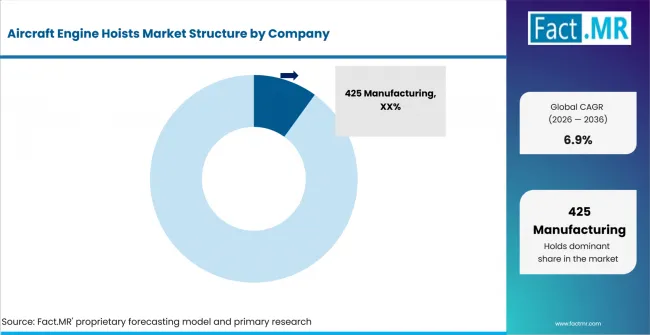
Aircraft Engine Hoists Market Analysis By Company | Source: Fact.MR
Aircraft Engine Hoists Market Analysis By Company
- Tronair / Malabar International, and TLD Group hold established positions in the aircraft engine ground support equipment market through broad aerospace product portfolios, certification compliance, and relationships with major MRO providers and airline maintenance operations.
- 425 Manufacturing, National Aero Stands, and Aviation Tool Pooling compete through specialized hoist and stand product lines, customization capabilities, and focused service to regional MRO operators and defense maintenance facilities.
- Certification compliance and proven safety records create competitive barriers, as MRO operators and airlines prioritize equipment suppliers with established track records in aviation-grade heavy-lift operations.
Aerospace ground support equipment specialists have a moderately consolidated competitive landscape. Tronair / Malabar International and TLD Group compete with broad aerospace GSE portfolios with engine hoists as part of integrated maintenance equipment packages.
Smaller specialists including 425 Manufacturing and National Aero Stands serve niche requirements including custom hoist configurations and legacy aircraft platform support. Competition is shaped by the long qualification cycles and safety certification requirements that characterize aerospace equipment procurement.
Key Companies in the Aircraft Engine Hoists Market
- Tronair / Malabar International, TLD Group, and 425 Manufacturing are among the leading players, supported by aerospace certification compliance, MRO provider relationships, and engine-type-specific hoist configurations.
- Aviation Tool Pooling, National Aero Stands, Dedienne Aerospace, Hydro Group compete across specific equipment categories, regional markets, and defense maintenance programs.
Recent Industry Developments
- GE Aerospace, Facility Modernization, USD 1 Billion MRO Investment (July 2024 / October 2024)
- GE Aerospace said it would invest USD 1 billion over five years in its global MRO and component repair network, with funds going to new tooling, equipment, facility upgrades, and repair technology. A 2024 regional announcement also confirmed more than USD 130 million for European MRO and component repair facilities through 2026.
- CFM International, MRO Network Expansion, LEAP Aftermarket Partnerships (April 2025)
- CFM expanded the LEAP aftermarket network by adding more MRO partners to provide full overhaul and repair services for LEAP-1A and LEAP-1B engines, which supports the growing global engine shop-visit ecosystem and increases demand for engine hoists and related ground-support equipment.
Key Companies in the Aircraft Engine Hoists Market
- 425 Manufacturing.
- Aviation Tool Pooling.
- National Aero Stands.
- Tronair / Malabar International
- TLD Group.
- Dedienne Aerospace.
- Hydro Group
Sources and Research References
[1] Safran. (2024, October 29). Safran invests over €1 billion to develop global MRO network for its LEAP engine. Safran.
[2] Safran. (2025, November 26). Safran steps up expansion in India for civil and military aviation and deepens commitment to “Make in India”. Safran.
[3] GE Aerospace. (2024, July 19). GE Aerospace investing $1 billion to expand and upgrade MRO facilities worldwide. GE Aerospace.
[4] GE Aerospace. (2024, October 23). GE Aerospace investing $130 million to expand and upgrade MRO facilities in Europe. GE Aerospace.
[5] Safran. (2025, April 8). CFM adds MTU Maintenance Dallas as LEAP Premier MRO shop. Safran.
This bibliography is provided for reader reference and is not exhaustive. The full report contains the complete reference list and detailed citations.
Key Questions This Report Addresses
- What is the current and future size of the Aircraft Engine Hoists Market?
- How fast is the Aircraft Engine Hoists Market expected to grow between 2026 and 2036?
- Which product type is likely to lead the market by 2026?
- Which application segment is expected to account for the highest demand by 2026?
- What factors are driving demand for aircraft engine hoists globally?
- How is MRO facility expansion in Asia Pacific influencing equipment procurement?
- Why are India and China the fastest-growing markets?
- How are engine maintenance cycle accelerations affecting hoist demand?
- Which countries are projected to show the fastest growth through 2036?
- Who are the key companies active in the Aircraft Engine Hoists Market?
- How does Fact.MR estimate and validate the market forecast?
Key Questions This Report Addresses
- What is the current and future size of the Aircraft Engine Hoists Market?
- How fast is the Aircraft Engine Hoists Market expected to grow between 2026 and 2036?
- Which product type is likely to lead the market by 2026?
- Which application segment is expected to account for the highest demand by 2026?
- What factors are driving demand for aircraft engine hoists globally?
- How is MRO facility expansion in Asia Pacific influencing equipment procurement?
- Why are India and China the fastest-growing markets?
- How are engine maintenance cycle accelerations affecting hoist demand?
- Which countries are projected to show the fastest growth through 2036?
- Who are the key companies active in the Aircraft Engine Hoists Market?
- How does Fact.MR estimate and validate the market forecast?
Aircraft Engine Hoists Market Definition
The aircraft engine hoists market covers ground support equipment designed for the removal, transport, and installation of aircraft engines during maintenance, repair, and overhaul operations. It includes hydraulic, electric, pneumatic, and manual hoist systems used in commercial aviation, military aviation, general aviation, and engine manufacturing and testing applications.
Aircraft Engine Hoists Market Inclusions
- The scope covers global and regional market size and forecasts for 2026 to 2036 across product type, application, end use, technology, formulation, distribution channel, and region.
- It includes regional demand analysis based on MRO facility capacity, fleet size, engine shop visit rates, and new facility construction timelines.
- The report covers pricing analysis across standard capacity, heavy-lift, and specialized engine hoist configurations.
Aircraft Engine Hoists Market Exclusions
- The scope excludes general-purpose industrial cranes, overhead bridge cranes, and warehouse lifting equipment not specifically designed for aircraft engine handling.
- It excludes aircraft jacks, wing stands, and fuselage support equipment classified as airframe ground support rather than engine handling equipment.
- The report excludes engine transportation containers, shipping fixtures, and logistics equipment used between MRO facilities.
Aircraft Engine Hoists Market Research Methodology
- The methodology combines secondary research, primary interviews, and forecast modelling.
- It draws on 80+ secondary sources and benchmarks 35+ company product portfolios.
- Market sizing covers 40+ countries through a demand-side model, supported by top-down validation.
- Key inputs include MRO facility capacity data, engine shop visit rates, fleet size projections and new facility build timelines.
- The model cross-validates demand against orders data from equipment manufacturers, capital expenditure reports from MRO operators and production ramp schedules from engine OEMs.
- Primary validation includes 20+ interviews with hoist manufacturers, MRO operators, airline maintenance teams & aerospace equipment distributors.
- Final estimates are reviewed against facility capacity, checked against procurement cycles, and put through sensitivity analysis.
Segmentation
Scope of Analysis
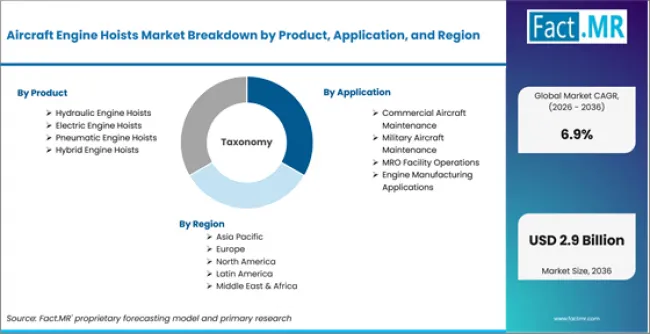
Aircraft Engine Hoists Market Breakdown By Product, Application, And Region | Source: Fact.MR
| Parameter | Details |
|---|---|
| Quantitative Units | USD 1.5 billion to USD 2.9 billion, at a CAGR of 6.9% |
| Market Definition | The Aircraft Engine Hoists Market covers ground support equipment for removal, transport, and installation of aircraft engines during MRO operations across commercial, military, and general aviation applications. |
| Regions Covered | North America, Latin America, Europe, East Asia, South Asia and Pacific, Middle East and Africa |
| Countries Covered | USA, India, China, Germany, United Kingdom, 40 plus countries |
| Key Companies | 425 Manufacturing, Aviation Tool Pooling, National Aero Stands, Tronair / Malabar International, TLD Group, Dedienne Aerospace, Hydro Group |
| Forecast Period | 2026 to 2036 |
| Approach | Hybrid demand-side and top-down methodology built on MRO facility capacity data, engine shop visit rates, fleet size projections, and primary interviews across hoist manufacturers, MRO operators, and aerospace equipment distributors |
Aircraft Engine Hoists Market Segmentation
-
Aircraft Engine Hoists Market Segmented by Product:
- Hydraulic Engine Hoists
- Mobile Hydraulic Hoists
- Towable Hydraulic Hoists
- Self-Propelled Hydraulic Hoists
- Fixed Hydraulic Hoists
- Hangar Mounted Hydraulic Hoists
- Workshop Hydraulic Hoists
- Mobile Hydraulic Hoists
- Electric Engine Hoists
- Battery Powered Hoists
- Lithium Battery Hoists
- Industrial Battery Hoists
- Corded Electric Hoists
- Single Phase Electric Hoists
- Three Phase Electric Hoists
- Battery Powered Hoists
- Pneumatic Engine Hoists
- Compressed Air Hoists
- Portable Pneumatic Hoists
- Heavy Duty Pneumatic Hoists
- Air Balancer Hoists
- Precision Lift Balancers
- Variable Load Balancers
- Compressed Air Hoists
- Hybrid Engine Hoists
- Electro-Hydraulic Hoists
- Smart Control Hoists
- Variable Speed Lift Hoists
- Multi-Power Hoists
- Dual Source Hoists
- Emergency Backup Hoists
- Electro-Hydraulic Hoists
- Hydraulic Engine Hoists
-
Aircraft Engine Hoists Market Segmented by Application:
- Commercial Aircraft Maintenance
- Narrow Body Aircraft Maintenance
- Single Aisle Engine Removal
- Single Aisle Engine Installation
- Wide Body Aircraft Maintenance
- Twin Aisle Engine Replacement
- Heavy Maintenance Operations
- Narrow Body Aircraft Maintenance
- Military Aircraft Maintenance
- Fighter Aircraft Maintenance
- Jet Engine Handling Operations
- Turbofan Engine Replacement
- Transport Aircraft Maintenance
- Cargo Aircraft Engine Servicing
- Strategic Airlift Engine Operations
- Fighter Aircraft Maintenance
- MRO Facility Operations
- Independent MRO Operations
- Third Party Engine Maintenance
- Engine Overhaul Operations
- OEM Service Operations
- Manufacturer Service Centers
- Certified Repair Facilities
- Independent MRO Operations
- Engine Manufacturing Applications
- Engine Assembly Operations
- New Engine Installation
- Production Line Engine Handling
- Engine Testing Operations
- Ground Test Preparation
- Post-Test Engine Handling
- Engine Assembly Operations
- Commercial Aircraft Maintenance
-
Aircraft Engine Hoists Market Segmented by End Use:
- Aircraft MRO Providers
- Independent MRO Companies
- Commercial Aircraft MRO Facilities
- Regional Maintenance Providers
- Integrated MRO Organizations
- Global MRO Networks
- Engine Overhaul Specialists
- Independent MRO Companies
- Airlines
- Full Service Airlines
- International Airline Maintenance Bases
- Domestic Fleet Maintenance Units
- Low Cost Carriers
- Regional Fleet Service Centers
- Cost Optimized Maintenance Facilities
- Full Service Airlines
- Defense Organizations
- Air Force Maintenance Units
- Fighter Aircraft Maintenance Depots
- Transport Aircraft Service Bases
- Naval Aviation Units
- Carrier Based Aircraft Maintenance
- Naval Air Station Service Facilities
- Air Force Maintenance Units
- Engine Manufacturers
- OEM Production Facilities
- Commercial Engine Manufacturing Plants
- Military Engine Production Facilities
- Engine Testing Centers
- Certification Testing Facilities
- Prototype Engine Development Centers
- OEM Production Facilities
- Aircraft MRO Providers
-
Aircraft Engine Hoists Market Segmented by Technology:
- Load Monitoring Technology
- Digital Load Sensing Systems
- Real Time Weight Monitoring
- Overload Detection Systems
- Balance Control Systems
- Center of Gravity Monitoring
- Dynamic Stability Systems
- Digital Load Sensing Systems
- Hydraulic Lift Technology
- High Pressure Hydraulic Systems
- Multi Cylinder Lift Systems
- Precision Hydraulic Controls
- Electro-Hydraulic Systems
- Automated Lift Synchronization
- Programmable Hydraulic Controls
- High Pressure Hydraulic Systems
- Smart Automation Technology
- Remote Operation Systems
- Wireless Hoist Controls
- Remote Diagnostic Platforms
- Predictive Maintenance Systems
- Usage Analytics Platforms
- Condition Monitoring Systems
- Remote Operation Systems
- Safety Management Technology
- Collision Prevention Systems
- Proximity Detection Sensors
- Obstacle Avoidance Controls
- Emergency Protection Systems
- Automatic Shutdown Functions
- Fail Safe Load Retention Systems
- Collision Prevention Systems
- Load Monitoring Technology
-
Aircraft Engine Hoists Market Segmented by Formulation:
- Mobile Hoist Configurations
- Compact Mobility Systems
- Hangar Mobility Platforms
- Workshop Transport Systems
- Heavy Duty Mobility Systems
- High Capacity Transfer Platforms
- Multi-Axle Mobility Systems
- Compact Mobility Systems
- Fixed Hoist Configurations
- Permanent Installation Systems
- Hangar Integrated Hoists
- Maintenance Bay Hoists
- Semi-Permanent Systems
- Modular Fixed Hoists
- Expandable Lift Systems
- Permanent Installation Systems
- Automated Hoist Configurations
- Semi-Automated Systems
- Programmable Lift Operations
- Assisted Positioning Systems
- Fully Automated Systems
- Autonomous Lift Operations
- Automated Engine Alignment Systems
- Semi-Automated Systems
- Specialized Hoist Configurations
- High Capacity Systems
- Wide Body Engine Hoists
- Military Engine Hoists
- Precision Handling Systems
- Test Cell Engine Hoists
- Prototype Engine Handling Systems
- High Capacity Systems
- Mobile Hoist Configurations
-
Aircraft Engine Hoists Market Segmented by Distribution Channel:
- Direct OEM Sales
- Aircraft OEM Contracts
- Commercial Aircraft OEM Agreements
- Military Aircraft OEM Agreements
- Engine OEM Contracts
- Commercial Engine Manufacturer Contracts
- Defense Engine Manufacturer Contracts
- Aircraft OEM Contracts
- Industrial Equipment Distributors
- Regional Distributors
- Aviation Equipment Suppliers
- Industrial Lift Equipment Dealers
- Global Distribution Networks
- International Aviation Suppliers
- Multi-Country Equipment Providers
- Regional Distributors
- System Integrators
- MRO Infrastructure Integrators
- Maintenance Facility Setup Providers
- Hangar Equipment Integrators
- Industrial Engineering Firms
- Facility Modernization Contractors
- Aviation Infrastructure Specialists
- MRO Infrastructure Integrators
- Rental & Leasing Providers
- Short Term Rental Services
- Project Based Equipment Rental
- Maintenance Shutdown Rentals
- Long Term Leasing Services
- Fleet Maintenance Leasing Programs
- Enterprise Equipment Leasing Contracts
- Short Term Rental Services
- Direct OEM Sales
-
Aircraft Engine Hoists Market by Region:
- North America
- USA
- Canada
- Mexico
- Latin America
- Brazil
- Chile
- Rest of Latin America
- Western Europe
- Germany
- United Kingdom
- Italy
- Spain
- France
- Nordic
- BENELUX
- Rest of Western Europe
- Eastern Europe
- Russia
- Poland
- Hungary
- Balkan & Baltic
- Rest of Eastern Europe
- East Asia
- China
- Japan
- South Korea
- South Asia and Pacific
- India
- ASEAN
- Australia & New Zealand
- Rest of South Asia and Pacific
- Middle East & Africa
- Kingdom of Saudi Arabia
- Other GCC Countries
- Turkiye
- South Africa
- Other African Union
- Rest of Middle East & Africa
- North America
Frequently Asked Questions
How big is the aircraft engine hoists market in 2026?
What will be the size of aircraft engine hoists market in 2036?
How much will be the aircraft engine hoists market growth between 2026 and 2036?
What are the key product in the aircraft engine hoists market?
Which application segment is expected to contribute significant share in the aircraft engine hoists market in 2026?
Who worked on this report


Preview the report firsthand - request a free sample
Free SampleGet the brochure for pricing and purchase details
Download PDF