- Market Value (2025): USD 6.4 Bn
- Estimated Value (2026): USD 7.6 Bn
- Forecast Value (2036): USD 41.1 Bn
- CAGR (2026-2036): 18.4%
What is the Agentic Artificial Intelligence in Financial Services Market forecast to be worth by 2036?
The market is projected to grow from USD 7.6 billion in 2026 to USD 41.1 billion by 2036, registering a CAGR of 18.4%.
- The Agentic Artificial Intelligence in Financial Services market reached USD 6.4 billion in 2025.
- Demand is forecast to increase from USD 7.6 billion in 2026 to USD 41.1 billion by 2036.
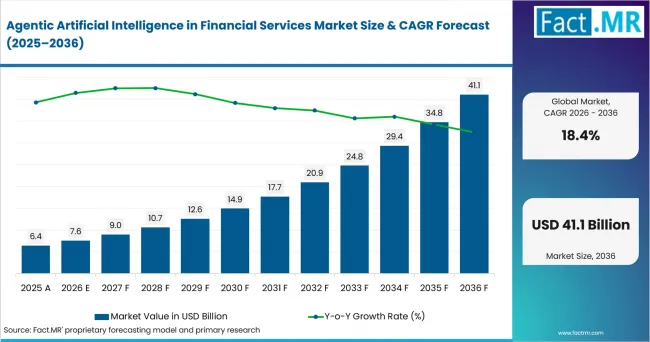
Agentic Artificial Intelligence In Financial Services Market Value Analysis | Source: Fact.MR
What are the defining numbers behind Agentic Artificial Intelligence in Financial Services Market growth?
An absolute dollar opportunity of USD 33.5 billion is expected between 2026 and 2036.
- Demand Drivers in the Market
- Fraud defense creates an urgent and measurable purchase trigger. AI-enabled attacks can increase the speed of identity abuse and transaction fraud, and institutions respond by linking detection models with agents that collect evidence and route cases.
- Regulatory insight is quantifying the capability gap that drives outsourcing. The U.S. Treasury found in March 2024 that historical data and cloud readiness give larger institutions an advantage, while smaller firms lack the data and talent to build comparable systems, expanding demand for managed agents and shared tooling.
- Supervisors across markets are documenting rapid adoption and clarifying expectations. The Bank of England and FCA reported in November 2024 that 75% of respondents used AI while only 2% of use cases were fully autonomous, and MAS issued an information paper on AI model risk in December 2024.
- Institutions are shifting from detection models to agents that can take controlled action. Microsoft introduced its Agent Framework in October 2025 with persistent state, error handling, and observability for regulated processes, supporting multi-agent workflows.
- Application vendors are packaging financial workflows. Oracle announced in February 2026 that its banking agentic platform includes agents for application tracking, credit decision support, and collections compliance, and Salesforce introduced Agentforce for Financial Services in May 2025.
- Technology service firms are industrializing deployment. Accenture invested in Lyzr in October 2025 to bring agentic AI to banking and insurance, and Infosys launched over 200 enterprise AI agents in May 2025, reducing the integration burden for regulated institutions.
- Key Segments Analyzed
- Autonomous Decision Agents anchor the Agent Type segment with a 39.0% share in 2026, as controlled execution creates more measurable value than advice alone.
- Fraud Detection & Prevention leads the Financial Application segment, taking 31.0% of demand in 2026, because it has a direct route from signal to commercial outcome.
- Banking is the dominant End-use Industry at 42.0% in 2026, reflecting the scale of transaction and compliance workloads.
- Large Financial Institutions anchor the Customer Category segment with a 46.0% share in 2026.
- Cloud-based Agents anchor the Deployment Model segment with a 48.0% share in 2026.
- Analyst Opinion at Fact.MR
- Shambhu Nath Jha, Sr. Consultant at Fact.MR, opines: “Financial services is the clearest test of whether agentic AI can earn production trust, because agents here can change financial outcomes. Fraud defense is the entry point: detection models linked to agents that collect evidence and route cases deliver measurable cycle-time and loss-reduction gains. Autonomous Decision Agents already hold 39.0% of the market in 2026. But explainability, data protection, and legacy integration delay approval for agents that can take action, so buyers reward governed multi-agent orchestration that extends proven controls from one workflow into several business lines with clear human escalation.”
- Strategic Implications
- Application vendors should package governed agents for fraud, compliance, credit, and collections workflows, so institutions can extend proven controls from one business line to several.
- Cloud and model providers should make secure execution, identity, and auditability first-class features, because explainability, data protection, and third-party risk gate every production approval.
- Service firms should lead with managed agents and shared tooling for smaller institutions, since the fraud data divide documented by the U.S. Treasury leaves smaller firms dependent on vendors.
- Channel and service investment should follow the fastest-growing country markets, including the USA, UK, and Singapore, while adapting to fragmented regulatory expectations.
- Providers should tie pricing to agent actions and inference volume transparently, because monitoring, security review, and exception handling raise total operating cost as usage grows.
How does the Agentic Artificial Intelligence in Financial Services Market break down by segment?
The market is segmented by Agent Type, Financial Application, End-use Industry, Customer Category, Deployment Model, and Region. Agent Type covers Autonomous Decision Agents, Customer Service Agents, Investment Advisory Agents, and Credit & Lending Agents, with fraud investigation, compliance automation, virtual financial assistance, claims support, portfolio optimization, risk assessment, credit underwriting, and loan approval among the sub-segments. Financial Application spans Fraud Detection & Prevention, Customer Support Automation, Robo-Advisory, and Loan Origination, while End-use Industry covers Banking, Insurance, Investment Management, and Capital Markets. Customer Category includes Large Financial Institutions, Insurance Providers, Asset Management Firms, and Brokerage Firms. Deployment Model covers Cloud-based Agents, Hybrid Deployment, Multi-agent Orchestration, and Model-driven Agents. Regional analysis follows North America, Latin America, Western Europe, Eastern Europe, East Asia, South Asia and Pacific, and Middle East & Africa.
Why do Autonomous Decision Agents lead Agent Type?
Autonomous Decision Agents is projected to account for a 39.0% share in 2026.
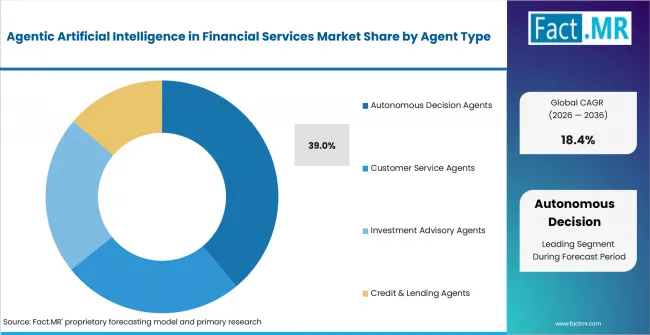
Agentic Artificial Intelligence In Financial Services Market Analysis By Agent Type | Source: Fact.MR
Autonomous Decision Agents sit closest to the economic purpose of agentic AI. They can observe a case, select a next step, and trigger an approved action, a pattern financial institutions value when a delay can increase fraud loss or processing cost. These agents also provide a reusable control structure for specialist agents, letting fraud investigators, compliance teams, and credit officers retain authority over exceptions while routine steps move automatically. Microsoft announced in October 2025 that its Agent Framework supports multi-agent workflows with persistent state, error handling, and observability for regulated processes.
Why does Fraud Detection & Prevention lead Financial Application?
Fraud Detection & Prevention is projected to account for a 31.0% share in 2026.
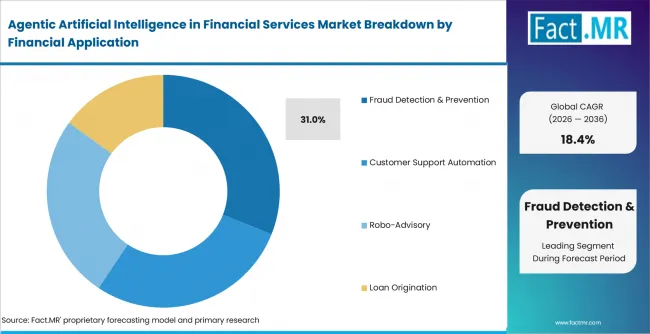
Agentic Artificial Intelligence In Financial Services Market Analysis By Financial Application | Source: Fact.MR
Fraud Detection & Prevention has a direct route from signal to commercial outcome. An agent can monitor transactions, gather context, open or prioritize an investigation, request identity evidence, or recommend a hold within defined authority. The workflow is continuous and data-rich, which makes performance easier to test than a broad advisory use case. Financial institutions also face adversaries that use automation to increase attack speed, so buyers treat agentic fraud systems as part of operational resilience. The U.S. Treasury reported in March 2024 that institutions face a fraud data divide and a widening capability gap between large and small firms, and Oracle announced in February 2026 that its banking agentic platform includes agents for application tracking, credit decision support, and collections compliance.
Why does Banking lead End-use Industry?
Banking is projected to account for a 42.0% share in 2026.
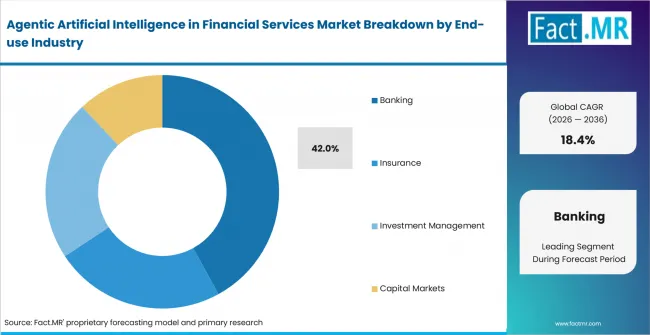
Agentic Artificial Intelligence In Financial Services Market Analysis By End Use Industry | Source: Fact.MR
Banking leads the End-use Industry because it runs the highest-volume transaction, compliance, and customer-service workloads where agents can take controlled action under defined authority. Banks operate under dense regulation, which gives them both the strongest motivation to automate evidence gathering and the clearest control requirements for doing so. Their fraud, credit, and collections operations generate the case volumes that justify agent deployment, and supervisor feedback across the UK, Singapore, Canada, Germany, Australia, and Japan is converging on the governance expectations that banks apply before granting agents authority over financial outcomes.
Why do Large Financial Institutions lead Customer Category?
Large Financial Institutions are projected to account for a 46.0% share in 2026.
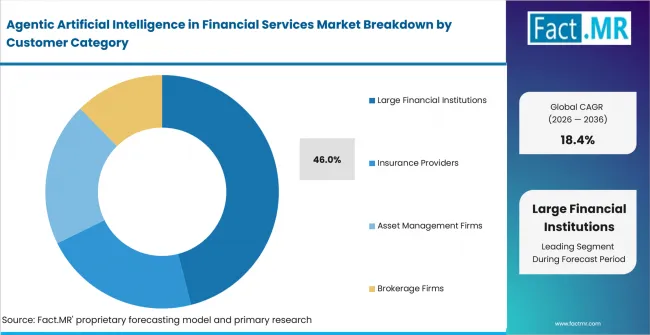
Agentic Artificial Intelligence In Financial Services Market Analysis By Customer Category | Source: Fact.MR
Large Financial Institutions can fund the controls that turn an agent prototype into a production system. They have larger data estates, dedicated security teams, and the capacity to assign model owners and compliance reviewers to each material workflow. This matters because agentic systems touch several applications and third-party services. Large buyers are not automatically faster, as their approval chains can be long, but they can spread integration cost across many business units once a control framework is accepted. OSFI and FCAC reported in September 2024 that 75% of responding Canadian institutions planned AI investment over the next three years and most relied on third parties, illustrating the production-readiness pattern of large institutions.
Why do Cloud-based Agents lead Deployment Model?
Cloud-based Agents are projected to account for a 48.0% share in 2026.
Cloud-based agents let institutions connect models, case-management systems, identity controls, and monitoring services without building all operating infrastructure in-house. Public-cloud deployment can simplify testing and scaling, while private-cloud and hybrid options remain relevant for workloads requiring tighter data control. Buyers still assess data residency, identity, audit trails, and third-party risk before production use.
What is accelerating Agentic Artificial Intelligence in Financial Services Market adoption, and what is holding it back?
Drivers Impact Analysis
| Driver | Relative Impact | Geographic Relevance | Impact Timeline |
|---|---|---|---|
| Need for faster fraud response and lower handling cost in transaction and compliance workflows | High | Global | Near term |
| AI-enabled attack speed and the need for evidence gathering and case routing | High | Global | Near term |
| Supervisory guidance on AI use and model risk | Medium | North America, Europe, Asia Pacific | Mid term |
| Prebuilt financial-agent workflows and managed deployment | Medium | Global | Mid term |
Restraints Impact Analysis
| Restraint | Relative Impact | Geographic Relevance | Impact Timeline |
|---|---|---|---|
| Explainability, data protection, and legacy-system integration | High | Global | Mid term |
| Third-party risk and human-escalation requirements | Medium | North America, Europe | Near term |
| Integration costs that outweigh gains from limited automation | Medium | Global | Mid term |
Which countries are scaling the Agentic Artificial Intelligence in Financial Services Market fastest?
- The USA leads the country comparison. Treasury reporting identifies data availability and cloud readiness as material differences between large and smaller financial institutions.
- UK financial firms have already adopted AI across operational use cases; Bank of England and FCA reporting found 75% of respondents used AI, while only 2% of use cases were fully autonomous.
- Singapore's MAS published an information paper on AI model risk management in December 2024 after reviewing banks' practices.
- Canada's OSFI and FCAC report highlights AI investment and third-party reliance among federally regulated institutions.
- Germany's BaFin has reported increasing AI use across the financial-services value chain.
- ASIC identified potential governance gaps in its review of Australian licensees' AI arrangements.
- The Bank of Japan surveyed 155 institutions on generative AI use and risk management in October 2024.
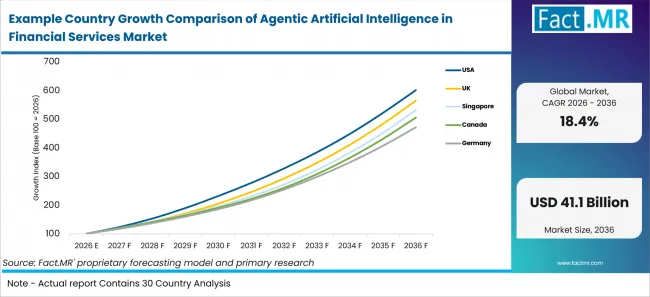
Example Country Growth Comparison Of Agentic Artificial Intelligence In Financial Services Market | Source: Fact.MR
Country-wise CAGR Forecast (2026-2036)
| Country | CAGR |
|---|---|
| USA | 19.7% |
| UK | 18.9% |
| Singapore | 18.2% |
| Canada | 17.6% |
| Germany | 16.8% |
| Australia | 16.1% |
| Japan | 15.5% |
What is driving the Agentic Artificial Intelligence in Financial Services Market in the USA?
USA is projected to register a 19.7% CAGR through 2036.
Large American banks and insurers can fund internal AI platforms, while smaller institutions often rely on vendor solutions. Treasury reporting published in March 2024 identified data availability and cloud readiness as material differences between large and smaller institutions.
What is driving the Agentic Artificial Intelligence in Financial Services Market in the UK?
The UK is projected to register an 18.9% CAGR through 2036.
UK financial firms use AI across operations, fraud, and customer service, but material decisions usually retain human oversight. Bank of England and FCA reporting in November 2024 found 75% of respondents used AI, while only 2% of use cases were fully autonomous.
What is driving the Agentic Artificial Intelligence in Financial Services Market in Singapore?
Singapore is projected to register an 18.2% CAGR through 2036.
Singapore's financial sector operates within a concentrated supervisory environment. MAS issued an information paper on AI model risk management in December 2024 after reviewing banks' AI practices, giving institutions a current reference for model-risk control.
What is driving the Agentic Artificial Intelligence in Financial Services Market in Canada?
Canada is projected to register a 17.6% CAGR through 2036.
Federally regulated institutions are assessing AI for efficiency, customer engagement, and fraud detection. OSFI and FCAC reporting from September 2024 also highlights third-party reliance, keeping governance and supplier controls relevant to implementation.
What is driving the Agentic Artificial Intelligence in Financial Services Market in Germany?
Germany is projected to register a 16.8% CAGR through 2036.
German banks and insurers place weight on resilience and formal control. BaFin's January 2025 digitalisation analysis noted expanding AI use across the financial-services value chain and reinforces the relevance of auditability and operating controls.
What is driving the Agentic Artificial Intelligence in Financial Services Market in Australia?
Australia is projected to register a 16.1% CAGR through 2036.
Australian licensees are using AI in customer service, fraud, and compliance. ASIC's October 2024 review of 23 licensees identified potential governance gaps, making control design and oversight central considerations for agent deployment.
What is driving the Agentic Artificial Intelligence in Financial Services Market in Japan?
Japan is projected to register a 15.5% CAGR through 2036.
Japanese financial institutions tend to place strong weight on human judgment and risk controls when assessing new decision tools. The Bank of Japan's October 2024 survey covered 155 institutions' generative-AI use and risk management practices.
Who leads the Agentic Artificial Intelligence in Financial Services Market?
Competition varies by supplier role. Microsoft Corporation, Google LLC, and Amazon Web Services, Inc. compete through cloud infrastructure, models, and agent-development tools.
NVIDIA Corporation contributes accelerated-computing and AI tooling. IBM Corporation, Oracle Corporation, and Salesforce, Inc. connect governance and workflow functions with enterprise systems. Accenture plc, Cognizant Technology Solutions Corporation, Infosys Limited, and Wipro Limited provide transformation and managed-deployment services. Buyers assess control ownership, workflow depth, and production support across jurisdictions.
Which companies are the key providers?
Key companies profiled in the Agentic Artificial Intelligence in Financial Services market include Microsoft Corporation, Google LLC, Amazon Web Services, Inc., NVIDIA Corporation, IBM Corporation, Oracle Corporation, Salesforce, Inc., Accenture plc, Cognizant Technology Solutions Corporation, Infosys Limited, and Wipro Limited.
- Microsoft Corporation
- Google LLC
- Amazon Web Services, Inc.
- NVIDIA Corporation
- IBM Corporation
- Oracle Corporation
- Salesforce, Inc.
- Accenture plc
- Cognizant Technology Solutions Corporation
- Infosys Limited
- Wipro Limited
Bibliography
- U.S. Department of the Treasury. (2024, March 27). U.S. Department of the Treasury Releases Report on Managing Artificial Intelligence-Specific Cybersecurity Risks in the Financial Sector.
- Bank of England and Financial Conduct Authority. (2024, November 21). Artificial Intelligence in UK Financial Services - 2024.
- Monetary Authority of Singapore. (2024, December 5). Artificial Intelligence Model Risk Management.
- Office of the Superintendent of Financial Institutions and Financial Consumer Agency of Canada. (2024, September 24). OSFI-FCAC Risk Report - AI Uses and Risks at Federally Regulated Financial Institutions.
- Federal Financial Supervisory Authority (BaFin). (2025, January 28). Risks in Focus 2025 - Digitalisation.
- Australian Securities and Investments Commission. (2024, October 29). REP 798 Beware the Gap: Governance Arrangements in the Face of AI Innovation.
- Bank of Japan. (2024, October 29). Use and Risk Management of Generative AI by Japanese Financial Institutions.
- Salesforce. (2025, May 21). Salesforce Introduces Agentforce for Financial Services to Address Shrinking Workforces and Rising Client Expectations.
- Oracle. (2026, February 3). Oracle Reimagines Banking for the AI Era with New Agentic Platform.
- Accenture. (2025, October 29). Accenture Invests in Lyzr to Bring Agentic AI to Banking and Insurance Companies.
- Infosys. (2025, May 29). Infosys Launches Over 200 Enterprise AI Agents, Part of Infosys Topaz AI Offerings and Google Cloud.
- Microsoft. (2025, October 1). Introducing Microsoft Agent Framework.
- Amazon Web Services. (2025, November 30). Amazon Connect Supports Multiple Knowledge Bases and Integrates with Amazon Bedrock Knowledge Bases.
- IBM. (2025, June 18). IBM Introduces Software to Unify Agentic Governance and Security.
- Wipro. (2025, March 19). Wipro Brings Sovereign AI Services with NVIDIA AI to Governments and Enterprises Around the World.
This Report Answers
- The report examines the Agentic Artificial Intelligence in Financial Services Market by Agent Type, Financial Application, End-use Industry, Customer Category, Deployment Model, and Region.
- Autonomous Decision Agents lead Agent Type with a 39.0% share in 2026.
- The country outlook compares the USA, UK, Singapore, Canada, Germany, Australia, and Japan.
- The competitive section profiles Microsoft Corporation, Google LLC, Amazon Web Services, Inc., NVIDIA Corporation, IBM Corporation, Oracle Corporation, Salesforce, Inc., Accenture plc, Cognizant Technology Solutions Corporation, Infosys Limited, and Wipro Limited.
- The analysis presents market value and share across the defined segments.
What does the Agentic Artificial Intelligence in Financial Services Market cover?
The market covers software frameworks, platforms, and services used to build, deploy, govern, and operate AI agents for financial-services workflows.
Coverage is organized by Agent Type, Financial Application, End-use Industry, Customer Category, Deployment Model, and Region for the 2026-2036 forecast period. It includes autonomous decision, customer-service, investment-advisory, and credit and lending agents, along with applications in fraud detection, customer support, robo-advisory, loan origination, and related financial workflows.
The market excludes standalone general-purpose software, commodity components, and services without a primary role in financial-services agent development, deployment, governance, or operations.
What is included in the scope?
Software, platforms, and services used to build, deploy, govern, and operate AI agents for financial-services workflows.
Included offerings support decisioning, fraud investigation, compliance automation, customer assistance, credit and lending, model and tool integration, governance, monitoring, and multi-agent coordination across the defined customer, deployment, and regional categories.
What is excluded from the scope?
General-purpose software, hardware, and services not sold or configured for financial-services agent workflows.
Adjacent software categories, commodity components, and general technology services remain outside the scope unless their principal commercial function supports financial-services agent development, deployment, governance, or operations.
How was the analysis built?
The analysis considers public company documentation, regulatory material, technical publications, and market activity relevant to financial-services AI agents.
- Primary Research:
- Market feedback from technology suppliers, system integrators, procurement specialists, and financial-services users informs the assessment.
- Desk Research:
- Relevant product launches, partnerships, technical documentation, and corporate disclosures are considered.
- Data Validation and Update Cycle:
- The assessment reviews adoption patterns, deployment models, end-use demand, technology substitution, and regional conditions.
- Market-Sizing and Forecasting:
- Company disclosures, product documentation, standards, regulatory material, and industry publications inform the assessment.
What is the report’s scope and coverage?
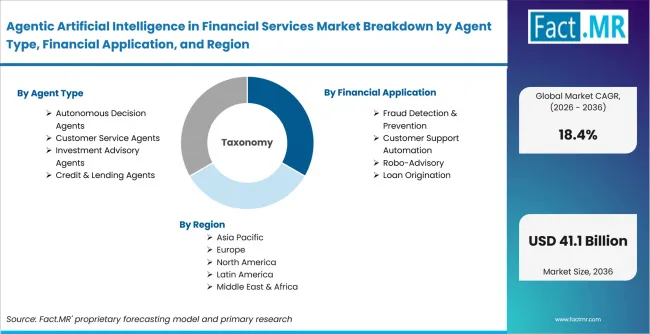
Agentic Artificial Intelligence In Financial Services Market Breakdown By Agent Type, Financial Application, And Region | Source: Fact.MR
| Attribute | Details |
|---|---|
| Forecast Period | 2026-2036 |
| Base Year | 2025 |
| Market Value, 2026 | USD 7.6 billion |
| Market Value, 2036 | USD 41.1 billion |
| CAGR, 2026-2036 | 18.4% |
| Absolute Dollar Opportunity | USD 33.5 billion |
| Key Regions Covered | USA, UK, Singapore, Canada, Germany, Australia, Japan, and more than twenty-five additional countries in the full report |
How is the market segmented?
-
Agent Type
- Autonomous Decision Agents
- Fraud Investigation Agents
- Compliance Automation Agents
- Customer Service Agents
- Virtual Financial Assistants
- Claims Assistance Agents
- Investment Advisory Agents
- Portfolio Optimization Agents
- Risk Assessment Agents
- Credit & Lending Agents
- Credit Underwriting Agents
- Loan Approval Agents
- Autonomous Decision Agents
-
Financial Application
- Fraud Detection & Prevention
- Transaction Monitoring
- Identity Verification
- Customer Support Automation
- Policy Servicing
- Claims Processing
- Robo-Advisory
- Portfolio Construction
- Risk Analytics
- Loan Origination
- Credit Risk Evaluation
- Collections Management
- Fraud Detection & Prevention
-
End-use Industry
- Banking
- Retail Banking
- Corporate Banking
- Insurance
- Life Insurance
- Property & Casualty Insurance
- Investment Management
- Wealth Management
- Hedge Funds
- Capital Markets
- Stock Exchanges
- Investment Banks
- Banking
-
Customer Category
- Large Financial Institutions
- Global Banks
- Regional Banks
- Insurance Providers
- InsurTech Companies
- Reinsurance Firms
- Asset Management Firms
- Wealth Management Firms
- Family Offices
- Brokerage Firms
- Securities Firms
- FinTech Companies
- Large Financial Institutions
-
Deployment Model
- Cloud-based Agents
- Public Cloud
- Private Cloud
- Hybrid Deployment
- On-premises Integration
- Edge-enabled Deployment
- Multi-agent Orchestration
- Agent Coordination Layer
- Agent Memory Framework
- Model-driven Agents
- Context-aware Reasoning
- Autonomous Decision Engine
- Cloud-based Agents
-
Region
- North America
- Latin America
- Western Europe
- Eastern Europe
- East Asia
- South Asia and Pacific
- Middle East & Africa