- Market Value (2025): USD 5.8 Bn
- Estimated Value (2026): USD 6.9 Bn
- Forecast Value (2036): USD 39.6 Bn
- CAGR (2026-2036): 19.1%
What is the Agentic Artificial Intelligence in Tool Use and API Integration Market forecast to be worth by 2036?
The market is projected to reach USD 39.6 billion by 2036.
- The Agentic Artificial Intelligence in Tool Use and API Integration market reached USD 5.8 billion in 2025.
- Demand is forecast to increase from USD 6.9 billion in 2026 to USD 39.6 billion by 2036.
- The market is projected to expand at a CAGR of 19.1% from 2026 to 2036.
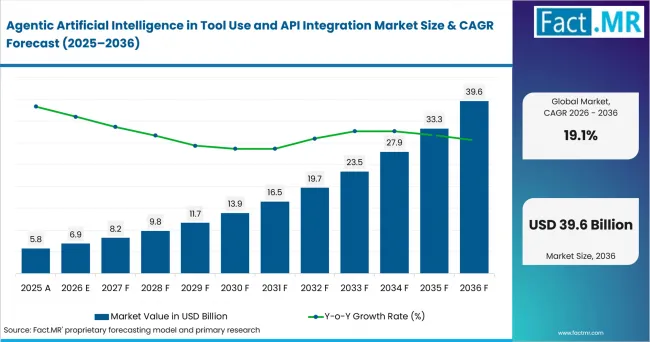
Agentic Artificial Intelligence In Tool Use And Api Integration Market Value Analysis | Source: Fact.MR
What are the defining numbers behind Agentic Artificial Intelligence in Tool Use and API Integration Market growth?
An absolute dollar opportunity of USD 32.7 billion is expected between 2026 and 2036.
- Demand Drivers in the Market
- The driver is the conversion of existing software interfaces into reusable agent tools. Integration teams no longer need to couple every workflow to one model or one application, so a shared tool layer can support many agents at once.
- Open protocols are standardizing how agents connect to tools. Anthropic introduced the Model Context Protocol (MCP) in November 2024 to standardize secure connections between AI applications and tools, and Google Cloud moved the Agent2Agent protocol to the Linux Foundation in June 2025.
- This design changes the unit of purchase. Buyers can fund a shared integration layer once and reuse it across workflows, rather than paying per workflow for bespoke connector development.
- Hyperscale cloud providers are shipping managed agent runtimes. AWS introduced Amazon Bedrock AgentCore in July 2025 with a Gateway that converts existing APIs into MCP-compatible tools, and Microsoft announced Copilot Tuning and multi-agent orchestration at Build 2025.
- Enterprise platforms are embedding agents next to business data. Salesforce announced Agentforce 2dx in March 2025, and ServiceNow’s Yokohama release added AI Agent Orchestrator and AI Agent Studio with lifecycle governance.
- Security and governance frameworks are clarifying safe tool access. OWASP’s GenAI Security Project flagged excessive agency as a top LLM risk, and OMB M-25-21 plus national guidance are establishing how agents may invoke tools in regulated environments.
- Key Segments Analyzed
- API Orchestration Agents anchor the Agent Capability segment with a 38.0% share in 2026, because they translate user goals into approved, sequenced calls that many agents can reuse.
- Enterprise Workflow Automation leads the Integration Use Case segment, taking 36.0% of demand in 2026, as it produces a direct operating outcome with a measurable cycle-time target.
- Information Technology is the dominant End-use Industry at 45.0% in 2026, because IT teams own the APIs, identity systems, and incident processes agents depend on.
- Large Enterprises lead the Organization Type segment with a 44.0% share in 2026, as they have enough fragmented applications to justify a shared agent integration layer.
- Cloud-native Integration leads the Integration Framework segment at 47.0% in 2026, since it offers the fastest route to managed observability and scalable tool execution.
- Analyst Opinion at Fact.MR
- Shambhu Nath Jha, Principal Consultant at Fact.MR, states: “The agentic AI market is being redefined by the layer that connects models to tools, because a model without a governed execution path has limited commercial value. API Orchestration Agents already hold 38.0% of the market in 2026, and open protocols such as MCP and A2A are turning the integration layer into shared infrastructure that many agents can reuse. But unbounded tool permissions increase security and operational risk, so buyers reward governed control planes that connect cloud agents with protected internal systems, preserve user-level permissions, and provide monitoring and approval controls. Vendors that balance breadth with operating fit will capture the largest share of spend.”
- Strategic Implications
- Hyperscale cloud providers should make managed runtimes with identity, monitoring, and approval controls the default, since the strongest offers reduce the gap between prototype and governed production workflow.
- Enterprise application vendors should embed agents near business data and transaction logic, with tool discovery and authentication as first-class capabilities.
- Integration specialists should connect cloud agents with protected internal systems, because buyers need cross-system control layers that preserve user-level permissions.
- Vendors should support open protocols such as MCP and A2A, since interoperability increases the value of the orchestration layer across vendor environments.
- Channel and service investment should follow the fastest-growing country markets, including the USA, Singapore, and the UK, while adapting to local assurance and governance expectations.
How does the Agentic Artificial Intelligence in Tool Use and API Integration Market break down by segment?
The market is structured across five analytical dimensions plus region. API Orchestration Agents leads the Agent Capability segment. Enterprise Workflow Automation leads the Integration Use Case segment. Information Technology leads the End-use Industry segment. Large Enterprises leads the Organization Type segment. Cloud-native Integration leads the Integration Framework segment. Regionally, USA, Singapore, UK, Germany, Canada, Japan, Australia anchor the demand base.
Why do API Orchestration Agents lead Agent Capability?
API Orchestration Agents is projected to account for a 38.0% share in 2026.
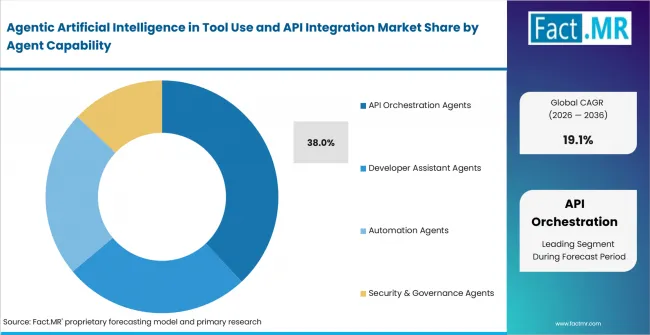
Agentic Artificial Intelligence In Tool Use And Api Integration Market Analysis By Agent Capability | Source: Fact.MR
API Orchestration Agents sit between model reasoning and production systems. They translate a user goal into approved calls, sequence those calls, and pass results back into the plan, giving them broader reuse than a code-only assistant or a single workflow bot. The same orchestration layer can expose REST services and GraphQL endpoints and support event triggers and audit controls, so buyers treat orchestration as shared infrastructure. Open agent interoperability increases the value of this layer because agents need consistent methods to discover and invoke capabilities across vendor environments. Google Cloud announced in June 2025 that the Agent2Agent protocol would move to a Linux Foundation project with support from major cloud and enterprise software companies.
Why does Enterprise Workflow Automation lead Integration Use Case?
Enterprise Workflow Automation is projected to account for a 36.0% share in 2026.
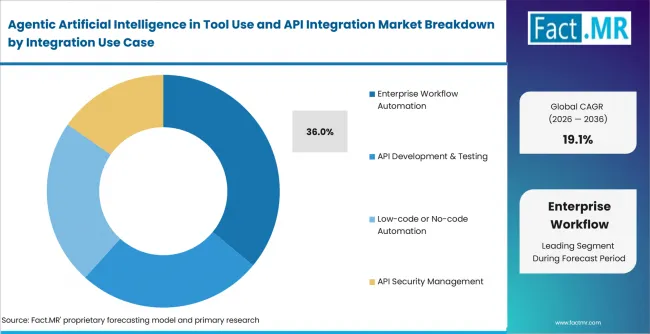
Agentic Artificial Intelligence In Tool Use And Api Integration Market Analysis By Integration Use Case | Source: Fact.MR
Enterprise Workflow Automation produces a direct operating outcome. It can update records and route work across several applications and respond to events without waiting for a user request, which makes the use case easier to fund than a general assistant with unclear ownership. Process leaders can define a cycle-time target or a reduction in manual handoffs, and integration teams can constrain the agent to approved actions. Cross-platform workflows create repeat demand because each new process reuses connectors and policy controls. Salesforce announced Agentforce 2dx in March 2025 with agents that can respond to data changes and operate in the background of business processes.
Why does Information Technology lead End-use Industry?
Information Technology is projected to account for a 45.0% share in 2026.
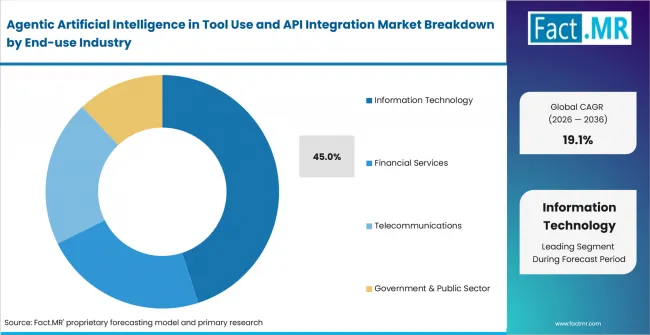
Agentic Artificial Intelligence In Tool Use And Api Integration Market Analysis By End Use Industry | Source: Fact.MR
Information technology teams own the APIs and identity systems that agents must use and manage the incidents that arise when a tool call fails or a permission changes, placing IT at the start of enterprise agent deployment. Cloud service providers and software developers have an additional incentive, because agent-ready interfaces can increase consumption of their platforms and improve developer retention. Financial services and government buyers support high-value projects but often require longer validation and security review, while telecommunications and manufacturing need stronger connections to operational systems. IT therefore leads because it supplies both the platform and the internal control function for adoption elsewhere.
Why do Large Enterprises lead Organization Type?
Large Enterprises is projected to account for a 44.0% share in 2026.
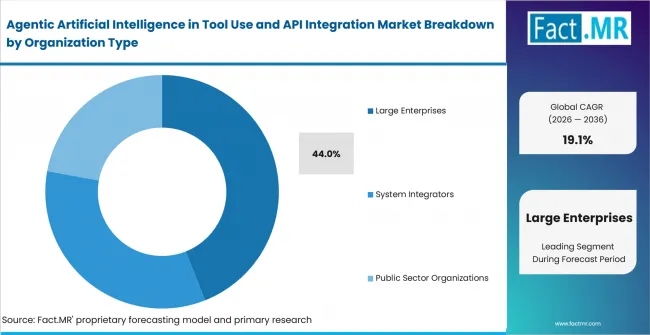
Agentic Artificial Intelligence In Tool Use And Api Integration Market Analysis By Organization Type | Source: Fact.MR
Large enterprises have enough fragmented applications to justify a shared agent integration layer, and they have integration centers and security teams that can operate it. Their buying case extends beyond labor savings to reducing brittle point-to-point connections and governing agent access across business units. Global enterprises need policy consistency across regions, banks and healthcare providers need detailed approval paths, and independent software vendors need reusable agent capabilities inside products. Smaller organizations can gain value from packaged agents but often lack the staff to manage identity design and continuous testing. ServiceNow reported in March 2025 that AI Agent Orchestrator and AI Agent Studio were generally available with lifecycle governance capabilities.
Why does Cloud-native Integration lead Integration Framework?
Cloud-native Integration is projected to account for a 47.0% share in 2026.
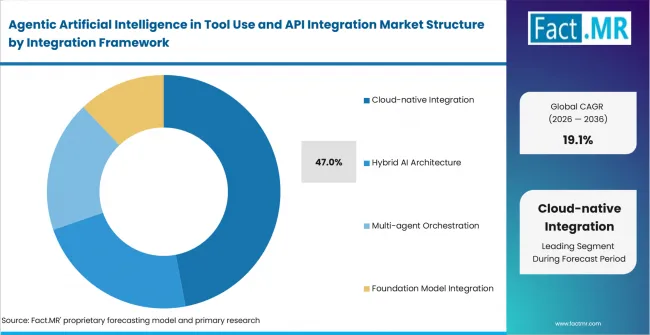
Agentic Artificial Intelligence In Tool Use And Api Integration Market Analysis By Integration Framework | Source: Fact.MR
Cloud-native integration gives agents immediate access to managed runtimes and identity services and supports the event streams and API gateways that are already part of modern application stacks. Buyers can start with a narrow workflow and add tools without provisioning a separate control plane, reducing the time between prototype and production. Private cloud and hybrid architectures remain important for sensitive systems, and edge-enabled integration is useful where latency or local control matters. Cloud-native deployment leads because it offers the fastest route to managed observability and scalable tool execution and fits consumption-based pricing for early projects. AWS introduced Amazon Bedrock AgentCore in preview in July 2025 with a Gateway that converts existing APIs and services into MCP-compatible tools.
What is accelerating Agentic Artificial Intelligence in Tool Use and API Integration Market adoption, and what is holding it back?
Drivers Impact Analysis
| Driver | % Impact on CAGR | Geographic Relevance | Impact Timeline |
|---|---|---|---|
| Conversion of existing software interfaces into reusable agent tools shared across workflows | +0.8% | Global | Near term |
| Open protocols (MCP, A2A) standardizing secure connections between agents and tools | +0.7% | Global | Near term |
| Managed cloud runtimes converting APIs into agent-ready tools at scale | +0.6% | North America, Europe | Mid term |
| Enterprise platforms embedding agents near business data and transaction logic | +0.5% | Global | Long term |
Source: Fact.MR analysis. Updated Aug 10, 2026
Restraints Impact Analysis
| Restraint | % Impact on CAGR | Geographic Relevance | Impact Timeline |
|---|---|---|---|
| Unbounded tool permissions increasing security and operational risk | -0.6% | Global | Near term |
| Identity design and continuous testing burden where integration teams are limited | -0.4% | Global | Mid term |
| Governed platforms requiring extensive custom work for every new action | -0.3% | North America, Europe | Long term |
Source: Fact.MR analysis. Updated Aug 10, 2026
Which countries are scaling the Agentic Artificial Intelligence in Tool Use and API Integration Market fastest?
- The United States leads the pace of expansion as buyers begin with cloud and software-platform integration, supported by OMB M-25-21 which accelerates federal AI use through innovation, governance, and public trust.
- Singapore is scaling rapidly through a compact market where government guidance and regional headquarters shape enterprise practice quickly, with IMDA updating its Model AI Governance Framework for Agentic AI in May 2026.
- The United Kingdom is advancing as public and private buyers involve security and commercial teams early when an agent will use external APIs, guided by the Government Digital Service AI Playbook published in February 2025.
- Germany is growing as enterprises test whether an agent architecture can preserve data control and allow component substitution, supported by BSI and ANSSI zero-trust design principles for LLM systems published in August 2025.
- Canada is expanding as buyers balance cloud adoption with public-sector duties and bilingual service delivery, underpinned by the Government of Canada AI Strategy for the Federal Public Service 2025-2027 published in February 2026.
- Japan is adopting through controlled deployment and dependable integration with long-lived enterprise systems, with METI and MIC issuing AI Guidelines for Business Ver 1.2 in March 2026.
- Australia is building demand as agencies and regulated enterprises evaluate agent projects through formal use-case ownership and lifecycle controls, supported by the Digital Transformation Agency’s agentic AI addendum issued in June 2026.
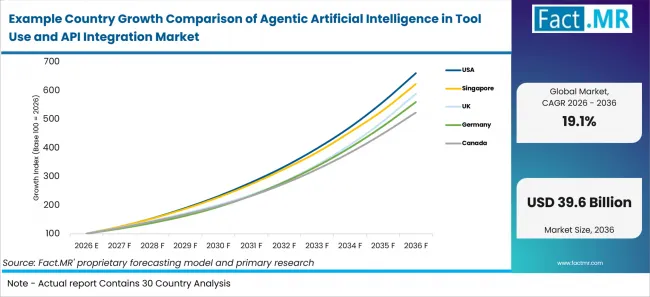
Example Country Growth Comparison Of Agentic Artificial Intelligence In Tool Use And Api Integration Market | Source: Fact.MR
Country-wise CAGR Forecast (2026-2036)
| Country | CAGR |
|---|---|
| USA | 20.8% |
| Singapore | 20.1% |
| UK | 19.4% |
| Germany | 18.8% |
| Canada | 18.0% |
| Japan | 17.3% |
| Australia | 16.7% |
Source: Fact.MR analysis. Updated Aug 10, 2026
What is driving the Agentic Artificial Intelligence in Tool Use and API Integration Market in the USA?
USA is projected to register a 20.8% CAGR through 2036, supported by cloud-platform integration and federal AI guidance.
U.S. buyers tend to begin with cloud and software-platform integration, and the federal government is accelerating adoption through OMB M-25-21, issued in April 2025, which promotes AI use through innovation, governance, and public trust. The depth of the U.S. cloud and developer ecosystem gives enterprises a large base of agent-ready tools and connectors.
What is driving the Agentic Artificial Intelligence in Tool Use and API Integration Market in Singapore?
Singapore is projected to register a 20.1% CAGR through 2036, supported by government guidance and regional-hub adoption.
Singaporean buyers operate in a compact market where government guidance and regional headquarters can shape enterprise practice quickly. IMDA updated its Model AI Governance Framework for Agentic AI in May 2026 with case studies on risk boundaries and human accountability, giving enterprises a governance reference for API and tool integration.
What is driving the Agentic Artificial Intelligence in Tool Use and API Integration Market in the UK?
The UK is projected to register a 19.4% CAGR through 2036, supported by early security review and API control guidance.
British public and private buyers involve security and commercial teams early when an agent will use external APIs. The Government Digital Service published the AI Playbook in February 2025 with guidance on API controls and human review for destructive actions, providing a clear reference for governed tool integration.
What is driving the Agentic Artificial Intelligence in Tool Use and API Integration Market in Germany?
Germany is projected to register an 18.8% CAGR through 2036, supported by data control, sovereignty, and zero-trust design.
German enterprises often test whether an agent architecture can preserve data control and allow component substitution. BSI and ANSSI published zero-trust design principles for LLM systems in August 2025 to guide secure development and deployment, shaping how German buyers approve agent tool access.
What is driving the Agentic Artificial Intelligence in Tool Use and API Integration Market in Canada?
Canada is projected to register an 18.0% CAGR through 2036, supported by public-sector modernization and responsible-adoption guidance.
Canadian buyers balance cloud adoption with public-sector duties and bilingual service delivery. The Government of Canada published its AI Strategy for the Federal Public Service 2025-2027 in February 2026 to support responsible adoption, giving federal agencies a framework for deploying agent integration.
What is driving the Agentic Artificial Intelligence in Tool Use and API Integration Market in Japan?
Japan is projected to register a 17.3% CAGR through 2036, supported by controlled deployment and dependable integration with legacy systems.
Japanese buyers favor controlled deployment and dependable integration with long-lived enterprise systems. METI and MIC issued AI Guidelines for Business Ver 1.2 in March 2026 and clarified responsibilities across AI providers and business users, giving Japanese organizations a structured path for agent tool integration.
What is driving the Agentic Artificial Intelligence in Tool Use and API Integration Market in Australia?
Australia is projected to register a 16.7% CAGR through 2036, supported by formal use-case ownership and lifecycle controls.
Australian agencies and regulated enterprises increasingly evaluate agent projects through formal use-case ownership and lifecycle controls. The Digital Transformation Agency published an agentic AI addendum in June 2026 for secure and governed implementation, establishing the governance framework for API and tool integration in the public sector.
Who leads the Agentic Artificial Intelligence in Tool Use and API Integration Market?
Competition is organized around control of the agent execution path. Hyperscale cloud providers combine agent runtimes with identity services and developer tools. Enterprise application platforms embed agents near business data and transaction logic. Integration specialists connect those platforms with older systems and third-party APIs. The strongest offers reduce the gap between a prototype and a governed production workflow, providing tool discovery, authentication, monitoring, and approval controls.
Microsoft Corporation, Google LLC, and Amazon Web Services, Inc. compete through cloud runtimes and developer ecosystems that expose tools to agents. Oracle Corporation, Salesforce, Inc., ServiceNow, Inc., and SAP SE compete by embedding agents into enterprise application and workflow contexts. IBM Corporation, MuleSoft, LLC, Boomi, LP, and Workato, Inc. add integration, API, and cross-system control layers.
Which companies are the key providers?
Key companies profiled in the Agentic Artificial Intelligence in Tool Use and API Integration market include Microsoft Corporation, Google LLC, Amazon Web Services, Inc., Oracle Corporation, Salesforce, Inc., ServiceNow, Inc., SAP SE, IBM Corporation, MuleSoft, LLC, Boomi, LP, and Workato, Inc.
- Microsoft Corporation
- Google LLC
- Amazon Web Services, Inc.
- Oracle Corporation
- Salesforce, Inc.
- ServiceNow, Inc.
- SAP SE
- IBM Corporation
- MuleSoft, LLC
- Boomi, LP
- Workato, Inc.
Bibliography
- Office of Management and Budget. (2025, April 3). M-25-21: Accelerating Federal Use of Artificial Intelligence through Innovation, Governance, and Public Trust.
- Infocomm Media Development Authority. (2026, May 20). Updated Model AI Governance Framework for Agentic AI.
- Government Digital Service. (2025, February 10). AI Playbook for the UK Government.
- BSI and ANSSI. (2025, August 11). Design Principles for LLM-based Systems with Zero Trust.
- Government of Canada. (2026, February 25). AI Strategy for the Federal Public Service 2025-2027: Overview.
- METI and MIC. (2026, March 31). AI Guidelines for Business Ver1.2.
- Digital Transformation Agency. (2026, June 4). Agentic AI Addendum to the AI Technical Standard for Australian Government.
- Anthropic. (2024, November 25). Introducing the Model Context Protocol.
- OWASP GenAI Security Project. (2025). LLM06:2025 Excessive Agency.
- Google Developers Blog. (2025, June 23). Google Cloud Donates A2A to Linux Foundation.
- Microsoft. (2025, May 19). Introducing Microsoft 365 Copilot Tuning, Multi-Agent Orchestration, and More from Microsoft Build 2025.
- Amazon Web Services. (2025, July 16). Amazon Bedrock AgentCore Now Available in Preview.
- ServiceNow. (2025, March 12). ServiceNow Yokohama Release Adds AI Agent Orchestrator and AI Agent Studio.
- Salesforce. (2025, March 5). A Deeply Unified Platform for Apps, Data, and AI Agents.
- IBM. (2025, May 6). IBM Accelerates Enterprise Gen AI Revolution with Hybrid Capabilities.
This Report Answers
- The report provides strategic intelligence on the Agentic Artificial Intelligence in Tool Use and API Integration Market across the segment categories that drive industrial and enterprise purchasing behavior.
- Segment analysis identifies API Orchestration Agents as the leading sub-segment within the Agent Capability segment, with a 38.0% share in 2026.
- Regional outlook evaluates USA, Singapore and UK while Germany, Canada complete the country growth comparison.
- Competitive analysis profiles Microsoft Corporation, Google LLC and Amazon Web Services, Inc. alongside Oracle Corporation and Salesforce, Inc., followed by additional active providers within the category.
- Category assessment covers demand across primary segment groupings within the market, evaluated by value (USD) and share.
- Use-case assessment covers key application areas and end-use sectors identified in the market analysis.
What does the Agentic Artificial Intelligence in Tool Use and API Integration Market cover?
The Agentic Artificial Intelligence in Tool Use and API Integration Market covers the systems, services, and software categories defined by Agent Capability, Integration Use Case, End-use Industry and related market attributes.
The Agentic Artificial Intelligence in Tool Use and API Integration Market covers the full range of products and services segmented by Agent Capability, Integration Use Case, End-use Industry, Organization Type, and Integration Framework within the 2026-2036 forecast horizon. Coverage includes API Orchestration Agents, the largest sub-segment within the Agent Capability segment, and extends across all primary categories identified in the report.
The market differs from adjacent consumer or industrial categories because commercial value comes from the function and performance requirements captured within the supplied segmentation framework. Commodity components and general-purpose categories remain outside the boundary unless they are explicitly formulated or configured for the defined market application.
What is included in the scope?
Agentic Artificial Intelligence in Tool Use and API Integration Market products and services deployed across the major segment categories and geographies profiled in the report.
The scope includes all product categories segmented by Agent Capability, Integration Use Case, End-use Industry, Organization Type, and Integration Framework covered through secondary research, supplier validation, and demand modeling. API Orchestration Agents, the leading sub-segment within the Agent Capability segment, is included with full value and share analysis alongside the complete set of profiled countries, companies, and end-use applications identified in the report.
What is excluded from the scope?
Commodity inputs, general-purpose goods, and unrelated service lines are outside the scope.
The scope excludes products and services that are not specifically designed, configured, or deployed for the Agentic Artificial Intelligence in Tool Use and API Integration Market. General-purpose or horizontal categories that may be used incidentally across multiple markets are excluded unless they are sold within a product or service bundle specific to the market under analysis. Adjacent categories and standalone commodity components remain outside the boundary unless their principal commercial function falls within the supplied segmentation framework.
How was the analysis built?
Fact.MR combines desk research with supplier, buyer and expert validation to define the market boundary and test segment adoption, pricing, deployment and regional demand assumptions. Company portfolios, product and technology documentation, regulatory material, industry publications and interview input are reconciled with activity-level data and country-level conditions before forecasts are updated.
Forecasts are validated through supplier checks, industry interviews, and demand-side input that tests assumptions on adoption, product trends, pricing, and regional dynamics. Portfolio mapping, regional demand assessments, and distributor feedback help confirm market direction. Ongoing monitoring of regulatory developments and competitive product launches supports continuous model and forecast updates.
- Primary Research:
- 120+ sources, 40+ company portfolios, 25+ countries, 20+ interviews.
- Desk Research:
- Primary research includes interviews with product managers, technology suppliers, system integrators, procurement specialists, and end-user organizations. Input from domain experts, application engineers, and sales teams involved in product specification, deployment, and commercialization is evaluated alongside buyer feedback on purchasing criteria, adoption drivers, and competitive evaluation.
- Data Validation and Update Cycle:
- Forecasting uses activity-level data, product adoption rates, attachment ratios, application demand, technology penetration curves, and average pricing benchmarks. Models also incorporate regulatory impact, regional adoption patterns, technology substitution effects, and format or deployment preferences across end-use applications and geographies.
- Market-Sizing and Forecasting:
- Desk research draws on company reports, investor presentations, product specifications, press releases, patent filings, and third-party market data. Government publications, regulatory filings, standards documentation, and industry body reports are also reviewed. News monitoring and business intelligence sources are systematically evaluated to track product launches, partnership activity, and competitive positioning.
Segmentation
What is the report’s scope and coverage?
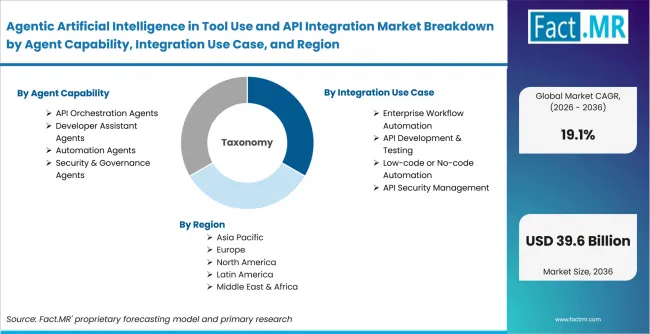
Agentic Artificial Intelligence In Tool Use And Api Integration Market Breakdown By Agent Capability, Integration Use Case, And Region | Source: Fact.MR
| Attribute | Details |
|---|---|
| Forecast Period | 2026-2036 |
| Base Year | 2025 |
| Market Value, 2026 | USD 6.9 billion |
| Market Value, 2036 | USD 39.6 billion |
| CAGR, 2026-2036 | 19.1% |
| Absolute Dollar Opportunity | USD 32.7 billion |
| Key Regions Covered | USA, Singapore, UK, Germany, Canada, Japan, Australia, and more than twenty-five additional countries in the full report |
Source: Fact.MR analysis. Updated Aug 10, 2026
How is the market segmented?
-
Agent Capability
- API Orchestration Agents
- REST API Agents
- GraphQL API Agents
- Developer Assistant Agents
- Code Generation Agents
- Debugging Agents
- Automation Agents
- Workflow Execution Agents
- Event-driven Agents
- Security & Governance Agents
- Access Control Agents
- Audit Trail Agents
- API Orchestration Agents
-
Integration Use Case
- Enterprise Workflow Automation
- Business Process Automation
- Cross-platform Integration
- API Development & Testing
- API Documentation
- Error Resolution
- Low-code or No-code Automation
- Business Rule Automation
- Event Processing
- API Security Management
- Compliance Monitoring
- API Usage Analytics
- Enterprise Workflow Automation
-
End-use Industry
- Information Technology
- Cloud Service Providers
- Software Development
- Financial Services
- Banking & FinTech
- Healthcare IT
- Telecommunications
- Telecom Operators
- Manufacturing
- Government & Public Sector
- Public Administration
- Defense & Security
- Information Technology
-
Organization Type
- Large Enterprises
- Global Enterprises
- Independent Software Vendors
- Banking Institutions
- FinTech Companies
- Healthcare Providers
- System Integrators
- Consulting Firms
- Industrial Enterprises
- Public Sector Organizations
- Regulatory Agencies
- Government Departments
- Large Enterprises
-
Integration Framework
- Cloud-native Integration
- Public Cloud
- Private Cloud
- Hybrid AI Architecture
- On-premises Deployment
- Edge-enabled Integration
- Multi-agent Orchestration
- Agent Coordination Layer
- Context-aware AI
- Foundation Model Integration
- Knowledge Graph Integration
- Vector-based Retrieval
- Cloud-native Integration
-
Region
- North America
- Latin America
- Western Europe
- Eastern Europe
- East Asia
- South Asia and Pacific
- Middle East & Africa
Frequently Asked Questions
What is the Agentic Artificial Intelligence in Tool Use and API Integration market size in 2026?
At what CAGR is the Agentic Artificial Intelligence in Tool Use and API Integration market expected to grow?
What is the projected Agentic Artificial Intelligence in Tool Use and API Integration market size by 2036?
Which country leads the Agentic Artificial Intelligence in Tool Use and API Integration market?
Which is the leading segment in the Agentic Artificial Intelligence in Tool Use and API Integration market?
What is driving growth in the Agentic Artificial Intelligence in Tool Use and API Integration Market?
Who are the key players in the Agentic Artificial Intelligence in Tool Use and API Integration Market?
Who worked on this report


Preview the report firsthand - request a free sample
Free SampleGet the brochure for pricing and purchase details
Download PDF