- Market Value (2025): USD 2.2 Bn
- Estimated Value (2026): USD 2.7 Bn
- Forecast Value (2036): USD 24.6 Bn
- CAGR (2026-2036): 24.8%.
What is the Agentic AI in HR Workflows Market forecast to be worth by 2036?
The market is projected to grow from USD 2.7 billion in 2026 to USD 24.6 billion by 2036, registering a CAGR of 24.8%.
- The Agentic AI in HR Workflows market reached USD 2.2 billion in 2025.
- Demand is forecast to increase from USD 2.7 billion in 2026 to USD 24.6 billion by 2036.
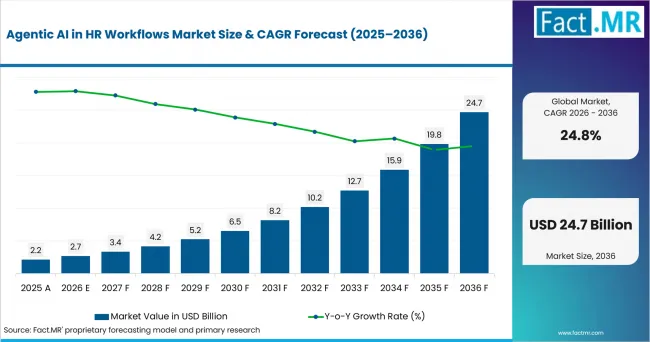
Agentic Ai In Hr Workflows Market Value Analysis | Source: Fact.MR
What are the defining numbers behind Agentic AI in HR Workflows Market growth?
An absolute dollar opportunity of USD 21.9 billion is expected between 2026 and 2036.
- Demand Drivers in the Market
- HR teams face a capacity problem that traditional self-service portals only partly solve, because employees still open cases when a portal cannot interpret context or complete an action, and recruiters still coordinate calendars and move information between systems. Action-taking agents close that gap by combining a natural-language request with real workflow execution.
- Suite vendors are embedding agents directly into platforms that already hold worker records, skills, and compensation data. Workday announced its next generation of Illuminate Agents in May 2025, and Oracle made role-based AI agents available in February 2025, giving buyers an upgrade path inside established HCM environments.
- Recruitment and talent acquisition offer measurable, high-volume workflows that are well suited to delegation without granting agents final hiring authority, which makes them a natural first commercial use case across HR departments.
- Cross-system collaboration is expanding agent reach beyond a single suite. UKG and ServiceNow announced an agent-to-agent collaboration in May 2025 connecting HR and payroll through a shared fabric, and Dayforce expanded its collaboration with Microsoft in October 2025 to transform HCM workflows with AI.
- Talent specialists are adding workforce intelligence and agentic capabilities of their own. Cornerstone launched Cornerstone Workforce AI in May 2026, Darwinbox introduced its Super Agent in September 2025, and HiBob brought people intelligence into Slack in June 2026, broadening the competitive and functional range of agents.
- Regulatory and guidance frameworks are clarifying how agents must be governed around employment data, which supports responsible deployment. The EU AI Act (Regulation (EU) 2024/1689, adopted June 2024) classifies many employment AI uses as high-risk, while the U.S. Department of Labor issued AI principles for worker well-being in May 2024 and the UK Information Commissioner published recruitment AI audit outcomes in November 2024.
- Key Segments Analyzed
- Autonomous Recruitment Agents anchor the AI Solution segment with a 41.0% share in 2026, as buyers delegate coordination-heavy recruiting tasks before broader agent authority.
- Talent Acquisition leads the HR Function segment, taking 38.0% of demand in 2026, because almost every step carries a direct operating metric such as time to fill.
- IT & Telecommunications is the largest End-use Industry at 36.0% in 2026, reflecting the technical readiness and recurring skills-demand of digital employers.
- Analyst Opinion at Fact.MR
- Shambhu Nath Jha, Senior Consultant at Fact.MR, states: “Agentic AI is reshaping HR software from a system that records work into one that completes it. The strongest early use case is recruitment, where coordination-heavy tasks can be delegated without handing over final hiring authority. Autonomous Recruitment Agents already hold 41.0% of the market in 2026. But employment decisions involve sensitive data, so buyers require fairness and transparency as well as documentation and human control. Vendors that combine governed APIs with multi-agent orchestration, and prove auditability across HR and payroll systems, will capture the largest share of spend.”
- Strategic Implications
- Suite vendors should package governed agents for repeatable HR workflows, deployed through cloud and API-first architectures so buyers can expand a first use case without rebuilding integration.
- Vendors must treat governed APIs and multi-agent orchestration as the core product, since they connect fragmented HR and payroll systems as well as IT and collaboration tools.
- Buyers will demand fairness, transparency, documentation, and human control for any agent that touches consequential employment actions, so providers should build bias testing and audit logging into the product from the start.
- Channel and service investment should follow the fastest-growing country markets, including the USA, UK, and Germany, while adapting packaging to local privacy and worker-representation requirements.
- Talent specialists should lead with focused recruitment, performance, and skills workflows, where they can outpace broad platforms on speed and depth in a narrow problem.
How does the Agentic AI in HR Workflows Market break down by segment?
The market is structured across three analytical dimensions plus region. Within AI Solution, Autonomous Recruitment Agents are the leading sub-segment. Talent Acquisition leads among HR Functions. IT & Telecommunications is the dominant End-use Industry, and North America, Europe, and Asia Pacific anchor the regional demand base.
Why do Autonomous Recruitment Agents lead AI Solution?
Autonomous Recruitment Agents is projected to account for a 41.0% share in 2026.
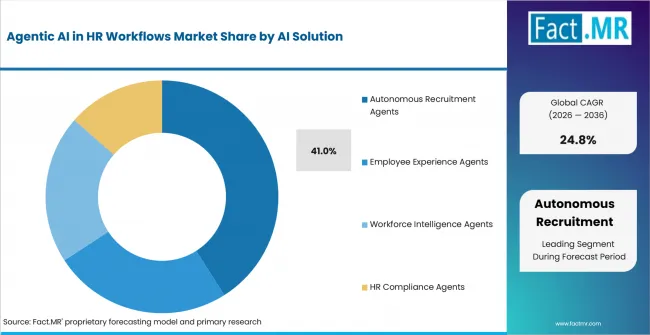
Agentic Ai In Hr Workflows Market Analysis By Ai Solution | Source: Fact.MR
Recruitment offers a clear sequence of high-volume tasks that can be delegated without giving an agent final hiring authority. Sourcing and resume organization create measurable cycle-time savings, while candidate communication and scheduling add further value through controlled requisition tracking. The workflow has defined handoffs to recruiters and hiring managers, making it easier to set permissions and escalation rules. Buyers can start with coordination tasks and add screening support after validating data quality and fairness. Workday announced Contingent Sourcing and other recruiting agents in May 2025, placing sourcing, screening support, and related actions inside an established HCM environment.
Why does Talent Acquisition lead HR Function?
Talent Acquisition is projected to account for a 38.0% share in 2026.
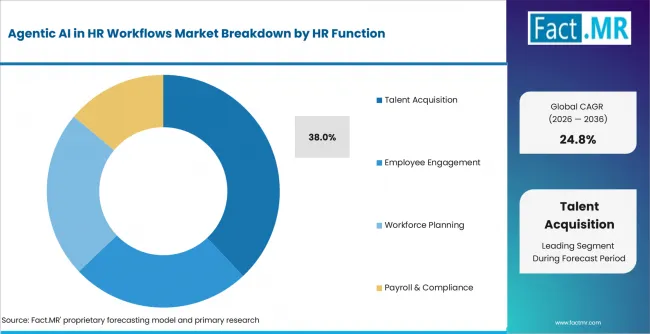
Agentic Ai In Hr Workflows Market Analysis By Hr Function | Source: Fact.MR
Talent Acquisition has a direct operating metric for almost every step. Employers can track screening speed, interview timing, recruiter workload, and candidate response against time to fill, a measurement discipline that supports a faster business case than functions where benefits are diffuse. The function also uses structured objects such as requisitions, profiles, and offer documents, which agents can act on through APIs while recruiters retain control over sensitive decisions. Oracle made role-based AI agents available in February 2025 covering career support, onboarding, performance, and employment details, showing how HCM vendors are packaging agent actions across the employee lifecycle.
Why do IT & Telecommunications lead End-use Industry?
IT & Telecommunications is projected to account for a 36.0% share in 2026.
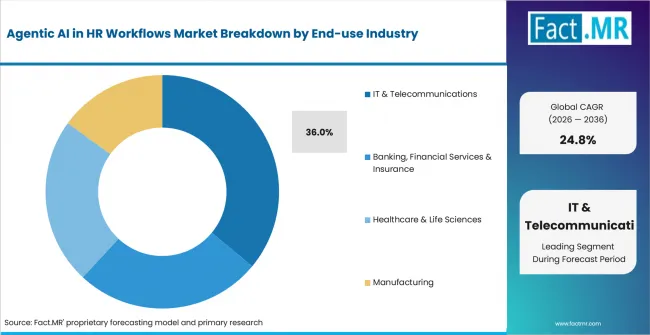
Agentic Ai In Hr Workflows Market Analysis By End Use Industry | Source: Fact.MR
Technology and telecommunications employers combine large digital workforces with frequent skills shifts and distributed operating models. Their HR teams manage technical hiring, internal mobility, contractor demand, and global employee service, and they have stronger API and cloud capabilities than many traditional industries, which reduces the cost of connecting agents to identity systems, collaboration tools, and HCM platforms. These buyers can test multi-agent use cases without rebuilding the full HR stack. ServiceNow and UKG announced an agent-to-agent collaboration in May 2025 designed to connect HR and payroll through a shared fabric, an integration pattern that IT-led employers can adopt readily.
What is accelerating Agentic AI in HR Workflows Market adoption, and what is holding it back?
Drivers Impact Analysis
| Driver | % Impact on CAGR | Geographic Relevance | Impact Timeline |
|---|---|---|---|
| High-volume recruiting and employee service work where action-taking agents close the portal gap | +0.8% | Global | Near term |
| HCM suite vendors embedding governed agents into platforms that already hold worker and payroll data | +0.7% | North America, Europe | Near term |
| Recruitment and talent acquisition offering measurable workflows suitable for staged delegation | +0.6% | Global | Mid term |
| Cross-system agent orchestration connecting HR, payroll, and service management | +0.5% | Global | Long term |
Restraints Impact Analysis
| Restraint | % Impact on CAGR | Geographic Relevance | Impact Timeline |
|---|---|---|---|
| Approval burden around sensitive employment data and consequential decisions | -0.6% | Global | Mid term |
| Privacy assessment, bias controls, and human oversight requirements raise validation friction | -0.4% | North America, Europe | Near term |
| Integration cost and governance overhead can offset savings where data quality or adoption is weak | -0.3% | Global | Mid term |
Which countries are scaling the Agentic AI in HR Workflows Market fastest?
- The United States leads the pace of expansion as large employers buy through joint CHRO and HRIT reviews in which security, legal, and procurement teams participate, reflecting a mature governance structure for deploying HR agents.
- The United Kingdom is scaling rapidly as employers place privacy review early in recruitment technology procurement, with the Information Commissioner publishing recruitment AI audit outcomes in November 2024.
- Germany is advancing as employers bring legal review and employee representation into workplace technology decisions, guided by the EU AI Act, adopted in June 2024, which classifies many employment AI uses as high-risk.
- Canada is moving from experiments toward formal business use as cost and privacy remain visible constraints, with Statistics Canada reporting in May 2026 that 19.2% of businesses used AI in the prior year.
- Japan is adopting through phased implementation with clear internal ownership and vendor support, compiled under the AI Guidelines for Business released by METI and the Ministry of Internal Affairs and Communications in April 2024.
- Singapore enables regional headquarters to pilot agents across shared services and multi-country HR operations, supported by IMDA’s Model AI Governance Framework for Agentic AI launched in January 2026.
- Australia is building demand among organizations with the scale and staff to govern AI programs, with the Australian Bureau of Statistics reporting in June 2026 that 35% of large businesses used AI in 2024–25.
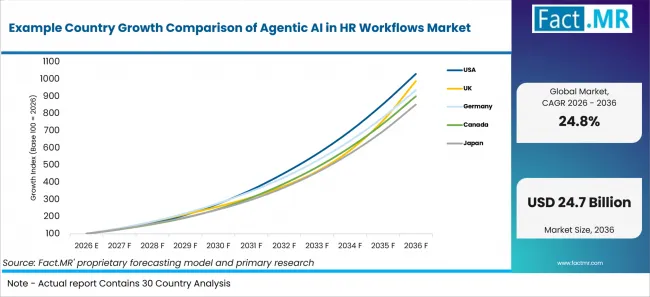
Example Country Growth Comparison Of Agentic Ai In Hr Workflows Market | Source: Fact.MR
Country-wise CAGR Forecast (2026-2036)
| Country | CAGR |
|---|---|
| USA | 26.3% |
| UK | 25.8% |
| Germany | 25.1% |
| Canada | 24.6% |
| Japan | 23.9% |
| Singapore | 23.4% |
| Australia | 22.8% |
What is driving the Agentic AI in HR Workflows Market in the USA?
USA is projected to register a 26.3% CAGR through 2036, supported by mature multi-stakeholder procurement and large employer demand.
Large American employers buy through joint CHRO and HRIT reviews, with security, legal, and procurement teams participating. The U.S. Department of Labor set out AI principles for worker well-being in May 2024, giving buyers a clear governance reference, and the scale of U.S. HR and payroll estates provides a large base for governed agent deployment.
What is driving the Agentic AI in HR Workflows Market in the UK?
The UK is projected to register a 25.8% CAGR through 2036, supported by early privacy review in recruitment technology.
British employers place privacy review early in recruitment technology procurement. The Information Commissioner published recruitment AI audit outcomes in November 2024, clarifying expectations for screening and hiring tools and supporting controlled adoption of autonomous recruitment agents.
What is driving the Agentic AI in HR Workflows Market in Germany?
Germany is projected to register a 25.1% CAGR through 2036, supported by high-risk classification and worker-representation requirements.
German employers bring legal review and employee representation into workplace technology decisions. Regulation (EU) 2024/1689, the EU AI Act adopted in June 2024, classifies many employment AI uses as high-risk, which shapes how German enterprises deploy agents and favors vendors with strong documentation and audit capabilities.
What is driving the Agentic AI in HR Workflows Market in Canada?
Canada is projected to register a 24.6% CAGR through 2036, supported by movement from experiments to formal business use.
Canadian buyers are moving from experiments toward formal business use, though cost and privacy remain visible constraints. Statistics Canada reported in May 2026 that 19.2% of businesses used AI in the prior year, establishing a base from which governed HR agent adoption can scale.
What is driving the Agentic AI in HR Workflows Market in Japan?
Japan is projected to register a 23.9% CAGR through 2036, supported by phased implementation and formal AI business guidance.
Japanese enterprises favor phased implementation with clear internal ownership and vendor support. METI and the Ministry of Internal Affairs and Communications compiled the AI Guidelines for Business in April 2024, giving organizations a structured framework for introducing autonomous agents into HR workflows.
What is driving the Agentic AI in HR Workflows Market in Singapore?
Singapore is projected to register a 23.4% CAGR through 2036, supported by regional-hub adoption and IMDA governance guidance.
Regional headquarters in Singapore can pilot agents across shared services and multi-country HR operations. IMDA launched a Model AI Governance Framework for Agentic AI in January 2026, giving Singapore-based enterprises a governance reference that supports responsible, cross-border deployment of HR agents.
What is driving the Agentic AI in HR Workflows Market in Australia?
Australia is projected to register a 22.8% CAGR through 2036, supported by adoption among large, governance-ready organizations.
Australian demand is concentrated among organizations with the scale and staff to govern AI programs. The Australian Bureau of Statistics reported in June 2026 that 35% of large businesses used AI in 2024–25, indicating a strong base among the employers best positioned to deploy governed HR agents.
Who leads the Agentic AI in HR Workflows Market?
The competitive field divides into three strategic positions. Core HCM and payroll suppliers monetize agents inside systems that already hold worker records, organization structures, skills, time, and compensation data. Enterprise orchestration platforms connect agents across HCM and service management, extending reach through identity, collaboration, and custom applications. Talent and modern HCM specialists compete through focused learning, skills, recruitment, performance, and employee experience workflows.
Workday, SAP, Oracle, UKG, and Dayforce compete through core HCM and payroll platforms, with embedded agents that use established time and workforce data. Microsoft, IBM, and ServiceNow compete through agent building and orchestration, with enterprise connectors and employee service workflows strengthening their role in multi-system environments. Cornerstone OnDemand, Darwinbox, and HiBob add focused talent, skills, and people-intelligence workflows.
Which companies are the key providers?
Key companies profiled in the Agentic AI in HR Workflows market include Workday, Inc.; SAP SE; Oracle Corporation; UKG Inc.; Dayforce, Inc.; Microsoft Corporation; IBM Corporation; ServiceNow, Inc.; Cornerstone OnDemand, Inc.; Darwinbox; and HiBob Ltd.
- Workday, Inc.
- SAP SE
- Oracle Corporation
- UKG Inc.
- Dayforce, Inc.
- Microsoft Corporation
- IBM Corporation
- ServiceNow, Inc.
- Cornerstone OnDemand, Inc.
- Darwinbox
- HiBob Ltd.
Bibliography
- U.S. Department of Labor. (2024, May 16). Biden-Harris administration announces groundbreaking AI principles for worker well-being.
- Information Commissioner’s Office. (2024, November 6). AI tools used in recruitment.
- European Union. (2024, June 13). Regulation (EU) 2024/1689 laying down harmonised rules on artificial intelligence.
- Statistics Canada. (2026, May 27). Canadian Survey on Business Conditions, second quarter 2026.
- Ministry of Economy, Trade and Industry of Japan. (2024, April 19). AI Guidelines for Business Ver. 1.0 compiled.
- Infocomm Media Development Authority of Singapore. (2026, January 22). Singapore launches new Model AI Governance Framework for Agentic AI.
- Australian Bureau of Statistics. (2026, June 25). Business adoption of Artificial Intelligence accelerates in 2024–25.
- Workday, Inc. (2025, May 19). Workday unveils next generation of Illuminate Agents to transform HR and finance operations.
- Oracle Corporation. (2025, February 6). Oracle AI Agents help HR leaders reshape the employee experience.
- UKG Inc. and ServiceNow, Inc. (2025, May 6). ServiceNow and UKG collaborate to supercharge employee productivity and efficiency with agentic AI.
- IBM Corporation. (2025, May 6). IBM accelerates enterprise generative AI with hybrid capabilities.
- Dayforce, Inc. (2025, October 7). Dayforce expands collaboration with Microsoft to transform HCM workflows with AI.
- Cornerstone OnDemand, Inc. (2026, May 20). Cornerstone launches Cornerstone Workforce AI.
- Darwinbox. (2025, September 12). Darwinbox launches Super Agent: The next leap in enterprise HR.
- HiBob Ltd. (2026, June 18). HiBob brings people intelligence into Slackbot to turn workforce insights into business action.
This Report Answers
- The report provides strategic intelligence on the Agentic AI in HR Workflows Market across the segment categories that drive industrial and enterprise purchasing behavior.
- Segment analysis covers Autonomous Recruitment Agents anchor the AI Solution segment with a as the leading sub-segment within the 2026 market structure.
- Regional outlook evaluates USA, UK and Germany while Canada, Japan complete the country growth comparison.
- Competitive analysis profiles alongside , followed by additional active providers within the category.
- Category assessment covers demand across primary segment groupings within the market, evaluated by value (USD) and share.
- Use-case assessment covers key application areas and end-use sectors identified in the market analysis.
What does the Agentic AI in HR Workflows Market cover?
The Agentic AI in HR Workflows Market covers the systems, services, and software categories defined by AI Solution, HR Function, End-use Industry and related market attributes.
The Agentic AI in HR Workflows Market covers the full range of products and services segmented by AI Solution, HR Function, End-use Industry within the 2026-2036 forecast horizon. Coverage includes Autonomous Recruitment Agents anchor the AI Solution segment with a as the largest sub-segment and extends across all primary categories identified in the report.
The market differs from adjacent consumer or industrial categories because commercial value comes from the function and performance requirements captured within the supplied segmentation framework. Commodity components and general-purpose categories remain outside the boundary unless they are explicitly formulated or configured for the defined market application.
What is included in the scope?
Agentic AI in HR Workflows Market products and services deployed across the major segment categories and geographies profiled in the report.
The scope includes all product categories segmented by AI Solution, HR Function, End-use Industry alongside covered through secondary research, supplier validation, and demand modeling. The leading sub-segment, Autonomous Recruitment Agents anchor the AI Solution segment with a, is included with full value and share analysis alongside the complete set of profiled countries, companies, and end-use applications identified in the report.
What is excluded from the scope?
Commodity inputs, general-purpose goods, and unrelated service lines are outside the scope.
The scope excludes products and services that are not specifically designed, configured, or deployed for the Agentic AI in HR Workflows Market. General-purpose or horizontal categories that may be used incidentally across multiple markets are excluded unless they are sold within a product or service bundle specific to the market under analysis. Adjacent categories and standalone commodity components remain outside the boundary unless their principal commercial function falls within the supplied segmentation framework.
How was the analysis built?
Fact.MR combines desk research with supplier, buyer and expert validation to define the market boundary and test segment adoption, pricing, deployment and regional demand assumptions. Company portfolios, product and technology documentation, regulatory material, industry publications and interview input are reconciled with activity-level data and country-level conditions before forecasts are updated.
What is the report’s scope and coverage?
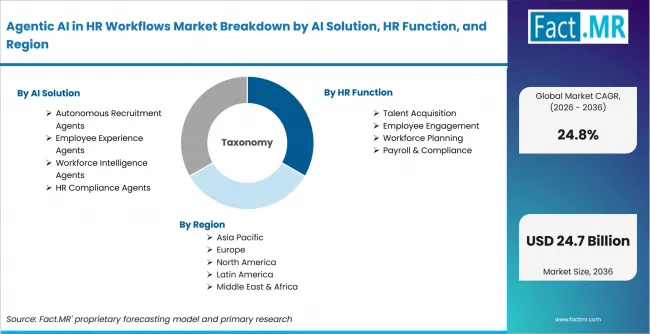
Agentic Ai In Hr Workflows Market Breakdown By Ai Solution, Hr Function, And Region | Source: Fact.MR
| Attribute | Details |
|---|---|
| Forecast Period | 2026-2036 |
| Base Year | 2025 |
| Market Value, 2026 | USD 2.7 billion |
| Market Value, 2036 | USD 24.6 billion |
| CAGR, 2026-2036 | 24.8% |
| Absolute Dollar Opportunity | USD 21.9 billion |
| Key Regions Covered | USA, UK, Germany, Canada, Japan, Singapore, Australia, and more than twenty-three additional countries in the full report |
How is the market segmented?
-
AI Solution
- Autonomous Recruitment Agents
- Candidate Screening Agents
- Interview Scheduling Agents
- Employee Experience Agents
- Onboarding Assistants
- Learning Assistants
- Workforce Intelligence Agents
- Workforce Analytics
- Skills Intelligence
- HR Compliance Agents
- Regulatory Monitoring
- Policy Automation
- Autonomous Recruitment Agents
-
HR Function
- Talent Acquisition
- Resume Parsing
- Interview Coordination
- Employee Engagement
- Performance Feedback
- Learning & Development
- Workforce Planning
- Succession Planning
- Headcount Forecasting
- Payroll & Compliance
- Payroll Processing
- Labor Law Compliance
- Talent Acquisition
-
End-use Industry
- IT & Telecommunications
- Software & IT Services
- Telecommunications
- Banking, Financial Services & Insurance
- Banking
- Insurance
- Healthcare & Life Sciences
- Hospitals
- Pharmaceutical Companies
- Manufacturing
- Automotive Manufacturing
- Industrial Manufacturing
- IT & Telecommunications
-
Region
- North America
- Latin America
- Western Europe
- Eastern Europe
- East Asia
- South Asia and Pacific
- Middle East & Africa