- Market Value (2025): USD 6235.5 Mn
- Estimated Value (2026): USD 8486.5 Mn
- Forecast Value (2036): USD 185058.9 Mn
- CAGR (2026-2036): 36.1%
What is the AI in Gaming Market forecast to be worth by 2036?
USD 8,486.5 million in 2026 to USD 185,058.9 million by 2036, at 36.1% CAGR.
- The AI in Gaming Market crossed a valuation of USD 6,235.5 million in 2025 amid broader use of generative tools inside production pipelines.
- Demand is projected to increase from USD 8,486.5 million in 2026 to USD 185,058.9 million by 2036.
- The market is anticipated to record a 36.1% CAGR from 2026 to 2036, supported by studios and platform teams expanding workflow automation and in-game AI systems.
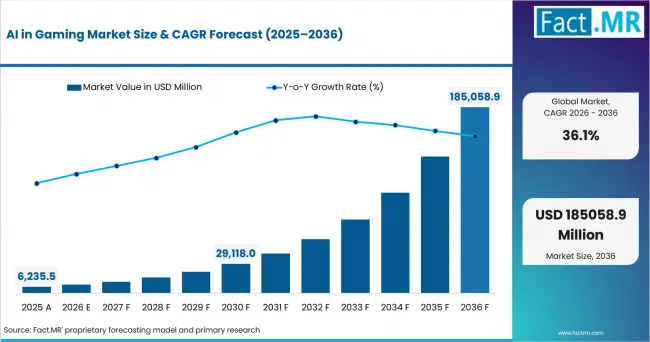
Ai In Gaming Market Market Value Analysis | Source: Fact.MR
What are the defining numbers behind AI in Gaming Market growth?
USD 176,572.4 million absolute opportunity by 2036, led by Software and Cloud deployment among BFSI.
- Demand Drivers in the Market
- BFSI need repeatable production assistants because code generation and asset iteration must fit existing engine workflows without breaking build stability.
- Quality-assurance teams need agent-based testing supported by repeatable test paths that expose failures across large maps and complex interaction states.
- Live game teams need fast model responses owing to player-facing dialogue and recommendation systems that must react inside tight response-time limits.
- Technical directors need clear model-use rules shaped by intellectual-property controls and project-data limits across internal tools and third-party services.
- Key Segments Analyzed
- By Component: Software is expected to account for 51.8% share in 2026, driven by direct integration of assistants and runtime models into development environments.
- By Deployment: Cloud is projected to garner 41.4% share in 2026, supported by flexible access to model training and processing capacity.
- By Organization Size: SMEs are anticipated to record 45.0% share in 2026, attributable to usage-based tools that reduce upfront infrastructure needs.
- By Application: Workflow Automation is estimated to hold 49.1% share in 2026, owing to demand for faster coding and testing cycles.
- Analyst Opinion at Fact.MR
- Shambhu Nath Jha, Senior Analyst at Fact.MR states, “The commercial bottleneck is not access to another model. Adoption is expected to favor tools that understand engine context and protect project data across active production pipelines. Providers should combine workflow integration and measurable response speed with clear controls over content rights and project data.”
- Strategic Implications
- Studio leaders should benchmark AI tools against build stability and revision time before extending them across production teams.
- Engine teams should define approved data paths and model permissions before external agents receive editor context or asset access.
- QA managers should compare path coverage and defect reproduction rates before replacing established manual regression routines.
As game studios increasingly seek AI solutions integrated into development workflows, Unity Technologies announced the Unity AI Gateway in November 2025 as an officially supported route for verified third-party agents to work with Unity Editor scene and asset context. The development is expected to shift purchasing attention from stand-alone generators toward tools that understand scenes and project assets while working inside controlled development environments.
India is expected to record 37.9% CAGR during the forecast period, driven by developer programs and expanding access to shared compute. China is projected to post 37.2% CAGR by 2036, supported by dense game and AI company clusters. Australia is anticipated to register 35.9% CAGR over the assessment period, attributable to production incentives and export-oriented studio activity. The United Kingdom is estimated to achieve 35.6% CAGR between 2026 and 2036, owing to established game-production depth and creative technology capacity. The United States is forecast to record 35.4% CAGR across the forecast horizon, reinforced by engine ecosystems and commercial AI deployment.
How does the AI in Gaming Market break down by segment?
Software holds 51.8% share; Cloud accounts for 41.4% share.
Which Component dominates?
Software leads with 51.8% share in 2026
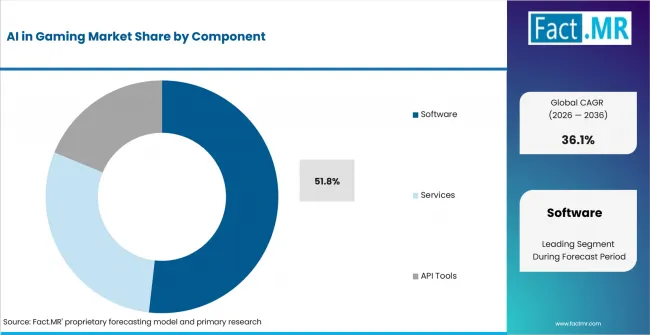
Ai In Gaming Market Analysis By Component | Source: Fact.MR
Software is projected to represent 51.8% share in 2026, supported by studio demand for tools working inside coding and testing workflows as well as in-game systems. Services remain relevant when custom pipelines or protected assets require integration work before a model reaches production. API Tools serve teams that need modular access to speech models or the ability to switch models without replacing the production tool set. In March 2025, NVIDIA reported that DLSS 4 supported more than 100 games and applications. The spread shows how engine-ready AI features scale when developers adopt them without rebuilding core production workflows.
What is shaping the Deployment split?
Cloud holds 41.4% share in 2026
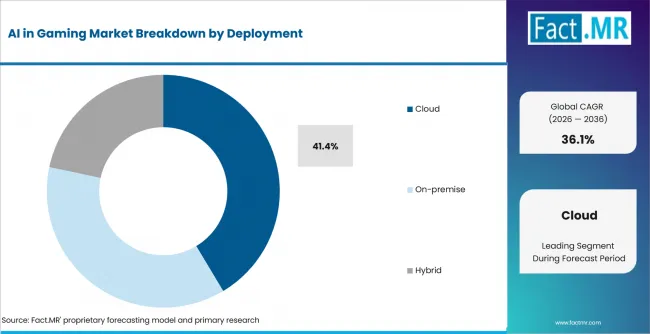
Ai In Gaming Market Analysis By Deployment | Source: Fact.MR
Cloud is anticipated to capture 41.4% share in 2026, owing to temporary processing spikes that favor flexible model capacity and managed access. On-premise systems remain relevant where source code or assets need tighter controls inside studio networks. Hybrid deployment connects protected data to external model capacity while access rules limit what leaves the studio. The cloud gaming services category reinforces a distributed delivery model already used across interactive entertainment worldwide. EuroHPC reported 19 AI Factories serving SMEs and startups across its network in December 2025. The access model lowers the infrastructure threshold for smaller development teams testing cloud AI tools.
How does Organization Size affect demand?
SMEs are anticipated to record 45.0% share in 2026
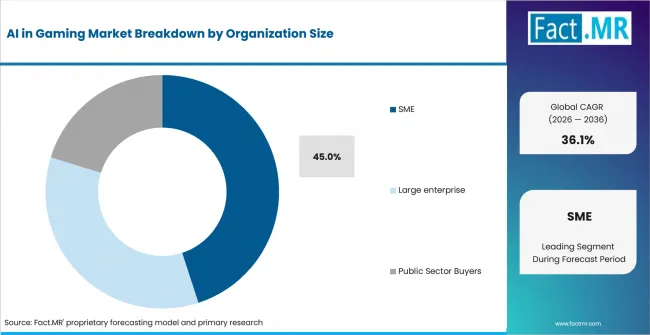
Ai In Gaming Market Analysis By Organization Size | Source: Fact.MR
SMEs are estimated to hold 45.0% share in 2026, attributable to smaller studios buying focused coding or testing tools before building internal model teams. Large Enterprises invest more often in private infrastructure and access controls that span several projects. The organization-size gap also reflects limited internal capacity among early-stage game businesses building dedicated AI teams. In July 2025, the UK Games Fund evaluation estimated that its current program would contribute around 430 additional full-time jobs to the video games sector. For game-tool providers, simpler onboarding and clear usage pricing remain central to converting smaller studios into recurring accounts.
What is accelerating AI in Gaming Market adoption, and what is holding it back?
Shorter production cycles drive adoption across studios; intellectual-property uncertainty and unclear data-use terms restrain wider deployment.
Drivers Impact Analysis
| Driver | (~) % Impact on CAGR | Geographic Relevance | Impact Timeline |
|---|---|---|---|
| Shorter production cycles | +4.6% | North America and Asia Pacific | Medium term (2-4 years) |
| Agent-based game testing | +3.8% | Global studio hubs | Medium term (2-4 years) |
| Real-time character dialogue | +3.1% | North America and Europe | Long term (>= 4 years) |
| Cloud model and GPU access | +2.5% | India and China | Short term (<= 2 years) |
| Live-operations personalization | +1.9% | United States and United Kingdom | Medium term (2-4 years) |
Source: Fact.MR analysis. Updated Jul 9, 2026
- Shorter production cycles: Studios are using assistants for code drafts and repetitive editor work that previously moved through several manual handoffs. The value becomes clearer when an assistant understands project context and reduces revision time inside existing engine workflows. In January 2026, the OECD reported that 20.2% of firms used AI during 2025 across OECD countries where data were available. Adoption is expected to widen, supported by game teams connecting assistants to measured reductions in build time and revision effort.
- Agent-based game testing: QA teams are adopting automated agents for path coverage and repeated test checks across large interactive environments. Automated play creates value when failures are reproduced with clear traces and stable build identifiers for engineering review. In March 2025, Epic Games published an Unreal Fest session collection that included game-playing NPCs and automated QA testing. Demand is projected to expand where testing agents complement human exploratory work and keep failure paths visible.
- Real-time character dialogue: Game teams are testing speech and language systems that respond during active play instead of following fixed dialogue trees. Commercial use depends on response speed and content limits that keep character behavior consistent across repeated player interactions. In October 2025, Inworld AI introduced an Unreal runtime toolkit with templates for conversational NPCs and response control. Runtime adoption is anticipated to expand where studios track response speed and session cost before wider deployment.
- Cloud model and GPU access: Shared infrastructure reduces the need for each studio to operate a dedicated training cluster during prototyping. The approach supports short periods of heavy processing while controlled storage keeps source code and project assets inside approved data paths. India expanded shared AI infrastructure in March 2025 by announcing 18,693 GPUs for the IndiaAI common compute facility. Cloud demand is estimated to rise, attributable to regional studios gaining managed model access without funding private clusters.
- Live-operations personalization: Retail and platform teams are using AI for recommendations and player support around ongoing games. Microsoft introduced Copilot for Gaming in March 2025 as a personalized companion for discovery and coaching tasks. The announcement points to wider interest in assistance around play while leaving the player in control. Commercial use is expected to increase where service boundaries and opt-in controls remain visible during every session.
Opportunity Impact Analysis
| Opportunity | (~) % Impact on CAGR | Geographic Relevance | Impact Timeline |
|---|---|---|---|
| Adaptive gameplay systems | +3.4% | North America and China | Long term (>= 4 years) |
| Text and image asset workflows | +2.8% | Europe and Asia Pacific | Medium term (2-4 years) |
| Small-studio productivity tools | +2.4% | India and Australia | Medium term (2-4 years) |
| Local-language voice and dialogue | +1.8% | India and China | Long term (>= 4 years) |
Source: Fact.MR analysis. Updated Jul 9, 2026
- Adaptive gameplay systems: Designers have room to build mechanics around adaptive characters and generated responses that affect the playable system itself. The commercial opening differs from using a model only to create background assets before a build ships. In June 2025, Epic Games presented language-model and character workflows for creator experiences at State of Unreal. Adoption is expected to expand where designers constrain character behavior and test repeatability under player pressure.
- Text and image asset workflows: Art teams are combining text guidance with image generation inside controlled review and revision workflows. The opportunity centers on faster iteration while preserving art direction and a clear record of how assets entered production. In July 2026, the UK Office for National Statistics reported that 14% of businesses used AI for visual content creation in June 2026. Demand is projected to expand for review tools that record source history and asset versions before content reaches production versions.
- Small-studio productivity tools: Smaller development teams have room to buy focused assistants without maintaining specialist model infrastructure. Trial activity is broader where developers test tools on a narrow task before changing an entire production process. India’s Game Forge events drew more than 2,000 attendees across three technology hubs in February 2025. Chennai and Bengaluru hosted two stages of the program while Hyderabad completed the three-city series for participating developers that month. SME spending is anticipated to rise where pricing follows project use and onboarding does not require a dedicated AI team.
- Local-language voice and dialogue: Speech systems create room for broader character coverage across languages that previously required separate recording workflows. Commercial use still depends on review control because pronunciation and character tone need approval before dialogue reaches a live build. In May 2026, Inworld AI introduced Realtime TTS-2 with one voice identity across more than 100 languages. Adoption is estimated to increase where localization teams keep final control over pronunciation and released character dialogue.
Restraints Impact Analysis
| Restraint | (~) % Impact on CAGR | Geographic Relevance | Impact Timeline |
|---|---|---|---|
| IP and training-data uncertainty | -2.7% | Global | Short term (<= 2 years) |
| Runtime compute cost and response delay | -2.2% | Global runtime applications | Medium term (2-4 years) |
| Player trust and disclosure | -1.7% | Europe and North America | Medium term (2-4 years) |
| Production integration and model changes | -1.4% | Large studios | Long term (>= 4 years) |
Source: Fact.MR analysis. Updated Jul 9, 2026
- IP and training-data uncertainty: Studios face extra review when generated code or assets arrive without clear source history or data-use terms. Legal review slows deployment inside projects built around licensed characters and carefully controlled art assets that cannot tolerate unclear ownership terms. Unity updated its legal information in June 2026 to state that project materials are not used for product improvements without developer authorization. Procurement is forecast to remain selective where vendors cannot explain data use and output rights in plain terms.
- Runtime compute cost and response delay: Player-facing AI creates recurring compute expense and response pressure that offline content drafting does not carry. A character system loses value when dialogue interrupts play or session cost exceeds the benefit created for the player. Providers are selecting different models and smaller systems to balance response speed against quality during player-facing interactions. Runtime adoption is expected to concentrate first in controlled interactions where response length and player concurrency are easier to manage.
- Player trust and disclosure: Generated dialogue and coaching features raise moderation questions when automated systems enter social spaces used by younger players. Platform teams need clear controls before assistants enter voice or text channels that connect players with strangers. In May 2026, Ofcom reported that 64% of parents of gaming children were concerned about contact with strangers in games or chat. Consumer-facing deployment is projected to move more carefully where moderation and disclosure rules remain unsettled.
- Production integration and model changes: Development teams need stable behavior across engine releases and production versions that change over several years. Model updates create revalidation work when prompts or generated outputs shift after a provider release. Large studios often maintain approval gates for plugins and external data access before any production team enables a new model. Large-studio adoption is anticipated to favor vendors that publish version controls and preserve reproducible behavior across production updates.
Which countries are scaling AI in Gaming Market fastest?
India 37.9%; China 37.2%; Australia 35.9%; United Kingdom 35.6%; United States 35.4%; Germany 35.1%; Japan 34.8%.
AI in Gaming Market coverage includes North America and Europe alongside Asia Pacific across the regional assessment. Latin America is also covered while the Middle East and Africa region completes the five-region framework for this report.
| Country | CAGR |
|---|---|
| India | 37.9% |
| China | 37.2% |
| Australia | 35.9% |
| United Kingdom | 35.6% |
| United States | 35.4% |
| Germany | 35.1% |
| Japan | 34.8% |
Source: Fact.MR analysis. Updated Jul 9, 2026
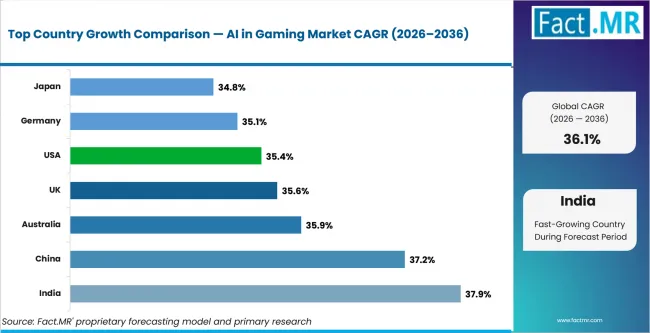
Ai In Gaming Market Cagr Analysis By Country | Source: Fact.MR
What is powering India's lead?
37.9% CAGR, driven by shared compute access and a widening developer base.
India’s developer base is widening while public programs give studios more routes to test tools and present original games internationally. The Ministry of Information and Broadcasting reported 1,078 registrations for Tech Triumph Season 3 in February 2025. The market is expected to record 37.9% CAGR between 2026 and 2036, supported by local studios improving access to production-tool validation before wider deployment.
How is China scaling game-development AI demand?
37.2% CAGR, supported by dense game-development clusters and expanding AI technology capacity near major studios.
Shanghai’s Xuhui District reported in December 2025 that 2024 game revenue exceeded USD 9.92 billion. The market is projected to post 37.2% CAGR over the assessment period, attributable to dense game and AI company networks that shorten partner discovery for local development teams. Export-oriented development is anticipated to favor tools that improve localization and live-service iteration across several markets.
What supports Australia’s outlook?
35.9% CAGR, attributable to production incentives and export-oriented studio activity.
Australia combines a formal game-development tax incentive with studios that serve international projects from distributed production teams. In November 2025, the Australian Taxation Office confirmed a 30% refundable offset for qualifying Australian game-development expenditure. The market is anticipated to register 35.9% CAGR across the forecast horizon, owing to studio investment in workflow tools that support multi-platform production and remote collaboration.
Why is the United Kingdom expanding steadily?
35.6% CAGR, owing to game-production depth and continued project activity.
The United Kingdom benefits from a well-established game development talent base, supported by tax-relief programs that help sustain consistent project activity across domestic studios. HM Revenue & Customs reported 560 video-game tax-relief claims for the 2023 to 2024 financial year in its August 2025 update. AI in Gaming demand is estimated to achieve 35.6% CAGR by 2036, reinforced by studios integrating assistants into coding and content workflows under tighter project-data controls.
What underpins growth in the United States?
35.4% CAGR, reinforced by engine ecosystems and commercial AI deployment.
The United States contains major engine and platform ecosystems that place AI tools near developer distribution channels and commercial users. The Census Bureau reported in May 2026 that 37% of firms with at least 250 employees used AI during the latest survey period. The market is forecast to record 35.4% CAGR during the forecast period, driven by studios expanding controlled use of agents and neural rendering inside production.
Who leads the AI in Gaming Market?
Microsoft and Unity Technologies strengthen platform and engine-side AI coverage.
Key players such as NVIDIA focus on neural rendering and character technologies that connect AI with graphics and gameplay systems. Unity Technologies focuses on project-aware assistance inside the Editor while Epic Games combines engine tools with creator workflows in Unreal Engine and Fortnite. Neural rendering also connects development software with the gaming PC market through hardware-backed AI processing and graphics features. Competition hinges on engine fit and response performance because studios prefer tools that reduce integration work before production approval.
Microsoft combines Xbox player services with developer-facing gaming AI resources that connect game teams with Microsoft AI tools and Azure services. Electronic Arts expanded its AI development work through an October 2025 partnership with Stability AI for models and workflows used by artists and developers. Ubisoft is testing player-facing generative interaction through Teammates while Google DeepMind advances game-playing agents for interactive 3D worlds through SIMA 2. Competition is expected to center on engine fit and response speed while clear data controls shape procurement decisions.
Which companies are the key providers?
Some of the key players profiled include NVIDIA, Microsoft (Xbox and Azure), Unity Technologies, Epic Games, Electronic Arts, Ubisoft, Google DeepMind.
- NVIDIA
- Microsoft (Xbox and Azure)
- Unity Technologies
- Epic Games
- Electronic Arts (EA)
- Ubisoft
- Google DeepMind
Bibliography
- Australian Taxation Office. (2025, November 25). Digital games tax offset. Australian Taxation Office.
- Epic Games. (2025, March 14). Unreal Fest Seattle 2024: Talks and demos. Epic Games Developer Community.
- Epic Games. (2025, June 3). All the big news and announcements from the State of Unreal 2025. Epic Games.
- Department for Culture, Media & Sport. (2025, July 18). Evaluation of the UK Games Fund. GOV.UK.
- HM Revenue & Customs. (2025, August 28). Creative industries statistics commentary: August 2025. GOV.UK.
- Inworld AI. (2025, October 29). Unreal AI Runtime: Build AI-powered games faster. Inworld AI.
- Inworld AI. (2026, May 5). Realtime TTS-2: A new frontier voice model that feels as human as it sounds. Inworld AI.
- Microsoft. (2025, March 13). New Copilot for Gaming aims to save you time, help you get good. Xbox Wire.
- Microsoft. (2025, January 14). Level up your game dev skills with the Microsoft Gaming AI Resource Hub. Microsoft Game Dev.
- Electronic Arts. (2025, March 21). EA at GDC: AI, machine learning, and much more. Electronic Arts.
- Electronic Arts. (2025, October 23). EA and Stability AI partner to empower artists, designers, and developers. Electronic Arts.
- Google DeepMind. (2025, November 13). SIMA 2: A Gemini-powered AI agent for 3D virtual worlds. Google DeepMind.
- Ubisoft. (2025, November 21). Ubisoft reveals Teammates: An AI experiment to change the game. Ubisoft.
- NVIDIA. (2025, March 13). NVIDIA reveals neural rendering and AI advancements at GDC 2025. NVIDIA.
- NVIDIA. (2026, March 10). GeForce @ GDC 2026: 20 new DLSS 4.5 and path-traced games, DLSS 4.5 Dynamic Multi Frame Gen available March 31, RTX Remix and Mega Geometry updates, and much more. NVIDIA.
- Office for National Statistics. (2026, July 2). Business insights and impact on the UK economy: 2 July 2026. Office for National Statistics.
- Ofcom. (2026, May 21). Children and parents media use and attitudes report 2025–6. Ofcom.
- Organisation for Economic Co-operation and Development. (2026, January 28). AI use by individuals surges across the OECD as adoption by firms continues to expand. OECD.
- Press Information Bureau. (2025, February 18). “Game Forge” programs organised under WAVES help students learn about technological advancements in gaming sector. Government of India.
- Press Information Bureau. (2025, February 21). Bharat Tech Triumph Program. Government of India.
- Press Information Bureau. (2025, January 30). IndiaAI Mission expands AI ecosystem with affordable compute and startup support. Government of India.
- Shanghai Municipal Government. (2025, December 12). Xuhui invites professionals to game industry conference. Shanghai Municipal Government.
- Unity Technologies. (2025, November 19). Unity puts developer choice and flexibility at the center of game development at Unite 2025. Unity Technologies.
- Unity Technologies. (2026, June 30). Legal information. Unity Technologies.
- United States Census Bureau. (2026, May 26). Large firms with at least 20 employees biggest AI users. U.S. Department of Commerce.
This Report Addresses
- The report provides strategic intelligence on Component and Deployment choices that shape AI procurement across game-development and runtime systems.
- Regional outlook evaluates India and China alongside Australia while the United Kingdom and United States complete the country growth comparison.
- Competitive analysis profiles NVIDIA and Microsoft (Xbox and Azure) alongside Unity Technologies and Epic Games. Electronic Arts and Ubisoft complete the commercial provider set while Google DeepMind adds research coverage around game-playing agents.
- Component assessment covers Software and Services alongside API Tools used across production pipelines and interactive runtime systems.
What does the AI in Gaming Market cover?
Workflow assistants, testing agents, content-generation systems, and runtime AI used in commercial game development and play.
The AI in Gaming Market covers software and services that apply machine learning or generative models to game production and interactive runtime functions. Coverage includes editor assistance and automated testing alongside analytics and character intelligence used during development or active play.
The market differs from the broader artificial-intelligence software category because commercial value is counted only when the product serves game development or gaming operations. General enterprise copilots and stand-alone creative tools remain outside scope unless they are sold or integrated for defined gaming workflows.
What is included in the scope?
AI in Gaming systems used inside game production pipelines and player-facing interactive services.
Coverage includes Software and Services alongside API Tools that connect models with game engines or back-end services. Deployment analysis covers Cloud and On-premise systems while Hybrid environments address controlled access to external model capacity. The Organization Size view compares SMEs with Large Enterprises that differ in infrastructure capacity and internal data-control needs. End-use coverage includes BFSI and Retail while Manufacturing and IT represent adjacent commercial users of gaming-specific AI services.
What is excluded from the scope?
General enterprise AI software and gaming hardware without a defined AI service component are outside the scope.
General-purpose AI subscriptions are excluded when no commercial gaming workflow or runtime deployment is defined. Conventional gaming hardware also remains outside scope unless a separately priced AI software or service component is directly tied to game development or interactive play.
How was the analysis built?
120+ sources, 40+ company portfolios, 25+ countries, 20+ interviews.
- Primary Research
- Primary research includes interviews with game developers, game publishers, AI platform providers, studio technology leaders and gaming infrastructure specialists. It also includes input from game designers, analytics teams, monetization managers, cloud gaming providers and esports stakeholders involved in AI deployment across gaming environments.
- Desk Research
- Desk research reviews gaming industry statistics, artificial intelligence adoption trends, developer platform documentation, company product portfolios and industry announcements. Technical publications, game engine updates, cloud gaming developments and AI tool releases are also assessed to evaluate market trends and competitive positioning.
- Market-Sizing and Forecasting
- Forecasting uses gaming industry revenue trends, AI software adoption, game development activity, player engagement initiatives and investment in intelligent gaming technologies across major regions. Models consider AI usage in game development, procedural workflow automation, analytics, and governance alongside broader digital entertainment growth.
- Data Validation and Update Cycle
- Forecasts are validated through provider checks and industry interviews that test assumptions on AI adoption, development priorities and gaming ecosystem demand. Portfolio mapping, end-user assessment and stakeholder feedback help confirm market direction, while ongoing reviews of game studio investments, technology launches and industry developments support forecast updates.
Segmentation
What is the report’s scope and coverage?
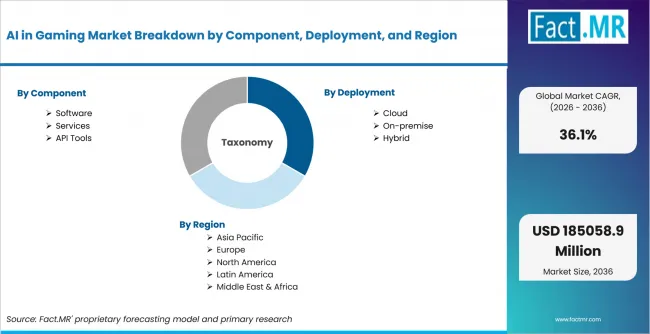
Ai In Gaming Market Breakdown By Component, Deployment, And Region | Source: Fact.MR
| Attribute | Details |
|---|---|
| Quantitative Units | USD Million |
| Market Definition | AI software, models, developer tools and services used to automate game production tasks or operate AI functions inside commercial games and gaming platforms |
| Component | Software; Services; API Tools |
| Deployment | Cloud; On-premise; Hybrid |
| Organization Size | SMEs; Large Enterprises, Public Sector Buyers |
| Application | Workflow Automation; Analytics; Governance |
| End Use |
BFSI, Retail, Manufacturing, IT |
| Regions Covered | North America; Europe; Asia Pacific; Latin America; Middle East and Africa |
| Countries Covered | United States; Canada; Germany; United Kingdom; France; Italy; Spain; India; China; Japan; South Korea; Australia; Brazil; Argentina; Mexico; Chile; UAE; Saudi Arabia; South Africa |
| Key Companies Profiled | NVIDIA; Microsoft (Xbox and Azure); Unity Technologies; Epic Games; Electronic Arts; Ubisoft; Google DeepMind |
| Forecast Period | 2026 to 2036 |
| Approach | Hybrid top-down and bottom-up approach using developer activity; engine ecosystem reach; share of developer teams using paid AI tools; deployment mix; production-cycle adoption; response speed and compute needs for player-facing AI; provider validation |
Source: Fact.MR analysis. Updated Jul 9, 2026
How is the market segmented?
-
By Component:
- Software
- Services
- API Tools
-
By Deployment :
- Cloud
- On-premise
- Hybrid
-
By Organization Size :
- SMEs
- Large Enterprises
- Public Sector Buyers
-
By Application :
- Workflow Automation
- Analytics
- Governance
-
By End Use :
- BFSI
- Retail
- Manufacturing
- IT
- BFSI
-
By Region :
- North America
- United States
- Canada
- Europe
- Germany
- United Kingdom
- France
- Italy
- Spain
- Asia Pacific
- India
- China
- Japan
- South Korea
- Australia
- Latin America
- Brazil
- Argentina
- Mexico
- Chile
- Middle East and Africa
- UAE
- Saudi Arabia
- South Africa
- North America
Frequently Asked Questions
What share is Software expected to capture within Component demand?
How is Cloud positioned across Deployment demand?
Which company-size group carries the primary share?
How quickly is India expected to expand?
Which factor shapes China’s projected expansion?
Which factors support Australia’s projected outlook?
How is the United Kingdom expected to progress?
What is behind United States growth?
Which driver has the clearest near-term effect?
Which restraint slows procurement decisions?
Why does Software carry commercial weight?
Who worked on this report


Preview the report firsthand - request a free sample
Free SampleGet the brochure for pricing and purchase details
Download PDF