- Market Value (2025): USD 1.5 Bn
- Estimated Value (2026): USD 1.8 Bn
- Forecast Value (2036): USD 9.0 Bn
- CAGR (2026-2036): 17.4%
What is the AI Image Upscaler Market forecast to be worth by 2036?
USD 1.8 billion in 2026 to USD 9.0 billion by 2036 at 17.4% CAGR.
- The AI image upscaler market surpassed a value of USD 1.5 billion in 2025.
- Demand is projected to increase from USD 1.8 billion in 2026 to USD 9.0 billion by 2036.
- The market is forecast to record 17.4% CAGR from 2026 to 2036 owing to repeat image-quality needs across creator and business use.
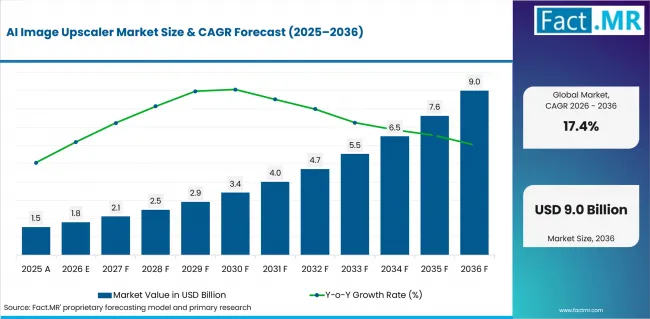
Ai Image Upscaler Market Value Analysis | Source: Fact.MR
What are the defining numbers behind AI Image Upscaler Market growth?
USD 7.2 billion absolute opportunity by 2036.
- Demand Drivers in the Market
- Marketing and creator teams need more usable image versions as campaigns move across social feeds and product pages.
- E-commerce sellers use upscaling when product images are cropped or inherited from older catalog files.
- Design teams prefer tools inside existing suites since separate repair steps add review time.
- Media and archive users are expected to test provenance controls before enhanced images enter paid workflows.
- Key Segments Analyzed
- By Deployment: Cloud-Based is projected to hold 58.0% share in 2026 since browser access fits irregular workloads.
- By Application: Photography Enhancement is projected to hold 34.0% share in 2026 as old photos and cropped assets need frequent repair.
- By End User: Individual Users are projected to hold 39.0% share in 2026 because mobile apps reduce setup effort.
- Analyst Opinion at Fact.MR
- Shambhu Nath Jha states as Principal Consultant at Fact.MR, “AI image upscaler vendors need to prove repeatable output. Customers are expected to compare face fidelity and text preservation. Batch controls and content-handling terms decide when paid use expands.”
- Strategic Implications
- Software providers should connect upscaling with approved design and review paths.
- Product teams should offer batch processing with human review before customers place enhanced images into catalogs or archives.
- Investors should separate simple consumer utilities from workflow tools that manage privacy and output proof.
The USA is expected to record an 18.4% CAGR from 2026 to 2036 through creative software use and online-retail image needs. South Korea is projected to record 18.7% CAGR through AI infrastructure and media technology demand. Japan is forecast at 16.9% as media teams place more weight on dependable output. Germany is estimated to reach 17.2% as enterprise users review data handling. The UK is anticipated to post 17.8% through agency and service-firm use. Canada is projected to record 18.1% as privacy-aware cloud use expands. Australia is expected to reach 17.5% through creator workflows and marketplace content demand.
How does the AI Image Upscaler Market break down by segment?
Cloud-Based deployment is expected to lead at 58.0% share in 2026. Photography Enhancement is projected to lead Application at 34.0% share in 2026.
Why does Cloud-Based lead Deployment?
Cloud-Based is projected to account for 58.0% share in 2026.
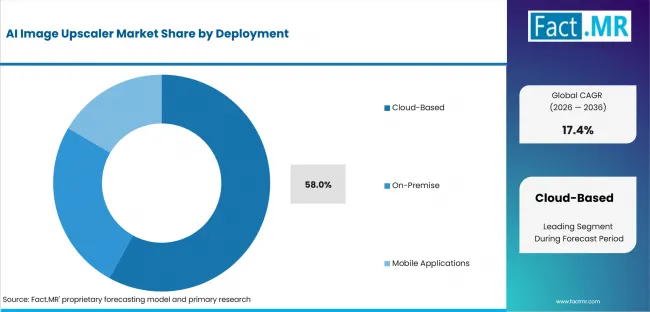
Ai Image Upscaler Market Analysis By Deployment | Source: Fact.MR
Cloud tools match short usage bursts since customers do not need to maintain GPUs or install heavy software. Central updates and APIs help providers serve casual users and teams with higher image volumes. This need is close to the API marketplace where access and routing affect software use.
Why does Photography Enhancement lead Application?
Photography Enhancement is projected to account for 34.0% share in 2026.
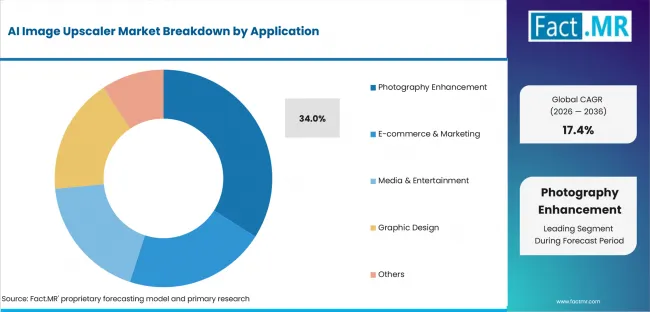
Ai Image Upscaler Market Analysis By Application | Source: Fact.MR
Photography has the widest pool of low-resolution source files across portraits and scanned images. Users can judge improvement quickly. Commercial use still requires careful review of faces and text before release.
Why do Individual Users lead End User?
Individual Users are projected to account for 39.0% share in 2026.
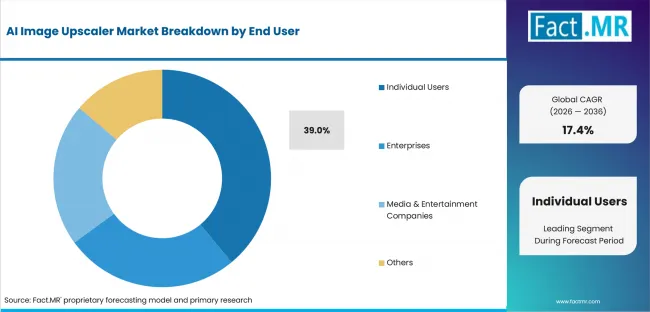
Ai Image Upscaler Market Analysis By End User | Source: Fact.MR
Individuals adopt through mobile apps and simple web flows without procurement or formal training. The segment leads in user count. Its conversion path resembles mobile applications where free entry can shape paid use.
What is accelerating AI Image Upscaler Market adoption, and what is holding it back?
Demand is expected to rise with visual content creation and cloud-based tools. Growth may be limited by inconsistent output quality and content-control concerns.
Drivers Impact Analysis
| DRIVER | (~) % IMPACT ON CAGR | GEOGRAPHIC RELEVANCE | IMPACT TIMELINE |
|---|---|---|---|
| Visual-content production growth | +3.8% | USA, UK, South Korea | Short term (<= 2 years) |
| Cloud workflow access | +3.0% | USA, Canada, Australia | Short term (<= 2 years) |
| E-commerce image repair | +2.4% | USA, Germany, UK | Medium term (2-4 years) |
| Creative-suite integration | +1.8% | Japan and South Korea | Medium term (2-4 years) |
| Archive and restoration use | +1.1% | Developed digital-content markets | Long term (>= 4 years) |
Source: Fact.MR analysis. Updated Aug 3, 2026
- Visual-content production growth: Teams are expected to produce more image variants for social posts and product pages.
- Cloud workflow access: Browser-based tools are expected to shorten adoption since users can test enhancement before a software plan.
- E-commerce image repair: Marketplace sellers need consistent product visuals when source images arrive from older listings. This connects with cognitive commerce where better product content supports digital buying paths.
Opportunity Impact Analysis
| OPPORTUNITY | (~) % IMPACT ON CAGR | GEOGRAPHIC RELEVANCE | IMPACT TIMELINE |
|---|---|---|---|
| Integrated batch workflows | +1.8% | Japan, USA, Germany | Medium term (2-4 years) |
| API-based image enhancement | +1.4% | USA and UK | Medium term (2-4 years) |
| On-device and local processing | +0.9% | South Korea and Germany | Long term (>= 4 years) |
| Provenance and review controls | +0.7% | Canada and Australia | Long term (>= 4 years) |
Source: Fact.MR analysis. Updated Aug 3, 2026
- Integrated batch workflows: The primary opening is found in products that combine queues and review views for repeat work.
- API-based image enhancement: Platform customers are expected to value APIs when upscaling becomes part of upload and publishing systems.
- On-device and local processing: Local options are expected to appeal where personal images or owned assets cannot enter public cloud tools. The same concern appears in edge AI tuning kits.
Restraints Impact Analysis
| RESTRAINT | (~) % IMPACT ON CAGR | GEOGRAPHIC RELEVANCE | IMPACT TIMELINE |
|---|---|---|---|
| Output fidelity risk | -1.5% | Global | Short term (<= 2 years) |
| Data-governance concerns | -1.1% | Germany, Canada, UK | Short term (<= 2 years) |
| Low willingness to pay | -0.8% | Consumer-heavy markets | Medium term (2-4 years) |
| Compute and latency costs | -0.6% | High-volume cloud use | Long term (>= 4 years) |
Source: Fact.MR analysis. Updated Aug 3, 2026
- Output fidelity risk: AI upscaling can change small details instead of only clarifying them. This makes review necessary for faces and logos.
- Data-governance concerns: Customers handling private or owned content are expected to compare storage and deletion terms before uploads.
- Low willingness to pay: Many individual users test free tools first. This can slow conversion to recurring paid plans.
Which countries are scaling AI Image Upscaler Market fastest?
- South Korea leads the country comparison as entertainment content and mobile-first creation encourage faster adoption. The USA follows through its large creator economy and online retail image demand.
- Canada benefits from small-business use of cloud tools, while the UK grows through agency adoption.
- Australia expands through creator publishing, Germany through enterprise and e-commerce demand, and Japan through quality-focused design and media workflows that require dependable output and strong workflow fit.
-
Comparable CAGRs can create different commercial routes across these countries. Providers are expected to adjust pricing and support models to match local review behavior.
The full report provides country-level CAGR analysis across North America, Latin America, Europe, East Asia, South Asia, Oceania and the Middle East and Africa.
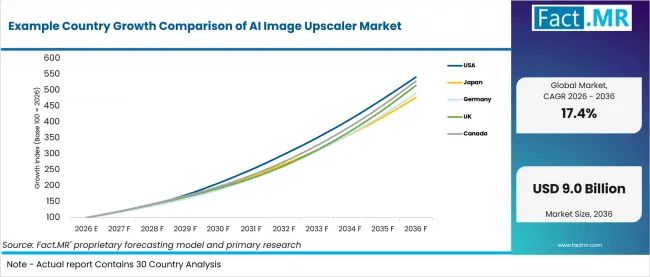
Example Country Growth Comparison Of Ai Image Upscaler Market | Source: Fact.MR
Country CAGR (2026-2036) USA 18.4% Japan 16.9% Germany 17.2% UK 17.8% Canada 18.1% Australia 17.5% South Korea 18.7% Source: Fact.MR analysis. Updated Aug 3, 2026
What supports USA adoption?
18.4% CAGR, supported by creator tools and online-retail image volume.
USA growth reflects marketers and online sellers that handle large visual-asset volumes. Software buyers are expected to test output quality before moving enhancement into paid workflows.
How does Japan perform?
16.9% CAGR, led by media quality standards and workflow integration.
Japan growth is shaped by customers that value controlled output and rights management. Media teams are expected to review enhanced files before release.
What shapes Germany’s outlook?
17.2% CAGR, backed by e-commerce use and data-protection review.
German demand reflects agency and e-commerce use cases. Customers are expected to review cloud processing against internal data rules before expanding paid use.
How is the UK developing demand?
17.8% CAGR, supported by agency workflows and business AI use.
UK demand is tied to service firms that need faster content preparation across brands. Agencies are expected to prefer tools that fit existing approval workflows.
What supports Canada’s growth?
18.1% CAGR, supported by cloud use and privacy-aware small businesses.
Canada growth reflects creative services and small-business content needs. Customers are expected to favor cloud tools that explain privacy terms in simple language.
How is Australia scaling adoption?
17.5% CAGR, supported by creator workflows and marketplace content.
Australia growth is shaped by small businesses that need better visuals without large production budgets. Local support remains important after trial use moves into paid work.
Why does South Korea lead the listed countries?
18.7% CAGR, driven by AI infrastructure and media technology demand.
South Korea growth reflects entertainment content and mobile-first creation. Customers are expected to test cloud and local tools when output review remains easy to manage.
Who leads the AI Image Upscaler Market?
Adobe and Canva show the clearest workflow relevance through creative platforms. Topaz Labs competes through specialist enhancement tools. NVIDIA supports the field through GPUs and AI video enhancement.
From 2026 to 2036, competition is expected to depend on fidelity and batch speed. Privacy terms and workflow fit are expected to shape paid conversion. Providers that show clear source controls are expected to gain enterprise trust.
Which companies are the key providers?
Key companies include Adobe Inc.; Topaz Labs; Canva; NVIDIA Corporation; Pixelcut; Bending Spoons S.p.A., through Remini; Let's Enhance; Shopsense Retail Technologies Limited, through Upscale.media; HitPaw; Icons8.
- Adobe Inc.
- Topaz Labs
- Canva
- NVIDIA Corporation
- Pixelcut
- Bending Spoons S.p.A., through Remini
- Let's Enhance
- Shopsense Retail Technologies Limited, through Upscale.media
- HitPaw
- Icons8
Bibliography
- Adobe. (2025, October 28). Adobe delivers new AI innovations, assistants and models across Creative Cloud to empower creative professionals.
- Canva. (2024, July 30). Welcome to Canva, Leonardo!
- NVIDIA. (2024, November 12). GPU’s companion: NVIDIA app supercharges RTX GPUs with AI-powered tools and features.
- U.S. Census Bureau. (2026, May 26). Large firms with at least 20 employees biggest AI users.
This Report Answers
- The report provides strategic intelligence on Deployment and Application choices that shape image-quality workflows.
- Segment analysis covers Cloud-Based deployment and Photography Enhancement as the share leaders within the 2026 market.
- Country outlook evaluates the USA and South Korea. Canada and the UK are included. Australia and Germany follow. Japan completes the growth comparison.
- Competitive analysis profiles Adobe and Canva. It profiles NVIDIA and Topaz Labs as core technology names. Pixelcut and Remini complete part of the provider set. Let's Enhance and Shopsense Retail Technologies Limited, through Upscale.media follow. HitPaw and Icons8 complete the list.
- Workflow assessment covers output fidelity and privacy terms. Batch processing and review controls complete the commercial view.
What does the AI Image Upscaler Market cover?
AI image upscaling software and services are used to enlarge low-resolution images where resolution and visible detail affect commercial use.
The AI Image Upscaler Market covers cloud tools and web services used to improve image resolution. Coverage includes paid upscaling functions inside broader design suites when enhancement use is identifiable.
What is included in the scope?
AI image upscaler tools are used by individuals and creators. Photographers, agencies and e-commerce teams form another user base. Publishers and enterprises are included when paid enhancement use is identifiable.
The scope includes Deployment and Application. It includes End User, Technology and Industry Vertical. It covers cloud-based tools and SaaS platforms. Web-based services and on-premise products are included when paid upscaling use is identifiable.
What is excluded from the scope?
General photo-editing tools and image-generation products remain outside the scope when upscaling revenue cannot be separated.
The scope excludes basic resizing and manual retouching. Generic design subscriptions without identifiable upscaling revenue remain outside the boundary. Camera hardware, scanning devices and finished-content services are excluded.
How Was the Analysis Built?
The analysis draws on 120+ sources and 35+ company portfolios. It reviews 25+ countries and more than 20 industry interviews.
- Primary Research: Primary research includes discussions with manufacturers and service providers. It covers technology developers, distributors and end users. These discussions examine purchasing priorities and approval requirements. They review operating barriers and competitive positioning.
- Desk Research: Desk research covers government statistics and regulatory publications. It reviews company filings, trade data and technical sources. Industry associations are used where they support the market boundary. Every retained source appears in the bibliography.
- Market Sizing and Forecasting: Market estimates combine historical performance and demand indicators. Pricing trends and segment shares are reviewed against company participation. Country-level growth, adoption patterns and market barriers are then reconciled.
- Data Validation and Update Cycle: Findings are validated by comparing interviews with public data. Company activity and regulatory changes are checked during each review cycle. Updates examine launches, partnerships and shifts in commercial adoption.
Segmentation
What is the report’s scope and coverage?
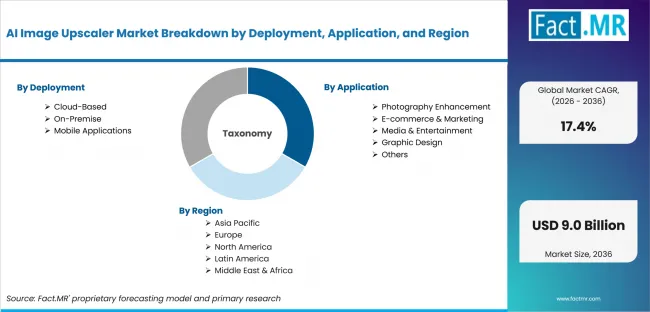
Ai Image Upscaler Market Breakdown By Deployment, Application, And Region | Source: Fact.MR
| Attribute | Details |
|---|---|
| Quantitative Units | USD billion in 2026 to USD billion by 2036 at CAGR |
| Market Definition | AI image upscaling software and services that enlarge low-resolution images through AI-based reconstruction for commercial or personal use. |
| Deployment | Cloud-Based; SaaS Platforms; Web-Based Services; On-Premise |
| Application | Photography Enhancement; Portrait Enhancement; Landscape Photography; E-commerce & Marketing |
| End User | Individual Users; Content Creators; Photography Enthusiasts; Enterprises |
| Technology | Deep Learning-Based Upscaling; Generative AI Models; Convolutional Neural Networks; GAN-Based Upscaling |
| Industry Vertical | Media & Entertainment; Film Production; Streaming Platforms; Retail & E-commerce |
| Regions Covered | North America; Latin America; Europe; East Asia; South Asia and Pacific; Middle East and Africa |
| Countries Covered | USA; Japan; Germany; UK; Canada; Australia; South Korea |
| Key Companies Profiled | Adobe Inc.; Topaz Labs; Canva; NVIDIA Corporation; Pixelcut; Bending Spoons S.p.A., through Remini; Let's Enhance; Shopsense Retail Technologies Limited, through Upscale.media; HitPaw; Icons8 |
| Forecast Period | 2026 to 2036 |
| Approach | Hybrid top-down and bottom-up analysis using image-workflow demand; paid tool adoption; deployment mix; use-case fit; pricing signals; country patterns and company portfolio validation. |
Source: Fact.MR analysis. Updated Aug 3, 2026
How is the market segmented?
-
By Deployment
- Cloud-Based
- Carbapenems
- Cephalosporins
- SaaS Platforms
- Web-Based Services
- On-Premise
- Colistin
- Polymyxin B
- Enterprise Software
- Local Workstations
- Mobile Applications
- Tigecycline
- Minocycline
- Android Apps
- iOS Apps
- Combination Therapies
- Beta-Lactam/Beta-Lactamase Inhibitors
- Multi-Drug Combination Regimens
- Novel Antimicrobials
- Sulbactam-Based Therapies
- Investigational Antibiotics
- Cloud-Based
-
By Application
- Photography Enhancement
- Ventilator-Associated Pneumonia
- Non-Ventilated HAP
- Portrait Enhancement
- Landscape Photography
- E-commerce & Marketing
- ICU Patients
- Long-Term Ventilation
- Product Image Enhancement
- Advertising Creatives
- Media & Entertainment
- Adult Patients
- Pediatric Patients
- Film Restoration
- Content Creation
- Graphic Design
- Carbapenem-Resistant Infections
- Multidrug-Resistant Infections
- Print Design
- Digital Artwork
- Others
- Post-Surgical Pneumonia
- Immunocompromised Patients
- Healthcare Imaging
- Satellite & Scientific Imaging
- Photography Enhancement
-
By End User
- Individual Users
- Tertiary Care Hospitals
- Community Hospitals
- Content Creators
- Photography Enthusiasts
- Enterprises
- Pulmonology Clinics
- Infectious Disease Clinics
- Marketing Agencies
- E-commerce Companies
- Media & Entertainment Companies
- Day Care Centers
- Outpatient Surgical Facilities
- Film Studios
- Publishing Houses
- Others
- Clinical Research Centers
- Academic Medical Centers
- Educational Institutions
- Healthcare Organizations
- Home Healthcare Settings
- Home Infusion Services
- Long-Term Care Facilities
- Individual Users
-
By Technology
- Deep Learning-Based Upscaling
- Public Hospitals
- Private Hospitals
- Generative AI Models
- Convolutional Neural Networks
- GAN-Based Upscaling
- Chain Pharmacies
- Independent Pharmacies
- SRGAN
- ESRGAN
- Diffusion-Based Upscaling
- E-Pharmacy Platforms
- Hospital E-Dispensing
- Latent Diffusion Models
- Denoising Diffusion Models
- Others
- Infectious Disease Pharmacies
- High-Cost Drug Pharmacies
- Hybrid AI Models
- Traditional Super-Resolution Algorithms
- Government Procurement
- Public Health Programs
- Defense Healthcare Procurement
- Deep Learning-Based Upscaling
-
By Industry Vertical
- Media & Entertainment
- Infusion Therapy
- Hospital IV Administration
- Film Production
- Streaming Platforms
- Retail & E-commerce
- Tablets
- Capsules
- Online Retailers
- Digital Marketing
- Information Technology
- Nebulized Antibiotics
- Dry Powder Inhalers
- Software Development
- Cloud Service Providers
- Healthcare
- Single-Dose Injection
- Multiple-Dose Injection
- Medical Imaging
- Diagnostic Centers
- Others
- IV Followed by Oral
- Multi-Route Administration
- Education
- Manufacturing
- Media & Entertainment
-
By Region
- North America
- Latin America
- Europe
- East Asia
- South Asia and Pacific
- Middle East and Africa
Frequently Asked Questions
Which Deployment leads the market?
Which Application leads the market?
Which End User leads the market?
Which country records the highest listed CAGR?
What is the primary driver in this market?
What is the main restraint?
Why do cloud-based tools lead demand?
Who worked on this report


Preview the report firsthand - request a free sample
Free SampleGet the brochure for pricing and purchase details
Download PDF