- Market Value (2025): USD 40.3 Bn
- Estimated Value (2026): USD 57.2 Bn
- Forecast Value (2036): USD 1893.3 Bn
- CAGR (2026-2036): 41.9%
What is the AI in mining market forecast to be worth by 2036?
USD 57.2 billion in 2026 to USD 1,893.3 billion by 2036, at 41.9% CAGR.
- The AI in mining market crossed a valuation of USD 40.3 billion in 2025, reflected by automation software across processing and safety operations.
- Demand is projected to increase from USD 57.2 billion in 2026 to USD 1,893.3 billion by 2036.
- Market is forecast to record 41.9% CAGR from 2026 to 2036 since OEM teams and control-room managers adopt AI for safer mine decisions.
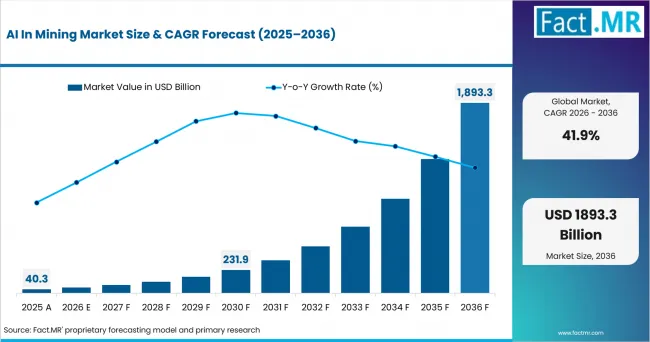
Ai In Mining Market Market Value Analysis | Source: Fact.MR
What are the defining numbers behind AI in mining market growth?
USD 1,836.1 billion absolute opportunity by 2036, led by predictive maintenance and autonomous haulage.
- Demand drivers in the market
- Mine operators depend on dispatch intelligence supported by loading and queue data across production shifts.
- Safety managers require AI alerts built around worker-location signals and high-risk equipment interactions.
- Processing teams use analytics responding to ore variability and recovery losses during live operations.
- Equipment OEMs need connected platforms linking autonomous machines with service and maintenance evidence.
- Key segments analyzed
- By Component: Software & platforms are estimated to represent 47% share in 2026, shaped by inspection and predictive maintenance.
- By Application: Predictive maintenance is forecast to account for 28% share in 2026, reinforced by equipment uptime and maintenance planning.
- By Mining Type: Surface mining is projected to account for 59% share in 2026, driven by fleet automation and open-pit monitoring needs.
- By Deployment: Cloud is projected to account for 54% share in 2026, backed by multi-site analytics and remote operations access.
- Analyst opinion at Fact.MR
- Shambhu Nath Jha, senior analyst at Fact.MR, opines, “Mining automation AI is attracting attention due to a practical site-control gap. Operators need fewer disconnected dashboards and more systems guiding decisions during changing ground and ore conditions. Adoption is expected to favor providers proving mixed-fleet integration and documented safety gains.”
- Strategic implications
- Mine operators are likely to map AI deployment against dispatch and safety workflows before scaling.
- OEMs are expected to test autonomy systems across mixed fleets and uneven communication conditions.
- Software providers are anticipated to design cloud and hybrid packages suited to remote sites with lean technical teams.
- Safety managers are projected to pair AI alerts with inspection records and response procedures.
- Komatsu announced in April 2026 it had commissioned its 1,000th ultra-class autonomous haul truck using FrontRunner Autonomous Haulage System. Komatsu also reported FrontRunner users had moved more than 11.5 billion metric tons of material. Development reflects mining automation AI shifting from pilot systems into fleet-level operation across demanding open-pit environments.
India is projected to record 43.7% CAGR by 2036, reflected by mineral-block execution and mine planning needs. China is estimated to post 43.0% CAGR through 2036 shaped by coal output scale and industrial modernization. Australia is anticipated to advance at 41.7% CAGR from 2026 to 2036, driven by autonomous haulage and remote operations. United Kingdom is forecast to hold 41.4% CAGR between 2026 and 2036, influenced by quarrying efficiency and automation services. United States is expected to record 41.2% CAGR during the study period, reinforced by safety rules and autonomous equipment adoption. Germany is projected to post 40.9% CAGR during the forecast period, owing to industrial automation strength and process-control expertise. Japan is anticipated to record 40.6% CAGR by 2036, shaped by industrial production systems and critical mineral security programs.
Komatsu announced in April 2026 it had commissioned its 1,000th ultra-class autonomous haul truck using FrontRunner Autonomous Haulage System. Komatsu also reported FrontRunner users had moved more than 11.5 billion metric tons of material. Development reflects mining automation AI shifting from pilot systems into fleet-level operation across demanding open-pit environments.
India is projected to record 43.7% CAGR by 2036, reflected by mineral-block execution and mine planning needs. China is estimated to post 43.0% CAGR through 2036 shaped by coal output scale and industrial modernization. Australia is anticipated to advance at 41.7% CAGR from 2026 to 2036, driven by autonomous haulage and remote operations. United Kingdom is forecast to hold 41.4% CAGR between 2026 and 2036, influenced by quarrying efficiency and automation services. United States is expected to record 41.2% CAGR during the study period, reinforced by safety rules and autonomous equipment adoption. Germany is projected to post 40.9% CAGR during the forecast period, owing to industrial automation strength and process-control expertise. Japan is anticipated to record 40.6% CAGR by 2036, shaped by industrial production systems and critical mineral security programs.
How does the AI in mining market break down by segment?
Software & Platforms lead with 47%; cloud is anticipated to lead at 54.0%.
What is anticipated to lead deployment demand?
Cloud is estimated to secure 54.0% share in 2026.
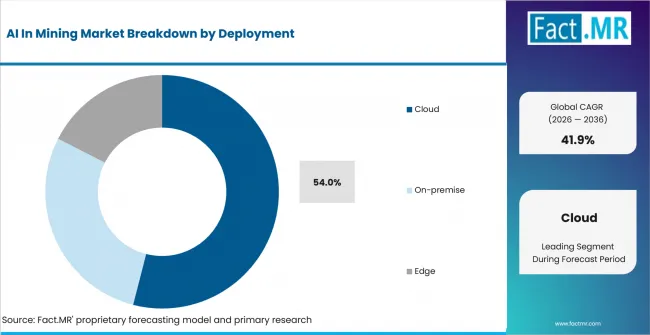
Ai In Mining Market Analysis By Deployment | Source: Fact.MR
Cloud is projected to account for 54.0% share in 2026, led by remote access and multi-mine data visibility. On-premise systems serve sites keeping operational technology inside local control environments. Ericsson and Epiroc expanded an alliance in June 2026 to support LTE and 5G connectivity for surface and underground automation.
Which component is likely to lead demand?
Software & Platforms account for 47.0% share in 2026.
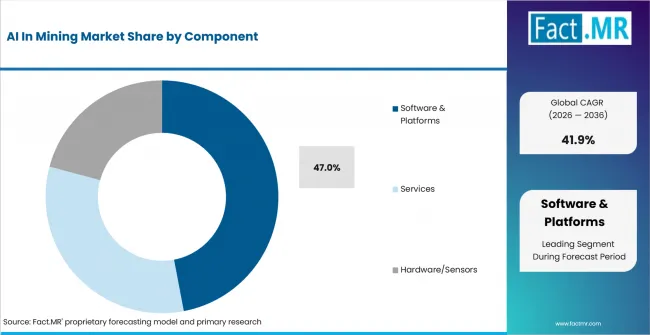
Ai In Mining Market Analysis By Component | Source: Fact.MR
Software & Platforms is estimated to represent 47.0% share in 2026, shaped by predictive maintenance and safety analytics. Services follow as mines need integration support and workflow redesign. API tools serve data exchange across geology and processing systems. Equipment remains linked to onboard sensing and automation hardware. Caterpillar reported in January 2026 nearly 700 autonomous trucks had safely hauled more than 11 billion tonnes of material.
Which application area is forecast to capture the leading share?
Predictive maintenance is estimated to secure 28% share in 2026.
Predictive maintenance is projected to account for 28% share in 2026, led by equipment uptime and maintenance planning. Autonomous haulage follows through fleet productivity and route coordination. Ore grade estimation supports exploration and processing decisions. Safety monitoring and exploration tools retain use across risk control and resource mapping. Ericsson and Epiroc expanded an alliance in June 2026 to support LTE and 5G connectivity for surface and underground automation.
Which mining type is anticipated to hold the leading position?
Surface mining is projected to represent 59% share in 2026.
Surface mining is anticipated to capture 59% share in 2026, supported by larger fleet visibility and open-pit monitoring needs. Underground mining follows through ventilation control and safety automation. India’s Ministry of Mines reported in March 2026 stating 30 mineral blocks were operationalized during FY 2025-26, making execution speed a practical automation use case.
What is accelerating AI in mining market adoption, and what is holding it back?
Autonomous operations drive it; integration burden restrains it.
Drivers impact analysis
| Driver | (~) % impact on CAGR | Geographic relevance | Impact timeline |
|---|---|---|---|
| Autonomous haulage expansion | +6.8% | Australia, United States, China | Medium term (2-4 years) |
| Critical mineral production pressure | +5.9% | India, China, Australia | Medium term (2-4 years) |
| Safety and zero-entry mining needs | +4.7% | United States and underground mines | Short term (<= 2 years) |
| Remote operations center adoption | +4.1% | Australia and North America | Medium term (2-4 years) |
| Ore-grade and processing variability | +3.5% | Copper, lithium, and iron ore regions | Long term (>= 4 years) |
Source: Fact.MR analysis. Updated Jul 9, 2026
- Autonomous haulage expansion: Autonomous haulage moves AI from reporting into active mine control. Fleet systems reduce manual dispatch pressure and help operators manage haul roads during changing shift conditions. Adoption is expected to expand as mines link dispatch models with machine navigation and maintenance signals.
- Critical mineral production pressure: Critical mineral schedules push mine owners toward faster planning and asset use. IEA reported in May 2025 stating lithium demand rose by nearly 30% during 2024, while graphite and rare earth demand rose 6-8%. AI planning is projected to support sequencing and equipment allocation.
- Safety and zero-entry mining needs: Safety demand supports remote control and worker-removal programs. MSHA reported 28 mining fatalities in fiscal 2025, down from 31 in fiscal 2024. Mine operators are anticipated to connect AI alerting with training and emergency response workflows.
- Remote operations center adoption: Remote operations are becoming a staffing and control tool for isolated mines. Operators use AI to review equipment health and production deviations from centralized rooms. Wider deployment is estimated to follow as communications layers improve across open-pit and underground sites.
- Ore-grade and processing variability: Lower ore quality increases pressure on predictive control and processing analytics. Processing AI helps teams adjust operating parameters before recovery losses expand across production shifts. Demand is forecast to expand as operators protect yields in lithium and iron ore flowsheets.
Opportunity impact analysis
| Opportunity | (~) % impact on CAGR | Geographic relevance | Impact timeline |
|---|---|---|---|
| AI dispatch and fleet control | +5.4% | Australia, China, United States | Medium term (2-4 years) |
| Underground perception systems | +4.8% | Canada, Australia, Europe | Medium term (2-4 years) |
| Cloud model deployment | +4.2% | Global multi-site miners | Short term (<= 2 years) |
| Predictive processing control | +3.7% | Copper, iron ore, lithium mines | Long term (>= 4 years) |
Source: Fact.MR analysis. Updated Jul 9, 2026
- AI dispatch and fleet control: Dispatch systems offer a clear entry point due to direct influence on idle time and equipment use. Fleet-control tools also provide measurable evidence for site managers before larger autonomy programs. Providers are expected to package dispatch intelligence with maintenance and safety modules.
- Underground perception systems: Underground mines need better awareness due to limited sight lines and changing ground conditions. NIOSH stated in July 2025, reporting its mining program studies machine safety and worker interaction with automated systems. AI perception is anticipated to expand across loader and inspection tools.
- Cloud model deployment: Cloud deployment helps operators update models across several sites without rebuilding local infrastructure. Multi-site miners need a simpler route to compare equipment behavior and safety exceptions. Cloud platforms are expected to gain share as secure connectivity improves near operating areas.
- Predictive processing control: Processing plants need ore-aware control tools as input quality changes during production. India reported refined copper output increased 12.6% to 5.73 lakh tonnes in FY 2024-25. AI control is estimated to help processing teams reduce variability during higher-output periods.
Restraints impact analysis
| Restraint | (~) % impact on CAGR | Geographic relevance | Impact timeline |
|---|---|---|---|
| Legacy system integration burden | -4.9% | Global mine sites | Medium term (2-4 years) |
| Connectivity gaps underground | -3.8% | Underground mines | Short term (<= 2 years) |
| Capital discipline after weak investment | -3.4% | Critical mineral projects | Medium term (2-4 years) |
| Workforce and safety validation needs | -2.9% | United States, Australia, Europe | Long term (>= 4 years) |
Source: Fact.MR analysis. Updated Jul 9, 2026
- Legacy system integration burden: Many mines operate mixed fleets, older control systems, and separate databases. Epiroc stated in September 2024, Groundbreaking Intelligence addresses mixed fleets and existing systems without forcing mines to start over. Adoption is expected to slow at sites lacking clean data pathways.
- Connectivity gaps underground: Underground mines need resilient networks before AI tools support real-time decisions. Communication limits affect vehicle location and equipment-health data during active shifts. Deployment is projected to remain staged in deep mines and infrastructure-limited operating areas.
- Capital discipline after weak investment: Capital discipline affects mine automation programs and technology upgrades. IEA reported in May 2025, STEPS requires around USD 500 billion in new mining capital investment between 2025 and 2040. Automation proposals are likely to need stronger proof around downtime reduction and safety gains.
- Workforce and safety validation needs: AI systems need operator trust and clear escalation rules before full operational use. ABB noted in November 2025 stating phased implementation helps reduce change risk in all-electric mine programs. Site teams are anticipated to expand validation before high-risk autonomy approvals.
Which countries are scaling AI in mining market demand?
India 43.7%; China 43.0%; Australia 41.7%; United Kingdom 41.4%; United States 41.2%; Germany 40.9%; Japan 40.6%.
AI in mining market is segmented into North America, Latin America, Europe, East Asia, South Asia and Pacific, and Middle East and Africa.
| Country | CAGR |
|---|---|
| India | 43.7% |
| China | 43.0% |
| Australia | 41.7% |
| United Kingdom | 41.4% |
| United States | 41.2% |
| Germany | 40.9% |
| Japan | 40.6% |
Source: Fact.MR analysis. Updated Jul 9, 2026
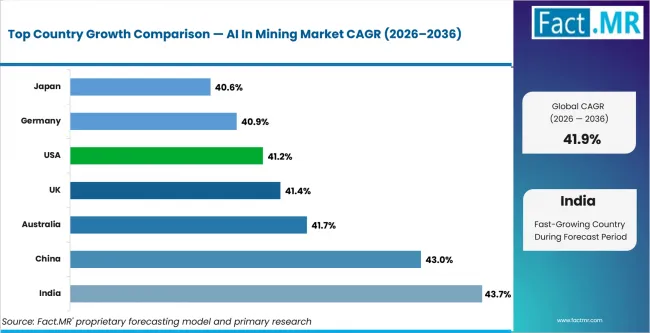
Ai In Mining Market Cagr Analysis By Country | Source: Fact.MR
What is powering India’s lead?
43.7% CAGR, driven by mineral-block execution and mine-production scale.
India’s mine development pipeline is moving from auctions into operational blocks. Market demand is projected to record 43.7% CAGR through 2036, led by mine teams seeking workflow tools for production planning and contractor coordination. Press Information Bureau reported in March 2026 that 200 mineral blocks were auctioned during FY 2025-26, including 22 critical mineral blocks.
How is China scaling AI in mining demand?
43.0% CAGR, backed by coal output scale and industrial modernization.
China’s mining base creates a large operating environment for fleet optimization and equipment monitoring. Market demand is estimated to post 43.0% CAGR from 2026 to 2036, since operators apply AI to high-volume extraction and energy-material logistics. National Bureau of Statistics of China reported raw coal output of 4.83 billion tons during 2025.
What supports Australia’s outlook?
41.7% CAGR, influenced by remote operations and autonomous haulage.
Australia remains a major testbed for remote mine control due to large iron ore operations and long-haul cycles. Market demand is anticipated to advance at 41.7% CAGR by 2036 as operators use AI dispatch and autonomous systems to protect productivity. Australian Department of Industry, Science and Resources reported iron ore export volumes rose 6% year-on-year in March quarter 2026.
What underpins United Kingdom demand?
41.4% CAGR, guided by quarrying efficiency and automation services.
United Kingdom demand centers on mine services and control-system expertise. Market demand is forecast to hold 41.4% CAGR during the forecast period, led by operators prioritizing maintenance and safety workflows. Office for National Statistics reported mining and quarrying output fell 2.5% month-on-month in November 2025.
How is United States demand developing?
41.2% CAGR, reinforced by safety enforcement and autonomous equipment adoption.
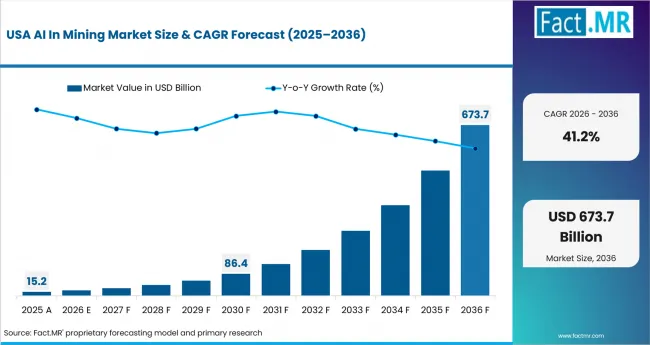
Ai In Mining Market Country Value Analysis | Source: Fact.MR
United States mine operators are adopting AI through safety monitoring and equipment-health platforms. Market demand is expected to record 41.2% CAGR from 2026 to 2036, due to high-risk work moving toward remote supervision. MSHA reported 12,568 mines and 327,465 miners in fiscal 2025.
What supports Germany’s AI in mining outlook?
40.9% CAGR, shaped by industrial automation depth and process-control capability.
Germany’s mining AI demand is linked to industrial automation providers and mineral-processing engineering. Market demand is projected to post 40.9% CAGR through 2036, led by operators adopt analytics for process control and equipment reliability. Destatis reported new orders excluding large-scale orders rose 0.9% month-on-month in December 2025.
How is Japan advancing AI in mining demand?
40.6% CAGR, supported by industrial production systems and critical mineral security programs.
Japan’s demand profile centers on offshore resource evaluation, and equipment-linked automation. Market demand is anticipated to record 40.6% CAGR through 2036, supported by mine technology overlapping with manufacturing and mineral security planning. METI reported Japan’s production index reached 103.0 in May 2026, increasing 0.5% from the previous month.
Who leads the AI in mining market?
Caterpillar and Komatsu lead surface autonomy, while Sandvik and Epiroc strengthen underground automation capability.
Caterpillar brings Cat MineStar and Command for hauling into autonomy programs supported by field-proven truck deployment. Komatsu adds FrontRunner Autonomous Haulage System and a unified fleet-management framework across major surface mines. Both companies compete on installed fleet scale and operating data from demanding haulage environments.
Sandvik strengthens underground automation led by AutoMine Aura and loader-focused control systems. Epiroc adds Groundbreaking Intelligence and connectivity partnerships for automated sites. Hexagon contributes fleet awareness and mine-management systems. Hexagon reported in November 2025 that Drill Assist delivers up to 50% productivity increases. ABB supports electrification and mine-wide integration. Competition through 2036 is expected to be shaped by safety validation and network resilience.
Which companies are the key providers?
Caterpillar and Komatsu are key providers. Sandvik and Epiroc are also profiled. Hexagon and ABB complete the company set.
- Caterpillar Inc.
- Komatsu Ltd.
- Sandvik AB
- Epiroc AB
- Hexagon AB
- ABB Ltd.
Bibliography
- ABB. (2025, November 11). ABB launches refreshed vision for the all-electric mine. ABB.
- Australian Department of Industry, Science and Resources. (2026, June). Resources and energy quarterly: June 2026. Australian Government.
- Caterpillar Inc. (2026, January 7). Cat® autonomy solutions. Caterpillar Inc.
- Centers for Disease Control and Prevention. (2025, July 10). NIOSH Mining Program poised to support mining of critical minerals. Centers for Disease Control and Prevention.
- Epiroc. (2024, September 24). Epiroc’s Groundbreaking Intelligence: Helping mines accelerate digitalization. Epiroc.
- Ericsson. (2026, June 8). Ericsson and Epiroc expand alliance to accelerate mining automation and digital transformation. Ericsson.
- Federal Statistical Office of Germany. (2026, February 5). New orders in manufacturing in December 2025: +7.8% on the previous month. Destatis.
- Hexagon. (2025, November 4). Hexagon Drill Assist wins Mining Magazine 2025 Excellence Award. Hexagon.
- International Energy Agency. (2025, May 21). Global Critical Minerals Outlook 2025. International Energy Agency.
- Komatsu Ltd. (2026, April 22). FrontRunner Autonomous Haulage System continues to create value for customer operations, delivering scalable productivity and safety improvements. Komatsu Ltd.
- Ministry of Economy, Trade and Industry. (2026, June 30). Indices of industrial production. Government of Japan.
- Mine Safety and Health Administration. (2026, February 27). Mine safety and health at a glance: Fiscal year. U.S. Department of Labor.
- National Bureau of Statistics of China. (2026, January 20). Energy production in December 2025. National Bureau of Statistics of China.
- Office for National Statistics. (2026, January 15). Index of Production, UK: November 2025. Office for National Statistics.
- Press Information Bureau. (2025, May 5). Record production in mining in FY 2024–25. Government of India.
- Press Information Bureau. (2026, March 19). India achieves historic milestone of 200 mineral block auctions in FY 2025–26. Government of India.
- Press Information Bureau. (2026, March 30). Record 30 mineral blocks operationalised in FY 2025–26. Government of India.
- Sandvik Mining and Rock Solutions. (2026, May 26). Sandvik launches AutoMine® Aura, a first-of-its-kind automation platform for the future of mining. Sandvik Mining and Rock Solutions.
- U.S. Geological Survey. (2026, February 6). Mineral Commodity Summaries 2026. U.S. Geological Survey.
This Report Addresses
- Report provides strategic intelligence on AI in mining across application and deployment choices shaping automation programs.
- Regional outlook evaluates India, China, Australia, United Kingdom, United States, Germany, and Japan.
- Competitive analysis profiles Caterpillar, Komatsu, Sandvik, Epiroc, Hexagon, and ABB.
- Application assessment covers Predictive maintenance, autonomous haulage, ore grade estimation, safety monitoring, and exploration across adoption patterns.
- Deployment assessment covers cloud, on-premise, and edge operating environments.
- Application assessment covers workflow Predictive maintenance, autonomous haulage, ore grade estimation, safety monitoring, and exploration across mine operating systems.
- Forecast view uses official mine-safety data, mineral production evidence, company portfolio checks, and provider validation.
What does the AI in mining market cover?
Software, services, API tools, and equipment-linked systems used for mining automation AI.
AI in mining market covers artificial intelligence systems used to plan, monitor, automate, and optimize mining workflows. Coverage includes fleet dispatch, autonomous haulage support, predictive maintenance, ore sorting, safety monitoring, and control-room decision tools.
Market scope differs from general mining equipment since commercial value comes from AI-enabled decision support and automation logic. Standard trucks, drills, sensors, and control hardware are excluded unless sold as part of an AI-enabled mining automation system.
What is included in the scope?
AI in mining systems used across surface mines, underground mines, processing plants, and remote operations centers.
Scope includes software, services, API tools, and equipment-linked AI systems. Coverage includes cloud, on-premise, and edge. Applications include autonomous haulage support, safety monitoring, predictive maintenance, and ore grade estimation. Surface mines and underground mines are included whenever AI supports production, safety, maintenance, or control-room decisions.
What is excluded from the scope?
Standalone mining equipment and generic enterprise AI tools are outside the scope.
Scope excludes conventional mining machines sold without AI-enabled automation or analytics. General office software, unrelated BFSI systems, retail AI platforms, and consumer AI tools are excluded unless linked directly to mine production, safety, maintenance, or processing workflows.
How was the analysis built?
120+ sources, 40+ company portfolios, 25+ countries, 20+ interviews.
- Primary research:
- Primary research includes interviews with automation engineers, safety managers, processing plant teams, equipment dealers, control-room managers, and mining technology integrators involved in AI deployment and system qualification.
- Desk research:
- Desk research reviews official mineral production statistics, mine safety data, critical mineral outlooks, autonomous haulage records, supplier product portfolios, connectivity announcements, and mining automation technology releases.
- Market-sizing and forecasting:
- Forecasting uses market values, segment shares, country CAGRs, autonomous haulage attachment rates, software deployment models, mine operating-site counts, and AI workflow adoption signals.
- Data validation and update cycle:
- Forecasts are validated through provider checks, portfolio mapping, technical interviews, active company screening, official statistics review, and source-date checks covering all evidence used in the report.
Segmentation
What is the report’s scope and coverage?
| Attribute | Details |
|---|---|
| Quantitative units | USD billion in 2026 to USD billion by 2036 |
| Market definition | AI-enabled software, services, API tools, and equipment-linked systems designed to automate, optimize, monitor, and support mining operations |
| Deployment | Cloud; on-premise; edge |
| Component | Software & Platforms; Services; Hardware/Sensors |
| Application | Predictive Maintenance, Autonomous Haulage. Ore Grade Estimation, Safety Monitoring, Exploration |
| Regions covered | North America; Latin America; Europe; East Asia; South Asia and Pacific; Middle East and Africa |
| Countries covered | India; China; Australia; United Kingdom; United States; Germany; Japan |
| Key companies profiled | Caterpillar Inc.; Komatsu Ltd.; Sandvik AB; Epiroc AB; Hexagon AB; ABB Ltd. |
| Forecast period | 2026 to 2036 |
| Approach | Hybrid top-down and bottom-up approach using mine automation deployment, autonomous haulage penetration, software attachment rates, operating-site counts, safety evidence, mineral production signals, and supplier validation |
Source: Fact.MR analysis. Updated Jul 9, 2026
How is the market segmented?
-
By Deployment :
- Cloud
- On-premise
- Edge
-
By Component :
- Software & Platforms
- Services
- Hardware/Sensors
-
By Application :
- Predictive Maintenance
- Autonomous Haulage
- Ore Grade Estimation
- Safety Monitoring
- Exploration
-
By Region :
- North America
- United States
- Canada
- Latin America
- Brazil
- Mexico
- Chile
- Argentina
- Europe
- Germany
- United Kingdom
- France
- Italy
- Spain
- East Asia
- China
- Japan
- South Korea
- South Asia and Pacific
- India
- Australia
- Indonesia
- Thailand
- Middle East and Africa
- UAE
- Saudi Arabia
- South Africa
- North America
Frequently Asked Questions
Which deployment is anticipated to considerably lead the AI in mining market?
Which component is projected to dominate the AI in mining market?
Which country is expected to record the top CAGR in the AI in mining market?
How is China predicted to grow in the AI in mining market?
How is Australia set to perform in the AI in mining market?
How is the United Kingdom likely to expand in the AI in mining market?
How is the United States projected to rise in the AI in mining market?
How is Germany anticipated to expand in the AI in mining market?
How is Japan expected to grow in the AI in mining market?
What is the primary driver in the AI in mining market?
What is the main restraint in the AI in mining market?
Why is cloud important?
Why are mine operators expected to lead demand?
Which companies are active in the AI in mining market?
What does the report exclude?
Who worked on this report


Preview the report firsthand - request a free sample
Free SampleGet the brochure for pricing and purchase details
Download PDF