- Market Value (2025): USD 28.6 Bn
- Estimated Value (2026): USD 35.0 Bn
- Forecast Value (2036): USD 259.9 Bn
- CAGR (2026-2036): 22.2%
What is the AI in Sales Market forecast to be worth by 2036?
USD 35.0 billion in 2026 to USD 259.9 billion by 2036, at 22.2% CAGR.
- The AI in Sales Market crossed a valuation of USD 28.6 billion in 2025 as CRM platforms expanded embedded automation across prospecting and pipeline management.
- Demand is projected to increase from USD 35.0 billion in 2026 to USD 259.9 billion by 2036 across enterprise sales operations.
- The market is forecast to record a 22.2% CAGR from 2026 to 2036 as sales teams and revenue operations groups automate repetitive decision work.
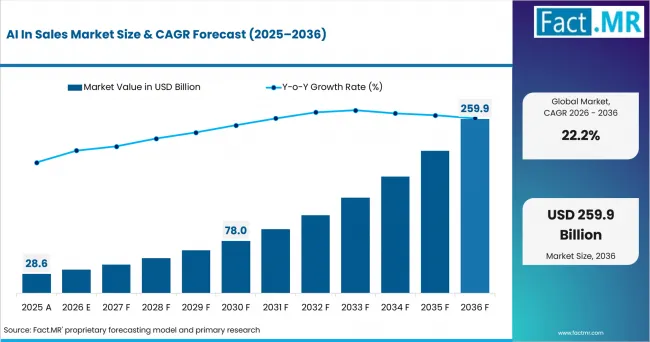
Ai In Sales Market Market Value Analysis | Source: Fact.MR
What are the defining numbers behind AI in Sales Market growth?
USD 224.9 billion absolute opportunity by 2036, led by Software and Cloud deployment alongside SME demand.
- Demand Drivers in the Market
- Sales operations teams need reliable CRM context because generic model output becomes less useful when account history and opportunity stages are incomplete.
- Field sales managers need short meeting preparation cycles while sellers handle more account signals across email and customer relationship systems.
- Revenue operations leaders need governed automation owing to rising pressure to connect recommendations with approved data sources and permission rules.
- SME sales teams need packaged workflows so prospect research and follow-up drafting do not require a separate internal AI engineering function.
- Key Segments Analyzed
- By Component: Software is expected to account for 40.7% share in 2026, driven by embedded scoring and assistant functions inside daily seller interfaces.
- By Deployment: Cloud is projected to hold 48.4% share in 2026, supported by faster model updates and easier integration across distributed sales teams.
- By Organization Size: SME is anticipated to record 47.8% share in 2026, owing to packaged tools that reduce manual prospect research and follow-up work.
- By Application: Workflow automation is estimated to hold 51.9% share in 2026, attributable to immediate time savings across preparation and CRM update tasks.
- By End Use: BFSI is forecast to capture 41.5% share in 2026, shaped by large relationship teams and strict requirements for traceable customer interactions.
- Analyst Opinion at Fact.MR
- Shambhu Nath Jha, Senior Analyst at Fact.MR, states, “Sales AI adoption depends less on model selection and more on context quality combined with clear permission controls inside revenue workflows. Adoption is expected to favor platforms that connect account history to seller actions without forcing constant data entry. Providers should combine CRM-native context with workflow controls and measurable deal-stage outcomes across defined sales processes.”
- Strategic Implications
- CRM platform vendors should measure whether AI suggestions reduce seller preparation time without creating duplicate records or conflicting account guidance.
- Revenue operations teams should map automation permissions before enabling agents that update opportunities or contact prospects without manual review.
- Sales enablement leaders should test recommendation quality across different deal stages before using generated guidance inside coaching and performance reviews.
- IT procurement teams should compare integration depth and audit controls before adding separate sales AI tools beside an existing CRM platform.
Organizations are increasingly adopting AI-powered sales platforms that connect predictive insights directly with frontline execution. For example, Clari + Salesloft connected Clari forecasting insights directly to Salesloft execution workflows for revenue teams in April 2026. The company also introduced a Model Context Protocol server that gives approved AI tools access to live revenue intelligence. The development reflects a market shift toward systems that connect forecast insight with seller action without moving data through manual exports.
India is forecast to record 24.0% CAGR during the forecast period, supported by wider AI infrastructure access and a large technology services base. China is projected to post 23.3% CAGR by 2036, shaped by high online transaction volumes and rapid deployment of AI in retail applications. Australia is anticipated to register 22.0% CAGR over the assessment period, attributable to broader business AI use and cloud-based selling systems. The United Kingdom is estimated to advance at 21.7% CAGR between 2026 and 2036, influenced by enterprise experimentation and customer data modernization. The United States is expected to expand at 21.5% CAGR across the forecast horizon, led by deep sales engagement software ecosystems and enterprise data availability.
How does the AI in Sales Market break down by segment?
Software is forecast to lead with 40.7% share; Cloud is anticipated to hold 48.4% share.
Which Component dominates?
Software is projected to account for 40.7% share in 2026
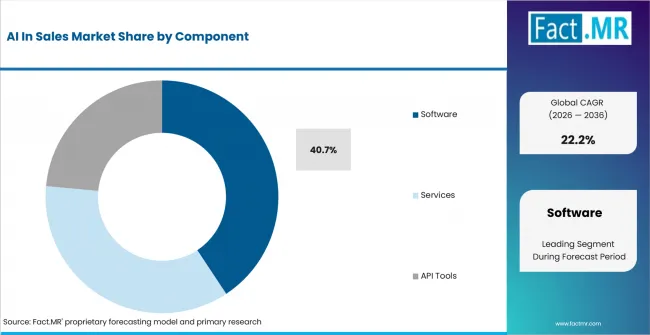
Ai In Sales Market Analysis By Component | Source: Fact.MR
Software is expected to represent 40.7% share in 2026, because sales teams prefer AI functions inside systems where opportunities are already managed. Services remain relevant for integration and workflow design while API Tools support specialist extensions that connect approved models to customer records. Eurostat reported in December 2025 that 34.70% of EU enterprises using AI applied it to marketing or sales purposes during 2025. That pattern supports software demand tied directly to commercial workflows where account context and customer interaction tasks already sit together.
What leads the Deployment segment?
Cloud is estimated to garner 48.4% share in 2026
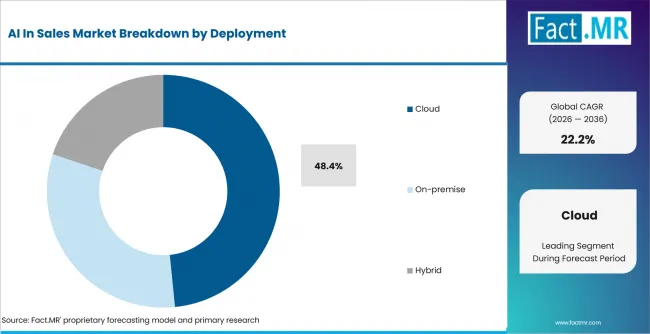
Ai In Sales Market Analysis By Deployment | Source: Fact.MR
Cloud is projected to capture 48.4% share in 2026, owing to faster implementation and simpler access across distributed revenue teams. On-premise environments serve accounts with tighter data controls while Hybrid deployment supports phased migration from legacy customer systems. The Office for National Statistics reported in March 2025 that 69% of UK firms had adopted cloud computing systems or applications. Existing cloud use lowers integration friction for customer relationship management software that adds AI assistance inside established account workflows.
How does Organization Size shape demand?
SMEs are anticipated to record 47.8% share in 2026
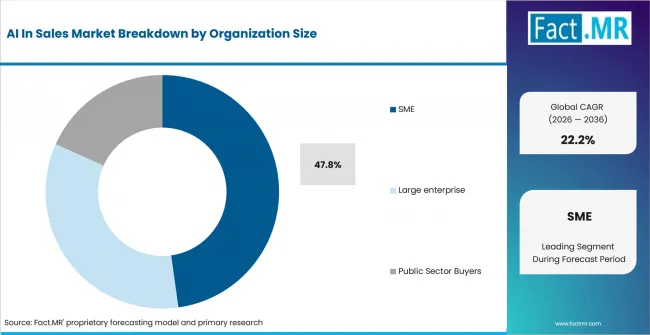
Ai In Sales Market Analysis By Organization Size | Source: Fact.MR
SME accounts are forecast to hold 47.8% share in 2026, due to tools that remove repetitive research and drafting work. Large Enterprise accounts require deeper governance and integration while Public Sector Buyers follow longer approval paths around data access. The OECD reported in November 2025 that generative AI was used in 30.7% of surveyed SMEs across participating countries. Packaged sales assistants are expected to gain where smaller teams receive immediate workflow value without building internal models or integration teams.
What supports Workflow automation within Application?
Workflow automation is expected to represent 51.9% share in 2026
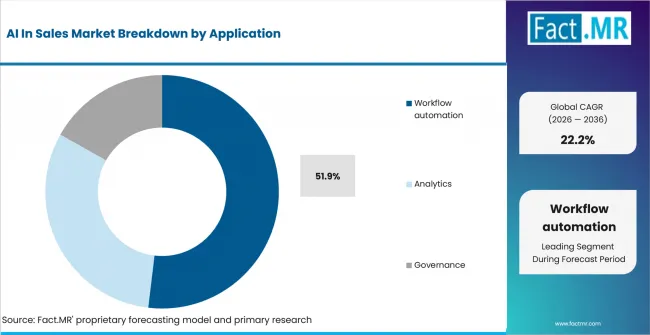
Ai In Sales Market Analysis By Application | Source: Fact.MR
Workflow automation is estimated to account for 51.9% share in 2026, attributable to direct gains from meeting preparation and record updates. Analytics remains central for scoring and forecasting while Governance tools manage permissions and review requirements inside customer-facing workflows. The OECD reported in January 2026 that 20.2% of firms across available countries used AI during 2025. Broader enterprise use is expected to expand the addressable base for workflow automation tied to account research and next-step preparation.
Which End Use category carries the primary share?
BFSI is forecast to capture 41.5% share in 2026
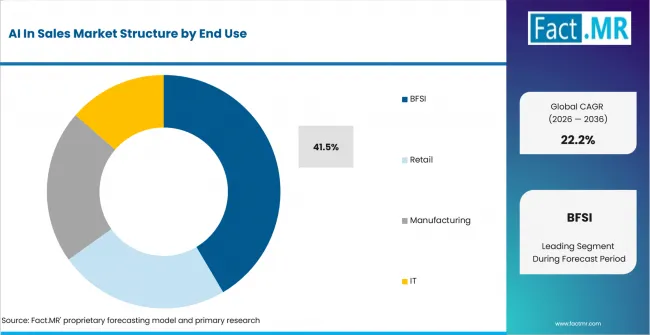
Ai In Sales Market Analysis By End Use | Source: Fact.MR
BFSI is anticipated to capture 41.5% share in 2026, because complex account coverage creates demand for concise customer context and documented actions. Retail uses AI sales tools for customer prioritization while Manufacturing applies them to dealer and account planning. IT providers use similar systems to support subscription expansion and renewal work across complex enterprise account portfolios. The U.S. Census Bureau reported in May 2026 that 33.9% of Finance and Insurance businesses used AI by May 3. That adoption base supports sales automation where compliance review remains visible across relationship management and customer communication workflows.
What is accelerating AI in Sales Market adoption, and what is holding it back?
CRM-embedded workflow automation drives adoption across sales teams; integration burden and governance requirements restrain wider enterprise deployment programs.
Drivers Impact Analysis
| DRIVER | (~) % IMPACT ON CAGR | GEOGRAPHIC RELEVANCE | IMPACT TIMELINE |
|---|---|---|---|
| CRM-embedded AI agents for seller workflows | +3.4% | North America and Europe | Short term (<= 2 years) |
| Pipeline forecasting and next-action guidance | +2.8% | Global enterprise accounts | Medium term (2-4 years) |
| Generative outreach and account research | +2.2% | United States and India | Short term (<= 2 years) |
| Conversation intelligence and coaching | +1.8% | North America and Australia | Medium term (2-4 years) |
| Governance and monitoring layers | +1.2% | Europe and BFSI accounts | Long term (>= 4 years) |
Source: Fact.MR analysis. Updated Jul 9, 2026
- CRM-embedded AI agents: Sales teams are moving AI from separate chat windows into account records and opportunity workflows. Eurostat reported in December 2025 that 11.8% of EU enterprises used AI for written-language analysis during 2025. Embedded text analysis is expected to support research summaries and follow-up preparation where sellers already maintain customer context.
- Pipeline forecasting and guidance: Revenue leaders are using machine learning to focus attention on opportunity changes and deal risk. The OECD reported in January 2026 that firm-level AI use grew 42.4% during 2025 across countries with available data. Forecasting tools are projected to gain more value where recommendations connect directly to stage history and seller activity.
- Generative outreach and research: Prospecting teams need faster account preparation without losing control over message quality or contact rules. The Australian Bureau of Statistics reported in June 2026 that 23% of businesses linked ICT use to better sales or marketing methods. Generative tools are anticipated to spread where teams combine research assistance with review controls before external communication.
- Conversation intelligence and coaching: Sales managers are using call summaries and topic extraction to review execution without listening to every interaction. The OECD reported in November 2025 that 65% of surveyed SMEs using generative AI saw improved employee performance. Coaching applications are estimated to expand where managers connect observed behavior to specific deal stages and follow-up actions.
- Governance and monitoring layers: Enterprise accounts need visibility into model outputs and data access before automating customer-facing actions. Eurostat reported in December 2025 that 55.03% of large EU enterprises used AI during 2025. Governance demand is forecast to rise as larger accounts extend AI from internal assistance toward agent actions across revenue workflows.
Opportunity Impact Analysis
| OPPORTUNITY | (~) % IMPACT ON CAGR | GEOGRAPHIC RELEVANCE | IMPACT TIMELINE |
|---|---|---|---|
| Agentic prospecting and qualification workflows | +2.1% | United States and United Kingdom | Short term (<= 2 years) |
| Vertical sales models for regulated sectors | +1.7% | BFSI and public sector accounts | Medium term (2-4 years) |
| Packaged SME adoption bundles | +1.3% | India and Australia | Medium term (2-4 years) |
| API orchestration across revenue systems | +0.9% | Global software ecosystems | Long term (>= 4 years) |
Source: Fact.MR analysis. Updated Jul 9, 2026
- Agentic prospecting workflows: Account research and initial sequencing create room for bounded agents that prepare work before a seller approves external action. HubSpot expanded Breeze Prospecting Agent in April 2025 to research target accounts and personalize outreach using CRM context. This opportunity is expected to widen where organizations set clear contact rules and human review points.
- Vertical sales models: Regulated sectors need models that understand approval paths and product rules without exposing restricted customer information. The U.S. Census Bureau reported in May 2026 that about 39% of Finance and Insurance businesses expected AI use during the following six months. Vertical configurations are projected to expand where vendors pair sales guidance with traceable source context.
- Packaged SME adoption: Smaller sales teams benefit from preset workflows that reduce configuration effort and shorten time to first useful output. The OECD reported in November 2025 that 26% of surveyed SMEs using generative AI said it helped increase revenue. Packaged offers are anticipated to gain where vendors connect prospecting and follow-up assistance with simple CRM administration.
- API orchestration: Sales stacks often contain separate prospecting and conversation systems that need controlled context exchange. LinkedIn introduced Sales Assistant in Sales Navigator in May 2025 to surface screened leads and suggest outreach from professional-network signals. API-based orchestration is estimated to gain commercial relevance where approved context moves across revenue systems without duplicating customer records.
Restraints Impact Analysis
| RESTRAINT | (~) % IMPACT ON CAGR | GEOGRAPHIC RELEVANCE | IMPACT TIMELINE |
|---|---|---|---|
| CRM data quality and integration burden | -1.7% | Global enterprise accounts | Medium term (2-4 years) |
| Privacy and model governance requirements | -1.3% | Europe and regulated sectors | Long term (>= 4 years) |
| Skills and use-case definition gaps | -1.0% | SME and midmarket accounts | Short term (<= 2 years) |
| Cost-to-value uncertainty | -0.8% | Australia and United Kingdom | Medium term (2-4 years) |
Source: Fact.MR analysis. Updated Jul 9, 2026
- CRM data quality and integration burden: AI recommendations weaken when activity history and account ownership rules remain inconsistent across connected systems. Integration work becomes heavier when email activity and CRM fields use different identifiers or incomplete ownership logic across account records. Adoption is forecast to remain selective where implementation teams cannot connect model output to a defined sales decision and accountable record owner.
- Privacy and model governance requirements: Customer records contain sensitive commercial context that limits uncontrolled prompt sharing and autonomous outreach. The European Commission reported in August 2025 that AI Act obligations for general-purpose AI model providers had entered into application across the European Union. Governance programs are expected to require technical controls alongside trained sales operations owners who understand customer-facing workflow risks.
- Skills and workflow ownership gaps: Sales AI projects often cross sales operations and IT responsibilities without a clear owner for data quality or prompt behavior. The OECD reported in June 2026 that 40% of employers in manufacturing and finance cited skills as the main AI adoption barrier. Deployment is projected to slow when teams cannot maintain workflow rules and data ownership responsibilities after initial implementation.
- Cost-to-value uncertainty: Subscription fees and integration work create scrutiny when vendors promise time savings without a defined measurement baseline. The Office for National Statistics reported in March 2025 that 21% of UK firms cited cost as an AI adoption barrier. Procurement is anticipated to favor pilots tied to seller time saved and opportunity-stage outcomes before wider rollout.
Which countries are scaling AI in Sales Market fastest?
India 24.0%; China 23.3%; Australia 22.0%; United Kingdom 21.7%; United States 21.5%; Germany 21.2%; Japan 20.9%
AI in Sales Market is segmented into North America, Europe, Asia Pacific, Latin America, and the Middle East & Africa.
| COUNTRY | CAGR |
|---|---|
| India | 24.0% |
| China | 23.3% |
| Australia | 22.0% |
| United Kingdom | 21.7% |
| United States | 21.5% |
| Germany | 21.2% |
| Japan | 20.9% |
Source: Fact.MR analysis. Updated Jul 9, 2026
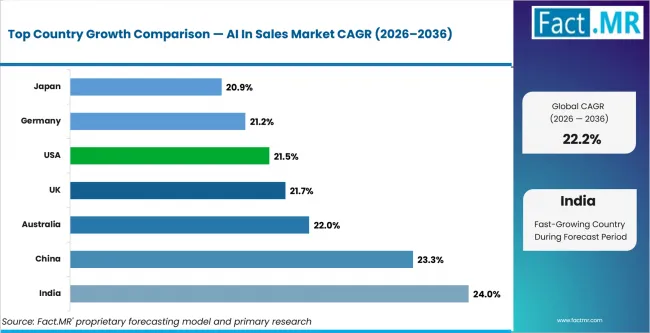
Ai In Sales Market Cagr Analysis By Country | Source: Fact.MR
Why is shared compute widening India’s sales AI opportunity?
24.0% CAGR, supported by shared AI compute access and a large software services base.
Shared computing infrastructure is lowering entry barriers for Indian startups that want to test AI across sales and service workflows. In February 2026, the Press Information Bureau reported that IndiaAI common compute had more than 38,000 onboarded GPUs. The market is forecast to record a 24.0% CAGR during the forecast period as accessible infrastructure accelerates controlled experimentation. Local providers can convert this activity into commercial opportunities by adapting sales applications to enterprise processes and service-delivery requirements.
How is digital commerce strengthening China’s AI in Sales market?
23.3% CAGR, shaped by high online transaction volumes and extensive customer data flows.
China’s extensive online commerce activity gives sales platforms a large stream of customer interactions for prioritization and engagement workflows. In February 2026, the National Bureau of Statistics reported that online retail sales of physical goods represented 26.1% of consumer goods retail sales during 2025. Demand is projected to post a 23.3% CAGR by 2036 owing to rising requirements for faster account selection and customer engagement. Provider selection will depend heavily on local language performance and integration depth across domestic customer data environments.
Where is Australia finding practical sales AI adoption routes?
22.0% CAGR, attributable to broader business AI use and cloud-based commercial workflows.
For Australian businesses, controlled pilot programs provide a practical route for testing AI before wider sales workflow deployment. In June 2026, the Australian Bureau of Statistics reported that 12% of businesses used AI during 2024–25. The market is anticipated to expand at a 22.0% CAGR over the assessment period due to broader adoption and demand for measurable productivity gains. Vendors can improve adoption when integrations remain simple and revenue teams can review performance before expanding automated actions.
Why is use-case selection shaping the United Kingdom growth path?
21.7% CAGR, influenced by enterprise AI trials and sales process modernization.
A persistent use-case identification gap is directing United Kingdom businesses toward focused sales applications with clearly assigned process ownership. In March 2025, the Office for National Statistics reported that 39% of UK firms cited difficulty identifying suitable AI activities or use cases. Demand is estimated to record a 21.7% CAGR between 2026 and 2036 as enterprises prioritize applications with observable workflow outcomes. Sales preparation and forecasting offer practical starting points because teams can review outputs before any customer-facing action takes place.
What gives the United States an enterprise deployment advantage?
21.5% CAGR, led by deep CRM ecosystems and broad enterprise AI activity.
Deep enterprise software adoption gives United States providers a strong foundation for embedding AI directly into established sales technology environments. In May 2026, the U.S. Census Bureau reported that national business AI use reached 19.8% by the period ending May 3. The market is expected to grow at a 21.5% CAGR across the forecast horizon attributable to platform competition and integration demand. Vendors can deepen account penetration by connecting CRM records with controlled actions across seller communication and pipeline management workflows.
Who leads the AI in Sales Market?
Salesforce (Einstein) and Gong lead broad AI sales coverage, while Outreach and Clari + Salesloft strengthen revenue execution and forecasting.
Key players such as Salesforce focus on Einstein and Agentforce capabilities tied to Sales Cloud while Gong focuses on revenue intelligence built from customer interaction data. In June 2025 Salesforce launched Agentforce 3 with a Command Center for monitoring agent activity and operational control. Gong launched Mission Andromeda in February 2026 with Gong Enable and new capabilities for conversational guidance and account management. Outreach expanded its AI revenue platform in February 2026 with secure connections to external AI systems and broader data integrations. These providers compete on workflow depth and context quality across prospecting and deal management while coaching and forecasting extend their value.
Clari and Salesloft completed their merger in December 2025 and now operate as a combined revenue AI group. Clari contributes forecasting and pipeline review workflows while Salesloft brings sales engagement and AI-assisted execution across revenue cadences. HubSpot serves smaller revenue teams through Breeze Prospecting Agent while LinkedIn Sales Navigator adds AI account research and relationship intelligence. Salesloft continues to provide Drift customer access within its broader buyer engagement portfolio for existing sales teams. Competition is forecast to center on context depth and action control inside systems that already hold account and pipeline history.
Which companies are the key providers?
- Salesforce (Einstein)
- Gong
- Outreach
- Clari
- HubSpot
- LinkedIn (Microsoft)
- and Salesloft (Drift).
Bibliography
- Australian Bureau of Statistics. (2026, June 25). Characteristics of Australian business, 2024–25 financial year. Australian Bureau of Statistics.
- Eurostat. (2025, December 11). 20% of EU enterprises use AI technologies. European Commission.
- Eurostat. (2025, December). Use of artificial intelligence in enterprises. Eurostat Statistics Explained.
- European Commission. (2025, August 1). EU rules on general-purpose AI models start to apply, bringing more transparency, safety and accountability. European Commission.
- Gong. (2026, February 25). Gong launches Mission Andromeda, expanding its Revenue AI OS to enablement and account management. Gong.
- HubSpot. (2025, April 10). Spotlight product deep dive: Four AI agents that help teams scale. HubSpot.
- LinkedIn Sales Solutions. (2025, May 21). Your best leads, delivered daily: Meet Sales Assistant in Sales Navigator. LinkedIn.
- National Bureau of Statistics of China. (2026, February 28). Statistical communiqué of the People’s Republic of China on the 2025 national economic and social development. National Bureau of Statistics of China.
- Organisation for Economic Co-operation and Development. (2025, November 5). Generative AI and the SME workforce. OECD Publishing.
- Organisation for Economic Co-operation and Development. (2026, January 28). AI use by individuals surges across the OECD as adoption by firms continues to expand. OECD.
- Organisation for Economic Co-operation and Development. (2026, June 5). AI and skills. OECD Publishing.
- Outreach. (2026, February 24). Outreach February 2026 product release: AI that understands and acts. Outreach.
- Press Information Bureau. (2026, February 13). In less than 24 months, IndiaAI Mission has set up a high-end common computing facility with more than 38 thousand GPUs. Government of India.
- Salesforce. (2025, June 23). Salesforce announces Agentforce 3. Salesforce.
- Salesloft. (2025, December 3). Clari and Salesloft complete merger and appoint Steve Cox as CEO to build the first Predictive Revenue System. Salesloft.
- Salesloft. (2026, April 14). Clari + Salesloft connect forecasting to execution, open revenue data to external AI with MCP Server. Salesloft.
- U.S. Census Bureau. (2026, May 26). Large firms with at least 20 employees are the biggest AI users. U.S. Census Bureau.
This Report Addresses
- The report provides strategic intelligence across Component and Deployment choices that shape sales AI procurement and integration decisions.
- Regional outlook evaluates India and China alongside Australia while the United Kingdom and United States complete the country comparison.
- Competitive analysis profiles Salesforce and Gong alongside Outreach while HubSpot and LinkedIn join Clari and Salesloft in the verified provider set.
- Component assessment covers Software and Services alongside API Tools used to extend AI functions across sales systems.
- Application assessment covers Workflow automation and Analytics alongside Governance functions that control sales AI actions and review requirements.
What does the AI in Sales Market cover?
Software and Services alongside API Tools and deployment models used to automate selling work and improve pipeline decisions.
The AI in Sales Market covers software and related services that apply machine learning or generative models to sales workflows. Core use includes prospect research and opportunity scoring while conversation analysis and forecasting support seller preparation and management decisions.
The market differs from general marketing automation because commercial value must connect directly to seller execution or pipeline management. General-purpose productivity assistants are excluded unless a defined sales workflow and customer record context form the primary commercial use.
What is included in the scope?
AI in Sales systems used across prospecting and account management while supporting pipeline forecasting and seller coaching workflows.
Coverage includes Software and Services alongside API Tools that extend AI functions into approved revenue systems. Deployment analysis covers Cloud and On-premise environments while Hybrid models reflect accounts that retain controlled data locally. Organization Size coverage includes SME and Large Enterprise accounts while Public Sector Buyers form a separate procurement class within the segmentation. Application coverage spans Workflow automation and Analytics alongside Governance controls that manage permissions and review requirements. End-use analysis covers BFSI and Retail while Manufacturing and IT complete the commercial user base examined in the forecast.
What is excluded from the scope?
General marketing automation and standalone customer service assistants are outside the scope unless sales execution is the primary use.
The scope excludes advertising optimization tools that do not support seller workflows or pipeline decisions. Standalone service bots and broad office assistants are excluded unless their commercial function is tied directly to prospecting or account management activity.
How was the analysis built?
120+ sources, 40+ company portfolios, 25+ countries, 20+ interviews.
- Primary Research
- Primary research includes interviews with sales technology providers, CRM platform vendors, revenue operations leaders and enterprise sales managers. It also includes input from sales enablement specialists, AI solution developers, business development executives and procurement teams evaluating AI-driven sales tools and workflow automation platforms.
- Desk Research
- Desk research reviews enterprise software adoption statistics, CRM market developments, AI platform portfolios, sales technology publications and company product announcements. Industry reports, vendor documentation, customer case studies and digital transformation research are also assessed to evaluate market trends and competitive positioning.
- Market-Sizing and Forecasting
- Forecasting uses enterprise AI adoption trends, CRM software spending, sales automation investments, customer engagement initiatives and demand for predictive analytics solutions across major regions. Models consider lead generation activity, sales workflow automation, conversational AI deployment, revenue intelligence adoption and broader digital sales transformation trends.
- Data Validation and Update Cycle
- Forecasts are validated through provider checks and industry interviews that test assumptions on AI adoption, sales technology spending and enterprise deployment trends. Portfolio mapping, end-user assessment and stakeholder feedback help confirm market direction, while ongoing reviews of product launches, technology developments and market investments support forecast updates.
Segmentation
What is the report’s scope and coverage?
| Attribute | Details |
|---|---|
| Quantitative Units | USD Billion |
| Market Definition | AI software and related services that support prospecting, account research, opportunity scoring, forecasting, conversation analysis, seller guidance, and governed sales workflow automation. |
| Component | Software; Services; API Tools |
| Deployment | Cloud; On-premise; Hybrid |
| Organization Size | SME; Large Enterprise; Public Sector Buyers |
| Application | Workflow automation; Analytics; Governance |
| End Use | BFSI; Retail; Manufacturing; IT |
| Regions Covered | North America; Europe; Asia Pacific; Latin America; Middle East & Africa |
| Countries Covered | United States; Canada; Germany; United Kingdom; France; Italy; Spain; India; China; Japan; South Korea; Australia; Brazil; Argentina; Mexico; Chile; UAE; Saudi Arabia; South Africa |
| Key Companies Profiled | Salesforce (Einstein); Gong; Outreach; Clari; HubSpot; LinkedIn (Microsoft); Salesloft (Drift) |
| Forecast Period | 2026 to 2036 |
| Approach | Hybrid top-down and bottom-up approach using enterprise AI adoption; CRM installed-base activity; seller workflow attachment rates; deployment mix; organization demand patterns; application adoption; provider validation |
Source: Fact.MR analysis. Updated Jul 9, 2026
How is the market segmented?
-
By Component
- Software
- Services
- API Tools
-
By Deployment
- Cloud
- On-premise
- Hybrid
-
By Organization Size
- SME
- Large Enterprise
- Public Sector Buyers
-
By Application
- Workflow automation
- Analytics
- Governance
-
By End Use
- BFSI
- Retail
- Manufacturing
- IT
-
By Region
- North America
- United States
- Canada
- Europe
- Germany
- United Kingdom
- France
- Italy
- Spain
- Asia Pacific
- India
- China
- Japan
- South Korea
- Australia
- Latin America
- Brazil
- Argentina
- Mexico
- Chile
- Middle East & Africa
- UAE
- Saudi Arabia
- South Africa
- North America
Frequently Asked Questions
Which Component leads the AI in Sales Market?
How is Cloud positioned in the AI in Sales Market?
Which Organization Size leads the AI in Sales Market?
Which Application leads the AI in Sales Market?
Which End-use Industry leads the AI in Sales Market?
Which country records the highest CAGR in the AI in Sales Market?
How does China perform in the AI in Sales Market?
How does Australia perform in the AI in Sales Market?
How does the United Kingdom perform in the AI in Sales Market?
How does the United States perform in the AI in Sales Market?
What is the primary driver in the AI in Sales Market?
What is the main restraint in the AI in Sales Market?
Why is Workflow Automation important in the AI in Sales Market?
Why are Revenue Operations teams central to purchasing decisions in the AI in Sales Market?
Who worked on this report


Preview the report firsthand - request a free sample
Free SampleGet the brochure for pricing and purchase details
Download PDF