- Market Value (2025): USD 1.6 Bn
- Estimated Value (2026): USD 1.8 Bn
- Forecast Value (2036): USD 5.9 Bn
- CAGR (2026-2036): 12.3%
What is the Air-Breathing Electric Thrusters Market forecast to be worth by 2036?
USD 1.8 billion in 2026 to USD 5.9 billion by 2036 at a 12.3% CAGR.
- As per Fact.MR analysis, the air-breathing electric thrusters market was valued at USD 1.6 billion in 2025.
- Demand is projected to increase from USD 1.8 billion in 2026 to USD 5.9 billion by 2036.
- The market is forecast to record a 12.3% CAGR from 2026 to 2036.
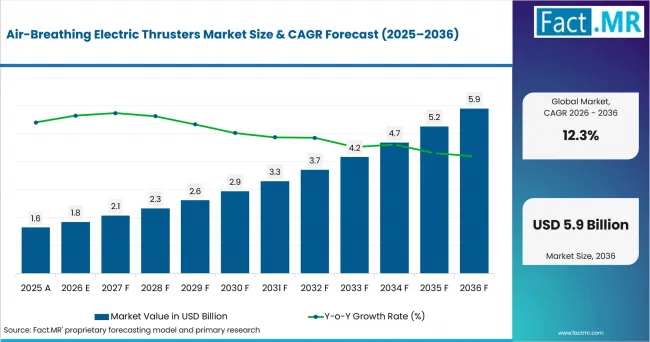
Air Breathing Electric Thrusters Market Value Analysis | Source: Fact.MR
What are the defining numbers behind Air-Breathing Electric Thrusters Market growth?
USD 4.0472 billion absolute opportunity by 2036, led by passive ram intake, atomic oxygen operation and the 120-180 km orbit band.
- Demand Drivers in the Market
- VLEO satellites need steady propulsion to stay in orbit at lower altitudes. In May 2026, the European Space Agency reported that its VOLTA test produced positive thrust using gases from the upper atmosphere [3]. This shows how air-breathing propulsion can help future VLEO satellites stay in orbit.
- Earth observation satellites need propulsion systems keep them at lower altitudes for longer time without carrying all their fuel from launch.
- Electric propulsion systems need parts that can handle oxygen in the upper atmosphere. This oxygen can affect thruster performance and cause parts.
- Key Segments Analyzed
- By Intake Coupling: Passive ram intake is expected to hold a 37.0% share in 2026 because it collects gases from the upper atmosphere without using an active compression system.
- By Thruster: Hall thrusters are projected to account for 31.0% share in 2026 because they are widely used in electric propulsion and can work with different gases during testing.
- By Atmospheric Species: Atomic oxygen is anticipated to capture 38.0% share in 2026 because it affects both thruster performance and the life of satellite materials in VLEO.
- By Orbit: The 120–180 km range is estimated to represent 34.0% share in 2026 because stronger air drag increases the need for propulsion that keeps satellites in orbit without carrying all the fuel from launch.
- Analyst Opinion at Fact.MR
- Shambhu Nath Jha, Principal Consultant at Fact.MR, states, “Flight tests need to check air collection, oxygen resistance, and thrust. Suppliers also need to show that the propulsion system works with the satellite’s power, heat, and control systems.”
- Strategic Implications
- Satellite engineers should design and test the air intake and thruster together. In February 2026, the UK Space Agency reported a £3.8 million investment in the DEEP electric propulsion lab [2]. The lab helps smaller companies test their propulsion systems.
- Thruster developers should test their systems with nitrogen and oxygen, not only xenon.
- Mission planners should compare the benefits of lower orbits with the power needed to keep satellites in orbit.
- Test labs should test low-density air and atomic oxygen together. This helps check the propulsion system and satellite materials under VLEO conditions.
The UK is expected to grow at 13.8% CAGR through 2036 as public funding supports electric propulsion facilities. Japan follows at 13.0% as government space funding supports lower-orbit technology. The USA is expected to grow at 12.7% due to funding for ABEP development. Germany records 12.4% with support from European technology programs, while France reaches 12.1% as its space programs support satellite and propulsion research.
How does the Air-Breathing Electric Thrusters Market break down by segment?
Passive ram intake leads Intake Coupling at 37.0%; atomic oxygen leads Atmospheric Species at 38.0%.
Which Intake Coupling dominates?
Passive ram intake is expected to hold 37.0% share in 2026.
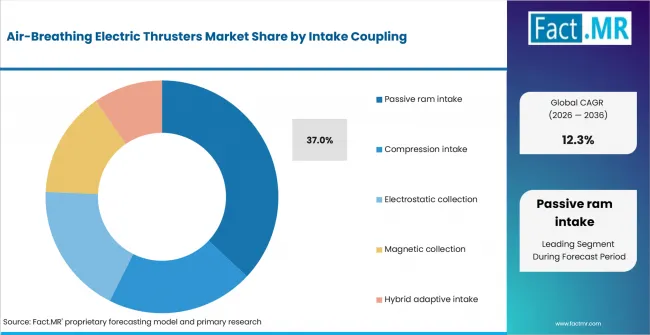
Air Breathing Electric Thrusters Market Analysis By Intake Coupling | Source: Fact.MR
Passive ram intake is expected to lead because the satellite’s movement collects gas from the upper atmosphere and sends it to the propulsion system. Compression intake can collect more gas but needs extra parts. Electrostatic and magnetic systems use electric or magnetic fields to collect gas, while hybrid systems combine different methods when gas levels and satellite position change.
What leads the Thruster segment?
Hall thrusters are projected to account for 31.0% share in 2026.
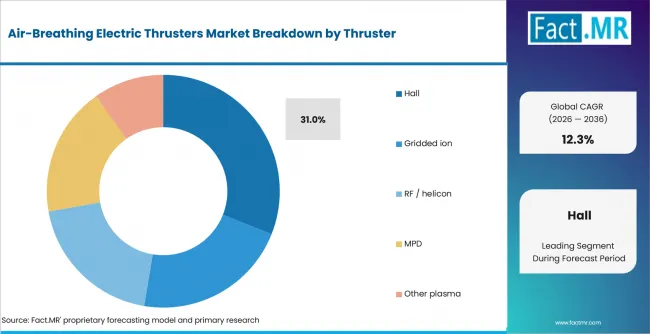
Air Breathing Electric Thrusters Market Analysis By Thruster | Source: Fact.MR
Hall thrusters are expected to lead because they are already widely used for long satellite missions and use power efficiently. Gridded ion thrusters are used when missions need higher fuel efficiency. RF and helicon thrusters reduce contact with internal parts, while MPD thrusters are less common because smaller VLEO satellites have limited power and heat control.
For air-breathing systems, the Hall thruster, air intake, and power system need to work together with low air levels and changing gases in VLEO.
How do Atmospheric Species shape demand?
Atomic oxygen is anticipated to capture 38.0% share in 2026.
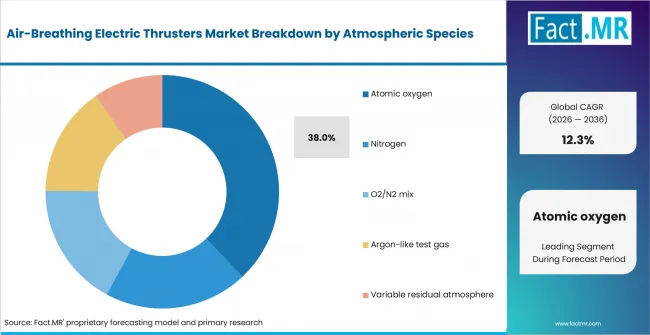
Air Breathing Electric Thrusters Market Analysis By Atmospheric Species | Source: Fact.MR
Atomic oxygen is expected to lead because it affects both the gas collected by the propulsion system and the satellite’s outer surfaces. Nitrogen can change how the thruster works compared with xenon. Oxygen and nitrogen mixtures help teams test the system under conditions closer to the VLEO atmosphere. Argon-like gases are used for controlled tests, while the actual mix of gases can change with orbit conditions.
What supports demand for 120-180 km within Orbit?
120-180 km is estimated to represent 34.0% share in 2026.
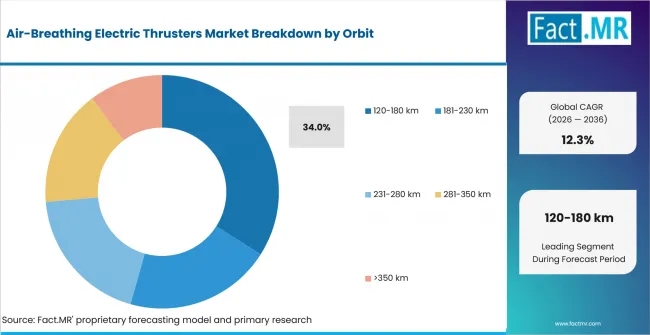
Air Breathing Electric Thrusters Market Analysis By Orbit | Source: Fact.MR
The 120–180 km range is expected to lead because air drag is much stronger closer to Earth. ABEP can use gases from the atmosphere instead of relying only on fuel carried by the satellite. The 181–230 km and 231–280 km ranges have less air drag while still supporting closer sensing. At higher altitudes, less atmospheric gas is available for the propulsion system.
Satellites at 120–180 km need continuous propulsion to stay in orbit. In 2025, the U.S. Small Business Innovation Research program awarded Viridian Space Corporation USD 1,687,447 for a VLEO air-scooping electric thruster [4]. The project supports the use of atmospheric gas to help satellites stay longer in lower orbits.
What is accelerating Air-Breathing Electric Thrusters Market adoption, and what is holding it back?
The need to control air drag in VLEO increases demand, while oxygen exposure and flight testing slower the use.
Drivers Impact Analysis
| DRIVER | (~) % IMPACT ON CAGR | GEOGRAPHIC RELEVANCE | IMPACT TIMELINE |
|---|---|---|---|
| Continuous VLEO drag compensation | +1.8% | Global | Short term (<= 2 years) |
| Closer-range Earth observation value | +1.4% | USA, UK, France, Japan | Medium term (2-4 years) |
| Electric-propulsion test infrastructure | +1.1% | USA, UK, Germany, France | Medium term (2-4 years) |
| Defence interest in persistent low-altitude maneuver | +0.9% | USA, UK, France | Long term (>= 4 years) |
Source: Fact.MR analysis. Updated Oct 6, 2026
Opportunity Impact Analysis
| OPPORTUNITY | (~) % IMPACT ON CAGR | GEOGRAPHIC RELEVANCE | IMPACT TIMELINE |
|---|---|---|---|
| Integrated VLEO satellite platforms | +1.3% | Global | Medium term (2-4 years) |
| Oxygen-tolerant cathodes and materials | +1.0% | USA, Europe, Japan | Short term (<= 2 years) |
| Shared rarefied-flow test facilities | +0.7% | Europe, USA, Japan | Medium term (2-4 years) |
Source: Fact.MR analysis. Updated Oct 6, 2026
Restraints Impact Analysis
| RESTRAINT | (~) % IMPACT ON CAGR | GEOGRAPHIC RELEVANCE | IMPACT TIMELINE |
|---|---|---|---|
| Atomic oxygen erosion | -0.9% | Global | Short term (<= 2 years) |
| Limited in-orbit ABEP heritage | -0.7% | Global | Medium term (2-4 years) |
| Power and thermal limits on compact platforms | -0.5% | USA, Europe, Japan | Medium term (2-4 years) |
Source: Fact.MR analysis. Updated Oct 6, 2026
Which countries are scaling the Air-Breathing Electric Thrusters Market through 2036?
- The country comparison spans 1.7 percentage points across the five forecast rates.
- The UK remains 0.8 percentage point above Japan as public space infrastructure supports propulsion development and testing.
- Japan remains 0.3 percentage point above the USA as national space investment supports satellite technology programs.
- The USA remains 0.3 percentage point above Germany through direct ABEP development awards and defence-oriented VLEO work.
- Germany remains 0.3 percentage point above France as ESA technology funding reinforces European propulsion research.
- France closes the displayed range while retaining a large national public-space budget and established satellite engineering capacity.
Comparable CAGRs can produce different entry conditions because air-breathing thrusters depend on flight access, rarefied-flow testing and oxygen-tolerant hardware. Full report coverage includes North America, Latin America, Western Europe, Eastern Europe, East Asia, South Asia & Pacific, Middle East & Africa.
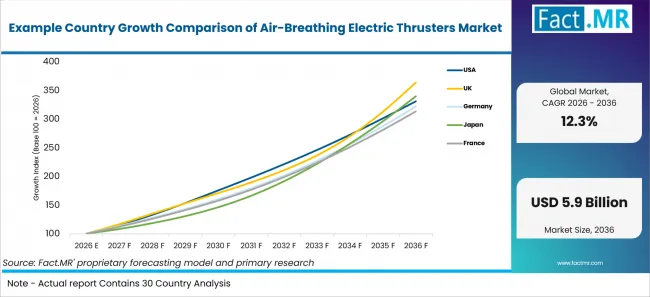
Example Country Growth Comparison Of Air Breathing Electric Thrusters Market | Source: Fact.MR
| Country | CAGR (2026-2036) |
|---|---|
| United Kingdom | 13.8% |
| Japan | 13.0% |
| United States | 12.7% |
| Germany | 12.4% |
| France | 12.1% |
Source: Fact.MR analysis. Updated Oct 6, 2026
What supports United Kingdom adoption?
13.8% CAGR through 2036, supported by electric-propulsion test infrastructure and national space investment.
The UK is increasing shared testing facilities for space propulsion systems. The UK Space Agency reported in July 2026 that the Space Clusters Infrastructure Fund had invested £48 million in projects across the country, including electric propulsion facilities [5]. These facilities can help companies test compact VLEO propulsion systems.
How is Japan scaling demand?
13.0% CAGR through 2036, supported by national space investment and lower-orbit technology programs.
Japan is expanding public funding for space technology and commercial space projects. In January 2026, the Prime Minister's Office stated that the Space Strategy Fund has a budget of JPY 1 trillion [6]. This funding supports satellite programs that need efficient propulsion, smaller systems, and longer operation in low orbits.
What supports USA adoption?
12.7% CAGR through 2036, driven by direct air-breathing propulsion development for VLEO missions.
The United States is developing air-breathing propulsion systems for longer VLEO missions. In 2025, the U.S. Small Business Innovation Research program awarded Viridian Space Corporation USD 1,247,690 to develop air-breathing electric propulsion that can handle oxygen exposure [1]. The technology helps satellites stay in orbit and move when air drag is high.
What supports Germany's outlook?
12.4% CAGR through 2036, supported by European space programs and technology funding.
Germany has a strong satellite industry and invests heavily in European space programs. In November 2025, the German Aerospace Center reported that Germany committed about EUR 5.4 billion to ESA programs [7]. This funding supports propulsion research, testing, and the development of satellites for lower orbits across Europe.
How is France developing demand?
12.1% CAGR through 2036, supported by national space funding and established satellite engineering.
France has a strong space industry that supports satellite and propulsion development. The National Space Strategy published in November 2025 states that France spends around EUR 3 billion each year on public space programs [8]. This funding supports electric propulsion and lower-orbit satellite missions through the forecast period.
Who leads the Air-Breathing Electric Thrusters Market?
Kreios Space and Viridian Space work on air-breathing electric propulsion. Viridian Space is developing systems that collect gas from the upper atmosphere and use it as fuel in very-low-Earth orbit. This helps satellites stay in orbit while carrying less fuel.
SITAEL makes and tests electric propulsion systems, including Hall-effect thrusters. Busek also develops electric propulsion technology. Celeste and Stellar Space Industries are also included in the company list. Their direct work on air-breathing propulsion needs separate evidence from their other electric propulsion work.
Suppliers need air intakes, thrusters, power systems, and heat control to work together. Their systems also need to handle oxygen and provide steady thrust in very-low-Earth orbit.
Which companies are the key providers?
Key companies include Kreios Space; Viridian Space; Busek; SITAEL; Celeste; and Stellar Space Industries.
- Kreios Space
- Viridian Space
- Busek
- SITAEL
- Celeste
- Stellar Space Industries
Bibliography
- [1] European Space Agency. (2026, May 6). OSIP Highlights July–December 2025.
- [2] UK Space Agency. (2026, February 6). UK Space Agency investment helps launch cutting-edge electric propulsion lab.
- [3] Small Business Innovation Research (SBIR). (2025). Air-Breathing Electric Propulsion with Oxygen Resilience for Long Duration Operation in VLEO.
- [4] Small Business Innovation Research (SBIR). (2025). Resilient VLEO Operations with an Air Scooping Electric Thruster.
- [5] UK Space Agency. (2026, July 14). UK Space Agency Annual Report and Accounts 2025–2026.
- [6] Prime Minister's Office of Japan. (2026, January 5). New Year’s Press Conference by Prime Minister TAKAICHI Sanae.
- [7] German Aerospace Center (DLR). (2025, November 28). Germany invests 5.4 billion euros in the future of European space.
- [8] General Secretariat for Defence and National Security (SGDSN). (2025, November 12). National Space Strategy 2025–2040.
This Report Answers
- The report explains where air-breathing electric propulsion fits within VLEO spacecraft design and how intake coupling changes the propulsion-system boundary.
- Segment analysis compares intake architecture, thruster type, atmospheric feed species and orbit bands while retaining the 2026 share values used throughout the report.
- Country analysis reviews the United Kingdom, Japan, the United States, Germany and France using the report CAGRs and current official space-program evidence.
- Competitive analysis distinguishes direct ABEP heritage from broader electric-propulsion capability so adjacent suppliers are not presented as confirmed air-breathing system vendors without evidence.
- Application analysis examines drag compensation, Earth observation proximity, oxygen tolerance, test access and spacecraft power limits that affect commercial adoption.
What does the Air-Breathing Electric Thrusters Market cover?
The Air-Breathing Electric Thrusters Market covers systems that collect residual atmospheric gas in VLEO and accelerate it electrically. The boundary includes the intake, gas path, plasma stage and thruster when designed for atmospheric feed. Revenue centers on drag compensation and maneuvering without full dependence on stored propellant.
Related context includes VLEO satellite platforms, in-space propulsion components and high-thrust electric propulsion. These adjacent areas help explain platform design, maneuvering needs and electric-thruster engineering around the air-breathing system boundary.
What is included in the scope?
The scope includes passive ram, compression, electrostatic, magnetic and hybrid intakes paired with Hall, gridded-ion, RF or helicon, MPD and other plasma thrusters. Atomic oxygen, nitrogen and mixed residual gases are covered when collected from the atmosphere. Ground-test hardware supports qualification evidence but is not counted as thruster revenue.
Qualification work is linked to electric propulsion thruster test equipment and small satellite environmental test systems. Platform packaging can also draw on 3D printed satellite structures when low mass and compact layouts support VLEO design.
What is excluded from the scope?
The scope excludes conventional electric propulsion when no atmospheric intake is present. Chemical propulsion, launch-vehicle air-breathing engines, aircraft ramjets and standalone spacecraft buses are also outside the revenue boundary. Communications, sensing payloads and defence software remain downstream uses unless bundled into an integrated ABEP package.
Downstream context includes satellite internet services, satellite communication systems and all-electric satellites. The report keeps these applications outside direct thruster revenue while using them to explain mission demand around lower-orbit spacecraft.
How Was the Analysis Built?
The analysis draws on 120+ sources, 35+ company portfolios, 25+ countries, and more than 20 industry interviews.
- Primary Research: Primary research includes discussions with manufacturers, service providers, technology developers, distributors, end users, and subject-matter experts. These conversations examine purchasing priorities, product adoption, operational challenges, approval requirements, competitive positioning, and the factors that influence wider market acceptance.
- Desk Research: Desk research covers government statistics, regulatory publications, company filings, trade data, technical studies, industry associations, standards, public policy, and other authoritative sources. Every source used in the analysis is documented in the bibliography.
- Market Sizing and Forecasting: Market estimates combine historical performance, demand indicators, pricing and volume trends, segment shares, company participation, country-level growth, adoption patterns, investment activity, and barriers to market expansion.
- Data Validation and Update Cycle: Findings are validated by comparing primary interviews with public data, company activity, regulatory changes, trade patterns, and industry developments. Regular updates review new product launches, capacity changes, partnerships, approvals, and shifts in commercial adoption.
Segmentation
What is the report’s scope and coverage?
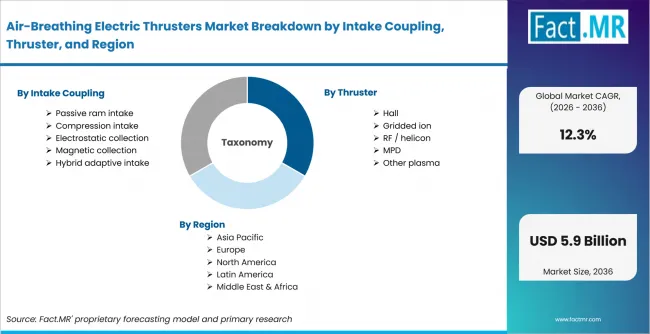
Air Breathing Electric Thrusters Market Breakdown By Intake Coupling, Thruster, And Region | Source: Fact.MR
| Attribute | Details |
|---|---|
| Quantitative Units | USD billion |
| Market Definition | Electric propulsion systems that ingest residual atmospheric species in very low Earth orbit and accelerate the collected gas to offset drag or provide maneuvering thrust. |
| Intake Coupling | Passive ram intake; Compression intake; Electrostatic collection; Magnetic collection; Hybrid adaptive intake |
| Thruster | Hall; Gridded ion; RF / helicon; MPD; Other plasma |
| Atmospheric Species | Atomic oxygen; Nitrogen; O2/N2 mix; Argon-like test gas; Variable residual atmosphere |
| Orbit | 120-180 km; 181-230 km; 231-280 km; 281-350 km; >350 km |
| Regions Covered | North America; Latin America; Western Europe; Eastern Europe; East Asia; South Asia & Pacific; Middle East & Africa |
| Countries Covered | United States; United Kingdom; Germany; Japan; France |
| Key Companies Profiled | Kreios Space; Viridian Space; Busek; SITAEL; Celeste; Stellar Space Industries |
| Forecast Period | 2026 to 2036 |
| Approach | Hybrid top-down and bottom-up analysis using VLEO mission activity, intake and thruster architecture, orbit bands, official program evidence and company capability checks. |
Source: Fact.MR analysis. Updated Oct 6, 2026
How is the market segmented?
-
By Intake Coupling:
- Passive ram intake
- Compression intake
- Electrostatic collection
- Magnetic collection
- Hybrid adaptive intake
-
By Thruster:
- Hall
- Gridded ion
- RF / helicon
- MPD
- Other plasma
-
By Atmospheric Species:
- Atomic oxygen
- Nitrogen
- O2/N2 mix
- Argon-like test gas
- Variable residual atmosphere
-
By Orbit:
- 120-180 km
- 181-230 km
- 231-280 km
- 281-350 km
- >350 km
-
By Region:
- North America
- Latin America
- Western Europe
- Eastern Europe
- East Asia
- South Asia & Pacific
- Middle East & Africa
Frequently Asked Questions
How big is the Air-Breathing Electric Thrusters Market in 2026?
What is the CAGR of the Air-Breathing Electric Thrusters Market from 2026 to 2036?
Which intake coupling segment leads in 2026?
Which atmospheric species segment leads in 2026?
Which companies are profiled?
Who worked on this report


Preview the report firsthand - request a free sample
Free SampleGet the brochure for pricing and purchase details
Download PDF