- Base Value(2025): 5.60 Bn
- Estimated Value(2026): 5.89 Bn
- Forecast Value (2036): 9.68 Bn
- CAGR (2026 - 2036): 5.1%
Aircraft Refurbishing Market Size, Market Forecast and Outlook By Fact.MR
The aircraft refurbishing market was valued at USD 5.60 billion in 2025, projected to reach USD 5.89 billion in 2026, and is forecast to expand to USD 9.68 billion by 2036 at a 5.1% CAGR. Airlines operating ageing fleets face increasing pressure to modernize cabin experiences as passenger expectations for connectivity, seat comfort, and premium amenities accelerate. The average age of the global commercial fleet reached 12.4 years in 2024 according to Cirium fleet data, with approximately 40% of in-service narrow-body aircraft exceeding 15 years of age. Refurbishing these aircraft costs between USD 2 million and USD 15 million per unit depending on scope, compared to USD 50 million to USD 130 million for a new narrow-body, making cabin upgrades the financially rational path for operators extending fleet utilization through the next decade. Aircraft lessors, who now control over 50% of the global commercial fleet, are increasingly mandating cabin refresh programs during lease transitions to maintain asset residual values.
The USA leads growth at a 5.8% CAGR, driven by the largest installed commercial and business aviation fleet globally and concentrated MRO capacity in Florida, Texas, and the Pacific Northwest. Mexico follows at 5.4%, supported by growing MRO hub development in Queretaro and competitive labor cost structures attracting US carrier refurbishment contracts. Germany expands at 5.1% anchored by Lufthansa Technik operations in Hamburg and a strong business aviation completion sector. France tracks at 4.8% with Air France Industries KLM E&M and Safran Seats driving narrow-body cabin modernization. The UK registers 4.5% growth linked to transatlantic carrier fleet upgrades routed through Manchester and Bournemouth facilities. South Korea advances at 4.3% and Japan at 4.1%, where domestic carriers refresh interiors on ageing regional jet fleets.
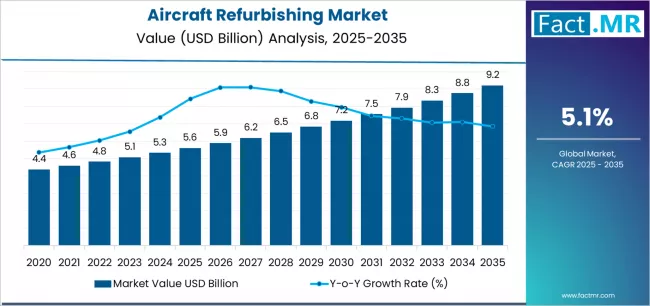
Aircraft Refurbishing Market Market Value Analysis | Source: Fact.MR
Aircraft Refurbishing Market Key Takeaways
| Metric | Details |
|---|---|
| Industry Size (2026) | USD 5.89 billion |
| Industry Value (2036) | USD 9.68 billion |
| CAGR (2026 to 2036) | 5.1% |
Source: Fact.MR analysis. Updated Mar 20, 2026
Aircraft Refurbishing Market Definition
The aircraft refurbishing market covers specialized modification, overhaul, and upgrade services applied to commercial, regional, and business aviation interiors and systems. Services include cabin reconfiguration (seat layout changes, class upgrades), interior component replacement (seats, galleys, lavatories, overhead bins), in-flight entertainment and connectivity system installation, livery and paint refinishing, and VIP/head-of-state completion projects. Refurbishing extends aircraft economic life and aligns cabin products with current passenger experience standards without requiring new aircraft acquisition.
Aircraft Refurbishing Market Inclusions
The report covers global and regional market sizes for aircraft refurbishing services, forecast projections from 2026 to 2036, segment breakdowns by service type (cabin interiors, IFE/connectivity, VIP/completions), aircraft category (narrow-body, wide-body, business jets), and customer type (airlines, lessors, private/VIP). Project cost benchmarks by aircraft type are included.
Aircraft Refurbishing Market Exclusions
Routine line maintenance, engine overhaul, and airframe structural repair services are excluded. New aircraft manufacturing and pre-delivery customization performed at OEM facilities fall outside the scope. Ground support equipment procurement is not covered.
Aircraft Refurbishing Market Research Methodology
- Primary Research: Fact.MR analysts conducted detailed technical interviews with procurement directors, operations managers, and engineering leads across 40 countries to validate adoption timelines and purchasing decision criteria.
- Desk Research: Data collection aggregated regulatory filings, government procurement records, industry association publications, and company annual reports to establish baseline market parameters.
- Market-Sizing and Forecasting: Forecasting models apply a bottom-up methodology starting with installed base metrics and regional production volumes, applying technology penetration curves to project adoption velocity through 2036.
- Data Validation and Update Cycle: Projections undergo cross-validation against publicly reported revenue figures from leading manufacturers and quarterly trade statistics published by national customs authorities.
Summary of Aircraft Refurbishing Market
- Aircraft Refurbishing Market Definition
- The aircraft refurbishing market covers specialized modification, overhaul, and upgrade services applied to commercial, regional, and business aviation interiors and systems. Services include cabin reconfiguration (seat layout changes, class upgrades), interior component replacement (seats, galleys, lavatories, overhead bins), in-flight entertainment and connectivity system installation, livery and paint refinishing, and VIP/head-of-state completion projects.
- Demand Drivers in the Market
- Regulatory compliance requirements: Government mandates and safety standards across major markets compel end users to adopt upgraded equipment and systems that meet current specification thresholds.
- Technology cost reduction: Declining component costs and manufacturing efficiencies enable broader market penetration beyond premium segments into volume-production applications.
- Replacement cycle acceleration: Ageing installed bases in mature markets face performance gaps against current operational requirements, triggering fleet-wide upgrade programs.
- Key Segments Analyzed in the Fact.MR Report
- Cabin Interiors (Service): 49.0% share in 2026, reflecting dominant adoption across primary use cases.
- Narrow-body (Aircraft): 46.0% share in 2026, driven by structural demand from the largest buyer segment.
- Airlines (Customer): 62.0% share in 2026, supported by established operational requirements.
- Analyst Opinion at Fact.MR
- The aircraft refurbishing market is positioned for sustained expansion through 2036 as regulatory mandates, technology maturation, and capital replacement cycles converge to create a multi-year procurement environment. Fact.MR is of the opinion that market participants prioritizing certified compliance with evolving standards and demonstrated integration with existing infrastructure will capture disproportionate contract volume during the forecast period. Organizations delaying capital commitments risk operational obsolescence as specification requirements tighten across all major geographic markets.
- Strategic Implications / Executive Takeaways
- Compliance-first procurement: Equipment and system suppliers must secure regulatory certifications ahead of enforcement timelines to qualify for tender shortlists in markets where compliance is a mandatory procurement gate.
- Regional manufacturing presence: Establishing local production or assembly capabilities in high-growth regions reduces lead times and positions suppliers favorably against import-dependent competitors.
- Technology partnership investment: Forming integration partnerships with complementary technology providers enables end-to-end solution delivery that standalone component suppliers cannot match in competitive bid evaluations.
- Methodology
- Primary Research: Fact.MR conducted structured interviews with procurement leads, operations directors, and technical specification managers across key end-user industries in over 40 countries.
- Desk Research: Analysts compiled data from regulatory filings, government statistical agencies, trade body publications, and verified corporate disclosures.
- Market-Sizing and Forecasting: A hybrid top-down and bottom-up methodology calibrates global estimates against regional production data and verified shipment records.
Why is the Aircraft Refurbishing Market Growing?
| AVIATION FLEET AGING TRENDS | PASSENGER EXPERIENCE REQUIREMENTS | REGULATORY & EFFICIENCY STANDARDS |
|---|---|---|
| Global Aircraft Fleet Aging | Advanced Cabin Experience Requirements | Aviation Safety Standards |
| Continuous aging of global aircraft fleets across established and emerging markets driving demand for comprehensive refurbishing solutions. | Modern aviation requires enhanced passenger experience systems delivering superior comfort and advanced in-flight entertainment capabilities. | Regulatory requirements establishing safety benchmarks favoring certified refurbishing services with proven aviation compliance. |
| Fleet Utilization Optimization | Processing Efficiency Demands | Operational Compliance Standards |
| Growing emphasis on fleet asset optimization and lifecycle extension creating demand for comprehensive aircraft interior and systems refurbishing. | Airlines investing in refurbishing services offering consistent quality while maintaining operational efficiency and regulatory compliance throughout aircraft lifecycles. | Quality standards requiring superior aviation-grade materials and resistance to operational stresses in aircraft environments. |
| Premium Aviation Service Positioning | Quality and Certification Standards | International Aviation Requirements |
| Superior refurbishing quality and certification compliance making professional aircraft refurbishing essential for premium airline operations and business aviation applications. | Certified service providers with proven track records required for advanced aircraft refurbishing and critical aviation maintenance applications. | Diverse international aviation requirements and airworthiness standards driving need for validated aircraft refurbishing technologies. |
Source: Fact.MR analysis. Updated Mar 20, 2026
DRIVERS
| DRIVERS | RESTRAINTS | KEY TRENDS |
|---|---|---|
| Aircraft Fleet Aging | High Service Costs | Advanced Cabin Technologies |
| Continuing aging of global aircraft fleets across established and emerging markets driving demand for comprehensive refurbishing solutions. | Significant refurbishing investment requirements and aircraft downtime costs affecting airline adoption rates and project timing decisions. | Integration of smart cabin systems, advanced materials, and passenger connectivity technologies enabling superior in-flight experience. |
| Passenger Experience Competition | Regulatory Complexity | Sustainable Interior Solutions |
| Increasing airline competition for passenger loyalty requiring enhanced cabin experiences and modern interior technologies across aviation markets. | Complex aviation certification requirements and airworthiness compliance affecting refurbishing project timelines and development costs. | Enhanced lightweight materials, recyclable interior components, and sustainable refurbishing practices compared to traditional aircraft interior solutions. |
| Fleet Utilization Optimization | Operational Downtime Impact | Digitalized Cabin Integration |
| Growing demand for aircraft asset optimization and lifecycle extension creating opportunities for refurbishing services in fleet management strategies. | Aircraft operational downtime during refurbishing affecting airline revenue generation and fleet utilization optimization across competitive markets. | Development of integrated cabin management systems and IoT connectivity providing enhanced passenger services and operational efficiency improvements. |
Source: Fact.MR analysis. Updated Mar 20, 2026
Analysis of Aircraft Refurbishing Market by Key Countries
.webp "Top Country Growth Comparison Aircraft Refurbishing Market Cagr (2026 2036)")
Top Country Growth Comparison Aircraft Refurbishing Market Cagr (2026 2036) | Source: Fact.MR
| Country | CAGR (2026-2036) |
|---|---|
| USA | 5.8% |
| Mexico | 5.4% |
| Germany | 5.1% |
| France | 4.8% |
| UK | 4.5% |
| South Korea | 4.3% |
| Japan | 4.1% |
Source: Fact.MR analysis. Updated Mar 20, 2026
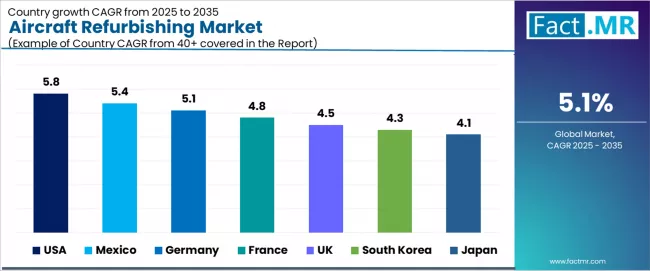
Aircraft Refurbishing Market Cagr Analysis By Country | Source: Fact.MR
USA Leads Global Market Growth with Aviation Excellence
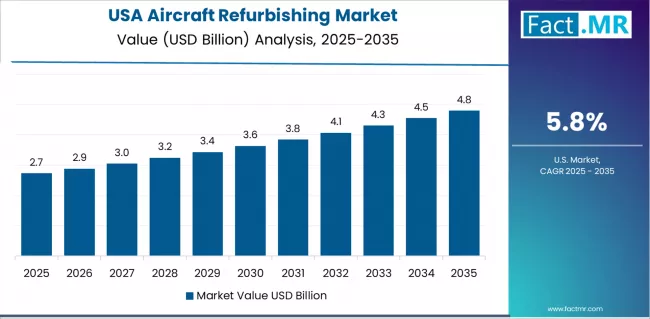
Aircraft Refurbishing Market Country Value Analysis | Source: Fact.MR
Revenue from the aircraft refurbishing market in USA is projected to exhibit strong growth with a market value of USD 3.1 billion by 2035, driven by expanding aviation infrastructure and comprehensive aircraft fleet modernization creating substantial opportunities for refurbishing service providers across commercial airline operations, business aviation applications, and aircraft leasing sectors.
The country's established aviation industry and expanding fleet management capabilities are creating significant demand for both interior refurbishing and advanced cabin technology integration services. Major airlines and aviation service companies including American Airlines, Delta, and specialized MRO providers are establishing comprehensive aircraft refurbishing programs to support large-scale fleet optimization operations and meet growing demand for enhanced passenger experience solutions.
- Aviation fleet modernization programs are supporting widespread adoption of refurbishing services across airline operations, driving demand for high-quality interior and technology upgrade solutions
- Passenger experience enhancement initiatives and competitive differentiation development are creating substantial opportunities for refurbishing suppliers requiring proven performance and aviation-certified solutions
- Business aviation growth and aircraft leasing expansion are facilitating adoption of specialized refurbishing technologies throughout major aviation regions
Mexico Demonstrates Strong Market Potential with Aviation Development
Revenue from Aircraft Refurbishing in Mexico is expanding to reach USD 720 million by 2035, supported by extensive aviation development and comprehensive airline industry growth creating sustained demand for reliable refurbishing solutions across diverse aviation categories and maintenance segments. The country's growing tourism industry and expanding airline operations are driving demand for refurbishing solutions that provide enhanced passenger experiences while supporting cost-effective aircraft operations. Aircraft refurbishing service providers and aviation suppliers are investing in local capabilities to support growing airline operations and aircraft maintenance demand.
- Aviation development operations expansion and airline industry growth capability development are creating opportunities for refurbishing solutions across diverse aircraft segments requiring reliable performance and competitive service costs
- Tourism industry modernization and airline expansion are driving investments in refurbishing supply chains supporting passenger experience requirements throughout major aviation regions
- Regional aviation growth and aircraft maintenance development programs are enhancing demand for comprehensive refurbishing services throughout Mexican aviation areas
Germany Maintains Leadership with Aviation Technology Innovation
Demand for Aircraft Refurbishing in Germany is projected to reach USD 680 million by 2035, supported by the country's leadership in aviation technology innovation and advanced aircraft maintenance requiring sophisticated refurbishing systems for airline operations and aviation service applications. German companies are implementing high-quality refurbishing procurement that supports advanced aviation techniques, operational efficiency, and comprehensive certification protocols. The market is characterized by focus on operational excellence, service sustainability, and compliance with stringent aviation safety and quality standards.
- Aviation technology innovation industry investments are prioritizing advanced refurbishing technologies that demonstrate superior passenger experience and quality while meeting German aviation and safety standards
- Aircraft maintenance leadership programs and operational excellence initiatives are driving adoption of precision-engineered refurbishing services that support advanced aviation requirements and operational optimization
- Research and development programs for aviation enhancement are facilitating adoption of specialized refurbishing technologies throughout major aviation innovation centers
France Expands Market with Aviation Innovation
Revenue from Aircraft Refurbishing in France is growing to reach USD 580 million by 2035, driven by aviation innovation development programs and increasing aircraft technology advancement creating sustained opportunities for refurbishing service providers serving both airline operations and aviation maintenance contractors. The country's established aviation infrastructure and expanding aerospace capabilities are creating demand for refurbishing solutions that support diverse aircraft requirements while maintaining operational efficiency standards. Aircraft refurbishing suppliers and aviation integrators are developing procurement strategies to support operational efficiency and regulatory compliance.
- Aviation innovation development programs and aircraft technology advancement are facilitating adoption of refurbishing solutions capable of supporting diverse aircraft requirements and competitive efficiency standards
- Passenger experience innovation and aviation technology development programs are enhancing demand for advanced refurbishing services that support operational efficiency and safety reliability
- EU aviation directive compliance and specialty service development are creating opportunities for advanced refurbishing technologies across French aviation facilities
UK Demonstrates Market Potential with Aviation Services Excellence
Revenue from Aircraft Refurbishing in United Kingdom is expanding to reach USD 480 million by 2035, supported by extensive aviation services excellence and comprehensive aircraft maintenance development creating sustained demand for reliable refurbishing solutions across diverse aviation categories and airline segments. The country's established aviation infrastructure and expanding post-Brexit aviation capabilities are driving demand for refurbishing solutions that provide consistent performance while supporting regulatory compliance requirements. Aircraft refurbishing processors and aviation suppliers are investing in local capabilities to support growing airline operations and aircraft maintenance demand.
- Aviation services excellence operations expansion and aircraft maintenance capability development are creating opportunities for refurbishing solutions across diverse aviation segments requiring reliable performance and competitive operational costs
- Aircraft maintenance advancement and aviation technology development are driving investments in refurbishing supply chains supporting passenger experience requirements throughout major aviation regions
- Post-Brexit aviation adaptation and specialty service development programs are enhancing demand for compliant refurbishing systems throughout British aviation areas
South Korea Focuses on Advanced Aviation Technology Excellence
Demand for Aircraft Refurbishing in South Korea is projected to reach USD 400 million by 2035, expanding at a CAGR of 4.3%, driven by advanced aviation technology excellence and specialty aircraft capabilities supporting high-tech aviation operations and comprehensive airline applications. The country's established aviation technology tradition and growing international airline market segments are creating demand for high-quality refurbishing solutions that support operational performance and technology standards. Aircraft refurbishing suppliers and aviation companies are maintaining comprehensive development capabilities to support diverse aviation requirements.
- Advanced aviation technology and specialty aircraft programs are supporting demand for precision refurbishing systems that meet contemporary quality and performance standards
- High-tech aviation operations development and international airline programs are creating opportunities for specialized refurbishing solutions that provide comprehensive passenger experience support
- Aviation export excellence and service quality enhancement programs are facilitating adoption of advanced refurbishing capabilities throughout major aviation regions
Japan Demonstrates Aviation Service Integration
Demand for Aircraft Refurbishing in Japan is projected to reach USD 340 million by 2035, expanding at a CAGR of 4.1%, driven by aviation service integration excellence and comprehensive aircraft system capabilities supporting precision aviation operations and advanced airline applications. The country's established aviation tradition and growing service excellence market segments are creating demand for high-quality refurbishing solutions that support operational precision and reliability standards. Aircraft refurbishing suppliers and aviation companies are maintaining comprehensive development capabilities to support diverse aviation requirements.
- Aviation service integration and aircraft system programs are supporting demand for reliable refurbishing systems that meet contemporary quality and operational precision standards
- Service excellence enhancement and aviation quality programs are creating opportunities for specialized refurbishing solutions that provide comprehensive passenger experience support
- Quality excellence and service enhancement programs are facilitating adoption of advanced refurbishing capabilities throughout major aviation regions
Europe Market Split by Country
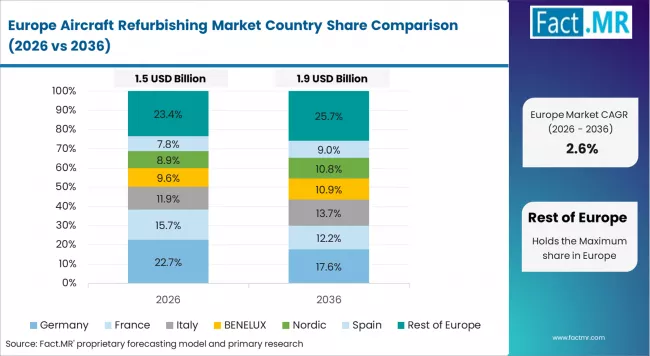
Aircraft Refurbishing Market Europe Country Market Share Analysis, 2026 & 2036 | Source: Fact.MR
The aircraft refurbishing market in Europe is projected to grow from USD 1.5 billion in 2025 to USD 2.4 billion by 2035, registering a CAGR of 4.7% over the forecast period. Germany is expected to maintain its leadership position with a 28.3% market share in 2025, supported by its advanced aviation technology industry and comprehensive aircraft maintenance capabilities including major facilities for Lufthansa Technik, Airbus, and aviation service providers.
France follows with a 21.1% share in 2025, projected to reach 21.4% by 2035, driven by comprehensive aviation innovation programs and aircraft technology development. The United Kingdom holds a 18.8% share in 2025, expected to maintain 18.5% by 2035 despite post-Brexit aviation adjustments. Italy commands a 15.7% share, while Spain accounts for 10.4% in 2025. The Rest of Europe region is anticipated to gain momentum, expanding its collective share from 5.7% to 6.2% by 2035, attributed to increasing aviation services development in Nordic countries and emerging Eastern European aviation facilities implementing aircraft refurbishing capabilities.
Premium Quality Standards Define Japanese Market Dynamics
Japanese aircraft refurbishing operations reflect the country's exacting quality standards and sophisticated aviation requirements. Major airlines and aviation companies including Japan Airlines, ANA, and aviation service providers maintain rigorous supplier qualification processes that often exceed international standards, requiring extensive documentation, service validation, and facility audits that can take 12-18 months to complete. This creates high barriers for new suppliers but ensures consistent quality that supports premium aviation service positioning.
The Japanese market demonstrates unique precision requirements, with significant demand for ultra-reliable refurbishing services tailored to Japanese aviation applications including earthquake-resistant installations, operational efficiency integration, and comprehensive passenger experience optimization. Companies require specific service characteristics and quality standards that differ from Western applications, driving demand for specialized engineering and quality control capabilities.
Regulatory oversight through the Ministry of Land, Infrastructure, Transport and Tourism emphasizes comprehensive safety standards and aviation service requirements that surpass most international benchmarks. The aviation service certification system requires detailed performance documentation, creating advantages for suppliers with transparent engineering data and comprehensive aviation validation.
Supply chain management focuses on relationship-based partnerships rather than purely transactional procurement. Japanese companies typically maintain long-term supplier relationships spanning decades, with annual contract negotiations emphasizing service reliability and quality consistency over price competition. This stability supports investment in specialized service equipment tailored to Japanese aviation specifications.
Market Dynamics Drive Innovation in South Korea
South Korean aircraft refurbishing operations reflect the country's advanced aviation sector and technology-oriented business model. Major airlines and aviation conglomerates including Korean Air, Asiana Airlines, and aviation technology companies drive sophisticated procurement strategies, establishing direct relationships with global suppliers to secure consistent quality and pricing for their aircraft operations targeting both domestic and international markets.
The Korean market demonstrates particular strength in applying aircraft refurbishing to international airline applications, with companies developing innovative services that integrate advanced technology with traditional Korean aviation excellence and efficiency principles. This innovation approach creates demand for specific service specifications that often exceed standard applications, requiring suppliers to adapt engineering and service technologies.
Regulatory frameworks emphasize aviation safety and international competitiveness, with Korean Agency for Technology and Standards requirements often exceeding international benchmarks. This creates barriers for lower-quality suppliers but benefits established service providers who can demonstrate advanced aviation capabilities. The regulatory environment particularly favors suppliers with comprehensive documentation and quality management systems.
Supply chain efficiency remains critical given Korea's integration with global aviation markets. Companies increasingly pursue long-term contracts with suppliers in Germany, France, and the United States to ensure reliable access to high-quality refurbishing services while managing technology transfer and foreign exchange risks. Advanced logistics investments support service integration during complex aircraft refurbishing operations.
Competitive Landscape of Aircraft Refurbishing Market
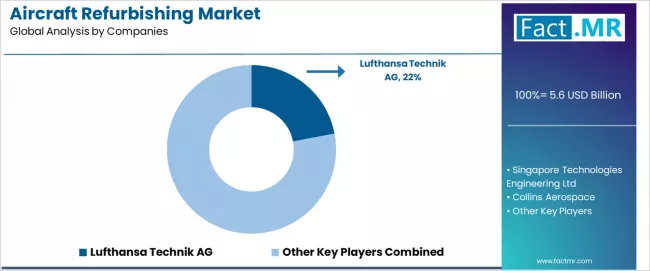
Aircraft Refurbishing Market Analysis By Company | Source: Fact.MR
Profit pools are consolidating upstream in scaled aviation service capabilities and downstream in value-added integrated aircraft solutions for commercial airlines, aircraft lessors, and business aviation applications. Value is migrating from basic refurbishing services to specification-tight, certification-compliant aviation solutions where regulatory compliance, passenger experience enhancement, and consistent quality command premiums.
Several archetypes set the pace: global aviation MRO leaders defending share through comprehensive service portfolios and airline relationships; specialized aircraft interior companies that manage certification complexity and customer customization; cabin technology integrators with IFE system IP and connectivity capabilities; and business aviation specialists pulling volume in VIP completions and luxury aircraft applications.
Switching costs—aviation certification requirements, airline approval processes, service facility investments—stabilize market position for incumbents, while technology disruptions (smart cabin integration, sustainable materials, passenger connectivity advancement) and regulatory evolution trends reopen opportunities for innovative refurbishing designs. Consolidation and vertical integration continue; digital cabin integration becomes essential as basic interior functionality evolves. Market dynamics favor suppliers with comprehensive aviation expertise, certification capabilities, and established airline relationships.
The competitive environment presents both opportunities and constraints. Premium aviation requirements create barriers for basic service providers but establish standards that favor proven aviation technology leaders over uncertified alternatives. Airline operational requirements and passenger experience demands increasingly influence procurement decisions as carriers demand certified services and documented performance improvements.
| Stakeholder Type | Primary Advantage | Repeatable Plays |
|---|---|---|
| Global aviation MRO leaders | Comprehensive portfolios, airline relationships, scale | Long-term airline partnerships, complete service solutions, global maintenance capability |
| Specialized interior companies | Certification expertise, customization capabilities | Technical differentiation, interior design focus, aviation compliance specialization |
| Cabin technology integrators | IFE system IP, connectivity capabilities | Technology leadership, smart cabin systems, passenger experience optimization |
| Business aviation specialists | VIP expertise, luxury customization | High-value projects, specialized craftsmanship, premium materials and finishes |
Source: Fact.MR analysis. Updated Mar 20, 2026
Key Players in the Aircraft Refurbishing Market
- Lufthansa Technik AG
- Singapore Technologies Engineering Ltd
- Collins Aerospace
- Safran Seats (Safran S.A.)
- HAECO Group
- Diehl Aviation GmbH
- GDC Technics LLC
- Air France Industries KLM Engineering & Maintenance
- JAMCO Corporation
- Avianor Inc.
Bibliography
- Cirium (a LexisNexis company). (2024). Global Fleet Report 2024: Age Demographics and Retirement Forecasts. Cirium.
- International Air Transport Association. (2024). World Air Transport Statistics 2024. IATA.
- Federal Aviation Administration. (2024). Supplemental Type Certificate Database: Cabin Modification Approvals. FAA.
- European Union Aviation Safety Agency. (2024). Annual Safety Review 2024. EASA.
- AerCap Holdings N.V. (2024). Annual Report 2023. AerCap.
- Boeing Commercial Airplanes. (2024). Commercial Market Outlook 2024-2043. Boeing.
This bibliography is provided for reader reference. The full Fact.MR report contains the complete reference list with primary research documentation.
This Report Addresses
- Market sizing and quantitative forecast metrics detailing industry revenue projections for the aircraft refurbishing market through 2036.
- Segmentation analysis identifying adoption patterns across Service, Aircraft, Customer segments and evaluating structural demand drivers.
- Regional deployment intelligence comparing growth dynamics across 7 key countries and broader geographic markets.
- Regulatory compliance assessment analyzing policy frameworks and standards that affect market adoption and procurement specifications.
- Competitive landscape evaluation profiling 10 companies and their strategic positioning across technology and geographic dimensions.
- Strategic investment guidance identifying infrastructure requirements and procurement specifications for market participants.
- Supply chain and operational analysis identifying capacity constraints, lead time factors, and sourcing patterns that influence market dynamics.
- Data delivery formats including PDF narrative reports, Excel datasets, interactive dashboards, and presentation files.
Segmentation
Aircraft Refurbishing Market Segmentation
| Category | Segments Covered |
|---|---|
| By Service | Cabin Interiors, IFE/Connectivity, VIP/Completions |
| By Aircraft | Narrow-body, Wide-body, Business Jets |
| By Customer | Airlines, Lessors, Private/VIP |
| By Region | North America, Europe, Asia Pacific, Latin America, Middle East & Africa |
Source: Fact.MR analysis. Updated Mar 20, 2026
Aircraft Refurbishing Market Analysis by Service
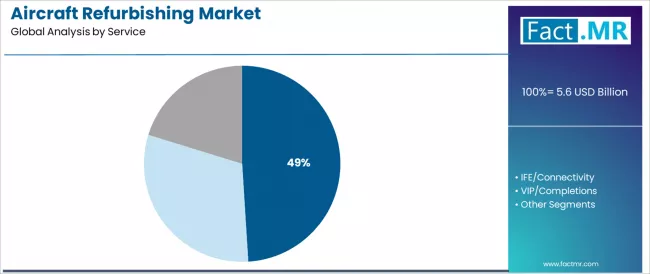
Aircraft Refurbishing Market Analysis By Service | Source: Fact.MR
| Segment | 2025 to 2035 Outlook |
|---|---|
| Cabin Interiors | Leader in 2025 with 49.0% market share; likely to maintain leadership through 2035. Comprehensive seat, galley, and interior refurbishing with established airline fleet renewal programs. Momentum: steady-to-strong. Watchouts: long aircraft downtime requirements, high capital investment needs, competitive pressure from new aircraft deliveries affecting refurbishing timing decisions. |
| IFE/Connectivity | Strong segment with 29.0% market share due to rapid technology advancement requiring frequent upgrades for passenger connectivity and entertainment systems. Benefits from shorter installation timeframes and high-value technology integration. Momentum: strong growth driven by passenger connectivity demands and technology refresh cycles. |
| VIP/Completions | Represents 22.0% market share, benefiting from high-value business jet and VIP aircraft customization requiring specialized craftsmanship and premium materials. Strong in luxury aviation and corporate aircraft applications. Momentum: moderate growth in premium aviation segments. Watchouts: economic sensitivity affecting luxury aviation spending, longer project timelines, specialized certification requirements. |
Source: Fact.MR analysis. Updated Mar 20, 2026
Aircraft Refurbishing Market Analysis by Aircraft
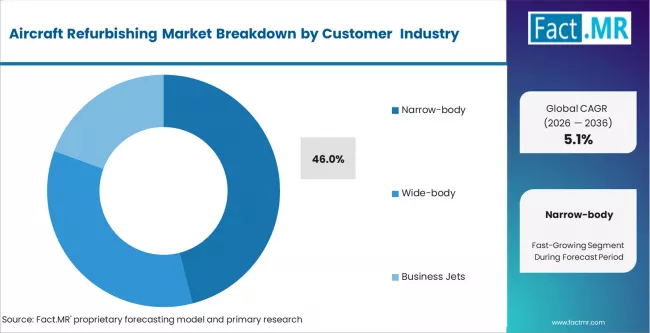
Aircraft Refurbishing Market Analysis By Aircraft | Source: Fact.MR
| Segment | 2025 to 2035 Outlook |
|---|---|
| Narrow-body | At 46.0%, largest aircraft segment in 2025 with established short to medium-haul airline operations requiring regular interior updates and passenger experience enhancement. Mature refurbishing processes, standardized cabin configurations. Momentum: steady growth driven by high-utilization aircraft requiring frequent interior updates and passenger experience improvements. Watchouts: operational downtime sensitivity, cost optimization pressure, competition from aircraft replacement decisions. |
| Wide-body | Strong segment with 32.0% share driven by long-haul aircraft requiring premium passenger experiences and advanced cabin technologies for international route competition. Benefits from higher-value refurbishing projects and complex system integration requirements. Momentum: moderate growth through international aviation recovery and premium cabin enhancement. Watchouts: airline capital allocation priorities, longer project timelines, complex certification requirements for international operations. |
| Business Jets | Holds 22.0% share encompassing corporate and private aircraft requiring specialized customization and luxury interior solutions. Growing emphasis on corporate travel efficiency and VIP transportation driving specialized refurbishing requirements. Momentum: selective growth in business aviation segments and corporate fleet upgrades. Innovation-dependent with specific luxury requirements and limited market scale compared to commercial aviation. |
Source: Fact.MR analysis. Updated Mar 20, 2026
Aircraft Refurbishing Market Analysis by Customer
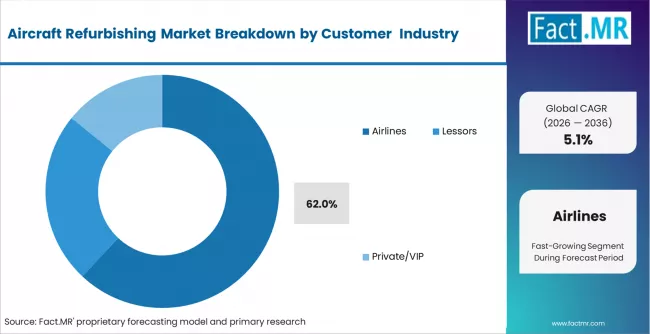
Aircraft Refurbishing Market Analysis By Customer | Source: Fact.MR
| Segment | 2025 to 2035 Outlook |
|---|---|
| Airlines | Dominant segment with 62.0% market share due to commercial aviation fleet management requirements and passenger experience competition demanding regular aircraft interior updates. Benefits from scheduled maintenance integration and fleet standardization opportunities. Momentum: steady growth driven by aviation recovery and competitive passenger experience requirements. Watchouts: airline financial health affecting capital investment, operational constraints limiting aircraft availability, cost sensitivity in competitive markets. |
| Lessors | Represents 23.0% market share, favored for aircraft asset value optimization and lease transition requirements necessitating interior updates between lessees. Strong in fleet management and aircraft remarketing applications. Momentum: rising growth in aircraft leasing market expansion and asset management optimization. Watchouts: lease market cyclicality, lessee specifications variations, residual value considerations affecting refurbishing investment decisions. |
| Private/VIP | Holds 15.1% share encompassing private owners and VIP operators requiring specialized luxury interiors and personalized aircraft configurations. Growing emphasis on corporate aviation and luxury travel driving high-value refurbishing projects. Momentum: moderate growth in luxury aviation and corporate travel segments despite economic sensitivity. Innovation-dependent with specific customization requirements and premium material specifications. |
Source: Fact.MR analysis. Updated Mar 20, 2026
Scope of the Report
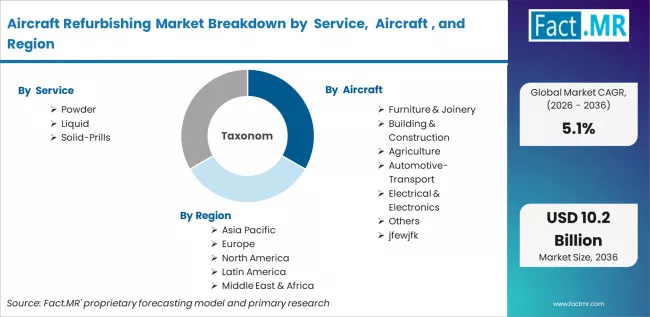
Aircraft Refurbishing Market Breakdown By Service, Aircraft , And Region | Source: Fact.MR
| Metric | Value |
|---|---|
| Quantitative Units | USD 5.89 billion to USD 9.68 billion, at a CAGR of 5.1% |
| Market Definition | The aircraft refurbishing market covers specialized modification, overhaul, and upgrade services applied to commercial, regional, and business aviation interiors and systems. Services include cabin reconfiguration (seat layout changes, class upgrades), interior component replacement (seats, galleys, lavatories, overhead bins), in-flight entertainment and connectivity system installation, livery and paint refinishing, and VIP/head-of-state completion projects. |
| Segmentation | Service (Cabin Interiors, IFE/Connectivity, VIP/Completions), Aircraft (Narrow-body, Wide-body, Business Jets), Customer (Airlines, Lessors, Private/VIP) |
| Regions Covered | North America, Latin America, Europe, East Asia, South Asia, Oceania, Middle East & Africa |
| Countries Covered | USA, Mexico, Germany, France, UK, South Korea, Japan, and 40 plus countries |
| Key Companies Profiled | Lufthansa Technik AG, Singapore Technologies Engineering Ltd, Collins Aerospace (RTX Corporation), Safran Seats (Safran S.A.), HAECO Group, Diehl Aviation GmbH, GDC Technics LLC, Air France Industries KLM Engineering & Maintenance, JAMCO Corporation, Avianor Inc. |
| Forecast Period | 2026 to 2036 |
| Approach | Forecasting models apply a hybrid top-down and bottom-up methodology, calibrating global estimates against regional production data and verified shipment records to project market trajectory through 2036. |
Source: Fact.MR analysis. Updated Mar 20, 2026
Aircraft Refurbishing Market Segmentation
-
By Service :
- Cabin Interiors
- IFE/Connectivity
- VIP/Completions
-
By Aircraft :
- Narrow-body
- Wide-body
- Business Jets
-
By Customer :
- Airlines
- Lessors
- Private/VIP
-
By Region :
- North America
- Europe
- Asia Pacific
- Latin America
- Middle East & Africa
Frequently Asked Questions
How large is the demand for Aircraft Refurbishing Market in the global market in 2026?
What will be the market size of Aircraft Refurbishing Market by 2036?
What is the expected demand growth for Aircraft Refurbishing Market between 2026 and 2036?
Which Service is poised to lead global sales by 2026?
How significant is the role of Narrow-body in the Aircraft Refurbishing Market?
What is the growth outlook for USA in this report?
What is the growth outlook for Mexico?
Does the report cover UK in its regional analysis?
What is Aircraft Refurbishing Market and what is it mainly used for?
What is included in the scope of this report?
What is excluded from the scope of this report?
How does Fact.MR build and validate the Aircraft Refurbishing Market forecast?
What regions are covered in this report?
Which companies are profiled in this report?
How large is the demand for Aircraft Refurbishing Market in the global market in 2026?
What will be the market size of Aircraft Refurbishing Market by 2036?
What is the expected demand growth for Aircraft Refurbishing Market between 2026 and 2036?
Which Service is poised to lead global sales by 2026?
How significant is the role of Narrow-body in the Aircraft Refurbishing Market?
What is the growth outlook for USA in this report?
What is the growth outlook for Mexico?
Does the report cover UK in its regional analysis?
What is Aircraft Refurbishing Market and what is it mainly used for?
What is included in the scope of this report?
What is excluded from the scope of this report?
How does Fact.MR build and validate the Aircraft Refurbishing Market forecast?
What regions are covered in this report?
Which companies are profiled in this report?
Who worked on this report


Preview the report firsthand - request a free sample
Free SampleGet the brochure for pricing and purchase details
Download PDF