- Market Value (2025): USD 116.1 Mn
- Estimated Value (2026): USD 130 Mn
- Forecast Value (2036): USD 403 Mn
- CAGR (2026-2036): 12.0%
What is the airport deicing fluid reclaimers market forecast to be worth by 2036?
USD 130 million in 2026 to USD 403 million by 2036, at 12.0% CAGR.
- The airport deicing fluid reclaimers market reached USD 116.1 million in 2025. Market value is projected to increase to USD 130 million in 2026 before reaching USD 403 million by 2036.
- The market is forecast to expand at a 12.0% CAGR during the assessment period as airports strengthen environmental compliance and expand glycol recovery infrastructure.
- Airport deicing fluid reclaimers collect, separate and recover glycol-based runoff generated during aircraft deicing operations.
- These systems reduce environmental impact while allowing airports to recycle valuable deicing fluids. Effective recovery also improves stormwater management during winter operations.
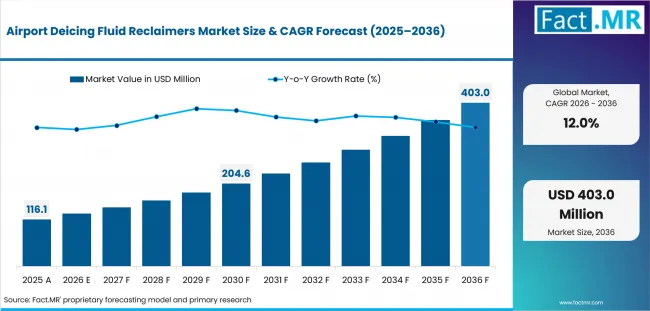
Airport Deicing Fluid Reclaimers Market Market Value Analysis | Source: Fact.MR
What are the defining numbers behind airport deicing fluid reclaimers market growth?
USD 273 million absolute opportunity by 2036, supported by stricter environmental regulations and wider glycol recycling adoption.
- Demand Drivers in the Market
- Airports continue expanding glycol recovery infrastructure.
- Environmental regulations increase investment in runoff management.
- Recycling technology improves fluid recovery efficiency.
- Winter flight operations support demand for advanced recovery systems.
- Key Segments Analyzed
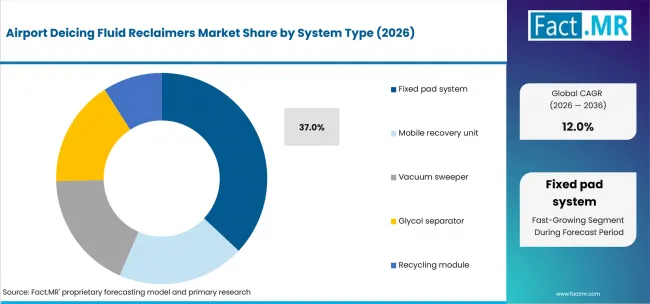
- By System Type: Fixed pad systems are expected to account for 37.0% share in 2026 as they provide efficient glycol collection at high-traffic airports.
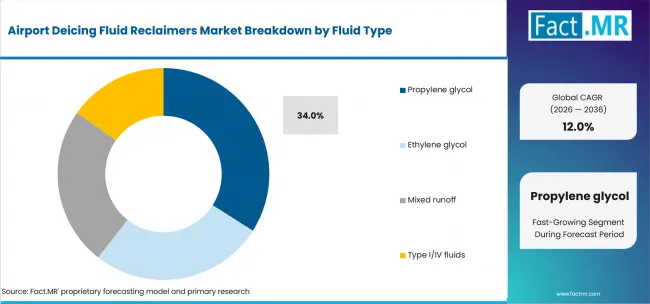
- By Fluid Type: Propylene glycol is projected to hold 34.0% share in 2026 because it remains the most widely used aircraft deicing fluid.
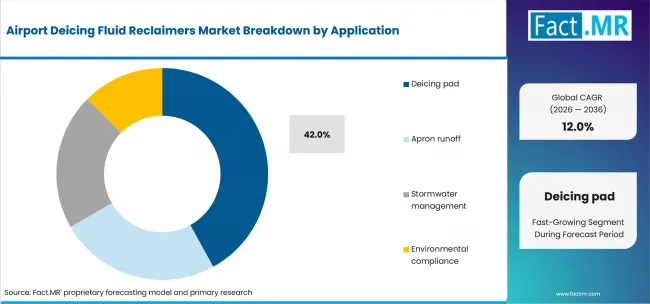
- By Application: Deicing pads are forecast to represent 42.0% share in 2026 as they serve as the primary collection point for glycol recovery.
- By Airport Climate: Snowbelt airports are expected to account for 45.0% share in 2026 because they experience frequent winter deicing operations.
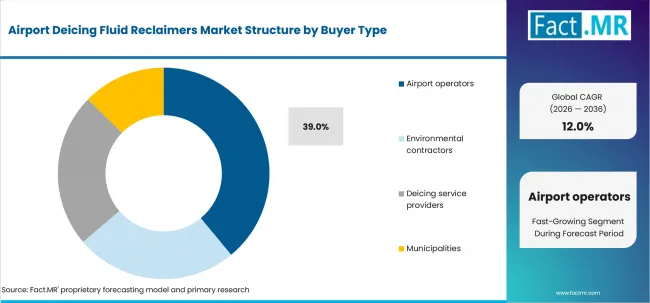
- By Buyer Type: Airport operators are projected to capture 39.0% share in 2026 as they lead investment in environmental infrastructure.
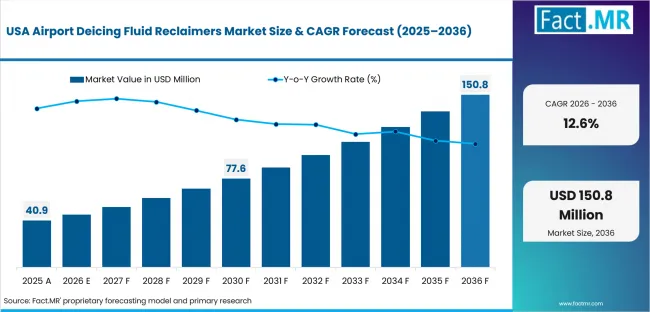
- By Geography: The United States is projected to record 12.6% CAGR through 2036 as airports continue strengthening glycol recovery programs.
- Analyst Opinion at Fact.MR
- Shambhu Nath Jha, Senior Analyst at Fact.MR, states, "Airport deicing fluid reclaimers are becoming essential as airports strengthen environmental compliance and reduce glycol discharge. Companies that improve recovery efficiency and recycling performance are expected to strengthen their market position during the forecast period."
- Strategic Implications
- Equipment manufacturers should improve glycol recovery rates through advanced separation technology.
- Airport operators should integrate recovery systems into long term environmental planning.
- Environmental contractors should expand recycling capability to reduce disposal costs.
- Technology providers should improve automation for efficient fluid collection and monitoring.
Demand continues increasing because airports face tighter environmental standards and higher deicing activity during severe winter seasons. Operators are investing in recovery systems that improve fluid collection efficiency while lowering treatment expenses. Recycling technology is also improving recovery rates across major airports.
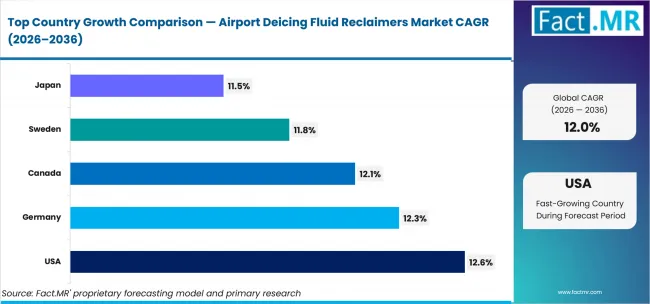
The United States is projected to record 12.6% CAGR through 2036 because environmental compliance programs continue expanding. Germany is expected to achieve 12.3% CAGR through airport sustainability investment. Canada is likely to register 12.1% CAGR through winter maintenance upgrades. Sweden is forecast to grow at 11.8% CAGR through advanced glycol recovery programs. Japan is anticipated to record 11.5% CAGR as airport environmental management continues improving.
How does the airport deicing fluid reclaimers market break down by segment?
Fixed pad systems lead at 37.0%. Propylene glycol leads at 34.0%.
Which system type dominates?
Fixed pad systems hold 37.0% share in 2026.
Airport Deicing Fluid Reclaimers Market Analysis By System Type | Source: Fact.MR
Fixed pad systems are expected to account for 37.0% share in 2026 because they provide efficient glycol collection at airports with frequent winter operations. Permanent installations improve recovery efficiency and simplify fluid management. Mobile recovery units support operational flexibility. Vacuum sweepers collect residual runoff. Recycling modules improve glycol reuse. Aeromag announced that its Recovery, Recycle and Reuse (RRR) glycol recycling facility at Syracuse Hancock International Airport had been recognized as the 2024 Airport Business Project of the Year in the Environmental category. The facility, is the first of its kind in the United States and is capable of producing up to 550,000 gallons of Type I aircraft deicing fluid annually while generating 5–7 million gallons of reusable water.
Which fluid type dominates?
Propylene glycol leads with 34.0% share in 2026.
Airport Deicing Fluid Reclaimers Market Analysis By Fluid Type | Source: Fact.MR
Propylene glycol is projected to capture 34.0% share in 2026 because it remains the most widely used aircraft deicing fluid across commercial airports. Its lower environmental impact supports wider adoption. Ethylene glycol continues serving selected applications. Mixed runoff requires advanced separation systems. Type I and Type IV fluids strengthen recovery demand during severe winter conditions. During the 2025–2026 winter season, EFM consumed 4,478 cubic meters of ADF Type I Mix, of which 2,958 cubic meters, or 66%, consisted of recycled material. Deicing operations reached 8,628 aircraft, compared with 6,937 in the previous year.
Which application dominates?
Deicing pads hold 42.0% share in 2026.
Airport Deicing Fluid Reclaimers Market Analysis By Application | Source: Fact.MR
Deicing pads remain the largest application because they serve as the primary location for glycol collection and recovery. The segment is expected to account for 42.0% share in 2026. Apron runoff management supports environmental protection. Stormwater management strengthens regulatory compliance. Environmental compliance programs continue driving investment. With new systems installed, Denver International Airport is now able to recycle 99% of glycol used in deicing processes. The project involved significant infrastructure upgrades including tunnel bores under active taxiways and runways. Burns & McDonnell provided engineering services for the deicing industrial wastewater pond expansion, which included four 5.4-million-gallon pond cells and associated infrastructure.
Which airport climate dominates?
Snowbelt airports lead market demand.
Snowbelt airports are expected to account for 45.0% share in 2026 because they perform frequent aircraft deicing throughout the winter season. Higher glycol consumption increases recovery requirements. Alpine airports continue upgrading recovery systems. DEN completed construction of the glycol recycling system in 2023 and fully commissioned the system in 2024. The airport collects approximately 70% of deicing fluid applied to aircraft each winter season. The on-site, closed-loop recycling plant reclaims spent glycol for reblending back into deicing fluid.
Which buyer type dominates?
Airport operators lead with 39.0% share in 2026.
Airport Deicing Fluid Reclaimers Market Analysis By Buyer Type | Source: Fact.MR
Airport operators remain the largest customer group because they oversee environmental compliance and winter operations. The segment is expected to account for 39.0% share in 2026. Environmental contractors expand recovery services. Deicing service providers strengthen equipment demand. Municipalities support stormwater management projects around airport facilities. Clariant expanded its storage capacity at its Uddevalla facility in Sweden with two new storage tanks and a truck unloading station to support increased use of recycled mono propylene glycol (MPG) in aircraft deicing fluids.
What is accelerating airport deicing fluid reclaimer adoption, and what is holding it back?
Environmental regulations support growth while high installation costs remain a challenge.
Drivers Impact Analysis
| DRIVER | (~) % IMPACT ON CAGR | GEOGRAPHIC RELEVANCE | IMPACT TIMELINE |
|---|---|---|---|
| Stricter environmental regulations | +1.1% | North America, Europe | Medium term (2-4 years) |
| Higher aircraft deicing activity | +0.9% | Cold climate regions | Long term (≥4 years) |
| Growth of glycol recycling programs | +0.8% | Global | Medium term (2-4 years) |
| Airport sustainability initiatives | +0.6% | Global | Medium term (2-4 years) |
| Better fluid recovery technology | +0.4% | Global | Short term (≤2 years) |
Source: Fact.MR analysis. Updated Jul 6, 2026
Stricter environmental regulations
Airports continue strengthening runoff control to meet environmental standards. Recovery systems reduce glycol discharge and improve compliance.
Higher aircraft deicing activity
Severe winter conditions increase aircraft deicing frequency. Greater fluid use creates stronger demand for recovery equipment.
Growth of glycol recycling programs
Recovered glycol can be processed for reuse through dedicated recycling systems. This lowers disposal costs and improves resource efficiency.
Airport sustainability initiatives
Airports continue reducing environmental impact through cleaner winter operations. Glycol recovery systems support long term sustainability goals.
Better fluid recovery technology
Modern separation systems improve glycol recovery rates while reducing operating costs. Automation also strengthens system performance.
Opportunity Impact Analysis
| OPPORTUNITY | (~) % IMPACT ON CAGR | GEOGRAPHIC RELEVANCE | IMPACT TIMELINE |
|---|---|---|---|
| Expansion of airport recycling facilities | +0.8% | North America, Europe | Long term (≥4 years) |
| Smart environmental monitoring | +0.6% | Global | Medium term (2-4 years) |
| Airport infrastructure expansion | +0.5% | Asia Pacific | Medium term (2-4 years) |
| Automated recovery systems | +0.4% | Global | Short term (≤2 years) |
Source: Fact.MR analysis. Updated Jul 6, 2026
Expansion of airport recycling facilities
More airports continue investing in glycol recycling plants. This creates additional demand for recovery equipment.
Smart environmental monitoring
Digital monitoring improves tracking of glycol collection and runoff quality. Operators gain better environmental reporting capability.
Airport infrastructure expansion
New airport developments increasingly include dedicated deicing pads and recovery systems. Early planning supports long term equipment demand.
Automated recovery systems
Automation improves collection efficiency while reducing manual intervention. Modern control systems also strengthen operational reliability.
Restraints Impact Analysis
| RESTRAINT | (~) % IMPACT ON CAGR | GEOGRAPHIC RELEVANCE | IMPACT TIMELINE |
|---|---|---|---|
| High installation cost | -0.7% | Global | Medium term (2-4 years) |
| Seasonal equipment utilization | -0.5% | Cold climate regions | Long term (≥4 years) |
| Complex recovery infrastructure | -0.3% | Large airports | Medium term (2-4 years) |
| Ongoing maintenance needs | -0.2% | Global | Short term (≤2 years) |
Source: Fact.MR analysis. Updated Jul 6, 2026
High installation cost
Recovery systems require investment in collection infrastructure and recycling equipment. Smaller airports often delay implementation.
Seasonal equipment utilization
Many airports operate recovery systems mainly during winter months. Seasonal demand influences equipment utilization.
Complex recovery infrastructure
Large airports require integrated drainage and storage systems for efficient glycol recovery. Installation can extend project timelines.
Ongoing maintenance needs
Recovery pumps, separators and storage systems require regular servicing. Preventive maintenance supports dependable winter operations.
Which countries are scaling airport deicing fluid recovery systems fastest?
United States 12.6%; Germany 12.3%; Canada 12.1%; Sweden 11.8%; Japan 11.5%.
Based on regional analysis, the airport deicing fluid reclaimers market is segmented into North America, Europe, East Asia, South Asia, the Middle East & Africa, and Latin America.
| Country | CAGR |
|---|---|
| United States | 12.6% |
| Germany | 12.3% |
| Canada | 12.1% |
| Sweden | 11.8% |
| Japan | 11.5% |
Source: Fact.MR analysis. Updated Jul 6, 2026
Airport Deicing Fluid Reclaimers Market Cagr Analysis By Country | Source: Fact.MR
What supports market growth in the United States?
12.6% CAGR, driven by environmental compliance and winter airport operations.
Airport Deicing Fluid Reclaimers Market Country Value Analysis | Source: Fact.MR
The United States is projected to record 12.6% CAGR from 2026 to 2036 as airports continue expanding glycol recovery infrastructure across major aviation hubs. Environmental regulations encourage higher fluid collection rates. Investment in recycling technology also strengthens long term market demand.
Why is Germany strengthening demand?
12.3% CAGR, supported by airport sustainability programs.
Germany is expected to achieve 12.3% CAGR through 2036 because airport operators continue improving environmental performance through advanced glycol recovery systems. Modern deicing facilities increase recovery efficiency. Long term investment in sustainable airport operations also supports equipment demand.
What is driving growth across Canada?
12.1% CAGR, backed by frequent winter deicing activity.
Canada is forecast to expand at 12.1% CAGR through 2036 because airports perform aircraft deicing throughout extended winter seasons. Greater glycol use creates higher recovery requirements. Environmental management programs also support recycling infrastructure investment.
Why does Sweden maintain steady expansion?
11.8% CAGR, driven by advanced winter maintenance.
Sweden is likely to register 11.8% CAGR through 2036 because airports continue strengthening environmental protection during winter operations. Modern recovery systems improve glycol collection while reducing runoff. Airport sustainability initiatives also encourage technology upgrades.
How is Japan creating future opportunities?
11.5% CAGR, supported by airport modernization.
Japan is expected to record 11.5% CAGR as airports continue improving winter operations and environmental management. Recovery systems support efficient deicing activities while reducing treatment costs. Continued airport modernization is expected to strengthen long term demand.
Who leads the airport deicing fluid reclaimers market?
Environmental expertise and glycol recovery technology define market competition.
The market includes airport environmental technology companies, winter maintenance equipment manufacturers and glycol recovery specialists. Inland Technologies maintains a strong position through glycol recovery and recycling services that support environmental compliance across major airports. Vestergaard Company strengthens its presence through aircraft deicing solutions that complement airport fluid management programs.
Global Ground Support supplies deicing equipment that supports efficient winter ground operations. Aebi Schmidt expands its airport maintenance portfolio through winter service equipment.
Competition increasingly depends on glycol recovery efficiency, recycling capability and environmental compliance. Airport operators seek systems that reduce disposal costs while improving resource recovery. Companies providing dependable technical support and proven recovery performance are expected to strengthen their market position.
Which companies are the key providers?
Inland Technologies and Vestergaard Company are leading providers. Aebi Schmidt remains established participant. Global Ground Support completes the competitive landscape.
- Vestergaard Company
- Inland Technologies
- Global Ground Support
- Aebi Schmidt
Bibliography
- Aeromag. (2024, April 15). Great news following the inauguration of RRR facility at Syracuse. Aeromag.
- Munich Airport. (2026, June 26). Annual report: Aircraft deicing, winter season 2025/2026 at Munich Airport. Munich Airport.
- Denver International Airport. (2025, April 22). DEN on track to meet sustainability initiatives. Denver International Airport.
- Clariant. (2024, November 7). Clariant expands storage capacity in Sweden, supporting increased use of recycled mono propylene glycol for deicing products. Clariant.
- Vestergaard Company. (2026). Glycol recovery vehicle (GRV). Vestergaard Company.
- Inland Technologies. (2026). Inland deicing services. Inland Technologies.
- Global Ground Support. (2026). Glycol recovery vehicles. Global Ground Support.
This Report Addresses
- Strategic assessment of airport deicing fluid recovery systems across winter airport operations.
- Segment evaluation covering Fixed Pad Systems and Propylene Glycol Recovery.
- Country outlook for the United States, Germany, Canada, Sweden and Japan.
- Competitive review of Vestergaard Company, Inland Technologies, Global Ground Support, Aebi Schmidt.
- Technology assessment covering glycol separators, recycling modules, vacuum recovery systems and environmental monitoring solutions.
- Operational assessment covering deicing pads, apron runoff, stormwater management and environmental compliance programs.
- Market estimates supported by airport winter operations, glycol recovery investment and primary industry interviews.
What does the airport deicing fluid reclaimers market cover?
Recovery systems developed for aircraft deicing fluid collection and recycling.
The market includes mobile recovery units, fixed pad systems, vacuum sweepers, glycol separators and recycling modules used during aircraft deicing operations. These systems improve glycol recovery while supporting environmental compliance across airports.
The assessment focuses on airport deicing fluid recovery equipment. Conventional aircraft deicing vehicles and standalone wastewater treatment systems remain outside the market scope.
What is included in the scope?
Glycol recovery systems used during airport winter operations.
The study covers propylene glycol, ethylene glycol, mixed runoff and Type I and Type IV deicing fluids. It also evaluates applications across deicing pads, apron runoff collection, stormwater management and environmental compliance.
Products supplied to airport operators, environmental contractors, deicing service providers and municipalities are included. The study evaluates installations across snowbelt airports, alpine airports, and high altitude airports.
What is excluded from the scope?
Airport equipment without glycol recovery capability is excluded.
The assessment excludes aircraft deicing trucks, runway snow removal vehicles, general drainage equipment and wastewater treatment systems supplied without dedicated deicing fluid recovery functionality.
How was the analysis built?
111+ sources, 42+ company portfolios, 31+ countries, 25+ interviews.
- Primary Research: Airport environmental managers, winter operations specialists, deicing service providers and equipment manufacturers contributed technical and operational insights. Environmental consultants also supported market validation.
- Desk Research: The assessment reviewed airport environmental regulations, glycol recovery technologies, company product portfolios and winter maintenance programs. Airport infrastructure announcements strengthened market analysis.
- Market Sizing and Forecasting: Forecasts were prepared using airport deicing activity, winter maintenance spending, environmental compliance investment and glycol recovery adoption across major aviation markets.
- Data Validation and Update Cycle: Forecasts were verified through supplier interviews, airport project monitoring and expert assessment. Procurement activity and environmental infrastructure upgrades supported the final market estimates.
Segmentation
What is the report's scope and coverage?
| Attribute | Details |
|---|---|
| Quantitative Units | USD Million in 2026 to USD Million by 2036 at CAGR |
| Market Definition | Systems designed to recover and recycle aircraft deicing fluids from airport operations |
| System Type | Mobile recovery unit; fixed pad system; vacuum sweeper; glycol separator; recycling module |
| Fluid Type | Propylene glycol; ethylene glycol; mixed runoff; Type I/IV fluids |
| Application | Deicing pad; apron runoff; stormwater management; environmental compliance |
| Airport Climate | Snowbelt airports; alpine airports; high-altitude airports |
| Buyer Type | Airport operators; environmental contractors; deicing service providers; municipalities |
| Regions Covered | North America; Europe; East Asia; South Asia; Middle East and Africa; Latin America |
| Countries Covered | United States; Germany; Canada; Sweden; Japan |
| Key Companies Profiled | Vestergaard Company; Inland Technologies; Global Ground Support; Aebi Schmidt |
| Forecast Period | 2026 to 2036 |
| Approach | Hybrid top down and bottom up approach using airport deicing activity, glycol recovery investment, environmental regulations and expert validation |
Source: Fact.MR analysis. Updated Jul 6, 2026
How is the market segmented?
-
By System Type:
- Mobile recovery unit
- Fixed pad system
- Vacuum sweeper
- Glycol separator
- Recycling module
-
By Fluid Type:
- Propylene glycol
- Ethylene glycol
- Mixed runoff
- Type I/IV fluids
-
By Application:
- Deicing pad
- Apron runoff
- Stormwater management
- Environmental compliance
-
By Airport Climate:
- Snowbelt airports
- Alpine airports
- High-altitude airports
-
By Buyer Type:
- Airport operators
- Environmental contractors
- Deicing service providers
- Municipalities
-
Region:
- North America
- United States
- Canada
- Europe
- Germany
- United Kingdom
- France
- Italy
- Spain
- Asia Pacific
- China
- Japan
- South Korea
- India
- Singapore
- Latin America
- Brazil
- Argentina
- Mexico
- Middle East & Africa
- GCC Countries
- South Africa
- Israel
- North America
Frequently Asked Questions
Which system type leads the Airport Deicing Fluid Reclaimers Market?
Which fluid type leads the Airport Deicing Fluid Reclaimers Market?
Which application leads the Airport Deicing Fluid Reclaimers Market?
Which airport climate leads the Airport Deicing Fluid Reclaimers Market?
Which buyer type leads the Airport Deicing Fluid Reclaimers Market?
Which region leads the Airport Deicing Fluid Reclaimers Market?
Who worked on this report


Preview the report firsthand - request a free sample
Free SampleGet the brochure for pricing and purchase details
Download PDF