- Base Value(2025): 3.38 Bn
- Estimated Value(2025): 3.4 Bn
- Forecast Value (2035): 7.3 Bn
- CAGR (2025 - 2035): 8.0%
Aluminum Composite Materials Market Forecast and Outlook 2025 to 2035
The global aluminum composite materials market is projected to reach USD 7.28 billion by 2035, recording an absolute increase of USD 3.90 billion over the forecast period. The market is valued at USD 3.38 billion in 2025 and is set to rise at a CAGR of 8.0% during the assessment period.
Demand for aluminum composite materials is expected to grow by approximately 2.2 times during the same period, supported by expanding construction activities across emerging economies worldwide, driving demand for lightweight cladding solutions in commercial and residential building projects, and increasing investments in sustainable building materials with superior fire resistance and thermal insulation properties across architectural facade applications globally.
Quick Stats for Aluminum Composite Materials Market
- Aluminum Composite Materials Market Value (2025): USD 3.38 billion
- Aluminum Composite Materials Market Forecast Value (2035): USD 7.28 billion
- Aluminum Composite Materials Market Forecast CAGR: 8.0%
- Leading Application in Aluminum Composite Materials Market: Construction (70.6%)
- Fastest Growing Application in Aluminum Composite Materials Market: Signage Industry
- Key Growth Regions in Aluminum Composite Materials Market: Asia Pacific, North America, and Europe
- Top Players in Aluminum Composite Materials Market: 3A Composites GmbH, Arconic Corporation, Alstrong Enterprises India Pvt. Ltd., Mitsubishi Chemical Corporation, Alubond U.S.A. (Mulk Holdings International), Yaret Industrial Group Co., Ltd., Shanghai Huayuan New Composite Materials Co., Ltd., Jyi Shyang Industrial Co., Ltd., Interplast Co. Ltd., Alstone India
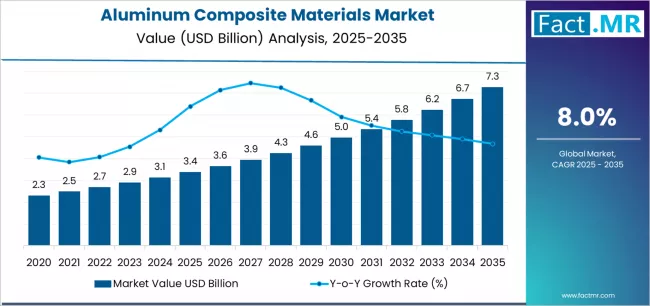
Aluminum Composite Materials Market Market Value Analysis | Source: Fact.MR
Building contractors and architects face mounting pressure to deliver aesthetically appealing facades and reduce building weights while meeting stringent fire safety standards and energy efficiency requirements, with modern aluminum composite panels providing documented performance advantages including design flexibility, weather resistance, and cost-effective installation compared to traditional curtain wall systems alone.
Rising demand for branded signage solutions and expanding recreational vehicle manufacturing enabling lightweight exterior applications create substantial opportunities for material manufacturers and fabrication partners. However, fire safety regulations and building code variations across different markets may pose obstacles to unrestricted product adoption.
The construction segment dominates market activity with 70.6% market share, driven by extensive adoption in high-rise building cladding, curtain wall systems, and architectural facade applications requiring lightweight panels across commercial, residential, and institutional developments worldwide.
Architects and contractors increasingly recognize the performance benefits of aluminum composite materials, with typical product offerings providing effective weather protection, design versatility, and installation efficiency at competitive price points through established building material distribution networks.
The signage industry segment demonstrates the fastest growth trajectory with substantial market presence, supported by rising demand for branded exterior signage, digital billboard substrates, and wayfinding systems requiring flat, rigid panels in retail, transportation, and advertising applications.
Three-layer sandwich construction emerges as the standard product configuration, reflecting industry preference for aluminum skin-thermoplastic core-aluminum skin assemblies with varying core materials and thicknesses. Asia Pacific represents the dominant regional market, driven by massive urbanization programs and infrastructure development across China, India, and Southeast Asian countries supporting construction industry growth.
Regional dynamics show Asia Pacific maintaining market leadership with the fastest growth rates, supported by unprecedented urban development and commercial construction activity across emerging economies.
China demonstrates particularly strong momentum driven by smart city initiatives and green building adoption, while India shows robust growth through expanding real estate sector and government infrastructure investments. North America emphasizes fire-safe formulations and compliance with updated building codes, while Europe focuses on sustainable building practices and energy-efficient facade systems. China leads country-level growth with 9.4% CAGR through massive construction volumes and domestic manufacturing capacity, followed by India with 8.9% CAGR supported by urbanization trends and growing middle-class housing demand.
The competitive landscape features moderate concentration with 3A Composites GmbH maintaining a 22% market leadership position, while established manufacturers including Arconic Corporation, Alstrong Enterprises India Pvt. Ltd., Mitsubishi Chemical Corporation, and Alubond U.S.A. compete through product innovation, fire safety certifications, and geographic expansion strategies across construction, signage, and transportation applications.
Aluminum Composite Materials Market Year-over-Year Forecast 2025 to 2035
Between 2025 and 2029, the aluminum composite materials market is projected to expand from USD 3.38 billion to USD 4.59 billion, resulting in a value increase of USD 1.21 billion, which represents 31% of the total forecast growth for the period. This phase of development will be shaped by rising demand for lightweight building cladding in urban development projects, product innovation in fire-retardant core materials with enhanced safety certifications and extended warranty periods, as well as expanding integration with prefabricated building systems and modular construction methodologies. Companies are establishing competitive positions through investment in advanced coating technologies, sustainable manufacturing processes, and strategic market expansion across architectural specification networks, signage fabricators, and recreational vehicle manufacturers.
From 2029 to 2035, the market is forecast to grow from USD 4.59 billion to USD 7.28 billion, adding another USD 2.69 billion, which constitutes 69% of the overall expansion. This period is expected to be characterized by the expansion of specialized product applications, including ultra-thin panels for interior design and antimicrobial surface treatments tailored for healthcare and food service environments, strategic collaborations between material manufacturers and building system integrators, and an enhanced focus on circular economy principles and aluminum recycling capabilities. The growing emphasis on sustainable building certifications and rising adoption of digitally-printed custom facade designs will drive demand for high-performance aluminum composite panels across diverse architectural and commercial applications.
Aluminum Composite Materials Market Key Takeaways
| Metric | Value |
|---|---|
| Market Value (2025) | USD 3.38 billion |
| Market Forecast Value (2035) | USD 7.28 billion |
| Forecast CAGR (2025-2035) | 8.0% |
Source: Fact.MR analysis. Updated Dec 8, 2025
Why is the Aluminum Composite Materials Market Growing?
The aluminum composite materials market grows by enabling architects, contractors, and building owners across commercial construction, retail developments, and institutional projects to deliver lightweight facade solutions and achieve design flexibility while reducing structural loads without compromising aesthetic quality or weather protection performance.
Building professionals face mounting pressure to meet energy efficiency mandates and reduce construction timelines while managing project budgets and ensuring fire safety compliance, with modern aluminum composite panels typically providing targeted performance characteristics including thermal break capabilities, impact resistance, and UV stability through sandwich panel construction, rapid installation systems, and factory-applied finishes compared to traditional brick, stone, or glass curtain walls alone, making aluminum composites essential for cost-effective modern building envelopes.
The construction industry's need for versatile and economically viable cladding materials creates demand for specialized aluminum composite products that can deliver consistent quality, support complex geometries, and meet diverse regulatory requirements without compromising project schedules or budget constraints.
Architectural specification and expanding urban development drive utilization in high-rise office buildings, retail centers, and transportation infrastructure, where material performance has direct impact on building aesthetics and long-term maintenance costs. The growing global construction output, particularly across Asia Pacific emerging markets experiencing rapid urbanization and infrastructure investment, creates expanding opportunities for aluminum composite panel manufacturers.
Rising building owner emphasis on lifecycle costs and maintenance reduction enables informed material selection favoring durable, low-maintenance facade systems. However, fire safety concerns following high-profile building incidents and varying regulatory frameworks may limit adoption in certain jurisdictions requiring enhanced fire testing and material composition restrictions across different building height classifications.
Segmental Analysis
The market is segmented by application and region. By application, the market is divided into construction, signage industry, RV/trailer construction skins, and others. Regionally, the market is divided into Asia Pacific, Europe, North America, Latin America, and Middle East & Africa.
By Application, Which Segment Accounts for the Dominant Market Share?
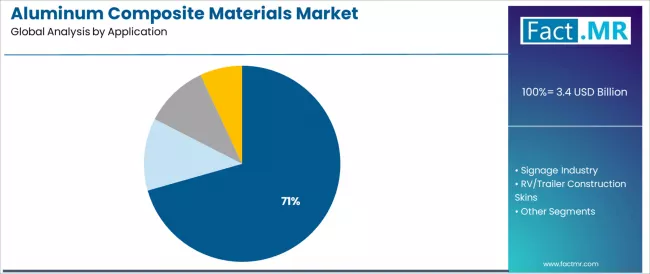
Aluminum Composite Materials Market Analysis By Application | Source: Fact.MR
The construction segment represents the dominant force in the aluminum composite materials market, capturing 70.6% of total market share in 2025. This established application category encompasses solutions featuring architectural facade cladding and exterior wall systems, including advanced panel designs combining mill-finished or coated aluminum skins with polyethylene, fire-retardant mineral, or honeycomb core materials that enable superior design flexibility and weather protection across commercial office buildings, residential high-rises, shopping centers, and institutional facilities worldwide.
The construction segment's market leadership stems from its versatile application scope, with material solutions capable of addressing critical building envelope requirements including lightweight structural loading, thermal insulation, moisture barriers, and architectural expression while maintaining excellent durability and cost-effectiveness standards across new construction and renovation projects.
Within this segment, commercial construction represents the largest application category, driven by office tower developments, retail complexes, and mixed-use projects requiring distinctive facade treatments. This sub-segment benefits from architectural design trends emphasizing curtain wall systems and continuous building skins supporting modern aesthetics.
The residential construction maintains substantial presence serving mid-rise and high-rise apartment buildings, condominium developments, and affordable housing projects where aluminum composite panels provide attractive exteriors at accessible price points. These solutions offer effective building envelope performance for developers managing construction budgets while delivering market-appropriate design quality.
Key performance advantages driving the construction segment include:
- Advanced design flexibility with documented capability to achieve complex geometries, curved surfaces, and custom colors supporting architectural vision
- Established lightweight characteristics enabling reduced structural requirements and foundation costs compared to traditional masonry and precast concrete cladding systems
- Enhanced installation efficiency features supporting rapid building envelope closure and weather protection while maintaining quality control
- Superior lifecycle performance providing optimal durability, minimal maintenance requirements, and sustained appearance across 20-30 year service life expectations
How does the Signage Industry Utilize Aluminum Composite Materials?
The signage industry segment demonstrates the fastest growth trajectory in the aluminum composite materials market, driven by expanding retail branding requirements, transportation wayfinding systems, and outdoor advertising infrastructure requiring flat, rigid substrates with excellent print surface characteristics.
The signage segment's growth momentum is reinforced by retail sector expansion, digital advertising integration demanding structural backing panels, and architectural signage trends emphasizing dimensional letters and illuminated displays.
Within this segment, branded retail signage represents significant growth opportunities, driven by franchise expansion, brand refresh initiatives, and omnichannel retail strategies requiring consistent storefront identity. This sub-segment benefits from quick turnaround fabrication and installation supporting retail rollout schedules.
The transportation signage maintains meaningful presence through highway signs, airport wayfinding, and transit system graphics where durability and visibility requirements favor aluminum composite substrates. Outdoor advertising applications demonstrate steady growth supporting billboard structures and street furniture panels.
The RV/trailer construction skins segment represents specialized applications serving recreational vehicle manufacturers and trailer builders requiring lightweight exterior panels reducing towing weight and fuel consumption. This segment benefits from established manufacturing relationships and continuous product specification.
Key market dynamics supporting application growth include:
- Signage industry expansion driven by retail sector growth and brand visibility requirements, demanding weather-resistant and print-compatible panel systems
- RV/trailer applications requiring weight reduction solutions and durable exterior surfaces withstanding road conditions and environmental exposure
- Others category encompassing transportation interiors, industrial equipment enclosures, and partition systems supporting diverse specialty applications
- Integration of digital printing technologies enabling photorealistic graphics and custom designs on aluminum composite substrates
What are the Drivers, Restraints, and Key Trends of the Aluminum Composite Materials Market?
The market is driven by three concrete demand factors tied to construction industry dynamics. First, rising urbanization rates and commercial construction activity in emerging markets create expanding material demand, with aluminum composite panels representing a critical solution for achieving modern building aesthetics, requiring widespread adoption in facade applications. Second, growing emphasis on sustainable building practices and energy efficiency drives specification of lightweight materials reducing structural loads and transportation emissions, with aluminum composite systems demonstrating recyclability advantages and thermal performance benefits by 2030. Third, increasing preference for prefabricated building components and modular construction methodologies enable faster project delivery approaches that improve construction productivity while reducing labor costs through factory-fabricated panel systems.
Market restraints include fire safety regulations and building code restrictions that can challenge product acceptance and market access, particularly following high-profile building fires that prompted regulatory reviews of combustible core materials and mandatory fire testing requirements. Raw material price volatility for aluminum and polymer resins poses another significant obstacle, as panel manufacturing economics depend on stable commodity costs and predictable pricing, potentially affecting manufacturer margins and product competitiveness. Limited awareness among smaller contractors and regional markets about proper installation techniques creates additional barriers for quality assurance, demanding comprehensive training programs and technical support initiatives.
Key trends indicate accelerated fire-safe product development in developed markets, particularly North America and Europe, where manufacturers demonstrate commitment to non-combustible core materials, enhanced fire barrier technologies, and third-party certification programs. Sustainability integration trends toward recycled aluminum content, low-VOC coatings, and end-of-life recyclability enable responsible material selection that optimizes environmental performance and green building certification contributions. However, the market thesis could face disruption if significant advances in alternative facade technologies or major shifts toward mass timber construction reduce reliance on metal-based building envelope systems.
Analysis of the Aluminum Composite Materials Market by Key Countries
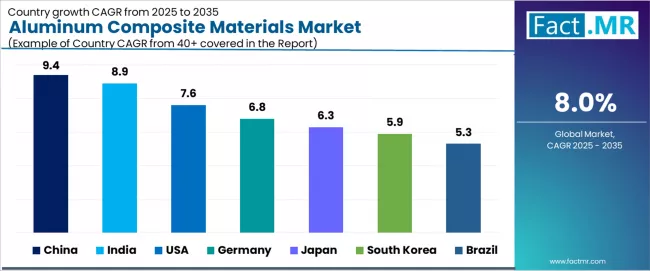
Aluminum Composite Materials Market Cagr Analysis By Country | Source: Fact.MR
| Country | CAGR (2025 to 2035) |
|---|---|
| China | 9.4% |
| India | 8.9% |
| USA | 7.6% |
| Germany | 6.8% |
| Japan | 6.3% |
| South Korea | 5.9% |
| Brazil | 5.3% |
Source: Fact.MR analysis. Updated Dec 8, 2025
The global aluminum composite materials market is expanding rapidly, with China leading at a 9.4% CAGR through 2035, driven by massive urbanization programs, smart city initiatives, and extensive commercial construction supporting domestic manufacturing capacity expansion. India follows at 8.9%, supported by real estate sector growth, government infrastructure investments, and expanding middle-class housing demand. USA records 7.6%, reflecting established construction markets with continuous building renovation activity and fire-safe product adoption.
Germany advances at 6.8%, leveraging sustainable building practices and energy-efficient facade system emphasis. Japan posts 6.3%, focusing on seismic-resistant building technologies and architectural innovation, while South Korea grows steadily at 5.9%, emphasizing high-rise residential developments and urban regeneration projects. Brazil demonstrates 5.3% growth, anchored by commercial construction recovery and infrastructure modernization programs.
How is China Leading Global Market Expansion?
China demonstrates the strongest growth potential in the aluminum composite materials market with a CAGR of 9.4% through 2035. The country's leadership position stems from unprecedented urban development scale, government-led smart city programs, and massive commercial construction volumes driving aluminum composite panel demand across building facade applications.
Growth is concentrated in major metropolitan regions and new development zones, including Beijing, Shanghai, Guangzhou, Shenzhen, and tier-2 cities, where real estate developers and construction companies are increasingly specifying aluminum composite cladding for office towers, shopping centers, residential high-rises, and transportation infrastructure across both private developments and government projects.
Distribution channels through building material distributors, fabrication networks, and direct manufacturer relationships expand market penetration across diverse construction segments and regional markets. The country's extensive domestic manufacturing capacity and vertical integration from aluminum production through panel fabrication provides strong momentum for cost-competitive supply, including comprehensive coverage across budget-conscious developers and premium architectural projects.
Key market factors:
- Urban construction activity concentrated in tier-1 and tier-2 cities with rising high-rise building development and commercial real estate investment
- Manufacturing ecosystem through companies like Yaret Industrial Group Co., Ltd. and Shanghai Huayuan New Composite Materials Co., Ltd. providing domestic production capacity
- Comprehensive supply chain integration from aluminum smelting through panel coating and fabrication supporting competitive pricing structures
- Government initiatives including green building standards and urbanization programs driving systematic adoption across public and private construction projects
Why is India Emerging as a High-Growth Market?
In major metropolitan areas including Mumbai, Delhi NCR, Bangalore, Chennai, and Hyderabad, the adoption of aluminum composite material solutions is accelerating across commercial office projects, retail developments, and residential high-rises, driven by real estate sector expansion and growing architectural sophistication. The market demonstrates strong growth momentum with a CAGR of 8.9% through 2035, linked to rapid urbanization trends and increasing focus on modern building aesthetics in major cities.
Indian developers and architects are implementing aluminum composite cladding systems and contemporary facade designs to enhance building market appeal while meeting construction budgets and project timelines. The country's expanding middle class creates ongoing demand for modern housing and commercial spaces incorporating international design standards, while government infrastructure investments drive systematic material adoption.
Key development areas:
- Commercial real estate development leading aluminum composite adoption with emphasis on Class A office buildings and premium retail centers
- Domestic manufacturing growth through companies like Alstrong Enterprises India Pvt. Ltd. and Alstone India expanding local production capacity
- Architectural specification networks and consultant relationships supporting product awareness and technical education initiatives
- Growing emphasis on green building certifications including LEED and GRIHA driving sustainable material selection and performance verification
What drives USA’s Market Resilience?
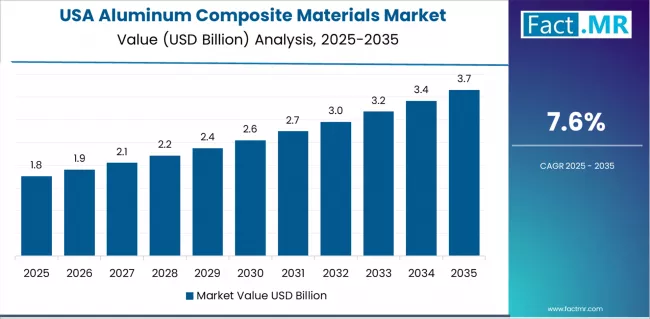
Aluminum Composite Materials Market Country Value Analysis | Source: Fact.MR
USA’s market expansion is driven by diverse construction requirements, including office building renovations in major metropolitan markets and new commercial developments in growing secondary cities. The country demonstrates strong growth potential with a CAGR of 7.6% through 2035, supported by continuous building modernization activity and increasing adoption of fire-safe aluminum composite formulations meeting enhanced building codes.
American architects and building owners face regulatory challenges related to fire safety requirements and insurance considerations, requiring manufacturers to demonstrate clear compliance with NFPA standards and local building codes. Established construction industry relationships and comprehensive building material distribution infrastructure create stable baseline demand for aluminum composite panels, particularly among commercial contractors and architectural metal-glass contractors where proven performance and technical support drive material specification decisions and project selection.
Market characteristics:
- Commercial construction and renovation projects showing robust demand with substantial annual material consumption across diverse building types
- Regional market variations between high-rise urban construction in major cities and suburban commercial developments requiring different product specifications
- Future projections indicate continued emphasis on fire-safe products with non-combustible cores and enhanced fire barrier systems
- Growing importance of building code compliance and third-party testing certifications supporting specification confidence and insurance acceptance
How does Germany Demonstrate Sustainable Building Leadership?
The market in Germany leads in environmentally-conscious facade systems based on integration with energy efficiency requirements and comprehensive sustainability frameworks for green building certification. The country shows strong potential with a CAGR of 6.8% through 2035, driven by stringent building energy codes and systematic emphasis on lifecycle environmental performance in major regions, including Bavaria, North Rhine-Westphalia, Baden-Württemberg, and Hesse.
Architects and building owners are adopting high-performance aluminum composite systems and thermal break technologies for building envelope optimization, particularly in office developments and institutional buildings demanding verified energy performance and occupant comfort. Distribution channels through specialized facade contractors and building envelope consultants expand coverage across quality-focused construction markets and architectural specification communities.
Leading market segments:
- Commercial office construction in major business centers implementing comprehensive energy efficiency strategies and sustainable material specifications
- Facade renovation projects addressing building envelope upgrades and thermal performance improvements in existing building stock
- Strategic emphasis on EPD (Environmental Product Declaration) documentation and sustainability certifications supporting material transparency
- Focus on recyclability and circular economy principles addressing end-of-life material recovery and aluminum recycling infrastructure
What positions Japan for Seismic Design Leadership?
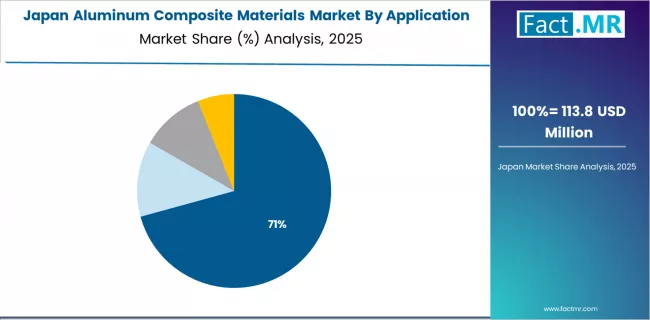
Aluminum Composite Materials Market Japan Market Share Analysis By Application | Source: Fact.MR
In major urban centers including Tokyo, Osaka, Nagoya, and Fukuoka, architects and structural engineers are implementing aluminum composite materials through seismic-resistant building designs and lightweight facade systems, with documented performance showing enhanced building resilience through reduced cladding mass and flexible attachment methodologies. The market shows steady growth potential with a CAGR of 6.3% through 2035, linked to ongoing urban redevelopment, aging building stock replacement, and increasing emphasis on earthquake preparedness in major metropolitan regions.
Architects are adopting aluminum composite cladding systems and advanced engineering approaches to minimize seismic loads while maintaining architectural quality standards demanded by sophisticated Japanese construction markets. The country's established quality requirements create ongoing opportunities for premium product specifications that differentiate through manufacturing precision and performance verification.
Market development factors:
- Seismic building design requirements leading lightweight material adoption with emphasis on reduced facade mass and flexible mounting systems
- Urban redevelopment projects supporting building replacement and facade modernization in major cities addressing aging infrastructure
- Quality manufacturing standards and precision fabrication capabilities supporting architectural detailing and installation tolerances
- Integration of fire safety requirements and building code compliance addressing comprehensive performance specifications
How does South Korea show Urban Regeneration Leadership?
South Korea's aluminum composite materials market demonstrates sophisticated urban development focused on high-rise residential construction and mixed-use project integration, with documented implementation of contemporary facade designs achieving substantial architectural impact through coordinated cladding systems and building identity programs.
The country maintains steady growth momentum with a CAGR of 5.9% through 2035, driven by concentrated urban populations emphasizing vertical development and continuous building improvement that aligns with Korean property market dynamics. Major metropolitan regions, including Seoul, Busan, Incheon, and Daegu, showcase intensive construction activity where residential towers integrate seamlessly with commercial podiums and transportation infrastructure supporting comprehensive urban regeneration initiatives.
Key market characteristics:
- High-rise residential construction driving aluminum composite demand with emphasis on building differentiation and unit marketability
- Urban regeneration programs supporting comprehensive redevelopment and facade modernization across older neighborhoods
- Architectural design trends emphasizing contemporary aesthetics and building envelope performance optimization
- Integration with Korean quality standards and construction practices supporting systematic specification and installation protocols
What Characterizes Brazil's Market Development?
In major urban centers including São Paulo, Rio de Janeiro, Brasília, and Belo Horizonte, the adoption of aluminum composite material solutions is expanding across commercial office developments, retail centers, and institutional projects, driven by economic recovery and construction sector modernization. The market demonstrates steady growth potential with a CAGR of 5.3% through 2035, linked to infrastructure investment programs and growing emphasis on contemporary building design in major metropolitan regions.
Brazilian architects and developers are implementing aluminum composite cladding systems and international design standards to enhance project competitiveness while managing construction economics. The country's expanding commercial construction sector creates ongoing demand for building envelope materials, while retail sector development drives facade system adoption supporting brand visibility and architectural distinction.
Key development areas:
- Commercial office construction leading aluminum composite adoption with emphasis on Class A building specifications and tenant appeal
- Retail development projects supporting branded facade systems and architectural signage integration
- Infrastructure modernization programs including transportation terminals and public buildings implementing contemporary design standards
- Growing specification networks and architectural education supporting product awareness and technical knowledge development
Europe Market Split by Country
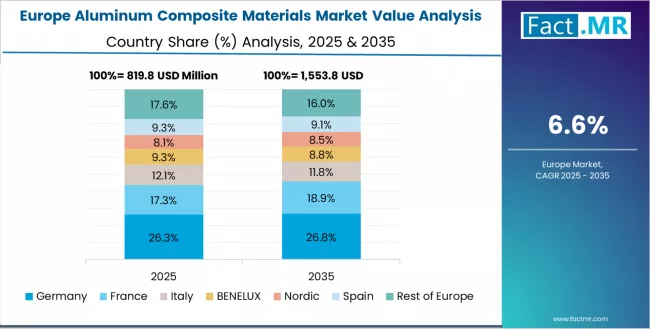
Aluminum Composite Materials Market Europe Country Market Share Analysis, 2025 & 2035 | Source: Fact.MR
The aluminum composite materials market in Europe is projected to grow from USD 0.82 billion in 2025 to USD 1.48 billion by 2035, registering a CAGR of 6.1% over the forecast period. Germany is expected to maintain its leadership position with a 31.4% market share in 2025, adjusting to 30.8% by 2035, supported by its extensive sustainable building infrastructure, energy efficiency requirements, and comprehensive facade engineering expertise serving European construction markets.
UK follows with a 19.7% share in 2025, projected to reach 20.1% by 2035, driven by commercial construction activity in major cities and ongoing building renovation programs implementing modern facade systems. France holds a 18.3% share in 2025, expected to maintain 18.6% by 2035 through continued urban development and architectural innovation emphasis. Italy commands a 14.8% share, while Spain accounts for 10.6% in 2025.
The rest of Europe region is anticipated to gain momentum, expanding its collective share from 5.2% to 5.9% by 2035, attributed to increasing aluminum composite adoption in Nordic countries and emerging Eastern European construction markets implementing contemporary building practices.
Competitive Landscape of the Aluminum Composite Materials Market
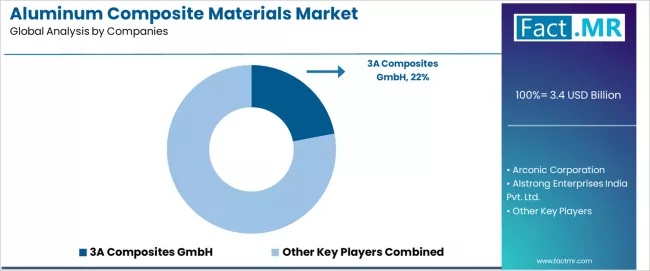
Aluminum Composite Materials Market Analysis By Company | Source: Fact.MR
The aluminum composite materials market features approximately 15-20 meaningful players with moderate concentration, where the top company controls 22% of the global market share through established brand recognition, comprehensive product portfolios, and extensive geographic distribution networks. Competition centers on product innovation, fire safety certifications, and technical support capabilities rather than price competition alone.
Market leaders include 3A Composites GmbH, which maintains competitive advantages through pioneering brand franchises including ALUCOBOND®, comprehensive manufacturing footprint across multiple continents, and deep integration with architectural specification communities and building envelope contractors, creating high specifier confidence among architects seeking proven facade solutions. This company leverages decades of panel technology development and application engineering expertise to defend market positions while advancing fire-safe formulations and sustainable product innovations.
Challengers encompass established manufacturers including Arconic Corporation, Mitsubishi Chemical Corporation, and Alubond U.S.A. (Mulk Holdings International), which compete through diversified product lines and strong regional presence in major construction markets through brand development and technical service programs.
Regional manufacturers, including Alstrong Enterprises India Pvt. Ltd., Yaret Industrial Group Co., Ltd., and Shanghai Huayuan New Composite Materials Co., Ltd., focus on specific geographical markets or price segments, offering differentiated capabilities in local manufacturing, cost competitiveness, and regional distribution networks.
Emerging composite material innovators and specialty fabricators create competitive pressure through novel core materials and enhanced fire safety technologies, particularly in high-growth markets including China and India, where manufacturing scale provides advantages in serving price-sensitive construction segments and rapidly growing urban development programs.
Market dynamics favor companies that combine product quality with technical expertise and customer support capabilities that address complete project cycles from specification through installation. Strategic emphasis on fire safety certifications, sustainability credentials, and architectural education programs enables differentiation in increasingly sophisticated building material markets across developed regions and expanding construction activity in emerging economies.
Global Aluminum Composite Materials Market - Stakeholder Contribution Framework
Aluminum composite materials represent a critical building product category that enables architects, contractors, and building owners across commercial construction, retail developments, and institutional projects to deliver lightweight facade solutions and achieve design flexibility while reducing structural loads, typically providing targeted advantages including thermal break capabilities, impact resistance, and UV stability through sandwich panel construction compared to traditional curtain wall systems alone while ensuring cost-effective installation and long-term durability.
With the market projected to grow from USD 3.38 billion in 2025 to USD 7.28 billion by 2035 at an 8.0% CAGR, these solutions offer compelling advantages for modern building envelopes, architectural expression, and diverse construction applications across global markets. Scaling market penetration and specification acceptance requires coordinated action across building codes, industry standards, material manufacturers, architectural communities, and contractor education initiatives.
How Could Governments Spur Local Development and Adoption?
- Building Code Modernization: Include performance-based facade requirements in building regulations, providing clear guidance for fire safety testing and material approval processes supporting innovation while ensuring public safety.
- Tax Policy & Green Building Support: Implement favorable treatment for sustainable building materials, provide tax incentives for manufacturers adopting recycled content and low-emission production processes, and establish structures encouraging building envelope energy efficiency improvements.
- Regulatory Framework Development: Create harmonized fire testing standards and certification processes across jurisdictions, establish clear material classification systems and installation requirements, and develop international alignment protocols facilitating cross-border product acceptance.
- Infrastructure & Skills Development: Fund technical training programs for facade installers and building envelope specialists, invest in fire testing laboratory capacity supporting domestic certification capabilities, and establish educational initiatives improving contractor installation quality.
- Innovation & Sustainability Support: Establish public-private partnerships for building material research, support academic-industry collaborations investigating fire-safe core materials and recyclability enhancement, and create regulatory environments encouraging sustainable manufacturing practices.
How Could Industry Bodies Support Market Development?
- Technical Standards & Specifications: Define standardized performance criteria for aluminum composite panels across different building applications, establish universal fire testing protocols and wind load specifications, and create installation guideline databases that contractors can reference for quality assurance.
- Market Education & Best Practices: Lead messaging demonstrating aluminum composite material benefits, emphasizing design flexibility, lifecycle cost advantages, and proper installation requirements compared to alternative facade systems.
- Fire Safety & Quality Standards: Develop comprehensive guidelines for core material selection, fire barrier integration, and building height application limits ensuring public safety across diverse building types.
- Professional Development: Run certification programs for facade contractors, architectural specifiers, and building inspectors on optimizing aluminum composite system design, installation techniques, and fire safety compliance in modern construction.
How Could Manufacturers and Material Producers Strengthen the Ecosystem?
- Advanced Product Development: Develop next-generation aluminum composite formulations with enhanced fire resistance, improved sustainability profiles, and specialized characteristics that advance building envelope performance while meeting evolving regulatory requirements.
- Testing & Certification Programs: Provide comprehensive fire test data, structural performance verification, and third-party certification documentation supporting specification confidence and code compliance demonstration.
- Technical Support Initiatives: Offer comprehensive design assistance, installation training, and troubleshooting services helping architects and contractors optimize system performance aligned with project requirements.
- Research & Innovation Networks: Build comprehensive R&D capabilities, collaborative fire safety research programs, and sustainability assessment systems ensuring aluminum composite products maintain high performance standards and address evolving market needs.
How Could Architects and Construction Professionals Navigate the Market?
- Specification Best Practices: Incorporate validated aluminum composite systems into building designs, with particular emphasis on appropriate fire-safe core selection, proper attachment details, and maintenance accessibility for long-term performance.
- Fire Safety Integration: Establish comprehensive understanding of building code requirements, fire testing standards, and material approval processes through continuous education and regulatory monitoring.
- Quality Assurance Protocols: Implement rigorous material verification, installation inspection, and commissioning procedures ensuring consistent system performance across project delivery phases.
- Lifecycle Planning: Develop maintenance specifications, cleaning protocols, and end-of-life recyclability plans maximizing building envelope value and sustainability performance.
How Could Investors and Financial Enablers Unlock Value?
- Market Leader Investment: Provide growth capital for established companies like 3A Composites GmbH and regional manufacturers to fund production capacity expansion, fire-safe product development, and geographic market penetration.
- Technology Innovation Financing: Back companies developing non-combustible core materials, advanced coating systems, and sustainable manufacturing processes advancing industry fire safety and environmental performance.
- Market Expansion Funding: Finance manufacturing facility development and distribution network establishment in high-growth regions including India and Southeast Asia, supporting localization strategies addressing regional construction requirements.
- Sustainability Investment: Support companies implementing recycled aluminum utilization, renewable energy manufacturing, and circular economy practices enhancing environmental performance through technology-enabled production.
Key Players in the Aluminum Composite Materials Market
- 3A Composites GmbH
- Arconic Corporation
- Alstrong Enterprises India Pvt. Ltd.
- Mitsubishi Chemical Corporation
- Alubond U.S.A. (Mulk Holdings International)
- Yaret Industrial Group Co., Ltd.
- Shanghai Huayuan New Composite Materials Co., Ltd.
- Jyi Shyang Industrial Co., Ltd.
- Interplast Co. Ltd.
- Alstone India
Segmentation
Scope of the Report
| Items | Values |
|---|---|
| Quantitative Units | USD 3.38 Billion |
| Application | Construction, Signage Industry, RV/Trailer Construction Skins, Others |
| Regions Covered | Asia Pacific, Europe, North America, Latin America, Middle East & Africa |
| Country Covered | China, India, USA, Germany, Japan, South Korea, Brazil, and 40+ countries |
| Key Companies Profiled | 3A Composites GmbH, Arconic Corporation, Alstrong Enterprises India Pvt. Ltd., Mitsubishi Chemical Corporation, Alubond U.S.A. (Mulk Holdings International), Yaret Industrial Group Co., Ltd., Shanghai Huayuan New Composite Materials Co., Ltd., Jyi Shyang Industrial Co., Ltd., Interplast Co. Ltd., Alstone India |
| Additional Attributes | Dollar sales by application categories, regional adoption trends across Asia Pacific, North America, and Europe, competitive landscape with material manufacturers and fabrication companies, product specifications and fire safety requirements, integration with building envelope systems and architectural design practices, innovations in fire-retardant core materials and sustainable coating technologies, and development of specialized applications with performance certification and installation quality capabilities. |
Source: Fact.MR analysis. Updated Dec 8, 2025
Aluminum Composite Materials Market by Segments
-
Application :
- Construction
- Signage Industry
- RV/Trailer Construction Skins
- Others
-
Region :
- Asia Pacific
- China
- Japan
- India
- South Korea
- Australia
- Thailand
- Rest of Asia Pacific
- Europe
- Germany
- UK
- France
- Italy
- Spain
- Denmark
- Sweden
- Norway
- Rest of Europe
- North America
- USA
- Canada
- Mexico
- Latin America
- Brazil
- Argentina
- Rest of Latin America
- Middle East & Africa
- South Africa
- Saudi Arabia
- UAE
- Kuwait
- Rest of Middle East & Africa
- Asia Pacific
Frequently Asked Questions
How big is the aluminum composite materials market in 2025?
What will be the size of aluminum composite materials market in 2035?
How much will be the aluminum composite materials market growth between 2025 and 2035?
What are the key product types in the aluminum composite materials market?
Which segment to contribute significant share in the aluminum composite materials market in 2025?
Who worked on this report


Preview the report firsthand - request a free sample
Free SampleGet the brochure for pricing and purchase details
Download PDF