- Market Value (2025): USD 4.0 Bn
- Estimated Value (2026): USD 4.3 Bn
- Forecast Value (2036): USD 8.2 Bn
- CAGR (2026-2036): 6.8%
What is the Aluminum Tube Protective Coatings Market forecast to be worth by 2036?
USD 4.3 billion in 2026 to USD 8.2 billion by 2036 at a 6.8% CAGR.
- According to Fact.MR analysis, the aluminum tube barrier coatings market reached USD 4.0 billion in 2025.
- Demand is projected to increase from USD 4.3 billion in 2026 to USD 8.2 billion by 2036.
- The aluminum tube protective coatings market will record 6.8% CAGR from 2026 to 2036.
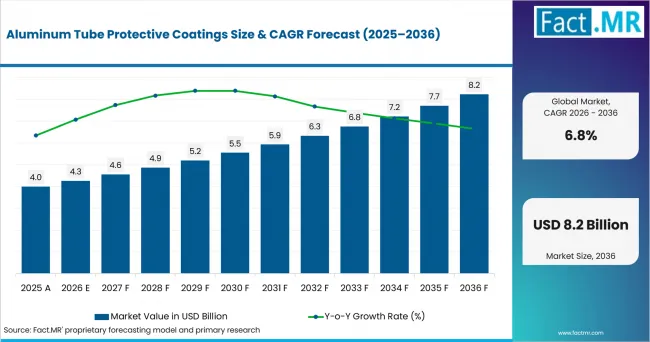
Aluminum Tube Protective Coatings Value Analysis | Source: Fact.MR
What are the defining numbers behind Aluminum Tube Protective Coatings Market growth?
As per Fact.MR analysis, an absolute opportunity of USD 4.0 billion is projected between 2026 and 2036.
- Demand Drivers in the Market
- Inner coatings for aluminum tubes stay flexible during shaping and sealing. A strong coating protects the aluminum after the tube is shaped and filled.
- Food and beverage packaging companies use coatings that meet changing food-contact rules. On March 7, 2025, the European Commission confirmed the BPA rule covering food-contact materials. The rule has applied since January 20, 2025 and includes coatings for metal cans [1].
- Personal care and pharmaceutical packaging requires strong inner coatings for products containing acids, solvents, or active ingredients. The coating protects the package and works with regular filling and sealing methods.
- Metal packaging companies use coatings that work with recycling-focused packaging designs. The coating protects the product while allowing the metal package to remain suitable for existing recycling systems.
- Key Segments Analyzed
- By Coating Chemistry: Polyester is expected to hold 34.0% share in 2026 because it stays strong during bending and protects metal packaging from chemicals.
- By Package Type: Beverage cans are projected to account for 31.0% share in 2026 because of high production volumes and the need for coatings that work well with the product inside.
- By Coating Position: Internal lining is expected to capture 36.0% share in 2026 because it keeps the packed product away from the aluminum surface.
- By Performance: Corrosion resistance is forecast to represent 29.0% share in 2026 because the coating protects the package during filling, storage, and transport.
- Analyst Opinion at Fact.MR
- Shambhu Nath Jha, Principal Consultant at Fact.MR, states, “Demand is growing for coatings that resist chemicals and stay flexible during shaping. Clear food-contact and migration documents make approval easier. Production support also helps suppliers get their coatings approved for more packaging lines.”
- Strategic Implications
- Coating makers match non-BPA coatings with the product inside the package and consider how tubes and one-piece containers are shaped during production.
- Testing inner coatings during tube sealing and shoulder shaping helps check coating strength. Drying settings are also checked before the same coating is used for different products.
- Brands align packaging requirements with new EU rules. On February 11, 2025, the European Commission stated that the Packaging and Packaging Waste Regulation entered into force, covering recycling, reuse, and circular use of materials [2].
- Quality checks include drying settings and coating condition. Small production changes may affect how well the coating sticks, bends during shaping, and protects against corrosion.
According to Fact.MR analysis, the United States and France are estimated to post 7.0% CAGR through 2036. China and Germany are projected at 6.8%, while Japan is expected to reach 5.7%.
How does the Aluminum Tube Protective Coatings Market break down by segment?
According to Fact.MR analysis, Polyester leads Coating Chemistry at 34.0% and Beverage cans lead Package Type at 31.0%. Internal lining leads Coating Position at 36.0%. Corrosion resistance leads Performance at 29.0%.
Which Coating Chemistry dominates?
Polyester is expected to hold 34.0% share in 2026.
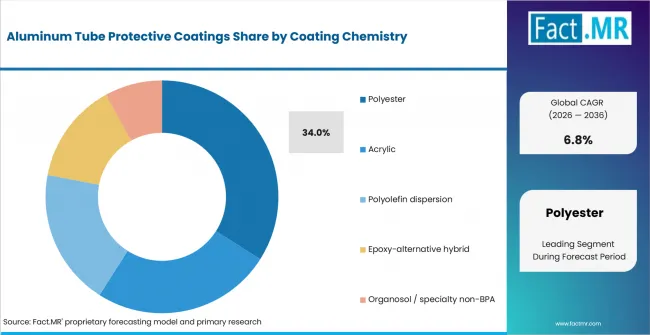
Aluminum Tube Protective Coatings Analysis By Coating Chemistry | Source: Fact.MR
Polyester is expected to lead because the coating stays flexible and firmly attached when metal packaging is shaped. Acrylic coatings are useful when water-based production and easy application are important. Polyolefin coatings provide flexibility and product protection for different types of packaging. Epoxy-alternative blends offer stronger protection from the product inside, while organosol and other non-BPA coatings are used when meeting specific rules is more important.
What leads the Package Type segment?
Beverage cans are projected to account for 31.0% share in 2026.
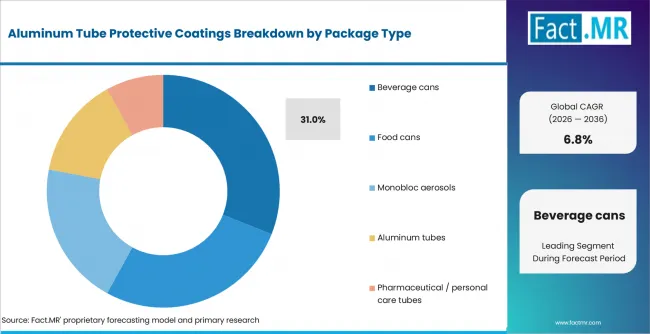
Aluminum Tube Protective Coatings Analysis By Package Type | Source: Fact.MR
Beverage cans are projected to lead because fast production lines require the same level of inner protection across large volumes. Food cans require coatings that handle heat during processing and acidic products. One-piece aerosol cans use inner coatings that handle pressure and strong personal care or household products. Aluminum tubes are used for medicines, cosmetics, and specialty foods, with medicine and personal care tubes requiring closer checks for product compatibility and migration.
How does Coating Position shape demand?
Internal lining is expected to capture 36.0% share in 2026.
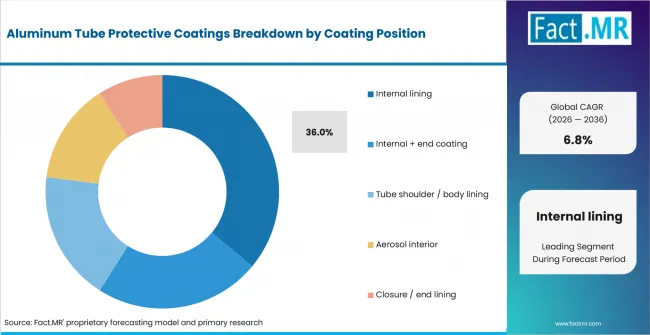
Aluminum Tube Protective Coatings Analysis By Coating Position | Source: Fact.MR
Internal lining is expected to lead because it keeps the product away from the metal during storage and use. Coatings on the inside and ends also protect seams, closures, and other areas that may come into contact with the product. Tube coatings stay strong when the body and shoulder are shaped. Aerosol coatings protect the inside of pressurized packs, while closure and end coatings protect metal ends and sealed areas.
What supports the Performance segment?
Corrosion resistance is forecast to represent 29.0% share in 2026.
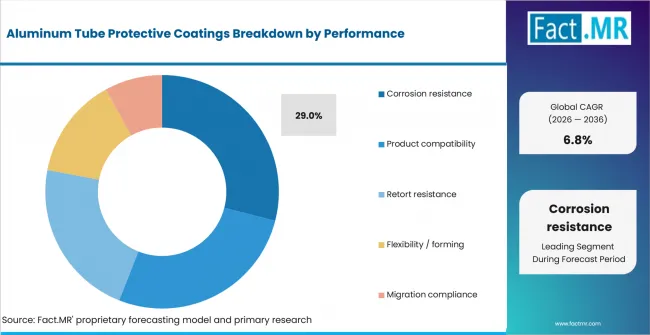
Aluminum Tube Protective Coatings Analysis By Performance | Source: Fact.MR
Corrosion resistance is forecast to lead because the coating protects bare metal from the product inside. The coating also has to work with products containing acids, salts, fragrances, and other strong ingredients. Some packaging requires coatings that handle high heat and pressure during processing, while tube coatings must stay flexible during shaping. Migration limits are also checked before coatings are approved for food, medicine, and personal care packaging.
What is accelerating Aluminum Tube Protective Coatings Market adoption, and what is holding it back?
Fact.MR finds that changes in coating rules and packaging needs increase demand. Long approval work and changes in production conditions can slow the move to new coatings.
Drivers Impact Analysis
| DRIVER | (~) % IMPACT ON CAGR | GEOGRAPHIC RELEVANCE | IMPACT TIMELINE |
|---|---|---|---|
| Shift to non-BPA food-contact coatings | +1.3% | Europe, North America | Short term (<= 2 years) |
| Higher use of aluminum in recyclable packaging | +1.0% | Global | Medium term (2-4 years) |
| Forming-flexibility requirements in tubes and aerosols | +0.8% | Europe, Asia | Medium term (2-4 years) |
| Barrier needs for personal-care and pharmaceutical fillings | +0.6% | Global | Medium term (2-4 years) |
| High-volume beverage and food can production | +0.4% | Asia, North America, Europe | Long term (>= 4 years) |
Opportunity Impact Analysis
| OPPORTUNITY | (~) % IMPACT ON CAGR | GEOGRAPHIC RELEVANCE | IMPACT TIMELINE |
|---|---|---|---|
| Low-temperature curing systems | +0.8% | Europe, Latin America | Medium term (2-4 years) |
| Non-BPA epoxy-alternative platforms | +0.7% | Europe, North America | Short term (<= 2 years) |
| Coatings for pharmaceutical and personal-care tubes | +0.5% | Global | Medium term (2-4 years) |
| Application support for line conversion | +0.4% | Global | Long term (>= 4 years) |
Restraints Impact Analysis
| RESTRAINT | (~) % IMPACT ON CAGR | GEOGRAPHIC RELEVANCE | IMPACT TIMELINE |
|---|---|---|---|
| Long qualification cycles for new coating chemistry | -0.8% | Global | Short term (<= 2 years) |
| Cure-window sensitivity on existing lines | -0.6% | Global | Medium term (2-4 years) |
| Compatibility variation across packed products | -0.5% | Global | Medium term (2-4 years) |
| Lower package volumes in selected beverage categories | -0.3% | Western Europe | Short term (<= 2 years) |
Which countries are scaling the Aluminum Tube Protective Coatings Market through 2036?
- The United States is estimated at 7.0% CAGR, matching France and standing 0.2 percentage points above China and Germany.
- France is forecast at 7.0% CAGR. A large packaged-beverage base and EU food-contact coating rules support the outlook.
- China is projected at 6.8% CAGR, matching Germany and standing 1.1 percentage points above Japan.
- Germany is anticipated at 6.8% CAGR as metal pack producers qualify coating systems for EU food-contact and pack needs.
- Japan is estimated at 5.7% CAGR, with personal-care and drug packaging supporting steady use of aluminum tube formats.
Comparable CAGRs create different entry conditions because package mix and coating approval needs vary by country. Full report coverage spans seven regions. These are North America, Latin America, Western Europe, Eastern Europe, East Asia, South Asia & Pacific, and Middle East & Africa.
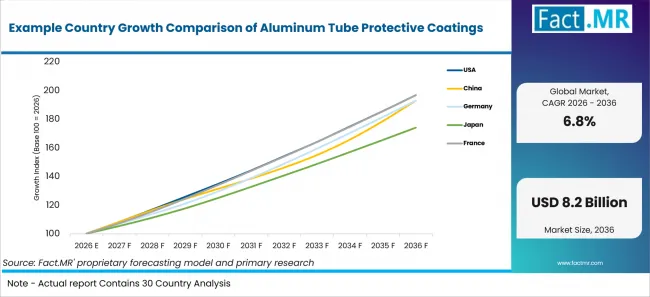
Example Country Growth Comparison Of Aluminum Tube Protective Coatings | Source: Fact.MR
| Country | CAGR (2026-2036) |
|---|---|
| United States | 7.0% |
| France | 7.0% |
| China | 6.8% |
| Germany | 6.8% |
| Japan | 5.7% |
How is the United States scaling demand?
7.0% CAGR, supported by aluminum recovery and established metal-packaging production.
The U.S. has a large aluminum recycling system that supports tube and can production. On January 31, 2025, the U.S. Geological Survey reported that about 3.6 million tons of aluminum were recovered from purchased scrap in 2024 [3]. The market is expected to grow at 7.0% CAGR through 2036, with coatings used in food, beverage, and personal care packaging.
What supports France adoption?
7.0% CAGR, shaped by beverage packaging and EU food-contact rules.
France has a large beverage industry and follows EU food-contact rules for metal packaging. On November 7, 2025, Agreste estimated French wine production at 36.2 million hectoliters in 2025 [4]. The market is forecast to post at 7.0% CAGR through 2036 as coatings are used for beverage containers and aluminum tubes.
How is China developing demand?
6.8% CAGR, supported by beverage manufacturing and large-scale packaging conversion.
China has a large beverage industry that supports high production of metal packaging. On February 28, 2026, the National Bureau of Statistics reported that production value for wine, beverage, and refined-tea manufacturing increased 2.0% in 2025 [5]. The market is projected to record 6.8% CAGR through 2036 as local packaging companies test and approve inner protective coatings.
What underpins Germany’s outlook?
6.8% CAGR, linked to metal-packaging regulation and large beverage volumes.
Germany has a large beverage industry and follows EU coating rules. On February 2, 2026, Destatis reported that German businesses sold about 7.8 billion liters of beer in 2025 [6]. The market is expected to reach 6.8% CAGR through 2036 as packaging companies adjust to new rules while keeping coatings stable and suitable for the product inside.
How does Japan perform?
5.7% CAGR, supported by cosmetics output and personal-care pack needs.
Japan has a large cosmetics industry that supports the use of aluminum tubes for personal care products. On September 17, 2026, the Japan Cosmetic Industry Association reported JPY 1.3907 trillion in cosmetics shipments in 2025 [7], based on Ministry of Economy, Trade and Industry production data. The market is expected to post 5.7% CAGR through 2036 as brands continue to use protective aluminum tube packaging.
Who leads the Aluminum Tube Protective Coatings Market?
PPG Industries, Sherwin-Williams, and AkzoNobel offer coatings for aluminum tubes. PPG Hoba coatings are used for collapsible tubes, one-piece aerosols, and aluminum bottles.
Sherwin-Williams offers valPure coatings for aluminum tubes, while AkzoNobel includes collapsible tubes in its metal packaging coating range. ACTEGA also makes inner coatings for aluminum tubes. ALTANA’s 2025 Corporate Report states that new ACTEGA coatings developed in Brazil reduce baking temperatures to 195–200°C and customer energy use by up to 15%.
Sherwin-Williams acquired Henkel’s Metal Packaging Coatings business in 2024, adding more production sites, products, and customers. The company also has packaging coating products from its 2017 acquisition of Valspar.
Which companies are the key providers?
Key companies include PPG Industries; AkzoNobel; Sherwin-Williams (including Valspar heritage); and ACTEGA.
- PPG Industries
- AkzoNobel
- Sherwin-Williams (including Valspar heritage)
- ACTEGA
Bibliography
- [1] European Commission. (2025, March 7). EU prohibition on the use and trade of Bisphenol A from 20 January 2025. Access2Markets.
- [2] European Commission, Directorate-General for Environment. (2025, February 11). New rules enter into force for a more sustainable and competitive packaging economy.
- [3] U.S. Geological Survey. (2025, January 31). Mineral Commodity Summaries 2025.
- [4] Agreste. (2025, November 7). Viticulture. Une production viticole 2025 estimée à 36,2 millions d'hectolitres [Viticulture: 2025 wine production estimated at 36.2 million hectoliters].
- [5] National Bureau of Statistics of China. (2026, February 28). Statistical Communiqué of the People’s Republic of China on the 2025 National Economic and Social Development.
- [6] Statistisches Bundesamt (Destatis). (2026, February 2). 6,0 % weniger Bier im Jahr 2025 abgesetzt [Beer sales down 6.0% in 2025].
- [7] Japan Cosmetic Industry Association. (2026, September 17).[Cosmetic shipments].
This Report Answers
- The report explains how aluminum tube protective coatings are sold by coating chemistry, package type, coating position and performance.
- Segment analysis identifies the subsegment that leads each dimension and the operating factors behind its 2026 share.
- Country analysis compares the United States, France, China, Germany and Japan using packaging demand, regulatory and production evidence.
- Competitive analysis reviews active coating suppliers serving aluminum tubes and adjacent light-metal packaging formats.
- Technology analysis assesses how corrosion resistance, forming flexibility, retort performance and migration compliance shape coating selection
What does the Aluminum Tube Protective Coatings Market cover?
According to Fact.MR analysis, this market covers protective coating systems used on aluminum tubes and related formed metal packs. Adjacent coverage includes metal packaging coatings, can coatings and metal cans. These linked categories help frame where internal barrier coatings sit within the wider packaging chain.
The revenue boundary focuses on finished protective coating value supplied for packaging use. Aluminum substrate, printing inks and stand-alone adhesives fall outside coating revenue unless they form part of the defined protective lining system.
What is included in the scope?
The scope includes coatings for internal linings, tube shoulder and body protection, aerosol interiors, and closure or end lining.
Related Fact.MR coverage includes tube packaging, beverage cans, aerosol cans and ready-to-drink packaging. The report tracks corrosion resistance, packed-product compatibility, retort exposure, forming flexibility and migration compliance.
What is excluded from the scope?
Outside the scope are bare aluminum tubes, decoration inks used only for decoration, plastic laminate tubes, separately sold caps and general industrial coatings for other surfaces.
Aluminum smelting, rolling and tube-forming equipment also fall outside the revenue boundary.
Pretreatments, cleaners, lubricants and sealants fall outside the revenue boundary when sold as separate process aids. They appear only where needed to explain coating adhesion or package performance on a production line.
How Was the Analysis Built?
The analysis draws on 120+ sources, 35+ company portfolios, 25+ countries, and more than 20 industry interviews.
- Primary Research: Primary research includes discussions with manufacturers, service providers, technology developers, distributors, end users, and subject-matter experts. These conversations examine purchasing priorities, product adoption, operational challenges, approval requirements, competitive positioning, and the factors that influence wider market acceptance.
- Desk Research: Desk research covers government statistics, regulatory publications, company filings, trade data, technical studies, industry associations, standards, public policy, and other authoritative sources. Every source used in the analysis is documented in the bibliography.
- Market Sizing and Forecasting: Market estimates combine historical performance, demand indicators, pricing and volume trends, segment shares, company participation, country-level growth, adoption patterns, investment activity, and barriers to market expansion.
- Data Validation and Update Cycle: Findings are validated by comparing primary interviews with public data, company activity, regulatory changes, trade patterns, and industry developments. Regular updates review new product launches, capacity changes, partnerships, approvals, and shifts in commercial adoption.
What is the report’s scope and coverage?
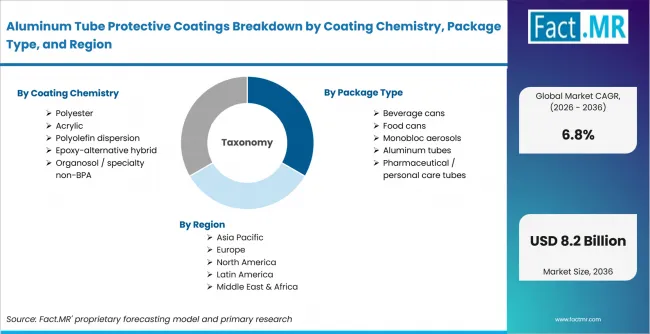
Aluminum Tube Protective Coatings Breakdown By Coating Chemistry, Package Type, And Region | Source: Fact.MR
| Attribute | Details |
|---|---|
| Quantitative Units | USD billion |
| Market Definition | Protective coatings and internal linings applied to aluminum tubes and closely related formed aluminum packaging to limit corrosion, product contact, migration and coating failure during forming or filling. |
| Coating Chemistry | Polyester; Acrylic; Polyolefin dispersion; Epoxy-alternative hybrid; Organosol / specialty non-BPA |
| Package Type | Beverage cans; Food cans; Monobloc aerosols; Aluminum tubes; Pharmaceutical / personal care tubes |
| Coating Position | Internal lining; Internal + end coating; Tube shoulder / body lining; Aerosol interior; Closure / end lining |
| Performance | Corrosion resistance; Product compatibility; Retort resistance; Flexibility / forming; Migration compliance |
| Regions Covered | North America; Latin America; Western Europe; Eastern Europe; East Asia; South Asia & Pacific; Middle East & Africa |
| Countries Covered | United States; China; Germany; Japan; France |
| Key Companies Profiled | PPG Industries; AkzoNobel; Sherwin-Williams (including Valspar heritage); ACTEGA |
| Forecast Period | 2026 to 2036 |
How is the market segmented?
-
By Coating Chemistry:
- Polyester
- Acrylic
- Polyolefin dispersion
- Epoxy-alternative hybrid
- Organosol / specialty non-BPA
-
By Package Type:
- Beverage cans
- Food cans
- Monobloc aerosols
- Aluminum tubes
- Pharmaceutical / personal care tubes
-
By Coating Position:
- Internal lining
- Internal + end coating
- Tube shoulder / body lining
- Aerosol interior
- Closure / end lining
-
By Performance:
- Corrosion resistance
- Product compatibility
- Retort resistance
- Flexibility / forming
- Migration compliance
-
By Region:
- North America
- Latin America
- Western Europe
- Eastern Europe
- East Asia
- South Asia & Pacific
- Middle East & Africa