Amine Alternatives for CO2 Capture Market
Amine Alternatives for CO2 Capture Market Size and Share Forecast Outlook 2026 to 2036
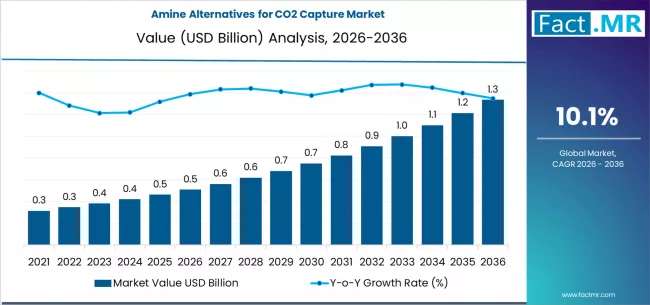
Amine alternatives for co2 capture market is projected to grow from USD 0.5 billion in 2026 to USD 1.3 billion by 2036, at a CAGR of 10.1%. Amino Acid Salt Solutions will dominate with a 28.0% market share, while power generation & utilities will lead the end-use industry segment with a 34.0% share.
Amine Alternatives for CO₂ Capture Market Forecast and Outlook 2026 to 2036
The global market for amine alternatives in carbon dioxide capture is entering a period of accelerated growth, driven by the urgent need for more sustainable and efficient decarbonization technologies. Projected to expand from USD 0.51 billion in 2026 to USD 1.33 billion by 2036, this market is set to rise at a 10.1% CAGR.
Key Takeaways from the Amine Alternatives for CO₂ Capture Market
- Market Value for 2026: USD 0.51 Billion
- Market Value for 2036: USD 1.33 Billion
- Forecast CAGR (2026-2036): 10.1%
- Leading Chemistry Type Share (2026): Amino Acid Salt Solutions (28%)
- Leading End-Use Industry Share (2026): Power Generation & Utilities (34%)
- Leading Integration Type Share (2026): Post-Combustion CO₂ Capture (48%)
- Key Players in the Market: Aker Carbon Capture, Carbon Clean, Mitsubishi Heavy Industries (MHI), Climeworks, Honeywell UOP
Amino acid salt solutions currently represent the most advanced alternative chemistry, holding a leading 28% market share. The power generation and utilities sector is the primary driver of demand, accounting for 34% of the market. Post-combustion capture remains the dominant integration pathway, with a 48% share, reflecting its applicability to retrofit existing industrial and power infrastructure.
This significant growth is propelled by globally tightening carbon emission regulations, corporate net-zero commitments, and the escalating economic viability of carbon capture, utilization, and storage. While conventional amines have been the industry standard, their drawbacks, including high regeneration energy, solvent degradation, and environmental concerns, are catalyzing the shift toward next-generation capture agents. These alternatives aim to reduce the energy penalty of capture, lower operational costs, and improve the overall sustainability profile of CCUS projects.
The market's evolution is centered on developing chemistries and materials with higher CO₂ selectivity, faster kinetics, and greater stability. These innovations are critical for reducing the cost per ton of CO₂ captured and enabling the widespread deployment necessary to meet international climate targets across hard-to-abate industrial sectors.
Metric
| Metric | Value |
|---|---|
| Market Value (2026) | USD 0.51 Billion |
| Market Forecast Value (2036) | USD 1.33 Billion |
| Forecast CAGR (2026-2036) | 10.1% |
Category
| Category | Segments |
|---|---|
| Capture Chemistry Type | Amino Acid Salt Solutions, Ionic Liquids, Solid Sorbents (MOFs, Zeolites, Activated Carbon), Membrane-Based Solvent Alternatives, Other Novel CO₂ Capture Agents |
| End-Use Industry | Power Generation & Utilities, Petrochemical & Refineries, Cement & Steel Manufacturing, Waste-to-Energy & Incineration, Other Industrial Emitters |
| Integration Type | Post-Combustion CO₂ Capture, Pre-Combustion Capture, Oxyfuel Combustion, Hybrid & Emerging Capture Technologies, Direct Air Capture Integration |
| Region | North America, Latin America, Western Europe, Eastern Europe, East Asia, South Asia & Pacific, MEA |
Segmental Analysis
By Capture Chemistry Type, Which Segment is the Current Front-Runner?
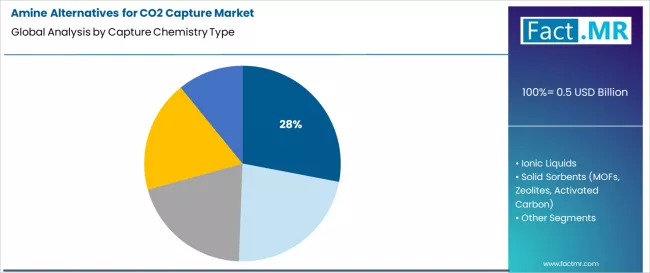
Amino acid salt solutions lead this segment with a 28% share. Their prominence stems from being a drop-in ready technology that mitigates key drawbacks of traditional amines. Derived from naturally occurring amino acids, these solutions offer lower volatility, reduced degradation rates, and a better environmental, health, and safety (EHS) profile.
Their compatibility with existing absorber-stripper infrastructure allows for easier retrofitting, positioning them as the first commercially viable alternative for large-scale post-combustion projects.
By End-Use Industry, Which Sector Provides the Strongest Demand Signal?
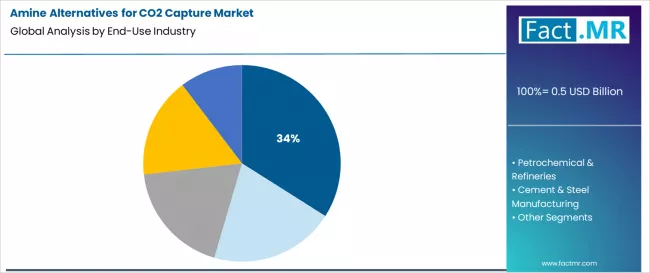
The power generation and utilities sector is the largest end-use industry, holding a 34% share. Coal and gas-fired power plants represent some of the largest single-point sources of CO₂ emissions globally.
Regulatory pressures, carbon pricing mechanisms, and the need to extend the operational life of assets in a carbon-constrained world are driving this sector to pilot and deploy advanced capture technologies. The scale of emissions from power generation creates a foundational demand for cost-effective capture chemistries.
By Integration Type, Where is Deployment Most Active?
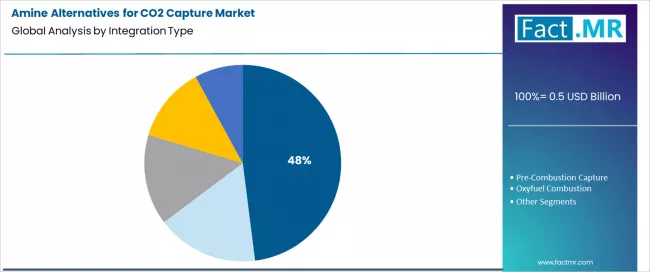
Post-combustion capture is the leading integration type, commanding a 48% share. This method’s dominance is due to its flexibility and retrofittability to existing industrial flue stacks without requiring a complete redesign of core combustion processes.
As most near-term CCUS projects focus on mitigating emissions from current infrastructure, post-combustion systems utilizing advanced solvents or sorbents represent the most immediate and large-scale market opportunity, concentrating investment and development efforts.
What are the Drivers, Restraints, and Key Trends of the Amine Alternatives for CO₂ Capture Market?
The primary market driver is the accelerating implementation of carbon pricing, emissions trading systems, and stringent climate policies worldwide, which transform CO₂ capture from a niche cost into a strategic necessity. Government funding and tax incentives for CCUS projects, such as the 45Q tax credit in the USA, significantly improve project economics. The growing focus on hard-to-abate sectors like cement and steel, where alternative fuels are limited, further mandates the adoption of capture technologies.
A significant market restraint is the substantial capital intensity and remaining technological risk associated with scaling novel capture agents from pilot to megaton-scale projects. The long-term stability and performance of new chemistries under real-world, variable flue gas conditions require further validation. Competition from other decarbonization pathways, such as direct electrification or hydrogen switching, can also impact the long-term demand trajectory for capture technologies in certain applications.
Key trends include the rapid advancement of solid sorbents, such as metal-organic frameworks (MOFs) and advanced zeolites, which promise lower regeneration energy through pressure or temperature swings. There is growing integration of membrane technologies with solvent systems to create hybrid processes that enhance efficiency. The market is also witnessing the convergence of point-source capture with Direct Air Capture (DAC) technologies, exploring shared sorbent or solvent platforms that could streamline manufacturing and reduce costs across the carbon removal landscape.
Analysis of the Amine Alternatives for CO₂ Capture Market by Key Countries
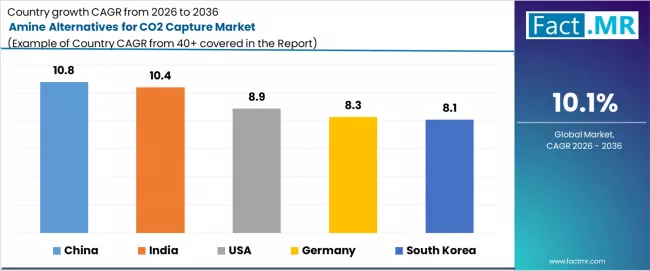
| Country | CAGR (2026-2036) |
|---|---|
| China | 10.80% |
| India | 10.40% |
| USA | 8.90% |
| Germany | 8.30% |
| South Korea | 8.10% |
How do China’s Carbon Neutrality Goals Drive Technology Development?
China’s leading CAGR of 10.80% is directly linked to its ambitious "Dual Carbon" goals aiming for carbon neutrality by 2060. The government’s strong support for CCUS as a critical bridging technology is resulting in numerous large-scale demonstration projects across the power and industrial sectors. This national strategy creates a massive testbed and demand driver for advanced, potentially lower-cost capture alternatives to conventional amines, fostering significant domestic R&D and international partnership opportunities.
What Role does India’s Growing Energy Demand and Emission Profile Play?
India’s 10.40% growth is fueled by the need to reconcile rapid economic growth with climate commitments. With a power sector still heavily reliant on coal, India is investing in CCUS as a vital technology to manage emissions from its existing fleet and future industrial growth. Pilot projects targeting refinery, steel, and cement emissions are creating early demand for alternative capture chemistries that can perform in cost-sensitive environments with challenging flue gas compositions.
How is the USA’s Policy and Financial Incentive Landscape Shaping the Market?
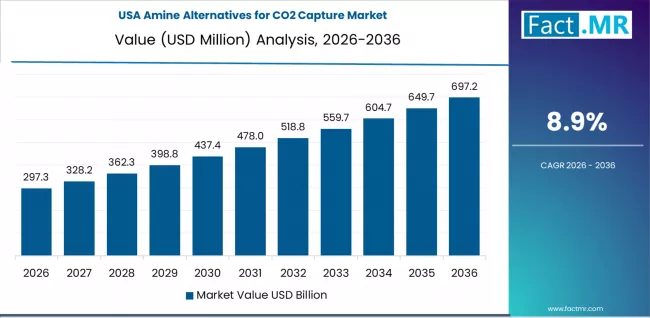
The USA’s 8.90% CAGR is underpinned by a powerful combination of federal tax incentives (45Q), Department of Energy funding, and growing corporate PPAs for carbon removal. This financial de-risking is accelerating final investment decisions for commercial-scale CCUS projects. The need to demonstrate long-term solvent durability and lower operational costs is pushing project developers to evaluate and adopt advanced amino acid salts and other next-generation alternatives over traditional amines.
Why is Germany a Key Market for High-Efficiency and Industrial Applications?
Germany’s 8.30% growth reflects its industrial decarbonization strategy and commitment to EU climate targets. German research institutions and industrial players are at the forefront of developing and testing advanced solid sorbents and membrane technologies, particularly for high-temperature applications in cement and steel manufacturing. The focus is on integrated process efficiency and minimizing energy penalties, creating a sophisticated market for innovative, high-performance capture materials.
What is Driving South Korea’s Focus on CCUS and Hydrogen Economy Integration?
South Korea’s 8.10% growth is anchored in its national roadmap for a hydrogen economy and carbon neutrality. CCUS is seen as essential for producing clean "blue" hydrogen from natural gas and for decarbonizing its robust industrial sector. This strategic vision drives investments in pre-combustion and industrial capture projects, stimulating demand for specialized solvents and sorbents compatible with hydrogen production and industrial off-gas streams.
Competitive Landscape of the Amine Alternatives for CO₂ Capture Market
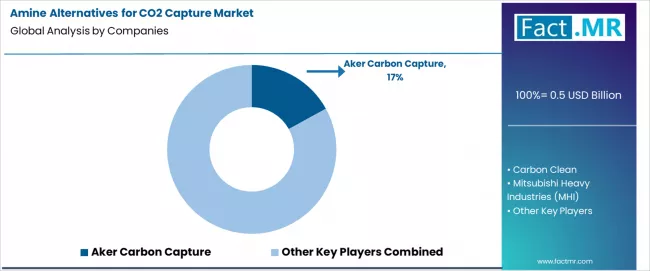
The competitive landscape features a mix of specialized technology developers, engineering giants, and established industrial corporations. Players like Aker Carbon Capture and Carbon Clean compete on the strength of their proprietary solvent formulations and modular plant designs.
Competition centers on demonstrating validated performance data from pilot plants, achieving reductions in the energy penalty, and forming strategic partnerships with industrial emitters and project developers. A key differentiator is the ability to offer not just a chemical, but a licensed process technology with guaranteed performance and cost parameters, reducing risk for large-scale adopters.
Key Players in the Amine Alternatives for CO₂ Capture Market
- Aker Carbon Capture
- Carbon Clean
- Mitsubishi Heavy Industries (MHI)
- Climeworks
- Honeywell UOP
Scope of Report
| Items | Values |
|---|---|
| Quantitative Units | USD Billion |
| Capture Chemistry Type | Amino Acid Salts, Ionic Liquids, Solid Sorbents, Membrane-Solvent Hybrids, Novel Agents |
| End-Use Industry | Power Generation, Petrochemicals & Refining, Cement & Steel, Waste-to-Energy, Other Industries |
| Integration Type | Post-Combustion, Pre-Combustion, Oxyfuel, Hybrid Systems, DAC Integration |
| Key Countries | China, India, USA, Germany, South Korea |
| Key Companies | Aker Carbon Capture, Carbon Clean, Mitsubishi Heavy Industries (MHI), Climeworks, Honeywell UOP |
| Additional Analysis | Analysis of regeneration energy requirements; solvent degradation and emissions profiling; techno-economic analysis (TEA) for novel agents; lifecycle assessment (LCA) of alternative chemistries; materials stability under impurity exposure (SOx, NOx, O₂). |
Market by Segments
-
Capture Chemistry Type :
- Amino Acid Salt Solutions
- Ionic Liquids
- Solid Sorbents (MOFs, Zeolites, Activated Carbon)
- Membrane-Based Solvent Alternatives
- Other Novel CO₂ Capture Agents
-
End-Use Industry :
- Power Generation & Utilities
- Petrochemical & Refineries
- Cement & Steel Manufacturing
- Waste-to-Energy & Incineration
- Other Industrial Emitters
-
Integration Type :
- Post-Combustion CO₂ Capture
- Pre-Combustion Capture
- Oxyfuel Combustion
- Hybrid & Emerging Capture Technologies
- Direct Air Capture Integration
-
Region :
-
North America
- USA
- Canada
-
Latin America
- Brazil
- Mexico
- Argentina
- Rest of Latin America
-
Western Europe
- Germany
- UK
- France
- Spain
- Italy
- BENELUX
- Rest of Western Europe
-
Eastern Europe
- Russia
- Poland
- Czech Republic
- Rest of Eastern Europe
-
East Asia
- China
- Japan
- South Korea
- Rest of East Asia
-
South Asia & Pacific
- India
- ASEAN
- Australia
- Rest of South Asia & Pacific
-
MEA
- Saudi Arabia
- UAE
- Turkiye
- Rest of MEA
-
Table of Content
- Executive Summary
- Global Market Outlook
- Demand to side Trends
- Supply to side Trends
- Technology Roadmap Analysis
- Analysis and Recommendations
- Market Overview
- Market Coverage / Taxonomy
- Market Definition / Scope / Limitations
- Market Background
- Market Dynamics
- Drivers
- Restraints
- Opportunity
- Trends
- Scenario Forecast
- Demand in Optimistic Scenario
- Demand in Likely Scenario
- Demand in Conservative Scenario
- Opportunity Map Analysis
- Product Life Cycle Analysis
- Supply Chain Analysis
- Investment Feasibility Matrix
- Value Chain Analysis
- PESTLE and Porter’s Analysis
- Regulatory Landscape
- Regional Parent Market Outlook
- Production and Consumption Statistics
- Import and Export Statistics
- Market Dynamics
- Global Market Analysis 2021 to 2025 and Forecast, 2026 to 2036
- Historical Market Size Value (USD Million) Analysis, 2021 to 2025
- Current and Future Market Size Value (USD Million) Projections, 2026 to 2036
- Y to o to Y Growth Trend Analysis
- Absolute $ Opportunity Analysis
- Global Market Pricing Analysis 2021 to 2025 and Forecast 2026 to 2036
- Global Market Analysis 2021 to 2025 and Forecast 2026 to 2036, By Capture Chemistry Type
- Introduction / Key Findings
- Historical Market Size Value (USD Million) Analysis By Capture Chemistry Type, 2021 to 2025
- Current and Future Market Size Value (USD Million) Analysis and Forecast By Capture Chemistry Type, 2026 to 2036
- Amino Acid Salt Solutions
- Ionic Liquids
- Solid Sorbents (MOFs, Zeolites, Activated Carbon)
- Membrane-Based Solvent Alternatives
- Other Novel CO₂ Capture Agents
- Amino Acid Salt Solutions
- Y to o to Y Growth Trend Analysis By Capture Chemistry Type, 2021 to 2025
- Absolute $ Opportunity Analysis By Capture Chemistry Type, 2026 to 2036
- Global Market Analysis 2021 to 2025 and Forecast 2026 to 2036, By End-Use Industry
- Introduction / Key Findings
- Historical Market Size Value (USD Million) Analysis By End-Use Industry, 2021 to 2025
- Current and Future Market Size Value (USD Million) Analysis and Forecast By End-Use Industry, 2026 to 2036
- Power Generation & Utilities
- Petrochemical & Refineries
- Cement & Steel Manufacturing
- Waste-to-Energy & Incineration
- Other Industrial Emitters
- Power Generation & Utilities
- Y to o to Y Growth Trend Analysis By End-Use Industry, 2021 to 2025
- Absolute $ Opportunity Analysis By End-Use Industry, 2026 to 2036
- Global Market Analysis 2021 to 2025 and Forecast 2026 to 2036, By Integration Type
- Introduction / Key Findings
- Historical Market Size Value (USD Million) Analysis By Integration Type, 2021 to 2025
- Current and Future Market Size Value (USD Million) Analysis and Forecast By Integration Type, 2026 to 2036
- Post-Combustion CO₂ Capture
- Pre-Combustion Capture
- Oxyfuel Combustion
- Hybrid & Emerging Capture Technologies
- Direct Air Capture Integration
- Post-Combustion CO₂ Capture
- Y to o to Y Growth Trend Analysis By Integration Type, 2021 to 2025
- Absolute $ Opportunity Analysis By Integration Type, 2026 to 2036
- Global Market Analysis 2021 to 2025 and Forecast 2026 to 2036, By Region
- Introduction
- Historical Market Size Value (USD Million) Analysis By Region, 2021 to 2025
- Current Market Size Value (USD Million) Analysis and Forecast By Region, 2026 to 2036
- North America
- Latin America
- Western Europe
- Eastern Europe
- East Asia
- South Asia and Pacific
- Middle East & Africa
- Market Attractiveness Analysis By Region
- North America Market Analysis 2021 to 2025 and Forecast 2026 to 2036, By Country
- Historical Market Size Value (USD Million) Trend Analysis By Market Taxonomy, 2021 to 2025
- Market Size Value (USD Million) Forecast By Market Taxonomy, 2026 to 2036
- By Country
- USA
- Canada
- Mexico
- By Capture Chemistry Type
- By End-Use Industry
- By Integration Type
- By Country
- Market Attractiveness Analysis
- By Country
- By Capture Chemistry Type
- By End-Use Industry
- By Integration Type
- Key Takeaways
- Latin America Market Analysis 2021 to 2025 and Forecast 2026 to 2036, By Country
- Historical Market Size Value (USD Million) Trend Analysis By Market Taxonomy, 2021 to 2025
- Market Size Value (USD Million) Forecast By Market Taxonomy, 2026 to 2036
- By Country
- Brazil
- Chile
- Rest of Latin America
- By Capture Chemistry Type
- By End-Use Industry
- By Integration Type
- By Country
- Market Attractiveness Analysis
- By Country
- By Capture Chemistry Type
- By End-Use Industry
- By Integration Type
- Key Takeaways
- Western Europe Market Analysis 2021 to 2025 and Forecast 2026 to 2036, By Country
- Historical Market Size Value (USD Million) Trend Analysis By Market Taxonomy, 2021 to 2025
- Market Size Value (USD Million) Forecast By Market Taxonomy, 2026 to 2036
- By Country
- Germany
- UK
- Italy
- Spain
- France
- Nordic
- BENELUX
- Rest of Western Europe
- By Capture Chemistry Type
- By End-Use Industry
- By Integration Type
- By Country
- Market Attractiveness Analysis
- By Country
- By Capture Chemistry Type
- By End-Use Industry
- By Integration Type
- Key Takeaways
- Eastern Europe Market Analysis 2021 to 2025 and Forecast 2026 to 2036, By Country
- Historical Market Size Value (USD Million) Trend Analysis By Market Taxonomy, 2021 to 2025
- Market Size Value (USD Million) Forecast By Market Taxonomy, 2026 to 2036
- By Country
- Russia
- Poland
- Hungary
- Balkan & Baltic
- Rest of Eastern Europe
- By Capture Chemistry Type
- By End-Use Industry
- By Integration Type
- By Country
- Market Attractiveness Analysis
- By Country
- By Capture Chemistry Type
- By End-Use Industry
- By Integration Type
- Key Takeaways
- East Asia Market Analysis 2021 to 2025 and Forecast 2026 to 2036, By Country
- Historical Market Size Value (USD Million) Trend Analysis By Market Taxonomy, 2021 to 2025
- Market Size Value (USD Million) Forecast By Market Taxonomy, 2026 to 2036
- By Country
- China
- Japan
- South Korea
- By Capture Chemistry Type
- By End-Use Industry
- By Integration Type
- By Country
- Market Attractiveness Analysis
- By Country
- By Capture Chemistry Type
- By End-Use Industry
- By Integration Type
- Key Takeaways
- South Asia and Pacific Market Analysis 2021 to 2025 and Forecast 2026 to 2036, By Country
- Historical Market Size Value (USD Million) Trend Analysis By Market Taxonomy, 2021 to 2025
- Market Size Value (USD Million) Forecast By Market Taxonomy, 2026 to 2036
- By Country
- India
- ASEAN
- Australia & New Zealand
- Rest of South Asia and Pacific
- By Capture Chemistry Type
- By End-Use Industry
- By Integration Type
- By Country
- Market Attractiveness Analysis
- By Country
- By Capture Chemistry Type
- By End-Use Industry
- By Integration Type
- Key Takeaways
- Middle East & Africa Market Analysis 2021 to 2025 and Forecast 2026 to 2036, By Country
- Historical Market Size Value (USD Million) Trend Analysis By Market Taxonomy, 2021 to 2025
- Market Size Value (USD Million) Forecast By Market Taxonomy, 2026 to 2036
- By Country
- Kingdom of Saudi Arabia
- Other GCC Countries
- Turkiye
- South Africa
- Other African Union
- Rest of Middle East & Africa
- By Capture Chemistry Type
- By End-Use Industry
- By Integration Type
- By Country
- Market Attractiveness Analysis
- By Country
- By Capture Chemistry Type
- By End-Use Industry
- By Integration Type
- Key Takeaways
- Key Countries Market Analysis
- USA
- Pricing Analysis
- Market Share Analysis, 2025
- By Capture Chemistry Type
- By End-Use Industry
- By Integration Type
- Canada
- Pricing Analysis
- Market Share Analysis, 2025
- By Capture Chemistry Type
- By End-Use Industry
- By Integration Type
- Mexico
- Pricing Analysis
- Market Share Analysis, 2025
- By Capture Chemistry Type
- By End-Use Industry
- By Integration Type
- Brazil
- Pricing Analysis
- Market Share Analysis, 2025
- By Capture Chemistry Type
- By End-Use Industry
- By Integration Type
- Chile
- Pricing Analysis
- Market Share Analysis, 2025
- By Capture Chemistry Type
- By End-Use Industry
- By Integration Type
- Germany
- Pricing Analysis
- Market Share Analysis, 2025
- By Capture Chemistry Type
- By End-Use Industry
- By Integration Type
- UK
- Pricing Analysis
- Market Share Analysis, 2025
- By Capture Chemistry Type
- By End-Use Industry
- By Integration Type
- Italy
- Pricing Analysis
- Market Share Analysis, 2025
- By Capture Chemistry Type
- By End-Use Industry
- By Integration Type
- Spain
- Pricing Analysis
- Market Share Analysis, 2025
- By Capture Chemistry Type
- By End-Use Industry
- By Integration Type
- France
- Pricing Analysis
- Market Share Analysis, 2025
- By Capture Chemistry Type
- By End-Use Industry
- By Integration Type
- India
- Pricing Analysis
- Market Share Analysis, 2025
- By Capture Chemistry Type
- By End-Use Industry
- By Integration Type
- ASEAN
- Pricing Analysis
- Market Share Analysis, 2025
- By Capture Chemistry Type
- By End-Use Industry
- By Integration Type
- Australia & New Zealand
- Pricing Analysis
- Market Share Analysis, 2025
- By Capture Chemistry Type
- By End-Use Industry
- By Integration Type
- China
- Pricing Analysis
- Market Share Analysis, 2025
- By Capture Chemistry Type
- By End-Use Industry
- By Integration Type
- Japan
- Pricing Analysis
- Market Share Analysis, 2025
- By Capture Chemistry Type
- By End-Use Industry
- By Integration Type
- South Korea
- Pricing Analysis
- Market Share Analysis, 2025
- By Capture Chemistry Type
- By End-Use Industry
- By Integration Type
- Russia
- Pricing Analysis
- Market Share Analysis, 2025
- By Capture Chemistry Type
- By End-Use Industry
- By Integration Type
- Poland
- Pricing Analysis
- Market Share Analysis, 2025
- By Capture Chemistry Type
- By End-Use Industry
- By Integration Type
- Hungary
- Pricing Analysis
- Market Share Analysis, 2025
- By Capture Chemistry Type
- By End-Use Industry
- By Integration Type
- Kingdom of Saudi Arabia
- Pricing Analysis
- Market Share Analysis, 2025
- By Capture Chemistry Type
- By End-Use Industry
- By Integration Type
- Turkiye
- Pricing Analysis
- Market Share Analysis, 2025
- By Capture Chemistry Type
- By End-Use Industry
- By Integration Type
- South Africa
- Pricing Analysis
- Market Share Analysis, 2025
- By Capture Chemistry Type
- By End-Use Industry
- By Integration Type
- USA
- Market Structure Analysis
- Competition Dashboard
- Competition Benchmarking
- Market Share Analysis of Top Players
- By Regional
- By Capture Chemistry Type
- By End-Use Industry
- By Integration Type
- Competition Analysis
- Competition Deep Dive
- Aker Carbon Capture
- Overview
- Product Portfolio
- Profitability by Market Segments (Product/Age /Sales Channel/Region)
- Sales Footprint
- Strategy Overview
- Marketing Strategy
- Product Strategy
- Channel Strategy
- Carbon Clean
- Mitsubishi Heavy Industries (MHI)
- Climeworks
- Honeywell UOP
- Aker Carbon Capture
- Competition Deep Dive
- Assumptions & Acronyms Used
- Research Methodology
List Of Table
- Table 1: Global Market Value (USD Million) Forecast by Region, 2021 to 2036
- Table 2: Global Market Value (USD Million) Forecast by Capture Chemistry Type, 2021 to 2036
- Table 3: Global Market Value (USD Million) Forecast by End-Use Industry, 2021 to 2036
- Table 4: Global Market Value (USD Million) Forecast by Integration Type, 2021 to 2036
- Table 5: North America Market Value (USD Million) Forecast by Country, 2021 to 2036
- Table 6: North America Market Value (USD Million) Forecast by Capture Chemistry Type, 2021 to 2036
- Table 7: North America Market Value (USD Million) Forecast by End-Use Industry, 2021 to 2036
- Table 8: North America Market Value (USD Million) Forecast by Integration Type, 2021 to 2036
- Table 9: Latin America Market Value (USD Million) Forecast by Country, 2021 to 2036
- Table 10: Latin America Market Value (USD Million) Forecast by Capture Chemistry Type, 2021 to 2036
- Table 11: Latin America Market Value (USD Million) Forecast by End-Use Industry, 2021 to 2036
- Table 12: Latin America Market Value (USD Million) Forecast by Integration Type, 2021 to 2036
- Table 13: Western Europe Market Value (USD Million) Forecast by Country, 2021 to 2036
- Table 14: Western Europe Market Value (USD Million) Forecast by Capture Chemistry Type, 2021 to 2036
- Table 15: Western Europe Market Value (USD Million) Forecast by End-Use Industry, 2021 to 2036
- Table 16: Western Europe Market Value (USD Million) Forecast by Integration Type, 2021 to 2036
- Table 17: Eastern Europe Market Value (USD Million) Forecast by Country, 2021 to 2036
- Table 18: Eastern Europe Market Value (USD Million) Forecast by Capture Chemistry Type, 2021 to 2036
- Table 19: Eastern Europe Market Value (USD Million) Forecast by End-Use Industry, 2021 to 2036
- Table 20: Eastern Europe Market Value (USD Million) Forecast by Integration Type, 2021 to 2036
- Table 21: East Asia Market Value (USD Million) Forecast by Country, 2021 to 2036
- Table 22: East Asia Market Value (USD Million) Forecast by Capture Chemistry Type, 2021 to 2036
- Table 23: East Asia Market Value (USD Million) Forecast by End-Use Industry, 2021 to 2036
- Table 24: East Asia Market Value (USD Million) Forecast by Integration Type, 2021 to 2036
- Table 25: South Asia and Pacific Market Value (USD Million) Forecast by Country, 2021 to 2036
- Table 26: South Asia and Pacific Market Value (USD Million) Forecast by Capture Chemistry Type, 2021 to 2036
- Table 27: South Asia and Pacific Market Value (USD Million) Forecast by End-Use Industry, 2021 to 2036
- Table 28: South Asia and Pacific Market Value (USD Million) Forecast by Integration Type, 2021 to 2036
- Table 29: Middle East & Africa Market Value (USD Million) Forecast by Country, 2021 to 2036
- Table 30: Middle East & Africa Market Value (USD Million) Forecast by Capture Chemistry Type, 2021 to 2036
- Table 31: Middle East & Africa Market Value (USD Million) Forecast by End-Use Industry, 2021 to 2036
- Table 32: Middle East & Africa Market Value (USD Million) Forecast by Integration Type, 2021 to 2036
List Of Figures
- Figure 1: Global Market Pricing Analysis
- Figure 2: Global Market Value (USD Million) Forecast 2021 to 2036
- Figure 3: Global Market Value Share and BPS Analysis by Capture Chemistry Type, 2026 and 2036
- Figure 4: Global Market Y to o to Y Growth Comparison by Capture Chemistry Type, 2026 to 2036
- Figure 5: Global Market Attractiveness Analysis by Capture Chemistry Type
- Figure 6: Global Market Value Share and BPS Analysis by End-Use Industry, 2026 and 2036
- Figure 7: Global Market Y to o to Y Growth Comparison by End-Use Industry, 2026 to 2036
- Figure 8: Global Market Attractiveness Analysis by End-Use Industry
- Figure 9: Global Market Value Share and BPS Analysis by Integration Type, 2026 and 2036
- Figure 10: Global Market Y to o to Y Growth Comparison by Integration Type, 2026 to 2036
- Figure 11: Global Market Attractiveness Analysis by Integration Type
- Figure 12: Global Market Value (USD Million) Share and BPS Analysis by Region, 2026 and 2036
- Figure 13: Global Market Y to o to Y Growth Comparison by Region, 2026 to 2036
- Figure 14: Global Market Attractiveness Analysis by Region
- Figure 15: North America Market Incremental Dollar Opportunity, 2026 to 2036
- Figure 16: Latin America Market Incremental Dollar Opportunity, 2026 to 2036
- Figure 17: Western Europe Market Incremental Dollar Opportunity, 2026 to 2036
- Figure 18: Eastern Europe Market Incremental Dollar Opportunity, 2026 to 2036
- Figure 19: East Asia Market Incremental Dollar Opportunity, 2026 to 2036
- Figure 20: South Asia and Pacific Market Incremental Dollar Opportunity, 2026 to 2036
- Figure 21: Middle East & Africa Market Incremental Dollar Opportunity, 2026 to 2036
- Figure 22: North America Market Value Share and BPS Analysis by Country, 2026 and 2036
- Figure 23: North America Market Value Share and BPS Analysis by Capture Chemistry Type, 2026 and 2036
- Figure 24: North America Market Y to o to Y Growth Comparison by Capture Chemistry Type, 2026 to 2036
- Figure 25: North America Market Attractiveness Analysis by Capture Chemistry Type
- Figure 26: North America Market Value Share and BPS Analysis by End-Use Industry, 2026 and 2036
- Figure 27: North America Market Y to o to Y Growth Comparison by End-Use Industry, 2026 to 2036
- Figure 28: North America Market Attractiveness Analysis by End-Use Industry
- Figure 29: North America Market Value Share and BPS Analysis by Integration Type, 2026 and 2036
- Figure 30: North America Market Y to o to Y Growth Comparison by Integration Type, 2026 to 2036
- Figure 31: North America Market Attractiveness Analysis by Integration Type
- Figure 32: Latin America Market Value Share and BPS Analysis by Country, 2026 and 2036
- Figure 33: Latin America Market Value Share and BPS Analysis by Capture Chemistry Type, 2026 and 2036
- Figure 34: Latin America Market Y to o to Y Growth Comparison by Capture Chemistry Type, 2026 to 2036
- Figure 35: Latin America Market Attractiveness Analysis by Capture Chemistry Type
- Figure 36: Latin America Market Value Share and BPS Analysis by End-Use Industry, 2026 and 2036
- Figure 37: Latin America Market Y to o to Y Growth Comparison by End-Use Industry, 2026 to 2036
- Figure 38: Latin America Market Attractiveness Analysis by End-Use Industry
- Figure 39: Latin America Market Value Share and BPS Analysis by Integration Type, 2026 and 2036
- Figure 40: Latin America Market Y to o to Y Growth Comparison by Integration Type, 2026 to 2036
- Figure 41: Latin America Market Attractiveness Analysis by Integration Type
- Figure 42: Western Europe Market Value Share and BPS Analysis by Country, 2026 and 2036
- Figure 43: Western Europe Market Value Share and BPS Analysis by Capture Chemistry Type, 2026 and 2036
- Figure 44: Western Europe Market Y to o to Y Growth Comparison by Capture Chemistry Type, 2026 to 2036
- Figure 45: Western Europe Market Attractiveness Analysis by Capture Chemistry Type
- Figure 46: Western Europe Market Value Share and BPS Analysis by End-Use Industry, 2026 and 2036
- Figure 47: Western Europe Market Y to o to Y Growth Comparison by End-Use Industry, 2026 to 2036
- Figure 48: Western Europe Market Attractiveness Analysis by End-Use Industry
- Figure 49: Western Europe Market Value Share and BPS Analysis by Integration Type, 2026 and 2036
- Figure 50: Western Europe Market Y to o to Y Growth Comparison by Integration Type, 2026 to 2036
- Figure 51: Western Europe Market Attractiveness Analysis by Integration Type
- Figure 52: Eastern Europe Market Value Share and BPS Analysis by Country, 2026 and 2036
- Figure 53: Eastern Europe Market Value Share and BPS Analysis by Capture Chemistry Type, 2026 and 2036
- Figure 54: Eastern Europe Market Y to o to Y Growth Comparison by Capture Chemistry Type, 2026 to 2036
- Figure 55: Eastern Europe Market Attractiveness Analysis by Capture Chemistry Type
- Figure 56: Eastern Europe Market Value Share and BPS Analysis by End-Use Industry, 2026 and 2036
- Figure 57: Eastern Europe Market Y to o to Y Growth Comparison by End-Use Industry, 2026 to 2036
- Figure 58: Eastern Europe Market Attractiveness Analysis by End-Use Industry
- Figure 59: Eastern Europe Market Value Share and BPS Analysis by Integration Type, 2026 and 2036
- Figure 60: Eastern Europe Market Y to o to Y Growth Comparison by Integration Type, 2026 to 2036
- Figure 61: Eastern Europe Market Attractiveness Analysis by Integration Type
- Figure 62: East Asia Market Value Share and BPS Analysis by Country, 2026 and 2036
- Figure 63: East Asia Market Value Share and BPS Analysis by Capture Chemistry Type, 2026 and 2036
- Figure 64: East Asia Market Y to o to Y Growth Comparison by Capture Chemistry Type, 2026 to 2036
- Figure 65: East Asia Market Attractiveness Analysis by Capture Chemistry Type
- Figure 66: East Asia Market Value Share and BPS Analysis by End-Use Industry, 2026 and 2036
- Figure 67: East Asia Market Y to o to Y Growth Comparison by End-Use Industry, 2026 to 2036
- Figure 68: East Asia Market Attractiveness Analysis by End-Use Industry
- Figure 69: East Asia Market Value Share and BPS Analysis by Integration Type, 2026 and 2036
- Figure 70: East Asia Market Y to o to Y Growth Comparison by Integration Type, 2026 to 2036
- Figure 71: East Asia Market Attractiveness Analysis by Integration Type
- Figure 72: South Asia and Pacific Market Value Share and BPS Analysis by Country, 2026 and 2036
- Figure 73: South Asia and Pacific Market Value Share and BPS Analysis by Capture Chemistry Type, 2026 and 2036
- Figure 74: South Asia and Pacific Market Y to o to Y Growth Comparison by Capture Chemistry Type, 2026 to 2036
- Figure 75: South Asia and Pacific Market Attractiveness Analysis by Capture Chemistry Type
- Figure 76: South Asia and Pacific Market Value Share and BPS Analysis by End-Use Industry, 2026 and 2036
- Figure 77: South Asia and Pacific Market Y to o to Y Growth Comparison by End-Use Industry, 2026 to 2036
- Figure 78: South Asia and Pacific Market Attractiveness Analysis by End-Use Industry
- Figure 79: South Asia and Pacific Market Value Share and BPS Analysis by Integration Type, 2026 and 2036
- Figure 80: South Asia and Pacific Market Y to o to Y Growth Comparison by Integration Type, 2026 to 2036
- Figure 81: South Asia and Pacific Market Attractiveness Analysis by Integration Type
- Figure 82: Middle East & Africa Market Value Share and BPS Analysis by Country, 2026 and 2036
- Figure 83: Middle East & Africa Market Value Share and BPS Analysis by Capture Chemistry Type, 2026 and 2036
- Figure 84: Middle East & Africa Market Y to o to Y Growth Comparison by Capture Chemistry Type, 2026 to 2036
- Figure 85: Middle East & Africa Market Attractiveness Analysis by Capture Chemistry Type
- Figure 86: Middle East & Africa Market Value Share and BPS Analysis by End-Use Industry, 2026 and 2036
- Figure 87: Middle East & Africa Market Y to o to Y Growth Comparison by End-Use Industry, 2026 to 2036
- Figure 88: Middle East & Africa Market Attractiveness Analysis by End-Use Industry
- Figure 89: Middle East & Africa Market Value Share and BPS Analysis by Integration Type, 2026 and 2036
- Figure 90: Middle East & Africa Market Y to o to Y Growth Comparison by Integration Type, 2026 to 2036
- Figure 91: Middle East & Africa Market Attractiveness Analysis by Integration Type
- Figure 92: Global Market - Tier Structure Analysis
- Figure 93: Global Market - Company Share Analysis
- FAQs -
How big is the amine alternatives for co2 capture market in 2026?
The global amine alternatives for co2 capture market is estimated to be valued at USD 0.5 billion in 2026.
What will be the size of amine alternatives for co2 capture market in 2036?
The market size for the amine alternatives for co2 capture market is projected to reach USD 1.3 billion by 2036.
How much will be the amine alternatives for co2 capture market growth between 2026 and 2036?
The amine alternatives for co2 capture market is expected to grow at a 10.1% CAGR between 2026 and 2036.
What are the key product types in the amine alternatives for co2 capture market?
The key product types in amine alternatives for co2 capture market are amino acid salt solutions, ionic liquids, solid sorbents (mofs, zeolites, activated carbon), membrane-based solvent alternatives and other novel co₂ capture agents.
Which end-use industry segment to contribute significant share in the amine alternatives for co2 capture market in 2026?
In terms of end-use industry, power generation & utilities segment to command 34.0% share in the amine alternatives for co2 capture market in 2026.