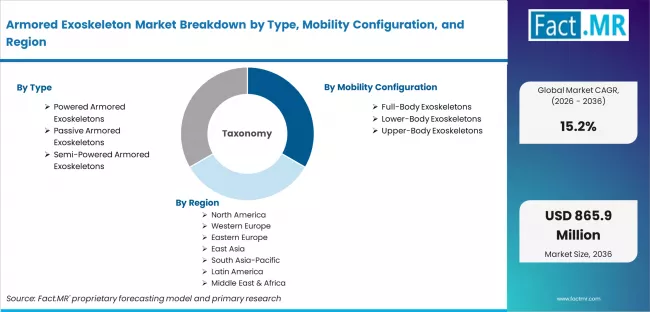
Armored Exoskeleton Market Size, Share, Growth and Forecast (2026 - 2036)

The Armored Exoskeleton Market is segmented by Type, Mobility Configuration, Application, End User and Region. Forecast for 2026 to 2036.

According to Fact.MR estimates, the armored exoskeleton market stood at USD 182.6 million in 2025. The market is projected to reach USD 210.4 million in 2026 and climb to USD 865.9 million by 2036, progressing at a CAGR of 15.2%. Powered Armored Exoskeletons is anticipated to account for nearly 52% share of the type segment, while Full-Body Exoskeletons is expected to remain the leading system mobility configuration with around 41% share, driven by rising defense modernization initiatives, increasing demand for mobility and load-bearing enhancement systems, rapid advancements in AI-enabled wearable robotics, and growing adoption of ergonomic and rehabilitation exoskeleton solutions across military, healthcare, industrial, and public safety sectors.

Armored Exoskeleton Market Overview, Growth Outlook, and Forecast by Fact.MR

  • Global armored exoskeleton market was valued at USD 182.6 Mn in 2025 and is forecast to reach USD 865.9 Mn by 2036.
  • At a 15.2% CAGR from 2026 to 2036, this market is set to expand ~ 4.1 x in value, adding USD 655.6 Mn in absolute opportunity.
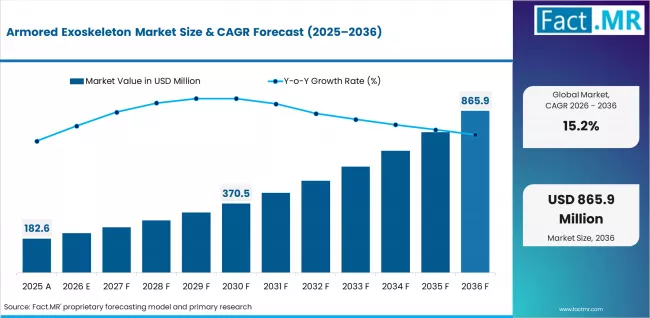
Armored Exoskeleton Market  Value Analysis

Summary of the Armored Exoskeleton Market

  • Demand and Growth Drivers
    • Increasing military modernization initiatives and defense spending are driving demand for armored exoskeleton systems designed to enhance soldier performance and survivability.
    • Growing focus on reducing physical strain and fatigue among defense personnel is supporting adoption of powered and semi-powered wearable systems.
    • Rising adoption of rehabilitation and mobility assistance technologies in healthcare applications is expanding market opportunities.
    • Increasing use of industrial exoskeletons to improve worker safety and productivity is driving deployment across manufacturing and logistics sectors.
    • Advancements in robotics, lightweight materials, and battery technologies are improving mobility, endurance, and operational efficiency.
    • Growing emphasis on public safety and emergency response preparedness is supporting demand for advanced wearable protection systems.
  • Product and Segment View
    • Powered armored exoskeletons hold 52% share of type segment, driven by superior mobility assistance, load-bearing capacity, and operational performance.
    • Semi-powered armored exoskeletons account for 27% share, supported by lower energy consumption and hybrid operational capabilities.
    • Passive armored exoskeletons contribute 21% share, reflecting adoption in rehabilitation and industrial support applications.
    • Full-body exoskeletons dominate mobility configuration with 41% share, driven by increasing demand for complete physical support and protection.
  • Geography and Competitive Outlook
    • North America and Europe represent key markets supported by advanced defense technologies and military modernization programs.
    • Asia Pacific is witnessing rapid growth driven by increasing defense spending, industrial automation, and robotics investments.
    • China, South Korea, and India are emerging as high-growth markets due to expansion of defense modernization and wearable robotics development initiatives.
    • Market growth is influenced by advancements in AI-enabled motion control, lightweight armor materials, and battery-powered mobility systems.
    • Key companies active in this market include Lockheed Martin Corporation, Sarcos Technology and Robotics Corporation, BAE Systems, Ottobock SE & Co. KGaA, and Ekso Bionics Holdings Inc.
  • Analyst Opinion
    • Shambhu Nath Jha, Principal Consultant at Fact.MR, says, “The Armored Exoskeleton Market is no longer defined solely by military mobility enhancement systems. Growth is increasingly driven by advancements in AI-enabled wearable robotics, rising demand for worker safety and rehabilitation support, and the shift toward lightweight, energy-efficient exoskeleton architectures that improve operational performance across defense, healthcare, industrial, and public safety applications

Armored Exoskeleton Market— At a Glance

Attribute Details
Market Value 2025 USD 182.6 Mn
Market Value 2036 USD 865.9 Mn
Absolute Dollar Opportunity (2026-2036) USD 655.6 Mn
CAGR 15.2%
Growth Multiple 4.1x
Key Demand Theme Increasing demand for wearable mobility enhancement and protective systems
Leading Type Powered Armored Exoskeletons
Segment Share (2026) 52%
Leading Mobility Configuration Full-Body Exoskeletons
Segment Share (2026) 41%
Leading Application Military & Defense
Segment Share (2026) 46%
Leading End User Defense Forces
Segment Share (2026) 48%
Key Growth Regions North America, Europe, Asia Pacific
Key Companies Lockheed Martin, Sarcos, BAE Systems, Ottobock, Ekso Bionics
Segmentation by Type Powered Armored Exoskeletons, Passive Armored Exoskeletons, Semi-Powered Armored Exoskeletons
Segmentation by Mobility Configuration Full-Body Exoskeletons, Lower-Body Exoskeletons, Upper-Body Exoskeletons, Modular Exoskeletons
Segmentation by Application Military & Defense, Healthcare & Rehabilitation, Industrial Applications, Public Safety
Segmentation by End User Defense Forces, Healthcare Institutions, Industrial Enterprises
Segmentation by Region North America, Latin America, Europe, East Asia, South Asia & Pacific, Middle East & Africa

Key Growth Drivers, Constraints, and Opportunities
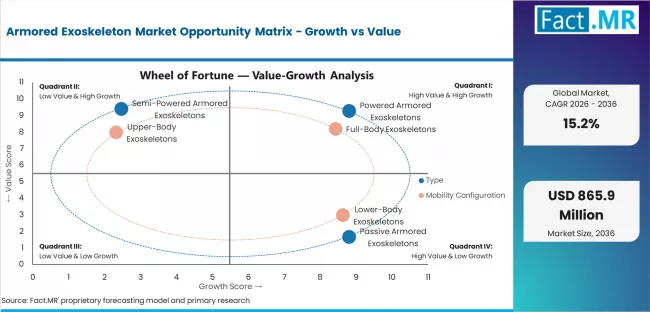
Armored Exoskeleton Market Opportunity Matrix Growth Vs Value

Key Factors Driving Growth

  • There will be more uptake of armored exoskeleton solutions because of increased investments in defense modernization initiatives and growing interest in mobility enhancement solutions.
  • Safety concerns, rehabilitation needs, and demands for ergonomic efficiency will prompt the use of wearable robot technologies by companies.
  • The development of AI solutions, sensors, lightweight materials, and batteries will promote the use of armored exoskeletons.
Growth Driver Demand Impact Time Horizon Key Impact Area Fact.MR Insight
Rising defense modernization and soldier enhancement programs High Short-Mid Term Defense mobility systems Increasing investment in soldier survivability and mobility enhancement is driving demand for armored exoskeleton systems
Growing focus on worker safety and ergonomic efficiency High Short-Mid Term Industrial operations Demand for fatigue reduction and injury prevention is accelerating adoption of wearable robotic systems
Increasing rehabilitation and mobility assistance demand High Short-Mid Term Healthcare applications Expanding use of exoskeletons in rehabilitation and assisted mobility is supporting market growth
Advancements in AI-enabled wearable robotics and smart sensors Medium-High Mid-Long Term Technology transformation AI-assisted mobility, adaptive control systems, and smart sensors are improving exoskeleton performance and usability

Key Market Constraints

  • High costs involved in design, acquisition, and integration will impede the implementation of armored exoskeletons.
  • Maintenance and power management challenges will hamper the widespread use of these systems.
  • Lack of proper infrastructure, minimal awareness, and limited budgets will be a problem for developing economies.

Key Opportunity Areas

  • The development of mobility systems using AI technology, sensors, and efficient human machine interfaces will offer lucrative prospects for manufacturers.
  • Demands from the defense industry, rehabilitation centers, manufacturing, and logistics activities will drive market growth.
  • The use of lightweight composites, energy-efficient actuators, and modularity of wearables will boost adoption.

Segment-wise Analysis of the Armored Exoskeleton Market

  • By the year 2026, Powered Armored Exoskeletons account for a 52% market share of the type segment due to their superior mobility enhancement capabilities, increasing military modernization programs, and growing adoption across industrial and rehabilitation applications requiring advanced load-bearing and fatigue-reduction solutions.
  • Military & Defense represent a 46% market share of the application segment by 2026, driven by rising investments in soldier augmentation technologies, increasing demand for battlefield mobility enhancement, and growing deployment of AI-enabled wearable robotic systems across combat, logistics, and tactical support operations.

The segmentation of the Armored Exoskeleton Market includes type, mobility configuration, application, end user, and region.

Which Type Dominates the Armored Exoskeleton Market?
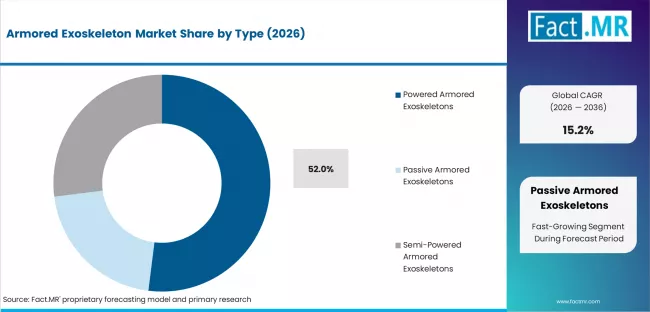
Armored Exoskeleton Market Analysis By Type

Powered Armored Exoskeletons have a market share of 52% since they provide better mobility enhancement, load-bearing capabilities, and AI-powered operational assistance. Semi-Powered Armored Exoskeletons account for 27% because of their flexibility in use and reduced power consumption. Passive Armored Exoskeletons constitute 21% as they offer ergonomic support and fatigue reduction.

Which Mobility Configuration Dominates the Armored Exoskeleton Market?
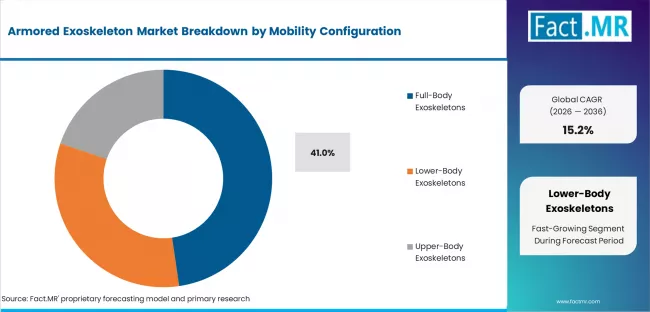
Armored Exoskeleton Market Analysis By Mobility Configuration

Full-Body Exoskeletons account for 41% as they find increased application in military and industrial use cases, where comprehensive mobility and strength enhancement is needed. Lower-Body Exoskeletons account for 28% as they are used for purposes of rehabilitation and endurance. Upper-Body Exoskeletons have a market share of 17% due to increased need for assistance with heavy lifting for industrial purposes. Modular Exoskeletons make up 14% of the market.

Which Application Dominates the Armored Exoskeleton Market?
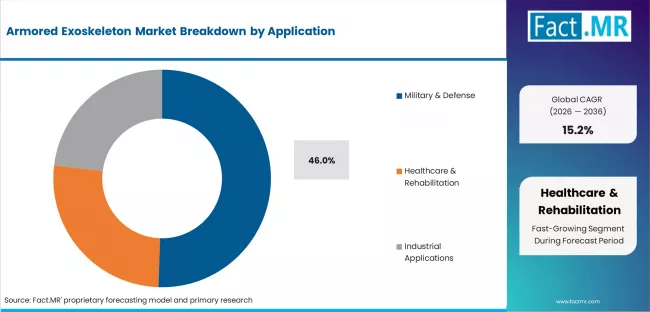
Armored Exoskeleton Market Analysis By Application

Military & Defense accounts for 46% share due to increased funding for soldier modernization programs and mobility enhancement systems. Healthcare & Rehabilitation makes up 24% of the market since mobility recovery is becoming increasingly common. Industrial Applications account for 21% as there are many ergonomic safety systems in use. Public Safety holds 9% due to use cases of firefighting and other emergencies.

Which End User Dominates the Armored Exoskeleton Market?
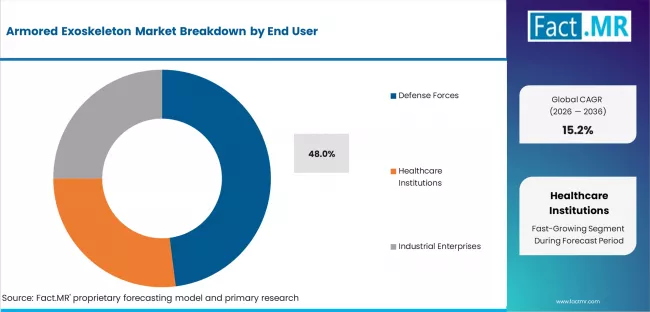
Armored Exoskeleton Market Analysis By End User

Defense Forces hold 48% of the market since procurement of wearable robots for combat and logistical needs is increasing. Healthcare Institutions account for 27% as there is greater rehabilitation and assisted mobility. Industrial Enterprises account for 25% as many firms use exoskeletons for ergonomics and efficiency improvements.

Regional Outlook Across Key Markets

The market analysis covers key global regions, including South Asia and Pacific, Middle East & Africa, North America, Latin America, Western Europe, and Eastern Europe. It is segmented geographically, with specific market dynamics for each region. The full report provides a detailed market attractiveness analysis.

Top Country Growth Comparison Armored Exoskeleton Market Cagr (2026 2036)

CAGR Table

Country CAGR (%)
U.K 14.5%
Germany 14.9%
Japan 15.8%
India 16.1%
U.S. 16.5%
South Korea 17.2%
China 17.8%

Source: Fact.MR (FMR) analysis, based on proprietary forecasting model and primary research.
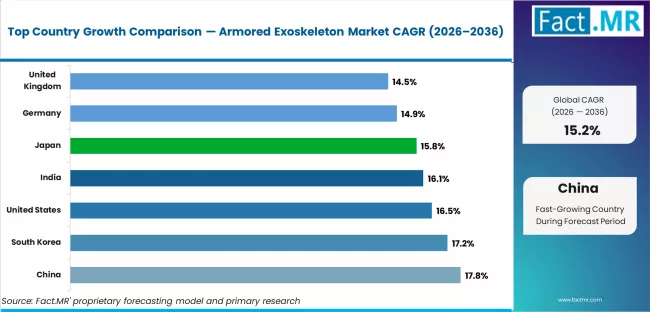
Armored Exoskeleton Market Cagr Analysis By Country

North America: The Global Defense Innovation Hub

North America represents the leading innovation and commercialization hub for armored exoskeleton technologies due to strong defense spending, advanced robotics development, and early adoption of wearable mobility systems. Major players including Lockheed Martin, Sarcos Technology and Robotics Corporation, and Ekso Bionics maintain strong competitive positions through military partnerships, AI integration capabilities, and industrial deployment networks. The region benefits from extensive soldier modernization initiatives and expanding rehabilitation robotics applications.

  • United States: Demand for armored exoskeleton systems in the United States is projected to rise at 16.5% CAGR through 2036. Growth is supported by large-scale military modernization investments and expanding industrial wearable robotics adoption. In March 2025, the U.S. Department of Defense expanded funding under its Soldier Lethality Cross-Functional Team initiative to accelerate wearable robotic mobility systems for infantry applications [1]. In January 2025, Sarcos Technology and Robotics Corporation announced additional commercialization investments targeting logistics and industrial exoskeleton deployment across manufacturing and warehouse operations [2]. Increasing rehabilitation demand within veterans’ healthcare programs and rising AI integration in tactical mobility systems are further strengthening market expansion across both defense and civilian sectors.

Western Europe: The Regulatory and Defense Modernization Center
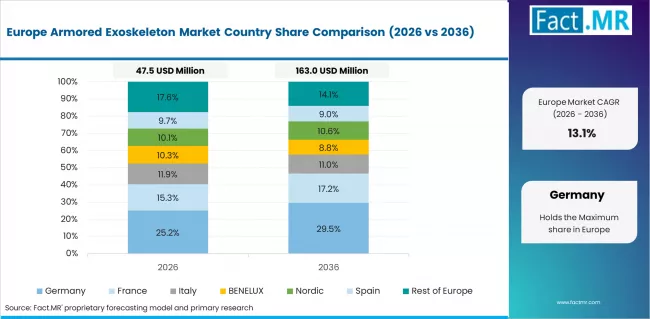
Armored Exoskeleton Market Europe Country Market Share Analysis, 2026 & 2036

Western Europe is emerging as a key regional market driven by NATO-aligned defense modernization, workplace ergonomics regulations, and rehabilitation technology investments. Companies such as BAE Systems, Ottobock, and Safran are strengthening their positions through advanced wearable robotics development and industrial partnerships. Regional growth is supported by increasing investments in soldier mobility enhancement and worker injury reduction technologies.

  • Germany: Demand for armored exoskeleton systems in Germany is projected to rise at 14.9% CAGR through 2036. Growth is driven by industrial automation and military mobility enhancement initiatives. In February 2025, the German Federal Ministry of Defence expanded wearable soldier systems evaluation programs focused on load-bearing mobility support for infantry personnel [3]. In April 2025, Ottobock announced increased investment in industrial exoskeleton deployment programs targeting automotive and manufacturing facilities across Germany [4]. Rising workplace safety standards, strong robotics manufacturing capabilities, and increasing adoption of ergonomic wearable systems in logistics operations are contributing to sustained market demand.

East Asia: The Advanced Robotics Manufacturing Powerhouse
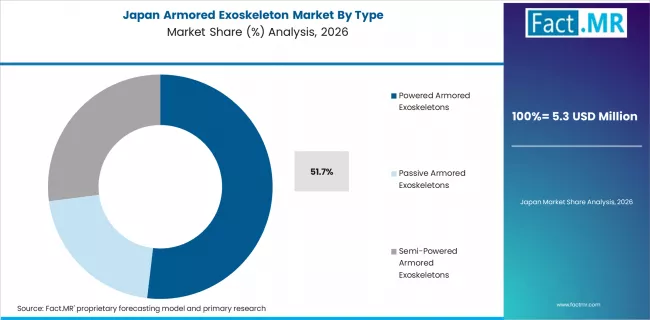
Armored Exoskeleton Market Japan Market Share Analysis By Type

East Asia represents the global production and technology advancement center for wearable robotics and AI-enabled exoskeleton systems. Leading companies including Cyberdyne Inc., Panasonic Corporation, and Hyundai Motor Company are driving innovation through AI integration, lightweight materials, and rehabilitation robotics development. Strong government-backed robotics programs and advanced electronics manufacturing ecosystems continue to strengthen the region’s market position.

  • Japan: Demand for armored exoskeleton systems in Japan is projected to rise at 15.8% CAGR through 2036. Demand is rising due to aging population challenges, advanced robotics adoption, and rehabilitation investments. In January 2025, Japan’s Ministry of Economy, Trade and Industry expanded support programs for wearable robotic technologies targeting healthcare and industrial mobility applications [5]. In April 2025, Cyberdyne Inc. increased commercialization efforts for HAL exoskeleton systems across rehabilitation and workforce support applications [6]. Strong robotics infrastructure, labor shortage concerns, and increasing demand for mobility assistance technologies are accelerating national adoption rates.
  • China: Demand for armored exoskeleton systems in China is projected to rise at 17.8% CAGR through 2036. China is witnessing strong demand due to large-scale defense modernization, industrial automation, and domestic robotics manufacturing expansion. In February 2025, China’s Ministry of Industry and Information Technology expanded national robotics development initiatives supporting wearable mobility technologies and AI-enabled industrial systems [7]. In June 2025, several state-backed defense technology programs accelerated procurement testing for powered military exoskeleton platforms aimed at logistics and infantry applications. Strong domestic manufacturing capabilities, increasing workplace automation, and rising investments in rehabilitation robotics continue to strengthen long-term market growth.

Fact.MR’s analysis of the global armored exoskeleton market provides region-wise and country-wise assessment across North America, Western Europe, East Asia, South Asia & Pacific, Eastern Europe, Latin America, and the Middle East & Africa. Readers can access detailed insights on defense modernization trends, industrial wearable robotics adoption, rehabilitation technology deployment, competitive benchmarking, AI integration developments, procurement strategies, and long-term regional growth opportunities shaping the global armored exoskeleton industry.

Competitive Benchmarking and Company Positioning

Leading Companies Shaping the Armored Exoskeleton Market
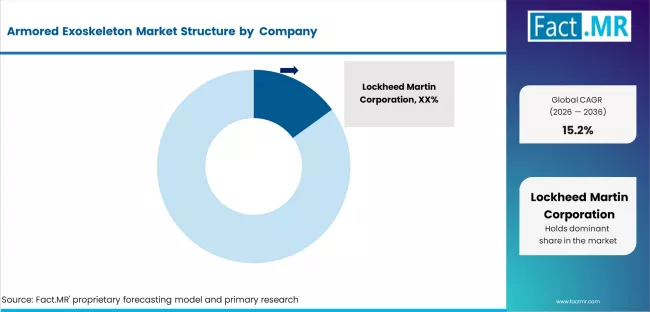
Armored Exoskeleton Market Analysis By Company

The armor exoskeleton market is slightly fragmented, with major participants such as Lockheed Martin Corporation, RTX, Safran, Ekso Bionics, and Cyberdyne Inc., together accounting for close to 40-50% of market share. The competition in this industry is based on the use of AI, efficiency of movement, ergonomics, and battery quality apart from price. Major defense contractors enjoy an advantage because of their established procurement and research and development systems, whereas robotics companies rely on innovation within a specialized segment. Consumers mitigate their dependence on suppliers through trials and assessments involving multiple vendors.

Key Players of the Armored Exoskeleton Market

  • Lockheed Martin Corporation
  • RTX
  • Safran
  • Bionic Power Inc.
  • Ekso Bionics
  • Cyberdyne Inc.
  • Ottobock
  • SuitX
  • Rostec
  • Hyundai Motor Company
  • Panasonic Holdings Corporation
  • Dephy
  • Rex Bionics Ltd.
  • MAWASHI SCIENCE & TECHNOLOGY

Recent Industry Developments

  • Lockheed Martin Corporation advances AI integration for defense systems (March 2025): Lockheed Martin announced a collaboration with Google Cloud to expand generative AI capabilities across national security and advanced defense technology platforms, strengthening its AI ecosystem relevant to next-generation wearable combat and mobility systems. [8]
  • Hyundai Motor Company expands wearable robotics commercialization initiatives (September 2025): Hyundai Motor and Kia expanded deployment of the X-ble Shoulder wearable robot through collaboration with Korea’s Rural Development Administration to improve worker safety and ergonomic efficiency across industrial and agricultural operations. [9]
  • Cyberdyne Inc. strengthens rehabilitation robotics research and commercialization (June 2025): Cyberdyne announced new findings supporting HAL exoskeleton technology for neuroplasticity and therapeutic rehabilitation benefits, strengthening adoption potential across healthcare and mobility assistance applications. [10]

Sources and Research References

  • [1] U.S. Department of Defense, “Soldier Lethality Cross-Functional Team Modernization Initiatives,” March 2025
  • [2] Sarcos Technology and Robotics Corporation, “Commercial Expansion of Industrial Exoskeleton Deployment Programs,” January 2025
  • [3] German Federal Ministry of Defence, “Wearable Soldier Systems Evaluation Program Expansion,” February 2025
  • [4] Ottobock, “Industrial Exoskeleton Investment Expansion in Germany,” April 2025
  • [5] Ministry of Economy, Trade and Industry (Japan), “Support Programs for Wearable Robotic Technologies,” January 2025
  • [6] Cyberdyne Inc., “Expansion of HAL Exoskeleton Commercialization Initiatives,” April 2025
  • [7] Ministry of Industry and Information Technology of China, “National Robotics Development Initiatives for Wearable Mobility Technologies,” February 2025
  • [8] Lockheed Martin Corporation, “Lockheed Martin and Google Cloud Announce Collaboration to Advance Generative AI for National Security,” March 2025
  • [9] Hyundai Motor Group, “Hyundai Motor and Kia Expand Use of Wearable Robot in Agriculture with Korea’s Rural Development Administration,” September 2025
  • [10] Cyberdyne Inc., “Press Releases Back Number – HAL Rehabilitation and Neuroplasticity Research Findings,” June 2025

Armored Exoskeleton Market Definition

Armored exoskeletons are wearable mechanical suits that increase human strength, flexibility, stamina, and protect them physically across the defense, healthcare, industry, and public sector. The systems utilize sensors, actuators, light weight material, and both power-driven or passive technology for reducing physical strain. Armored exoskeletons find application in soldier modernization, rehabilitation assistance, carrying of heavy loads, ergonomic improvements at workstations, and dangerous environments operation. There are several types of armored exoskeletons such as powered, passive, or semi-powered exoskeletons. These can be segmented according to mobility configuration and functions.

Armored Exoskeleton Market Inclusions

The report includes information about the worldwide and regional market size, past performance, growth, forecasted values of the market till 2036, including segmentation analysis of the market by type, mobility configuration, applications, end-user segments, and geography. Further analysis includes pricing trends, technological advancements, benchmarking the competition, adoption factors, regulations, supply chain analysis, and funding of the business.

Armored Exoskeleton Market Exclusions

The scope of this report does not cover non-armored fitness wearable, consumer smartwear or smart clothing, prosthesis, or traditional rehabilitation brace that does not have an exoskeleton function. This does not include humanoid robots, unmanned military robotics, body armor product, or consumer exosuits for gaming.

Armored Exoskeleton Market Research Methodology

  • Primary Research
    • Interviews were carried out with exoskeleton makers, defense acquisition agencies, rehabilitation centers, industrial safety organizations, component producers, and technocrats to evaluate market trends, price dynamics, adoption rates, and future investments.
  • Desk Research
    • The analysis leveraged public sources such as corporate annual reports, defense modernization initiatives, government publications, healthcare robotics statistics, trade publications, patent archives, investor relations material, and industry association magazines.
  • Market-Sizing and Forecasting
    • Market modeling was done using a mixed strategy that combined both top-down analysis of the industry along with bottom-up analysis of the revenues of key players based on demand mapping for defense, health care, industry, and public safety sectors.
  • Data Validation and Update Cycle
    • Every market figure presented is verified via triangulation of information obtained from primary interviews, company accounts, regional demand studies, and supply chains. The forecast is updated frequently to incorporate advances in technology, regulatory shifts, and commercialization trends.

Scope of Analysis

Armored Exoskeleton Market Breakdown By Type, Mobility Configuration, And Region

Parameter Details
Quantitative Units USD 182.6 million in 2025 to USD 865.9 million in 2036, at a CAGR of 15.2%
Market Definition The armored exoskeleton market includes wearable robotic systems designed to enhance human strength, mobility, endurance, and protection across defense, healthcare, industrial, and public safety applications through powered or passive assistance technologies.
Regions Covered North America, Latin America, Europe, East Asia, South Asia and Pacific, MiddleEastand Africa
Countries Covered USA, Canada, UK, Germany, China, India, 30 plus countries
Key Companies Lockheed Martin Corporation, RTX, Safran, Bionic Power Inc., Ekso Bionics, Cyberdyne Inc., Ottobock, SuitX, Rostec, Hyundai Motor Company, Panasonic Holdings Corporation, Dephy, Rex Bionics Ltd., Mawashi Science & Technology
Forecast Period 2026 to 2036
Approach Hybrid demand-side and top-downmethodologybuilt on country-level application demand, product benchmarking, pricing analysis, shipment validation, and primary interviews across manufacturers, distributors, retailers, and end users

Segment-wise Analysis

  • Armored Exoskeleton Market by Type

    • Powered Armored Exoskeletons
      • Hydraulic Powered
      • Electric Powered
      • Hybrid Powered
    • Passive Armored Exoskeletons
      • Mechanical Support Systems
      • Load Redistribution Systems
      • Energy-Storing Passive Systems
    • Semi-Powered Armored Exoskeletons
      • Motor-Assisted Lower Body Systems
      • Smart Assist Systems
      • Modular Assist Platforms
  • Armored Exoskeleton Market by Mobility Configuration

    • Full-Body Exoskeletons
      • Combat Enhancement Systems
      • Heavy Load Carrier Systems
      • Tactical Protection Systems
    • Lower-Body Exoskeletons
      • Mobility Enhancement
      • Rehabilitation & Recovery
      • Industrial Lower-Body Systems
    • Upper-Body Exoskeletons
      • Arm Support Systems
      • Industrial Work Assistance
      • Medical Assistance Systems
    • Modular Exoskeletons
      • Mission-Specific Modules
      • Replaceable Armor Modules
      • Upgradeable Electronics Modules
  • Armored Exoskeleton Market by Application

    • Military & Defense

      • Combat Operations
      • Logistics & Support
      • Defense Training
    • Healthcare & Rehabilitation
      • Neurological Rehabilitation
      • Elderly Assistance
      • Physical Therapy
    • Industrial Applications
      • Manufacturing
      • Construction
      • Mining & Energy
    • Public Safety
      • Firefighting
      • Disaster Response
      • Law Enforcement
  • Armored Exoskeleton Market by End-User

    • Defense Forces

      • Army
      • Navy
      • Air Force
    • Healthcare Institutions
      • Hospitals
      • Rehabilitation Centers
      • Elderly Care Facilities
    • Industrial Enterprises
      • Automotive Manufacturing
      • Warehousing & Logistics
      • Energy & Utilities
  • Armored Exoskeleton Market by Region

    • North America

      • USA
      • Canada
      • Mexico
    • Latin America
      • Brazil
      • Chile
      • Rest of LATAM
    • East Asia
      • China
      • Japan
      • South Korea
    • Western Europe
      • Germany
      • Italy
      • France
      • U.K.
      • Spain
      • BENELUX
      • Nordic
      • Rest of W. Europe
    • Eastern Europe
      • Russia
      • Hungary
      • Poland
      • Balkan & Baltics
      • Rest of E. Europe
    • South Asia & Pacific
      • India
      • ASEAN
      • ANZ
      • Rest of SAP
    • Middle East and Africa
      • Kingdom of Saudi Arabia
      • United Arab Emirates
      • South Africa
      • Rest of Middle East and Africa

- Frequently Asked Questions -

How large is the demand for Armored Exoskeletons in the global market in 2026?

Demand for Armored Exoskeletons in the global market is estimated to be valued at USD 210.4 million in 2026.

What will be the market size of Armored Exoskeletons in the global market by 2036?

The market size for Armored Exoskeletons is projected to reach USD 865.9 million by 2036.

What is the expected demand growth for Armored Exoskeletons in the global market between 2026 and 2036?

Demand for Armored Exoskeletons in the global market is expected to grow at a CAGR of 15.2% between 2026 and 2036, driven by increasing defense modernization programs and demand for enhanced soldier mobility systems.

Which type is expected to dominate the market?

Powered Armored Exoskeletons are expected to dominate the market, accounting for 52% of the market share in 2026, due to their ability to enhance endurance, strength, and operational efficiency in combat environments.

Which country is expected to show the highest growth rate for Armored Exoskeletons?

China is projected to show the highest regional CAGR at 17.8%, supported by increasing military modernization initiatives and investments in advanced defense technologies.

Which company is identified as a leading player in the Armored Exoskeleton market?

Lockheed Martin Corporation is recognized as a leading player in this market, developing advanced powered exoskeleton systems for military and defense applications.

Table of Content

  1. Armored Exoskeleton Market – Executive Summary
  2. Market Overview
    • Market Definition & Introduction
    • Market Taxonomy & Research Scope
  3. Global Armored Exoskeleton Market Demand Analysis 2021-2025 and Forecast, 2026–2036
    • Historical Market Volume (Units) Analysis, 2021-2025
    • Current and Future Market Volume (Units) Projections, 2026–2036
    • Y-o-Y Growth Trend Analysis
  4. Global Armored Exoskeleton Market - Pricing Analysis
    • Product Category and Country-Level Pricing Analysis
    • Region Average Pricing Analysis Benchmark
    • Price Trends and Forecasts
      • Historical price trends
      • Future price forecasts
    • Factors Influencing Pricing
    • Competitive Pricing Strategies
  5. Global Armored Exoskeleton Market Demand (in Value or Size in US$ Mn) Analysis 2021-2025 and Forecast, 2026–2036
    • Historical Market Value (US$ Mn) Analysis, 2021-2025
    • Current and Future Market Value (US$ Mn) Projections, 2026–2036
      • Y-o-Y Growth Trend Analysis
      • Absolute $ Opportunity Analysis
  6. Market Background and Foundational Data Points
    • Cross-industry exoskeleton adoption rates
    • AI and wearable robotics advancements
    • Demand for ergonomic safety solutions
    • Rehabilitation and mobility assistance demand
    • Industrial automation expansion
    • Defense modernization investments
    • Aging population growth
    • Battery and power efficiency improvements
    • Regulatory and certification standards
    • Commercial deployments and partnerships
    • Advanced lightweight material availability
    • Trade Scenario, 2025
      • Imports and Export Analysis
        • By Region
        • By Country
    • Start-up Ecosystem Analysis, 2021-2025
    • Armored Exoskeleton Market Opportunity Assessment
      • Total Available Market (US$ Mn)
      • Serviceable Addressable Market (US$ Mn)
      • Serviceable Obtainable Market (US$ Mn)
    • Porter’s Five Forces and PESTEL Analysis
    • Investment Feasibility Analysis
    • Macro-Economic Factors & Forecast Factors - Relevance & Impact
    • Industry Value and Supply Chain Analysis
      • List of Key Channel Partners
      • Profit Margin & Operating Margin at Each Node of Supply Chain.
      • Notes on Value Added at Each Node in the Value Chain
      • Factors Influencing Value Chain
    • Market Dynamics
      • Drivers
      • Restraints
      • Opportunity Analysis
    • Key Regulations & Certifications
  7. Armored Exoskeleton Market Analysis 2021-2025 and Forecast 2026–2036, By Type
    • Introduction / Key Findings
    • Historical Market Size (US$ Mn) & Volume (Units) Trend Analysis By Type, 2021-2025
    • Current and Future Market Size (US$ Mn) & Volume (Units) Analysis and Forecast By Type, 2026-2036
      • Powered Armored Exoskeletons
        • Hydraulic Powered
        • Electric Powered
        • Hybrid Powered
      • Passive Armored Exoskeletons
        • Mechanical Support Systems
        • Load Redistribution Systems
        • Energy-Storing Passive Systems
      • Semi-Powered Armored Exoskeletons
        • Motor-Assisted Lower Body Systems
        • Smart Assist Systems
        • Modular Assist Platforms
    • Market Attractiveness Analysis By Type
  8. Armored Exoskeleton Market Analysis 2021-2025 and Forecast 2026–2036, By Mobility Configuration
    • Introduction / Key Findings
    • Historical Market Size (US$ Mn) & Volume (Units) Trend Analysis By Mobility Configuration, 2021-2025
    • Current and Future Market Size (US$ Mn) & Volume (Units) Analysis and Forecast By Mobility Configuration, 2026-2036
      • Full-Body Exoskeletons
        • Combat Enhancement Systems
        • Heavy Load Carrier Systems
        • Tactical Protection Systems
      • Lower-Body Exoskeletons
        • Mobility Enhancement
        • Rehabilitation & Recovery
        • Industrial Lower-Body Systems
      • Upper-Body Exoskeletons
        • Arm Support Systems
        • Industrial Work Assistance
        • Medical Assistance Systems
      • Modular Exoskeletons
        • Mission-Specific Modules
        • Replaceable Armor Modules
        • Upgradeable Electronics Modules
    • Market Attractiveness Analysis By Mobility Configuration
  9. Armored Exoskeleton Market Analysis 2021-2025 and Forecast 2026–2036, By Application
    • Introduction / Key Findings
    • Historical Market Size (US$ Mn) & Volume (Units) Trend Analysis By Application, 2021-2025
    • Current and Future Market Size (US$ Mn) & Volume (Units) Analysis and Forecast By Application, 2026-2036
      • Military & Defense
        • Combat Operations
        • Logistics & Support
        • Defense Training
      • Healthcare & Rehabilitation
        • Neurological Rehabilitation
        • Elderly Assistance
        • Physical Therapy
      • Industrial Applications
        • Manufacturing
        • Construction
        • Mining & Energy
      • Public Safety
        • Firefighting
        • Disaster Response
        • Law Enforcement
    • Market Attractiveness Analysis By Application
  10. Armored Exoskeleton Market Analysis 2021-2025 and Forecast 2026–2036, By End User
    • Introduction / Key Findings
    • Historical Market Size (US$ Mn) & Volume (Units) Trend Analysis By End User, 2021-2025
    • Current and Future Market Size (US$ Mn) & Volume (Units) Analysis and Forecast By End User, 2026-2036
      • Defense Forces
        • Army
        • Navy
        • Air Force
      • Healthcare Institutions
        • Hospitals
        • Rehabilitation Centers
        • Elderly Care Facilities
      • Industrial Enterprises
        • Automotive Manufacturing
        • Warehousing & Logistics
        • Energy & Utilities
    • Market Attractiveness Analysis By End User
  11. Global Armored Exoskeleton Market Analysis and Forecast, by Region
    • Introduction / Key Findings
    • Historical Market Size (US$ Mn) & Volume (Units) Trend Analysis by Region, 2021-2025
    • Current and Future Market Size (US$ Mn) & Volume (Units) Analysis and Forecast by Region, 2026-2036
      • North America
      • Latin America
      • Western Europe
      • Eastern Europe
      • East Asia
      • South Asia & Pacific
      • Middle East & Africa
    • Market Attractiveness Analysis by Region
  12. North America Armored Exoskeleton Market Analysis and Forecast
    • Introduction / Key Findings
    • Pricing Analysis
    • Historical Market Size (US$ Mn) & Volume (Units) Trend Analysis by Market Taxonomy, 2021-2025
    • Current and Future Market Size (US$ Mn) and Volume (Units) Analysis & Forecast by Market Taxonomy, 2026-2036
    • By Country
      • United States
      • Canada
      • Mexico
    • By Taxonomy
    • Market Attractiveness Analysis By Country & Taxonomy
    • Market Trends
    • Key Market Participants – Intensity Mapping
    • Drivers and Restraints - Impact Analysis
  13. Latin America Armored Exoskeleton Market Analysis and Forecast
    • Introduction / Key Findings
    • Pricing Analysis
    • Historical Market Size (US$ Mn) & Volume (Units) Trend Analysis by Market Taxonomy, 2021-2025
    • Current and Future Market Size (US$ Mn) and Volume (Units) Analysis & Forecast by Market Taxonomy, 2026-2036
    • By Country
      • Brazil
      • Chile
      • Rest of LATAM
    • By Taxonomy
    • Market Attractiveness Analysis By Country & Taxonomy
    • Market Trends
    • Key Market Participants – Intensity Mapping
    • Drivers and Restraints - Impact Analysis
  14. Western Europe Armored Exoskeleton Market Analysis and Forecast
    • Introduction / Key Findings
    • Pricing Analysis
    • Historical Market Size (US$ Mn) & Volume (Units) Trend Analysis by Market Taxonomy, 2021-2025
    • Current and Future Market Size (US$ Mn) and Volume (Units) Analysis & Forecast by Market Taxonomy, 2026-2036
    • By Country
      • Germany
      • Italy
      • France
      • United Kingdom
      • Spain
      • BENELUX
      • Nordics
      • Rest of Western Europe
    • By Taxonomy
    • Market Attractiveness Analysis By Country & Taxonomy
    • Market Trends
    • Key Market Participants – Intensity Mapping
    • Drivers and Restraints - Impact Analysis
  15. Eastern Europe Armored Exoskeleton Market Analysis and Forecast
    • Introduction / Key Findings
    • Pricing Analysis
    • Historical Market Size (US$ Mn) & Volume (Units) Trend Analysis by Market Taxonomy, 2021-2025
    • Current and Future Market Size (US$ Mn) and Volume (Units) Analysis & Forecast by Market Taxonomy, 2026-2036
    • By Country
      • Russia
      • Hungary
      • Poland
      • Balkan & Baltics
      • Rest of Eastern Europe
    • By Taxonomy
    • Market Attractiveness Analysis By Country & Taxonomy
    • Market Trends
    • Key Market Participants – Intensity Mapping
    • Drivers and Restraints - Impact Analysis
  16. East Asia Armored Exoskeleton Market Analysis and Forecast
    • Introduction / Key Findings
    • Pricing Analysis
    • Historical Market Size (US$ Mn) & Volume (Units) Trend Analysis by Market Taxonomy, 2021-2025
    • Current and Future Market Size (US$ Mn) and Volume (Units) Analysis & Forecast by Market Taxonomy, 2026-2036
    • By Country
      • China
      • Japan
      • South Korea
    • By Taxonomy
    • Market Attractiveness Analysis By Country & Taxonomy
    • Market Trends
    • Key Market Participants – Intensity Mapping
    • Drivers and Restraints - Impact Analysis
  17. South Asia & Pacific Armored Exoskeleton Market Analysis and Forecast
    • Introduction / Key Findings
    • Pricing Analysis
    • Historical Market Size (US$ Mn) & Volume (Units) Trend Analysis by Market Taxonomy, 2021-2025
    • Current and Future Market Size (US$ Mn) and Volume (Units) Analysis & Forecast by Market Taxonomy, 2026-2036
    • By Country
      • India
      • ASEAN
      • Australia & New Zealand
      • Rest of South Asia & Pacific
    • By Taxonomy
    • Market Attractiveness Analysis By Country & Taxonomy
    • Market Trends
    • Key Market Participants – Intensity Mapping
    • Drivers and Restraints - Impact Analysis
  18. Middle East & Africa Armored Exoskeleton Market Analysis and Forecast
    • Introduction / Key Findings
    • Pricing Analysis
    • Historical Market Size (US$ Mn) & Volume (Units) Trend Analysis by Market Taxonomy, 2021-2025
    • Current and Future Market Size (US$ Mn) and Volume (Units) Analysis & Forecast by Market Taxonomy, 2026-2036
    • By Country
      • Kingdom of Saudi Arabia
      • Other GCC Countries
      • Turkiye
      • South Africa
      • Other African Union
    • By Taxonomy
    • Market Attractiveness Analysis By Country & Taxonomy
    • Market Trends
    • Key Market Participants – Intensity Mapping
    • Drivers and Restraints - Impact Analysis
  19. Country-level Armored Exoskeleton Market Analysis and ForecastCanada Armored Exoskeleton Market Analysis
    • Introduction
    • Market Value Proportion Analysis, By Key Countries
    • Global Vs. Country Growth Comparison
      • United States Armored Exoskeleton Market Analysis
        • Market Size (US$ Mn) & Volume (Units) Analysis by Market Taxonomy, 2021–2036
        • By Type
        • By Mobility Configuration
        • By Application
        • By End User
    • Mexico Armored Exoskeleton Market Analysis
    • Brazil Armored Exoskeleton Market Analysis
    • Chile Armored Exoskeleton Market Analysis
    • Germany Armored Exoskeleton Market Analysis
    • France Armored Exoskeleton Market Analysis
    • Italy Armored Exoskeleton Market Analysis
    • Spain Armored Exoskeleton Market Analysis
    • United Kingdom Armored Exoskeleton Market Analysis
    • BENELUX Armored Exoskeleton Market Analysis
    • Nordics Armored Exoskeleton Market Analysis
    • Poland Armored Exoskeleton Market Analysis
    • Russia Armored Exoskeleton Market Analysis
    • Hungary Armored Exoskeleton Market Analysis
    • Balkan & Baltics Armored Exoskeleton Market Analysis
    • China Armored Exoskeleton Market Analysis
    • Japan Armored Exoskeleton Market Analysis
    • South Korea Armored Exoskeleton Market Analysis
    • India Armored Exoskeleton Market Analysis
    • ASEAN Armored Exoskeleton Market Analysis
    • ANZ Armored Exoskeleton Market Analysis
    • KSA Armored Exoskeleton Market Analysis
    • Other GCC Countries Armored Exoskeleton Market Analysis
    • South Africa Armored Exoskeleton Market Analysis
    • Turkiye Armored Exoskeleton Market Analysis
  20. Armored Exoskeleton Market Structure Analysis
    • Market Analysis by Tier of Companies
    • Market Concentration
    • Market Share Analysis of Top Players
    • Market Space for New Brands and Dollar Opportunity
    • Market Presence Analysis
      • Regional Footprint of Players
      • Product Footprint by Players
    • Mobile Optical Pluggable Competition Analysis
      • Competition Dashboard
      • Pricing Analysis by Competition
      • Competition Benchmarking
      • Competition Deep Dive
        • Lockheed Martin Corporation
          • Overview
          • Product Portfolio
          • Sales Footprint
          • Key Developments
          • SWOT Analysis
          • Strategy Overview
          • Key Financials
        • RTX
        • Safran
        • Bionic Power Inc.
        • Ekso Bionics
        • Cyberdyne Inc.
        • Ottobock
        • SuitX
        • Rostec
        • Hyundai Motor Company
        • Panasonic Holdings Corporation
        • Dephy
        • Rex Bionics Ltd.
        • MAWASHI SCIENCE & TECHNOLOGY
        • Other Prominent Players
  21. Primary insights
  22. Assumptions & Acronyms Used
  23. Research Methodology & Data Sources

List Of Table

  • Table 1: Global Market Value (USD Mn) Forecast by Region, 2021 to 2036
  • Table 2: Global Market Volume (Units) Forecast by Region, 2021 to 2036
  • Table 3: Global Market Value (USD Mn) Forecast by Type, 2021 to 2036
  • Table 4: Global Market Volume (Units) Forecast by Type, 2021 to 2036
  • Table 5: Global Market Value (USD Mn) Forecast by Mobility Configuration, 2021 to 2036
  • Table 6: Global Market Volume (Units) Forecast by Mobility Configuration, 2021 to 2036
  • Table 7: Global Market Value (USD Mn) Forecast by Application, 2021 to 2036
  • Table 8: Global Market Volume (Units) Forecast by Application, 2021 to 2036
  • Table 9: Global Market Value (USD Mn) Forecast by End User, 2021 to 2036
  • Table 10: Global Market Volume (Units) Forecast by End User, 2021 to 2036
  • Table 11: North America Market Value (USD Mn) Forecast by Country, 2021 to 2036
  • Table 12: North America Market Volume (Units) Forecast by Country, 2021 to 2036
  • Table 13: North America Market Value (USD Mn) Forecast by Type, 2021 to 2036
  • Table 14: North America Market Volume (Units) Forecast by Type, 2021 to 2036
  • Table 15: North America Market Value (USD Mn) Forecast by Mobility Configuration, 2021 to 2036
  • Table 16: North America Market Volume (Units) Forecast by Mobility Configuration, 2021 to 2036
  • Table 17: North America Market Value (USD Mn) Forecast by Application, 2021 to 2036
  • Table 18: North America Market Volume (Units) Forecast by Application, 2021 to 2036
  • Table 19: North America Market Value (USD Mn) Forecast by End User, 2021 to 2036
  • Table 20: North America Market Volume (Units) Forecast by End User, 2021 to 2036
  • Table 21: Latin America Market Value (USD Mn) Forecast by Country, 2021 to 2036
  • Table 22: Latin America Market Volume (Units) Forecast by Country, 2021 to 2036
  • Table 23: Latin America Market Value (USD Mn) Forecast by Type, 2021 to 2036
  • Table 24: Latin America Market Volume (Units) Forecast by Type, 2021 to 2036
  • Table 25: Latin America Market Value (USD Mn) Forecast by Mobility Configuration, 2021 to 2036
  • Table 26: Latin America Market Volume (Units) Forecast by Mobility Configuration, 2021 to 2036
  • Table 27: Latin America Market Value (USD Mn) Forecast by Application, 2021 to 2036
  • Table 28: Latin America Market Volume (Units) Forecast by Application, 2021 to 2036
  • Table 29: Latin America Market Value (USD Mn) Forecast by End User, 2021 to 2036
  • Table 30: Latin America Market Volume (Units) Forecast by End User, 2021 to 2036
  • Table 31: Western Europe Market Value (USD Mn) Forecast by Country, 2021 to 2036
  • Table 32: Western Europe Market Volume (Units) Forecast by Country, 2021 to 2036
  • Table 33: Western Europe Market Value (USD Mn) Forecast by Type, 2021 to 2036
  • Table 34: Western Europe Market Volume (Units) Forecast by Type, 2021 to 2036
  • Table 35: Western Europe Market Value (USD Mn) Forecast by Mobility Configuration, 2021 to 2036
  • Table 36: Western Europe Market Volume (Units) Forecast by Mobility Configuration, 2021 to 2036
  • Table 37: Western Europe Market Value (USD Mn) Forecast by Application, 2021 to 2036
  • Table 38: Western Europe Market Volume (Units) Forecast by Application, 2021 to 2036
  • Table 39: Western Europe Market Value (USD Mn) Forecast by End User, 2021 to 2036
  • Table 40: Western Europe Market Volume (Units) Forecast by End User, 2021 to 2036
  • Table 41: Eastern Europe Market Value (USD Mn) Forecast by Country, 2021 to 2036
  • Table 42: Eastern Europe Market Volume (Units) Forecast by Country, 2021 to 2036
  • Table 43: Eastern Europe Market Value (USD Mn) Forecast by Type, 2021 to 2036
  • Table 44: Eastern Europe Market Volume (Units) Forecast by Type, 2021 to 2036
  • Table 45: Eastern Europe Market Value (USD Mn) Forecast by Mobility Configuration, 2021 to 2036
  • Table 46: Eastern Europe Market Volume (Units) Forecast by Mobility Configuration, 2021 to 2036
  • Table 47: Eastern Europe Market Value (USD Mn) Forecast by Application, 2021 to 2036
  • Table 48: Eastern Europe Market Volume (Units) Forecast by Application, 2021 to 2036
  • Table 49: Eastern Europe Market Value (USD Mn) Forecast by End User, 2021 to 2036
  • Table 50: Eastern Europe Market Volume (Units) Forecast by End User, 2021 to 2036
  • Table 51: East Asia Market Value (USD Mn) Forecast by Country, 2021 to 2036
  • Table 52: East Asia Market Volume (Units) Forecast by Country, 2021 to 2036
  • Table 53: East Asia Market Value (USD Mn) Forecast by Type, 2021 to 2036
  • Table 54: East Asia Market Volume (Units) Forecast by Type, 2021 to 2036
  • Table 55: East Asia Market Value (USD Mn) Forecast by Mobility Configuration, 2021 to 2036
  • Table 56: East Asia Market Volume (Units) Forecast by Mobility Configuration, 2021 to 2036
  • Table 57: East Asia Market Value (USD Mn) Forecast by Application, 2021 to 2036
  • Table 58: East Asia Market Volume (Units) Forecast by Application, 2021 to 2036
  • Table 59: East Asia Market Value (USD Mn) Forecast by End User, 2021 to 2036
  • Table 60: East Asia Market Volume (Units) Forecast by End User, 2021 to 2036
  • Table 61: South Asia and Pacific Market Value (USD Mn) Forecast by Country, 2021 to 2036
  • Table 62: South Asia and Pacific Market Volume (Units) Forecast by Country, 2021 to 2036
  • Table 63: South Asia and Pacific Market Value (USD Mn) Forecast by Type, 2021 to 2036
  • Table 64: South Asia and Pacific Market Volume (Units) Forecast by Type, 2021 to 2036
  • Table 65: South Asia and Pacific Market Value (USD Mn) Forecast by Mobility Configuration, 2021 to 2036
  • Table 66: South Asia and Pacific Market Volume (Units) Forecast by Mobility Configuration, 2021 to 2036
  • Table 67: South Asia and Pacific Market Value (USD Mn) Forecast by Application, 2021 to 2036
  • Table 68: South Asia and Pacific Market Volume (Units) Forecast by Application, 2021 to 2036
  • Table 69: South Asia and Pacific Market Value (USD Mn) Forecast by End User, 2021 to 2036
  • Table 70: South Asia and Pacific Market Volume (Units) Forecast by End User, 2021 to 2036
  • Table 71: Middle East & Africa Market Value (USD Mn) Forecast by Country, 2021 to 2036
  • Table 72: Middle East & Africa Market Volume (Units) Forecast by Country, 2021 to 2036
  • Table 73: Middle East & Africa Market Value (USD Mn) Forecast by Type, 2021 to 2036
  • Table 74: Middle East & Africa Market Volume (Units) Forecast by Type, 2021 to 2036
  • Table 75: Middle East & Africa Market Value (USD Mn) Forecast by Mobility Configuration, 2021 to 2036
  • Table 76: Middle East & Africa Market Volume (Units) Forecast by Mobility Configuration, 2021 to 2036
  • Table 77: Middle East & Africa Market Value (USD Mn) Forecast by Application, 2021 to 2036
  • Table 78: Middle East & Africa Market Volume (Units) Forecast by Application, 2021 to 2036
  • Table 79: Middle East & Africa Market Value (USD Mn) Forecast by End User, 2021 to 2036
  • Table 80: Middle East & Africa Market Volume (Units) Forecast by End User, 2021 to 2036

List Of Figures

  • Figure 1: Global Market Volume (Units) Forecast 2021–2036
  • Figure 2: Global Market Pricing Analysis
  • Figure 3: Global Market Value (USD Mn) Forecast 2021–2036
  • Figure 4: Global Market Value Share and BPS Analysis by Type, 2026 and 2036
  • Figure 5: Global Market Y-o-Y Growth Comparison by Type, 2026 to 2036
  • Figure 6: Global Market Attractiveness Analysis by Type
  • Figure 7: Global Market Value Share and BPS Analysis by Mobility Configuration, 2026 and 2036
  • Figure 8: Global Market Y-o-Y Growth Comparison by Mobility Configuration, 2026 to 2036
  • Figure 9: Global Market Attractiveness Analysis by Mobility Configuration
  • Figure 10: Global Market Value Share and BPS Analysis by Application, 2026 and 2036
  • Figure 11: Global Market Y-o-Y Growth Comparison by Application, 2026 to 2036
  • Figure 12: Global Market Attractiveness Analysis by Application
  • Figure 13: Global Market Value Share and BPS Analysis by End User, 2026 and 2036
  • Figure 14: Global Market Y-o-Y Growth Comparison by End User, 2026 to 2036
  • Figure 15: Global Market Attractiveness Analysis by End User
  • Figure 16: Global Market Value (USD Mn) Share and BPS Analysis by Region, 2026 and 2036
  • Figure 17: Global Market Y-o-Y Growth Comparison by Region, 2026 to 2036
  • Figure 18: Global Market Attractiveness Analysis by Region
  • Figure 19: North America Market Incremental $ Opportunity, 2026 to 2036
  • Figure 20: Latin America Market Incremental $ Opportunity, 2026 to 2036
  • Figure 21: Western Europe Market Incremental $ Opportunity, 2026 to 2036
  • Figure 22: Eastern Europe Market Incremental $ Opportunity, 2026 to 2036
  • Figure 23: East Asia Market Incremental $ Opportunity, 2026 to 2036
  • Figure 24: South Asia and Pacific Market Incremental $ Opportunity, 2026 to 2036
  • Figure 25: Middle East & Africa Market Incremental $ Opportunity, 2026 to 2036
  • Figure 26: North America Market Value Share and BPS Analysis by Country, 2026 and 2036
  • Figure 27: North America Market Value Share and BPS Analysis by Type, 2026 and 2036
  • Figure 28: North America Market Y-o-Y Growth Comparison by Type, 2026 to 2036
  • Figure 29: North America Market Attractiveness Analysis by Type
  • Figure 30: North America Market Value Share and BPS Analysis by Mobility Configuration, 2026 and 2036
  • Figure 31: North America Market Y-o-Y Growth Comparison by Mobility Configuration, 2026 to 2036
  • Figure 32: North America Market Attractiveness Analysis by Mobility Configuration
  • Figure 33: North America Market Value Share and BPS Analysis by Application, 2026 and 2036
  • Figure 34: North America Market Y-o-Y Growth Comparison by Application, 2026 to 2036
  • Figure 35: North America Market Attractiveness Analysis by Application
  • Figure 36: North America Market Value Share and BPS Analysis by End User, 2026 and 2036
  • Figure 37: North America Market Y-o-Y Growth Comparison by End User, 2026 to 2036
  • Figure 38: North America Market Attractiveness Analysis by End User
  • Figure 39: Latin America Market Value Share and BPS Analysis by Country, 2026 and 2036
  • Figure 40: Latin America Market Value Share and BPS Analysis by Type, 2026 and 2036
  • Figure 41: Latin America Market Y-o-Y Growth Comparison by Type, 2026 to 2036
  • Figure 42: Latin America Market Attractiveness Analysis by Type
  • Figure 43: Latin America Market Value Share and BPS Analysis by Mobility Configuration, 2026 and 2036
  • Figure 44: Latin America Market Y-o-Y Growth Comparison by Mobility Configuration, 2026 to 2036
  • Figure 45: Latin America Market Attractiveness Analysis by Mobility Configuration
  • Figure 46: Latin America Market Value Share and BPS Analysis by Application, 2026 and 2036
  • Figure 47: Latin America Market Y-o-Y Growth Comparison by Application, 2026 to 2036
  • Figure 48: Latin America Market Attractiveness Analysis by Application
  • Figure 49: Latin America Market Value Share and BPS Analysis by End User, 2026 and 2036
  • Figure 50: Latin America Market Y-o-Y Growth Comparison by End User, 2026 to 2036
  • Figure 51: Latin America Market Attractiveness Analysis by End User
  • Figure 52: Western Europe Market Value Share and BPS Analysis by Country, 2026 and 2036
  • Figure 53: Western Europe Market Value Share and BPS Analysis by Type, 2026 and 2036
  • Figure 54: Western Europe Market Y-o-Y Growth Comparison by Type, 2026 to 2036
  • Figure 55: Western Europe Market Attractiveness Analysis by Type
  • Figure 56: Western Europe Market Value Share and BPS Analysis by Mobility Configuration, 2026 and 2036
  • Figure 57: Western Europe Market Y-o-Y Growth Comparison by Mobility Configuration, 2026 to 2036
  • Figure 58: Western Europe Market Attractiveness Analysis by Mobility Configuration
  • Figure 59: Western Europe Market Value Share and BPS Analysis by Application, 2026 and 2036
  • Figure 60: Western Europe Market Y-o-Y Growth Comparison by Application, 2026 to 2036
  • Figure 61: Western Europe Market Attractiveness Analysis by Application
  • Figure 62: Western Europe Market Value Share and BPS Analysis by End User, 2026 and 2036
  • Figure 63: Western Europe Market Y-o-Y Growth Comparison by End User, 2026 to 2036
  • Figure 64: Western Europe Market Attractiveness Analysis by End User
  • Figure 65: Eastern Europe Market Value Share and BPS Analysis by Country, 2026 and 2036
  • Figure 66: Eastern Europe Market Value Share and BPS Analysis by Type, 2026 and 2036
  • Figure 67: Eastern Europe Market Y-o-Y Growth Comparison by Type, 2026 to 2036
  • Figure 68: Eastern Europe Market Attractiveness Analysis by Type
  • Figure 69: Eastern Europe Market Value Share and BPS Analysis by Mobility Configuration, 2026 and 2036
  • Figure 70: Eastern Europe Market Y-o-Y Growth Comparison by Mobility Configuration, 2026 to 2036
  • Figure 71: Eastern Europe Market Attractiveness Analysis by Mobility Configuration
  • Figure 72: Eastern Europe Market Value Share and BPS Analysis by Application, 2026 and 2036
  • Figure 73: Eastern Europe Market Y-o-Y Growth Comparison by Application, 2026 to 2036
  • Figure 74: Eastern Europe Market Attractiveness Analysis by Application
  • Figure 75: Eastern Europe Market Value Share and BPS Analysis by End User, 2026 and 2036
  • Figure 76: Eastern Europe Market Y-o-Y Growth Comparison by End User, 2026 to 2036
  • Figure 77: Eastern Europe Market Attractiveness Analysis by End User
  • Figure 78: East Asia Market Value Share and BPS Analysis by Country, 2026 and 2036
  • Figure 79: East Asia Market Value Share and BPS Analysis by Type, 2026 and 2036
  • Figure 80: East Asia Market Y-o-Y Growth Comparison by Type, 2026 to 2036
  • Figure 81: East Asia Market Attractiveness Analysis by Type
  • Figure 82: East Asia Market Value Share and BPS Analysis by Mobility Configuration, 2026 and 2036
  • Figure 83: East Asia Market Y-o-Y Growth Comparison by Mobility Configuration, 2026 to 2036
  • Figure 84: East Asia Market Attractiveness Analysis by Mobility Configuration
  • Figure 85: East Asia Market Value Share and BPS Analysis by Application, 2026 and 2036
  • Figure 86: East Asia Market Y-o-Y Growth Comparison by Application, 2026 to 2036
  • Figure 87: East Asia Market Attractiveness Analysis by Application
  • Figure 88: East Asia Market Value Share and BPS Analysis by End User, 2026 and 2036
  • Figure 89: East Asia Market Y-o-Y Growth Comparison by End User, 2026 to 2036
  • Figure 90: East Asia Market Attractiveness Analysis by End User
  • Figure 91: South Asia and Pacific Market Value Share and BPS Analysis by Country, 2026 and 2036
  • Figure 92: South Asia and Pacific Market Value Share and BPS Analysis by Type, 2026 and 2036
  • Figure 93: South Asia and Pacific Market Y-o-Y Growth Comparison by Type, 2026 to 2036
  • Figure 94: South Asia and Pacific Market Attractiveness Analysis by Type
  • Figure 95: South Asia and Pacific Market Value Share and BPS Analysis by Mobility Configuration, 2026 and 2036
  • Figure 96: South Asia and Pacific Market Y-o-Y Growth Comparison by Mobility Configuration, 2026 to 2036
  • Figure 97: South Asia and Pacific Market Attractiveness Analysis by Mobility Configuration
  • Figure 98: South Asia and Pacific Market Value Share and BPS Analysis by Application, 2026 and 2036
  • Figure 99: South Asia and Pacific Market Y-o-Y Growth Comparison by Application, 2026 to 2036
  • Figure 100: South Asia and Pacific Market Attractiveness Analysis by Application
  • Figure 101: South Asia and Pacific Market Value Share and BPS Analysis by End User, 2026 and 2036
  • Figure 102: South Asia and Pacific Market Y-o-Y Growth Comparison by End User, 2026 to 2036
  • Figure 103: South Asia and Pacific Market Attractiveness Analysis by End User
  • Figure 104: Middle East & Africa Market Value Share and BPS Analysis by Country, 2026 and 2036
  • Figure 105: Middle East & Africa Market Value Share and BPS Analysis by Type, 2026 and 2036
  • Figure 106: Middle East & Africa Market Y-o-Y Growth Comparison by Type, 2026 to 2036
  • Figure 107: Middle East & Africa Market Attractiveness Analysis by Type
  • Figure 108: Middle East & Africa Market Value Share and BPS Analysis by Mobility Configuration, 2026 and 2036
  • Figure 109: Middle East & Africa Market Y-o-Y Growth Comparison by Mobility Configuration, 2026 to 2036
  • Figure 110: Middle East & Africa Market Attractiveness Analysis by Mobility Configuration
  • Figure 111: Middle East & Africa Market Value Share and BPS Analysis by Application, 2026 and 2036
  • Figure 112: Middle East & Africa Market Y-o-Y Growth Comparison by Application, 2026 to 2036
  • Figure 113: Middle East & Africa Market Attractiveness Analysis by Application
  • Figure 114: Middle East & Africa Market Value Share and BPS Analysis by End User, 2026 and 2036
  • Figure 115: Middle East & Africa Market Y-o-Y Growth Comparison by End User, 2026 to 2036
  • Figure 116: Middle East & Africa Market Attractiveness Analysis by End User
  • Figure 117: Global Market – Tier Structure Analysis
  • Figure 118: Global Market – Company Share Analysis

Armored Exoskeleton Market