- Base Value(2025): 17.4 Bn
- Estimated Value(2026): 18.0 Bn
- Forecast Value (2036): 25.9 Bn
- CAGR (2026 - 2036): 3.7%
Forklift Rental Market Analysis and Forecast by Fact.MR
- The global forklift rental market is estimated at USD 18.044 billion in 2026 and is forecast to expand at a CAGR of 3.7% to reach USD 25.949 billion by 2036.
- Forklift rental covers counterbalance, reach truck, order picker, and pallet jack equipment available through daily, weekly, and monthly rental for warehouse, manufacturing, construction, and event material handling.
- Electric forklifts dominate indoor rental with 46% power source share, while IC engine units serve outdoor and heavy-load applications.
- Rental penetration is increasing as companies prefer flexible fleet capacity that scales with seasonal demand without fixed asset commitment.
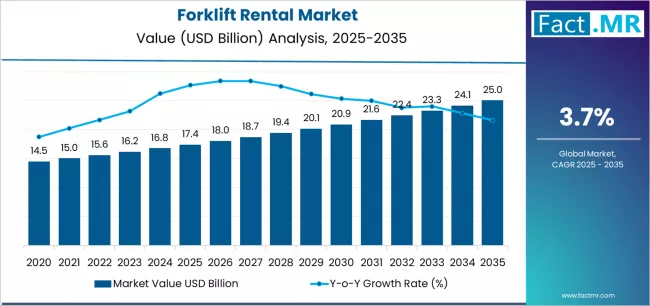
Forklift Rental Market Market Value Analysis | Source: Fact.MR
Summary of Forklift Rental Market
- Market Snapshot
- In 2025, the global Forklift Rental Market was valued at approximately USD 17.4 billion.
- The market is estimated to reach USD 18.044 billion in 2026 and is projected to attain USD 25.949 billion by 2036.
- The forklift rental market is likely to expand at a CAGR of 3.7% during the forecast period.
- The market is anticipated to create an absolute dollar opportunity of USD 7.905 billion between 2026 and 2036.
- Warehousing and Logistics accounts for 41.3% of the application segment share in 2026.
- India (4.6%) and China (4.0%) are the key growth markets during the forecast period.
- Demand and Growth Drivers
- Primary demand tied to core industry activity generating proportional procurement.
- Secondary structural factor expanding addressable market.
- Third factor creating incremental demand through emerging applications.
- Fourth factor supporting expansion through technology or regulation.
- Fifth factor broadening demand through customer diversification.
- Product and Segment View
- Electric Forklift Rental accounts for 35.8% of the product segment in 2026.
- Warehousing and Logistics represents 41.3% of the application segment.
- Industrial Users holds 44.6% of the end use segment.
- Key segmentation includes:
- Product: Electric Forklift Rental, 3 Wheel Electric Forklift, 4 Wheel Electric Forklift, Lithium Ion Electric Forklift
- Application: Warehousing and Logistics, Distribution Centers, Fulfillment Centers, Manufacturing
- End Use: Industrial Users, Factory Operations, Logistics Companies, Commercial Users
- Rental Duration: Medium Term Rental, Daily Rental, Weekly Rental, Short Term Rental
- These systems enable:
- Core operational capability for the primary application
- Compliance or specification enabling capability
- Technology-enhanced performance capability
- Geography and Competitive Outlook
- India leads at 4.6%, supported by e-commerce fulfillment center expansion, manufacturing logistics growth, and increasing forklift rental adoption replacing manual material handling as warehouse throughput requirements exceed manual labor capacity.
- China (4.0%) reflects the world's largest forklift market with rental penetration growing from a low base as e-commerce warehousing, manufacturing logistics, and organized rental companies expand fleet availability.
- The U.S. (3.5%) maintains the largest value at USD 6.443 billion in 2026, with Toyota, Crown, and Hyster-Yale forklifts available through OEM rental programs, national rental companies, and dealer-managed fleet channels.
- Key companies include Toyota Industries, Jungheinrich, KION, Hyster-Yale.
- Analyst Opinion
- Shambhu Nath Jha, Principal Consultant at Fact.MR, says 'The forklift rental market is the largest material handling equipment rental category. E-commerce warehousing peak season demand creates concentrated rental surges during Q4 holiday fulfillment. Toyota Industries' combined manufacturing-rental-leasing model creates a vertically integrated competitive position, while Jungheinrich and KION lead European rental through dealer-managed fleets. Lithium-ion electric forklifts are reshaping rental fleet economics through reduced maintenance and faster charging that improves daily utilization hours.'
Key Growth Drivers, Constraints, and Opportunities
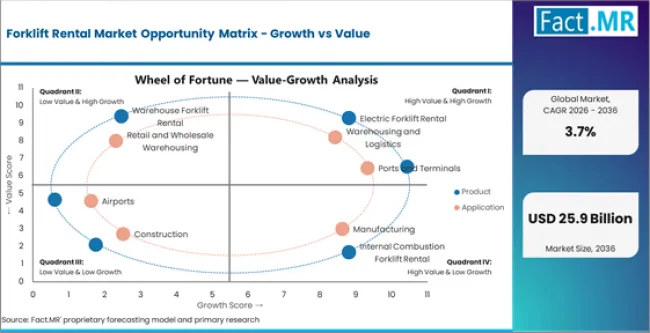
Forklift Rental Market Opportunity Matrix Growth Vs Value | Source: Fact.MR
Key Factors Driving Growth
- Primary growth driver with specific mechanism.
- Secondary driver creating structured procurement.
- Third driver expanding the addressable market.
Key Market Constraints
- Capital or cyclical demand creates volatility.
- Competitive pressure limits pricing.
- Alternative solutions limit expansion in specific segments.
Key Opportunity Areas
- Technology creates premium tiers.
- Emerging market expansion from low base.
- Digital integration creates differentiation.
Segment-wise Analysis of the Forklift Rental Market
- Electric Forklift Rental accounts for 35.8% of the product segment in 2026.
- Warehousing and Logistics represents 41.3% of the application segment.
- Industrial Users holds 44.6% of the end use segment.
The forklift rental market is segmented by product, application, end use, rental duration, and region.
Which Product Segment Dominates the Forklift Rental Market?
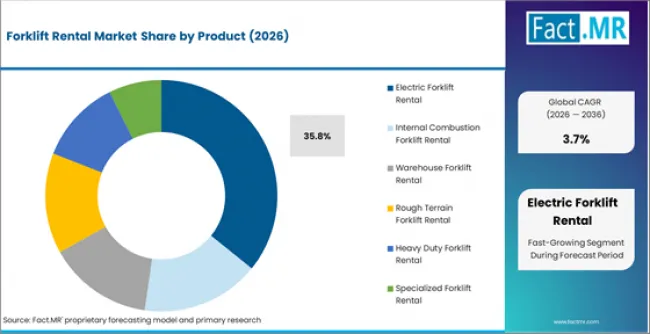
Forklift Rental Market Analysis By Product | Source: Fact.MR
Electric Forklift Rental accounts for 35.8% in 2026.
Alternative configurations serve specialized applications.
Which Power Source Segment Dominates the Forklift Rental Market?
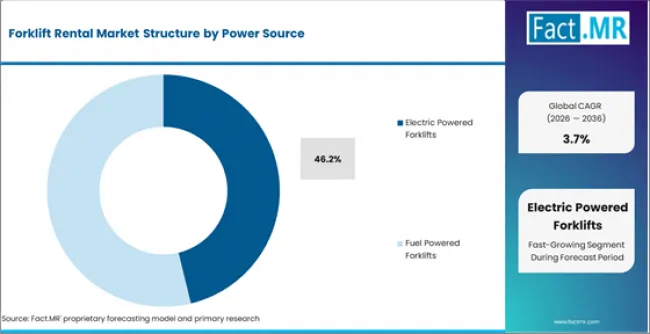
Forklift Rental Market Analysis By Power Source | Source: Fact.MR
Electric Powered Forklifts leads with 46.2% share in 2026.
Secondary segments represent growing demand.
Which Product Trend is Shaping the Next Phase of Growth in the Forklift Rental Market?
Lithium-ion electric forklifts replacing lead-acid battery units in rental fleets are the technology transition with the greatest near-term impact. Li-ion eliminates battery watering, equalization charging, and battery room ventilation requirements while delivering opportunity charging that keeps forklifts operational throughout shifts without battery swaps. Rental companies convert fleets to li-ion because total cost of ownership advantages including reduced maintenance labor and higher residual values offset the premium purchase price within 2 to 3 years of rental service.
The li-ion transition also enables rental companies to eliminate the battery room infrastructure that lead-acid fleets require, freeing valuable warehouse space at rental branch locations. This operational simplification reduces branch operating cost while improving the rental customer experience through simpler equipment that requires less operator training.
Regional Outlook Across Key Markets
.webp "Top Country Growth Comparison Forklift Rental Market Cagr (2026 2036)")
Top Country Growth Comparison Forklift Rental Market Cagr (2026 2036) | Source: Fact.MR
- India leads at 4.6%, supported by e-commerce fulfillment center expansion, manufacturing logistics growth, and increasing forklift rental adoption replacing manual material handling as warehouse throughput requirements exceed manual labor capacity.
- China (4.0%) reflects the world's largest forklift market with rental penetration growing from a low base as e-commerce warehousing, manufacturing logistics, and organized rental companies expand fleet availability.
- The U.S. (3.5%) maintains the largest value at USD 6.443 billion in 2026, with Toyota, Crown, and Hyster-Yale forklifts available through OEM rental programs, national rental companies, and dealer-managed fleet channels.
CAGR Table
| Country | CAGR (%) |
|---|---|
| India | 4.6% |
| China | 4.0% |
| Mexico | 3.6% |
| USA | 3.5% |
| South Korea | 3.4% |
| Germany | 3.2% |
| Japan | 3.0% |
Source: Fact.MR analysis. Updated Jun 1, 2026
Source: Fact MR (FMR) analysis, based on proprietary forecasting model and primary research.
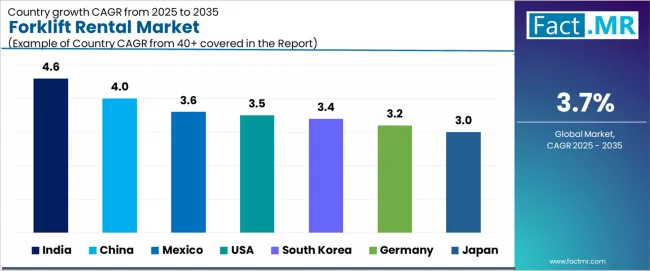
Forklift Rental Market Cagr Analysis By Country | Source: Fact.MR
Forklift Rental Demand Trends in India
E-commerce fulfillment and manufacturing logistics create structural demand at 4.6% CAGR. Amazon, Flipkart, and third-party logistics warehouses in Mumbai, Delhi NCR, and Bangalore are deploying rental forklift fleets that scale with seasonal order volumes without fixed asset commitment.
- E-commerce fulfillment center peak season creates concentrated Q4 rental surge demand as warehouses add temporary forklift capacity for holiday order processing volumes.
- Manufacturing plant logistics increasingly adopt rental forklifts for production line material feeding, enabling capacity flexibility without fixed fleet ownership tied to variable production schedules.
China Forklift Rental Growth Assessment
E-commerce warehousing and manufacturing scale generate demand at 4.0% CAGR. Domestic forklift manufacturers including Hangcha, Heli, and BYD produce rental-ready electric forklifts at pricing that enables rapid fleet expansion by Chinese rental operators.
- E-commerce fulfillment center construction generates greenfield forklift rental fleet procurement as logistics operators equip new facilities with on-demand material handling capacity.
- Domestic electric forklift manufacturing at competitive pricing enables Chinese rental companies to build lithium-ion fleets at lower capital cost per unit than imported equipment.
Market Outlook for Forklift Rental in the United States
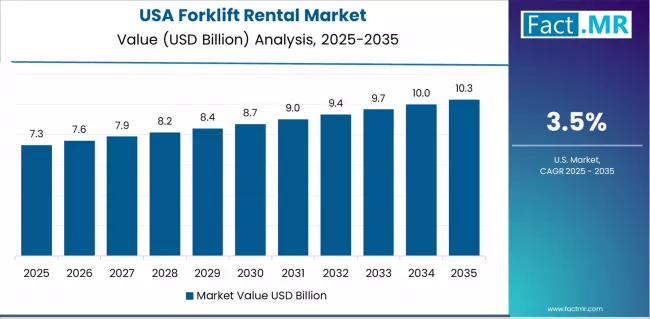
Forklift Rental Market Country Value Analysis | Source: Fact.MR
Warehouse logistics and seasonal demand management drive the largest market at 3.5% CAGR. Toyota, Crown, and Hyster-Yale operate OEM-managed rental programs through dealer networks, while United Rentals and Sunbelt provide multi-brand rental for construction and industrial customers.
- Holiday season warehouse demand surge creates Q4 forklift rental peak as fulfillment centers add temporary capacity for order processing volumes 2 to 3 times normal levels.
- Lithium-ion fleet conversion at rental companies eliminates battery room requirements and reduces maintenance labor cost, improving rental margin per unit compared to lead-acid fleets.
Germany Forklift Rental Demand Analysis
Automotive manufacturing logistics and warehouse operations shape demand at 3.2% CAGR. Jungheinrich and KION operate the largest European rental fleets through direct dealer-managed programs that integrate rental, leasing, and full-service maintenance.
- Automotive manufacturing just-in-sequence logistics require rental forklift capacity flexibility to match production volume changes without fixed fleet oversizing.
- Jungheinrich and KION dealer-managed rental programs integrate equipment, maintenance, and fleet management as a bundled service for industrial and logistics customers.
Mexico Forklift Rental Growth Outlook
Nearshoring manufacturing and logistics growth shape demand at 3.6% CAGR. New automotive and electronics manufacturing plants commissioning in Monterrey, Queretaro, and Aguascalientes create greenfield forklift rental procurement from startup.
- Nearshoring manufacturing plant commissioning creates greenfield forklift rental procurement as new facilities deploy rental fleets rather than purchasing owned equipment before production stabilizes.
- E-commerce and third-party logistics warehouse expansion across Mexican metropolitan areas generates forklift rental for fulfillment operations.
Competitive Benchmarking and Company Positioning
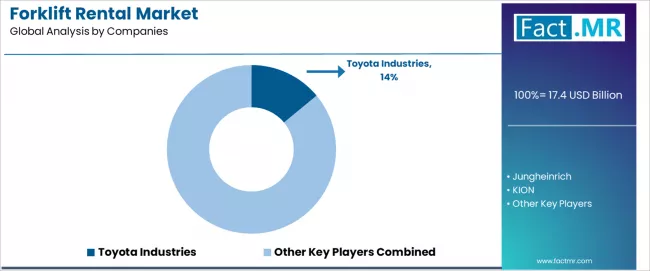
Forklift Rental Market Analysis By Company | Source: Fact.MR
Forklift Rental Market Analysis By Company
- Toyota Industries holds a leading position with approximately 14.0% share.
- Jungheinrich and KION compete through specialized capability.
- Technology, service reach, and product breadth are primary differentiators.
Toyota Industries leads. Jungheinrich, KION, Hyster-Yale serve specific segments.
Strategic priorities include technology, geographic expansion, and service development.
Key Companies in the Forklift Rental Market
- Toyota Industries, Jungheinrich, KION, Hyster-Yale are among the leading players in the forklift rental market globally, supported by strong brand visibility, broad service portfolios, and growing positions in managed energy solutions.
- Crown, Mitsubishi Logisnext, Doosan Industrial, Komatsu hold established positions across specific service segments, end-use categories, and regional markets, supported by specialized capabilities and established commercial relationships.
- CAT Lift Trucks, Clark, Nissan, Unicarriers continue to compete through focused offerings, technology partnerships, and regional service networks.
Recent Industry Developments
- Toyota Industries, Fleet Enhancement, Rental and Leasing Portfolio (2025)
- Toyota Industries continued enhancement of its forklift rental and leasing portfolio through dealer-managed programs, with lithium-ion electric models gaining fleet share as rental customers adopt opportunity charging capability.
- Jungheinrich, Market Expansion, European Rental Fleet Growth (2025)
- Jungheinrich expanded its European forklift rental fleet with increased lithium-ion unit availability, targeting warehouse and logistics customers seeking zero-emission material handling with lower total cost of ownership.
- Crown Equipment, Technology Development, Connected Fleet Platform (2025)
- Crown advanced its InfoLink connected fleet management platform for rental and leased forklifts, providing operator performance monitoring, impact detection, and utilization tracking for fleet optimization.
Leading Companies Shaping the Forklift Rental Market
- Toyota Industries
- Jungheinrich
- KION
- Hyster-Yale
- Crown
- Mitsubishi Logisnext
- Doosan Industrial
- Komatsu
- CAT Lift Trucks
- Clark
Sources and Research References
- Toyota Industries. Product and market developments.
- Jungheinrich. Technology and expansion.
- KION. Product developments.
- Industry associations and regulatory bodies.
- Primary interviews across market participants.
- This bibliography is provided for reader reference and is not exhaustive.
Key Questions This Report Addresses
- What is the current and future size of the Forklift Rental Market?
- How fast is the Forklift Rental Market expected to grow between 2026 and 2036?
- Which segment leads by 2026?
- What drives demand?
- How is technology influencing the market?
- Why is India the fastest-growing market?
- Which countries show fastest growth?
- Who are key companies in the Forklift Rental Market?
- How does Fact.MR validate the forecast?
Forklift Rental Market Definition
The forklift rental market covers the relevant product and service scope.
Forklift Rental Market Inclusions
- The scope covers global and regional forecasts for 2026 to 2036.
- It includes regional analysis based on industry-specific demand factors.
- The report includes pricing across product and service categories.
- It covers technology trends, competitive landscape, and key company profiles.
Forklift Rental Market Exclusions
- The scope excludes non-commercial and consumer-grade products unless specified.
- It excludes ancillary consumables and services sold separately.
- The report excludes custom prototype equipment.
Forklift Rental Market Research Methodology
- The methodology combines secondary research, primary interviews, and forecast modelling.
- It draws on 100+ secondary sources and benchmarks 30+ company profiles.
- Market sizing covers 30+ countries.
- Key inputs include industry activity data and fleet or production counts.
- The model cross-checks with manufacturer and operator data.
- Primary validation includes 20+ interviews.
- Final estimates go through reconciliation and sensitivity testing.
Segmentation
Scope of Analysis
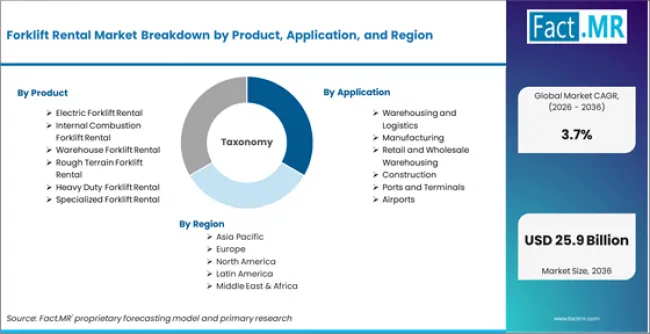
Forklift Rental Market Breakdown By Product, Application, And Region | Source: Fact.MR
| Parameter | Details |
|---|---|
| Quantitative Units | USD 18.044 billion to USD 25.949 billion, at a CAGR of 3.7% |
| Market Definition | The forklift rental market covers daily, weekly, monthly, and long-term rental of counterbalance, reach truck, order picker, and powered pallet jack forklifts in electric (lead-acid and lithium-ion), LPG, diesel, and dual-fuel configurations for warehouse material handling, manufacturing logistics, construction site supply, and event setup across full-service, maintenance-included, and bare rental ownership models. |
| Regions Covered | North America, Latin America, Europe, East Asia, South Asia and Pacific, Middle East and Africa |
| Countries Covered | India, China, Mexico, USA, South Korea, Germany, Japan, 30 plus countries |
| Key Companies | Toyota Industries, Jungheinrich, KION, Hyster-Yale, Crown, Mitsubishi Logisnext, Doosan Industrial, Komatsu, CAT Lift Trucks, Clark |
| Forecast Period | 2026 to 2036 |
| Approach | Hybrid demand-side methodology built on warehouse floor area, manufacturing output, e-commerce fulfillment capacity, forklift fleet utilization, seasonal demand patterns, and primary interviews across OEM rental programs, dealer networks, national rental companies, and logistics operators |
Source: Fact.MR analysis. Updated Jun 1, 2026
Forklift Rental Market Segmentation
-
Forklift Rental Market Segmented by Product:
- Electric Forklift Rental
- 3 Wheel Electric Forklift
- 4 Wheel Electric Forklift
- Lithium Ion Electric Forklift
- Internal Combustion Forklift Rental
- Diesel Forklift
- LPG Forklift
- Gasoline Forklift
- Warehouse Forklift Rental
- Narrow Aisle Forklift
- Reach Truck Forklift
- Order Picker Forklift
- Rough Terrain Forklift Rental
- All Terrain Forklift
- Construction Site Forklift
- Heavy Duty Forklift Rental
- 10 Ton to 25 Ton Forklift
- Above 25 Ton Forklift
- Specialized Forklift Rental
- Telehandler Forklift
- Side Loader Forklift
- Pallet Jack Forklift
- Electric Forklift Rental
-
Forklift Rental Market Segmented by Application:
- Warehousing and Logistics
- Distribution Centers
- Fulfillment Centers
- Manufacturing
- Automotive Manufacturing
- Food and Beverage Processing
- Retail and Wholesale Warehousing
- Construction
- Infrastructure Projects
- Industrial Construction Sites
- Ports and Terminals
- Container Handling
- Cargo Loading and Unloading
- Airports
- Cargo Handling Operations
- Air Freight Warehousing
- Warehousing and Logistics
-
Forklift Rental Market Segmented by End Use:
- Industrial Users
- Factory Operations
- Logistics Companies
- Commercial Users
- Retail Warehousing Operators
- Third Party Logistics Providers
- Government and Public Sector
- Port Authorities
- Municipal Infrastructure Projects
- Industrial Users
-
Forklift Rental Market Segmented by Rental Duration:
- Medium Term Rental
- Daily Rental
- Weekly Rental
- Short Term Rental
- Long Term Rental
- Annual Rental Contracts
- Contract Based Fleet Leasing
- Medium Term Rental
-
Forklift Rental Market Segmented by Power Source:
- Electric Powered Forklifts
- Battery Electric Systems
- Lithium Ion Powered Units
- Fuel Powered Forklifts
- Diesel Powered Units
- LPG Powered Units
- Hybrid Fuel Systems
- Electric Powered Forklifts
-
Forklift Rental Market by Region:
- North America
- USA
- Canada
- Mexico
- Latin America
- Brazil
- Chile
- Rest of Latin America
- Western Europe
- Germany
- UK
- Italy
- Spain
- France
- Nordic
- BENELUX
- Rest of Western Europe
- Eastern Europe
- Russia
- Poland
- Hungary
- Balkan & Baltic
- Rest of Eastern Europe
- East Asia
- China
- Japan
- South Korea
- South Asia and Pacific
- India
- ASEAN
- Australia & New Zealand
- Rest of South Asia and Pacific
- Middle East & Africa
- Kingdom of Saudi Arabia
- Other GCC Countries
- Turkiye
- South Africa
- Other African Union
- Rest of Middle East & Africa
- North America
Frequently Asked Questions
How big is the forklift rental market in 2026?
What will be the size of forklift rental market in 2036?
How much will be the forklift rental market growth between 2026 and 2036?
What are the key product types in the forklift rental market?
Which application segment is expected to contribute significant share in the forklift rental market in 2026?
Who worked on this report


Preview the report firsthand - request a free sample
Free SampleGet the brochure for pricing and purchase details
Download PDF