- Market Value (2025): USD 9.65 Bn
- Estimated Value (2026): USD 10.1 Bn
- Forecast Value (2036): USD 16.3 Bn
- CAGR (2026-2036): 4.9%
What is the Artificial Lift Pumps Market forecast to be worth by 2036?
USD 10.1 billion in 2026 to USD 16.3 billion by 2036 at a 4.9% CAGR.
- As per Fact.MR analysis, the artificial lift pumps market reached USD 9.65 billion in 2025.
- Demand will increase from USD 10.1 billion in 2026 to USD 16.3 billion by 2036.
- The artificial lift pumps market will record a 4.9% CAGR from 2026 to 2036.
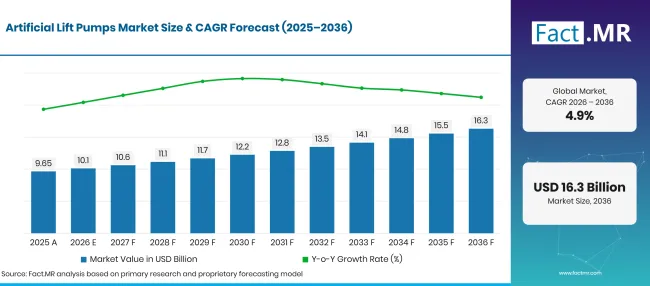
Factmr Artificial Lift Pumps Market Forecast Global | Source: Fact.MR
| Year | Basis | Market value (USD Billion) |
|---|---|---|
| 2025 | Actual | 9.6 |
| 2026 | Estimate | 10.1 |
| 2036 | Forecast | 16.3 |
| CAGR 2026 to 2036 | Forecast period | 4.9% |
Source: Fact.MR analysis. Updated Oct 13, 2026
What are the defining numbers behind Artificial Lift Pumps Market growth?
An absolute opportunity of USD 6.2 billion will be created between 2026 and 2036.
- Demand Drivers in the Market
- Mature wells will need more lift support each year. As reservoir pressure is declining, fewer wells will be able to flow on their own, so operators will be installing or upgrading lift systems to hold output. Every ageing field will keep adding to the installed base that requires pumps, replacement parts and service, and older fields will be generating steadier aftermarket demand than newly drilled ones.
- Operators are favoring more output from existing assets. Raising production from current wells will cost less than drilling new ones in many fields, so artificial lift is gaining a larger share of field development budgets.
- Unconventional and offshore wells will be raising the technical demand. Shale wells are declining faster than conventional wells and are moving to lift earlier in their life, while offshore wells will need more reliable, higher-rate systems because well intervention will cost far more at sea than on land.
- Better equipment and monitoring are broadening use. Variable speed drives, downhole sensors and automated controls are helping operators match pump speed to well conditions, and these systems will be extending run life and cutting unplanned failures more effectively than fixed-speed units.
- Key Segments Analyzed
- By Type: Electric Submersible Pump (ESP) will hold 38.2% share in 2026 since these pumps handle high flow rates across a wide range of well depths.
- By Application: Onshore will account for 62.4% share in 2026, supported by the large number of producing wells on land.
- By Component: Pump will capture 42.1% share in 2026 owing to its central role in lifting fluid and its regular replacement cycle.
- By End-User: Oil & Gas will represent 82.5% share in 2026, given that most artificial lift installations support crude oil and associated gas production.
- Analyst Opinion at Fact.MR
- Shambhu Nath Jha, Principal Consultant at Fact.MR, states, “Artificial lift is now planned as part of the well design rather than added after production falls. Operators will favor systems that combine high run life with remote monitoring and lower power use. Suppliers that pair reliable equipment with strong field service and fast replacement support will gain the most as mature fields and unconventional wells expand the installed base.”
- Strategic Implications
- Pump manufacturers will need to put more engineering effort into longer run life and abrasion-resistant designs, since operators are comparing lift systems on total cost of ownership and will be giving purchase price less weight than failure rates over the life of the well.
- Motor, cable and drive head suppliers will need to build sensors and remote diagnostics into their products, so operators will be spotting faults earlier and keeping wells producing for longer.
- Service providers will need to expand local repair, rental and spare-part networks, given that faster response will be limiting lost production and earning repeat business from operators.
Germany will lead at 6.0% CAGR on a strong pump engineering base and demand from mature fields and geothermal wells. Brazil will follow at 5.5% on offshore development and mature onshore basins. The USA will record 4.9% on large shale and mature well inventories. The UK will post 4.4% as ageing North Sea assets need life-extension support, while Japan will close at 3.9% with limited domestic production and a focus on equipment supply.
How does the Artificial Lift Pumps Market break down by segment?
Electric Submersible Pump (ESP) will lead Type at 38.2%; Onshore will lead Application at 62.4%; Pump will lead Component at 42.1%; Oil & Gas will lead End-User at 82.5%.
Which Type dominates?
Electric Submersible Pump (ESP) will hold 38.2% share in 2026.
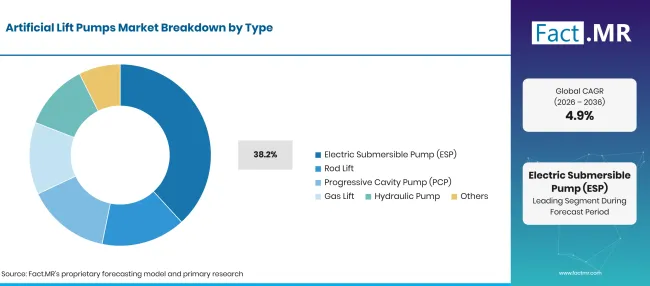
Factmr Artificial Lift Pumps Market Breakdown Type | Source: Fact.MR
| Type | Share (2026) |
|---|---|
| Electric Submersible Pump (ESP) (Leading segment) | 38.2% |
| Other segments combined | 61.8% |
| Total | 100.0% |
Source: Fact.MR analysis. Updated Oct 13, 2026
ESPs will lead because they will be lifting large fluid volumes from deep and high-rate wells, and they are serving onshore and offshore fields alike. A downhole pump, a motor and a power cable will be working together as one system, allowing operators to adjust output as well conditions are changing.
Rod lift will remain the main choice for low-rate onshore wells, where simple surface drive units and a long service record are keeping operating costs low. Progressive cavity pumps will be handling heavy, viscous and sand-laden fluids. Gas lift will be serving wells with an available gas supply, mainly offshore and in high-deviation wells, while hydraulic pumps will be covering specialized applications in deep and complex-trajectory wells.
What supports Onshore within Application?
Onshore will account for 62.4% share in 2026.
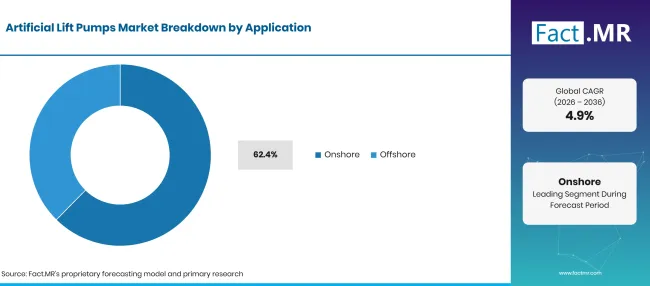
Factmr Artificial Lift Pumps Market Breakdown Application | Source: Fact.MR
| Application | Share (2026) |
|---|---|
| Onshore (Leading segment) | 62.4% |
| Other segment combined | 37.6% |
| Total | 100.0% |
Source: Fact.MR analysis. Updated Oct 13, 2026
Onshore will lead since land-based fields are holding the largest number of producing wells, and many of them are maturing and will need lift to stay productive. Lower access and intervention costs are allowing operators to repair, replace and adjust pumps on land at a lower cost than at sea.
Offshore installations will remain fewer in number, but each system will carry a higher value and will have to meet strict reliability requirements because well intervention at sea is costing far more than on land. Offshore operators are therefore selecting equipment with long run life and remote monitoring.
What leads the Component segment?
Pump will capture 42.1% share in 2026.
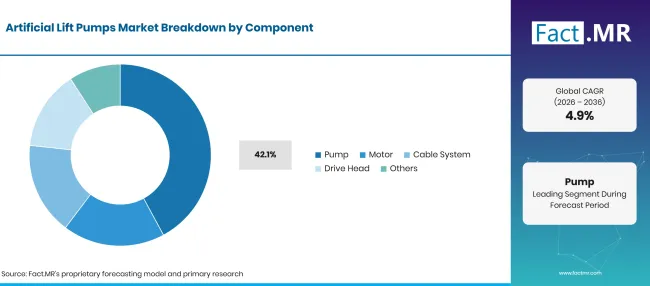
Factmr Artificial Lift Pumps Market Breakdown Component | Source: Fact.MR
| Component | Share (2026) |
|---|---|
| Pump (Leading segment) | 42.1% |
| Other segments combined | 57.9% |
| Total | 100.0% |
Source: Fact.MR analysis. Updated Oct 13, 2026
Pumps will spearhead as they are performing the core lifting task and facing constant wear from abrasive solids, gas, heat and corrosive fluids. This wear will keep generating steady replacement demand across the installed base.
Motors, cable systems and drive heads will be completing the lift system. Motors and cables will remain central to ESP installations, while drive heads will be supporting rod lift and progressive cavity pump systems. Other components, including controllers, sensors and accessories, will be improving performance and monitoring.
How does End-User shape demand?
Oil & Gas will represent 82.5% share in 2026.
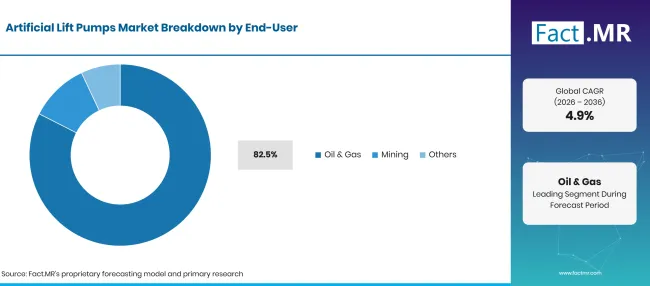
Factmr Artificial Lift Pumps Market Breakdown End User | Source: Fact.MR
| End-User | Share (2026) |
|---|---|
| Oil & Gas (Leading segment) | 82.5% |
| Other segments combined | 17.5% |
| Total | 100.0% |
Source: Fact.MR analysis. Updated Oct 13, 2026
Oil & Gas will dominate because artificial lift is essential to maintaining output from wells that can no longer flow on their own. Operators of both conventional and unconventional fields depend on lift systems for daily production.
Mining uses similar pump technology for dewatering and fluid removal. Other end-users include geothermal projects and water extraction, where submersible pump designs are also applied.
What is accelerating Artificial Lift Pumps Market adoption, and what is holding it back?
Demand will rise through field maturity, production optimization and better pump technology. Growth is held back by volatile oil prices, high equipment failure costs in harsh wells and the long-term shift toward lower-carbon energy.
Drivers Impact Analysis
| DRIVER | (~) % IMPACT ON CAGR | GEOGRAPHIC RELEVANCE | IMPACT TIMELINE |
|---|---|---|---|
| Declining reservoir pressure in maturing wells, increasing reliance on artificial lift | +1.6% | Global | Short term (<= 2 years) |
| Steep decline curves in unconventional shale and tight-oil wells, driving early lift installation | +1.0% | North America, Middle East | Medium term (2-4 years) |
| Expansion of offshore and deepwater developments favoring ESP deployment | +0.8% | Latin America, Western Europe, Africa | Long term (>= 4 years) |
| Brownfield redevelopment and rising energy demand in producing regions | +0.5% | Middle East, South Asia & Pacific | Long term (>= 4 years) |
Source: Fact.MR analysis. Updated Oct 13, 2026
Opportunity Impact Analysis
| OPPORTUNITY | (~) % IMPACT ON CAGR | GEOGRAPHIC RELEVANCE | IMPACT TIMELINE |
|---|---|---|---|
| Adoption of IoT-enabled smart lift systems and predictive maintenance solutions | +0.7% | Global | Medium term (2-4 years) |
| Development of energy-efficient, high-temperature ESP and PCP designs for heavy-oil and harsh-condition wells | +0.5% | Middle East, Latin America | Long term (>= 4 years) |
| Diversification into geothermal, mining dewatering and water extraction applications | +0.4% | Western Europe, North America, East Asia | Long term (>= 4 years) |
| Growth of refurbishment, replacement and aftermarket service contracts | +0.3% | Global | Short term (<= 2 years) |
Source: Fact.MR analysis. Updated Oct 13, 2026
Restraints Impact Analysis
| RESTRAINT | (~) % IMPACT ON CAGR | GEOGRAPHIC RELEVANCE | IMPACT TIMELINE |
|---|---|---|---|
| Crude oil price volatility constraining upstream capital expenditure | -0.5% | Global | Short term (<= 2 years) |
| High installation and workover costs, with run-life risks from sand, gas and high temperatures | -0.3% | Global | Medium term (2-4 years) |
| Decarbonization pressure and energy transition limiting long-term upstream investment | -0.1% | Western Europe, North America | Long term (>= 4 years) |
Source: Fact.MR analysis. Updated Oct 13, 2026
Which countries are scaling the Artificial Lift Pumps Market through 2036?
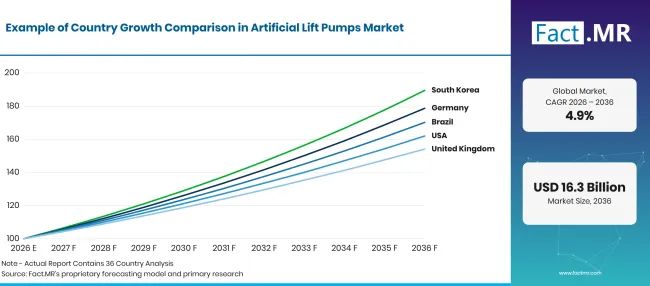
Factmr Artificial Lift Pumps Market Growth Index | Source: Fact.MR
| Country | CAGR (2026-2036) |
|---|---|
| Germany | 6.0% |
| Brazil | 5.5% |
| USA | 4.9% |
| UK | 4.4% |
| Japan | 3.9% |
Source: Fact.MR analysis. Updated Oct 13, 2026
What supports Germany adoption?
6.0% CAGR, supported by a strong pump engineering base and demand from mature and geothermal wells.
Germany combines a long-established pump and drive manufacturing sector with mature onshore oil fields in Lower Saxony and Schleswig-Holstein that depend on rod lift. Geothermal projects in the Bavarian Molasse Basin and Upper Rhine Graben use submersible pumps to bring hot water to the surface, adding a second source of demand.
How is Brazil scaling demand?
5.5% CAGR, driven by offshore development and mature onshore basins.
Brazil’s pre-salt fields in the Santos and Campos basins rely on gas lift and ESPs to sustain high-rate offshore output, with Petrobras leading deployment. Mature onshore basins such as Potiguar, Sergipe and Bahia add steady demand for rod lift and progressive cavity pumps, as operators seek higher run life and lower maintenance cost.
What supports USA adoption?
4.9% CAGR, supported by large shale and mature well inventories.
Shale wells in the Permian, Eagle Ford and Bakken decline quickly, so operators move them to artificial lift soon after first production. A large base of older conventional wells in Texas, Oklahoma and California relies on rod lift, while gas lift and ESPs serve high-rate unconventional wells, keeping replacement and upgrade demand steady.
How does the UK perform?
4.4% CAGR, shaped by ageing North Sea assets.
Many fields on the UK Continental Shelf are mature and operate at late-life conditions. Operators focus on extending field life under the North Sea Transition Authority’s recovery objectives, so demand centers on replacement equipment, repair and service, supported by the Aberdeen service hub, rather than on new installations.
How is Japan developing demand?
3.9% CAGR, backed by limited domestic production and a focus on equipment supply.
Japan has modest domestic oil production, mainly from mature fields in Niigata and Akita, so local installation volumes remain small. Demand also comes from geothermal and water applications in regions such as Tohoku and Kyushu, while manufacturers such as Ebara supply pumps and motors to international markets.
Who leads the Artificial Lift Pumps Market?
Competition falls into three groups. Large oilfield service companies compete on global reach and integrated lift portfolios: SLB offers REDA ESPs, Baker Hughes Company sells Centrilift ESPs, Weatherford International plc pairs ESPs with ForeSite production optimization, and NOV Inc. supplies Mono progressing cavity pumps.
ESP specialists compete on run life and application engineering, including Borets International Limited and NOVOMET, which is known for high-speed permanent magnet motor systems. Artificial lift and pump specialists compete on focused ranges and regional support: Dover Artificial Lift supplies rod lift and plunger lift products, ChampionX Corporation offers rod lift, gas lift and ESPs, and Sulzer Ltd and Ebara Corporation provide submersible pump technology. Run life, service coverage, digital monitoring and total cost of ownership will decide competition through 2036.
Which companies are the key providers?
Key companies include SLB; Baker Hughes Company; Weatherford International plc; NOV Inc.; Borets International Limited; NOVOMET; Dover Artificial Lift; ChampionX Corporation; Sulzer Ltd; and Ebara Corporation.
- SLB
- Baker Hughes Company
- Weatherford International plc
- NOV Inc.
- Borets International Limited
- NOVOMET
- Dover Artificial Lift
- ChampionX Corporation
- Sulzer Ltd
- Ebara Corporation
Bibliography
- [1] U.S. Energy Information Administration. (2025, November 5). Rapid declines from horizontal wells require more drilling to sustain production.
- https://www.eia.gov/TodayinEnergy/detail.php?id=66564
- [2] Agência Nacional do Petróleo, Gás Natural e Biocombustíveis. (2026, July 17). Oil, Natural Gas and Biofuels Statistical Yearbook 2026.
- https://www.gov.br/anp/pt-br/centrais-de-conteudo/publicacoes/anuario-estatistico/oil-natural-gas-and-biofuels-statistical-yearbook-2026
- [3] Oil and Gas Authority & North Sea Transition Authority. (2025, July 17). OGA/NSTA annual report and accounts, 2024 to 2025. GOV.UK.
- https://www.gov.uk/government/publications/ogansta-annual-report-and-accounts-2024-to-2025
- [4] SLB. (n.d.). Artificial lift.
- https://www.slb.com/products-and-services/innovating-in-oil-and-gas/completions/artificial-lift
- [5] SLB. (n.d.). Electric submersible pumps.
- https://www.slb.com/products-and-services/innovating-in-oil-and-gas/completions/artificial-lift/electrical-submersible-pumps
- [6] Weatherford International plc. (n.d.). Artificial lift solutions.
- https://www.weatherford.com/production-and-intervention/artificial-lift-solutions/
- [7] Weatherford International plc. (n.d.). ForeSite® production optimization platform.
- https://www.weatherford.com/production-and-intervention/production-4-0/production-optimization-platform/
- [8] NOV. (n.d.). Artificial lift.
- https://www.nov.com/products-and-services/capabilities/artificial-lift
- [9] NOVOMET. (n.d.). Rotary displacement cylindrical pumps.
- https://www.novometgroup.com/products-services/artificial-lift/rotary-displacement-pumps/index.html
- [10] Agência Nacional do Petróleo, Gás Natural e Biocombustíveis. (2026, June 30). ANP divulga dados consolidados do setor regulado em 2025.
- https://www.gov.br/anp/pt-br/canais_atendimento/imprensa/noticias-comunicados/anp-divulga-dados-consolidados-do-setor-regulado-em-2025
This Report Answers
- The report explains how artificial lift pumps are used by type, application, component and end-user.
- Segment analysis identifies the subsegment that leads each segment and the operating needs behind its 2026 share.
- Country analysis compares the five listed countries through field maturity, production activity and equipment demand.
- Competitive analysis reviews oilfield service groups, ESP specialists and pump manufacturers.
- Technology analysis tracks run-life improvements, energy-efficient motors and remote monitoring of lift systems.
What does the Artificial Lift Pumps Market cover?
The Artificial Lift Pumps Market covers pumps and related systems that raise oil, gas and other fluids from wells when reservoir pressure alone cannot bring them to the surface. Typical systems include electric submersible pumps, rod lift, progressive cavity pumps, gas lift and hydraulic pumps.
The assessment tracks pumps, motors, cable systems, drive heads and other components used in onshore and offshore wells. Demand is analyzed for oil and gas production, mining and other end-uses.
What is included in the scope?
The scope includes complete artificial lift systems and the key components that make them work, including pumps, motors, cable systems and drive heads. It covers new installations, replacement units and upgrades for onshore and offshore wells.
Gas lift equipment is included when it forms part of an installed lift system. Related surface controls and accessories count only for their value within the lift system.
What is excluded from the scope?
The scope excludes pipeline transfer pumps, drilling mud pumps, hydraulic fracturing pumps and general-purpose industrial pumps that are not used to lift well fluids.
Drilling rigs, wellheads and other production equipment sold without a lift function fall outside the revenue boundary. Oilfield chemicals and services unrelated to artificial lift are also excluded.
How Was the Analysis Built?
The analysis draws on 120+ sources, 35+ company portfolios, 25+ countries, and more than 20 industry interviews.
- Primary Research: Primary research includes discussions with manufacturers, service providers, technology developers, distributors, end users, and subject-matter experts. These conversations examine purchasing priorities, product adoption, operational challenges, approval requirements, competitive positioning, and the factors that influence wider market acceptance.
- Desk Research: Desk research covers government statistics, regulatory publications, company filings, trade data, technical studies, industry associations, standards, public policy, and other authoritative sources. Every source used in the analysis is documented in the bibliography.
- Market Sizing and Forecasting: Market estimates combine historical performance, demand indicators, pricing and volume trends, segment shares, company participation, country-level growth, adoption patterns, investment activity, and barriers to market expansion.
- Data Validation and Update Cycle: Findings are validated by comparing primary interviews with public data, company activity, regulatory changes, trade patterns, and industry developments. Regular updates review new product launches, capacity changes, partnerships, approvals, and shifts in commercial adoption.
Segmentation
What is the report’s scope and coverage?
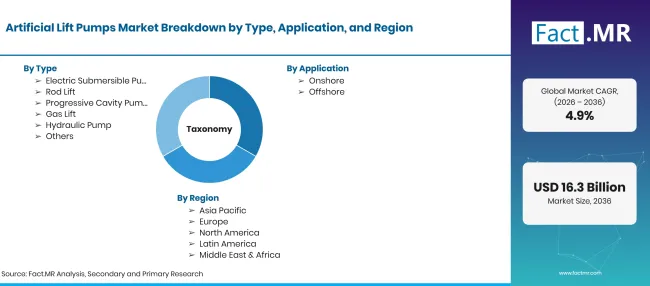
Factmr Artificial Lift Pumps Market Taxonomy | Source: Fact.MR
| Attribute | Details |
|---|---|
| Quantitative Units | USD billion |
| Market Definition | Pumps and related lift systems, such as electric submersible pumps, rod lift, progressive cavity pumps, gas lift and hydraulic pumps, used to raise fluids from wells when natural reservoir pressure is not enough to sustain production. |
| Type | Electric Submersible Pump (ESP); Rod Lift; Progressive Cavity Pump (PCP); Gas Lift; Hydraulic Pump; Others |
| Application | Onshore; Offshore |
| Component | Pump; Motor; Cable System; Drive Head; Others |
| End-User | Oil & Gas; Mining; Others |
| Regions Covered | North America; Latin America; Western Europe; Eastern Europe; East Asia; South Asia & Pacific; Middle East & Africa |
| Countries Covered | Germany; Brazil; USA; UK; Japan |
| Key Companies Profiled | SLB; Baker Hughes Company; Weatherford International plc; NOV Inc.; Borets International Limited; NOVOMET; Dover Artificial Lift; ChampionX Corporation; Sulzer Ltd; Ebara Corporation |
| Forecast Period | 2026 to 2036 |
| Approach | Hybrid top-down and bottom-up approach using producing well counts by lift type; production decline profiles; operator capital spending trends; component replacement cycles; country growth; and supplier portfolio review. |
Source: Fact.MR analysis. Updated Oct 13, 2026
How is the market segmented?
-
By Type
- Electric Submersible Pump (ESP)
- Rod Lift
- Progressive Cavity Pump (PCP)
- Gas Lift
- Hydraulic Pump
- Others
-
By Application
- Onshore
- Offshore
-
By Component
- Pump
- Motor
- Cable System
- Drive Head
- Others
-
By End-User
- Oil & Gas
- Mining
- Others
-
By Region
- North America
- Latin America
- Western Europe
- Eastern Europe
- East Asia
- South Asia & Pacific
- Middle East & Africa
Frequently Asked Questions
How big is the artificial lift pumps market in 2026?
What is the CAGR of the artificial lift pumps market from 2026 to 2036?
Which type leads the artificial lift pumps market?
Which application leads the artificial lift pumps market?
Which component leads the artificial lift pumps market?
Which end-user leads the artificial lift pumps market?
Which country will grow the most in the artificial lift pumps market?
Who are the main companies in the artificial lift pumps market?
Who worked on this report


Preview the report firsthand - request a free sample
Free SampleGet the brochure for pricing and purchase details
Download PDF