- Market Value (2025): USD 296.8 Mn
- Estimated Value (2026): USD 328.1 Mn
- Forecast Value (2036): USD 894.5 Mn
- CAGR (2026-2036): 10.6%
What is the At-Home Menopause Test Kits Market forecast to be worth by 2036?
USD 328.1 million in 2026 to USD 894.5 million by 2036, registering a CAGR of 10.6%.
- As per Fact.MR analysis, the at-home menopause test kits market crossed a valuation of USD 296.8 million in 2025.
- Demand is projected to increase from USD 328.1 million in 2026 to USD 894.5 million by 2036.
- The market is forecast to expand at a 10.6% CAGR from 2026 to 2036 as consumers show greater interest in accessible hormone testing and ongoing health monitoring.
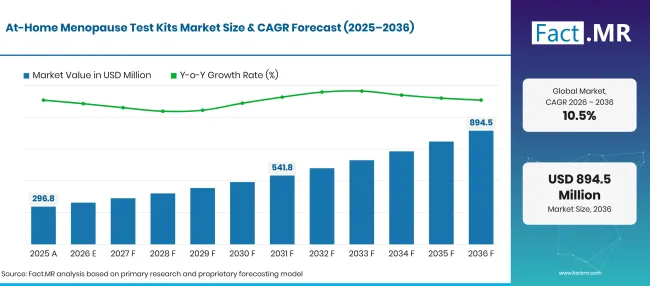
At Home Menopause Test Kits Forecast Global | Source: Fact.MR
| Year | Basis | Market Value (USD million) |
|---|---|---|
| 2025 | Actual | 296.7 |
| 2026 | Estimate | 328.1 |
| 2036 | Forecast | 894.5 |
| CAGR 2026 to 2036 | Forecast period | 10.6% |
Source: Fact.MR analysis. Updated Nov 9, 2026
What are the defining numbers behind At-Home Menopause Test Kits Market growth?
The market is expected to create an absolute opportunity of USD 566.4 million between 2026 and 2036.
- Demand Drivers in the Market
- Greater consumer interest in hormone health has create lucrative opportunity for the growth of the market. Consumers are seeking more information about hormonal changes that may accompany perimenopause and menopause. At-home testing and digital health services can provide a convenient starting point for tracking selected hormone indicators.
- Demand for convenient testing options has driven the market growth. At-home sample collection can reduce the need for an initial in-person laboratory visit. This may appeal to consumers who value privacy and flexible testing arrangements.
- Expansion of direct-to-consumer testing services supports the market growth. Companies such as Mira, Oova, Everlywell and Proov offer consumer-facing hormone testing or monitoring products. Quest Health provides access to laboratory testing services, including hormone-related testing, through its consumer platform.
- Key Segments Analyzed
- By Menopause Analyte Panel: FSH-only tests are projected to account for 29.5% of the market in 2026, supported by consumer interest in a commonly measured hormone associated with reproductive aging.
- By Sample / Examination: Fact.MR estimates blood testing to account for 23.2% of the market in 2026. Imaging / optical methods are classified separately and require a defined relationship to menopause hormone testing.
- By Testing Location: Retail diagnostics is expected to lead with a 32.3% share in 2026, indicating the role of retail-based access and consumer testing services.
- By Result Delivery: AI decision support is projected to account for 30.3% of the market in 2026, reflecting demand for digital interpretation and personalized health insights.
- Analyst Opinion at Fact.MR
- Shambhu Nath Jha, Principal Consultant at Fact.MR, states, “The market's development will depend on whether consumer testing services can provide clear and clinically responsible information. Hormone measurements may help explain selected changes, but results can fluctuate during perimenopause and should not be treated as a stand-alone diagnosis. Providers need to communicate test limitations and make it easy for consumers to seek qualified clinical advice when results or symptoms require further evaluation.”
- Strategic Implications
- Test kit providers should clearly disclose the hormones included in each panel and explain the purpose of every measurement. Product materials should distinguish screening information from diagnostic evidence, describe factors that may affect results and direct consumers to healthcare professionals for interpretation and appropriate follow-up.
- Digital health companies should display longitudinal hormone measurements alongside symptom records to help users understand changes over time. Interfaces should explain the limitations of data and avoid presenting automated scores as definitive diagnoses. Clear prompts should encourage users to discuss concerning patterns with healthcare professionals.
- Laboratory providers should maintain procedures for sample collection and transport alongside processing and result reporting. Consumer-facing instructions should explain storage requirements and sources of error. Quality controls and transparent reporting can improve confidence in results and help users understand when testing may be necessary.
- Retail diagnostics providers should distinguish self-tests completed at home from laboratory tests requiring sample collection or processing. Service information should explain where samples are handled, how results are delivered and whether support is available. Clear descriptions help consumers choose testing options and understand their limitations.
The USA is projected to record a 10.8% CAGR through 2036. China is forecast to expand at 12.7%, followed by Germany at 10.4%. The UK is expected to register a 10.2% CAGR, while Japan is projected to grow at 9.8%.
How does the At-Home Menopause Test Kits Market break down by segment?
Fact.MR identifies FSH-only tests as the leading Menopause Analyte Panel category with a 29.5% share in 2026. Blood testing accounts for 23.2% of Sample / Examination; the imaging / optical category requires a clear definition. Retail diagnostics leads Testing Location at 32.3%, while AI decision support leads Result Delivery at 30.3%.
Which Menopause Analyte Panel dominates?
FSH-only tests are projected to account for 29.5% of the market in 2026.
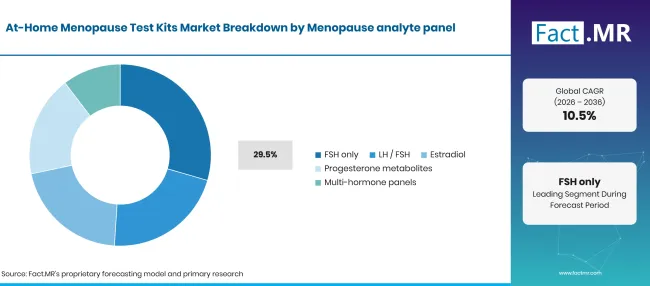
At Home Menopause Test Kits Breakdown Menopause Analyte Panel | Source: Fact.MR
| Menopause Analyte Panel | Share (2026) |
|---|---|
| FSH only (Leading segment) | 29.5% |
| Other segments combined | 70.5%* |
| Total | 100.0% |
Source: Fact.MR analysis. Updated Nov 9, 2026
FSH-only tests hold the largest share. FSH is commonly measured in reproductive hormone testing, but its levels can vary during the menopausal transition. A single FSH result may provide limited information about an individual's menopause stage. Multi-hormone panels can provide a broader set of measurements. [1] [2].
What leads the Sample / Examination segment?
Blood and imaging / optical methods are each set to represent 23.2% share in 2026.
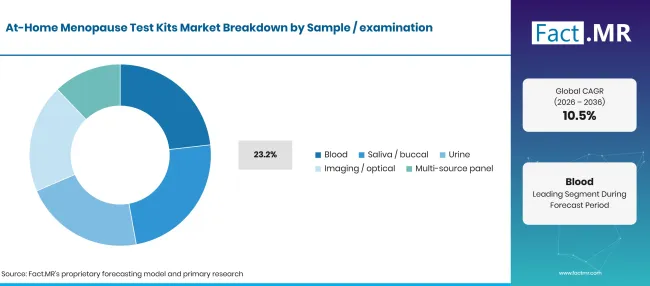
At Home Menopause Test Kits Breakdown Sample Examination | Source: Fact.MR
| Sample / Examination | Share (2026) |
|---|---|
| Blood | 23.2% |
| Other segments combined | 76.8%* |
| Total | 100.0% |
Source: Fact.MR analysis. Updated Nov 9, 2026
Blood testing is used to measure hormones such as FSH and estradiol. Urine-based products can measure selected reproductive hormones or their metabolites and may support repeated home monitoring. Saliva-based tests are also marketed for hormone assessment, although their clinical role in menopause evaluation needs to be distinguished from established diagnostic practice. Imaging / optical methods describe a measurement approach rather than a biological sample type. They should be evaluated separately from blood, urine and saliva sampling methods.
How does Testing Location shape demand?
Retail diagnostics is likely to account for 32.3% of the market in 2026.
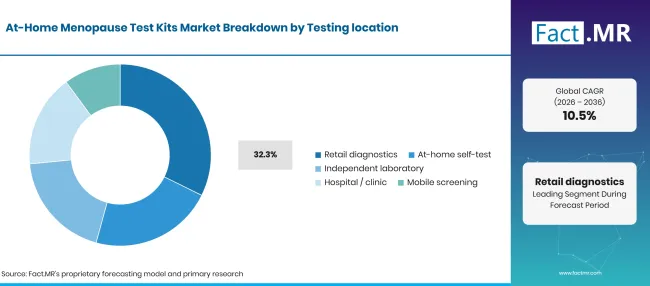
At Home Menopause Test Kits Breakdown Testing Location | Source: Fact.MR
| Testing Location | Share (2026) |
|---|---|
| Retail diagnostics (Leading segment) | 32.3% |
| Other segments combined | 67.7% |
| Total | 100.0% |
Source: Fact.MR analysis. Updated Nov 9, 2026
Retail diagnostics leads the testing-location segmentation. Retail access can help consumers find hormone testing products through physical stores or consumer health platforms. Independent laboratories provide sample processing and analytical services, while hospitals and clinics offer testing within a broader clinical setting. At-home self-tests allow consumers to collect or analyze samples outside a conventional healthcare facility. Mobile screening may extend access through temporary or community-based testing services.
How does Result Delivery shape demand?
AI decision support is projected to account for 30.3% of the market in 2026.
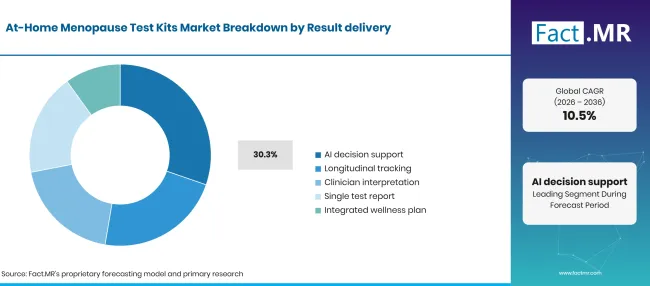
At Home Menopause Test Kits Breakdown Result Delivery | Source: Fact.MR
| Result Delivery | Share (2026) |
|---|---|
| AI decision support (Leading segment) | 30.3% |
| Other segments combined | 69.7% |
| Total | 100.0% |
Source: Fact.MR analysis. Updated Nov 9, 2026
Fact.MR estimates AI-enabled result interpretation and decision support to be the leading result-delivery category. Such tools can organize hormone results, while clinical assessment remains important for evaluating menopause-related symptoms. Digital platforms can organize hormone measurements and help users identify changes across repeated tests. Longitudinal tracking can provide additional context when hormone levels fluctuate. Clinician interpretation remains important when results need to be assessed alongside symptoms, age and medical history. Integrated wellness plans may combine test results with lifestyle information, but recommendations should remain within appropriate clinical limits.
What is accelerating At-Home Menopause Test Kits Market adoption, and what is holding it back?
Greater interest in hormone health and convenient testing supports demand, while clinical limitations and differences in testing formats can create barriers to adoption.
Drivers Impact Analysis
| DRIVER | % IMPACT ON CAGR | GEOGRAPHIC RELEVANCE | IMPACT TIMELINE |
|---|---|---|---|
| Rising consumer interest in menopause health | +1.0% | North America, Europe | Medium term (2–4 years) |
| Wider availability of at-home hormone monitoring | +0.9% | Global | Short term (≤ 2 years) |
| Growth in digital health platforms | +0.7% | North America, Asia | Medium term (2–4 years) |
| Greater access to consumer-ordered laboratory tests | +0.5% | North America, Europe | Short term (≤ 2 years) |
| Demand for repeated hormone tracking | +0.4% | Global | Long term (≥ 4 years) |
Source: Fact.MR analysis. Updated Nov 9, 2026
Opportunity Impact Analysis
| OPPORTUNITY | % IMPACT ON CAGR | GEOGRAPHIC RELEVANCE | IMPACT TIMELINE |
|---|---|---|---|
| More comprehensive at-home hormone panels | +0.8% | Global | Medium term (2–4 years) |
| Symptom and hormone tracking integration | +0.6% | North America, Europe | Medium term (2–4 years) |
| Clinician-supported result interpretation | +0.5% | Global | Short term (≤ 2 years) |
| Improved sample collection convenience | +0.4% | North America, Asia | Long term (≥ 4 years) |
Source: Fact.MR analysis. Updated Nov 9, 2026
Restraints Impact Analysis
| RESTRAINT | % IMPACT ON CAGR | GEOGRAPHIC RELEVANCE | IMPACT TIMELINE |
|---|---|---|---|
| Hormone fluctuations during perimenopause | -0.8% | Global | Short term (≤ 2 years) |
| Limited diagnostic value of a single FSH result | -0.7% | Global | Short term (≤ 2 years) |
| Consumer confusion about test interpretation | -0.6% | Global | Medium term (2–4 years) |
| Differences in sample collection and testing methods | -0.4% | Global | Medium term (2–4 years) |
Source: Fact.MR analysis. Updated Nov 9, 2026
Which countries are scaling the At-Home Menopause Test Kits Market through 2036?
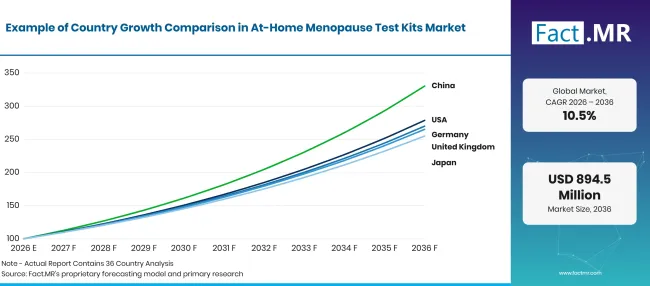
At Home Menopause Test Kits Growth Index | Source: Fact.MR
| Country | CAGR (2026–2036) |
|---|---|
| USA | 10.8% |
| Japan | 9.8% |
| Germany | 10.4% |
| UK | 10.2% |
| China | 12.7% |
Source: Fact.MR analysis. Updated Nov 9, 2026
What supports USA adoption?
10.8% CAGR, supported by consumer access to hormone testing and digital health services.
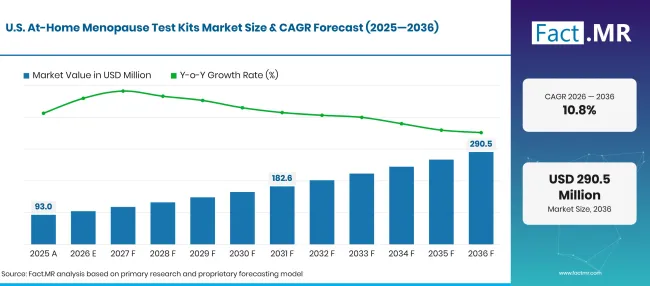
At Home Menopause Test Kits Forecast Usa | Source: Fact.MR
The U.S. market benefits from direct-to-consumer testing platforms and established laboratory networks. Consumers can order menopause-related hormone panels online and use laboratory collection services for blood testing. Quest Health offers a Menopause and Perimenopause Assessment Test Panel for consumers aged 40 and older. Everlywell also offers a Perimenopause Check that measures estradiol, FSH and TSH through a laboratory blood draw [3] [4].
What is driving demand for menopause testing in Japan?
9.8% CAGR, shaped by growing attention to women's health and demand for accessible support during the menopausal transition.
Japan's market opportunity is linked to growing attention to women's health and the need for accessible support during the menopausal transition. Digital health services and consumer hormone monitoring may help individuals organize health information and discuss symptoms with healthcare professionals. Clear guidance on the limitations of hormone testing will remain important because menopause assessment depends on clinical context rather than a single test result.
What supports Germany adoption?
10.4% CAGR, driven by consumer interest in preventive health and established access to laboratory-based diagnostic services.
Germany's market can benefit from consumer interest in preventive health and access to laboratory-based diagnostic services. At-home sample collection and digital result delivery may offer convenient alternatives for consumers who want to monitor selected hormone indicators. Providers need to communicate the difference between wellness-oriented tracking and tests used for specific clinical decisions.
How is the menopause testing market developing in the United Kingdom?
10.2% CAGR, supported by demand for accessible menopause information
The UK market is shaped by demand for accessible menopause information and support. However, clinical guidance influences how consumer tests are positioned. NICE recommends identifying menopause in otherwise healthy people aged 45 or older through symptoms and menstrual history without routine laboratory testing. This creates a need for providers to position at-home hormone kits as informational or monitoring tools rather than definitive diagnostic products.
What supports China adoption?
12.7% CAGR, led by increasing consumer engagement with digital health services and women's wellness products
China is projected to record the fastest growth among the listed countries. Greater consumer engagement with digital health services and women's wellness products can support interest in convenient hormone monitoring. Growth opportunities may also arise from wider access to laboratory services and mobile health platforms. Product providers need to account for local regulatory requirements and ensure that test interpretation is appropriate for the intended population.
Who leads the At-Home Menopause Test Kits Market?
Fact.MR profiles Mira, Oova, Everlywell, Proov and Quest Diagnostics through its Quest Health platform across the consumer hormone testing and menopause assessment value chain.
Mira offers a hormone monitoring system with a dedicated perimenopause kit. Its Ultra4 product is designed to track FSH, LH, E3G and PdG through urine testing and a connected analyzer. The company positions the product for hormone tracking and personal cycle awareness rather than as a stand-alone menopause diagnosis [5].
Oova offers urine-based hormone monitoring through test strips and a smartphone application. Its system measures LH, E3G and PdG and uses digital analysis to present hormone patterns. Its current positioning is primarily focused on fertility and cycle monitoring, so it is more appropriately considered an adjacent hormone-monitoring provider than a direct menopause test kit competitor [6]. Everlywell offers a Perimenopause Check that measures estradiol, FSH and TSH through a blood sample collected at a laboratory.
Proov offers its Empower system for perimenopause and menopause hormone tracking. The urine-based kit measures FSH, LH, E1G and PdG at multiple time points and uses an app to present hormone patterns [7].
Quest Diagnostics, through Quest Health, offers consumer-ordered menopause-related laboratory panels that measure selected hormones, including FSH and estradiol. These require laboratory analysis rather than a self-test performed entirely at home. Its Menopause and Perimenopause Assessment Test Panel requires a blood sample collected at a Quest location or through Quest Mobile where available [8].
Which companies are the key providers?
Key companies profiled in the At-Home Menopause Test Kits Market include:
- Mira
- Oova
- Everlywell
- Proov
- Quest Diagnostics (Quest Health)
Bibliography
- [1] National Institute for Health and Care Excellence. (2024, November). Menopause: Identification and management (NG23) – Recommendations.
- [2] U.S. Food and Drug Administration. (n.d.). Menopause: Home-use tests.
- [3] Everlywell. (n.d.). Perimenopause Test.
- [4] Everlywell. (2026, January 8). How does the Perimenopause test determine if I am approaching menopause?
- [5] Mira. (n.d.). Ultra4 Kit for Perimenopause.
- [6] Oova. (2024, June 20). Which hormones does Oova monitor? Oova Support Center.
- [7] Proov. (n.d.). Proov Empower Hormone Tracker.
- [8] Quest Diagnostics. (n.d.). Menopause & Perimenopause Assessment Test Panel.
This Report Answers
- The report examines consumer hormone testing products and services used to assess or monitor changes associated with perimenopause and menopause.
- Segment analysis compares the specified analyte panels and their 2026 market shares.
- Sample analysis distinguishes blood, saliva, urine and other examination categories.
- Testing-location analysis compares at-home self-testing with retail, laboratory, hospital and mobile testing services.
- Result-delivery analysis examines single reports, longitudinal tracking, clinician interpretation and digital decision support.
- Country analysis covers the USA, Japan, Germany, the UK and China.
- The competitive overview profiles Mira, Oova, Everlywell, Proov and Quest Diagnostics.
What does the At-Home Menopause Test Kits Market cover?
The market covers consumer-facing test kits and related services used to measure or monitor hormones associated with the menopausal transition. It includes urine-based home testing products and blood-based testing services ordered by consumers. The analysis also considers digital platforms that present hormone results and track changes over time. Product coverage depends on the hormones measured and the intended use by each provider.
What is included in the scope?
Included products comprise home hormone test kits and consumer-accessible menopause-related testing services.
These may measure FSH, LH, estradiol and progesterone metabolites through urine or blood samples. Digital result delivery and hormone-tracking features are included where they form part of the testing service. Laboratory-based tests are included only when they are marketed as consumer-accessible menopause or perimenopause testing services.
What is excluded from the scope?
The analysis excludes prescription hormone replacement therapies and other menopause treatments.
General fertility tests are excluded unless their hormone measurements or product purpose directly relate to menopausal transition monitoring. Routine diagnostic services unrelated to menopause are also excluded. General wellness applications without a hormone testing component fall outside the product boundary.
How Was the Analysis Built?
The analysis draws on 120+ sources, 35+ company portfolios, 25+ countries, and more than 20 industry interviews.
- Primary Research: Primary research includes discussions with manufacturers, service providers, technology developers, distributors, end users, and subject-matter experts. These conversations examine purchasing priorities, product adoption, operational challenges, approval requirements, competitive positioning, and the factors that influence wider market acceptance.
- Desk Research: Desk research covers government statistics, regulatory publications, company filings, trade data, technical studies, industry associations, standards, public policy, and other authoritative sources. Every source used in the analysis is documented in the bibliography.
- Market Sizing and Forecasting: Market estimates combine historical performance, demand indicators, pricing and volume trends, segment shares, company participation, country-level growth, adoption patterns, investment activity, and barriers to market expansion.
- Data Validation and Update Cycle: Findings are validated by comparing primary interviews with public data, company activity, regulatory changes, trade patterns, and industry developments. Regular updates review new product launches, capacity changes, partnerships, approvals, and shifts in commercial adoption.
Segmentation
What is the report’s scope and coverage?
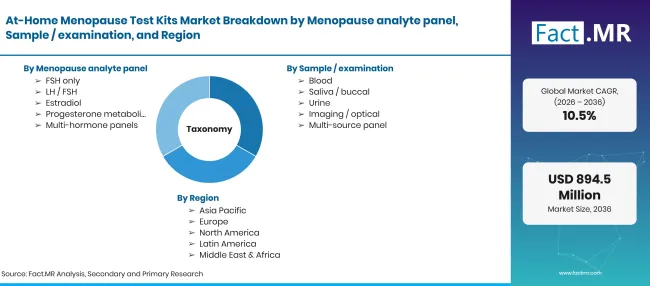
At Home Menopause Test Kits Taxonomy | Source: Fact.MR
| Attribute | Details |
|---|---|
| Quantitative Units | USD million |
| Market Definition | The menopause test kits market comprises consumer-facing diagnostic products and associated testing services designed to measure or monitor hormonal changes during perimenopause and menopause. It includes at-home test kits that analyze hormones such as follicle-stimulating hormone (FSH), luteinizing hormone (LH), estradiol and progesterone metabolites using blood, urine or saliva samples. |
| Menopause Analyte Panel | FSH only; LH / FSH; Estradiol; Progesterone metabolites; Multi-hormone panels |
| Sample / Examination | Blood; Saliva / buccal; Urine; Imaging / optical; Multi-source panel |
| Testing Location | At-home self-test; Retail diagnostics; Independent laboratory; Hospital / clinic; Mobile screening |
| Result Delivery | Single test report; Longitudinal tracking; Clinician interpretation; AI decision support; Integrated wellness plan |
| Regions Covered | North America; Latin America; Western Europe; Eastern Europe; East Asia; South Asia & Pacific; Middle East & Africa |
| Countries Covered | USA; Japan; Germany; UK; China |
| Companies Profiled | Mira; Oova; Everlywell; Proov; Quest Diagnostics (Quest Health) |
| Forecast Period | 2026 to 2036 |
| Approach | Market segmentation and forecast analysis supported by product information, clinical guidance and public company disclosures |
Source: Fact.MR analysis. Updated Nov 9, 2026
How is the market segmented?
-
By Menopause Analyte Panel
- FSH only
- LH / FSH
- Estradiol
- Progesterone metabolites
- Multi-hormone panels
-
By Sample / Examination
- Blood
- Saliva / buccal
- Urine
- Imaging / optical
- Multi-source panel
-
By Testing Location
- At-home self-test
- Retail diagnostics
- Independent laboratory
- Hospital / clinic
- Mobile screening
-
By Result Delivery
- Single test report
- Longitudinal tracking
- Clinician interpretation
- AI decision support
- Integrated wellness plan
-
By Region
- North America
- Latin America
- Western Europe
- Eastern Europe
- East Asia
- South Asia & Pacific
- Middle East & Africa
Frequently Asked Questions
How big is the At-Home Menopause Test Kits Market in 2026?
What is the CAGR from 2026 to 2036?
Which Menopause Analyte Panel has the largest share?
Which Sample / Examination categories lead the market?
Which Testing Location has the largest share?
Which Result Delivery category leads?
Which companies are covered?
Who worked on this report


Preview the report firsthand - request a free sample
Free SampleGet the brochure for pricing and purchase details
Download PDF