Field Test Kits Chemicals for Soil Contamination Screening Market
Field Test Kits Chemicals for Soil Contamination Screening Market Size and Share Forecast Outlook 2026 to 2036
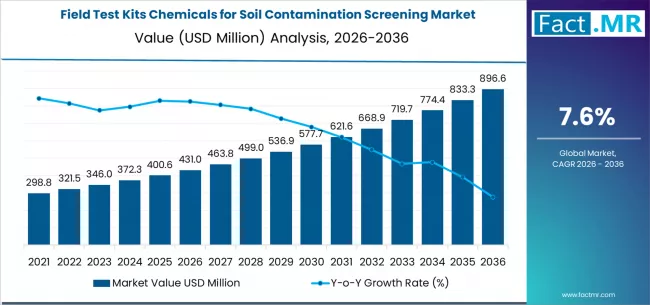
Field test kits chemicals for soil contamination screening market is projected to grow from USD 431.0 million in 2026 to USD 896.6 million by 2036, at a CAGR of 7.6%. Heavy metals (Pb, Hg, Cd, As) reagents will dominate with a 28.0% market share, while environmental site assessments (phase i&ii esa) will lead the application segment with a 26.0% share.
Field Test Kits Chemicals for Soil Contamination Screening Market Forecast and Outlook 2026 to 2036
The global field test kits chemicals for soil contamination screening market is projected to reach USD 896.60 million by 2036. The market is valued at USD 431.00 million in 2026 and is set to rise at a CAGR of 7.6% during the assessment period.
By contaminant type, Heavy metals (Pb, Hg, Cd, As) reagents hold a leading 28% share. Environmental site assessments (Phase I&II ESA) represents the dominant application at 26%, while Colorimetric liquid reagents is the primary chemistry at 34.0%. Environmental consulting firms is the leading end user at 30.0%.
Key Takeaways from the Field Test Kits Chemicals for Soil Contamination Screening Market
- Market Value for 2026: USD 431.00 Million
- Market Value for 2036: USD 896.60 Million
- Forecast CAGR (2026-2036): 7.6%
- Leading Contaminant Type Share (2026): Heavy metals (Pb, Hg, Cd, As) reagents (28%)
- Leading Application Share (2026): Environmental site assessments (Phase I&II ESA) (26%)
- Leading Chemistry Share (2026): Colorimetric liquid reagents (34.0%)
- Leading End User Share (2026): Environmental consulting firms (30.0%)
- Key Players in the Market: Hach (Danaher), Palintest (HORIBA), LaMotte Companies, Merck & Co. Inc., Hanna Instruments, Chemetrics, MilliporeSigma
Defining trends involve the development of multi-analyte panel kits and immunoassay-based rapid tests for emerging contaminants like PFAS. Innovation is focused on enhancing reagent sensitivity, reducing cross-reactivity, and simplifying protocols for non-expert users. Integration of these chemical kits with digital tools for data capture and reporting is becoming a key competitive strategy.
Stringent global regulations governing land use, brownfield redevelopment, and industrial liability drive market growth. The need for rapid, cost-effective preliminary site screening to guide more expensive lab analysis acts as a significant catalyst, creating sustained demand for reliable, on-site chemical testing solutions.
Field Test Kits Chemicals for Soil Contamination Screening Market
| Metric | Value |
|---|---|
| Market Value (2026) | USD 431.00 Million |
| Market Forecast Value (2036) | USD 896.60 Million |
| Forecast CAGR (2026-2036) | 7.6% |
Category
| Category | Segments |
|---|---|
| Contaminant Type | Heavy metals (Pb, Hg, Cd, As) reagents, Hydrocarbons & petrochemical residues, Pesticides & agrochemical screening reagents, Volatile organic compounds (VOC) indicators, Nutrient overload & salinity indicators, Pathogen & microbial ATP & rapid tests, Specialty analytes (PFAS, flame retardants, dyes) |
| Application | Environmental site assessments (Phase I&II ESA), Agriculture & soil health monitoring, Industrial spill & emergency response, Mining & extractive industries, Brownfield redevelopment & urban planning, Construction & infrastructure projects, Academic, research & NGOs |
| Chemistry | Colorimetric liquid reagents, Test strips & dipstick kits, Powder&tablet reagents, Immunoassay-based rapid kits (ELISA field kits), Portable sensor-cartridge reagents, Multi-parameter combination kits |
| End User | Environmental consulting firms, Government & regulatory agencies, Industrial & manufacturing facilities, Agriculture & agronomy service providers, Mining & energy sector operators, Community groups & NGOs & academia |
| Region | North America, Latin America, Western Europe, Eastern Europe, East Asia, South Asia & Pacific, MEA |
Segmental Analysis
By Contaminant Type, Which Class Represents the Most Pervasive Regulatory Concern?
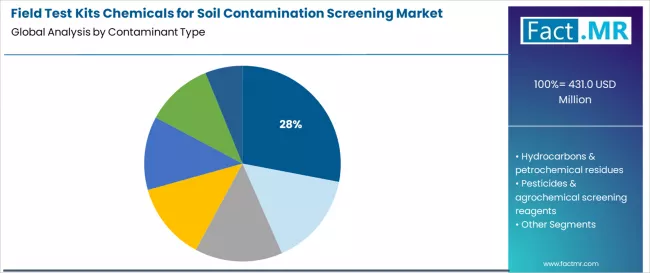
Heavy metals reagents lead the segment with a 28% share. This dominance is due to the widespread legacy of industrial contamination, mining activities, and the strict regulatory limits for metals like lead, arsenic, and cadmium in soil. Their toxicity and persistence make them a primary target for initial screening in virtually all contaminated land investigations, driving consistent demand for reliable field test chemicals.
By Application, Which Use Case is the Cornerstone of Commercial Due Diligence?
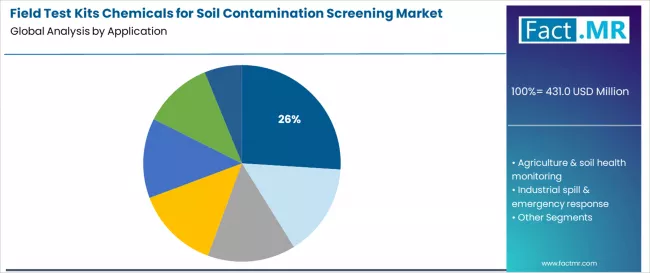
Environmental site assessments (Phase I&II ESA) command the largest application share at 26%. This process is mandated for most commercial property transactions, redevelopment projects, and financing. The need for rapid, on-site screening during Phase II investigations to delineate contamination and guide sampling for formal laboratory analysis creates a high-volume, recurring market for field test kit chemicals.
By Chemistry, Which Method Offers a Balance of Simplicity and Quantitative Potential?
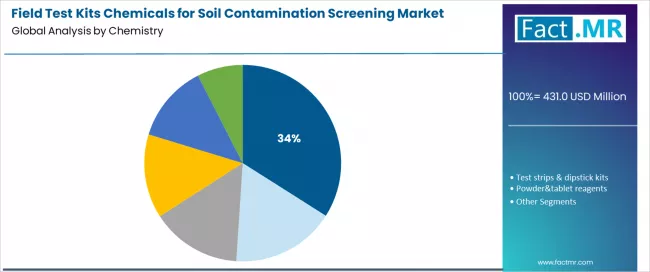
Colorimetric liquid reagents represent the leading chemistry at 34.0%. This method, where a liquid reagent produces a color change proportional to contaminant concentration, offers a good balance of user-friendliness, relatively low cost, and the ability to provide semi-quantitative or quantitative results with a portable photometer. Its versatility across many contaminant types underpins its dominant market position.
By End User, Which Group is the Primary Specifier and Volume Buyer?
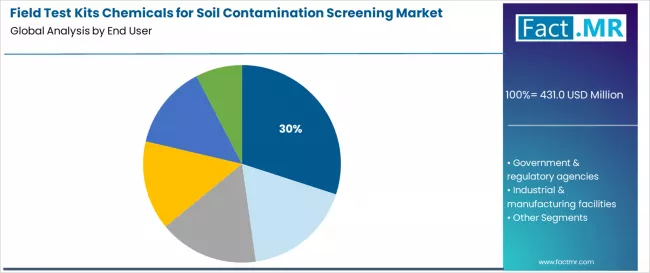
Environmental consulting firms is the leading end user at 30.0%. These firms are the primary service providers conducting Phase I/II ESAs, spill response, and remediation planning. They are the key specifiers of field test methods, requiring kits that deliver defensible, cost-effective data to inform client decisions and regulatory submissions, making them the core driver of volume and product development.
What are the Drivers, Restraints, and Key Trends of the Field Test Kits Chemicals for Soil Contamination Screening Market?
Globally tightening regulations on soil quality for residential, agricultural, and industrial use drive market growth. The acceleration of urban brownfield redevelopment and infrastructure projects necessitates rapid site screening. Increasing awareness and regulation of emerging contaminants like PFAS create demand for new screening chemistries.
A significant restraint is the inherent limitation in sensitivity and accuracy compared to certified laboratory methods, restricting use to screening purposes only. The complexity of soil matrices can cause interference, leading to false positives or negatives. Competition from portable XRF analyzers for heavy metals screening poses a challenge to traditional wet chemistry kits for that specific segment.
Key trends include the development of simplified, all-inclusive kits with minimal steps for use by non-scientists in community-led monitoring. There is a growing focus on creating digital workflows where kit results are captured via smartphone apps and linked to GIS data. The market is also seeing expansion into agricultural nutrient and salinity testing, blending environmental monitoring with precision agriculture.
Analysis of the Field Test Kits Chemicals for Soil Contamination Screening Market by Key Countries
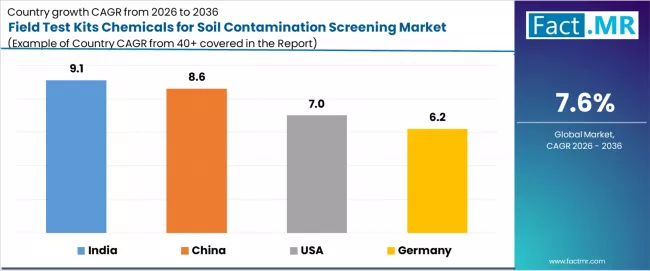
| Country | CAGR (2026-2036) |
|---|---|
| India | 9.10% |
| China | 8.60% |
| USA | 7.00% |
| Germany | 6.20% |
How does India's Rapid Infrastructure Development and Environmental Enforcement Drive Growth?
India leads with a 9.10% CAGR, driven by massive urban development, new environmental impact assessment requirements, and increasing enforcement of soil contamination guidelines. The growth of environmental consulting services and the need for rapid screening on industrial, mining, and legacy sites create robust demand for cost-effective field test solutions.
Why is China's Soil Pollution Prevention Action Plan and Redevelopment a Key Driver?
China’s 8.60% growth is fueled by its national "Soil Pollution Prevention and Control Action Plan" and the vast scale of its urban redevelopment and industrial transformation. Mandatory surveys of contaminated land and monitoring of agricultural soil safety generate significant demand for field screening kits to triage sites before detailed laboratory analysis.
What Role does the USA's Mature Regulatory and Liability Framework Play?
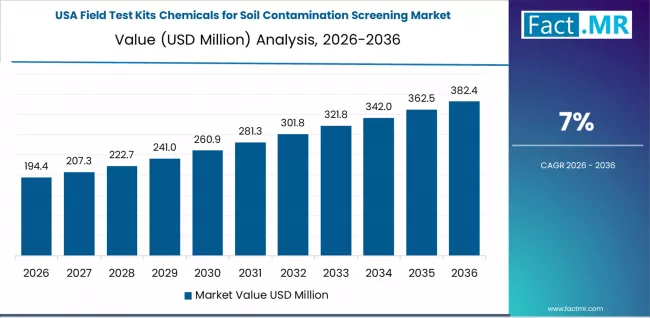
The USA's 7.00% growth is underpinned by well-established regulations (CERCLA, RCRA) and a strong liability-driven market for environmental due diligence. Demand is driven by the constant cycle of property transactions, brownfield grants, and state-level initiatives, with consultants seeking reliable, defensible field methods to manage project costs and risks.
How does Germany's Strict Contaminated Land Ordinance and Engineering Rigor Influence the Market?
Germany’s 6.20% growth reflects its stringent Federal Soil Protection Act and advanced approach to site investigation. The market demands high-quality, precise field test chemicals that provide reliable preliminary data for the country's methodical and engineering-led remediation frameworks, often requiring kits with strong technical documentation.
Competitive Landscape of the Field Test Kits Chemicals for Soil Contamination Screening Market
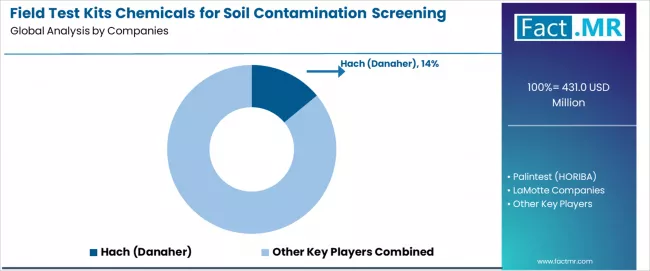
The competitive landscape features established players in water and environmental analysis diversifying into soil testing. Leaders like Hach (Danaher) and Merck (via MilliporeSigma) compete on the strength of their broad chemical reagent portfolios, global distribution, and brand reputation in analytical science.
Specialist field testing companies like Palintest, LaMotte, and Chemetrics compete through deep expertise in colorimetric and comparator methods tailored for on-site use. Instrument companies like Hanna Instruments offer integrated systems pairing their portable meters with proprietary reagent chemistries. Competition centers on product reliability, ease of use, comprehensiveness of supported contaminants, and the quality of technical support and training provided.
Key Players in the Field Test Kits Chemicals for Soil Contamination Screening Market
- Hach (Danaher)
- Palintest (HORIBA)
- LaMotte Companies
- Merck & Co. Inc.
- Hanna Instruments
- Chemetrics
- MilliporeSigma
Scope of Report
| Items | Values |
|---|---|
| Quantitative Units | USD Million |
| Contaminant Type | Heavy metals (Pb, Hg, Cd, As) reagents, Hydrocarbons & petrochemical residues, Pesticides & agrochemical screening reagents, Volatile organic compounds (VOC) indicators, Nutrient overload & salinity indicators, Pathogen & microbial ATP & rapid tests, Specialty analytes (PFAS, flame retardants, dyes) |
| Application | Environmental site assessments (Phase I&II ESA), Agriculture & soil health monitoring, Industrial spill & emergency response, Mining & extractive industries, Brownfield redevelopment & urban planning, Construction & infrastructure projects, Academic, research & NGOs |
| Chemistry | Colorimetric liquid reagents, Test strips & dipstick kits, Powder&tablet reagents, Immunoassay-based rapid kits (ELISA field kits), Portable sensor-cartridge reagents, Multi-parameter combination kits |
| End User | Environmental consulting firms, Government & regulatory agencies, Industrial & manufacturing facilities, Agriculture & agronomy service providers, Mining & energy sector operators, Community groups & NGOs & academia |
| Key Countries | India, China, USA, Germany |
| Key Companies | Hach (Danaher), Palintest (HORIBA), LaMotte Companies, Merck & Co. Inc., Hanna Instruments, Chemetrics, MilliporeSigma |
| Additional Analysis | Analysis of detection limits versus regulatory thresholds, interference studies from common soil matrices, total cost-per-sample versus laboratory analysis, competitive assessment versus portable analytical instruments (XRF, GC-MS), and regulatory acceptance of field kit data for decision-making. |
Field Test Kits Chemicals for Soil Contamination Screening Market by Segments
-
Contaminant Type :
- Heavy metals (Pb, Hg, Cd, As) reagents
- Hydrocarbons & petrochemical residues
- Pesticides & agrochemical screening reagents
- Volatile organic compounds (VOC) indicators
- Nutrient overload & salinity indicators
- Pathogen & microbial ATP & rapid tests
- Specialty analytes (PFAS, flame retardants, dyes)
-
Application :
- Environmental site assessments (Phase I&II ESA)
- Agriculture & soil health monitoring
- Industrial spill & emergency response
- Mining & extractive industries
- Brownfield redevelopment & urban planning
- Construction & infrastructure projects
- Academic, research & NGOs
-
Chemistry :
- Colorimetric liquid reagents
- Test strips & dipstick kits
- Powder&tablet reagents
- Immunoassay-based rapid kits (ELISA field kits)
- Portable sensor-cartridge reagents
- Multi-parameter combination kits
-
End User :
- Environmental consulting firms
- Government & regulatory agencies
- Industrial & manufacturing facilities
- Agriculture & agronomy service providers
- Mining & energy sector operators
- Community groups & NGOs & academia
-
Region :
-
North America
- USA
- Canada
-
Latin America
- Brazil
- Mexico
- Argentina
- Rest of Latin America
-
Western Europe
- Germany
- UK
- France
- Spain
- Italy
- BENELUX
- Rest of Western Europe
-
Eastern Europe
- Russia
- Poland
- Czech Republic
- Rest of Eastern Europe
-
East Asia
- China
- Japan
- South Korea
- Rest of East Asia
-
South Asia & Pacific
- India
- ASEAN
- Australia
- Rest of South Asia & Pacific
-
MEA
- Saudi Arabia
- UAE
- Turkiye
- Rest of MEA
-
Table of Content
- Executive Summary
- Global Market Outlook
- Demand to side Trends
- Supply to side Trends
- Technology Roadmap Analysis
- Analysis and Recommendations
- Market Overview
- Market Coverage / Taxonomy
- Market Definition / Scope / Limitations
- Market Background
- Market Dynamics
- Drivers
- Restraints
- Opportunity
- Trends
- Scenario Forecast
- Demand in Optimistic Scenario
- Demand in Likely Scenario
- Demand in Conservative Scenario
- Opportunity Map Analysis
- Product Life Cycle Analysis
- Supply Chain Analysis
- Investment Feasibility Matrix
- Value Chain Analysis
- PESTLE and Porter’s Analysis
- Regulatory Landscape
- Regional Parent Market Outlook
- Production and Consumption Statistics
- Import and Export Statistics
- Market Dynamics
- Global Market Analysis 2021 to 2025 and Forecast, 2026 to 2036
- Historical Market Size Value (USD Million) Analysis, 2021 to 2025
- Current and Future Market Size Value (USD Million) Projections, 2026 to 2036
- Y to o to Y Growth Trend Analysis
- Absolute $ Opportunity Analysis
- Global Market Pricing Analysis 2021 to 2025 and Forecast 2026 to 2036
- Global Market Analysis 2021 to 2025 and Forecast 2026 to 2036, By Contaminant Type
- Introduction / Key Findings
- Historical Market Size Value (USD Million) Analysis By Contaminant Type, 2021 to 2025
- Current and Future Market Size Value (USD Million) Analysis and Forecast By Contaminant Type, 2026 to 2036
- Heavy metals (Pb, Hg, Cd, As) reagents
- Hydrocarbons & petrochemical residues
- Pesticides & agrochemical screening reagents
- Volatile organic compounds (VOC) indicators
- Nutrient overload & salinity indicators
- Pathogen & microbial ATP & rapid tests
- Specialty analytes (PFAS, flame retardants, dyes)
- Heavy metals (Pb, Hg, Cd, As) reagents
- Y to o to Y Growth Trend Analysis By Contaminant Type, 2021 to 2025
- Absolute $ Opportunity Analysis By Contaminant Type, 2026 to 2036
- Global Market Analysis 2021 to 2025 and Forecast 2026 to 2036, By Application
- Introduction / Key Findings
- Historical Market Size Value (USD Million) Analysis By Application, 2021 to 2025
- Current and Future Market Size Value (USD Million) Analysis and Forecast By Application, 2026 to 2036
- Environmental site assessments (Phase I&II ESA)
- Agriculture & soil health monitoring
- Industrial spill & emergency response
- Mining & extractive industries
- Brownfield redevelopment & urban planning
- Construction & infrastructure projects
- Academic, research & NGOs
- Environmental site assessments (Phase I&II ESA)
- Y to o to Y Growth Trend Analysis By Application, 2021 to 2025
- Absolute $ Opportunity Analysis By Application, 2026 to 2036
- Global Market Analysis 2021 to 2025 and Forecast 2026 to 2036, By Chemistry
- Introduction / Key Findings
- Historical Market Size Value (USD Million) Analysis By Chemistry, 2021 to 2025
- Current and Future Market Size Value (USD Million) Analysis and Forecast By Chemistry, 2026 to 2036
- Colorimetric liquid reagents
- Test strips & dipstick kits
- Powder&tablet reagents
- Immunoassay-based rapid kits (ELISA field kits)
- Portable sensor-cartridge reagents
- Multi-parameter combination kits
- Colorimetric liquid reagents
- Y to o to Y Growth Trend Analysis By Chemistry, 2021 to 2025
- Absolute $ Opportunity Analysis By Chemistry, 2026 to 2036
- Global Market Analysis 2021 to 2025 and Forecast 2026 to 2036, By End User
- Introduction / Key Findings
- Historical Market Size Value (USD Million) Analysis By End User, 2021 to 2025
- Current and Future Market Size Value (USD Million) Analysis and Forecast By End User, 2026 to 2036
- Environmental consulting firms
- Government & regulatory agencies
- Industrial & manufacturing facilities
- Agriculture & agronomy service providers
- Mining & energy sector operators
- Community groups & NGOs & academia
- Environmental consulting firms
- Y to o to Y Growth Trend Analysis By End User, 2021 to 2025
- Absolute $ Opportunity Analysis By End User, 2026 to 2036
- Global Market Analysis 2021 to 2025 and Forecast 2026 to 2036, By Region
- Introduction
- Historical Market Size Value (USD Million) Analysis By Region, 2021 to 2025
- Current Market Size Value (USD Million) Analysis and Forecast By Region, 2026 to 2036
- North America
- Latin America
- Western Europe
- Eastern Europe
- East Asia
- South Asia and Pacific
- Middle East & Africa
- Market Attractiveness Analysis By Region
- North America Market Analysis 2021 to 2025 and Forecast 2026 to 2036, By Country
- Historical Market Size Value (USD Million) Trend Analysis By Market Taxonomy, 2021 to 2025
- Market Size Value (USD Million) Forecast By Market Taxonomy, 2026 to 2036
- By Country
- USA
- Canada
- Mexico
- By Contaminant Type
- By Application
- By Chemistry
- By End User
- By Country
- Market Attractiveness Analysis
- By Country
- By Contaminant Type
- By Application
- By Chemistry
- By End User
- Key Takeaways
- Latin America Market Analysis 2021 to 2025 and Forecast 2026 to 2036, By Country
- Historical Market Size Value (USD Million) Trend Analysis By Market Taxonomy, 2021 to 2025
- Market Size Value (USD Million) Forecast By Market Taxonomy, 2026 to 2036
- By Country
- Brazil
- Chile
- Rest of Latin America
- By Contaminant Type
- By Application
- By Chemistry
- By End User
- By Country
- Market Attractiveness Analysis
- By Country
- By Contaminant Type
- By Application
- By Chemistry
- By End User
- Key Takeaways
- Western Europe Market Analysis 2021 to 2025 and Forecast 2026 to 2036, By Country
- Historical Market Size Value (USD Million) Trend Analysis By Market Taxonomy, 2021 to 2025
- Market Size Value (USD Million) Forecast By Market Taxonomy, 2026 to 2036
- By Country
- Germany
- UK
- Italy
- Spain
- France
- Nordic
- BENELUX
- Rest of Western Europe
- By Contaminant Type
- By Application
- By Chemistry
- By End User
- By Country
- Market Attractiveness Analysis
- By Country
- By Contaminant Type
- By Application
- By Chemistry
- By End User
- Key Takeaways
- Eastern Europe Market Analysis 2021 to 2025 and Forecast 2026 to 2036, By Country
- Historical Market Size Value (USD Million) Trend Analysis By Market Taxonomy, 2021 to 2025
- Market Size Value (USD Million) Forecast By Market Taxonomy, 2026 to 2036
- By Country
- Russia
- Poland
- Hungary
- Balkan & Baltic
- Rest of Eastern Europe
- By Contaminant Type
- By Application
- By Chemistry
- By End User
- By Country
- Market Attractiveness Analysis
- By Country
- By Contaminant Type
- By Application
- By Chemistry
- By End User
- Key Takeaways
- East Asia Market Analysis 2021 to 2025 and Forecast 2026 to 2036, By Country
- Historical Market Size Value (USD Million) Trend Analysis By Market Taxonomy, 2021 to 2025
- Market Size Value (USD Million) Forecast By Market Taxonomy, 2026 to 2036
- By Country
- China
- Japan
- South Korea
- By Contaminant Type
- By Application
- By Chemistry
- By End User
- By Country
- Market Attractiveness Analysis
- By Country
- By Contaminant Type
- By Application
- By Chemistry
- By End User
- Key Takeaways
- South Asia and Pacific Market Analysis 2021 to 2025 and Forecast 2026 to 2036, By Country
- Historical Market Size Value (USD Million) Trend Analysis By Market Taxonomy, 2021 to 2025
- Market Size Value (USD Million) Forecast By Market Taxonomy, 2026 to 2036
- By Country
- India
- ASEAN
- Australia & New Zealand
- Rest of South Asia and Pacific
- By Contaminant Type
- By Application
- By Chemistry
- By End User
- By Country
- Market Attractiveness Analysis
- By Country
- By Contaminant Type
- By Application
- By Chemistry
- By End User
- Key Takeaways
- Middle East & Africa Market Analysis 2021 to 2025 and Forecast 2026 to 2036, By Country
- Historical Market Size Value (USD Million) Trend Analysis By Market Taxonomy, 2021 to 2025
- Market Size Value (USD Million) Forecast By Market Taxonomy, 2026 to 2036
- By Country
- Kingdom of Saudi Arabia
- Other GCC Countries
- Turkiye
- South Africa
- Other African Union
- Rest of Middle East & Africa
- By Contaminant Type
- By Application
- By Chemistry
- By End User
- By Country
- Market Attractiveness Analysis
- By Country
- By Contaminant Type
- By Application
- By Chemistry
- By End User
- Key Takeaways
- Key Countries Market Analysis
- USA
- Pricing Analysis
- Market Share Analysis, 2025
- By Contaminant Type
- By Application
- By Chemistry
- By End User
- Canada
- Pricing Analysis
- Market Share Analysis, 2025
- By Contaminant Type
- By Application
- By Chemistry
- By End User
- Mexico
- Pricing Analysis
- Market Share Analysis, 2025
- By Contaminant Type
- By Application
- By Chemistry
- By End User
- Brazil
- Pricing Analysis
- Market Share Analysis, 2025
- By Contaminant Type
- By Application
- By Chemistry
- By End User
- Chile
- Pricing Analysis
- Market Share Analysis, 2025
- By Contaminant Type
- By Application
- By Chemistry
- By End User
- Germany
- Pricing Analysis
- Market Share Analysis, 2025
- By Contaminant Type
- By Application
- By Chemistry
- By End User
- UK
- Pricing Analysis
- Market Share Analysis, 2025
- By Contaminant Type
- By Application
- By Chemistry
- By End User
- Italy
- Pricing Analysis
- Market Share Analysis, 2025
- By Contaminant Type
- By Application
- By Chemistry
- By End User
- Spain
- Pricing Analysis
- Market Share Analysis, 2025
- By Contaminant Type
- By Application
- By Chemistry
- By End User
- France
- Pricing Analysis
- Market Share Analysis, 2025
- By Contaminant Type
- By Application
- By Chemistry
- By End User
- India
- Pricing Analysis
- Market Share Analysis, 2025
- By Contaminant Type
- By Application
- By Chemistry
- By End User
- ASEAN
- Pricing Analysis
- Market Share Analysis, 2025
- By Contaminant Type
- By Application
- By Chemistry
- By End User
- Australia & New Zealand
- Pricing Analysis
- Market Share Analysis, 2025
- By Contaminant Type
- By Application
- By Chemistry
- By End User
- China
- Pricing Analysis
- Market Share Analysis, 2025
- By Contaminant Type
- By Application
- By Chemistry
- By End User
- Japan
- Pricing Analysis
- Market Share Analysis, 2025
- By Contaminant Type
- By Application
- By Chemistry
- By End User
- South Korea
- Pricing Analysis
- Market Share Analysis, 2025
- By Contaminant Type
- By Application
- By Chemistry
- By End User
- Russia
- Pricing Analysis
- Market Share Analysis, 2025
- By Contaminant Type
- By Application
- By Chemistry
- By End User
- Poland
- Pricing Analysis
- Market Share Analysis, 2025
- By Contaminant Type
- By Application
- By Chemistry
- By End User
- Hungary
- Pricing Analysis
- Market Share Analysis, 2025
- By Contaminant Type
- By Application
- By Chemistry
- By End User
- Kingdom of Saudi Arabia
- Pricing Analysis
- Market Share Analysis, 2025
- By Contaminant Type
- By Application
- By Chemistry
- By End User
- Turkiye
- Pricing Analysis
- Market Share Analysis, 2025
- By Contaminant Type
- By Application
- By Chemistry
- By End User
- South Africa
- Pricing Analysis
- Market Share Analysis, 2025
- By Contaminant Type
- By Application
- By Chemistry
- By End User
- USA
- Market Structure Analysis
- Competition Dashboard
- Competition Benchmarking
- Market Share Analysis of Top Players
- By Regional
- By Contaminant Type
- By Application
- By Chemistry
- By End User
- Competition Analysis
- Competition Deep Dive
- Hach (Danaher)
- Overview
- Product Portfolio
- Profitability by Market Segments (Product/Age /Sales Channel/Region)
- Sales Footprint
- Strategy Overview
- Marketing Strategy
- Product Strategy
- Channel Strategy
- Palintest (HORIBA)
- LaMotte Companies
- Merck & Co. Inc.
- Hanna Instruments
- Chemetrics
- MilliporeSigma
- Hach (Danaher)
- Competition Deep Dive
- Assumptions & Acronyms Used
- Research Methodology
List Of Table
- Table 1: Global Market Value (USD Million) Forecast by Region, 2021 to 2036
- Table 2: Global Market Value (USD Million) Forecast by Contaminant Type, 2021 to 2036
- Table 3: Global Market Value (USD Million) Forecast by Application, 2021 to 2036
- Table 4: Global Market Value (USD Million) Forecast by Chemistry, 2021 to 2036
- Table 5: Global Market Value (USD Million) Forecast by End User, 2021 to 2036
- Table 6: North America Market Value (USD Million) Forecast by Country, 2021 to 2036
- Table 7: North America Market Value (USD Million) Forecast by Contaminant Type, 2021 to 2036
- Table 8: North America Market Value (USD Million) Forecast by Application, 2021 to 2036
- Table 9: North America Market Value (USD Million) Forecast by Chemistry, 2021 to 2036
- Table 10: North America Market Value (USD Million) Forecast by End User, 2021 to 2036
- Table 11: Latin America Market Value (USD Million) Forecast by Country, 2021 to 2036
- Table 12: Latin America Market Value (USD Million) Forecast by Contaminant Type, 2021 to 2036
- Table 13: Latin America Market Value (USD Million) Forecast by Application, 2021 to 2036
- Table 14: Latin America Market Value (USD Million) Forecast by Chemistry, 2021 to 2036
- Table 15: Latin America Market Value (USD Million) Forecast by End User, 2021 to 2036
- Table 16: Western Europe Market Value (USD Million) Forecast by Country, 2021 to 2036
- Table 17: Western Europe Market Value (USD Million) Forecast by Contaminant Type, 2021 to 2036
- Table 18: Western Europe Market Value (USD Million) Forecast by Application, 2021 to 2036
- Table 19: Western Europe Market Value (USD Million) Forecast by Chemistry, 2021 to 2036
- Table 20: Western Europe Market Value (USD Million) Forecast by End User, 2021 to 2036
- Table 21: Eastern Europe Market Value (USD Million) Forecast by Country, 2021 to 2036
- Table 22: Eastern Europe Market Value (USD Million) Forecast by Contaminant Type, 2021 to 2036
- Table 23: Eastern Europe Market Value (USD Million) Forecast by Application, 2021 to 2036
- Table 24: Eastern Europe Market Value (USD Million) Forecast by Chemistry, 2021 to 2036
- Table 25: Eastern Europe Market Value (USD Million) Forecast by End User, 2021 to 2036
- Table 26: East Asia Market Value (USD Million) Forecast by Country, 2021 to 2036
- Table 27: East Asia Market Value (USD Million) Forecast by Contaminant Type, 2021 to 2036
- Table 28: East Asia Market Value (USD Million) Forecast by Application, 2021 to 2036
- Table 29: East Asia Market Value (USD Million) Forecast by Chemistry, 2021 to 2036
- Table 30: East Asia Market Value (USD Million) Forecast by End User, 2021 to 2036
- Table 31: South Asia and Pacific Market Value (USD Million) Forecast by Country, 2021 to 2036
- Table 32: South Asia and Pacific Market Value (USD Million) Forecast by Contaminant Type, 2021 to 2036
- Table 33: South Asia and Pacific Market Value (USD Million) Forecast by Application, 2021 to 2036
- Table 34: South Asia and Pacific Market Value (USD Million) Forecast by Chemistry, 2021 to 2036
- Table 35: South Asia and Pacific Market Value (USD Million) Forecast by End User, 2021 to 2036
- Table 36: Middle East & Africa Market Value (USD Million) Forecast by Country, 2021 to 2036
- Table 37: Middle East & Africa Market Value (USD Million) Forecast by Contaminant Type, 2021 to 2036
- Table 38: Middle East & Africa Market Value (USD Million) Forecast by Application, 2021 to 2036
- Table 39: Middle East & Africa Market Value (USD Million) Forecast by Chemistry, 2021 to 2036
- Table 40: Middle East & Africa Market Value (USD Million) Forecast by End User, 2021 to 2036
List Of Figures
- Figure 1: Global Market Pricing Analysis
- Figure 2: Global Market Value (USD Million) Forecast 2021 to 2036
- Figure 3: Global Market Value Share and BPS Analysis by Contaminant Type, 2026 and 2036
- Figure 4: Global Market Y to o to Y Growth Comparison by Contaminant Type, 2026 to 2036
- Figure 5: Global Market Attractiveness Analysis by Contaminant Type
- Figure 6: Global Market Value Share and BPS Analysis by Application, 2026 and 2036
- Figure 7: Global Market Y to o to Y Growth Comparison by Application, 2026 to 2036
- Figure 8: Global Market Attractiveness Analysis by Application
- Figure 9: Global Market Value Share and BPS Analysis by Chemistry, 2026 and 2036
- Figure 10: Global Market Y to o to Y Growth Comparison by Chemistry, 2026 to 2036
- Figure 11: Global Market Attractiveness Analysis by Chemistry
- Figure 12: Global Market Value Share and BPS Analysis by End User, 2026 and 2036
- Figure 13: Global Market Y to o to Y Growth Comparison by End User, 2026 to 2036
- Figure 14: Global Market Attractiveness Analysis by End User
- Figure 15: Global Market Value (USD Million) Share and BPS Analysis by Region, 2026 and 2036
- Figure 16: Global Market Y to o to Y Growth Comparison by Region, 2026 to 2036
- Figure 17: Global Market Attractiveness Analysis by Region
- Figure 18: North America Market Incremental Dollar Opportunity, 2026 to 2036
- Figure 19: Latin America Market Incremental Dollar Opportunity, 2026 to 2036
- Figure 20: Western Europe Market Incremental Dollar Opportunity, 2026 to 2036
- Figure 21: Eastern Europe Market Incremental Dollar Opportunity, 2026 to 2036
- Figure 22: East Asia Market Incremental Dollar Opportunity, 2026 to 2036
- Figure 23: South Asia and Pacific Market Incremental Dollar Opportunity, 2026 to 2036
- Figure 24: Middle East & Africa Market Incremental Dollar Opportunity, 2026 to 2036
- Figure 25: North America Market Value Share and BPS Analysis by Country, 2026 and 2036
- Figure 26: North America Market Value Share and BPS Analysis by Contaminant Type, 2026 and 2036
- Figure 27: North America Market Y to o to Y Growth Comparison by Contaminant Type, 2026 to 2036
- Figure 28: North America Market Attractiveness Analysis by Contaminant Type
- Figure 29: North America Market Value Share and BPS Analysis by Application, 2026 and 2036
- Figure 30: North America Market Y to o to Y Growth Comparison by Application, 2026 to 2036
- Figure 31: North America Market Attractiveness Analysis by Application
- Figure 32: North America Market Value Share and BPS Analysis by Chemistry, 2026 and 2036
- Figure 33: North America Market Y to o to Y Growth Comparison by Chemistry, 2026 to 2036
- Figure 34: North America Market Attractiveness Analysis by Chemistry
- Figure 35: North America Market Value Share and BPS Analysis by End User, 2026 and 2036
- Figure 36: North America Market Y to o to Y Growth Comparison by End User, 2026 to 2036
- Figure 37: North America Market Attractiveness Analysis by End User
- Figure 38: Latin America Market Value Share and BPS Analysis by Country, 2026 and 2036
- Figure 39: Latin America Market Value Share and BPS Analysis by Contaminant Type, 2026 and 2036
- Figure 40: Latin America Market Y to o to Y Growth Comparison by Contaminant Type, 2026 to 2036
- Figure 41: Latin America Market Attractiveness Analysis by Contaminant Type
- Figure 42: Latin America Market Value Share and BPS Analysis by Application, 2026 and 2036
- Figure 43: Latin America Market Y to o to Y Growth Comparison by Application, 2026 to 2036
- Figure 44: Latin America Market Attractiveness Analysis by Application
- Figure 45: Latin America Market Value Share and BPS Analysis by Chemistry, 2026 and 2036
- Figure 46: Latin America Market Y to o to Y Growth Comparison by Chemistry, 2026 to 2036
- Figure 47: Latin America Market Attractiveness Analysis by Chemistry
- Figure 48: Latin America Market Value Share and BPS Analysis by End User, 2026 and 2036
- Figure 49: Latin America Market Y to o to Y Growth Comparison by End User, 2026 to 2036
- Figure 50: Latin America Market Attractiveness Analysis by End User
- Figure 51: Western Europe Market Value Share and BPS Analysis by Country, 2026 and 2036
- Figure 52: Western Europe Market Value Share and BPS Analysis by Contaminant Type, 2026 and 2036
- Figure 53: Western Europe Market Y to o to Y Growth Comparison by Contaminant Type, 2026 to 2036
- Figure 54: Western Europe Market Attractiveness Analysis by Contaminant Type
- Figure 55: Western Europe Market Value Share and BPS Analysis by Application, 2026 and 2036
- Figure 56: Western Europe Market Y to o to Y Growth Comparison by Application, 2026 to 2036
- Figure 57: Western Europe Market Attractiveness Analysis by Application
- Figure 58: Western Europe Market Value Share and BPS Analysis by Chemistry, 2026 and 2036
- Figure 59: Western Europe Market Y to o to Y Growth Comparison by Chemistry, 2026 to 2036
- Figure 60: Western Europe Market Attractiveness Analysis by Chemistry
- Figure 61: Western Europe Market Value Share and BPS Analysis by End User, 2026 and 2036
- Figure 62: Western Europe Market Y to o to Y Growth Comparison by End User, 2026 to 2036
- Figure 63: Western Europe Market Attractiveness Analysis by End User
- Figure 64: Eastern Europe Market Value Share and BPS Analysis by Country, 2026 and 2036
- Figure 65: Eastern Europe Market Value Share and BPS Analysis by Contaminant Type, 2026 and 2036
- Figure 66: Eastern Europe Market Y to o to Y Growth Comparison by Contaminant Type, 2026 to 2036
- Figure 67: Eastern Europe Market Attractiveness Analysis by Contaminant Type
- Figure 68: Eastern Europe Market Value Share and BPS Analysis by Application, 2026 and 2036
- Figure 69: Eastern Europe Market Y to o to Y Growth Comparison by Application, 2026 to 2036
- Figure 70: Eastern Europe Market Attractiveness Analysis by Application
- Figure 71: Eastern Europe Market Value Share and BPS Analysis by Chemistry, 2026 and 2036
- Figure 72: Eastern Europe Market Y to o to Y Growth Comparison by Chemistry, 2026 to 2036
- Figure 73: Eastern Europe Market Attractiveness Analysis by Chemistry
- Figure 74: Eastern Europe Market Value Share and BPS Analysis by End User, 2026 and 2036
- Figure 75: Eastern Europe Market Y to o to Y Growth Comparison by End User, 2026 to 2036
- Figure 76: Eastern Europe Market Attractiveness Analysis by End User
- Figure 77: East Asia Market Value Share and BPS Analysis by Country, 2026 and 2036
- Figure 78: East Asia Market Value Share and BPS Analysis by Contaminant Type, 2026 and 2036
- Figure 79: East Asia Market Y to o to Y Growth Comparison by Contaminant Type, 2026 to 2036
- Figure 80: East Asia Market Attractiveness Analysis by Contaminant Type
- Figure 81: East Asia Market Value Share and BPS Analysis by Application, 2026 and 2036
- Figure 82: East Asia Market Y to o to Y Growth Comparison by Application, 2026 to 2036
- Figure 83: East Asia Market Attractiveness Analysis by Application
- Figure 84: East Asia Market Value Share and BPS Analysis by Chemistry, 2026 and 2036
- Figure 85: East Asia Market Y to o to Y Growth Comparison by Chemistry, 2026 to 2036
- Figure 86: East Asia Market Attractiveness Analysis by Chemistry
- Figure 87: East Asia Market Value Share and BPS Analysis by End User, 2026 and 2036
- Figure 88: East Asia Market Y to o to Y Growth Comparison by End User, 2026 to 2036
- Figure 89: East Asia Market Attractiveness Analysis by End User
- Figure 90: South Asia and Pacific Market Value Share and BPS Analysis by Country, 2026 and 2036
- Figure 91: South Asia and Pacific Market Value Share and BPS Analysis by Contaminant Type, 2026 and 2036
- Figure 92: South Asia and Pacific Market Y to o to Y Growth Comparison by Contaminant Type, 2026 to 2036
- Figure 93: South Asia and Pacific Market Attractiveness Analysis by Contaminant Type
- Figure 94: South Asia and Pacific Market Value Share and BPS Analysis by Application, 2026 and 2036
- Figure 95: South Asia and Pacific Market Y to o to Y Growth Comparison by Application, 2026 to 2036
- Figure 96: South Asia and Pacific Market Attractiveness Analysis by Application
- Figure 97: South Asia and Pacific Market Value Share and BPS Analysis by Chemistry, 2026 and 2036
- Figure 98: South Asia and Pacific Market Y to o to Y Growth Comparison by Chemistry, 2026 to 2036
- Figure 99: South Asia and Pacific Market Attractiveness Analysis by Chemistry
- Figure 100: South Asia and Pacific Market Value Share and BPS Analysis by End User, 2026 and 2036
- Figure 101: South Asia and Pacific Market Y to o to Y Growth Comparison by End User, 2026 to 2036
- Figure 102: South Asia and Pacific Market Attractiveness Analysis by End User
- Figure 103: Middle East & Africa Market Value Share and BPS Analysis by Country, 2026 and 2036
- Figure 104: Middle East & Africa Market Value Share and BPS Analysis by Contaminant Type, 2026 and 2036
- Figure 105: Middle East & Africa Market Y to o to Y Growth Comparison by Contaminant Type, 2026 to 2036
- Figure 106: Middle East & Africa Market Attractiveness Analysis by Contaminant Type
- Figure 107: Middle East & Africa Market Value Share and BPS Analysis by Application, 2026 and 2036
- Figure 108: Middle East & Africa Market Y to o to Y Growth Comparison by Application, 2026 to 2036
- Figure 109: Middle East & Africa Market Attractiveness Analysis by Application
- Figure 110: Middle East & Africa Market Value Share and BPS Analysis by Chemistry, 2026 and 2036
- Figure 111: Middle East & Africa Market Y to o to Y Growth Comparison by Chemistry, 2026 to 2036
- Figure 112: Middle East & Africa Market Attractiveness Analysis by Chemistry
- Figure 113: Middle East & Africa Market Value Share and BPS Analysis by End User, 2026 and 2036
- Figure 114: Middle East & Africa Market Y to o to Y Growth Comparison by End User, 2026 to 2036
- Figure 115: Middle East & Africa Market Attractiveness Analysis by End User
- Figure 116: Global Market - Tier Structure Analysis
- Figure 117: Global Market - Company Share Analysis
- FAQs -
How big is the field test kits chemicals for soil contamination screening market in 2026?
The market size for the passive sampler sorbents for emerging pollutants market is projected to reach USD 464.5 million by 2036.
What will be the size of field test kits chemicals for soil contamination screening market in 2036?
The passive sampler sorbents for emerging pollutants market is expected to grow at a 8.9% CAGR between 2026 and 2036.
How much will be the field test kits chemicals for soil contamination screening market growth between 2026 and 2036?
The key product types in passive sampler sorbents for emerging pollutants market are pfas & other persistent organic pollutants (pops), pharmaceuticals & personal care products (ppcps), pesticides & endocrine-disrupting compounds, hydrocarbons (pahs, vocs), industrial solvents & plasticizers, heavy metals & inorganic ions and nanomaterials & engineered particles.
What are the key product types in the field test kits chemicals for soil contamination screening market?
In terms of sorbent type, polymer-based sorbents (e.g., pocis-type) segment to command 32.0% share in the passive sampler sorbents for emerging pollutants market in 2026.
Which application segment to contribute significant share in the field test kits chemicals for soil contamination screening market in 2026?
The global green corrosion inhibitors for district heating systems market is estimated to be valued at USD 278.0 million in 2026.