- Market Value (2025): USD 93.7 Mn
- Estimated Value (2026): USD 103.0 Mn
- Forecast Value (2036): USD 266.2 Mn
- CAGR (2026-2036): 10.0%
What is the COPD Biomarker Testing Systems Market forecast to be worth by 2036?
USD 103.0 million in 2026 to USD 266.2 million by 2036 at a 10.0% CAGR.
- Fact.MR estimates that the COPD biomarker testing systems market was valued at USD 93.7 million in 2025.
- Demand is projected to increase from USD 103.0 million in 2026 to USD 266.2 million by 2036.
- The market is projected to grow at a 10.0% CAGR from 2026 to 2036 as respiratory care providers expand the use of biomarker-based evaluation and monitoring.
| Year | Basis | Market Value (USD million) |
|---|---|---|
| 2025 | Actual* | 93.6 |
| 2026 | Estimate | 103.0 |
| 2036 | Forecast | 266.2 |
| CAGR 2026 to 2036 | Forecast period | 10.0% |
Source: Fact.MR analysis. Updated Nov 11, 2026
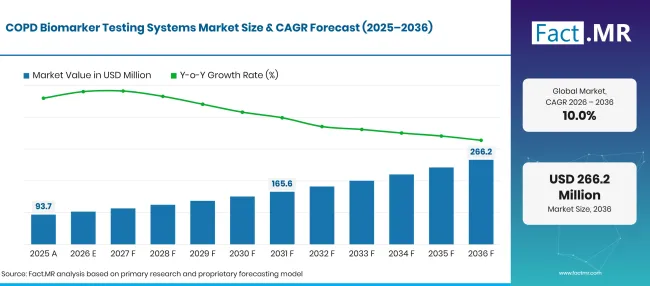
Copd Biomarker Testing Systems Forecast Global | Source: Fact.MR
What are the defining numbers behind COPD Biomarker Testing Systems Market growth?
USD 163.2 million in additional market value between 2026 and 2036.
- Demand Drivers in the Market
- The World Health Organization reported that COPD caused 3.4 million deaths worldwide in 2023 and remained the third-leading cause of death. This substantial disease burden supports investment in respiratory assessment and monitoring technologies.
- The 2026 GOLD strategy considers blood eosinophil counts when guiding inhaled corticosteroid treatment in patients with COPD. This increases the clinical relevance of biomarker testing alongside established lung-function evaluation.
- Portable breath-analysis systems can make respiratory testing more accessible in primary care and remote monitoring pathways. TidalSense’s N-Tidal platform analyzes exhaled carbon dioxide waveforms to support respiratory assessment using digital biomarkers.
- Key Segments Analyzed
- By COPD Biomarker Modality: FeNO / NO is projected to account for 31.8% of the market in 2026, reflecting demand for noninvasive exhaled-breath analysis. Its role in COPD-specific diagnosis remains limited compared with its established use in asthma.
- By Clinical Care Location: Pediatric care and home / remote settings are each set to represent 21.9% of the market in 2026, indicating demand across both supervised testing and decentralized monitoring.
- By Device Consumable Model: Service subscription is forecast to hold 25.7% of the market in 2026, supported by connected testing platforms and recurring software or service requirements.
- By Patient / Use Profile: Diagnostic evaluation is expected to lead with a 25.7% share in 2026, as biomarker systems are used to support clinical assessment and respiratory care decisions.
- Analyst Opinion at Fact.MR
- Shambhu Nath Jha, Principal Consultant at Fact.MR, states, “COPD biomarker testing is gaining attention as respiratory care moves toward more detailed patient assessment. Providers will need to distinguish established diagnostic measures from emerging biomarkers and select systems that deliver reliable results across clinical and remote care settings.”
- Strategic Implications
- Device manufacturers should validate biomarker performance against established clinical methods and provide clear evidence of accuracy and reproducibility. They also need to define the intended use of each testing platform by specifying its target patient population and clinical application. This can help healthcare professionals understand test limitations and make informed decisions.
- Healthcare providers need to interpret biomarker results alongside patient symptoms and lung-function measurements rather than relying on a single test for COPD diagnosis. Combining multiple clinical indicators can support more comprehensive patient assessments and help clinicians distinguish COPD from other respiratory conditions with overlapping symptoms.
- Developers must improve sensor reliability and simplify calibration procedures to support consistent testing across hospitals and primary care facilities. Greater measurement stability can reduce variations between testing environments and improve confidence in reported results. User-friendly interfaces and streamlined operating procedures can also make these systems easier for healthcare professionals to adopt.
- Suppliers can develop connected monitoring platforms that allow clinicians to review patient results over time and identify meaningful changes in respiratory status. Integration with electronic health records and remote monitoring systems can improve access to longitudinal patient data. These capabilities can support timely clinical assessments and more coordinated COPD management.
China is projected to record the fastest growth at a 12.3% CAGR through 2036. The USA is set to advance at 10.2%, followed by the UK at 9.9%. Germany is forecast to grow at 9.0%, while Japan is expected to record an 8.9% CAGR.
How does the COPD Biomarker Testing Systems Market break down by segment?
Fact.MR finds that FeNO / NO leads COPD Biomarker Modality at 31.8%; Pediatric care and Home / remote each account for 21.9% of Clinical Care Location; Service subscription leads Device Consumable Model at 25.7%; and Diagnostic evaluation leads Patient / Use Profile at 25.7%.
Which COPD Biomarker Modality dominates?
FeNO / NO is set to hold a 31.8% share in 2026.
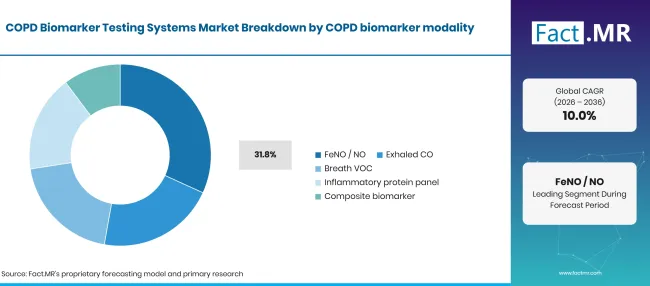
Copd Biomarker Testing Systems Breakdown Copd Biomarker Modality | Source: Fact.MR
| COPD Biomarker Modality | Share (2026) |
|---|---|
| FeNO / NO (Leading segment) | 31.8% |
| Other segments combined | 68.2%* |
| Total | 100.0% |
Source: Fact.MR analysis. Updated Nov 11, 2026
FeNO systems measure nitric oxide in exhaled breath and are established tools for assessing airway inflammation, particularly in asthma management. Their inclusion in this market reflects demand for noninvasive respiratory biomarker platforms. However, FeNO is not a standalone COPD diagnostic marker and its role in COPD assessment remains less established than spirometry and blood eosinophil testing.
Which Clinical Care Location leads?
Pediatric care and Home / remote are each set to represent 21.9% of the market in 2026.
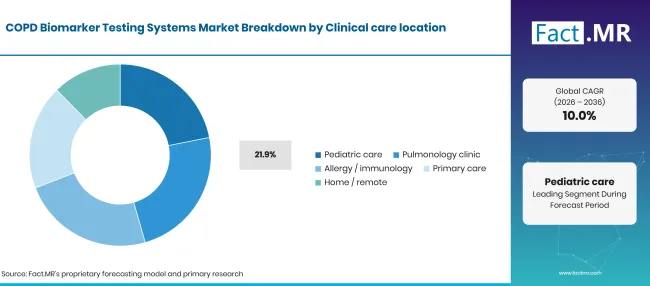
Copd Biomarker Testing Systems Breakdown Clinical Care Location | Source: Fact.MR
| Clinical Care Location | Share (2026) |
|---|---|
| Pediatric care | 21.9% |
| Home / remote | 21.9% |
| Other segments combined | 56.2%* |
| Total | 100.0% |
Source: Fact.MR analysis. Updated Nov 11, 2026
Pediatric respiratory testing is an adjacent application for some biomarker platforms. Its inclusion in COPD-specific market estimates requires evidence that the reported revenue is attributable to COPD assessment. Home and remote testing supports repeated measurement outside conventional clinical facilities. Connected devices can transmit results to clinicians for review and longitudinal monitoring. The two settings serve different patient needs and should not be treated as interchangeable.
What leads the Device Consumable Model segment?
Service subscription is set to account for 25.7% of the market in 2026.
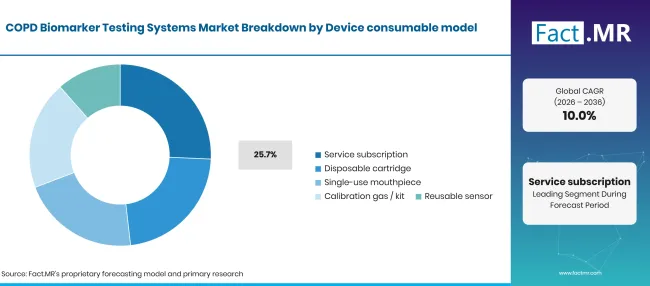
Copd Biomarker Testing Systems Breakdown Device Consumable Model | Source: Fact.MR
| Device Consumable Model | Share (2026) |
|---|---|
| Service subscription (Leading segment) | 25.7% |
| Other segments combined | 74.3%* |
| Total | 100.0% |
Source: Fact.MR analysis. Updated Nov 11, 2026
Service subscriptions can combine device access with software updates and data management support. This model is relevant to connected respiratory platforms that provide recurring monitoring and clinical dashboards. Disposable cartridges and single-use mouthpieces serve other testing systems, while reusable sensors can reduce recurring consumable requirements where device design permits.
Which Patient / Use Profile accounts for the largest share?
Diagnostic evaluation is projected to represent 25.7% of the market in 2026.
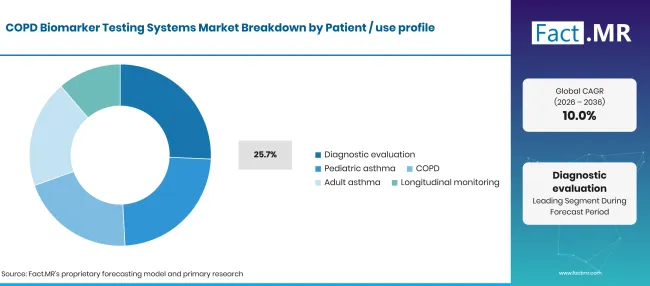
Copd Biomarker Testing Systems Breakdown Patient Use Profile | Source: Fact.MR
| Patient / Use Profile | Share (2026) |
|---|---|
| Diagnostic evaluation (Leading segment) | 25.7% |
| Other segments combined | 74.3%* |
| Total | 100.0% |
Source: Fact.MR analysis. Updated Nov 11, 2026
Diagnostic evaluation leads because respiratory biomarker systems are increasingly considered as part of broader clinical assessment. These tests can provide information about airway inflammation or respiratory physiology. COPD diagnosis still requires appropriate clinical assessment and confirmation of persistent airflow obstruction through spirometry. Biomarker results are therefore most useful when interpreted alongside symptoms and lung-function findings.
What is accelerating COPD Biomarker Testing Systems Market adoption, and what is holding it back?
Rising demand for respiratory assessment and connected monitoring supports market growth, while clinical validation requirements and uncertainty around some biomarkers can slow adoption.
Drivers Impact Analysis
| DRIVER | (~) % IMPACT ON CAGR | GEOGRAPHIC RELEVANCE | IMPACT TIMELINE |
|---|---|---|---|
| Greater focus on early COPD assessment | +1.1% | Global | Medium term (2–4 years) |
| Integration of blood eosinophils into treatment assessment | +0.9% | North America, Europe | Short term (≤ 2 years) |
| Growth in portable breath-analysis platforms | +0.8% | Europe, North America | Medium term (2–4 years) |
| Expansion of remote respiratory monitoring | +0.6% | Global | Long term (≥ 4 years) |
| Wider access to pulmonary function testing | +0.5% | Asia Pacific | Medium term (2–4 years) |
Source: Fact.MR analysis. Updated Nov 11, 2026
Opportunity Impact Analysis
| OPPORTUNITY | (~) % IMPACT ON CAGR | GEOGRAPHIC RELEVANCE | IMPACT TIMELINE |
|---|---|---|---|
| Clinical validation of emerging breath biomarkers | +0.9% | Global | Medium term (2–4 years) |
| Connected home monitoring platforms | +0.8% | North America, Europe | Long term (≥ 4 years) |
| Integration with electronic health records | +0.6% | Global | Medium term (2–4 years) |
| Point-of-care testing in primary care | +0.5% | Europe, Asia | Short term (≤ 2 years) |
Source: Fact.MR analysis. Updated Nov 11, 2026
Restraints Impact Analysis
| RESTRAINT | (~) % IMPACT ON CAGR | GEOGRAPHIC RELEVANCE | IMPACT TIMELINE |
|---|---|---|---|
| Limited clinical validation for emerging biomarkers | -0.9% | Global | Short term (≤ 2 years) |
| High equipment and testing costs | -0.7% | Emerging markets | Medium term (2–4 years) |
| Variation in test protocols and interpretation | -0.6% | Global | Medium term (2–4 years) |
| Limited reimbursement for newer testing methods | -0.5% | North America, Europe | Long term (≥ 4 years) |
Source: Fact.MR analysis. Updated Nov 11, 2026
Which countries are scaling the COPD Biomarker Testing Systems Market through 2036?
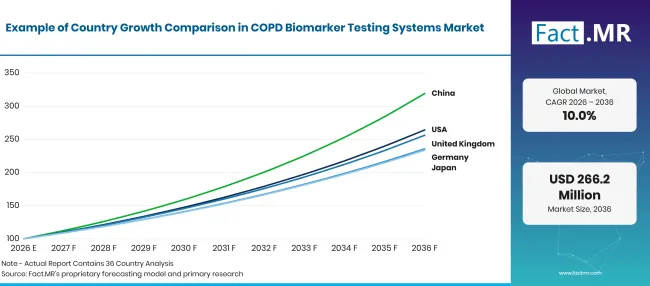
Copd Biomarker Testing Systems Growth Index | Source: Fact.MR
| Country | CAGR (2026–2036) |
|---|---|
| China | 12.3% |
| USA | 10.2% |
| UK | 9.9% |
| Germany | 9.0% |
| Japan | 8.9% |
Source: Fact.MR analysis. Updated Nov 11, 2026
What supports China’s market growth?
12.3% CAGR, supported by a substantial COPD burden and opportunities to expand respiratory assessment.
China’s large population of adults at risk of chronic respiratory disease creates demand for improved case identification and monitoring. A 2026 meta-analysis covering studies published from 2019 to 2024 estimated COPD prevalence at 11.0% among adults aged 40 and older. Wider access to pulmonary testing and biomarker-based assessment can support market development.
What supports United States adoption?
10.2% CAGR, shaped by established respiratory care services and demand for improved disease assessment.
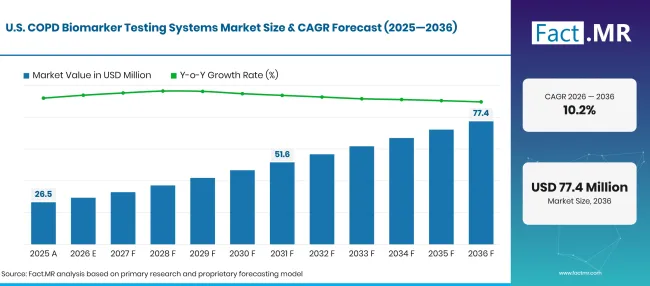
Copd Biomarker Testing Systems Forecast Usa | Source: Fact.MR
The U.S. Centers for Disease Control and Prevention reported that 4.4% of adults had ever been diagnosed with COPD, emphysema or chronic bronchitis in 2025. This patient base supports demand for respiratory evaluation and monitoring. Providers can consider biomarker platforms that complement established pulmonary function testing and support treatment assessment.
How is the United Kingdom developing this market?
9.9% CAGR, driven by COPD case identification and opportunities for primary care testing.
The Office for Health Improvement and Disparities publishes COPD indicators through England’s Respiratory Disease Profile, supporting assessment of recorded disease burden and service requirements. The scale of recorded cases supports demand for accessible diagnostic and monitoring services. Point-of-care breath testing may help primary care teams assess patients and guide further investigation.
What supports Germany’s market development?
9.0% CAGR, backed by a sizeable diagnosed COPD population and established clinical testing infrastructure.
Germany’s recorded COPD burden supports demand for assessment and respiratory management, as described in public health information from the Federal Ministry of Health. This disease burden creates demand for clinical assessment and ongoing respiratory management. Biomarker testing providers can address the market through validated systems that complement pulmonary function testing and help clinicians evaluate relevant patient characteristics.
What supports Japan’s market growth?
8.9% CAGR, led by opportunities to identify undiagnosed cases and strengthen respiratory monitoring.
Japan’s 2023 Patient Survey recorded approximately 382,000 people receiving treatment for COPD. The GOLD Japan Committee has also highlighted a substantial gap between diagnosed cases and estimated disease prevalence. This creates an opportunity for improved case finding and follow-up. Testing providers can focus on accessible respiratory assessment and clinically validated monitoring solutions.
Who leads the COPD Biomarker Testing Systems Market?
Fact.MR finds that TidalSense, MGC Diagnostics, ECO MEDICS AG, and Owlstone Medical Ltd. are profiled across the respiratory diagnostics and biomarker testing value chain.
TidalSense has a direct focus on COPD testing through its N-Tidal platform, which analyzes exhaled carbon dioxide waveforms and uses digital biomarkers to support COPD diagnosis and remote monitoring. MGC Diagnostics offers pulmonary function testing systems and respiratory diagnostic equipment. Its portfolio includes spirometry and gas exchange testing as well as FeNO testing through its Fenom Flo platform.
ECO MEDICS AG supplies pulmonary diagnostic systems, including FeNO analyzers and nitrogen washout equipment. Its EXHALYZER systems support pulmonary function assessment in conditions including COPD, while its FeNO platforms are primarily positioned for asthma management and related applications.
Competition depends on clinical validation and the ability to deliver consistent measurements across different care settings. Manufacturers need to demonstrate the intended clinical use of each biomarker and provide clear testing protocols. Connected platforms can also create differentiation through remote data transfer and longitudinal patient monitoring.
Which companies are the key providers?
Key companies include TidalSense; MGC Diagnostics; ECO MEDICS AG; and Owlstone Medical Ltd.
- TidalSense
- MGC Diagnostics
- ECO MEDICS AG
- Owlstone Medical Ltd.
Bibliography
- Centers for Disease Control and Prevention, National Center for Health Statistics. (n.d.). FastStats: Chronic Obstructive Pulmonary Disease (COPD).
- ECO MEDICS AG. (n.d.). Products.
- Federal Ministry of Health, Germany. (n.d.). Chronic obstructive pulmonary disease (COPD).
- Global Initiative for Chronic Obstructive Lung Disease. (2026). Global strategy for prevention, diagnosis and management of COPD: 2026.
- MGC Diagnostics. (n.d.). Pulmonary Function Testing (PFT).
- Ministry of Health, Labour and Welfare, Japan. (2025, September 11). 診療領域ごとの患者数 [Patient numbers by clinical area].
- National Health Commission of the People’s Republic of China. (2025, March 3). 筑牢基层慢性病防治“健康保障线” [Strengthening primary-level chronic disease prevention and treatment].
- Office for Health Improvement and Disparities. (2026, May 6). Respiratory disease profile. GOV.UK.
- TidalSense. (n.d.). N-Tidal® Capture.
- World Health Organization. (2026, June 10). Chronic obstructive pulmonary disease (COPD)..
This Report Answers
- The report evaluates the demand for COPD biomarker testing systems across the specified biomarker modalities.
- Segment analysis compares clinical care locations and device consumable models using their 2026 market shares.
- Country analysis discusses the USA, Germany, UK, China and Japan alongside available respiratory disease statistics.
- The competitive overview profiles TidalSense, MGC Diagnostics, ECO MEDICS AG, and Owlstone Medical Ltd..
- Application analysis distinguishes diagnostic evaluation from COPD-related testing and longitudinal respiratory monitoring.
What does the COPD Biomarker Testing Systems Market cover?
The market covers diagnostic and monitoring platforms that measure selected respiratory biomarkers through exhaled breath or biological samples. It includes systems designed to assess airway inflammation and respiratory physiology as well as emerging breath-analysis technologies. The scope covers equipment and associated testing models across clinical and remote care settings.
What is included in the scope?
Included products comprise dedicated respiratory biomarker analyzers and testing platforms that measure exhaled gases or inflammatory indicators relevant to respiratory assessment.
The scope also includes connected monitoring solutions and associated consumable or subscription models. Systems used to support COPD evaluation are covered when their intended application aligns with the defined market.
What is excluded from the scope?
The analysis excludes general respiratory medicines and treatment devices that do not measure biomarkers.
Standard spirometry equipment without a relevant biomarker-testing component is excluded from the defined biomarker systems market. General laboratory instruments are also excluded unless they are specifically used to provide the relevant respiratory biomarker measurement.
How Was the Analysis Built?
The analysis draws on 120+ sources, 35+ company portfolios, 25+ countries and more than 20 industry interviews.
- Primary Research: Primary research includes discussions with medical device manufacturers and respiratory care providers. These conversations examine testing priorities and purchasing criteria alongside clinical validation needs and barriers to wider adoption.
- Desk Research: Desk research covers government health statistics and clinical guidelines as well as regulatory publications and company filings. Technical studies and industry publications are reviewed to understand biomarker performance and testing applications.
- Market Sizing and Forecasting: Market estimates combine historical performance and demand indicators with segment shares and company participation. Country-level growth and adoption patterns are assessed alongside pricing trends and barriers to market expansion.
- Data Validation and Update Cycle: Findings are validated by comparing primary interviews with public data and company activity. Regular updates review new product launches and clinical validation studies as well as regulatory changes and developments in respiratory testing.
Segmentation
What is the report’s scope and coverage?
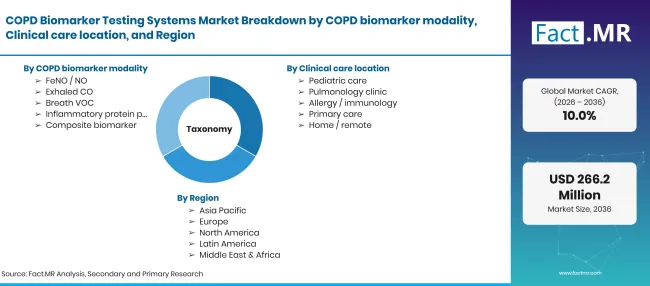
Copd Biomarker Testing Systems Taxonomy | Source: Fact.MR
| Attribute | Details |
|---|---|
| Quantitative Units | USD million in 2026 to USD million by 2036, at CAGR |
| Market Definition | COPD biomarker testing systems are diagnostic and monitoring platforms designed to measure respiratory biomarkers through exhaled breath or biological samples. These systems support the assessment of airway inflammation and respiratory function while helping healthcare professionals evaluate disease status and monitor changes in patients with chronic obstructive pulmonary disease. |
| COPD Biomarker Modality | FeNO / NO; Exhaled CO; Breath VOC; Inflammatory protein panel; Composite biomarker |
| Clinical Care Location | Pediatric care; Pulmonology clinic; Allergy / immunology; Primary care; Home / remote |
| Device Consumable Model | Service subscription; Disposable cartridge; Single-use mouthpiece; Calibration gas / kit; Reusable sensor |
| Patient / Use Profile | Diagnostic evaluation; Pediatric asthma; COPD; Adult asthma; Longitudinal monitoring |
| Regions Covered | North America; Latin America; Western Europe; Eastern Europe; East Asia; South Asia & Pacific; Middle East & Africa |
| Countries Covered | USA; Germany; UK; China; Japan |
| Companies Profiled | TidalSense; MGC Diagnostics; ECO MEDICS AG; Owlstone Medical Ltd. |
| Forecast Period | 2026 to 2036 |
| Approach | Market segmentation and scenario-based analysis supported by clinical guidelines, disease statistics and company portfolio reviews |
Source: Fact.MR analysis. Updated Nov 11, 2026
How is the market segmented?
-
By COPD Biomarker Modality
- FeNO / NO
- Exhaled CO
- Breath VOC
- Inflammatory protein panel
- Composite biomarker
-
By Clinical Care Location
- Pediatric care
- Pulmonology clinic
- Allergy / immunology
- Primary care
- Home / remote
-
By Device Consumable Model
- Service subscription
- Disposable cartridge
- Single-use mouthpiece
- Calibration gas / kit
- Reusable sensor
-
By Patient / Use Profile
- Diagnostic evaluation
- Pediatric asthma
- COPD
- Adult asthma
- Longitudinal monitoring
-
By Region
- North America
- Latin America
- Western Europe
- Eastern Europe
- East Asia
- South Asia & Pacific
- Middle East & Africa
Frequently Asked Questions
Fact.MR places the market at USD 103.0 million in 2026 and is set to reach USD 266.2 million by 2036.
What is the CAGR from 2026 to 2036?
Which COPD biomarker modality has the largest share?
Which clinical care locations lead the market?
Which device consumable model leads?
Which patient / use profile has the largest share?
Which companies are covered?
Who worked on this report


Preview the report firsthand - request a free sample
Free SampleGet the brochure for pricing and purchase details
Download PDF