- Market Value (2025): USD 360.5 Mn
- Estimated Value (2026): USD 460.0 Mn
- Forecast Value (2036): USD 5263.4 Mn
- CAGR (2026-2036): 27.6%
What is the Atmospheric Intake Propulsion Systems Market forecast to be worth by 2036?
USD 460.0 million in 2026 to USD 5263.4 million by 2036, at a 27.6% CAGR.
- The market is valued at USD 360.5 million in 2025.
- Demand is projected to increase from USD 460.0 million in 2026 to USD 5263.4 million by 2036.
- The market is forecast to record a 27.6% CAGR from 2026 to 2036 as very-low-orbit mission demand and electric propulsion research widen the commercial development base.
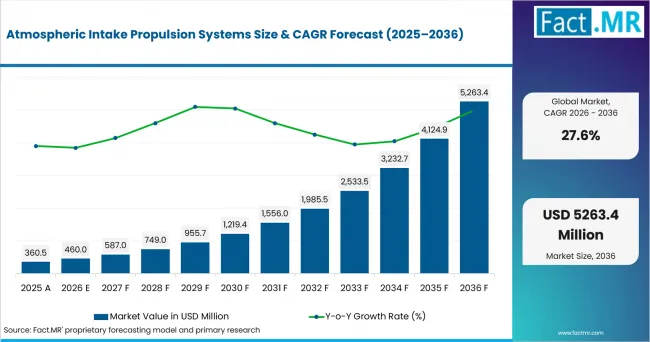
Atmospheric Intake Propulsion Systems Value Analysis | Source: Fact.MR
What are the defining numbers behind Atmospheric Intake Propulsion Systems Market growth?
USD 4,803.4 million absolute opportunity is expected between 2026 and 2036, with passive ram scoop intakes, Hall-effect coupling, 181-250 km operation and VLEO Earth observation forming the largest categories in 2026.
- Demand Drivers in the Market
- Very-low-Earth-orbit Earth observation is increasing interest in propulsion systems that can sustain spacecraft where atmospheric drag is materially higher than at conventional Earth observation altitudes.
- JAXA has demonstrated sustained operation in super-low orbit using electric propulsion, showing the mission value of active drag compensation at altitudes around the core operating band covered in this market.
- Public research infrastructure in Europe supports intake aerodynamics, electric propulsion testing and spacecraft qualification, which helps move atmospheric intake concepts from laboratory work toward integrated systems.
- Electric propulsion research continues to support Hall-effect, ion and plasma-based coupling options that can be paired with atmospheric intake architectures.
- Earth observation, security and atmospheric science programs provide the clearest mission pull because lower orbit can improve sensing geometry while increasing the propulsion burden that these systems are intended to address.
- Key Segments Analyzed
- By Intake Architecture: Passive ram scoop is expected to hold 34% share in 2026, followed by compression duct intake at 25%.
- By Thruster Coupling: Hall-effect is projected to account for 31% share in 2026, while gridded ion represents 27%.
- By Operating Altitude: 181-250 km is anticipated to capture 35% share in 2026, ahead of 251-300 km at 26%.
- By Mission: VLEO Earth observation is estimated to represent 34% share in 2026, followed by defence surveillance at 23%.
- Analyst Opinion at Fact.MR
- Shambhu Nath Jha, Senior Consultant, Fact.MR.The main commercial test is whether intake efficiency and thruster performance can be sustained together across realistic orbital conditions. Developers need to prove that the propulsion benefit remains meaningful after accounting for variable atmospheric density, spacecraft power demand and qualification requirements.
- Strategic Implications
- Developers should optimize systems around the 181-250 km band because it carries the highest operating-altitude share in the 2026 mix.
- Hall-effect and gridded-ion coupling deserve early integration work because together they represent the majority of thruster coupling demand.
- Intake design should be tested with propulsion hardware rather than as a separate aerodynamic subsystem because collection efficiency determines downstream thruster performance.
- Mission planners should evaluate altitude benefits against drag exposure and material durability before selecting a very-low-orbit architecture.
The five country growth rates remain tightly grouped from 27.6% to 29.3% through 2036. Italy is supported by national Earth observation investment and aerospace test infrastructure, France by aerodynamic research, the USA by small-spacecraft technology programs, Germany by electric propulsion research, and Japan by demonstrated super-low-orbit operations and atmospheric observation missions.
How does the Atmospheric Intake Propulsion Systems Market break down by segment?
Passive ram scoop leads Intake Architecture at 34%; Hall-effect leads Thruster Coupling at 31%; 181-250 km leads Operating Altitude at 35%; VLEO Earth observation leads Mission at 34%.
Which Intake Architecture dominates?
Passive ram scoop accounts for 34% share in 2026.
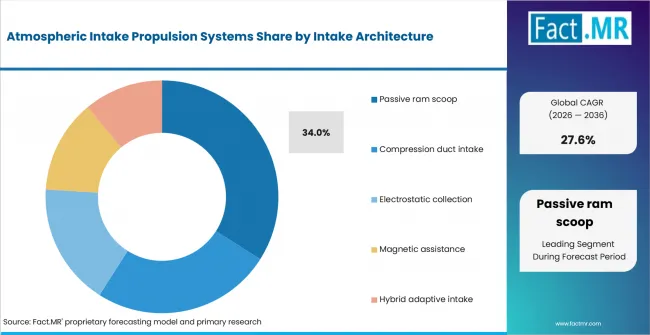
Atmospheric Intake Propulsion Systems Analysis By Intake Architecture | Source: Fact.MR
Passive ram scoop architectures lead because they offer the most direct path to collecting residual atmospheric flow without adding a separate active collection stage. Compression duct intake follows at 25%, indicating a substantial second category where flow conditioning is used to improve the gas stream delivered to the propulsion system.
Electrostatic collection represents 17%, magnetic assistance 13%, and hybrid adaptive intake 11%. Intake performance depends on spacecraft aerodynamics and qualification under low-pressure conditions. That makes adjacent capability in small satellite environmental testing relevant as developers move from component tests toward integrated spacecraft validation.
What leads the Thruster Coupling segment?
Hall-effect coupling represents 31% share in 2026.
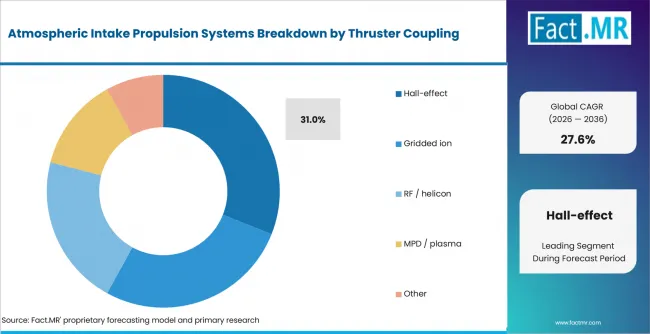
Atmospheric Intake Propulsion Systems Analysis By Thruster Coupling | Source: Fact.MR
Hall-effect coupling leads the thruster mix because electric propulsion is already used for efficient orbital control while atmospheric intake concepts need a compatible method for accelerating a low-density working medium. Gridded ion coupling follows at 27%, supported by long-standing ion propulsion experience in low-thrust spacecraft applications.
RF / helicon systems account for 21%, MPD / plasma systems 13%, and other coupling approaches 8%. DLR continues research on radio-frequency ion propulsion and other plasma propulsion concepts. The market therefore sits next to broader development in green propellants, although atmospheric intake propulsion uses a distinct operating concept and market boundary.
Why does 181-250 km lead Operating Altitude?
The 181-250 km band accounts for 35% share in 2026.
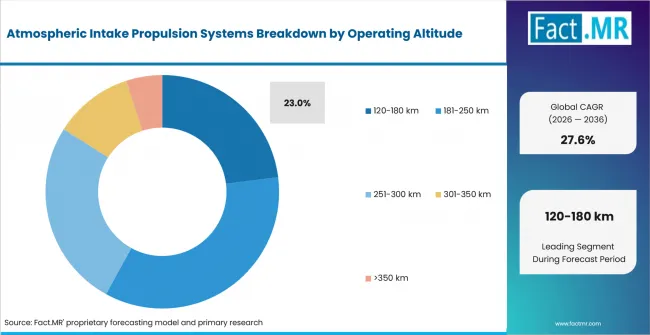
Atmospheric Intake Propulsion Systems Analysis By Operating Altitude | Source: Fact.MR
The 181-250 km band leads because it sits inside the range where very-low-orbit missions can capture stronger proximity benefits while still demanding active drag compensation. JAXA demonstrated orbit keeping down to roughly this range with its super-low-altitude test satellite, providing a public technical reference for sustained operation under much stronger atmospheric resistance than conventional Earth observation orbit.
The 251-300 km band represents 26%, while 120-180 km accounts for 23%. The 301-350 km band holds 11%, and altitudes above 350 km account for 5%. Very-low-orbit platforms must still pass thermal, vacuum and environmental qualification before deployment, linking propulsion development with the wider Earth observation ecosystem that provides much of the mission demand.
What supports VLEO Earth observation demand within Mission?
VLEO Earth observation represents 34% share in 2026.
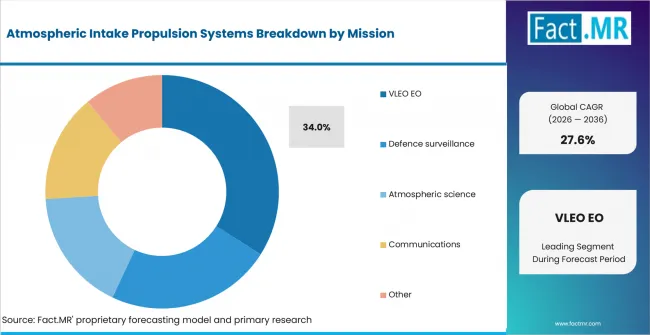
Atmospheric Intake Propulsion Systems Analysis By Mission | Source: Fact.MR
Earth observation leads the mission mix because lower altitude can improve observation geometry while creating a larger drag penalty that requires sustained orbit control. Italy's IRIDE program and Japan's Earth observation programs show the public-sector depth of demand for compact sensing platforms and recurring geospatial data.
Defence surveillance accounts for 23%, followed by atmospheric science at 17%. Communications represents 15%, while other missions account for 11%. Communications platforms create a separate demand path where low-orbit system design connects with satellite communication and satellite internet networks, although the propulsion requirement depends on the chosen orbital architecture.
What is accelerating Atmospheric Intake Propulsion Systems Market adoption, and what is holding it back?
Very-low-orbit mission demand and electric propulsion maturity support adoption; intake efficiency, material exposure and qualification complexity remain the main constraints.
Drivers Impact Analysis
| DRIVER (~) | % IMPACT ON CAGR | GEOGRAPHIC RELEVANCE | IMPACT TIMELINE |
|---|---|---|---|
| VLEO Earth observation demand | +5.1% | Global | Short term (<= 2 years) |
| Need for continuous drag compensation | +4.4% | Global | Short term (<= 2 years) |
| Public propulsion and test infrastructure | +3.2% | Europe, USA, Japan | Medium term (2-4 years) |
| Electric thruster technology maturity | +2.8% | Global | Medium term (2-4 years) |
- Very-low-orbit Earth observation is the strongest demand driver because moving a spacecraft closer to Earth can improve sensing performance while sharply increasing atmospheric drag. JAXA's super-low-altitude work provides a public demonstration that active electric propulsion can maintain operation in this environment.
- Public test infrastructure reduces part of the technical barrier. CIRA supports aerodynamic testing, space qualification and electric propulsion work, while ONERA provides wind-tunnel and aerodynamic research capability. These facilities matter because an intake propulsion system has to be evaluated as both a flow device and a propulsion subsystem.
- Electric thruster maturity gives developers multiple coupling paths. DLR highlights radio-frequency ion propulsion as an active research area, while NASA's small-spacecraft technology programs continue to fund demonstration and subsystem development for compact spacecraft platforms.
Opportunity Impact Analysis
| OPPORTUNITY (~) | % IMPACT ON CAGR | GEOGRAPHIC RELEVANCE | IMPACT TIMELINE |
|---|---|---|---|
| 181-250 km mission platforms | +4.0% | Global | Short term (<= 2 years) |
| Hall-effect and ion coupling | +3.3% | Global | Short term (<= 2 years) |
| Adaptive intake architectures | +2.6% | Europe, Japan | Medium term (2-4 years) |
| Defence VLEO missions | +2.1% | USA, Europe | Medium term (2-4 years) |
- The 181-250 km altitude band is the clearest opportunity because it carries the largest operating-altitude share and has direct relevance to proven super-low-orbit demonstrations. Systems that can sustain this range without excessive propellant dependence could support longer-duration missions in a band that remains difficult for conventional spacecraft architectures.
- Hall-effect and gridded-ion coupling provide a near-term engineering path because the two categories already account for most of the coupling mix. The opportunity is to improve intake-to-thruster matching rather than treating collection and acceleration as independent design problems.
- Adaptive intake concepts create a longer-term route where passive collection can be supplemented by electrostatic or magnetic assistance as atmospheric density changes. Defence surveillance also provides a mission class where persistence and image resolution can justify additional propulsion-system complexity.
Restraints Impact Analysis
| RESTRAINT (~) | % IMPACT ON CAGR | GEOGRAPHIC RELEVANCE | IMPACT TIMELINE |
|---|---|---|---|
| Low-density intake efficiency | -4.8% | Global | Short term (<= 2 years) |
| Atomic oxygen and contamination exposure | -3.6% | Global | Short term (<= 2 years) |
| Integrated qualification complexity | -2.9% | Global | Medium term (2-4 years) |
| Spacecraft power and thermal burden | -2.4% | Global | Medium term (2-4 years) |
- Low-density intake efficiency is the largest restraint because the propulsion system cannot deliver sustained benefit if the intake does not collect and condition enough atmospheric material for the coupled thruster. Performance can also change with altitude and atmospheric conditions, making laboratory validation more demanding than for a fixed propellant feed.
- Material exposure is another constraint. JAXA has documented the much higher atmospheric resistance and atomic oxygen environment faced by super-low-altitude spacecraft. ECSS cleanliness and contamination-control requirements add a formal qualification layer for hardware that must operate reliably after exposure to demanding ground and orbital conditions.
- Integrated qualification can extend development cycles because intake aerodynamics, plasma behavior, power electronics and spacecraft materials have to operate as one system. Power and thermal demand also matter because electric propulsion competes with payload and communications systems for limited spacecraft resources.
Which countries are scaling the Atmospheric Intake Propulsion Systems Market through 2036?
- The country outlook spans 1.7 percentage points across the 2026 to 2036 CAGR range, so the rates should be read as a tight cluster rather than a leadership ranking.
- Italy is forecast at 29.0% CAGR, supported by Earth observation investment and national aerospace test infrastructure.
- France is forecast at 27.6% CAGR, with aerodynamic research and wind-tunnel capability supporting intake-system development.
- USA is forecast at 28.0% CAGR as NASA small-spacecraft technology programs support propulsion and technology demonstration work.
- Germany is forecast at 28.5% CAGR as DLR advances electric propulsion research and related satellite technologies.
- Japan is forecast at 29.3% CAGR, supported by super-low-altitude flight experience and continuing atmospheric and Earth observation missions.
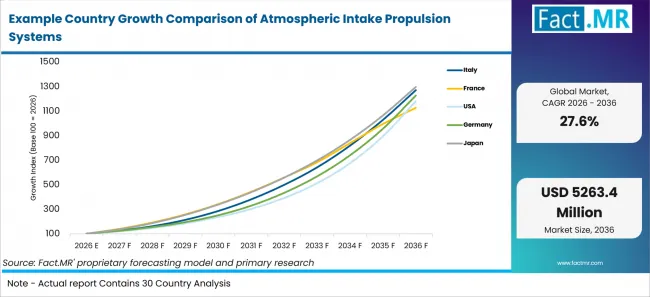
Example Country Growth Comparison Of Atmospheric Intake Propulsion Systems | Source: Fact.MR
| Country | CAGR (2026-2036) |
|---|---|
| Italy | 29.0% |
| France | 27.6% |
| USA | 28.0% |
| Germany | 28.5% |
| Japan | 29.3% |
What supports Italy adoption?
29.0% CAGR through 2036, supported by Earth observation demand and national aerospace test capability.
Italy has a clear mission-side demand base through IRIDE, the national Earth observation constellation managed with ESA support. ASI records continued satellite deployment through 2026, creating a domestic environment where compact observation platforms and supporting subsystem technologies remain active development areas.
CIRA strengthens the engineering side with aerodynamic facilities, space qualification capability and a vacuum chamber used for electric propulsion testing. That combination is relevant to atmospheric intake propulsion because developers need both flow characterization and thruster validation before an integrated system can mature.
How is France scaling demand?
27.6% CAGR through 2036, shaped by aerospace aerodynamics and space-application test capability.
France's market path is research-led. ONERA's aerodynamics work and wind-tunnel infrastructure provide a technical base for understanding intake flow, pressure behavior and heat effects that influence the performance of a residual-atmosphere collection system.
The commercial opportunity depends on translating aerodynamic evidence into compact flight hardware that can maintain useful collection efficiency across changing orbital conditions. This makes intake geometry and spacecraft integration central development priorities.
What supports USA adoption?
28.0% CAGR through 2036, supported by small-spacecraft technology development and flight demonstration programs.
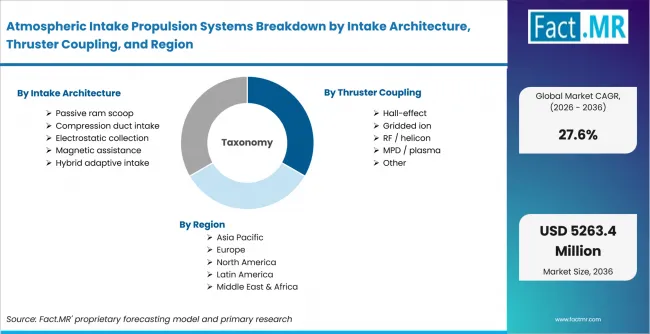
Atmospheric Intake Propulsion Systems Breakdown By Intake Architecture, Thruster Coupling, And Region | Source: Fact.MR
NASA's Space Technology Mission Directorate develops and demonstrates technologies for NASA, commercial and other government missions. Its small-spacecraft programs support subsystem development and in-space demonstration, which provides a route for advanced propulsion concepts to progress through higher technology-readiness stages.
The USA therefore offers a development environment built around small-spacecraft innovation and mission demonstration. The market opportunity depends on atmospheric intake systems reaching performance levels that justify integration into operational very-low-orbit platforms.
How is Germany scaling demand?
28.5% CAGR through 2036, supported by electric propulsion research and large-scale aerospace research infrastructure.
DLR identifies electric propulsion as an important field for satellite technology and highlights radio-frequency ion propulsion among its research priorities. That work is directly relevant to atmospheric intake propulsion because thruster coupling is a core part of the market definition.
Germany's route to market expansion is therefore technology-led. Progress in propulsion efficiency, plasma control and spacecraft integration can widen the set of very-low-orbit missions that can use intake-fed electric propulsion.
What supports Japan adoption?
29.3% CAGR through 2036, supported by super-low-orbit flight experience and continuing Earth and atmospheric observation programs.
JAXA's super-low-altitude satellite work demonstrated orbit keeping in the 181-300 km range with electric propulsion while collecting data on atmospheric density and atomic oxygen. That flight heritage is directly relevant to the operating environment covered by this market.
Japan also maintains active atmospheric and Earth observation programs, including greenhouse-gas and cloud observation missions. This sustains mission demand for compact sensing platforms while preserving a strong institutional base for low-orbit spacecraft technologies.
Who leads the Atmospheric Intake Propulsion Systems Market?
The competitive landscape includes propulsion specialists and spacecraft primes working across intake concepts, electric thrusters and very-low-orbit platform technologies. No company share is published in this assessment, so competitive position is evaluated through system capability, test progress and mission relevance rather than a market-share ranking.
Key competitors include SITAEL, Thales Alenia Space, Airbus Defence and Space, Busek, Redwire, and ThrustMe. Competition is expected to focus on intake efficiency, thruster compatibility, spacecraft integration and progression from research hardware toward qualified flight systems.
Which companies are the key providers?
Key companies include SITAEL, Thales Alenia Space, Airbus Defence and Space, Busek, Redwire, and ThrustMe.
- SITAEL
- Thales Alenia Space
- Airbus Defence and Space
- Busek
- Redwire
- ThrustMe
Bibliography
- Italian Space Agency (ASI). IRIDE satellite constellation for Earth Observation, including 2026 deployment updates. Accessed September 15, 2026.
- Italian Aerospace Research Centre (CIRA). Research infrastructures for aerodynamic testing, space qualification and electric propulsion. Accessed September 15, 2026.
- ONERA, The French Aerospace Lab. Aerodynamics, aeroelasticity and acoustics research and wind-tunnel infrastructure. Accessed September 15, 2026.
- National Aeronautics and Space Administration. State-of-the-Art of Small Spacecraft Technology and Space Technology Mission Directorate program pages. 2026 edition accessed September 15, 2026.
- German Aerospace Center (DLR). Electric propulsion systems and satellite technology research. Accessed September 15, 2026.
- Japan Aerospace Exploration Agency. Super Low Altitude Test Satellite technical brochure and current Earth observation mission material. 2025-2026 material accessed September 15, 2026.
- European Space Agency. Space Environment Report, Issue 10. Released May 1, 2026; statistics updated July 31, 2026.
- EU Agency for the Space Programme. UCP 2025 User Needs and Requirements reports. August 17, 2026.
- European Cooperation for Space Standardization. ECSS-Q-ST-70-01C Rev.1, Cleanliness and contamination control. October 15, 2025.
This Report Answers
- The report explains atmospheric intake propulsion demand across intake architecture, thruster coupling, operating altitude and mission.
- Segment analysis identifies passive ram scoop intake, Hall-effect coupling, the 181-250 km altitude band and VLEO Earth observation as the largest categories in 2026.
- Country analysis examines Italy, France, USA, Germany and Japan through 2036 without treating the narrow CAGR range as a country leadership ranking.
- Competitive analysis covers SITAEL, Thales Alenia Space, Airbus Defence and Space, Busek, Redwire and ThrustMe.
- Technology analysis considers aerodynamic collection, electric thruster coupling, material exposure and qualification requirements that affect system readiness.
- Scope analysis separates atmospheric intake propulsion from conventional stored-propellant spacecraft propulsion and from downstream satellite applications.
What does the Atmospheric Intake Propulsion Systems Market cover?
Propulsion systems designed for very-low-orbit spacecraft where atmospheric intake architecture is coupled with an onboard thruster to support sustained orbital operation.
The Atmospheric Intake Propulsion Systems Market covers systems classified by passive ram scoop, compression duct, electrostatic, magnetic or hybrid adaptive intake architectures. It also covers the Hall-effect, gridded ion, RF / helicon, MPD / plasma and other thruster coupling categories used in this assessment.
The market boundary is defined by the propulsion system rather than by the spacecraft mission itself. Earth observation, defence surveillance, atmospheric science and communications are treated as mission demand categories when they use a qualifying atmospheric intake propulsion architecture.
What is included in the scope?
Atmospheric intake architectures and their coupled thruster systems for spacecraft operating across the defined very-low-orbit altitude bands.
The scope includes systems intended for operation from 120 km through the >350 km category used in this assessment. Intake coverage includes passive, compression, electrostatic, magnetic and hybrid designs, while thruster coverage includes Hall-effect, gridded ion, RF / helicon and MPD / plasma coupling.
Country analysis covers Italy, France, USA, Germany and Japan for the forecast comparison. Public research programs, test infrastructure, Earth observation demand and qualification standards are considered where they affect development or adoption.
What is excluded from the scope?
Conventional spacecraft propulsion that does not use an atmospheric intake is outside the direct market boundary.
Standalone satellites and downstream Earth observation or communications services are excluded unless discussed as sources of mission demand. Launch vehicles are also outside the market definition.
Wind tunnels, vacuum chambers and qualification equipment are excluded as standalone markets. They are discussed only where they affect the development and validation of atmospheric intake propulsion systems.
How Was the Analysis Built?
The analysis evaluates the 2026 to 2036 market outlook using the defined intake architecture, thruster coupling, operating-altitude and mission segments together with the five countries covered in the forecast.
The assessment considers very-low-orbit mission demand, aerodynamic research, electric propulsion development, spacecraft qualification and Earth observation programs that can affect the pace of system deployment.
Market sizing is tested against segment mix and country growth within the defined atmospheric intake propulsion boundary. Public program and research evidence is used to evaluate whether the demand mechanisms described in the outlook are consistent with current spacecraft technology activity.
What is the report’s scope and coverage?
Atmospheric Intake Propulsion Systems Breakdown By Intake Architecture, Thruster Coupling, And Region | Source: Fact.MR
| Attribute | Details |
|---|---|
| Quantitative Units | USD 460.0 million in 2026 to USD 5,263.4 million by 2036 at a 27.6% CAGR |
| Market Definition | Atmospheric intake propulsion systems for very-low-orbit spacecraft, assessed by intake architecture, thruster coupling, operating altitude and mission. |
| Intake Architecture | Passive ram scoop; Compression duct intake; Electrostatic collection; Magnetic assistance; Hybrid adaptive intake |
| Thruster Coupling | Hall-effect; Gridded ion; RF / helicon; MPD / plasma; Other |
| Operating Altitude | 120-180 km; 181-250 km; 251-300 km; 301-350 km; >350 km |
| Mission | VLEO Earth observation; Defence surveillance; Atmospheric science; Communications; Other |
| Regions Covered | North America; Latin America; Western Europe; Eastern Europe; East Asia; South Asia & Pacific; Middle East & Africa |
| Countries Covered | Italy; France; USA; Germany; Japan |
| Key Companies Covered | SITAEL; Thales Alenia Space; Airbus Defence and Space; Busek; Redwire; ThrustMe |
| Forecast Period | 2026 to 2036 |
| Approach | Market sizing by intake architecture, thruster coupling, operating altitude and mission, supported by country-level space-program and research evidence. |
How is the market segmented?
-
By Intake Architecture
- Passive ram scoop
- Compression duct intake
- Electrostatic collection
- Magnetic assistance
- Hybrid adaptive intake
-
By Thruster Coupling
- Hall-effect
- Gridded ion
- RF / helicon
- MPD / plasma
- Other
-
By Operating Altitude
- 120-180 km
- 181-250 km
- 251-300 km
- 301-350 km
- >350 km
-
By Mission
- VLEO Earth observation
- Defence surveillance
- Atmospheric science
- Communications
- Other
-
By Region
- North America
- Latin America
- Western Europe
- Eastern Europe
- East Asia
- South Asia & Pacific
- Middle East & Africa