- Base Value(2026): 1 Bn
- Estimated Value(2026): 1 Bn
- Forecast Value (2036): 1.6 Bn
- CAGR (2026 - 2036): 4.4%
Water Intake Screen Market Forecast Outlook 2026 to 2036
The water intake screen market is likely to be valued at USD 1 billion in 2026 and is projected to reach USD 1.6 billion by 2036, expanding at a 4.4% compound annual growth rate (CAGR).
Key Takeaways from Water Intake Screen Market
- Water Intake Screen Market Value (2026): USD 1 billion
- Water Intake Screen Market Forecast Value (2036): USD 1.6 billion
- Water Intake Screen Market Forecast CAGR (2026-2036): 4.4%
- Leading Segment in Water Intake Screen Market: EPC/Turnkey Projects (49%)
- Key Growth Region in Water Intake Screen Market: Asia Pacific
- Key Players in Water Intake Screen Market: Aqseptence Group GmbH, Huber SE (Huber Technology), Xylem Inc., Veolia Water Technologies & Solutions, ANDRITZ AG, WesTech Engineering, LLC, Johnson Screens, Jash Engineering Pvt. Ltd., Evoqua Water Technologies LLC, Passavant-Geiger GmbH
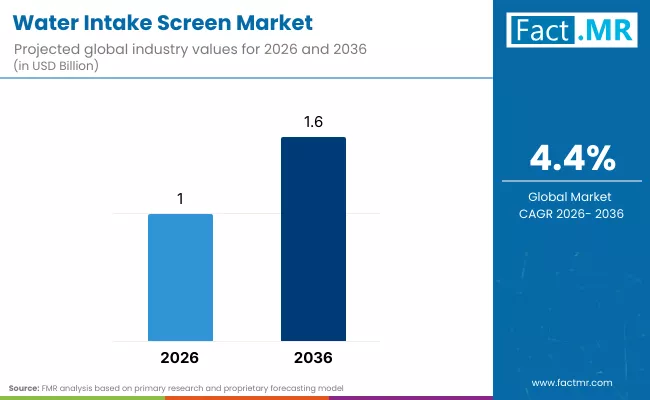
Water Intake Screen Market By Industry | Source: Fact.MR
Dominant players like Evoqua (Xylem), Veolia, and Aqseptence Group defend their pricing power by shifting from basic filtration hardware to high-margin, "active" self-cleaning and automated systems. Competitive control is maintained through high entry barriers, specifically the proprietary wedge-wire welding techniques and advanced alloy coatings, such as Z-Alloy, that prevent biofouling and zebra mussel infestation.
While the broader water industry remains fragmented, this niche is narrowing into a specialized Tier 1 cluster because municipal and power-plant buyers exhibit extreme risk aversion toward unvalidated intake solutions. Strategic market control is further cemented through long-term service contracts and "lock-in" replacement ecosystems, where the high cost of custom civil engineering makes switching vendors economically prohibitive for established facilities.
Water Intake Screen Market
| Metric | Value |
|---|---|
| Estimated Value in (2026E) | USD 1 billion |
| Forecast Value in (2036F) | USD 1.6 billion |
| Forecast CAGR (2026 to 2036) | 4.4% |
Source: Fact.MR analysis. Updated Feb 6, 2026
Category
| Category | Sub-Segment |
|---|---|
| By Screen Technology | Traveling Water Screens; Band Screens; Rotary Drum Screens; Other |
| By Installation Location | Power Plant Cooling Intakes; Municipal Water Intakes; Desalination Intakes; Irrigation/Canal Intakes |
| By Debris Type Handling | Macro Debris Screens; Fish-Friendly Screens; Fine Screening; Other |
| By Procurement Channel | EPC/Turnkey Projects; Direct to Utilities/Plants; System Integrators; Other |
| Region | North America; Europe; Asia Pacific; Latin America; Middle East & Africa |
Source: Fact.MR analysis. Updated Feb 6, 2026
Segmental Analysis
What is Driving the Dominance of Traveling Water Screens in the Water Intake Screen Market?
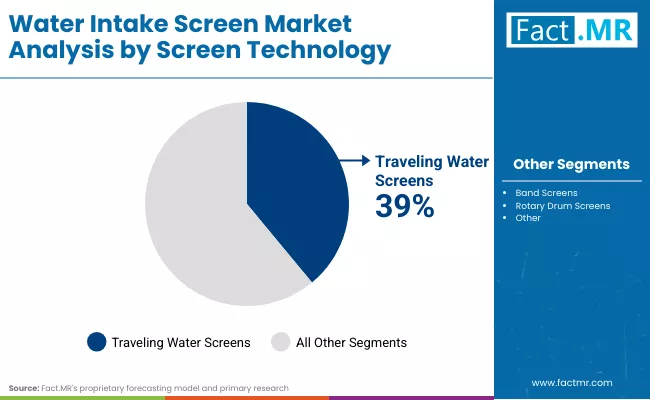
Water Intake Screen Market By Screen Technology | Source: Fact.MR
Traveling Water Screens hold 39% of the market share in 2026, driven by their ability to efficiently remove debris from water intake systems. These screens are particularly effective in high-flow applications where continuous debris removal is necessary to ensure the smooth operation of water filtration systems. The traveling mechanism allows for constant cleaning and maintenance, making them ideal for power plants, municipal water systems, and industrial applications where uninterrupted intake is essential.
What is the Role of Macro Debris Screens in the Water Intake Screen Market?
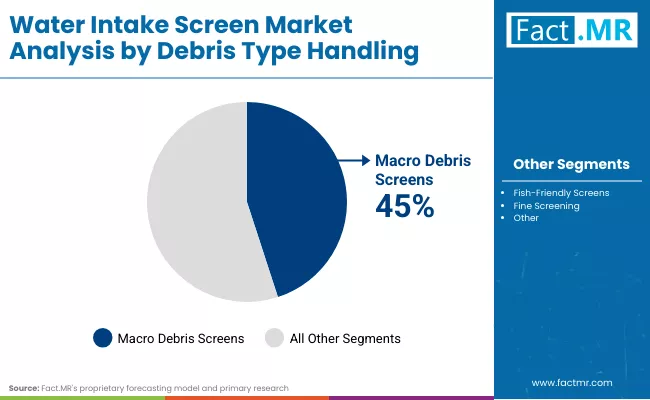
Water Intake Screen Market By Debris Type Handling | Source: Fact.MR
Macro Debris Screens account for 45% of the market share in 2026. These screens are designed to handle larger debris, such as sticks, leaves, and other organic materials, which can clog intake systems. They are commonly used in environments where water intake is exposed to a high volume of large debris, such as rivers and lakes. Their ability to effectively manage and filter out larger particles ensures the protection and efficiency of downstream processes, particularly in industries like power generation and water treatment.
Water Intake Screen Market - Drivers, Restraints & Trends
| Country | Drivers | Restraints | Trends |
|---|---|---|---|
| USA | Large utility, power, and industrial water intake infrastructure needs reliable screening for cooling and effluent systems. | High installation and maintenance costs slow small hydropower and facility upgrades. | Shift toward fish‑friendly and automated screens for environmental compliance. |
| China | Major expansion in power plants, desalination, and industrial water systems drives demand. | Price sensitivity in regional projects may delay adoption of advanced systems. | Growth in localized manufacturing and multi‑stage screening systems. |
| India | Rapid infrastructure build‑out in power, irrigation, and municipal water systems increases intake screen deployment. | Budget constraints and inconsistent enforcement of screening standards. | Rising use of modular and portable intake screens for project‑based applications. |
| Germany | Stringent environmental norms for aquatic protection and industrial water use support high‑performance intake screens. | Higher regulatory compliance and certification costs. | Adoption of eco‑friendly, automated screening with debris detection. |
| Japan | Advanced industrial and power sectors require reliable screening to protect turbine and cooling systems. | Limited new large‑scale water intake projects constrain volume growth. | Compact, efficient intake screens suited to space‑constrained installations. |
| South Korea | Strong shipbuilding, power, and industrial facilities emphasize water intake screening for cooling systems. | Competitive pricing pressures from local and imported suppliers. | Increased use of smart debris monitoring and adaptive gates. |
| Mexico | Expansion of water treatment and power plant capacity for local and export‑oriented industries drives uptake. | Cost sensitivity and uneven regulation across regions. | Growth in aftermarket services and retrofit installations of improved intake systems. |
Source: Fact.MR analysis. Updated Feb 6, 2026
Analysis of the Water Intake Screen Market by Key Country
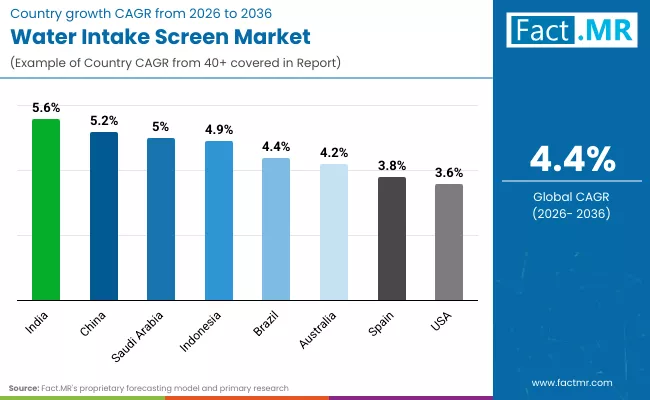
Water Intake Screen Market By Country | Source: Fact.MR
| Country | CAGR (2026-2036) |
|---|---|
| India | 5.6% |
| China | 5.2% |
| Saudi Arabia | 5.0% |
| USA | 3.6% |
| Australia | 4.2% |
| Spain | 3.8% |
| Brazil | 4.4% |
| Indonesia | 4.9% |
Source: Fact.MR analysis. Updated Feb 6, 2026
The report covers an in-depth analysis of 40+ countries; top-performing countries are highlighted below.
What Drives the Growth in the India Water Intake Screen Market?
The India water intake screen market is expanding at a rate of 5.6%, driven by the country’s growing demand for water treatment solutions. India is facing increasing water scarcity, leading to a greater need for efficient intake systems to manage water resources in power plants, municipalities, and irrigation projects. The government's push for sustainable water management and infrastructure development has led to a rise in investments in water intake technologies, including screens. Additionally, industrial and agricultural sectors’ need for clean water further fuels the demand for these systems, promoting market growth.
How Does the China Water Intake Screen Market Expand?
The China water intake screen market is growing at a rate of 5.2%, with increasing demand from the country's expanding industrial and urban sectors. China’s commitment to modernizing its water infrastructure and meeting water quality standards drives the adoption of water intake screens. The growing need for desalination plants, power plants, and industrial water supply systems boosts the demand for advanced intake screens that prevent debris from entering water treatment systems. Additionally, China’s focus on environmental sustainability and efficient water resource management further accelerates the market’s growth.
What Influences the Growth of the Saudi Arabia Water Intake Screen Market?
The Saudi Arabia water intake screen market is growing at 5.0%, driven by the country's significant investments in water desalination. As one of the largest producers of desalinated water, Saudi Arabia relies heavily on advanced intake systems to ensure the intake of clean seawater for desalination processes. The growing demand for potable water in both industrial and municipal applications further accelerates the need for high-performance water intake screens. With increasing focus on sustainable water management and technology upgrades in desalination facilities, the market for water intake screens in Saudi Arabia is expected to expand steadily.
What Drives the Growth in the USA Water Intake Screen Market?
The USA water intake screen market is growing at a rate of 3.6%, driven by the need for advanced water management solutions in power generation, municipal water treatment, and industrial sectors. As the country continues to invest in infrastructure upgrades, the demand for reliable water intake systems that prevent debris and ensure clean water supply is increasing. Environmental regulations, such as the Clean Water Act, also contribute to the market’s growth, as they require the implementation of sustainable water intake systems in many industries. Despite slower growth compared to other regions, the market remains essential for ensuring efficient water usage in various sectors.
How Does the Australia Water Intake Screen Market Expand?
The Australia water intake screen market is expanding at 4.2%, driven by the country’s increasing focus on water conservation and management. Australia’s need for efficient water intake systems is growing due to the country’s dependence on water resources for agricultural irrigation and industrial processes. The government’s initiatives to improve water quality and ensure sustainable water usage in critical industries, including mining and power generation, fuel the demand for advanced water intake screens. As Australia also faces drought challenges, the need for reliable water intake systems is essential in managing limited water resources effectively.
What Influences the Growth of the Spain Water Intake Screen Market?
The Spain water intake screen market is growing at a rate of 3.8%, with increasing demand driven by the country’s focus on water treatment and environmental sustainability. Spain’s reliance on desalination plants, particularly in coastal areas, drives the need for effective water intake systems. Additionally, the country’s agricultural sector, which relies on efficient irrigation systems, contributes to the demand for water intake screens. Spain’s push for sustainable water management and adherence to European Union water quality regulations further supports the adoption of advanced water intake screen technologies.
What Drives the Growth in the Brazil Water Intake Screen Market?
The Brazil water intake screen market is expanding at 4.4%, supported by the country’s growing industrial sector and the need for improved water management solutions. Brazil’s agricultural sector, one of the largest in the world, requires reliable irrigation systems that utilize clean water, thereby driving the demand for water intake screens. Moreover, the country’s expanding municipal water treatment infrastructure and the focus on improving water quality in urban areas contribute to the market’s growth. Brazil’s commitment to reducing water waste and improving water resource management further boosts the need for advanced water intake systems.
How Does the Indonesia Water Intake Screen Market Expand?
The Indonesia water intake screen market is growing at 4.9%, driven by the country’s increasing investments in infrastructure development and water resource management. As Indonesia faces rapid urbanization and industrialization, the need for reliable water intake systems in power plants, desalination facilities, and agricultural irrigation becomes more critical. The government’s focus on improving water quality and ensuring sustainable water usage in industrial sectors accelerates the adoption of advanced intake screens. Indonesia’s emphasis on environmental sustainability and efficient resource management ensures continued growth in the water intake screen market.
How Are Key Players Competing in the Water Intake Screen Market?
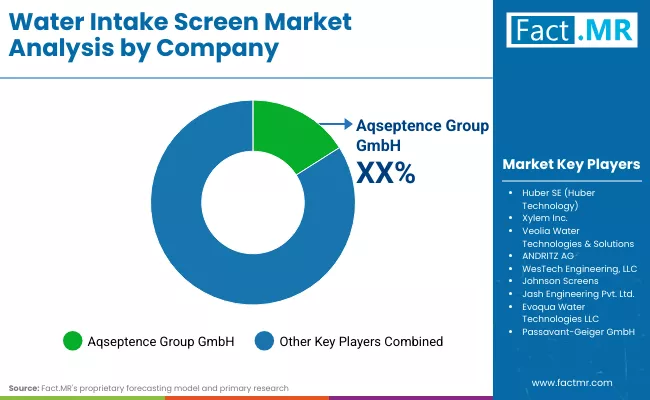
Water Intake Screen Market By Company | Source: Fact.MR
The water intake screen market is driven by the increasing demand for efficient water filtration systems in industrial, municipal, and agricultural sectors. Aqseptence Group GmbH and Huber SE lead with advanced travelling water screens and band screens, offering high-capacity filtration for cooling water intakes and wastewater treatment. Xylem Inc. and Veolia Water Technologies are focusing on smart filtration solutions, integrating sensors and digital monitoring to enhance operational efficiency. ANDRITZ AG and WesTech Engineering specialize in providing customized solutions for desalination and power plant intakes, while Johnson Screens offers precision-engineered products tailored for fine debris filtration. Jash Engineering Pvt. Ltd. and Evoqua Water Technologies are focusing on cost-effective and sustainable intake screens for municipal and industrial applications, addressing both environmental regulations and operational needs. Passavant-Geiger GmbH emphasizes innovative design and durable materials for high-flow water systems, making them competitive in global water treatment projects.
Recent Industry Developments
- Research Publication (2025): A study was published on passive water intake screen designs that reduce entrainment of debris and aquatic organisms under varying hydraulic flow conditions, demonstrating ongoing engineering advances in screening effectiveness and ecological protection.
- Field Implementation Specification (2025): A project specification document from Clackamas County (Jan 16 2025) includes details of a proposed water intake screen installation used to isolate in-water work areas, illustrating real infrastructure deployment of modern intake screens for water management and debris control.
- Regulatory Compliance Upgrade (2024): A utilities board agenda (Jul 2 2024) indicates the replacement and upgrade of existing cooling water intake screen systems to meet updated environmental rules - showing adoption of improved intake screening technology in municipal water infrastructure.
Key Players of the Water Intake Screen Market
- Aqseptence Group GmbH
- Huber SE (Huber Technology)
- Xylem Inc.
- Veolia Water Technologies & Solutions
- ANDRITZ AG
- WesTech Engineering, LLC
- Johnson Screens
- Jash Engineering Pvt. Ltd.
- Evoqua Water Technologies LLC
- Passavant-Geiger GmbH
Bibliographies
- U.S. Environmental Protection Agency. (2023). Cooling Water Intake Structures (CWA 316(b)) - National Pollutant Discharge Elimination System requirements. EPA.
- National Oceanic and Atmospheric Administration, National Marine Fisheries Service. (2024). Fish protection at water intake structures: Engineering and operational measures. NOAA Fisheries.
- U.S. Army Corps of Engineers. (2023). Engineering manual: Design of water intake structures and debris screening systems. USACE.
- Bureau of Reclamation, U.S. Department of the Interior. (2024). Design standards for water diversion and intake structures. USBR.
- International Organization for Standardization. (2023). ISO 14001: Environmental management systems - Requirements with guidance for use. ISO.
Segmentation
Scope of the Report
| Items | Values |
|---|---|
| Quantitative Units (2026) | USD Billion |
| By Screen Technology | Traveling Water Screens, Band Screens, Rotary Drum Screens, Other |
| By Installation Location | Power Plant Cooling Intakes, Municipal Water Intakes, Desalination Intakes, Irrigation/Canal Intakes |
| By Debris Type Handling | Macro Debris Screens, Fish-Friendly Screens, Fine Screening, Other |
| By Procurement Channel | EPC/Turnkey Projects, Direct to Utilities/Plants, System Integrators, Other |
| Regions Covered | North America, Europe, Asia Pacific, Latin America, Middle East & Africa |
| Countries Covered | United States, Canada, Mexico, Germany, United Kingdom, France, Japan, South Korea, China, India, Brazil, and other countries |
| Key Companies Profiled | Aqseptence Group GmbH, Huber SE (Huber Technology), Xylem Inc., Veolia Water Technologies & Solutions, ANDRITZ AG, WesTech Engineering, LLC, Johnson Screens, Jash Engineering Pvt. Ltd., Evoqua Water Technologies LLC, Passavant-Geiger GmbH |
| Additional Attributes | Dollar revenue by screen technology, installation location, debris type handling, procurement channel, and region; regional demand trends, competitive landscape, technological advancements in water intake screens, operational performance optimization initiatives, and product development strategies |
Source: Fact.MR analysis. Updated Feb 6, 2026
Water Intake Screen Market Key Segments
-
By Screen Technology :
- Traveling Water Screens
- Band Screens
- Rotary Drum Screens
- Other
-
By Installation Location :
- Power Plant Cooling Intakes
- Municipal Water Intakes
- Desalination Intakes
- Irrigation/Canal Intakes
-
By Debris Type Handling :
- Macro Debris Screens
- Fish-Friendly Screens
- Fine Screening
- Other
-
By Procurement Channel :
- EPC/Turnkey Projects
- Direct to Utilities/Plants
- System Integrators
- Other
-
Region :
- North America
- USA
- Canada
- Mexico
- Europe
- Germany
- UK
- France
- Italy
- Spain
- Nordic Countries
- BENELUX
- Rest of Europe
- Asia Pacific
- China
- Japan
- South Korea
- India
- Australia
- Rest of Asia Pacific
- Latin America
- Brazil
- Argentina
- Rest of Latin America
- Middle East and Africa
- Kingdom of Saudi Arabia
- United Arab Emirates
- South Africa
- Rest of Middle East and Africa
- Other Regions
- Oceania
- Central Asia
- Other Markets
- North America
Frequently Asked Questions
What is the projected market size for water intake screens in 2026?
What value is expected for water intake screens in 2036?
At what rate will the water intake screen market progress from 2026 to 2036?
Which region is expected to experience the fastest growth and what rate is it projected at?
Which procurement channel dominates demand and what share does it hold?
Who are the major players in the water intake screen market?
Who worked on this report


Preview the report firsthand - request a free sample
Free SampleGet the brochure for pricing and purchase details
Download PDF