The Automated Cage Handling Systems Market is analyzed across its key product, application and end-use segments, with the study covering market dynamics, regional trends and demand outlook, forecast 2026 to 2036.
By Fact.MR Industrial Goods DeskFact-checked under the Fact.MR editorial processUpdated
11 min read
Automated Cage Handling Systems Market Forecast and Outlook 2026 to 2036
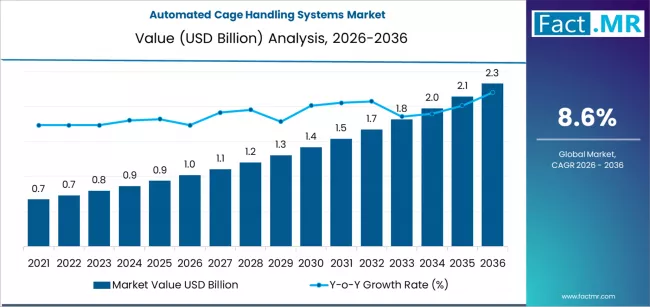
The global automated cage handling systems market is projected to total USD 1.02 billion in 2026, advancing to USD 2.33 billion by 2036, progressing at an 8.6% CAGR.
This accelerated growth is driven by the life science sector's imperative to enhance both operational efficiency and animal welfare standards within vivarium operations.
Automated Cage Handling Systems Market Market Value Analysis | Source: Fact.MR
Summary of Automated Cage Handling Systems Market
Market Snapshot
Global automated cage handling systems market revenue stood at USD 1.02 billion in 2026 and is forecast to reach USD 2.33 billion by 2036.
Ata8.6%CAGRfrom 2026 to 2036, this market is set to expand ~2.3x in value, adding USD 1.31 billion in absolute opportunity.
Growth is being driven by increasing demand for operational automation, contamination control, and animal welfare optimization across vivarium and preclinical research facilities.
Automated cage handling systems are evolving into critical laboratory infrastructure solutions, enabling improved workflow efficiency, biosecurity management, and research reproducibility across animal research operations.
Demand and Growth Drivers
Rising preclinical research activity and increasing use of rodent models in drug discovery are accelerating demand for automated cage processing systems globally.
Increasing focus on contamination control, workflow standardization, and animal welfare compliance is reinforcing market expansion across life sciences research facilities.
Growing adoption of automated vivarium technologies capable of reducing manuallabor, minimizing variability, and improving operational efficiency is supporting sustained market growth.
Pharmaceutical and research organizations are increasingly prioritizing automated systems that deliver enhanced cage washing efficiency, controlled bedding management, and integrated facility workflow optimization.
Advancements in robotic cage washing systems, automated transport technologies, and software-based facility control platforms are further supporting market adoption.
Productand Segment View
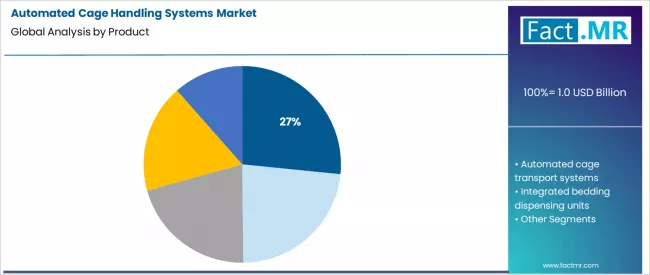
Robotic cage washing systems hold 26.6% of product segment share in 2026,emergingas the leading segment due to their ability to automatelabor-intensiveand contamination-sensitive workflow operations.
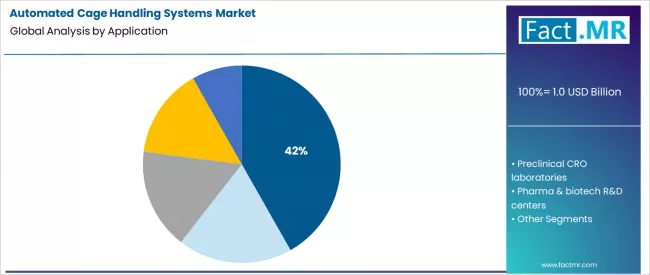
Rodent research facilities account for 41.8% of application segment share in 2026, positioning them as the dominant segment driven by high cage-processing requirements in preclinical research environments.
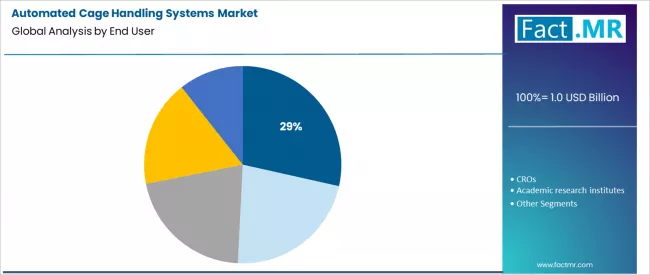
Pharmaceutical companies account for 28.5% of end-user share in 2026, supported by increasing investments in automated preclinical research infrastructure and laboratory efficiency optimization.
Automated cage transport systems, integrated bedding dispensing units, and software-driven facility management platforms arewitnessingincreasing adoption due to their ability to improve operational consistency and biosecurity performance.
Geography and Competitive Outlook
India, Brazil, China, the United States, Germany, the United Kingdom, and France represent key growth markets supported by expanding life sciences research infrastructure and increasing pharmaceutical R&D activity.
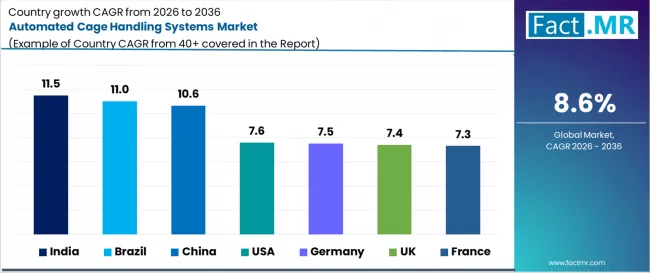
India (11.5%CAGR), Brazil (11.0%), China (10.6%), USA (7.6%), Germany (7.5%), UK (7.4%), and France (7.3%) are major growth countries within the market.
Market expansion is closely tied to preclinical research growth, pharmaceutical R&D investments, laboratory automation adoption, and increasing animal welfare compliance requirements.
Competitive dynamics are shaped by laboratory automationexpertise, vivarium workflow engineering capabilities, biosecurity management technologies, and integrated facility automation solutions.
Key companies active in this market includeTecniplast, Allentown,Getinge,BioZone, andLenderking.
Automated Cage Handling Systems Market — At a Glance
Attribute
Details
Market Value 2026
USD 1.02 billion
Market Value 2036
USD 2.33 billion
Absolute Dollar Opportunity 2026–2036
USD 1.31 billion
Total Growth 2026–2036
128.4%
CAGR2026–2036
8.6%
Growth Multiple
~2.3x
Key Demand Theme
Increasing adoption of laboratory automation and biosecurity optimization systems across vivarium operations
Leading Product Segment (2026)
Robotic Cage Washing Systems
Segment Share (2026)
26.6%
Leading Application Segment (2026)
Rodent Research Facilities
Segment Share (2026)
41.8%
Leading End User Segment (2026)
Pharmaceutical Companies
Segment Share (2026)
28.5%
Key Growth Countries
India, Brazil, China, USA, Germany, UK, France
CountryCAGRs
India 11.5%, Brazil 11.0%, China 10.6%, USA 7.6%, Germany 7.5%, UK 7.4%, France 7.3%
Rodent Research Facilities, PreclinicalCROLaboratories, Pharma & Biotech R&DCenters, Academic Animal Research Institutes, Government Research Labs
Segmentation by End User
Pharmaceutical Companies,CROs, Academic Research Institutes, Government Labs, Private Research Facilities
Segmentation by Region
North America, Latin America, Western Europe, Eastern Europe, East Asia, South Asia & Pacific, Middle East & Africa
The scaling of preclinical research, particularly in rodent models, necessitates solutions that minimize manual labor, reduce variability, and mitigate contamination risks. Robotic cage washing systems have emerged as the foundational product segment, automating the most labor-intensive and biosecurity-critical task in the workflow. The dominance of rodent research facilities as the primary application underscores the sheer volume of cage processing required in modern drug discovery and basic research. This transition to automation is not merely a logistical upgrade but a strategic investment in data quality, reproducibility, and compliance with increasingly stringent animal welfare regulations, positioning this market as a key enabler of next-generation research infrastructure.
Rodent Research Facilities, Preclinical CRO Laboratories, Pharma & Biotech R&D Centers, Academic Animal Research Institutes, Government Research Labs
End User
Pharmaceutical Companies, CROs, Academic Research Institutes, Government Labs, Private Research Facilities
Region
North America, Latin America, Western Europe, Eastern Europe, East Asia, South Asia & Pacific, Middle East & Africa
How are Research Scalability and Regulatory Compliance Converging to Drive Automation?
The exponential increase in genetically engineered rodent models and the complexity of longitudinal studies have dramatically escalated cage processing volumes, making manual workflows a bottleneck to research scalability.
Global regulatory frameworks, institutional animal care, and use committees are intensifying focus on environmental standardization, biosecurity, and the reduction of stress-related variables in animal research.
Automated systems provide a tangible solution by ensuring consistent washing parameters, minimizing cross-contamination during transport, and reducing human-animal interaction that can confound experimental data. This dual pressure to increase throughput while elevating welfare and data integrity is transforming cage handling from a facility maintenance task into a critical, technology-driven component of the scientific method.
Segmental Analysis
By Product, Which System Addresses the Most Labor-Intensive and Critical Cleaning Process?
Automated Cage Handling Systems Market Analysis By Product | Source: Fact.MR
Robotic cage washing systems command a leading 26.6% share. This segment’s central role is attributed to its direct automation of the most repetitive, physically demanding, and hygiene-critical task in vivarium management. These systems ensure consistent, high-temperature washing and sterilization of cages, feeders, and water bottles according to validated cycles.
By guaranteeing decontamination efficacy and freeing skilled technicians from manual washing, robotic systems directly address core challenges of labor shortage, ergonomic injury risk, and biosecurity, forming the essential first node in an automated workflow.
By Application, Which Setting Generates the Highest Density and Throughput Demand?
Automated Cage Handling Systems Market Analysis By Application | Source: Fact.MR
Rodent research facilities constitute the overwhelming primary application segment at 41.8%. The ubiquitous use of mouse and rat models across therapeutic areas, from oncology to neuroscience, creates an immense, continuous demand for cage processing.
The scale of these facilities, often housing tens of thousands of cages, makes the efficiency gains from automation not merely beneficial but operationally essential to maintain research momentum and animal welfare standards, securing this application's dominant market position.
By End User, Which Sector Combines High Research Volume with Capital for Infrastructure Investment?
Automated Cage Handling Systems Market Analysis By End User | Source: Fact.MR
Pharmaceutical companies hold a leading 28.5% share. This segment operates large, internal preclinical research divisions where timelines and data quality are paramount. With the resources for significant capital investment, pharmaceutical companies are early adopters of integrated automation to streamline their vivarium operations, reduce variable costs, and enhance the reproducibility of studies supporting multi-billion-dollar drug pipelines. Their demand often sets the technological standard for the wider market.
What are the Drivers, Restraints, Opportunities, and Trends Influencing Growth of the Automated Cage Handling Systems Market?
Attribute
Impact
Driver
Escalating volume and complexity of preclinical research using animal models, which overwhelms manual cage handling capacity and compromises study timelines.
Restraint
Very high capital expenditure and significant facility footprint required for installing comprehensive automated systems, creating a barrier for smaller academic or startup labs.
Opportunity
Integration of automated handling systems with digital vivarium management software for real-time inventory tracking, animal census management, and predictive maintenance scheduling.
Trend
Development of flexible, modular automation solutions that can be retrofitted into existing vivarium layouts and scaled incrementally, lowering the initial adoption threshold.
Analysis of the Automated Cage Handling Systems Market by Key Countries
Automated Cage Handling Systems Market Cagr Analysis By Country | Source: Fact.MR
Country
CAGR 2026 to 2036
USA
7.6%
Germany
7.5%
China
10.6%
India
11.5%
Brazil
11.0%
France
7.3%
UK
7.4%
What Underpins Adoption within the USA's Concentrated Biopharma Research Hub?
A 7.6% CAGR is supported by the dense concentration of large pharmaceutical headquarters and advanced preclinical CROs. These organizations invest in automation to gain a competitive edge in research speed and data quality. Demand focuses on high-throughput, integrated solutions that connect cage washing to bedding disposal and transport, often as part of new vivarium construction or major retrofits in established research campuses.
How does Germany's Research Excellence and Engineering Focus Shape Demand?
Germany's 7.5% CAGR reflects its leading position in academic life sciences and precision engineering. Max Planck institutes, university hospitals, and industrial R&D centers demand highly reliable, precise automation that integrates with stringent German animal welfare (3R principles) and facility design standards. The market favors robust systems from vendors offering strong technical support and validation services.
Which Factors are Propelling China's Rapid Expansion in Preclinical Research Capacity?
China's 10.6% CAGR is fueled by massive state and private investment in becoming a global leader in drug discovery. The construction of numerous large-scale, state-of-the-art preclinical research facilities and CRO campuses creates a greenfield market for installing automated cage handling as a core infrastructure component from the outset, driving significant system sales.
Why does India's Growth Trajectory Link to CRO and Academic Sector Expansion?
India's leading 11.5% CAGR is propelled by its booming contract research sector and the modernization of university life sciences programs. As Indian CROs compete for global preclinical studies, investing in automated vivarium operations is a key differentiator for quality and efficiency. This drives rapid adoption of entry and mid-level automation systems suitable for high-volume, cost-conscious operations.
How is Brazil's Evolving Life Sciences Ambition Influencing Market Development?
Brazil's 11.0% CAGR is connected to national strategies to grow its domestic pharmaceutical and biomedical research capacity. New government-funded research centers and expanding private labs are investing in foundational research infrastructure. Automation adoption focuses on core robotic washing systems to establish baseline efficiency and hygiene standards in growing vivariums.
What drives Steady Investment in France's Public Research Infrastructure?
France's 7.3% CAGR benefits from sustained public funding for major research organizations (INSERM, CNRS) which are modernizing their animal research facilities. Procurement is often centralized, favoring solutions that enhance animal welfare compliance and operational efficiency across multiple sites. Adoption is careful and standards-driven.
How does the UK's Strong CRO and Academic Base Guide Procurement?
The UK’s 7.4% CAGR operates within a vibrant ecosystem of world-class academic institutions and preclinical CROs. Funding from research councils and competitive grants often includes budgets for infrastructure that improves experimental rigour. Demand is for flexible systems that can handle diverse research protocols and integrate with existing building management systems.
Competitive Landscape of the Automated Cage Handling Systems Market
Specialized vendors with deep expertise in vivarium workflow and animal housing characterize the competitive landscape. Leaders like Tecniplast and Allentown compete through integrated ecosystems that combine automated cage handling with their proprietary housing systems, bedding, and environmental monitoring.
Diversified players like Getinge apply their expertise in industrial washing and sterilizing to the vivarium context. Success hinges on demonstrating reliable uptime in a 24/7 operational environment, providing comprehensive validation support for GLP-compliant facilities, and offering software that provides tangible workflow visibility and management insights to facility directors.
Key Players in the Automated Cage Handling Systems Market
Tecniplast
Allentown
Getinge
BioZone
Lenderking
Others
Bibliography
American Association for Laboratory Animal Science (AALAS). (2025). Position Paper on the Role of Automation in Enhancing Animal Welfare. Journal of the American Association for Laboratory Animal Science.
Guide for the Care and Use of Laboratory Animals, 9th Edition. (2024). National Academies Press.
National Centre for the Replacement, Refinement & Reduction of Animals in Research (NC3Rs). (2025). Automation in the Vivarium: Opportunities for the 3Rs.
Smith, J. A., & Lofgren, J. L. (2023). Vivarium Management: Principles and Practices. CRC Press.
The European Convention for the Protection of Vertebrate Animals used for Experimental and other Scientific Purposes. (2024). Guidelines for Facility Design and Management.
Tecniplast White Paper. (2025). The Integrated Vivarium: Data-Driven Workflows from Cage to Computer.
Total cost of ownership analysis comparing manual vs. automated workflows; impact analysis on staff ergonomics and turnover; review of validation protocols for automated washing cycles; study of energy and water consumption efficiency of different systems.
Market by Segments
Product :
Robotic Cage Washing Systems
Automated Cage Transport Systems
Integrated Bedding Dispensing Units
Automated Cage Storage & Retrieval
Software & Facility Control Platforms
Application :
Rodent Research Facilities
Preclinical CRO Laboratories
Pharma & Biotech R&D Centers
Academic Animal Research Institutes
Government Research Labs
End User :
Pharmaceutical Companies
CROs
Academic Research Institutes
Government Labs
Private Research Facilities
Region :
North America
USA
Canada
Latin America
Brazil
Mexico
Argentina
Rest of Latin America
Western Europe
Germany
France
UK
Italy
Spain
BENELUX
Rest of Western Europe
Eastern Europe
Poland
Russia
Czech Republic
Rest of Eastern Europe
East Asia
China
Japan
South Korea
Rest of East Asia
South Asia & Pacific
India
ASEAN
Australia & New Zealand
Rest of South Asia & Pacific
MEA
GCC Countries
South Africa
Turkiye
Rest of MEA
Frequently Asked Questions
How big is the automated cage handling systems market in 2026?
The global automated cage handling systems market is estimated to be valued at USD 1.0 billion in 2026.
What will be the size of automated cage handling systems market in 2036?
The market size for the automated cage handling systems market is projected to reach USD 2.3 billion by 2036.
How much will be the automated cage handling systems market growth between 2026 and 2036?
The automated cage handling systems market is expected to grow at a 8.6% CAGR between 2026 and 2036.
What are the key product types in the automated cage handling systems market?
The key product types in automated cage handling systems market are robotic cage washing systems, automated cage transport systems, integrated bedding dispensing units, automated cage storage & retrieval and software & facility control platforms.
Which application segment to contribute significant share in the automated cage handling systems market in 2026?
In terms of application, rodent research facilities segment to command 41.8% share in the automated cage handling systems market in 2026.