Robotic Automation Solutions for Recycling Plants Market

Robotic Automation Solutions for Recycling Plants Market Size and Share Forecast Outlook 2026 to 2036

The robotic automation solutions for recycling plants market is projected to grow from USD 1.1 billion in 2026 to USD 2.9 billion by 2036, at a CAGR of 10.6%. MRFs & plastics recycling will dominate with a 45.0% market share, while robotic picking & sorting cells will lead the automation solution type segment with a 43.1% share.

Robotic Automation Solutions for Recycling Plants Market Forecast and Outlook 2026 to 2036

The global robotic automation solutions for recycling plants market is projected to grow from USD 1.06 billion in 2026 to USD 2.93 billion by 2036, progressing at a CAGR of 10.6%. This growth is catalyzed by a critical labor shortage in waste management and stringent new purity standards for recyclate driven by global recycled content mandates.

Key Takeaways from the Robotic Automation Solutions for Recycling Plants Market

  • Market Value for 2026: USD 1.06 Billion
  • Market Value for 2036: USD 2.93 Billion
  • Forecast CAGR 2026 to 2036: 10.6%
  • Leading Technology Segment (2026): AI Vision-Guided Robotic Arms (38.0%)
  • Leading Automation Solution Type (2026): Robotic Picking & Sorting Cells (43.1%)
  • Leading Material Stream Segment (2026): Mixed Recyclables (50.0%)
  • Leading End-Use Segment (2026): MRFs & Plastics Recycling (45.0%)
  • Key Growth Countries: India (12.8% CAGR), China (11.8% CAGR), USA (9.0% CAGR), Brazil (8.5% CAGR), Germany (7.8% CAGR), Japan (5.2% CAGR)
  • Key Players in the Market: AMP Robotics, Bollegraaf Recycling Solutions, Huawei Robotics, Tata Robotics, FANUC Corporation, ZenRobotics, Stadler Anlagenbau GmbH
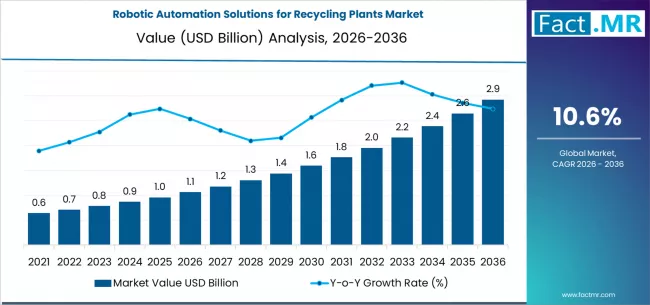
Robotic Automation Solutions For Recycling Plants Market Market Value Analysis

The expansion is not just about efficiency; it is a necessary adaptation for MRFs to remain economically viable and compliant. Specific policy decisions, such as EPR schemes that tie fees to packaging recyclability, are creating a quantifiable return on investment for automation by directly linking sorting accuracy to financial outcomes.

The evolution of the robotic automation solutions for recycling plants market is marked by a shift from standalone robotic pickers to fully integrated, data-driven ecosystems. Key developments include the proliferation of AI vision systems capable of identifying material attributes beyond polymer type, such as color, form, and even brand, for precise sorting. The integration of robotics with real-time analytics platforms is enabling predictive maintenance, dynamic sorting program changes based on feedstock, and the generation of digital purity certificates for each bale, transforming robots from simple labor replacements into central nodes of plant intelligence.

Metric

Metric Value
Market Value (2026) USD 1.06 Billion
Market Forecast Value (2036) USD 2.93 Billion
Forecast CAGR 2026 to 2036 10.6%

Category

Category Segments
End-Use MRFs & Plastics Recycling, High-Efficiency Recycling Plants, Large Recycling Hubs, Emerging MRFs, Municipal Recycling Facilities, Precision Recycling
Automation Solution Type Robotic Picking & Sorting Cells, Automated Sorting Lines, Conveyor-Integrated Robots, Semi-Automated Robot Cells, Others
Material Stream Mixed Recyclables, Plastics & Metals, Mixed Waste Streams, Plastics-Heavy Waste, Others
Technology AI Vision-Guided Robotic Arms; Multi-Robot Orchestration; Cost-Optimised Robotics; Hybrid Human-Robot Systems; Others
Region North America, Latin America, Western Europe, Eastern Europe, East Asia, South Asia & Pacific, Middle East & Africa

Segmental Analysis

By Technology, Which Innovation is reducing the 'Cognitive Load' on Robotic Systems?
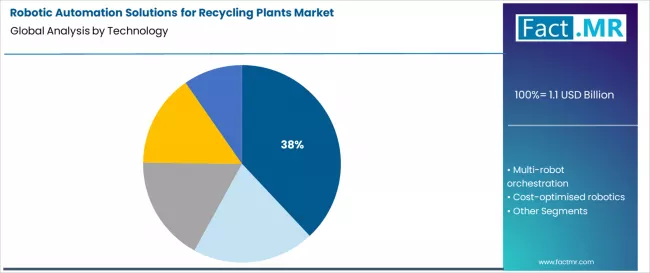
Robotic Automation Solutions For Recycling Plants Market Analysis By Technology

AI vision-guided robotic arms command a leading 38.0% share. This segment's growth is fueled by advancements in machine learning that reduce the need for explicit programming for every object. Modern systems use deep learning to generalize from vast image datasets, allowing a single robot to recognize and handle thousands of unique items without manual updates. This reduced cognitive load enables faster deployment, adaptability to changing waste streams, and lower long-term software maintenance costs, which is critical for the dynamic environment of a recycling plant.

By End-Use, Which Sector is Automating to Mitigate Operational and Regulatory Risk?
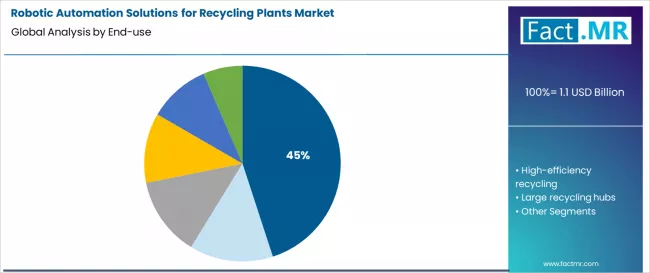
Robotic Automation Solutions For Recycling Plants Market Analysis By End Use

MRFs and plastics recycling facilities constitute the primary end-use segment at 45.0%. This sector faces the dual risk of volatile labor markets and severe financial penalties under EPR for contaminant-laden output bales. Implementing robotic automation solutions for recycling plants is a strategic risk-mitigation tool, ensuring consistent throughput and sort purity regardless of workforce availability, thereby safeguarding both operational continuity and compliance revenue.

By Material Stream, Which Category Justifies Automation Through Maximum Complexity?
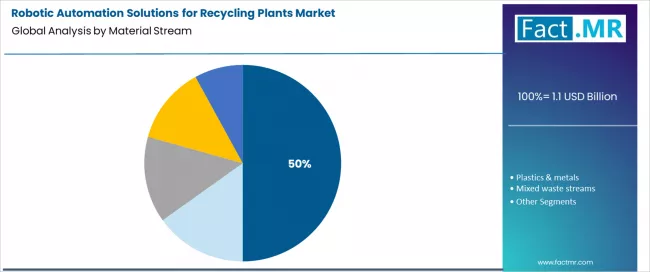
Robotic Automation Solutions For Recycling Plants Market Analysis By Material Stream

Mixed recyclables form the dominant material stream segment with a 50.0% share. This stream, comprising comingled containers, paper, and metals, presents the highest degree of complexity and variation, making it the most challenging and costly to sort manually. The economic justification for high-capital robotic systems is strongest here, as they can uniquely differentiate between a wide range of materials at high speed, directly boosting the recovery rate and value of output fractions from the most common municipal waste stream.

What are the Principal Drivers, Constraints, and Evolving Dynamics in the Robotic Automation Solutions for Recycling Plants Market?

The principal driver for the robotic automation solutions for recycling plants market is the severe and persistent skilled labor crisis in waste management, making automation a strategic necessity for continuity rather than a luxury. A major constraint is the significant upfront capital expenditure and the technical expertise required for integration and maintenance, which can be prohibitive for smaller, independent MRFs.

Opportunity lies in the nascent market for retrofitting existing legacy sorting lines with modular robotic cells, allowing for incremental automation without full plant overhaul. The dominant trend is the transition from task-specific robots to multi-purpose systems where a single robotic cell, guided by sophisticated AI, can perform multiple sorting, quality control, and even cleaning tasks, maximizing the return on automation investment.

Analysis of the Robotic Automation Solutions for Recycling Plants Market by Key Countries
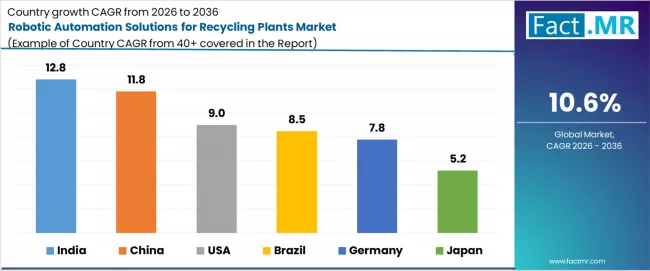
Robotic Automation Solutions For Recycling Plants Market Cagr Analysis By Country

Country CAGR 2026 to 2036
India 12.8%
China 11.8%
USA 9.0%
Brazil 8.5%
Germany 7.8%
Japan 5.2%

Is the USA's Market Advancement affected by a Mismatch between Technology and Aging Infrastructure?

The USA’s 9.0% CAGR faces a unique hurdle, deploying advanced robotic automation solutions for recycling plants within aging MRF infrastructure not designed for such technology.

Growth is driven by high labor costs and corporate sustainability demand, but is often tempered by the need for costly pre-automation upgrades to conveyors, lighting, and material feed systems, slowing widespread adoption despite strong economic drivers.

Does Germany's Regulatory Precision Create a 'Gold Standard' Testing Ground for Robotic Sorters?

Legally mandated recycling quotas and stringent output purity standards shape Germany’s 7.8% CAGR. This environment functions as a premium testing ground, demanding robotic solutions that deliver exceptionally high accuracy and detailed material data for compliance reporting. The market focuses on integrating robotics with full traceability software, setting a technological benchmark that solutions must meet to gain credibility in other regulated markets.

Can China's Dual-Path Strategy of Scale and Sovereignty Reshape Global Supply Chains?

China’s 11.8% CAGR is propelled by a dual-path strategy: deploying massive, multi-robot orchestration systems in giant state-backed recycling hubs while fostering a domestic industrial robotics sector. This approach aims to achieve scale economics and reduce dependence on foreign automation suppliers simultaneously, potentially positioning China as both the world’s largest market and a future exporter of cost-competitive robotic recycling solutions.

Will ‘Frugal Automation’ for Heterogeneous Waste Streams define India’s Growth?

India’s leading 12.8% CAGR is pioneering the concept of 'frugal automation', which includes developing and deploying cost-optimised robotics resilient enough to handle highly contaminated, heterogeneous waste with minimal human oversight. The focus is less on maximum purity and more on achieving a basic, reliable separation to formalize waste streams, creating a distinct market segment for robust, lower-cost systems with higher tolerance for variability.

Is Brazil's Trajectory Dependent on Bridging the Formal-Informal Sector Divide with Technology?

Brazil’s 8.5% CAGR hinges on the effective integration of robotic automation solutions for recycling plants into the transition from informal to formal recycling. The opportunity lies in implementing semi-automated robot cells and hybrid systems that augment the knowledge of informal waste pickers within new, structured MRFs, enhancing efficiency and safety while leveraging existing human expertise in material identification.

Does Japan's Focus on 'Hyper-Efficiency' in a Declining Waste Stream Limit Market Scale?

Japan’s 5.2% CAGR is concentrated on achieving hyper-efficiency and precision in a context of overall declining municipal waste volumes and extreme space constraints. The robotic automation solutions for recycling plants market here is characterized by compact, multi-tasking robotic cells designed for ultra-high-purity sorting to maximize the value of a shrinking feedstock, representing a high-tech but inherently niche and volume-limited approach.

Competitive Landscape of the Robotic Automation Solutions for Recycling Plants Market
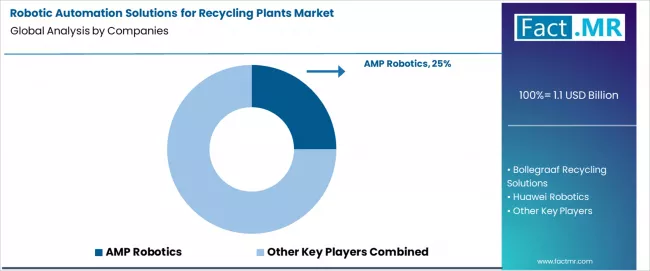
Robotic Automation Solutions For Recycling Plants Market Analysis By Company

The competitive landscape is fragmented between agile AI-software startups and established industrial robotics giants. Startups like AMP Robotics compete through superior, cloud-updatable AI algorithms and a focus on the specific problem of waste recognition, often offering robotics-as-a-service models to lower entry barriers.

Industry leaders like FANUC and Huawei Robotics leverage their expertise in reliable, high-speed robotic hardware and integration with broader industrial IoT platforms, appealing to large operators planning fully automated greenfield facilities.

The playing field is centered on data ownership and ecosystem lock-in. Companies that provide not only robots but also the proprietary operating system that analyzes sortation data and optimizes plant flow are creating sticky customer relationships.

Success is shifting towards forming alliances with waste management conglomerates and OEMs of traditional sorting equipment like Stadler and Bollegraaf to offer integrated, seamless solutions from infeed to bale, making standalone robotic arms a commodity in favor of comprehensive smart plant solutions.

Key Players in the Robotic Automation Solutions for Recycling Plants Market

  • AMP Robotics
  • Bollegraaf Recycling Solutions
  • Huawei Robotics
  • Tata Robotics
  • FANUC Corporation
  • ZenRobotics
  • Stadler Anlagenbau GmbH

Scope of Report

Items Metrics
Quantitative Units USD Billion
Technology AI Vision-Guided Robotic Arms, Multi-Robot Orchestration, Cost-Optimised Robotics, Hybrid Human-Robot Systems, Others
Automation Solution Type Robotic Picking & Sorting Cells, Automated Sorting Lines, Conveyor-Integrated Robots, Semi-Automated Robot Cells, Others
End-Use MRFs & Plastics Recycling, High-Efficiency Recycling Plants, Large Recycling Hubs, Emerging MRFs, Municipal Recycling, Precision Recycling
Material Stream Mixed Recyclables, Plastics & Metals, Mixed Waste Streams, Plastics-Heavy Waste, Others
Key Countries India, China, USA, Brazil, Germany, Japan
Key Companies AMP Robotics, Bollegraaf, Huawei Robotics, Tata Robotics, FANUC, ZenRobotics, Stadler, Others
Additional Analysis Comparative analysis of robotic vs. optical sorting capex and opex; study of AI training data requirements for different waste streams; impact of robotic sorting on workplace injury rates; analysis of resale value and upgrade paths for robotic systems; assessment of cybersecurity risks in cloud-connected automation.

Market by Segments

  • End-Use :

    • MRFs & Plastics Recycling
    • High-Efficiency Recycling Plants
    • Large Recycling Hubs
    • Emerging MRFs
    • Municipal Recycling Facilities
    • Precision Recycling
  • Automation Solution Type :

    • Robotic Picking & Sorting Cells
    • Automated Sorting Lines
    • Conveyor-Integrated Robots
    • Semi-Automated Robot Cells
    • Others
  • Material Stream :

    • Mixed Recyclables
    • Plastics & Metals
    • Mixed Waste Streams
    • Plastics-Heavy Waste
    • Others
  • Region :

    • North America
      • USA
      • Canada
    • Latin America
      • Brazil
      • Mexico
      • Argentina
      • Rest of Latin America
    • Western Europe
      • Germany
      • France
      • Italy
      • Spain
      • UK
      • BENELUX
      • Rest of Western Europe
    • Eastern Europe
      • Russia
      • Poland
      • Czech Republic
      • Rest of Eastern Europe
    • East Asia
      • China
      • Japan
      • South Korea
      • Rest of East Asia
    • South Asia & Pacific
      • India
      • ASEAN
      • Australia
      • Rest of South Asia & Pacific
    • MEA
      • GCC Countries
      • South Africa
      • Turkiye
      • Rest of MEA

References

  • International Federation of Robotics (IFR). (2025). Service Robots for Professional Use: Trends in Waste Management and Recycling. IFR Press.
  • National Waste & Recycling Association (NWRA). (2024). The Impact of Automation on MRF Safety and Economics. NWRA Safety Committee.
  • Robotic Industries Association (RIA). (2025). Integration Standards for Robotic Cells in Mixed-Industrial Environments. RIA Technical Report.
  • U.S. Department of Labor, OSHA. (2024). Guidance on Collaborative Robotics (Cobots) in Waste Management Facilities. OSHA Publication.

Table of Content

  1. Executive Summary
    • Global Market Outlook
    • Demand to side Trends
    • Supply to side Trends
    • Technology Roadmap Analysis
    • Analysis and Recommendations
  2. Market Overview
    • Market Coverage / Taxonomy
    • Market Definition / Scope / Limitations
  3. Market Background
    • Market Dynamics
      • Drivers
      • Restraints
      • Opportunity
      • Trends
    • Scenario Forecast
      • Demand in Optimistic Scenario
      • Demand in Likely Scenario
      • Demand in Conservative Scenario
    • Opportunity Map Analysis
    • Product Life Cycle Analysis
    • Supply Chain Analysis
    • Investment Feasibility Matrix
    • Value Chain Analysis
    • PESTLE and Porter’s Analysis
    • Regulatory Landscape
    • Regional Parent Market Outlook
    • Production and Consumption Statistics
    • Import and Export Statistics
  4. Global Market Analysis 2021 to 2025 and Forecast, 2026 to 2036
    • Historical Market Size Value (USD Million) Analysis, 2021 to 2025
    • Current and Future Market Size Value (USD Million) Projections, 2026 to 2036
      • Y to o to Y Growth Trend Analysis
      • Absolute $ Opportunity Analysis
  5. Global Market Pricing Analysis 2021 to 2025 and Forecast 2026 to 2036
  6. Global Market Analysis 2021 to 2025 and Forecast 2026 to 2036, By End-use
    • Introduction / Key Findings
    • Historical Market Size Value (USD Million) Analysis By End-use, 2021 to 2025
    • Current and Future Market Size Value (USD Million) Analysis and Forecast By End-use, 2026 to 2036
      • MRFs & plastics recycling
      • High-efficiency recycling
      • Large recycling hubs
      • Emerging MRFs
      • Municipal recycling
      • Precision recycling
    • Y to o to Y Growth Trend Analysis By End-use, 2021 to 2025
    • Absolute $ Opportunity Analysis By End-use, 2026 to 2036
  7. Global Market Analysis 2021 to 2025 and Forecast 2026 to 2036, By Automation Solution Type
    • Introduction / Key Findings
    • Historical Market Size Value (USD Million) Analysis By Automation Solution Type, 2021 to 2025
    • Current and Future Market Size Value (USD Million) Analysis and Forecast By Automation Solution Type, 2026 to 2036
      • Robotic picking & sorting cells
      • Automated sorting lines
      • Conveyor-integrated robots
      • Semi-automated robot cells
      • Others
    • Y to o to Y Growth Trend Analysis By Automation Solution Type, 2021 to 2025
    • Absolute $ Opportunity Analysis By Automation Solution Type, 2026 to 2036
  8. Global Market Analysis 2021 to 2025 and Forecast 2026 to 2036, By Material Stream
    • Introduction / Key Findings
    • Historical Market Size Value (USD Million) Analysis By Material Stream, 2021 to 2025
    • Current and Future Market Size Value (USD Million) Analysis and Forecast By Material Stream, 2026 to 2036
      • Mixed recyclables
      • Plastics & metals
      • Mixed waste streams
      • Plastics-heavy waste
      • Others
    • Y to o to Y Growth Trend Analysis By Material Stream, 2021 to 2025
    • Absolute $ Opportunity Analysis By Material Stream, 2026 to 2036
  9. Global Market Analysis 2021 to 2025 and Forecast 2026 to 2036, By Technology
    • Introduction / Key Findings
    • Historical Market Size Value (USD Million) Analysis By Technology, 2021 to 2025
    • Current and Future Market Size Value (USD Million) Analysis and Forecast By Technology, 2026 to 2036
      • AI vision-guided robotic arms
      • Multi-robot orchestration
      • Cost-optimised robotics
      • Hybrid human-robot systems
      • Others
    • Y to o to Y Growth Trend Analysis By Technology, 2021 to 2025
    • Absolute $ Opportunity Analysis By Technology, 2026 to 2036
  10. Global Market Analysis 2021 to 2025 and Forecast 2026 to 2036, By Region
    • Introduction
    • Historical Market Size Value (USD Million) Analysis By Region, 2021 to 2025
    • Current Market Size Value (USD Million) Analysis and Forecast By Region, 2026 to 2036
      • North America
      • Latin America
      • Western Europe
      • Eastern Europe
      • East Asia
      • South Asia and Pacific
      • Middle East & Africa
    • Market Attractiveness Analysis By Region
  11. North America Market Analysis 2021 to 2025 and Forecast 2026 to 2036, By Country
    • Historical Market Size Value (USD Million) Trend Analysis By Market Taxonomy, 2021 to 2025
    • Market Size Value (USD Million) Forecast By Market Taxonomy, 2026 to 2036
      • By Country
        • USA
        • Canada
        • Mexico
      • By End-use
      • By Automation Solution Type
      • By Material Stream
      • By Technology
    • Market Attractiveness Analysis
      • By Country
      • By End-use
      • By Automation Solution Type
      • By Material Stream
      • By Technology
    • Key Takeaways
  12. Latin America Market Analysis 2021 to 2025 and Forecast 2026 to 2036, By Country
    • Historical Market Size Value (USD Million) Trend Analysis By Market Taxonomy, 2021 to 2025
    • Market Size Value (USD Million) Forecast By Market Taxonomy, 2026 to 2036
      • By Country
        • Brazil
        • Chile
        • Rest of Latin America
      • By End-use
      • By Automation Solution Type
      • By Material Stream
      • By Technology
    • Market Attractiveness Analysis
      • By Country
      • By End-use
      • By Automation Solution Type
      • By Material Stream
      • By Technology
    • Key Takeaways
  13. Western Europe Market Analysis 2021 to 2025 and Forecast 2026 to 2036, By Country
    • Historical Market Size Value (USD Million) Trend Analysis By Market Taxonomy, 2021 to 2025
    • Market Size Value (USD Million) Forecast By Market Taxonomy, 2026 to 2036
      • By Country
        • Germany
        • UK
        • Italy
        • Spain
        • France
        • Nordic
        • BENELUX
        • Rest of Western Europe
      • By End-use
      • By Automation Solution Type
      • By Material Stream
      • By Technology
    • Market Attractiveness Analysis
      • By Country
      • By End-use
      • By Automation Solution Type
      • By Material Stream
      • By Technology
    • Key Takeaways
  14. Eastern Europe Market Analysis 2021 to 2025 and Forecast 2026 to 2036, By Country
    • Historical Market Size Value (USD Million) Trend Analysis By Market Taxonomy, 2021 to 2025
    • Market Size Value (USD Million) Forecast By Market Taxonomy, 2026 to 2036
      • By Country
        • Russia
        • Poland
        • Hungary
        • Balkan & Baltic
        • Rest of Eastern Europe
      • By End-use
      • By Automation Solution Type
      • By Material Stream
      • By Technology
    • Market Attractiveness Analysis
      • By Country
      • By End-use
      • By Automation Solution Type
      • By Material Stream
      • By Technology
    • Key Takeaways
  15. East Asia Market Analysis 2021 to 2025 and Forecast 2026 to 2036, By Country
    • Historical Market Size Value (USD Million) Trend Analysis By Market Taxonomy, 2021 to 2025
    • Market Size Value (USD Million) Forecast By Market Taxonomy, 2026 to 2036
      • By Country
        • China
        • Japan
        • South Korea
      • By End-use
      • By Automation Solution Type
      • By Material Stream
      • By Technology
    • Market Attractiveness Analysis
      • By Country
      • By End-use
      • By Automation Solution Type
      • By Material Stream
      • By Technology
    • Key Takeaways
  16. South Asia and Pacific Market Analysis 2021 to 2025 and Forecast 2026 to 2036, By Country
    • Historical Market Size Value (USD Million) Trend Analysis By Market Taxonomy, 2021 to 2025
    • Market Size Value (USD Million) Forecast By Market Taxonomy, 2026 to 2036
      • By Country
        • India
        • ASEAN
        • Australia & New Zealand
        • Rest of South Asia and Pacific
      • By End-use
      • By Automation Solution Type
      • By Material Stream
      • By Technology
    • Market Attractiveness Analysis
      • By Country
      • By End-use
      • By Automation Solution Type
      • By Material Stream
      • By Technology
    • Key Takeaways
  17. Middle East & Africa Market Analysis 2021 to 2025 and Forecast 2026 to 2036, By Country
    • Historical Market Size Value (USD Million) Trend Analysis By Market Taxonomy, 2021 to 2025
    • Market Size Value (USD Million) Forecast By Market Taxonomy, 2026 to 2036
      • By Country
        • Kingdom of Saudi Arabia
        • Other GCC Countries
        • Turkiye
        • South Africa
        • Other African Union
        • Rest of Middle East & Africa
      • By End-use
      • By Automation Solution Type
      • By Material Stream
      • By Technology
    • Market Attractiveness Analysis
      • By Country
      • By End-use
      • By Automation Solution Type
      • By Material Stream
      • By Technology
    • Key Takeaways
  18. Key Countries Market Analysis
    • USA
      • Pricing Analysis
      • Market Share Analysis, 2025
        • By End-use
        • By Automation Solution Type
        • By Material Stream
        • By Technology
    • Canada
      • Pricing Analysis
      • Market Share Analysis, 2025
        • By End-use
        • By Automation Solution Type
        • By Material Stream
        • By Technology
    • Mexico
      • Pricing Analysis
      • Market Share Analysis, 2025
        • By End-use
        • By Automation Solution Type
        • By Material Stream
        • By Technology
    • Brazil
      • Pricing Analysis
      • Market Share Analysis, 2025
        • By End-use
        • By Automation Solution Type
        • By Material Stream
        • By Technology
    • Chile
      • Pricing Analysis
      • Market Share Analysis, 2025
        • By End-use
        • By Automation Solution Type
        • By Material Stream
        • By Technology
    • Germany
      • Pricing Analysis
      • Market Share Analysis, 2025
        • By End-use
        • By Automation Solution Type
        • By Material Stream
        • By Technology
    • UK
      • Pricing Analysis
      • Market Share Analysis, 2025
        • By End-use
        • By Automation Solution Type
        • By Material Stream
        • By Technology
    • Italy
      • Pricing Analysis
      • Market Share Analysis, 2025
        • By End-use
        • By Automation Solution Type
        • By Material Stream
        • By Technology
    • Spain
      • Pricing Analysis
      • Market Share Analysis, 2025
        • By End-use
        • By Automation Solution Type
        • By Material Stream
        • By Technology
    • France
      • Pricing Analysis
      • Market Share Analysis, 2025
        • By End-use
        • By Automation Solution Type
        • By Material Stream
        • By Technology
    • India
      • Pricing Analysis
      • Market Share Analysis, 2025
        • By End-use
        • By Automation Solution Type
        • By Material Stream
        • By Technology
    • ASEAN
      • Pricing Analysis
      • Market Share Analysis, 2025
        • By End-use
        • By Automation Solution Type
        • By Material Stream
        • By Technology
    • Australia & New Zealand
      • Pricing Analysis
      • Market Share Analysis, 2025
        • By End-use
        • By Automation Solution Type
        • By Material Stream
        • By Technology
    • China
      • Pricing Analysis
      • Market Share Analysis, 2025
        • By End-use
        • By Automation Solution Type
        • By Material Stream
        • By Technology
    • Japan
      • Pricing Analysis
      • Market Share Analysis, 2025
        • By End-use
        • By Automation Solution Type
        • By Material Stream
        • By Technology
    • South Korea
      • Pricing Analysis
      • Market Share Analysis, 2025
        • By End-use
        • By Automation Solution Type
        • By Material Stream
        • By Technology
    • Russia
      • Pricing Analysis
      • Market Share Analysis, 2025
        • By End-use
        • By Automation Solution Type
        • By Material Stream
        • By Technology
    • Poland
      • Pricing Analysis
      • Market Share Analysis, 2025
        • By End-use
        • By Automation Solution Type
        • By Material Stream
        • By Technology
    • Hungary
      • Pricing Analysis
      • Market Share Analysis, 2025
        • By End-use
        • By Automation Solution Type
        • By Material Stream
        • By Technology
    • Kingdom of Saudi Arabia
      • Pricing Analysis
      • Market Share Analysis, 2025
        • By End-use
        • By Automation Solution Type
        • By Material Stream
        • By Technology
    • Turkiye
      • Pricing Analysis
      • Market Share Analysis, 2025
        • By End-use
        • By Automation Solution Type
        • By Material Stream
        • By Technology
    • South Africa
      • Pricing Analysis
      • Market Share Analysis, 2025
        • By End-use
        • By Automation Solution Type
        • By Material Stream
        • By Technology
  19. Market Structure Analysis
    • Competition Dashboard
    • Competition Benchmarking
    • Market Share Analysis of Top Players
      • By Regional
      • By End-use
      • By Automation Solution Type
      • By Material Stream
      • By Technology
  20. Competition Analysis
    • Competition Deep Dive
      • AMP Robotics
        • Overview
        • Product Portfolio
        • Profitability by Market Segments (Product/Age /Sales Channel/Region)
        • Sales Footprint
        • Strategy Overview
          • Marketing Strategy
          • Product Strategy
          • Channel Strategy
      • Bollegraaf Recycling Solutions
      • Huawei Robotics
      • Tata Robotics
      • FANUC Corporation
      • ZenRobotics
      • Stadler Anlagenbau GmbH
  21. Assumptions & Acronyms Used
  22. Research Methodology

List Of Table

  • Table 1: Global Market Value (USD Million) Forecast by Region, 2021 to 2036
  • Table 2: Global Market Value (USD Million) Forecast by End-use, 2021 to 2036
  • Table 3: Global Market Value (USD Million) Forecast by Automation Solution Type, 2021 to 2036
  • Table 4: Global Market Value (USD Million) Forecast by Material Stream, 2021 to 2036
  • Table 5: Global Market Value (USD Million) Forecast by Technology, 2021 to 2036
  • Table 6: North America Market Value (USD Million) Forecast by Country, 2021 to 2036
  • Table 7: North America Market Value (USD Million) Forecast by End-use, 2021 to 2036
  • Table 8: North America Market Value (USD Million) Forecast by Automation Solution Type, 2021 to 2036
  • Table 9: North America Market Value (USD Million) Forecast by Material Stream, 2021 to 2036
  • Table 10: North America Market Value (USD Million) Forecast by Technology, 2021 to 2036
  • Table 11: Latin America Market Value (USD Million) Forecast by Country, 2021 to 2036
  • Table 12: Latin America Market Value (USD Million) Forecast by End-use, 2021 to 2036
  • Table 13: Latin America Market Value (USD Million) Forecast by Automation Solution Type, 2021 to 2036
  • Table 14: Latin America Market Value (USD Million) Forecast by Material Stream, 2021 to 2036
  • Table 15: Latin America Market Value (USD Million) Forecast by Technology, 2021 to 2036
  • Table 16: Western Europe Market Value (USD Million) Forecast by Country, 2021 to 2036
  • Table 17: Western Europe Market Value (USD Million) Forecast by End-use, 2021 to 2036
  • Table 18: Western Europe Market Value (USD Million) Forecast by Automation Solution Type, 2021 to 2036
  • Table 19: Western Europe Market Value (USD Million) Forecast by Material Stream, 2021 to 2036
  • Table 20: Western Europe Market Value (USD Million) Forecast by Technology, 2021 to 2036
  • Table 21: Eastern Europe Market Value (USD Million) Forecast by Country, 2021 to 2036
  • Table 22: Eastern Europe Market Value (USD Million) Forecast by End-use, 2021 to 2036
  • Table 23: Eastern Europe Market Value (USD Million) Forecast by Automation Solution Type, 2021 to 2036
  • Table 24: Eastern Europe Market Value (USD Million) Forecast by Material Stream, 2021 to 2036
  • Table 25: Eastern Europe Market Value (USD Million) Forecast by Technology, 2021 to 2036
  • Table 26: East Asia Market Value (USD Million) Forecast by Country, 2021 to 2036
  • Table 27: East Asia Market Value (USD Million) Forecast by End-use, 2021 to 2036
  • Table 28: East Asia Market Value (USD Million) Forecast by Automation Solution Type, 2021 to 2036
  • Table 29: East Asia Market Value (USD Million) Forecast by Material Stream, 2021 to 2036
  • Table 30: East Asia Market Value (USD Million) Forecast by Technology, 2021 to 2036
  • Table 31: South Asia and Pacific Market Value (USD Million) Forecast by Country, 2021 to 2036
  • Table 32: South Asia and Pacific Market Value (USD Million) Forecast by End-use, 2021 to 2036
  • Table 33: South Asia and Pacific Market Value (USD Million) Forecast by Automation Solution Type, 2021 to 2036
  • Table 34: South Asia and Pacific Market Value (USD Million) Forecast by Material Stream, 2021 to 2036
  • Table 35: South Asia and Pacific Market Value (USD Million) Forecast by Technology, 2021 to 2036
  • Table 36: Middle East & Africa Market Value (USD Million) Forecast by Country, 2021 to 2036
  • Table 37: Middle East & Africa Market Value (USD Million) Forecast by End-use, 2021 to 2036
  • Table 38: Middle East & Africa Market Value (USD Million) Forecast by Automation Solution Type, 2021 to 2036
  • Table 39: Middle East & Africa Market Value (USD Million) Forecast by Material Stream, 2021 to 2036
  • Table 40: Middle East & Africa Market Value (USD Million) Forecast by Technology, 2021 to 2036

List Of Figures

  • Figure 1: Global Market Pricing Analysis
  • Figure 2: Global Market Value (USD Million) Forecast 2021 to 2036
  • Figure 3: Global Market Value Share and BPS Analysis by End-use, 2026 and 2036
  • Figure 4: Global Market Y to o to Y Growth Comparison by End-use, 2026 to 2036
  • Figure 5: Global Market Attractiveness Analysis by End-use
  • Figure 6: Global Market Value Share and BPS Analysis by Automation Solution Type, 2026 and 2036
  • Figure 7: Global Market Y to o to Y Growth Comparison by Automation Solution Type, 2026 to 2036
  • Figure 8: Global Market Attractiveness Analysis by Automation Solution Type
  • Figure 9: Global Market Value Share and BPS Analysis by Material Stream, 2026 and 2036
  • Figure 10: Global Market Y to o to Y Growth Comparison by Material Stream, 2026 to 2036
  • Figure 11: Global Market Attractiveness Analysis by Material Stream
  • Figure 12: Global Market Value Share and BPS Analysis by Technology, 2026 and 2036
  • Figure 13: Global Market Y to o to Y Growth Comparison by Technology, 2026 to 2036
  • Figure 14: Global Market Attractiveness Analysis by Technology
  • Figure 15: Global Market Value (USD Million) Share and BPS Analysis by Region, 2026 and 2036
  • Figure 16: Global Market Y to o to Y Growth Comparison by Region, 2026 to 2036
  • Figure 17: Global Market Attractiveness Analysis by Region
  • Figure 18: North America Market Incremental Dollar Opportunity, 2026 to 2036
  • Figure 19: Latin America Market Incremental Dollar Opportunity, 2026 to 2036
  • Figure 20: Western Europe Market Incremental Dollar Opportunity, 2026 to 2036
  • Figure 21: Eastern Europe Market Incremental Dollar Opportunity, 2026 to 2036
  • Figure 22: East Asia Market Incremental Dollar Opportunity, 2026 to 2036
  • Figure 23: South Asia and Pacific Market Incremental Dollar Opportunity, 2026 to 2036
  • Figure 24: Middle East & Africa Market Incremental Dollar Opportunity, 2026 to 2036
  • Figure 25: North America Market Value Share and BPS Analysis by Country, 2026 and 2036
  • Figure 26: North America Market Value Share and BPS Analysis by End-use, 2026 and 2036
  • Figure 27: North America Market Y to o to Y Growth Comparison by End-use, 2026 to 2036
  • Figure 28: North America Market Attractiveness Analysis by End-use
  • Figure 29: North America Market Value Share and BPS Analysis by Automation Solution Type, 2026 and 2036
  • Figure 30: North America Market Y to o to Y Growth Comparison by Automation Solution Type, 2026 to 2036
  • Figure 31: North America Market Attractiveness Analysis by Automation Solution Type
  • Figure 32: North America Market Value Share and BPS Analysis by Material Stream, 2026 and 2036
  • Figure 33: North America Market Y to o to Y Growth Comparison by Material Stream, 2026 to 2036
  • Figure 34: North America Market Attractiveness Analysis by Material Stream
  • Figure 35: North America Market Value Share and BPS Analysis by Technology, 2026 and 2036
  • Figure 36: North America Market Y to o to Y Growth Comparison by Technology, 2026 to 2036
  • Figure 37: North America Market Attractiveness Analysis by Technology
  • Figure 38: Latin America Market Value Share and BPS Analysis by Country, 2026 and 2036
  • Figure 39: Latin America Market Value Share and BPS Analysis by End-use, 2026 and 2036
  • Figure 40: Latin America Market Y to o to Y Growth Comparison by End-use, 2026 to 2036
  • Figure 41: Latin America Market Attractiveness Analysis by End-use
  • Figure 42: Latin America Market Value Share and BPS Analysis by Automation Solution Type, 2026 and 2036
  • Figure 43: Latin America Market Y to o to Y Growth Comparison by Automation Solution Type, 2026 to 2036
  • Figure 44: Latin America Market Attractiveness Analysis by Automation Solution Type
  • Figure 45: Latin America Market Value Share and BPS Analysis by Material Stream, 2026 and 2036
  • Figure 46: Latin America Market Y to o to Y Growth Comparison by Material Stream, 2026 to 2036
  • Figure 47: Latin America Market Attractiveness Analysis by Material Stream
  • Figure 48: Latin America Market Value Share and BPS Analysis by Technology, 2026 and 2036
  • Figure 49: Latin America Market Y to o to Y Growth Comparison by Technology, 2026 to 2036
  • Figure 50: Latin America Market Attractiveness Analysis by Technology
  • Figure 51: Western Europe Market Value Share and BPS Analysis by Country, 2026 and 2036
  • Figure 52: Western Europe Market Value Share and BPS Analysis by End-use, 2026 and 2036
  • Figure 53: Western Europe Market Y to o to Y Growth Comparison by End-use, 2026 to 2036
  • Figure 54: Western Europe Market Attractiveness Analysis by End-use
  • Figure 55: Western Europe Market Value Share and BPS Analysis by Automation Solution Type, 2026 and 2036
  • Figure 56: Western Europe Market Y to o to Y Growth Comparison by Automation Solution Type, 2026 to 2036
  • Figure 57: Western Europe Market Attractiveness Analysis by Automation Solution Type
  • Figure 58: Western Europe Market Value Share and BPS Analysis by Material Stream, 2026 and 2036
  • Figure 59: Western Europe Market Y to o to Y Growth Comparison by Material Stream, 2026 to 2036
  • Figure 60: Western Europe Market Attractiveness Analysis by Material Stream
  • Figure 61: Western Europe Market Value Share and BPS Analysis by Technology, 2026 and 2036
  • Figure 62: Western Europe Market Y to o to Y Growth Comparison by Technology, 2026 to 2036
  • Figure 63: Western Europe Market Attractiveness Analysis by Technology
  • Figure 64: Eastern Europe Market Value Share and BPS Analysis by Country, 2026 and 2036
  • Figure 65: Eastern Europe Market Value Share and BPS Analysis by End-use, 2026 and 2036
  • Figure 66: Eastern Europe Market Y to o to Y Growth Comparison by End-use, 2026 to 2036
  • Figure 67: Eastern Europe Market Attractiveness Analysis by End-use
  • Figure 68: Eastern Europe Market Value Share and BPS Analysis by Automation Solution Type, 2026 and 2036
  • Figure 69: Eastern Europe Market Y to o to Y Growth Comparison by Automation Solution Type, 2026 to 2036
  • Figure 70: Eastern Europe Market Attractiveness Analysis by Automation Solution Type
  • Figure 71: Eastern Europe Market Value Share and BPS Analysis by Material Stream, 2026 and 2036
  • Figure 72: Eastern Europe Market Y to o to Y Growth Comparison by Material Stream, 2026 to 2036
  • Figure 73: Eastern Europe Market Attractiveness Analysis by Material Stream
  • Figure 74: Eastern Europe Market Value Share and BPS Analysis by Technology, 2026 and 2036
  • Figure 75: Eastern Europe Market Y to o to Y Growth Comparison by Technology, 2026 to 2036
  • Figure 76: Eastern Europe Market Attractiveness Analysis by Technology
  • Figure 77: East Asia Market Value Share and BPS Analysis by Country, 2026 and 2036
  • Figure 78: East Asia Market Value Share and BPS Analysis by End-use, 2026 and 2036
  • Figure 79: East Asia Market Y to o to Y Growth Comparison by End-use, 2026 to 2036
  • Figure 80: East Asia Market Attractiveness Analysis by End-use
  • Figure 81: East Asia Market Value Share and BPS Analysis by Automation Solution Type, 2026 and 2036
  • Figure 82: East Asia Market Y to o to Y Growth Comparison by Automation Solution Type, 2026 to 2036
  • Figure 83: East Asia Market Attractiveness Analysis by Automation Solution Type
  • Figure 84: East Asia Market Value Share and BPS Analysis by Material Stream, 2026 and 2036
  • Figure 85: East Asia Market Y to o to Y Growth Comparison by Material Stream, 2026 to 2036
  • Figure 86: East Asia Market Attractiveness Analysis by Material Stream
  • Figure 87: East Asia Market Value Share and BPS Analysis by Technology, 2026 and 2036
  • Figure 88: East Asia Market Y to o to Y Growth Comparison by Technology, 2026 to 2036
  • Figure 89: East Asia Market Attractiveness Analysis by Technology
  • Figure 90: South Asia and Pacific Market Value Share and BPS Analysis by Country, 2026 and 2036
  • Figure 91: South Asia and Pacific Market Value Share and BPS Analysis by End-use, 2026 and 2036
  • Figure 92: South Asia and Pacific Market Y to o to Y Growth Comparison by End-use, 2026 to 2036
  • Figure 93: South Asia and Pacific Market Attractiveness Analysis by End-use
  • Figure 94: South Asia and Pacific Market Value Share and BPS Analysis by Automation Solution Type, 2026 and 2036
  • Figure 95: South Asia and Pacific Market Y to o to Y Growth Comparison by Automation Solution Type, 2026 to 2036
  • Figure 96: South Asia and Pacific Market Attractiveness Analysis by Automation Solution Type
  • Figure 97: South Asia and Pacific Market Value Share and BPS Analysis by Material Stream, 2026 and 2036
  • Figure 98: South Asia and Pacific Market Y to o to Y Growth Comparison by Material Stream, 2026 to 2036
  • Figure 99: South Asia and Pacific Market Attractiveness Analysis by Material Stream
  • Figure 100: South Asia and Pacific Market Value Share and BPS Analysis by Technology, 2026 and 2036
  • Figure 101: South Asia and Pacific Market Y to o to Y Growth Comparison by Technology, 2026 to 2036
  • Figure 102: South Asia and Pacific Market Attractiveness Analysis by Technology
  • Figure 103: Middle East & Africa Market Value Share and BPS Analysis by Country, 2026 and 2036
  • Figure 104: Middle East & Africa Market Value Share and BPS Analysis by End-use, 2026 and 2036
  • Figure 105: Middle East & Africa Market Y to o to Y Growth Comparison by End-use, 2026 to 2036
  • Figure 106: Middle East & Africa Market Attractiveness Analysis by End-use
  • Figure 107: Middle East & Africa Market Value Share and BPS Analysis by Automation Solution Type, 2026 and 2036
  • Figure 108: Middle East & Africa Market Y to o to Y Growth Comparison by Automation Solution Type, 2026 to 2036
  • Figure 109: Middle East & Africa Market Attractiveness Analysis by Automation Solution Type
  • Figure 110: Middle East & Africa Market Value Share and BPS Analysis by Material Stream, 2026 and 2036
  • Figure 111: Middle East & Africa Market Y to o to Y Growth Comparison by Material Stream, 2026 to 2036
  • Figure 112: Middle East & Africa Market Attractiveness Analysis by Material Stream
  • Figure 113: Middle East & Africa Market Value Share and BPS Analysis by Technology, 2026 and 2036
  • Figure 114: Middle East & Africa Market Y to o to Y Growth Comparison by Technology, 2026 to 2036
  • Figure 115: Middle East & Africa Market Attractiveness Analysis by Technology
  • Figure 116: Global Market - Tier Structure Analysis
  • Figure 117: Global Market - Company Share Analysis

- FAQs -

How big is the robotic automation solutions for recycling plants market in 2026?

The global robotic automation solutions for recycling plants market is estimated to be valued at USD 1.1 billion in 2026.

What will be the size of robotic automation solutions for recycling plants market in 2036?

The market size for the robotic automation solutions for recycling plants market is projected to reach USD 2.9 billion by 2036.

How much will be the robotic automation solutions for recycling plants market growth between 2026 and 2036?

The robotic automation solutions for recycling plants market is expected to grow at a 10.6% CAGR between 2026 and 2036.

What are the key product types in the robotic automation solutions for recycling plants market?

The key product types in robotic automation solutions for recycling plants market are mrfs & plastics recycling, high-efficiency recycling, large recycling hubs, emerging mrfs, municipal recycling and precision recycling.

Which automation solution type segment to contribute significant share in the robotic automation solutions for recycling plants market in 2026?

In terms of automation solution type, robotic picking & sorting cells segment to command 43.1% share in the robotic automation solutions for recycling plants market in 2026.

Robotic Automation Solutions for Recycling Plants Market