- Market Value (2025): USD 12.7 Bn
- Estimated Value (2026): USD 13.5 Bn
- Forecast Value (2036): USD 25.0 Bn
- CAGR (2026-2036): 6.3%
What is the Automated Clinical Analyzers Market forecast to be worth by 2036?
USD 13.5 billion in 2026 to USD 25.0 billion by 2036, at a 6.3% CAGR.
- The automated clinical analyzers market was valued at USD 12.7 billion in 2025.
- Sales are forecast to rise from USD 13.5 billion in 2026 to USD 25.0 billion by 2036.
- The market carries a 6.3% CAGR outlook for 2026 to 2036 as clinical laboratories update chemistry and immunoassay platforms.
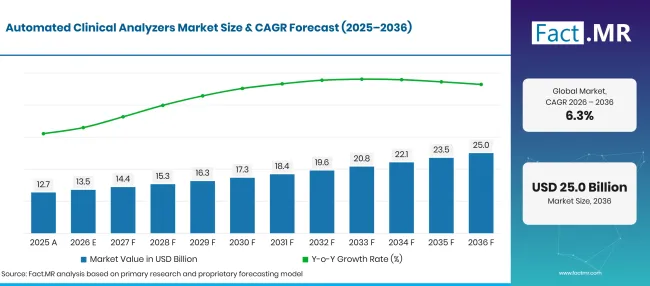
Automated Clinical Analyzers Market Forecast Global | Source: Fact.MR
| Year | Basis | Market Value (USD billion) |
|---|---|---|
| 2025 | Actual | 12.7 |
| 2026 | Estimate | 13.5 |
| 2036 | Forecast | 25.0 |
| CAGR 2026 to 2036 | Forecast period | 6.3% |
Source: Fact.MR analysis. Updated Oct 22, 2026
What are the defining numbers behind Automated Clinical Analyzers Market growth?
USD 11.5 billion absolute opportunity from 2026 to 2036, with chemistry analyzers and hospital testing forming the main purchasing base.
- Demand Drivers in the Market
- Hospital laboratory managers need instruments that handle regular inpatient blood testing while keeping turnaround times predictable during busy shifts.
- Independent diagnostic laboratories often use common analyzer platforms and reagents across their locations. Shared procedures make it easier to train employees, manage quality checks and maintain comparable results.
- Clinical chemistry departments compare reagent availability and analyzer uptime when planning replacement cycles. Roche describes its cobas pro platform as a modular chemistry and immunochemistry system for medium- to high-volume laboratories.
- Even with automated equipment, laboratory staff must review calibration and quality-control records. Managers therefore consider how clearly an instrument documents its performance before approving it for regular clinical work.
- Key Segments Analyzed
- By Product Type: Chemistry Analyzers account for 28.5% share in 2026 as laboratories use them for routine biochemical measurements.
- By Application: Hospitals represent 42.3% share in 2026, reflecting broad inpatient and outpatient laboratory workloads.
- By Technology: Fully Automated systems capture 71.4% share in 2026 as integrated handling reduces repeated manual steps.
- By End-User: Hospitals hold 40.1% share in 2026 because hospital laboratories operate across diverse clinical departments.
- Analyst Opinion at Fact.MR
- Shambhu Nath Jha, Principal Consultant at Fact.MR, states, “Clinical analyzer purchasing is shaped by the cost of keeping a testing service running after installation. A system with a suitable assay menu still needs reliable reagent supply and local maintenance support. Hospital laboratories are likely to place greater weight on uptime and result consistency when replacing instruments used across several departments.”
- Strategic Implications
- Instrument manufacturers should explain the cost per reportable result alongside instrument throughput when presenting proposals to laboratory networks.
- Hospital laboratories can compare sample-routing layouts and service terms before committing space to a new integrated testing line.
- Diagnostic distributors benefit from maintaining stocks of compatible controls and consumables so their customers can limit interruptions during routine testing.
- Health networks should review interface compatibility between analyzers and laboratory information systems before setting a timetable for installation.
Germany is forecast to post a 7.9% CAGR, while Brazil reaches 7.3% as hospital testing services review analyzer capacity. The USA follows at 6.6% in an established regulated laboratory network. The UK posts 5.9%, and Japan records 5.2% as laboratories balance equipment renewal against operational costs.
How does the Automated Clinical Analyzers Market break down by segment?
Chemistry Analyzers 28.5%; Hospitals application 42.3%; Fully Automated 71.4%; Hospitals end-user 40.1% in 2026.
Which Product Type leads clinical analyzer sales?
According to Fact.MR analysis, chemistry Analyzers hold 28.5% share in 2026.
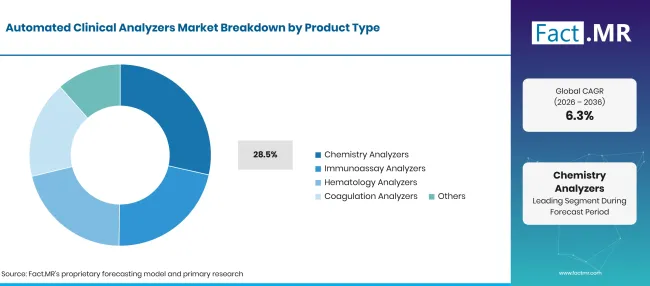
Automated Clinical Analyzers Market Breakdown Product Type 1 | Source: Fact.MR
| Product Type leads clini | Share (2026) |
|---|---|
| Chemistry Analyzers (Leading segment) | 28.5% |
| Other segments combined | 71.5% |
| Total | 100.0% |
Source: Fact.MR analysis. Updated Oct 22, 2026
Chemistry analyzers perform routine clinical chemistry measurements that hospitals order repeatedly during patient assessment and treatment monitoring. Immunoassay instruments address tests requiring specific antigen or antibody reactions, while hematology systems measure blood-cell parameters. Coagulation analyzers serve clinical decisions related to clotting function. Laboratories often purchase according to the menu they need and whether the chosen platform fits existing sample-handling procedures.
What leads the Application segment?
Hospitals account for 42.3% share in 2026.
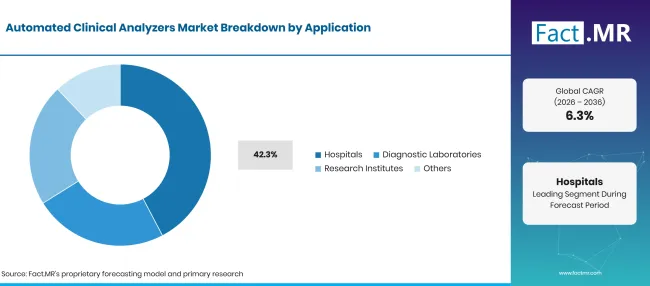
Automated Clinical Analyzers Market Breakdown Application | Source: Fact.MR
| Application segment | Share (2026) |
|---|---|
| Hospitals (Leading segment) | 42.3% |
| Other segments combined | 57.7% |
| Total | 100.0% |
Source: Fact.MR analysis. Updated Oct 22, 2026
Hospital applications cover the testing required by inpatient wards and outpatient departments. Diagnostic laboratories also operate high-volume routes for specimens collected outside the hospital. Research institutes use suitable analyzers for defined investigations when assay performance meets their protocols. Hospital managers assess whether an analyzer can manage changes in sample arrivals without creating reporting delays.
How does Technology influence instrument purchases?
Fully Automated systems lead with 71.4% share in 2026.
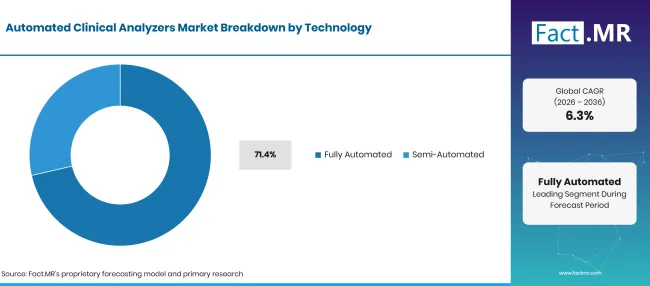
Automated Clinical Analyzers Market Breakdown Technology | Source: Fact.MR
| Technology influence ins | Share (2026) |
|---|---|
| Fully Automated (Leading segment) | 71.4% |
| Other segments combined | 28.6% |
| Total | 100.0% |
Source: Fact.MR analysis. Updated Oct 22, 2026
Fully automated systems bring sample movement, reagent handling and testing steps into a more connected process. This can reduce repeated manual tasks, but trained staff still maintain the equipment, run controls and review results. Smaller laboratories may prefer semi-automated instruments when their test menus or sample volumes do not justify a larger system.
Which End-User accounts for the principal share?
Hospitals represent 40.1% share in 2026.
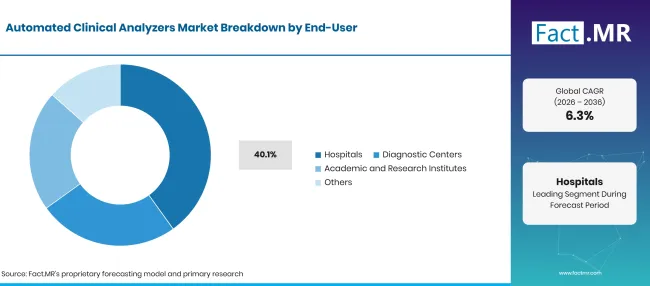
Automated Clinical Analyzers Market Breakdown End User | Source: Fact.MR
| End-User accounts for th | Share (2026) |
|---|---|
| Hospitals (Leading segment) | 40.1% |
| Other segments combined | 59.9% |
| Total | 100.0% |
Source: Fact.MR analysis. Updated Oct 22, 2026
Hospitals commonly support emergency and scheduled testing within the same clinical laboratory service. Diagnostic centers often focus on predictable specimen collection routes and repeat test panels. Academic and research institutes use laboratory analyzers in studies that require controlled workflows. End users compare after-sales service and training alongside test performance because an instrument outage affects clinical reporting schedules.
What is accelerating Automated Clinical Analyzers Market adoption, and what is holding it back?
Routine laboratory testing and integrated workflows support sales; validation requirements and operating costs restrain replacement decisions.
Drivers Impact Analysis
| DRIVER | (~) % IMPACT ON CAGR | GEOGRAPHIC RELEVANCE | IMPACT TIMELINE |
|---|---|---|---|
| Hospital chemistry workload | +1.0% | Global | Medium term (2–4 years) |
| Integrated analyzer platforms | +0.8% | North America, Europe | Medium term (2–4 years) |
| Laboratory standardization | +0.7% | Global | Short term (<= 2 years) |
| Assay menu expansion | +0.5% | Global | Medium term (2–4 years) |
| After-sales servicing | +0.4% | Global | Long term (>= 4 years) |
Source: Fact.MR analysis. Updated Oct 22, 2026
Opportunity Impact Analysis
| OPPORTUNITY | (~) % IMPACT ON CAGR | GEOGRAPHIC RELEVANCE | IMPACT TIMELINE |
|---|---|---|---|
| Network-wide replacements | +0.8% | United States, Europe | Medium term (2–4 years) |
| Smaller laboratory automation | +0.6% | Latin America, Asia | Long term (>= 4 years) |
| Capillary sample capability | +0.5% | Europe | Medium term (2–4 years) |
| Instrument refurbishment | +0.4% | Europe, North America | Short term (<= 2 years) |
Source: Fact.MR analysis. Updated Oct 22, 2026
Restraints Impact Analysis
| RESTRAINT | (~) % IMPACT ON CAGR | GEOGRAPHIC RELEVANCE | IMPACT TIMELINE |
|---|---|---|---|
| Capital equipment costs | -0.8% | Global | Short term (<= 2 years) |
| Complex testing compliance | -0.6% | Global | Medium term (2–4 years) |
| Reagent dependence | -0.5% | Global | Medium term (2–4 years) |
| Instrument downtime risk | -0.4% | Global | Short term (<= 2 years) |
Source: Fact.MR analysis. Updated Oct 22, 2026
Which countries are scaling Automated Clinical Analyzers Market through 2036?
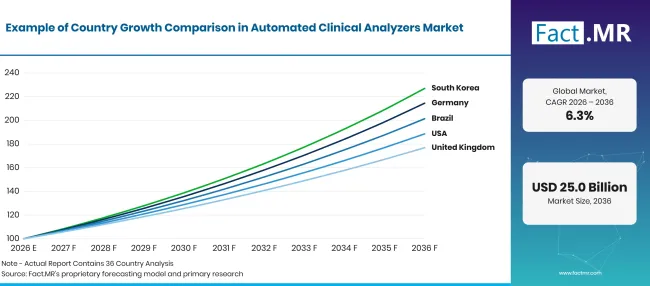
Automated Clinical Analyzers Market Growth Index | Source: Fact.MR
| Country | CAGR (2026–2036) |
|---|---|
| Germany | 7.9% |
| Brazil | 7.3% |
| United States | 6.6% |
| United Kingdom | 5.9% |
| Japan | 5.2% |
Source: Fact.MR analysis. Updated Oct 22, 2026
Why is Germany expanding automated clinical analyzer use?
7.9% CAGR, shaped by hospital workloads and standardized clinical testing.
German hospital laboratories are expected to keep investing in automated chemistry testing as inpatient services place steady pressure on result turnaround times. In November 2025, Destatis reported around 17.5 million inpatient hospital treatments for 2024 [1]. This care activity requires reliable laboratory testing across hospital departments.
How is Brazil developing analyzer purchases?
7.3% CAGR, linked to clinical testing rules and public health service needs.
Brazilian diagnostic laboratories are adapting their testing procedures to the clinical-analysis rules introduced by Anvisa. In August 2025, Anvisa confirmed that RDC 978/2025 had taken effect on June 10, 2025, with additional clarifications concerning RDC 986/2025 [2]. Laboratory directors therefore have a practical reason to review instrument records and approved work procedures when selecting chemistry or immunoassay equipment.
What supports the United States outlook?
6.6% CAGR, reflecting a regulated laboratory base and broad analyzer replacement needs.
United States clinical laboratories select analyzer systems around test quality and reliable daily operation. The Centers for Medicare & Medicaid Services describes Clinical Laboratory Improvement Amendments requirements for laboratory testing and quality oversight in its October 2026 programme information [3]. These rules influence how laboratories document procedures and assess a new platform before clinical use. FDA device reviews also shape when a manufacturer can introduce a new test system to the U.S. market. In February 2026, the FDA recorded a decision on submission K253491 [4], illustrating the role of product-specific regulatory review.
How is the United Kingdom approaching analyzer renewal?
5.9% CAGR, associated with hospital diagnostics capacity and laboratory efficiency.
United Kingdom hospital laboratories are placing closer attention on the flow of specimens between collection sites and core testing departments. Chemistry and immunoassay analyzers are likely to attract interest where laboratories need consistent results across a hospital group. NHS England's 2024/25 performance report describes national diagnostic activity and waiting-time measures [5], giving health services a picture of pressures on patient testing pathways.
Why is Japan maintaining analyzer investment?
5.2% CAGR, informed by laboratory quality and equipment renewal cycles.
Japan's hospital laboratories tend to place value on consistent clinical results and reliable manufacturer support when reviewing replacement analyzers. Chemistry testing systems must fit established laboratory routines, which can make staff familiarity an important consideration alongside instrument performance. In December 2025, the Ministry of Health, Labour and Welfare published its October medical facility survey covering changes in the country's hospital network [6]. These updates help describe the wider service setting in which laboratories plan equipment use.
Who leads the Automated Clinical Analyzers Market?
Roche Diagnostics offers cobas chemistry and immunochemistry systems, while Siemens Healthineers supplies Atellica analyzers for clinical laboratory work. Abbott Laboratories sells Alinity platforms, and Beckman Coulter supports clinical chemistry and immunoassay testing through Dx systems. The products differ in assay menus, workflow options and the maintenance arrangements offered to hospital customers.
Sysmex Corporation and Horiba Medical supply hematology instruments, while Mindray Medical International markets laboratory analyzers across relevant test categories. Thermo Fisher Scientific and Bio-Rad Laboratories participate through clinical laboratory instrumentation and related testing or quality-control products. Hospital buyers compare service coverage and assay suitability rather than treating all suppliers as identical.
Sysmex announced in April 2025 that its new Indian manufacturing operation had begun full-scale production, including the XQ-320 automated hematology analyzer. Local production may affect supply and service planning for its hematology business, while the company continues serving clinical laboratories across several markets. [7]
In May 2025, Siemens Healthineers announced its Certified Atellica programme for restored analyzers. The programme gives laboratories another equipment sourcing option while keeping service and performance assessment central to the purchasing process. [8]
Which companies are the key providers?
Key companies include Roche Diagnostics; Siemens Healthineers; Abbott Laboratories; Beckman Coulter; Thermo Fisher Scientific; Sysmex Corporation; Bio-Rad Laboratories; Horiba Medical; and Mindray Medical International.
- Roche Diagnostics
- Siemens Healthineers
- Abbott Laboratories
- Beckman Coulter
- Thermo Fisher Scientific
- Sysmex Corporation
- Bio-Rad Laboratories
- Horiba Medical
- Mindray Medical International
Bibliography
- [1] Statistisches Bundesamt (Destatis). (2025, November 6). 2,0 % mehr stationäre Krankenhausbehandlungen im Jahr 2024.
- [2] Agência Nacional de Vigilância Sanitária. (2025, August 28). Anvisa esclarece dúvidas sobre serviços que realizam exames de análises clínicas.
- [3] Centers for Medicare & Medicaid Services. (2026, October 7). Clinical Laboratory Improvement Amendments (CLIA).
- [4] U.S. Food and Drug Administration. (2026, February 12). 510(k) premarket notification: K253491.
- [5] NHS England. (2025). Performance report 2024/25.
- [6] Ministry of Health, Labour and Welfare. (2025, December 24).[Medical facility dynamic survey: Preliminary figures as of the end of October 2025].
- [7] Sysmex Corporation. (2025, April 28). Sysmex Group's new manufacturing base in India begins full-scale operations and launches “Make in India” products
- [8] Siemens Healthineers. (2025, May 19). Greener clinical lab testing now within reach: New solutions from Siemens Healthineers address labs’ environmental and efficiency goals.
- [9] Roche Diagnostics. (2026, March 30). Roche receives FDA 510(k) clearance for cobas c 703 and cobas ISE neo, next-generation analytical units enhancing efficiency and capability for laboratories.
- [10] Siemens Healthineers. (2025). ADVIA Chemistry XPT system.
This Report Answers
- The report compares chemistry analyzers with immunoassay, hematology and coagulation products used in clinical testing.
- Application analysis explains differences between hospital and diagnostic laboratory instrument purchases.
- Technology analysis describes operational differences between fully automated and semi-automated systems.
- Country analysis compares clinical laboratory conditions in Germany, Brazil, the USA, the UK and Japan.
- Competitive analysis identifies manufacturer product categories without assigning unsupported company market shares.
What does the Automated Clinical Analyzers Market cover?
The market includes automated clinical analyzers used for routine chemistry testing and relevant immunoassay workflows. Hematology and coagulation instruments also fall within the product categories. Equipment is considered when used for clinical specimen analysis.
What is included in the scope?
The scope covers automated and semi-automated clinical analyzers used by hospital laboratories and other testing facilities.
It includes instruments supporting defined diagnostic assays, together with interfaces needed for routine result handling. The analysis looks at equipment selection through instrument capacity, test-menu fit and service requirements. Clinical analyzers remain separate from imaging systems.
What is excluded from the scope?
The scope excludes equipment used only for diagnostic imaging and non-laboratory patient monitoring.
Research-only products are excluded from clinical analyzer sales unless the equipment is also supplied for eligible clinical use. Standalone sample collection devices and individual test kits are outside the core analyzer equipment category. Laboratory buildings and general hospital infrastructure are also excluded.
How Was the Analysis Built?
The analysis draws on 120+ sources, 35+ company portfolios, 25+ countries, and more than 20 industry interviews.
- Primary Research: Primary research includes discussions with manufacturers, service providers, technology developers, distributors, end users, and subject-matter experts. These conversations examine purchasing priorities, product adoption, operational challenges, approval requirements, competitive positioning, and the factors that influence wider market acceptance.
- Desk Research: Desk research covers government statistics, regulatory publications, company filings, trade data, technical studies, industry associations, standards, public policy, and other authoritative sources. Every source used in the analysis is documented in the bibliography.
- Market Sizing and Forecasting: Market estimates combine historical performance, demand indicators, pricing and volume trends, segment shares, company participation, country-level growth, adoption patterns, investment activity, and barriers to market expansion.
- Data Validation and Update Cycle: Findings are validated by comparing primary interviews with public data, company activity, regulatory changes, trade patterns, and industry developments. Regular updates review new product launches, capacity changes, partnerships, approvals, and shifts in commercial adoption.
Segmentation
What is the report’s scope and coverage?
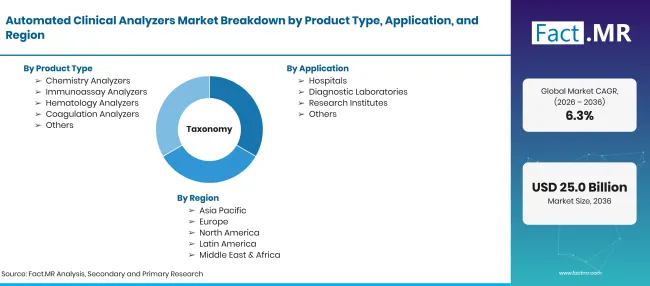
Automated Clinical Analyzers Market Taxonomy | Source: Fact.MR
| Attribute | Details |
|---|---|
| Quantitative Units | USD billion in 2026 to USD billion in 2036, at CAGR |
| Market Definition | Automated clinical laboratory analyzers for measurement of patient specimen parameters |
| Product Type | Chemistry; Immunoassay; Hematology; Coagulation; Others |
| Application | Hospitals; Diagnostic Laboratories; Research Institutes; Others |
| Technology | Fully Automated; Semi-Automated |
| End-User | Hospitals; Diagnostic Centers; Academic and Research Institutes; Others |
| Regions Covered | North America; Latin America; Western Europe; Eastern Europe; East Asia; South Asia & Pacific; Middle East & Africa |
| Countries Covered | Germany; Brazil; United States; United Kingdom; Japan |
| Companies Profiled | |
| Forecast Period | 2026 to 2036 |
| Approach | Product and customer analysis with official regulatory and supplier evidence |
Source: Fact.MR analysis. Updated Oct 22, 2026
How is the market segmented?
-
By Product Type
- Chemistry Analyzers
- Immunoassay Analyzers
- Hematology Analyzers
- Coagulation Analyzers
- Others
-
By Application
- Hospitals
- Diagnostic Laboratories
- Research Institutes
- Others
-
By Technology
- Fully Automated
- Semi-Automated
-
By End-User
- Hospitals
- Diagnostic Centers
- Academic and Research Institutes
- Others
-
By Region
- North America
- Latin America
- Western Europe
- Eastern Europe
- East Asia
- South Asia & Pacific
- Middle East & Africa
Frequently Asked Questions
How big is the Automated Clinical Analyzers Market in 2026?
What is the CAGR of the Automated Clinical Analyzers Market from 2026 to 2036?
Which product type leads the Automated Clinical Analyzers Market?
Which application leads the Automated Clinical Analyzers Market?
Who are the leading companies in the Automated Clinical Analyzers Market?
Who worked on this report


Preview the report firsthand - request a free sample
Free SampleGet the brochure for pricing and purchase details
Download PDF