- Base Value(2025): 5.8 Bn
- Estimated Value(2026): 6.0 Bn
- Forecast Value (2036): 8.5 Bn
- CAGR (2026 - 2036): 3.5%
Hematology Analyzer Market Analysis and Forecast by Fact.MR
The global hematology analyzer market is estimated at USD 5.8 billion in 2025 and is forecast to reach USD 6.0 billion in 2026 before expanding to USD 8.5 billion by 2036, progressing at a CAGR of 3.5% over the 2026 to 2036 forecast period. Automated Hematology Analyzers is anticipated to account for 42.6% share of the product segment in 2026, supported by high throughput processing capability, reduced manual intervention requirements, and broad adoption across hospital and diagnostic laboratory settings. India (5.2%) and China (4.5%) are the fastest growing country markets through 2036.
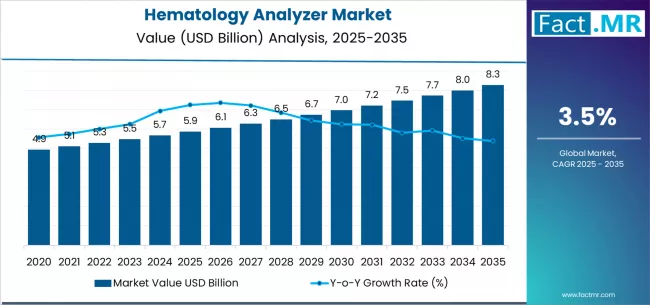
Hematology Analyzer Market Market Value Analysis | Source: Fact.MR
Summary of Hematology Analyzer Market
- Market Snapshot
- In 2025, the global Hematology Analyzer Market was valued at approximately USD 5.8 billion.
- The market is estimated to reach USD 6.0 billion in 2026 and is projected to attain USD 8.5 billion by 2036.
- The hematology analyzer market is likely to expand at a CAGR of 3.5% during the forecast period.
- The market is anticipated to create an absolute dollar opportunity of USD 2.5 billion between 2026 and 2036.
- Automated hematology analyzers account for 42.6% of market share in 2026.
- India (5.2%) and China (4.5%) are the key growth markets during the forecast period.
- Demand and Growth Drivers
- CBC testing remains the most frequently ordered laboratory test globally, creating non-discretionary demand that supports consistent analyzer utilization and reagent consumption.
- Laboratory infrastructure expansion in India, China, and Brazil is increasing the installed base of hematology analyzers as new diagnostic facilities are established and existing ones upgrade from manual to automated testing.
- Technology-driven replacement cycles from 3-part to 5-part differential analyzers and from standalone units to integrated laboratory automation solutions support upgrade demand in mature markets.
- Rising institutional procurement volumes across hospitals, academic facilities, and government programs create a sustained base-level demand that is less sensitive to short-term economic cycles.
- Expanding distribution through specialized channels and direct-to-institution sales models is improving product accessibility across underpenetrated geographies.
- Product and Segment View
- Automated Hematology Analyzers accounts for 42.6% of the product segment in 2026, maintaining the leading position due to established usage patterns and broad commercial adoption.
- Disease Diagnosis represents 43.8% of the application segment in 2026, supported by the largest concentration of end-use demand and procurement volumes.
- The hematology analyzer market is segmented by product, technology, parameter type, end use, application, and region.
- Geography and Competitive Outlook
- India leads growth at 5.2%, supported by infrastructure expansion and increasing institutional adoption.
- North America reflects a mature but steady demand profile, with the USA at 3.2% supported by replacement demand and established clinical protocols.
- Europe maintains stable growth, with Germany at 2.9% supported by regulatory standards and established institutional procurement frameworks.
- Sysmex Corporation, Beckman Coulter (Danaher), Abbott Diagnostics hold strong positions through broad product portfolios and established distribution networks.
- Analyst Opinion
- Shambhu Nath Jha, Principal Consultant at Fact.MR, says 'The hematology analyzer market is structurally supported by non-discretionary diagnostic testing demand. Complete blood count (CBC) testing is the single most commonly ordered laboratory test globally, creating a demand floor that is largely insensitive to economic cycles. Growth reflects two dynamics: expanding laboratory infrastructure in India, China, and other emerging markets where diagnostic access is improving; and technology-driven replacement cycles in mature markets where laboratories upgrade from 3-part to 5-part differential analyzers and adopt integrated automation solutions. Sysmex Corporation holds a dominant global position, particularly in high-throughput hospital laboratory systems, with Beckman Coulter and Abbott competing strongly in North America and Europe. The reagent annuity model is central to market economics, as analyzer placements generate recurring consumable revenue that typically exceeds the capital equipment value within two to three years. Point-of-care hematology analyzers represent the fastest-evolving product category, expanding testing from centralized laboratories into emergency departments, clinics, and field settings.'
Key Growth Drivers, Constraints, and Opportunities
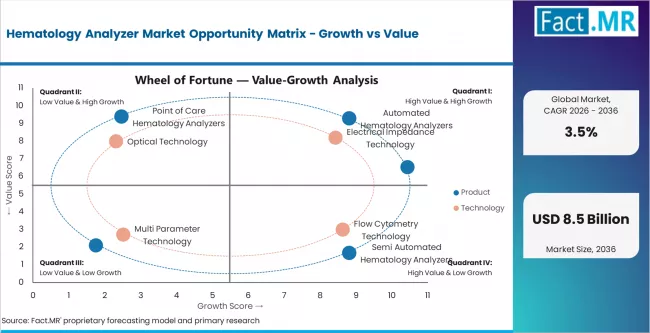
Hematology Analyzer Market Opportunity Matrix Growth Vs Value | Source: Fact.MR
Key Factors Driving Growth
- CBC testing remains the most frequently ordered laboratory test globally, creating non-discretionary demand that supports consistent analyzer utilization and reagent consumption.
- Laboratory infrastructure expansion in India, China, and Brazil is increasing the installed base of hematology analyzers as new diagnostic facilities are established and existing ones upgrade from manual to automated testing.
- Technology-driven replacement cycles from 3-part to 5-part differential analyzers and from standalone units to integrated laboratory automation solutions support upgrade demand in mature markets.
Key Market Constraints
- High capital cost of advanced automated analyzers limits procurement in small and mid-size laboratories in developing markets, restricting adoption to larger hospital and reference laboratory settings.
- Reagent-locked systems create switching costs that favor incumbent manufacturers and limit competitive pricing pressure in installed base accounts.
- Skilled laboratory technician shortages in developing markets constrain the pace of automation adoption despite equipment availability.
Key Opportunity Areas
- Point-of-care hematology analyzers are expanding testing beyond centralized laboratories into emergency departments, primary care clinics, and field settings, creating a new growth layer.
- AI-assisted morphology analysis and automated flagging systems are adding clinical value to standard CBC results, supporting premium pricing for advanced analyzer platforms.
- Expansion of blood bank screening and transfusion medicine programs in emerging markets creates additional institutional procurement channels for hematology testing equipment.
Segment-wise Analysis of the Hematology Analyzer Market
- Automated Hematology Analyzers holds 42.6% of the product segment in 2026.
- Disease Diagnosis represents 43.8% of the application segment in 2026.
The hematology analyzer market is segmented by product, technology, parameter type, end use, application, and region.
Which Product Segment Leads the Hematology Analyzer Market?
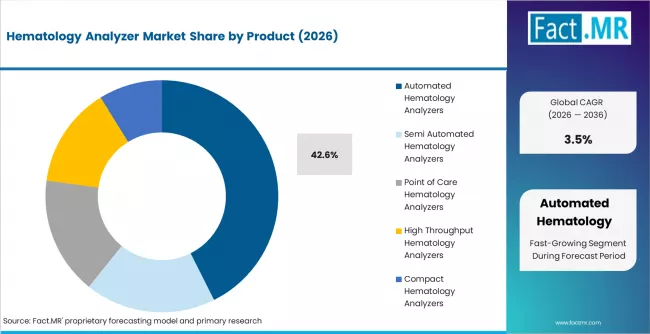
Hematology Analyzer Market Analysis By Product | Source: Fact.MR
Automated Hematology Analyzers accounts for 42.6% of the product segment in 2026. This position reflects high throughput processing capability, reduced manual intervention requirements, and broad adoption across hospital and diagnostic laboratory settings. The segment benefits from an established base, broad geographic adoption, and consistent demand from institutional and individual buyer channels.
Which Application Segment Leads the Hematology Analyzer Market?
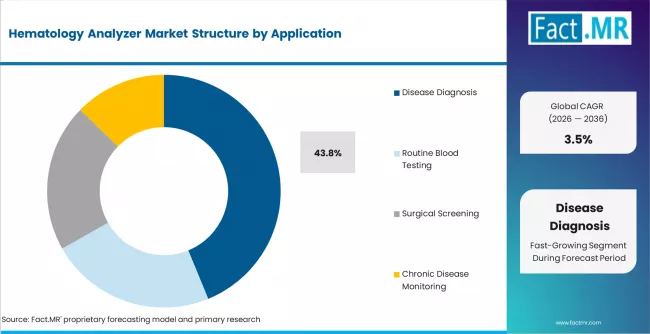
Hematology Analyzer Market Analysis By Application | Source: Fact.MR
Disease Diagnosis is expected to account for 43.8% of the application segment in 2026. This segment represents the largest concentration of purchasing activity and maintains its position through established procurement cycles and direct alignment with the primary use cases.
Which Product Trend is Shaping the Next Phase of Growth in the Hematology Analyzer Market?
Point-of-care hematology analyzers represent the fastest-evolving product segment, expanding complete blood count testing from centralized diagnostic laboratories into emergency departments, primary care clinics, and decentralized field settings. These compact devices deliver CBC results within minutes at the patient bedside, supporting clinical decisions where laboratory turnaround time creates treatment delays. Adoption is strongest in emergency medicine and critical care, but growing clinical evidence supporting point-of-care hematology in primary care and outpatient settings is broadening the addressable market. Manufacturers are improving accuracy, parameter coverage, and connectivity in compact analyzer formats, narrowing the performance gap with centralized laboratory systems.
Regional Outlook Across Key Markets
.webp "Top Country Growth Comparison Hematology Analyzer Market Cagr (2026 2036)")
Top Country Growth Comparison Hematology Analyzer Market Cagr (2026 2036) | Source: Fact.MR
- India leads growth at 5.2%, supported by infrastructure expansion and rising adoption.
- North America shows steady growth, with the USA at 3.2% reflecting a mature market with established procurement.
- Europe maintains consistent demand, with Germany at 2.9%.
- Asia Pacific is the fastest growing region overall.
Country CAGR Table
| Country | CAGR (%) |
|---|---|
| India | 5.2% |
| China | 4.5% |
| Brazil | 4.0% |
| USA | 3.2% |
| South Korea | 3.1% |
| Germany | 2.9% |
| Japan | 2.7% |
Source: Fact.MR analysis, based on proprietary forecasting model and primary research.
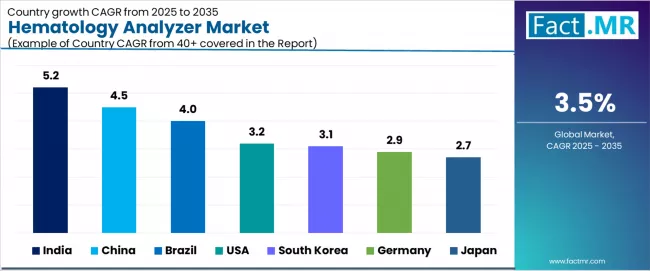
Hematology Analyzer Market Cagr Analysis By Country | Source: Fact.MR
Hematology Analyzer Market in India
India leads global market expansion with a projected CAGR of 5.2% through 2036. Growth reflects expanding diagnostic laboratory infrastructure, government healthcare programs that mandate basic laboratory services at district-level facilities, and increasing private laboratory chain growth.
- Diagnostic laboratory infrastructure expansion creates new analyzer placement opportunities.
- Government mandates for district-level laboratory services drive institutional procurement.
- Private laboratory chain growth supports volume-based procurement of automated analyzers.
Hematology Analyzer Market in China
China is projected to grow at a CAGR of 4.5% through 2036. Demand reflects hospital laboratory modernization, strong domestic analyzer manufacturing from companies like Mindray, and rising diagnostic test volumes across both public and private healthcare systems.
- Hospital laboratory modernization supports upgrade demand from semi-automated to fully automated systems.
- Domestic manufacturing improves cost competitiveness and supports rapid installed base expansion.
- Rising diagnostic test volumes across public and private systems sustain high analyzer utilization rates.
Hematology Analyzer Market in Brazil
Brazil is projected to grow at a CAGR of 4.0% through 2036. Expansion reflects improving laboratory infrastructure, growing private diagnostic laboratory networks, and increasing adoption of automated testing to handle rising test volumes.
- Private diagnostic laboratory growth creates procurement demand for automated analyzer systems.
- Rising test volumes support adoption of higher-throughput automated platforms.
- Laboratory quality accreditation programs drive equipment standardization and upgrade cycles.
Hematology Analyzer Market in USA
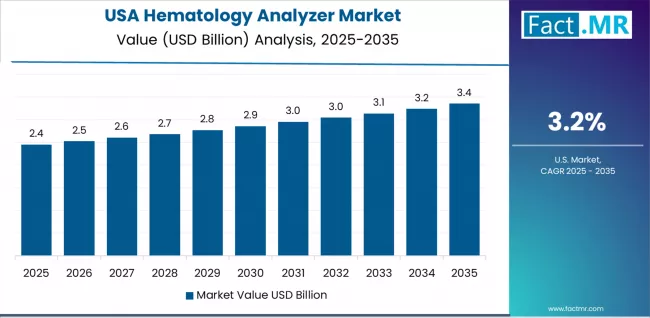
Hematology Analyzer Market Country Value Analysis | Source: Fact.MR
The United States is projected to grow at a CAGR of 3.2% through 2036. The market is mature, with growth shaped by laboratory automation integration, point-of-care testing expansion, and replacement demand for aging analyzer fleets.
- Laboratory automation integration drives demand for analyzers compatible with track-based sample processing systems.
- Point-of-care hematology expansion creates new testing locations outside centralized laboratories.
- Replacement demand from aging analyzer installations sustains steady equipment procurement volumes.
Hematology Analyzer Market in South Korea
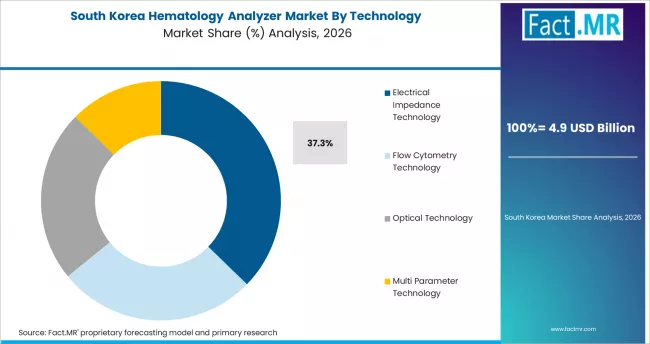
Hematology Analyzer Market South Korea Market Share Analysis By Technology | Source: Fact.MR
South Korea is projected to grow at a CAGR of 3.1% through 2036. Growth reflects advanced laboratory infrastructure, high diagnostic test utilization rates, and adoption of integrated automation solutions.
- Advanced laboratory infrastructure supports adoption of high-throughput automated analyzers.
- High diagnostic test utilization rates sustain strong reagent consumption volumes.
- Integrated laboratory automation adoption drives premium system procurement.
Hematology Analyzer Market in Germany
Germany is projected to grow at a CAGR of 2.9% through 2036. Demand reflects established diagnostic laboratory networks, preference for high-quality automated systems, and steady replacement-driven procurement.
- Established diagnostic networks maintain consistent analyzer procurement cycles.
- Quality standards and accreditation requirements support premium product positioning.
- Replacement-driven procurement sustains steady annual demand volumes.
Hematology Analyzer Market in Japan
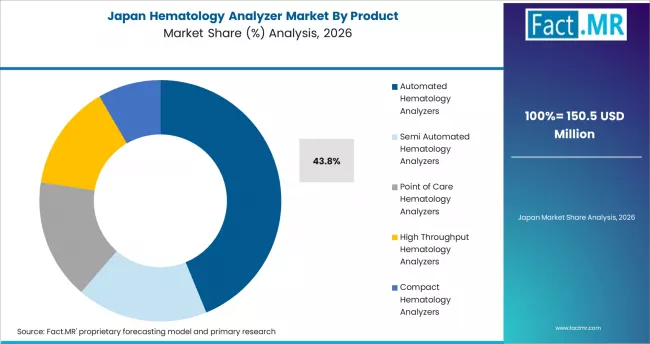
Hematology Analyzer Market Japan Market Share Analysis By Product | Source: Fact.MR
Japan is projected to grow at a CAGR of 2.7% through 2036. The market is mature, with growth supported by aging population diagnostic needs, advanced laboratory automation, and Sysmex's strong domestic presence.
- Aging population diagnostic needs sustain high CBC test volumes.
- Advanced laboratory automation maintains demand for integrated hematology systems.
- Strong domestic manufacturer presence ensures competitive pricing and rapid service support.
Competitive Benchmarking and Company Positioning
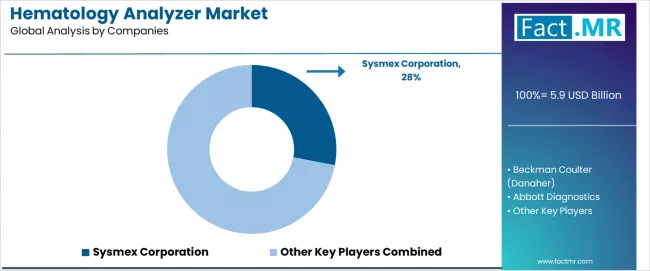
Hematology Analyzer Market Analysis By Company | Source: Fact.MR
Hematology Analyzer Market Analysis By Company
- Sysmex Corporation, Beckman Coulter (Danaher), Abbott Diagnostics hold strong positions through broad portfolios and established distribution networks.
- Siemens Healthineers, HORIBA Medical, Boule Diagnostics participate meaningfully across specific segments and regional markets.
Sysmex Corporation holds a dominant position in the global hematology analyzer market through comprehensive product portfolios spanning 3-part to 6-part differential analyzers, integrated automation platforms, and the industry's largest global reagent distribution network.
Beckman Coulter (Danaher) and Abbott Diagnostics compete strongly in North America and Europe through bundled laboratory solutions, multi-analyzer track integration, and established hospital system procurement relationships.
Mindray Medical and other Asian manufacturers create competitive pressure through cost-effective analyzer platforms that are gaining share in emerging markets where price sensitivity drives procurement decisions.
The competitive landscape is highly concentrated at the high-throughput segment, with Sysmex, Beckman Coulter, and Abbott commanding the majority of hospital laboratory installations, while the point-of-care and compact segments are more fragmented with emerging entrants targeting decentralized testing applications.
Recent Industry Developments
- Sysmex Corporation introduced an updated 6-part differential hematology platform in early 2026, featuring expanded flagging capabilities and AI-assisted morphology analysis for advanced clinical decision support.
- Mindray Medical expanded its hematology analyzer distribution in 2025 across Latin America and Africa, targeting mid-volume laboratories with cost-competitive automated platforms.
- Abbott Diagnostics launched a compact point-of-care hematology analyzer in 2025, designed for emergency department and critical care applications with rapid CBC results delivery.
Leading Companies in the Hematology Analyzer Market
Major Players
- Sysmex Corporation
- Beckman Coulter (Danaher)
- Abbott Diagnostics
- Siemens Healthineers
- HORIBA Medical
- Boule Diagnostics
- Mindray Medical
- Nihon Kohden
Emerging Players
- Bio-Rad Laboratories
- Drew Scientific
- EKF Diagnostics
- Erba Mannheim
- Transasia Bio-Medicals
- Melet Schloesing Laboratoires
- CellaVision
Sources and Research References
- World Health Organization (WHO). Global Diagnostics Capacity and Laboratory Infrastructure Reports.
- International Society for Laboratory Hematology (ISLH). Standards and Guidelines for Automated Hematology Testing.
- Sysmex Corporation. Product Portfolio and Hematology Analyzer Technology Updates.
- U.S. Food and Drug Administration (FDA). Medical Device Database for In Vitro Diagnostic Equipment.
- Primary interviews with diagnostic laboratory directors, hospital pathology departments, hematology analyzer distributors, and blood bank administrators.
This bibliography is provided for reader reference and is not exhaustive.
Key Questions This Report Addresses
- What is the current and future size of the hematology analyzer market?
- How fast is the market expected to grow between 2026 and 2036?
- Which product is likely to lead by 2026?
- Which application segment accounts for the highest demand?
- What factors are driving demand globally?
- Which countries show the fastest growth?
- Who are the key companies?
- How does Fact.MR validate the forecast?
Hematology Analyzer Market Definition
The hematology analyzer market covers automated, semi-automated, point-of-care, and high-throughput blood cell analysis instruments used for disease diagnosis, routine blood testing, surgical screening, and chronic disease monitoring across hospital, diagnostic laboratory, research, and blood bank settings.
Hematology Analyzer Market Inclusions
The scope covers global and regional market size and forecasts for 2026 to 2036 across product, technology, parameter type, end use, application, and region. It includes regional demand analysis, pricing and cost analysis, technology trends, market drivers and constraints, and the competitive landscape.
Hematology Analyzer Market Exclusions
The scope excludes general-purpose devices, products, or services not purpose-built for the applications defined within this market. It excludes unbranded products with low market visibility, rental or leasing services without hardware sales, and custom-built systems without commercial sales distribution.
Hematology Analyzer Market Research Methodology
- Primary research includes interviews with manufacturers, distributors, end users, and institutional procurement teams across key geographies.
- Secondary research draws on industry publications, regulatory filings, company reports, and trade databases.
- Market sizing follows a demand-side model supported by top-down validation across 30 plus countries.
- Final estimates are validated through trade-flow checks, pricing trend analysis, and sensitivity testing.
Scope of Analysis
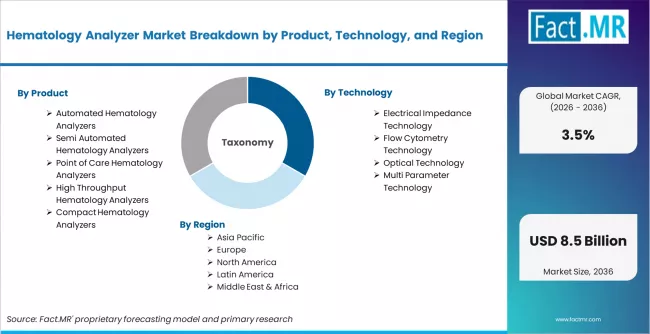
Hematology Analyzer Market Breakdown By Product, Technology, And Region | Source: Fact.MR
| Parameter | Details |
|---|---|
| Quantitative Units | USD 6.0 billion to USD 8.5 billion, at a CAGR of 3.5% |
| Market Definition | The hematology analyzer market covers automated, semi-automated, point-of-care, and high-throughput blood cell analysis instruments used for disease diagnosis, routine blood testing, surgical screening, and chronic disease monitoring across hospital, diagnostic laboratory, research, and blood bank settings. |
| Regions Covered | North America, Latin America, Europe, East Asia, South Asia and Pacific, Middle East and Africa |
| Countries Covered | USA, India, China, Brazil, Germany, South Korea, Japan, and 30 plus countries |
| Key Companies | Sysmex Corporation, Beckman Coulter (Danaher), Abbott Diagnostics, Siemens Healthineers, HORIBA Medical, Boule Diagnostics, Mindray Medical, Nihon Kohden, Bio-Rad Laboratories, Drew Scientific |
| Forecast Period | 2026 to 2036 |
| Approach | Hybrid demand-side and top-down methodology built on country-level diagnostic test volumes, installed base analysis, pricing trends, and primary interviews across analyzer manufacturers, diagnostic laboratories, hospital procurement teams, and blood bank administrators |
Market Segmentation Analysis
-
Hematology Analyzer Market Market Segmented by Product:
- Automated Hematology Analyzers
- 3 Part Differential Analyzers
- 5 Part Differential Analyzers
- 6 Part Differential Analyzers
- Semi Automated Hematology Analyzers
- Bench Top Semi Automated Systems
- Portable Semi Automated Systems
- Point of Care Hematology Analyzers
- Bedside Testing Devices
- Clinic Based Rapid Analyzers
- High Throughput Hematology Analyzers
- Laboratory Grade Large Volume Systems
- Reference Laboratory Systems
- Compact Hematology Analyzers
- Small Laboratory Systems
- Clinic Level Compact Systems
- Automated Hematology Analyzers
-
Hematology Analyzer Market Market Segmented by Technology:
- Electrical Impedance Technology
- DC Detection Systems
- RF Based Cell Counting Systems
- Flow Cytometry Technology
- Laser Based Cell Analysis
- Fluorescence Based Detection Systems
- Optical Technology
- Image Based Cell Morphology Analysis
- Digital Microscopy Integration
- Multi Parameter Technology
- Hemoglobin Measurement Integration
- Cell Volume and Count Integration
- Electrical Impedance Technology
-
Hematology Analyzer Market Market Segmented by Parameter Type:
- Cell Counting Parameters
- Red Blood Cell Count
- White Blood Cell Count
- Platelet Count
- Hemoglobin Parameters
- Total Hemoglobin Measurement
- Hemoglobin Derivatives Analysis
- Differential Parameters
- 3 Part Differential
- 5 Part Differential
- Advanced Leukocyte Differentiation
- Red Cell Indices
- Mean Corpuscular Volume
- Mean Corpuscular Hemoglobin
- Mean Corpuscular Hemoglobin Concentration
- Cell Counting Parameters
-
Hematology Analyzer Market Market Segmented by End Use:
- Hospitals
- Government Hospitals
- Private Hospitals
- Diagnostic Laboratories
- Independent Diagnostic Labs
- Hospital Based Labs
- Research Institutes
- Academic Research Centers
- Biomedical Research Facilities
- Blood Banks
- Transfusion Centers
- Regional Blood Collection Centers
- Ambulatory Care Centers
- Clinics
- Day Care Medical Centers
- Hospitals
-
Hematology Analyzer Market Market Segmented by Application:
- Disease Diagnosis
- Anemia Detection
- Leukemia Screening
- Infection Diagnosis
- Routine Blood Testing
- Complete Blood Count Testing
- Pre Employment Screening
- Surgical Screening
- Pre Operative Testing
- Post Operative Monitoring
- Chronic Disease Monitoring
- Cancer Monitoring
- Chronic Infection Monitoring
- Disease Diagnosis
-
Hematology Analyzer Market Market by Region:
- North America
- USA
- Canada
- Mexico
- Latin America
- Brazil
- Chile
- Rest of Latin America
- Western Europe
- Germany
- UK
- Italy
- Spain
- France
- Nordic
- BENELUX
- Rest of Western Europe
- Eastern Europe
- Russia
- Poland
- Hungary
- Balkan & Baltic
- Rest of Eastern Europe
- East Asia
- China
- Japan
- South Korea
- South Asia and Pacific
- India
- ASEAN
- Australia & New Zealand
- Rest of South Asia and Pacific
- Middle East & Africa
- Kingdom of Saudi Arabia
- Other GCC Countries
- Turkiye
- South Africa
- Other African Union
- Rest of Middle East & Africa
- North America