- Market Value (2025): USD 407.2 Mn
- Estimated Value (2026): USD 430 Mn
- Forecast Value (2036): USD 741 Mn
- CAGR (2026-2036): 5.6%
What is the Automatic Sack Emptying Systems Market forecast to be worth by 2036?
USD 741 million by 2036.
- The automatic sack emptying systems market reached USD 407.2 million in 2025.
- Demand is projected to increase from USD 430 million in 2026 to USD 741 million by 2036.
- The market is expected to expand at 5.6% CAGR from 2026 to 2036.
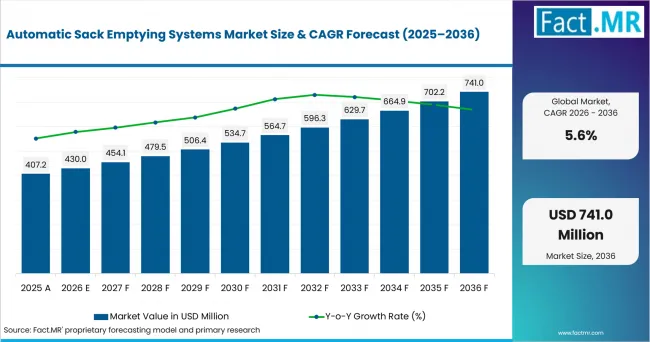
Automatic Sack Emptying Systems Market Value Analysis | Source: Fact.MR
What are the defining numbers behind Automatic Sack Emptying Systems Market growth?
USD 311 million in absolute opportunity is expected between 2026 and 2036.
- Demand Drivers in the Market
- Enclosed sack emptying removes direct operator contact with airborne powders, which supports compliance with occupational exposure limits and reduces dust-related housekeeping at intake points.
- Combustible dust compliance under NFPA 652 in the United States and ATEX equipment rules in Europe pushes processors toward extraction-linked, rated emptying stations instead of open manual tipping.
- Food and pharmaceutical plants require intake equipment with hygienic surfaces, integrated filtration and tool-free cleaning to keep allergen, contamination and batch-changeover risks under control.
- Sustained labor pressure in manufacturing makes repetitive 25-kilogram sack lifting a staffing and injury concern, which supports semi-automatic and fully automatic emptying investments.
- Plastics, building materials and battery-materials producers are adding powder intake capacity, raising demand for higher-throughput emptying lines tied into downstream conveying.
- Key Segments Analyzed
- By Product Type: The Manual-assist tip stations category is projected to account for 34.0% of the automatic sack emptying systems market in 2026. Assisted stations retrofit into mixed-bag, frequent-changeover lines without requiring robotic sack presentation upstream.
- By Dust Control: The Integrated filter units category is projected to account for 46.0% of the automatic sack emptying systems market in 2026. On-board filters capture dust at the opening point and can return collected powder to the process.
- By End-Use Industry: The Food & beverage category is projected to account for 31.0% of the automatic sack emptying systems market in 2026. Food plants combine frequent sack intake with hygiene, allergen-control and housekeeping requirements.
- By Capacity: The 10-30 sacks/hr category is projected to account for 41.0% of the automatic sack emptying systems market in 2026. The 10-30 sacks/hr range fits the batch-intake rhythm of many food, chemical and pharmaceutical plants.
- Analyst Opinion at Fact.MR
- Shambhu Nath Jha, Principal Consultant at Fact.MR, states, "A sack-emptying station has to work as part of the intake line. Processors evaluate containment, filter access, cleaning time and the discharge interface together, because a fast machine still fails the application if it releases dust or interrupts material transfer. Manual-assist systems remain relevant where recipes change often, while fully automatic de-bagging fits stable, high-throughput lines."
- Strategic Implications
- Suppliers should document containment performance, extraction rates and filter efficiency under the actual powders and sack types used by customers.
- Processors should specify dust control at the equipment level rather than the room level, because point-of-source capture reduces both operator exposure and combustible-dust loading in intake areas.
- Equipment positioning should emphasize cleanability and changeover time alongside tipping speed, since allergen control and batch identity drive acceptance in food and pharmaceutical plants.
- Vendors fielding both manual-assist and fully automatic ranges can route high-throughput or hazardous-powder applications toward automation while keeping cost-sensitive lines on assisted stations.
- Integration support with pneumatic or mechanical conveying should be treated as part of the offer, because most emptying systems feed directly into downstream transfer equipment.
How does the Automatic Sack Emptying Systems Market break down by segment?
Why does the Manual-assist tip stations category lead Product Type?
The Manual-assist tip stations category is projected to account for 34.0% of Product Type
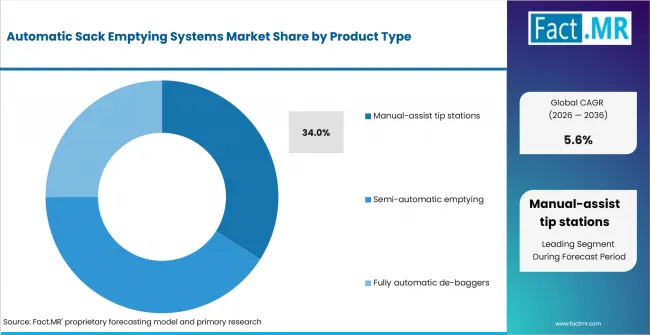
Automatic Sack Emptying Systems Market Analysis By Product Type | Source: Fact.MR
Mixed pallets, variable bag constructions and frequent recipe changes make fully automatic sack presentation difficult in many plants. An assisted station lets one operator empty sacks inside a contained intake point without rebuilding the upstream material flow.
Retrofit practicality sustains demand. Plants can add a hooded station, extraction and a discharge interface around an existing conveyor or feeder, then reserve full de-bagging automation for stable, high-throughput products.
Why does the Integrated filter units category lead Dust Control?
The Integrated filter units category is projected to account for 46.0%.
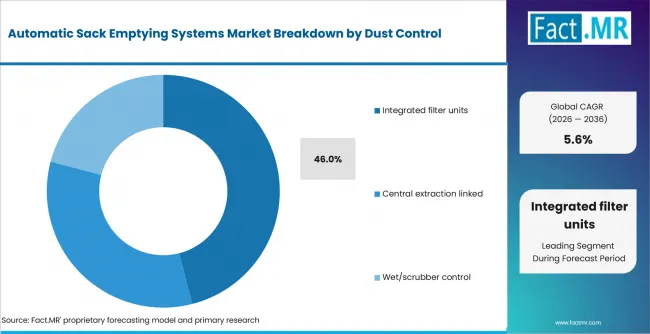
Automatic Sack Emptying Systems Market Analysis By Dust Control | Source: Fact.MR
An integrated filter captures dust where the sack is opened, limiting dispersion into the room and reducing the load on general ventilation. Collected product can often return to the process instead of becoming housekeeping waste. The self-contained arrangement also simplifies installation where central extraction capacity is limited. Buyers still evaluate filter access, cleaning method and explosion-protection requirements against the powder being handled.
Why does the Food & beverage category lead End-Use Industry?
The Food & beverage category is projected to account for 31.0% of End-Use Industry.
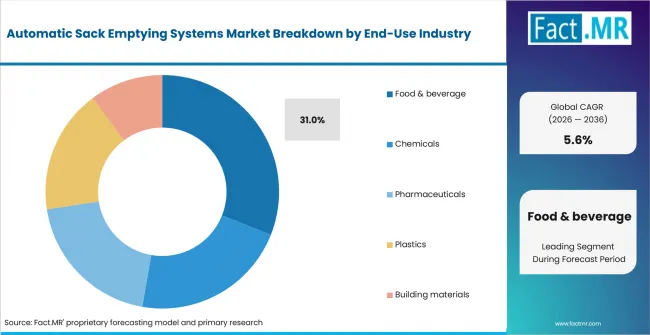
Automatic Sack Emptying Systems Market Analysis By End Use Industry | Source: Fact.MR
Food plants receive flour, starches, dairy powders, sugar, seasonings and other ingredients in sacks throughout the production day. The intake step therefore has to control dust while supporting allergen separation and hygienic cleaning. Auditability influences equipment choice. Smooth contact surfaces, accessible filters and documented cleaning procedures can matter as much as emptying speed when several ingredients share the same station.
Why does the 10-30 sacks/hr category lead Capacity?
The 10-30 sacks/hr category is projected to account for 41.0% of Capacity.
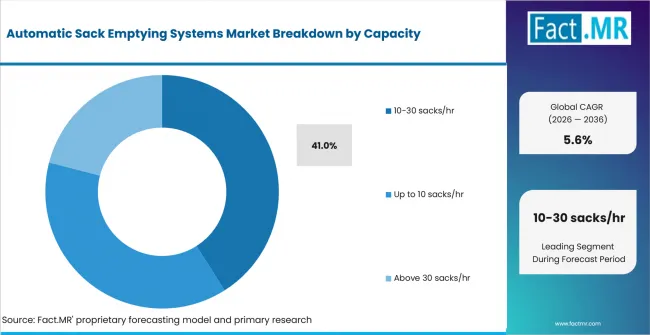
Automatic Sack Emptying Systems Market Analysis By Capacity | Source: Fact.MR
The 10-30 sacks/hr band suits batch plants where material addition follows recipe timing rather than a continuous bulk-flow target. It provides enough capacity for routine production while preserving flexibility between ingredients.
Systems above this range fit sustained high-volume intake, whereas lower-capacity stations serve pilot or occasional duties. The middle band therefore aligns with a broad set of food, chemical and pharmaceutical installations.
What is accelerating Automatic Sack Emptying Systems Market adoption, and what is holding it back?
Drivers Impact Analysis
| Driver | (~) % Impact on CAGR | Geographic Relevance | Impact Timeline |
|---|---|---|---|
| Enclosed equipment replacing open manual sack tipping | +1.3% | Global | Near term |
| Combustible-dust and ATEX compliance at intake points | +1.1% | USA and Europe | Near term |
| Hygienic design requirements in food and pharma intake | +0.9% | USA and Europe | Mid term |
| Labor scarcity and ergonomics in manual sack handling | +0.8% | Global | Mid term |
Opportunity Impact Analysis
| Opportunity | (~) % Impact on CAGR | Geographic Relevance | Impact Timeline |
|---|---|---|---|
| Retrofit extraction and filter packages for installed stations | +0.7% | USA and Europe | Mid term |
| Fully automatic de-bagging for continuous high-throughput lines | +0.6% | Global | Long term |
| Contained emptying for battery-materials and potent-compound powders | +0.5% | South Korea, USA and Europe | Mid term |
Restraints Impact Analysis
| Restraint | (~) % Impact on CAGR | Geographic Relevance | Impact Timeline |
|---|---|---|---|
| Capital cost of enclosed, rated equipment for small processors | -0.8% | Global | Near term |
| Sack variety and pallet patterns complicating full automation | -0.6% | Global | Mid term |
| Layout and headroom constraints in legacy plants | -0.5% | USA and Europe | Mid term |
Which countries are scaling the Automatic Sack Emptying Systems Market through 2036?
- Germany: A deep machinery-building base and large chemical and food sectors make enclosed, ATEX-conform intake equipment a standard part of plant modernization programs.
- United States: Combustible-dust enforcement and food-safety sanitation rules give processors a compliance-led reason to replace open tipping with filtered emptying stations.
- South Korea: Expanding battery-materials, specialty-chemical and food-ingredient capacity raises the number of powder intake points that need automated, contained sack handling.
- Italy: A strong processing and packaging machinery sector, together with export-oriented food manufacturing, supports steady replacement of legacy tipping setups.
- France: Food and chemical producers operating under EU hygiene and ATEX rules keep upgrading intake steps to documented, enclosed equipment.
- Switzerland: Pharmaceutical and fine-chemical production requires contained, hygienic powder handling with validated cleaning, favoring high-specification emptying systems.
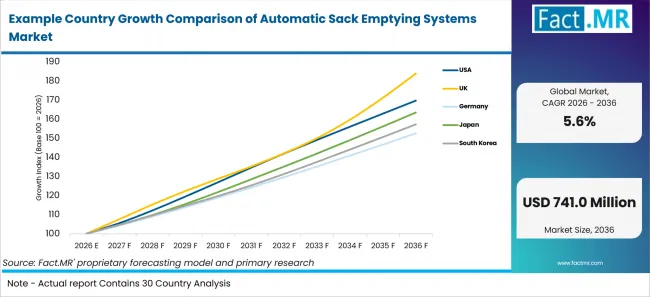
Example Country Growth Comparison Of Automatic Sack Emptying Systems Market | Source: Fact.MR
| Country | 2026 Share | CAGR (2026-2036) |
|---|---|---|
| Germany | 22.0% | 5.4% |
| United States | 24.0% | 6.6% |
| South Korea | 16.0% | 7.8% |
| Italy | 13.0% | 5.9% |
| France | 13.0% | 6.4% |
| Switzerland | 12.0% | 5.7% |
What is driving Germany's growth through 2036?
Demand in Germany is projected to expand at 5.4% CAGR from 2026 to 2036.
Germany anchors Europe's process-plant and mechanical-engineering industry, and its chemical and food producers apply ATEX equipment rules throughout powder handling areas. Modernization programs typically bundle intake equipment with conveying and dosing upgrades, which keeps sack emptying systems inside broader automation budgets.
What is driving growth in the United States through 2036?
Demand in the United States is projected to expand at 6.6% CAGR from 2026 to 2036.
The Occupational Safety and Health Administration enforces combustible-dust controls through its National Emphasis Program, and FDA-regulated food plants operate under sanitation and preventive-control expectations. Both frameworks push processors toward enclosed, filtered intake equipment that can be documented during inspections.
What is driving South Korea's growth through 2036?
Demand in South Korea is projected to expand at 7.8% CAGR.
South Korea is investing in battery-materials, chemical and food-ingredient production lines where powders must be received, emptied and transferred under containment. New-build plants tend to specify automated intake from the design stage, which lifts growth above mature-market levels.
What is driving Italy's growth through 2036?
Demand in Italy is projected to expand at 5.9% CAGR.
Italy has a well-established processing and packaging machinery cluster and an export-oriented food industry. Replacement demand centers on hygienic equipment with compact footprints suited to existing plants.
What is driving France's growth through 2036?
Demand in France is projected to expand at 6.4% CAGR from 2026 to 2036.
France applies EU hygiene and ATEX frameworks across its food, dairy and chemical industries, and industrial employers face sustained pressure to reduce manual handling risks. Enclosed sack emptying with point-of-source extraction fits both compliance tracks.
What is driving Switzerland's growth through 2036?
Demand in Switzerland is projected to expand at 5.7% CAGR from 2026 to 2036.
Switzerland's pharmaceutical and fine-chemical producers require containment, validated cleaning and documented material contact surfaces at every intake step. This specification-heavy environment supports premium equipment even where volumes are smaller than in neighboring markets.
Who leads the Automatic Sack Emptying Systems Market?
Palamatic Process, Flexicon and Spiroflow fit where sack emptying connects with dust capture, hygienic handling and downstream conveying.
Dinnissen Process Technology and Gericke AG position sack emptying within wider powder-processing systems, while Volkmann GmbH links emptying stations with vacuum conveying. Their offers differ in automation level, hygienic execution and the degree of responsibility accepted for the full intake package.
Supplier selection is application-led. Buyers compare dust-capture performance, access for filter service, cleanability after allergen or product changeovers, hazardous-area conformity and integration with conveying or dosing equipment. Demonstration trials with the customer's sacks and powders can materially influence final qualification.
Which companies are the key providers?
Key companies include Palamatic Process; Flexicon Corporation; Spiroflow; Dinnissen Process Technology; Gericke AG; and Volkmann GmbH.
- Palamatic Process
- Flexicon Corporation
- Spiroflow
- Dinnissen Process Technology
- Gericke AG
- Volkmann GmbH
Bibliography
- Occupational Safety and Health Administration. Combustible Dust National Emphasis Program.
- National Fire Protection Association. NFPA 652: Standard on the Fundamentals of Combustible Dust.
- European Commission. Directive 2014/34/EU on equipment intended for use in potentially explosive atmospheres.
- U.S. Food and Drug Administration. Current Good Manufacturing Practice, Hazard Analysis, and Risk-Based Preventive Controls for Human Food.
- European Hygienic Engineering & Design Group. Hygienic design principles for dry-product processing equipment.
- National Institute for Occupational Safety and Health. Applications Manual for the Revised NIOSH Lifting Equation.
- Palamatic Process. Automatic and manual bag-emptying equipment documentation.
- Flexicon Corporation. Bag-dump stations for contained manual sack emptying.
- Spiroflow. Sack-tip and powder-handling system documentation.
- Dinnissen Process Technology. Automatic bag-emptying and powder-processing systems.
- Gericke AG. Sack-tipping stations for dry bulk intake.
- Volkmann GmbH. Bag emptying and vacuum-conveying system documentation.
This Report Answers
- The report maps demand by product type, dust-control arrangement, end-use industry and sack-handling capacity.
- It explains why assisted tipping remains relevant alongside automatic de-bagging and how containment requirements alter equipment choice.
- Country analysis examines the industrial and regulatory conditions shaping enclosed powder intake across the listed markets.
- The competitive review compares the listed suppliers by automation scope, hygienic execution and conveying integration.
- The scope clarifies the boundary between sack-emptying equipment and bulk-bag dischargers, drum tippers or downstream processing machinery.
What does the Automatic Sack Emptying Systems Market cover?
The market covers equipment designed to open, tip and discharge ingredient sacks at process intake points while keeping dust release under control. The covered product set includes manual-assist tip stations, semi-automatic emptying systems and fully automatic de-baggers, offered with integrated filter units, central-extraction connections or wet and scrubber-based dust control.
The assessment follows the stated segmentation by Product Type, Dust Control, End-Use Industry and Capacity. Revenue is counted where the commercial product is sold as a sack emptying or de-bagging system for industrial powder intake.
What is included in the scope?
The scope includes Manual-assist tip stations, Semi-automatic emptying systems and Fully automatic de-baggers. It covers Integrated filter units, Central extraction linked and Wet/scrubber control configurations across food & beverage, chemicals, pharmaceuticals, plastics and building materials intake lines.
Demand is assessed across capacity bands from single-sack pilot operation to continuous de-bagging above 30 sacks per hour. Equipment is included when sack emptying is the defining function, whether sold as a stand-alone station or as part of an intake package with integrated filtration.
What is excluded from the scope?
Bulk-bag (FIBC) dischargers, drum and container dumpers and octabin tippers are excluded because their container formats and handling duty differ from 25-kilogram-class sacks. Standalone conveying, mixing, dosing and packaging machinery placed downstream of the intake point are also outside the market.
General industrial vacuum cleaners and central dust-collection plants are excluded when sold without the emptying station itself. Used-equipment resale and manual tipping aids without containment or extraction interfaces are not counted.
How Was the Analysis Built?
The assessment starts with the equipment boundary, separating open-mouth sack emptying from FIBC discharge, drum dumping and general conveying systems.
- Primary Research: Discussions center on plant engineers, maintenance teams and procurement specialists responsible for powder-intake safety, cleaning and throughput.
- Secondary Research: Occupational-safety material, combustible-dust guidance, hygienic-design publications and official supplier literature are used to test the operating assumptions.
- Market Sizing and Forecasting: Demand is modeled from product configuration, intake capacity, dust-control selection and purchasing activity across food, chemical, pharmaceutical and materials plants.
- Validation and Updates: Company names, segment arithmetic and country projections are checked separately, with duplicate categories and unrelated bulk-container equipment removed from the market boundary.
What is the report's scope and coverage?
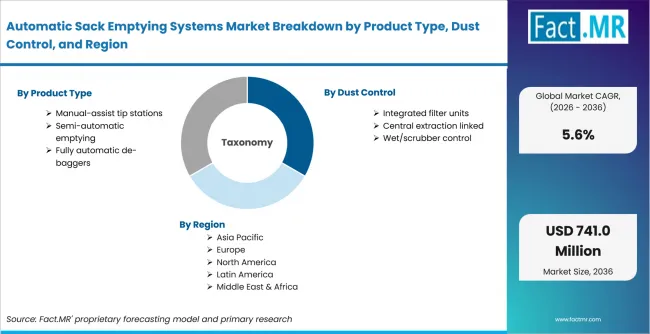
Automatic Sack Emptying Systems Market Breakdown By Product Type, Dust Control, And Region | Source: Fact.MR
| Attribute | Details |
|---|---|
| Quantitative Units | USD Million |
| Market Definition | Automated bag-tip and sack-emptying stations with integrated dust control that discharge powders from open-mouth sacks into downstream process equipment. |
| Segments Covered | Product Type; Dust Control; End-Use Industry; Capacity |
| Regions Covered | North America; Latin America; Europe; East Asia; South Asia and Oceania; Middle East and Africa |
| Countries Covered | Germany; United States; South Korea; Italy; France; Switzerland |
| Key Companies Profiled | Palamatic Process; Flexicon Corporation; Spiroflow; Dinnissen Process Technology; Gericke AG; Volkmann GmbH |
| Forecast Period | 2026 to 2036 |
| Base Year | 2025 |
| Market Value, 2026 | USD 430 million |
| Market Value, 2036 | USD 741 million |
| CAGR, 2026-2036 | 5.6% |
| Absolute Opportunity | USD 311 million |
| Approach | Demand is modeled from product configuration, intake capacity, dust-control selection and purchasing activity across food, chemical, pharmaceutical and materials plants. |
How is the market segmented?
-
By Product Type:
- Manual-assist tip stations
- Semi-automatic emptying
- Fully automatic de-baggers
-
By Dust Control:
- Integrated filter units
- Central extraction linked
- Wet/scrubber control
-
By End-Use Industry:
- Food & beverage
- Chemicals
- Pharmaceuticals
- Plastics
- Building materials
-
By Capacity:
- Up to 10 sacks/hr
- 10-30 sacks/hr
- Above 30 sacks/hr
-
By Region
- North America
- Latin America
- Western Europe
- Eastern Europe
- East Asia
- South Asia and Pacific
- Middle East & Africa