Automatic Checkweigher Market Size, Share, Growth and Forecast (2026 - 2036)
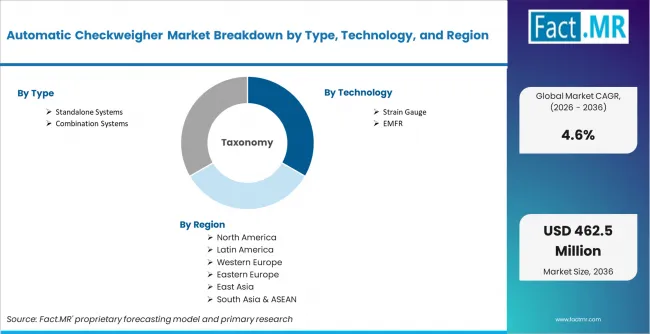
The Automatic Checkweigher Market is segmented by Type (Standalone Systems, Combination Systems), by Technology by End Use, by Line Configuration, and by Sales Channel and Region. Forecast for 2026 to 2036.
Fact.MR states that automatic checkweigher demand is moving toward faster inspection and better packaging control. Food and beverage manufacturers need systems that check package weight without slowing production lines. Pharmaceutical companies need accurate weighing for bottles and cartons. Consumer goods producers use checkweighers to reduce product giveaway and remove incorrect-weight packs before shipment.
Automatic Checkweigher Market Size, Market Forecast and Outlook by Fact.MR
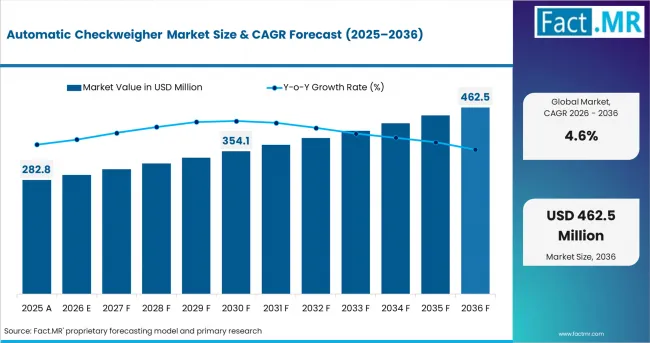
- The automatic checkweigher market was valued at USD 282.8 million in 2025.
- Demand is estimated to reach USD 295.0 million in 2026 and is projected to rise to USD 462.5 million by 2036.
- The market is forecast to record 4.6% CAGR from 2026 to 2036 as manufacturers use in-line inspection to improve filling accuracy and avoid underweight or overweight packs.
| Metric | Details |
|---|---|
| Industry Size 2026 | USD 295.0 million |
| Industry Value 2036 | USD 462.5 million |
| CAGR 2026 to 2036 | 4.6% |
Summary of Automatic Checkweigher Market
- Demand Drivers in the Market
- Fill Accuracy: Food and pharmaceutical plants need checkweighers to reduce underfilled packs and cut product giveaway.
- Line Automation: Manufacturers prefer in-motion weighing systems that check products without slowing packaging lines.
- Quality Control: Automated rejection removes incorrect-weight packs before shipment and helps maintain audit records.
- Key Segments Analyzed
- By Type: Standalone systems are expected to hold 62.0% share in 2026 as manufacturers need dedicated weight inspection on packaging lines.
- By Technology: Strain gauge systems are likely to account for 57.0% share in 2026 because they offer a practical balance of accuracy and cost.
- By End Use: Food & beverages are projected to hold 39.0% share in 2026 since packaged products need weight checks and reject control.
- By Line Configuration: In-motion conveyor checkweighers are anticipated to capture 68.0% share in 2026 because production lines need continuous weighing.
- By Sales Channel: Direct sales are expected to hold 46.0% share in 2026 since large plants need installation and validation support.
- By Geography: China is projected to record 5.4% CAGR through 2036 as packaged food and pharmaceutical production support checkweigher demand.
- Analyst Opinion at Fact.MR
- Shambhu Nath Jha, Principal Consultant at Fact.MR, states, “Automatic checkweigher demand is moving from basic weight control to production assurance. Manufacturers need systems that protect fill accuracy and support audit records. Suppliers with reliable sensors and service support will gain better access to production lines.”
- Strategic Implications
- Accuracy Control: Suppliers need systems that reduce product giveaway and underfill risk on fast lines without requent false rejects.
- Integration Support: Manufacturers should choose checkweighers that connect with fillers and production data software.
- Service Readiness: Local maintenance support is important because inspection downtime can stop packaging output and delay shipment release.
Automatic checkweigher demand is shifting from basic weighing to quality control built into production lines. Packaging managers need machines that detect incorrect weight and reject faulty products automatically. Production heads need systems that track process data and reduce product giveaway. Food and pharmaceutical plants are using combined systems that bring checkweighing together with metal detection or labeling.
China is projected to record 5.4% CAGR through 2036 as food packaging and pharmaceutical production support checkweigher demand. India is likely to post 5.2% CAGR because packaged food and healthcare manufacturing expand. The United States is expected to register 4.8% CAGR by 2036 as industrial automation and packaging compliance support system upgrades. Germany is poised to record 4.5% CAGR since food and industrial producers use dynamic weighing systems. Japan is forecast to advance at 4.3% CAGR as manufacturers replace older inspection lines with compact checkweighers.
Segmental Analysis
Automatic Checkweigher Market Analysis by Type
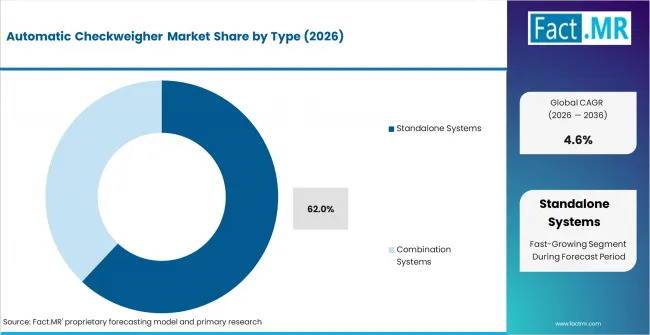
Standalone systems are expected to hold 62.0% share in 2026 as manufacturers need dedicated weight inspection on packaging lines. The segment leads because many plants install checkweighers after filling or labeling equipment. Minebea Intec stated in 2025 that checkweighers are used in packaging to ensure products meet specified weight and comply with legal and operational standards. [1] Combination systems are gaining in food and pharmaceutical lines because weight checking can be paired with metal detection or vision inspection. Type selection depends on line layout and inspection needs.
- Standalone Use: Standalone systems support dedicated weight checks after filling or packing and are easier to add to existing lines.
- Combination Value: Combination systems help plants save floor space by combining checkweighing with metal detection or other inspection steps.
- Layout Fit: Type selection depends on available line space and product handling needs.
Automatic Checkweigher Market Analysis by Technology
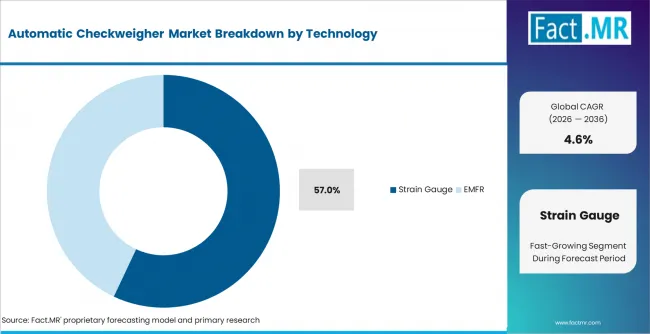
Strain gauge systems remain common because they suit many food and general packaging lines. EMFR systems are gaining in high-speed and high-precision settings. Strain gauge systems are likely to account for 57.0% share in 2026 because they offer a practical balance of accuracy and cost. Wipotec states that EMFR technology enables fast settling times and repeatability compared with conventional strain-gauge cells. [3] Technology selection depends on target accuracy and product speed.
- Strain Gauge Use: Strain gauge systems support routine package weighing with proven load-cell technology and practical cost.
- EMFR Precision: EMFR systems suit fast lines that need quick settling and tighter weight control.
- Throughput Fit: Technology choice depends on product spacing and acceptable reject levels.
Automatic Checkweigher Market Analysis by End Use
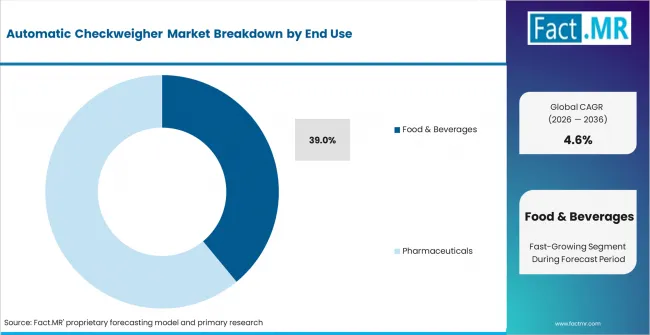
Food & beverages are projected to hold 39.0% share in 2026 as packaged products need weight checks and reject control. The segment leads because food packs must meet declared weight and avoid underfilled retail units. Pharmaceutical lines need checkweighers for capsules and carton checks. Consumer products use checkweighing to confirm pack completeness. FDA’s Food Traceability Rule adds recordkeeping requirements for listed foods and supports stronger product tracking across the supply chain. [2] End-use demand depends on regulation and line speed.
- Food Packaging: Food plants need checkweighers that protect declared weight and remove incorrect packs before shipment.
- Pharma Inspection: Pharmaceutical producers use checkweighers for bottles and capsule checks that support quality assurance.
- Consumer Goods: Consumer product manufacturers use weight inspection to confirm pack completeness and reduce customer complaints.
Automatic Checkweigher Market Analysis by Line Configuration
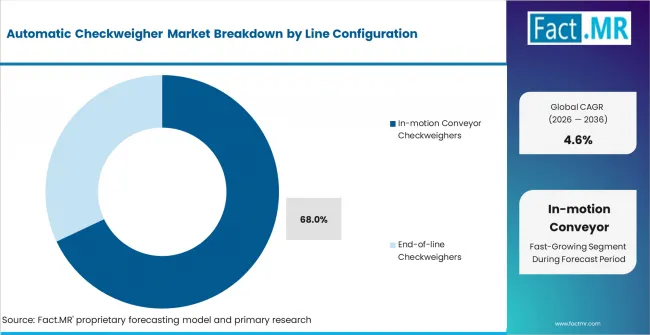
In-motion conveyor checkweighers lead because production lines need continuous inspection without manual handling. These systems weigh products as they move through the line and reject packs outside the acceptable range. In-motion conveyor checkweighers are anticipated to capture 68.0% share in 2026 because production lines need continuous weighing. All-Fill stated in 2025 that checkweigher reject systems remove containers into a reject tray or separate conveyor after weight inspection. [4] Configuration choice depends on line speed and package stability.
- In-motion Weighing: Conveyor checkweighers inspect packages continuously and remove incorrect-weight packs without stopping production lines.
- End-of-line Checks: End-of-line systems inspect cartons and grouped products before shipment release.
- Compact Systems: Compact checkweighers suit smaller plants and crowded packaging areas with limited line space.
Automatic Checkweigher Market Analysis by Sales Channel
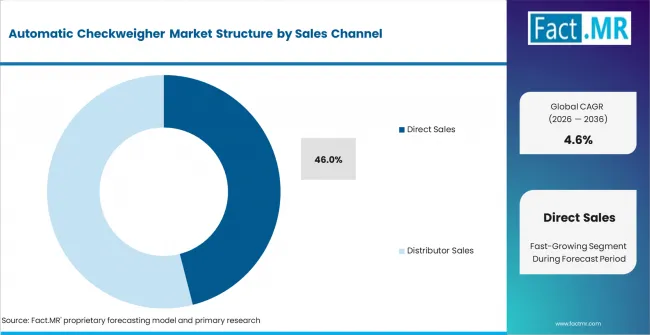
Large manufacturers often prefer direct purchases because checkweighers need installation planning and line validation. Distributor sales remain important for smaller plants that need standard models and local service. Direct sales are expected to hold 46.0% share in 2026 as large plants need installation and validation support. Channel selection depends on system complexity and service response.
- Direct Sales: Direct supplier relationships help large manufacturers manage system selection and service planning.
- Distributor Sales: Distributors help smaller plants access standard checkweighers with local installation guidance and faster support.
- Service Sales: Aftermarket service supports calibration and software updates that keep inspection equipment production-ready.
Automatic Checkweigher Market Drivers, Restraints, and Opportunities

Product weight control is the main driver for automatic checkweigher demand. Manufacturers need accurate in-line weighing to avoid underfilled packs and remove incorrect products before shipment.
High system cost can slow adoption among smaller manufacturers. Automatic checkweighers need installation and regular maintenance. Plants with low line speeds may delay upgrades if manual weighing still meets basic quality needs.
Opportunities in the Automatic Checkweigher Market
- Combination Inspection: Suppliers can expand checkweighers that combine weighing and reject systems for compact production lines.
- Pharma Micro-weighing: Equipment makers can target capsule and sachet lines that need higher precision and validation support.
- Data-linked Weighing: Vendors can connect checkweighers with filling systems and production software to reduce giveaway and improve audit records.
Regional Analysis
Based on regional analysis, the automatic checkweigher market is segmented into North America, Latin America, Europe, East Asia, South Asia and Pacific, and Middle East and Africa.
.webp)
| Country | CAGR 2026 to 2036 |
|---|---|
| China | 5.4% |
| India | 5.2% |
| United States | 4.8% |
| Germany | 4.5% |
| Japan | 4.3% |
Source: Fact.MR analysis, based on forecast approach and primary research.
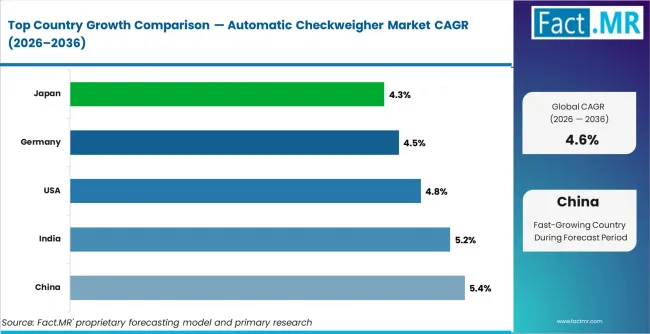
East Asia Automatic Checkweigher Market Analysis
East Asia demand comes from packaged food and advanced manufacturing. China and Japan support sales through fast packaging and quality-focused production. Suppliers need good service support and product handling knowledge.
- China: China is projected to record 5.4% CAGR through 2036 as food packaging and pharmaceutical production support checkweigher demand. Large factories need systems that inspect weight quickly and reject faulty packs automatically. Food and consumer goods producers will use in-motion systems to improve quality control. Pharmaceutical plants will need precise models for small packs and bottles. Domestic suppliers can compete through cost and service coverage. International brands can gain through combination systems and better accuracy.
- Japan: Japan checkweigher demand is tied to quality manufacturing and replacement. Food and pharmaceutical plants need precise inspection equipment that supports low-errors. Japan is forecast to advance at 4.3% CAGR by 2036 as manufacturers replace older inspection lines with compact checkweighers. Compact systems suit plants that need accuracy in limited floor space.
South Asia and Pacific Automatic Checkweigher Market Analysis
South Asia and Pacific demand is led by India. Food processing and pharmaceutical production are increasing the need for in-line weighing. Smaller plants need standard models with local service support.
- India: Food processing and healthcare manufacturing are raising India need for automatic checkweighers. The country is likely to capture 5.2% CAGR by 2036 as packaged products move through faster filling and sealing lines. Packaged food firms need systems that reduce underfilled units and limit giveaway. Pharmaceutical companies need validation-ready equipment for bottles and cartons. Distributor support will be important for small and mid-sized plants. Suppliers with affordable models and quick service response will gain stronger repeat orders.
North America Automatic Checkweigher Market Analysis
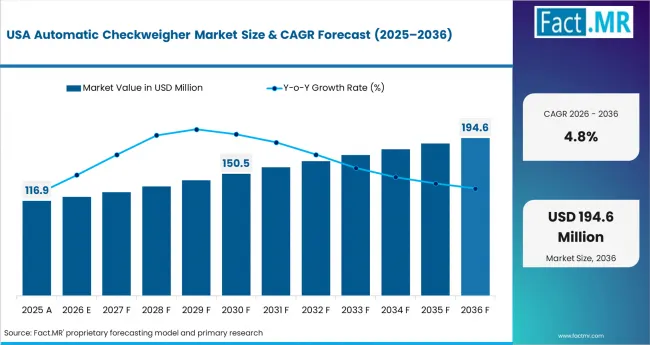
North America demand is driven by the United States. Food safety and automation upgrades support checkweigher replacement. Manufacturers need systems that connect weighing and data records.
- United States: The United States is expected to register 4.8% CAGR from 2026 to 2036 as industrial automation and packaging compliance support system upgrades. Food and beverage plants need checkweighers that remove incorrect packs before shipment. Pharmaceutical producers need higher precision for small containers and carton checks. Suppliers with validation support and national service coverage will gain better access. Combination systems can gain traction in plants that need compact inspection setups.
Europe Automatic Checkweigher Market Analysis

Europe demand is supported by food packaging automation and legal metrology needs. Germany leads regional demand through food and industrial goods production. Precision and hygiene design guide equipment selection.
- Germany: Germany is anticipated to record 4.5% CAGR through 2036 as food and industrial producers use dynamic weighing systems. Manufacturers need checkweighers that work with automated lines and support quality records. German plants will value hygienic design and calibration support. EMFR systems can gain in lines that need higher accuracy and fast settling. Suppliers must support reject systems and production data integration.
Competitive Aligners for Market Suppliers

The automatic checkweigher market includes weighing system suppliers and inspection equipment companies. A&D Company Limited and Mettler-Toledo International Inc. are tied to industrial weighing and checkweighing systems. All-Fill Inc. supports packaging lines with filling and weighing equipment. Minebea Intec GmbH and LOMA SYSTEMS serve food and pharma plants with inspection and checkweighing solutions.
Suppliers with compact combination systems and better data connectivity will gain plant access by 2036. Food and pharma plants will prefer systems that reduce product giveaway and support compliance. Service depth will stay important because checkweigher downtime can stop packing lines.
Key Companies in Automatic Checkweigher Market
- A&D Company, Limited
- Mettler-Toledo International Inc.
- All-Fill Inc.
- Minebea Intec GmbH
- LOMA SYSTEMS
Bibliography
- [1] Minebea Intec. (2025, January 30). Minebea Intec presents leading technology for industrial weighing and inspection at Propak Africa 2025. Mynewsdesk.
- [2] U.S. Food and Drug Administration. (2026, May). FSMA final rule on requirements for additional traceability records for certain foods. U.S. Food and Drug Administration.
- [3] Wipotec. (2025, October 15). Precision at high speed: The EMFR advantage. Wipotec.
- [4] All-Fill Inc. (2025, May 23). Checkweigher reject systems: It’s all in the reject device.
This Report Addresses
- Strategic intelligence on automatic checkweigher demand across food, pharmaceutical, consumer goods, and industrial production lines.
- Growth opportunity mapping across China, India, the United States, Germany, and Japan.
- Segment analysis by type, technology, end use, line configuration, and sales channel.
- Regional outlook covering in-motion weighing, pharmaceutical inspection, food packaging control, and production-line automation.
- Competitive analysis of A&D Company, Limited, Mettler-Toledo International Inc., All-Fill Inc., Minebea Intec GmbH, LOMA SYSTEMS.
- Product assessment covering standalone systems, combination systems, strain gauge checkweighers, EMFR systems, and conveyor-based inspection.
- Primary interviews, supplier checks, and official source review support validation.
Automatic Checkweigher Market Definition
The automatic checkweigher market covers in-line and end-of-line weighing systems that automatically weigh packaged or discrete products during production. These systems classify products by weight and help manufacturers meet quality and legal metrology requirements.
Automatic Checkweigher Market Inclusions
The scope includes checkweighers reject mechanisms and maintenance services used in production lines.
Automatic Checkweigher Market Exclusions
The scope excludes manual weighing scales and laboratory balances. It excludes static bench scales unless integrated into automatic production inspection. General conveyors are outside scope unless supplied with automatic checkweighing capability. Metal detectors are excluded unless sold as part of a checkweigher combination system.
Automatic Checkweigher Market Research Methodology
- Primary Research
- Primary research includes interviews with packaging line managers and quality control heads. Inspection equipment distributors were reviewed separately.
- Desk Research
- Desk research reviews legal metrology rules and supplier product documentation. Company pages support technology and application validation.
- Market-Sizing and Forecasting
- Forecasting uses type demand and technology adoption. End-use uptake and channel structure support the forecast approach.
- Data Validation and Update Cycle
- Forecasts are validated through supplier checks and production-line interviews. Regional assumptions are reviewed against packaging automation and pharmaceutical inspection activity.
Scope of the Report

| Attribute | Details |
|---|---|
| Quantitative Units | USD 295.0 million in 2026 to USD 462.5 million by 2036 at 4.6% CAGR |
| Market Definition | Automatic weighing systems used to inspect, classify, and reject products by weight during production |
| Type | Standalone Systems, Combination Systems |
| Technology | Strain Gauge, EMFR |
| End Use | Food & Beverages, Pharmaceuticals, Consumer Products, Other End Uses |
| Line Configuration | In-motion Conveyor Checkweighers, End-of-line Checkweighers, Compact Checkweighers, Heavy-load Checkweighers |
| Sales Channel | Direct Sales, Distributor Sales, Aftermarket Service Sales |
| Regions Covered | North America, Latin America, Europe, East Asia, South Asia and Pacific, Middle East and Africa |
| Countries Covered | China, India, United States, Germany, Japan |
| Key Companies Profiled | A&D Company, Limited, Mettler-Toledo International Inc., All-Fill Inc., Minebea Intec GmbH, LOMA SYSTEMS |
| Forecast Period | 2026 to 2036 |
| Approach | Hybrid top-down and bottom-up approach using type demand, technology adoption, end-use uptake, line configuration, and regional validation |
Automatic Checkweigher Market Analysis by Segments
-
By Type:
- Standalone Systems
- Combination Systems
-
By Technology:
- Strain Gauge
- EMFR
-
By End Use:
- Food & Beverages
- Pharmaceuticals
- Consumer Products
- Other End Uses
-
By Line Configuration:
- In-motion Conveyor Checkweighers
- End-of-line Checkweighers
- Compact Checkweighers
- Heavy-load Checkweighers
-
By Sales Channel:
- Direct Sales
- Distributor Sales
- Aftermarket Service Sales
-
Region:
- North America
- United States
- Canada
- Europe
- Germany
- United Kingdom
- France
- Italy
- Spain
- East Asia
- China
- Japan
- South Korea
- South Asia and Pacific
- India
- ASEAN
- Australia and New Zealand
- Latin America
- Brazil
- Mexico
- Argentina
- Middle East and Africa
- GCC Countries
- South Africa
- Turkey
- North America
- Frequently Asked Questions -
What is the Automatic Checkweigher Market size in 2026?
The automatic checkweigher market is estimated to reach USD 295.0 million in 2026.
What will the Automatic Checkweigher Market be worth by 2036?
The automatic checkweigher market is projected to reach USD 462.5 million by 2036.
What CAGR is projected for the Automatic Checkweigher Market?
The automatic checkweigher market is forecast to record 4.6% CAGR from 2026 to 2036.
Which type leads the Automatic Checkweigher Market?
Standalone systems lead with 62.0% share in 2026 as manufacturers need dedicated weight inspection on packaging lines.
Which country expands fastest in the Automatic Checkweigher Market?
China is projected to record 5.4% CAGR through 2036 as food packaging and pharmaceutical production support checkweigher demand.
How does India perform in the Automatic Checkweigher Market?
India is likely to post 5.2% CAGR through 2036 as packaged food and healthcare manufacturing expand.
How does the United States perform in the Automatic Checkweigher Market?
The United States is expected to register 4.8% CAGR through 2036 as industrial automation supports system upgrades.
How does Germany perform in the Automatic Checkweigher Market?
Germany is poised to record 4.5% CAGR through 2036 as food and pharma producers use dynamic weighing systems.
How does Japan perform in the Automatic Checkweigher Market?
Japan is forecast to advance at 4.3% CAGR through 2036 as manufacturers replace older inspection lines.
What is the main driver in the Automatic Checkweigher Market?
The main driver is product weight control because manufacturers need to reduce giveaway and reject incorrect packs.
What is the main restraint in the Automatic Checkweigher Market?
The main restraint is high system cost because checkweighers need installation and maintenance.
Why are standalone systems important in this market?
Standalone systems are important because they give manufacturers dedicated weight inspection without full line redesign.
Why is strain gauge technology widely used?
Strain gauge technology is widely used because it offers proven weighing performance at practical system cost.
Why are food and beverages important for automatic checkweighers?
Food and beverage plants need checkweighers to protect declared weight and remove incorrect packs.
Table of Content
- Executive Summary
- Global Market Outlook
- Demand to side Trends
- Supply to side Trends
- Technology Roadmap Analysis
- Analysis and Recommendations
- Market Overview
- Market Coverage / Taxonomy
- Market Definition / Scope / Limitations
- Research Methodology
- Chapter Orientation
- Analytical Lens and Working Hypotheses
- Market Structure, Signals, and Trend Drivers
- Benchmarking and Cross-market Comparability
- Market Sizing, Forecasting, and Opportunity Mapping
- Research Design and Evidence Framework
- Desk Research Programme (Secondary Evidence)
- Company Annual and Sustainability Reports
- Peer-reviewed Journals and Academic Literature
- Corporate Websites, Product Literature, and Technical Notes
- Earnings Decks and Investor Briefings
- Statutory Filings and Regulatory Disclosures
- Technical White Papers and Standards Notes
- Trade Journals, Industry Magazines, and Analyst Briefs
- Conference Proceedings, Webinars, and Seminar Materials
- Government Statistics Portals and Public Data Releases
- Press Releases and Reputable Media Coverage
- Specialist Newsletters and Curated Briefings
- Sector Databases and Reference Repositories
- Fact.MR Internal Proprietary Databases and Historical Market Datasets
- Subscription Datasets and Paid Sources
- Social Channels, Communities, and Digital Listening Inputs
- Additional Desk Sources
- Expert Input and Fieldwork (Primary Evidence)
- Primary Modes
- Qualitative Interviews and Expert Elicitation
- Quantitative Surveys and Structured Data Capture
- Blended Approach
- Why Primary Evidence is Used
- Field Techniques
- Interviews
- Surveys
- Focus Groups
- Observational and In-context Research
- Social and Community Interactions
- Stakeholder Universe Engaged
- C-suite Leaders
- Board Members
- Presidents and Vice Presidents
- R&D and Innovation Heads
- Technical Specialists
- Domain Subject-matter Experts
- Scientists
- Physicians and Other Healthcare Professionals
- Governance, Ethics, and Data Stewardship
- Research Ethics
- Data Integrity and Handling
- Primary Modes
- Tooling, Models, and Reference Databases
- Desk Research Programme (Secondary Evidence)
- Data Engineering and Model Build
- Data Acquisition and Ingestion
- Cleaning, Normalisation, and Verification
- Synthesis, Triangulation, and Analysis
- Quality Assurance and Audit Trail
- Market Background
- Market Dynamics
- Drivers
- Restraints
- Opportunity
- Trends
- Scenario Forecast
- Demand in Optimistic Scenario
- Demand in Likely Scenario
- Demand in Conservative Scenario
- Opportunity Map Analysis
- Product Life Cycle Analysis
- Supply Chain Analysis
- Investment Feasibility Matrix
- Value Chain Analysis
- PESTLE and Porter’s Analysis
- Regulatory Landscape
- Regional Parent Market Outlook
- Production and Consumption Statistics
- Import and Export Statistics
- Market Dynamics
- Global Market Analysis 2021 to 2025 and Forecast, 2026 to 2036
- Historical Market Size Value (USD Million) Analysis, 2021 to 2025
- Current and Future Market Size Value (USD Million) Projections, 2026 to 2036
- Y to o to Y Growth Trend Analysis
- Absolute $ Opportunity Analysis
- Global Market Pricing Analysis 2021 to 2025 and Forecast 2026 to 2036
- Global Market Analysis 2021 to 2025 and Forecast 2026 to 2036, By Type
- Introduction / Key Findings
- Historical Market Size Value (USD Million) Analysis By Type , 2021 to 2025
- Current and Future Market Size Value (USD Million) Analysis and Forecast By Type , 2026 to 2036
- Standalone Systems
- Combination Systems
- Standalone Systems
- Y to o to Y Growth Trend Analysis By Type , 2021 to 2025
- Absolute $ Opportunity Analysis By Type , 2026 to 2036
- Global Market Analysis 2021 to 2025 and Forecast 2026 to 2036, By Technology
- Introduction / Key Findings
- Historical Market Size Value (USD Million) Analysis By Technology, 2021 to 2025
- Current and Future Market Size Value (USD Million) Analysis and Forecast By Technology, 2026 to 2036
- Strain Gauge
- EMFR
- Strain Gauge
- Y to o to Y Growth Trend Analysis By Technology, 2021 to 2025
- Absolute $ Opportunity Analysis By Technology, 2026 to 2036
- Global Market Analysis 2021 to 2025 and Forecast 2026 to 2036, By End Use
- Introduction / Key Findings
- Historical Market Size Value (USD Million) Analysis By End Use, 2021 to 2025
- Current and Future Market Size Value (USD Million) Analysis and Forecast By End Use, 2026 to 2036
- Food & Beverages
- Pharmaceuticals
- Consumer Products
- Other End Uses
- Food & Beverages
- Y to o to Y Growth Trend Analysis By End Use, 2021 to 2025
- Absolute $ Opportunity Analysis By End Use, 2026 to 2036
- Global Market Analysis 2021 to 2025 and Forecast 2026 to 2036, By Line Configuration
- Introduction / Key Findings
- Historical Market Size Value (USD Million) Analysis By Line Configuration, 2021 to 2025
- Current and Future Market Size Value (USD Million) Analysis and Forecast By Line Configuration, 2026 to 2036
- In-motion Conveyor Checkweighers
- End-of-line Checkweighers
- Compact Checkweighers
- Heavy-load Checkweighers
- In-motion Conveyor Checkweighers
- Y to o to Y Growth Trend Analysis By Line Configuration, 2021 to 2025
- Absolute $ Opportunity Analysis By Line Configuration, 2026 to 2036
- Global Market Analysis 2021 to 2025 and Forecast 2026 to 2036, By Sales Channel
- Introduction / Key Findings
- Historical Market Size Value (USD Million) Analysis By Sales Channel, 2021 to 2025
- Current and Future Market Size Value (USD Million) Analysis and Forecast By Sales Channel, 2026 to 2036
- Direct Sales
- Distributor Sales
- Aftermarket Service Sales
- Direct Sales
- Y to o to Y Growth Trend Analysis By Sales Channel, 2021 to 2025
- Absolute $ Opportunity Analysis By Sales Channel, 2026 to 2036
- Global Market Analysis 2021 to 2025 and Forecast 2026 to 2036, By Region
- Introduction
- Historical Market Size Value (USD Million) Analysis By Region, 2021 to 2025
- Current Market Size Value (USD Million) Analysis and Forecast By Region, 2026 to 2036
- North America
- Latin America
- Western Europe
- Eastern Europe
- East Asia
- South Asia and Pacific
- Middle East & Africa
- Market Attractiveness Analysis By Region
- North America Market Analysis 2021 to 2025 and Forecast 2026 to 2036, By Country
- Historical Market Size Value (USD Million) Trend Analysis By Market Taxonomy, 2021 to 2025
- Market Size Value (USD Million) Forecast By Market Taxonomy, 2026 to 2036
- By Country
- USA
- Canada
- Mexico
- By Type
- By Technology
- By End Use
- By Line Configuration
- By Sales Channel
- By Country
- Market Attractiveness Analysis
- By Country
- By Type
- By Technology
- By End Use
- By Line Configuration
- By Sales Channel
- Key Takeaways
- Latin America Market Analysis 2021 to 2025 and Forecast 2026 to 2036, By Country
- Historical Market Size Value (USD Million) Trend Analysis By Market Taxonomy, 2021 to 2025
- Market Size Value (USD Million) Forecast By Market Taxonomy, 2026 to 2036
- By Country
- Brazil
- Chile
- Rest of Latin America
- By Type
- By Technology
- By End Use
- By Line Configuration
- By Sales Channel
- By Country
- Market Attractiveness Analysis
- By Country
- By Type
- By Technology
- By End Use
- By Line Configuration
- By Sales Channel
- Key Takeaways
- Western Europe Market Analysis 2021 to 2025 and Forecast 2026 to 2036, By Country
- Historical Market Size Value (USD Million) Trend Analysis By Market Taxonomy, 2021 to 2025
- Market Size Value (USD Million) Forecast By Market Taxonomy, 2026 to 2036
- By Country
- Germany
- UK
- Italy
- Spain
- France
- Nordic
- BENELUX
- Rest of Western Europe
- By Type
- By Technology
- By End Use
- By Line Configuration
- By Sales Channel
- By Country
- Market Attractiveness Analysis
- By Country
- By Type
- By Technology
- By End Use
- By Line Configuration
- By Sales Channel
- Key Takeaways
- Eastern Europe Market Analysis 2021 to 2025 and Forecast 2026 to 2036, By Country
- Historical Market Size Value (USD Million) Trend Analysis By Market Taxonomy, 2021 to 2025
- Market Size Value (USD Million) Forecast By Market Taxonomy, 2026 to 2036
- By Country
- Russia
- Poland
- Hungary
- Balkan & Baltic
- Rest of Eastern Europe
- By Type
- By Technology
- By End Use
- By Line Configuration
- By Sales Channel
- By Country
- Market Attractiveness Analysis
- By Country
- By Type
- By Technology
- By End Use
- By Line Configuration
- By Sales Channel
- Key Takeaways
- East Asia Market Analysis 2021 to 2025 and Forecast 2026 to 2036, By Country
- Historical Market Size Value (USD Million) Trend Analysis By Market Taxonomy, 2021 to 2025
- Market Size Value (USD Million) Forecast By Market Taxonomy, 2026 to 2036
- By Country
- China
- Japan
- South Korea
- By Type
- By Technology
- By End Use
- By Line Configuration
- By Sales Channel
- By Country
- Market Attractiveness Analysis
- By Country
- By Type
- By Technology
- By End Use
- By Line Configuration
- By Sales Channel
- Key Takeaways
- South Asia and Pacific Market Analysis 2021 to 2025 and Forecast 2026 to 2036, By Country
- Historical Market Size Value (USD Million) Trend Analysis By Market Taxonomy, 2021 to 2025
- Market Size Value (USD Million) Forecast By Market Taxonomy, 2026 to 2036
- By Country
- India
- ASEAN
- Australia & New Zealand
- Rest of South Asia and Pacific
- By Type
- By Technology
- By End Use
- By Line Configuration
- By Sales Channel
- By Country
- Market Attractiveness Analysis
- By Country
- By Type
- By Technology
- By End Use
- By Line Configuration
- By Sales Channel
- Key Takeaways
- Middle East & Africa Market Analysis 2021 to 2025 and Forecast 2026 to 2036, By Country
- Historical Market Size Value (USD Million) Trend Analysis By Market Taxonomy, 2021 to 2025
- Market Size Value (USD Million) Forecast By Market Taxonomy, 2026 to 2036
- By Country
- Kingdom of Saudi Arabia
- Other GCC Countries
- Turkiye
- South Africa
- Other African Union
- Rest of Middle East & Africa
- By Type
- By Technology
- By End Use
- By Line Configuration
- By Sales Channel
- By Country
- Market Attractiveness Analysis
- By Country
- By Type
- By Technology
- By End Use
- By Line Configuration
- By Sales Channel
- Key Takeaways
- Key Countries Market Analysis
- USA
- Pricing Analysis
- Market Share Analysis, 2025
- By Type
- By Technology
- By End Use
- By Line Configuration
- By Sales Channel
- Canada
- Pricing Analysis
- Market Share Analysis, 2025
- By Type
- By Technology
- By End Use
- By Line Configuration
- By Sales Channel
- Mexico
- Pricing Analysis
- Market Share Analysis, 2025
- By Type
- By Technology
- By End Use
- By Line Configuration
- By Sales Channel
- Brazil
- Pricing Analysis
- Market Share Analysis, 2025
- By Type
- By Technology
- By End Use
- By Line Configuration
- By Sales Channel
- Chile
- Pricing Analysis
- Market Share Analysis, 2025
- By Type
- By Technology
- By End Use
- By Line Configuration
- By Sales Channel
- Germany
- Pricing Analysis
- Market Share Analysis, 2025
- By Type
- By Technology
- By End Use
- By Line Configuration
- By Sales Channel
- UK
- Pricing Analysis
- Market Share Analysis, 2025
- By Type
- By Technology
- By End Use
- By Line Configuration
- By Sales Channel
- Italy
- Pricing Analysis
- Market Share Analysis, 2025
- By Type
- By Technology
- By End Use
- By Line Configuration
- By Sales Channel
- Spain
- Pricing Analysis
- Market Share Analysis, 2025
- By Type
- By Technology
- By End Use
- By Line Configuration
- By Sales Channel
- France
- Pricing Analysis
- Market Share Analysis, 2025
- By Type
- By Technology
- By End Use
- By Line Configuration
- By Sales Channel
- India
- Pricing Analysis
- Market Share Analysis, 2025
- By Type
- By Technology
- By End Use
- By Line Configuration
- By Sales Channel
- ASEAN
- Pricing Analysis
- Market Share Analysis, 2025
- By Type
- By Technology
- By End Use
- By Line Configuration
- By Sales Channel
- Australia & New Zealand
- Pricing Analysis
- Market Share Analysis, 2025
- By Type
- By Technology
- By End Use
- By Line Configuration
- By Sales Channel
- China
- Pricing Analysis
- Market Share Analysis, 2025
- By Type
- By Technology
- By End Use
- By Line Configuration
- By Sales Channel
- Japan
- Pricing Analysis
- Market Share Analysis, 2025
- By Type
- By Technology
- By End Use
- By Line Configuration
- By Sales Channel
- South Korea
- Pricing Analysis
- Market Share Analysis, 2025
- By Type
- By Technology
- By End Use
- By Line Configuration
- By Sales Channel
- Russia
- Pricing Analysis
- Market Share Analysis, 2025
- By Type
- By Technology
- By End Use
- By Line Configuration
- By Sales Channel
- Poland
- Pricing Analysis
- Market Share Analysis, 2025
- By Type
- By Technology
- By End Use
- By Line Configuration
- By Sales Channel
- Hungary
- Pricing Analysis
- Market Share Analysis, 2025
- By Type
- By Technology
- By End Use
- By Line Configuration
- By Sales Channel
- Kingdom of Saudi Arabia
- Pricing Analysis
- Market Share Analysis, 2025
- By Type
- By Technology
- By End Use
- By Line Configuration
- By Sales Channel
- Turkiye
- Pricing Analysis
- Market Share Analysis, 2025
- By Type
- By Technology
- By End Use
- By Line Configuration
- By Sales Channel
- South Africa
- Pricing Analysis
- Market Share Analysis, 2025
- By Type
- By Technology
- By End Use
- By Line Configuration
- By Sales Channel
- USA
- Market Structure Analysis
- Competition Dashboard
- Competition Benchmarking
- Market Share Analysis of Top Players
- By Regional
- By Type
- By Technology
- By End Use
- By Line Configuration
- By Sales Channel
- Competition Analysis
- Competition Deep Dive
- A&D Company, Limited
- Overview
- Product Portfolio
- Profitability by Market Segments (Product/Age /Sales Channel/Region)
- Sales Footprint
- Strategy Overview
- Marketing Strategy
- Product Strategy
- Channel Strategy
- Mettler-Toledo International Inc.
- All-Fill Inc.
- Minebea Intec GmbH
- LOMA SYSTEMS
- A&D Company, Limited
- Competition Deep Dive
- Assumptions & Acronyms Used
List Of Table
- Table 1: Global Market Value (USD Million) Forecast by Region, 2021 to 2036
- Table 2: Global Market Value (USD Million) Forecast by Type, 2021 to 2036
- Table 3: Global Market Value (USD Million) Forecast by Technology, 2021 to 2036
- Table 4: Global Market Value (USD Million) Forecast by End Use, 2021 to 2036
- Table 5: Global Market Value (USD Million) Forecast by Line Configuration, 2021 to 2036
- Table 6: Global Market Value (USD Million) Forecast by Sales Channel, 2021 to 2036
- Table 7: North America Market Value (USD Million) Forecast by Country, 2021 to 2036
- Table 8: North America Market Value (USD Million) Forecast by Type, 2021 to 2036
- Table 9: North America Market Value (USD Million) Forecast by Technology, 2021 to 2036
- Table 10: North America Market Value (USD Million) Forecast by End Use, 2021 to 2036
- Table 11: North America Market Value (USD Million) Forecast by Line Configuration, 2021 to 2036
- Table 12: North America Market Value (USD Million) Forecast by Sales Channel, 2021 to 2036
- Table 13: Latin America Market Value (USD Million) Forecast by Country, 2021 to 2036
- Table 14: Latin America Market Value (USD Million) Forecast by Type, 2021 to 2036
- Table 15: Latin America Market Value (USD Million) Forecast by Technology, 2021 to 2036
- Table 16: Latin America Market Value (USD Million) Forecast by End Use, 2021 to 2036
- Table 17: Latin America Market Value (USD Million) Forecast by Line Configuration, 2021 to 2036
- Table 18: Latin America Market Value (USD Million) Forecast by Sales Channel, 2021 to 2036
- Table 19: Western Europe Market Value (USD Million) Forecast by Country, 2021 to 2036
- Table 20: Western Europe Market Value (USD Million) Forecast by Type, 2021 to 2036
- Table 21: Western Europe Market Value (USD Million) Forecast by Technology, 2021 to 2036
- Table 22: Western Europe Market Value (USD Million) Forecast by End Use, 2021 to 2036
- Table 23: Western Europe Market Value (USD Million) Forecast by Line Configuration, 2021 to 2036
- Table 24: Western Europe Market Value (USD Million) Forecast by Sales Channel, 2021 to 2036
- Table 25: Eastern Europe Market Value (USD Million) Forecast by Country, 2021 to 2036
- Table 26: Eastern Europe Market Value (USD Million) Forecast by Type, 2021 to 2036
- Table 27: Eastern Europe Market Value (USD Million) Forecast by Technology, 2021 to 2036
- Table 28: Eastern Europe Market Value (USD Million) Forecast by End Use, 2021 to 2036
- Table 29: Eastern Europe Market Value (USD Million) Forecast by Line Configuration, 2021 to 2036
- Table 30: Eastern Europe Market Value (USD Million) Forecast by Sales Channel, 2021 to 2036
- Table 31: East Asia Market Value (USD Million) Forecast by Country, 2021 to 2036
- Table 32: East Asia Market Value (USD Million) Forecast by Type, 2021 to 2036
- Table 33: East Asia Market Value (USD Million) Forecast by Technology, 2021 to 2036
- Table 34: East Asia Market Value (USD Million) Forecast by End Use, 2021 to 2036
- Table 35: East Asia Market Value (USD Million) Forecast by Line Configuration, 2021 to 2036
- Table 36: East Asia Market Value (USD Million) Forecast by Sales Channel, 2021 to 2036
- Table 37: South Asia and Pacific Market Value (USD Million) Forecast by Country, 2021 to 2036
- Table 38: South Asia and Pacific Market Value (USD Million) Forecast by Type, 2021 to 2036
- Table 39: South Asia and Pacific Market Value (USD Million) Forecast by Technology, 2021 to 2036
- Table 40: South Asia and Pacific Market Value (USD Million) Forecast by End Use, 2021 to 2036
- Table 41: South Asia and Pacific Market Value (USD Million) Forecast by Line Configuration, 2021 to 2036
- Table 42: South Asia and Pacific Market Value (USD Million) Forecast by Sales Channel, 2021 to 2036
- Table 43: Middle East & Africa Market Value (USD Million) Forecast by Country, 2021 to 2036
- Table 44: Middle East & Africa Market Value (USD Million) Forecast by Type, 2021 to 2036
- Table 45: Middle East & Africa Market Value (USD Million) Forecast by Technology, 2021 to 2036
- Table 46: Middle East & Africa Market Value (USD Million) Forecast by End Use, 2021 to 2036
- Table 47: Middle East & Africa Market Value (USD Million) Forecast by Line Configuration, 2021 to 2036
- Table 48: Middle East & Africa Market Value (USD Million) Forecast by Sales Channel, 2021 to 2036
List Of Figures
- Figure 1: Global Market Pricing Analysis
- Figure 2: Global Market Value (USD Million) Forecast 2021-2036
- Figure 3: Global Market Value Share and BPS Analysis by Type, 2026 and 2036
- Figure 4: Global Market Y-o-Y Growth Comparison by Type, 2026 to 2036
- Figure 5: Global Market Attractiveness Analysis by Type
- Figure 6: Global Market Value Share and BPS Analysis by Technology, 2026 and 2036
- Figure 7: Global Market Y-o-Y Growth Comparison by Technology, 2026 to 2036
- Figure 8: Global Market Attractiveness Analysis by Technology
- Figure 9: Global Market Value Share and BPS Analysis by End Use, 2026 and 2036
- Figure 10: Global Market Y-o-Y Growth Comparison by End Use, 2026 to 2036
- Figure 11: Global Market Attractiveness Analysis by End Use
- Figure 12: Global Market Value Share and BPS Analysis by Line Configuration, 2026 and 2036
- Figure 13: Global Market Y-o-Y Growth Comparison by Line Configuration, 2026 to 2036
- Figure 14: Global Market Attractiveness Analysis by Line Configuration
- Figure 15: Global Market Value Share and BPS Analysis by Sales Channel, 2026 and 2036
- Figure 16: Global Market Y-o-Y Growth Comparison by Sales Channel, 2026 to 2036
- Figure 17: Global Market Attractiveness Analysis by Sales Channel
- Figure 18: Global Market Value (USD Million) Share and BPS Analysis by Region, 2026 and 2036
- Figure 19: Global Market Y-o-Y Growth Comparison by Region, 2026 to 2036
- Figure 20: Global Market Attractiveness Analysis by Region
- Figure 21: North America Market Incremental Dollar Opportunity, 2026 to 2036
- Figure 22: Latin America Market Incremental Dollar Opportunity, 2026 to 2036
- Figure 23: Western Europe Market Incremental Dollar Opportunity, 2026 to 2036
- Figure 24: Eastern Europe Market Incremental Dollar Opportunity, 2026 to 2036
- Figure 25: East Asia Market Incremental Dollar Opportunity, 2026 to 2036
- Figure 26: South Asia and Pacific Market Incremental Dollar Opportunity, 2026 to 2036
- Figure 27: Middle East & Africa Market Incremental Dollar Opportunity, 2026 to 2036
- Figure 28: North America Market Value Share and BPS Analysis by Country, 2026 and 2036
- Figure 29: North America Market Value Share and BPS Analysis by Type, 2026 and 2036
- Figure 30: North America Market Y-o-Y Growth Comparison by Type, 2026 to 2036
- Figure 31: North America Market Attractiveness Analysis by Type
- Figure 32: North America Market Value Share and BPS Analysis by Technology, 2026 and 2036
- Figure 33: North America Market Y-o-Y Growth Comparison by Technology, 2026 to 2036
- Figure 34: North America Market Attractiveness Analysis by Technology
- Figure 35: North America Market Value Share and BPS Analysis by End Use, 2026 and 2036
- Figure 36: North America Market Y-o-Y Growth Comparison by End Use, 2026 to 2036
- Figure 37: North America Market Attractiveness Analysis by End Use
- Figure 38: North America Market Value Share and BPS Analysis by Line Configuration, 2026 and 2036
- Figure 39: North America Market Y-o-Y Growth Comparison by Line Configuration, 2026 to 2036
- Figure 40: North America Market Attractiveness Analysis by Line Configuration
- Figure 41: North America Market Value Share and BPS Analysis by Sales Channel, 2026 and 2036
- Figure 42: North America Market Y-o-Y Growth Comparison by Sales Channel, 2026 to 2036
- Figure 43: North America Market Attractiveness Analysis by Sales Channel
- Figure 44: Latin America Market Value Share and BPS Analysis by Country, 2026 and 2036
- Figure 45: Latin America Market Value Share and BPS Analysis by Type, 2026 and 2036
- Figure 46: Latin America Market Y-o-Y Growth Comparison by Type, 2026 to 2036
- Figure 47: Latin America Market Attractiveness Analysis by Type
- Figure 48: Latin America Market Value Share and BPS Analysis by Technology, 2026 and 2036
- Figure 49: Latin America Market Y-o-Y Growth Comparison by Technology, 2026 to 2036
- Figure 50: Latin America Market Attractiveness Analysis by Technology
- Figure 51: Latin America Market Value Share and BPS Analysis by End Use, 2026 and 2036
- Figure 52: Latin America Market Y-o-Y Growth Comparison by End Use, 2026 to 2036
- Figure 53: Latin America Market Attractiveness Analysis by End Use
- Figure 54: Latin America Market Value Share and BPS Analysis by Line Configuration, 2026 and 2036
- Figure 55: Latin America Market Y-o-Y Growth Comparison by Line Configuration, 2026 to 2036
- Figure 56: Latin America Market Attractiveness Analysis by Line Configuration
- Figure 57: Latin America Market Value Share and BPS Analysis by Sales Channel, 2026 and 2036
- Figure 58: Latin America Market Y-o-Y Growth Comparison by Sales Channel, 2026 to 2036
- Figure 59: Latin America Market Attractiveness Analysis by Sales Channel
- Figure 60: Western Europe Market Value Share and BPS Analysis by Country, 2026 and 2036
- Figure 61: Western Europe Market Value Share and BPS Analysis by Type, 2026 and 2036
- Figure 62: Western Europe Market Y-o-Y Growth Comparison by Type, 2026 to 2036
- Figure 63: Western Europe Market Attractiveness Analysis by Type
- Figure 64: Western Europe Market Value Share and BPS Analysis by Technology, 2026 and 2036
- Figure 65: Western Europe Market Y-o-Y Growth Comparison by Technology, 2026 to 2036
- Figure 66: Western Europe Market Attractiveness Analysis by Technology
- Figure 67: Western Europe Market Value Share and BPS Analysis by End Use, 2026 and 2036
- Figure 68: Western Europe Market Y-o-Y Growth Comparison by End Use, 2026 to 2036
- Figure 69: Western Europe Market Attractiveness Analysis by End Use
- Figure 70: Western Europe Market Value Share and BPS Analysis by Line Configuration, 2026 and 2036
- Figure 71: Western Europe Market Y-o-Y Growth Comparison by Line Configuration, 2026 to 2036
- Figure 72: Western Europe Market Attractiveness Analysis by Line Configuration
- Figure 73: Western Europe Market Value Share and BPS Analysis by Sales Channel, 2026 and 2036
- Figure 74: Western Europe Market Y-o-Y Growth Comparison by Sales Channel, 2026 to 2036
- Figure 75: Western Europe Market Attractiveness Analysis by Sales Channel
- Figure 76: Eastern Europe Market Value Share and BPS Analysis by Country, 2026 and 2036
- Figure 77: Eastern Europe Market Value Share and BPS Analysis by Type, 2026 and 2036
- Figure 78: Eastern Europe Market Y-o-Y Growth Comparison by Type, 2026 to 2036
- Figure 79: Eastern Europe Market Attractiveness Analysis by Type
- Figure 80: Eastern Europe Market Value Share and BPS Analysis by Technology, 2026 and 2036
- Figure 81: Eastern Europe Market Y-o-Y Growth Comparison by Technology, 2026 to 2036
- Figure 82: Eastern Europe Market Attractiveness Analysis by Technology
- Figure 83: Eastern Europe Market Value Share and BPS Analysis by End Use, 2026 and 2036
- Figure 84: Eastern Europe Market Y-o-Y Growth Comparison by End Use, 2026 to 2036
- Figure 85: Eastern Europe Market Attractiveness Analysis by End Use
- Figure 86: Eastern Europe Market Value Share and BPS Analysis by Line Configuration, 2026 and 2036
- Figure 87: Eastern Europe Market Y-o-Y Growth Comparison by Line Configuration, 2026 to 2036
- Figure 88: Eastern Europe Market Attractiveness Analysis by Line Configuration
- Figure 89: Eastern Europe Market Value Share and BPS Analysis by Sales Channel, 2026 and 2036
- Figure 90: Eastern Europe Market Y-o-Y Growth Comparison by Sales Channel, 2026 to 2036
- Figure 91: Eastern Europe Market Attractiveness Analysis by Sales Channel
- Figure 92: East Asia Market Value Share and BPS Analysis by Country, 2026 and 2036
- Figure 93: East Asia Market Value Share and BPS Analysis by Type, 2026 and 2036
- Figure 94: East Asia Market Y-o-Y Growth Comparison by Type, 2026 to 2036
- Figure 95: East Asia Market Attractiveness Analysis by Type
- Figure 96: East Asia Market Value Share and BPS Analysis by Technology, 2026 and 2036
- Figure 97: East Asia Market Y-o-Y Growth Comparison by Technology, 2026 to 2036
- Figure 98: East Asia Market Attractiveness Analysis by Technology
- Figure 99: East Asia Market Value Share and BPS Analysis by End Use, 2026 and 2036
- Figure 100: East Asia Market Y-o-Y Growth Comparison by End Use, 2026 to 2036
- Figure 101: East Asia Market Attractiveness Analysis by End Use
- Figure 102: East Asia Market Value Share and BPS Analysis by Line Configuration, 2026 and 2036
- Figure 103: East Asia Market Y-o-Y Growth Comparison by Line Configuration, 2026 to 2036
- Figure 104: East Asia Market Attractiveness Analysis by Line Configuration
- Figure 105: East Asia Market Value Share and BPS Analysis by Sales Channel, 2026 and 2036
- Figure 106: East Asia Market Y-o-Y Growth Comparison by Sales Channel, 2026 to 2036
- Figure 107: East Asia Market Attractiveness Analysis by Sales Channel
- Figure 108: South Asia and Pacific Market Value Share and BPS Analysis by Country, 2026 and 2036
- Figure 109: South Asia and Pacific Market Value Share and BPS Analysis by Type, 2026 and 2036
- Figure 110: South Asia and Pacific Market Y-o-Y Growth Comparison by Type, 2026 to 2036
- Figure 111: South Asia and Pacific Market Attractiveness Analysis by Type
- Figure 112: South Asia and Pacific Market Value Share and BPS Analysis by Technology, 2026 and 2036
- Figure 113: South Asia and Pacific Market Y-o-Y Growth Comparison by Technology, 2026 to 2036
- Figure 114: South Asia and Pacific Market Attractiveness Analysis by Technology
- Figure 115: South Asia and Pacific Market Value Share and BPS Analysis by End Use, 2026 and 2036
- Figure 116: South Asia and Pacific Market Y-o-Y Growth Comparison by End Use, 2026 to 2036
- Figure 117: South Asia and Pacific Market Attractiveness Analysis by End Use
- Figure 118: South Asia and Pacific Market Value Share and BPS Analysis by Line Configuration, 2026 and 2036
- Figure 119: South Asia and Pacific Market Y-o-Y Growth Comparison by Line Configuration, 2026 to 2036
- Figure 120: South Asia and Pacific Market Attractiveness Analysis by Line Configuration
- Figure 121: South Asia and Pacific Market Value Share and BPS Analysis by Sales Channel, 2026 and 2036
- Figure 122: South Asia and Pacific Market Y-o-Y Growth Comparison by Sales Channel, 2026 to 2036
- Figure 123: South Asia and Pacific Market Attractiveness Analysis by Sales Channel
- Figure 124: Middle East & Africa Market Value Share and BPS Analysis by Country, 2026 and 2036
- Figure 125: Middle East & Africa Market Value Share and BPS Analysis by Type, 2026 and 2036
- Figure 126: Middle East & Africa Market Y-o-Y Growth Comparison by Type, 2026 to 2036
- Figure 127: Middle East & Africa Market Attractiveness Analysis by Type
- Figure 128: Middle East & Africa Market Value Share and BPS Analysis by Technology, 2026 and 2036
- Figure 129: Middle East & Africa Market Y-o-Y Growth Comparison by Technology, 2026 to 2036
- Figure 130: Middle East & Africa Market Attractiveness Analysis by Technology
- Figure 131: Middle East & Africa Market Value Share and BPS Analysis by End Use, 2026 and 2036
- Figure 132: Middle East & Africa Market Y-o-Y Growth Comparison by End Use, 2026 to 2036
- Figure 133: Middle East & Africa Market Attractiveness Analysis by End Use
- Figure 134: Middle East & Africa Market Value Share and BPS Analysis by Line Configuration, 2026 and 2036
- Figure 135: Middle East & Africa Market Y-o-Y Growth Comparison by Line Configuration, 2026 to 2036
- Figure 136: Middle East & Africa Market Attractiveness Analysis by Line Configuration
- Figure 137: Middle East & Africa Market Value Share and BPS Analysis by Sales Channel, 2026 and 2036
- Figure 138: Middle East & Africa Market Y-o-Y Growth Comparison by Sales Channel, 2026 to 2036
- Figure 139: Middle East & Africa Market Attractiveness Analysis by Sales Channel
- Figure 140: Global Market - Tier Structure Analysis
- Figure 141: Global Market - Company Share Analysis