- Market Value (2025): USD 1.3 Bn
- Estimated Value (2026): USD 1.4 Bn
- Forecast Value (2036): USD 3.4 Bn
- CAGR (2026-2036): 9.0%
What is the Automatic Tea Bag Packaging Equipment Market forecast to be worth by 2036?
USD 1.4 billion in 2026 to USD 3.4 billion by 2036 at 9.0% CAGR.
- The automatic tea bag packaging equipment market was valued at USD 1.3 billion in 2025.
- Demand is projected to increase from USD 1.4 billion in 2026 to USD 3.4 billion by 2036 as processors add line capacity.
- The market is forecast to record 9.0% CAGR from 2026 to 2036 as buyers focus on fill weight and seal quality.
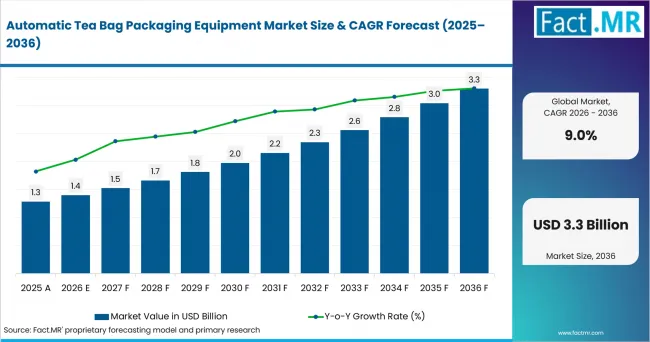
Automatic Tea Bag Packaging Equipment Market Value Analysis | Source: Fact.MR
What are the defining numbers behind Automatic Tea Bag Packaging Equipment Market growth?
USD 1.9 billion absolute opportunity is forecast by 2036.
- Demand Drivers in the Market
- Tea processors need repeatable dosing as leaf size and flow behavior change across black tea and herbal blends.
- Brand owners need machines that switch between single-chamber bags and double-chamber bags without long rebuild work.
- Food packaging co-packers depend on coding and inspection so customer specifications can be checked without manual reconciliation.
- Key Segments Analyzed
- By Equipment Category: Fully Automatic Tea Bag Packaging Machines are expected to hold 44% share in 2026 as buyers prefer one controlled production sequence.
- By Packaging Function: Tea Bag Filling & Sealing is projected to account for 41% share in 2026 since every tea bag needs controlled dosing.
- By End-use Industry: Tea Manufacturing is anticipated to capture 43% share in 2026 due to repeat output from black tea and green tea processors.
- By End User: Tea Processing Companies are estimated to represent 45% share in 2026 as they control blending and line release decisions.
- By Automation Technology: Servo-driven Automation is forecast to account for 39% share in 2026 through recipe control and accurate movement.
- Analyst Opinion at Fact.MR
- Shambhu Nath Jha, Principal Consultant at Fact.MR, states, “Tea bag equipment purchases are now line-architecture decisions. Buyers need proof that a machine can handle leaf flow and filter material. Format change and coding must hold up during operation. Inspection and service work need the same proof.”
- Strategic Implications
- Tea manufacturers can test representative blends at planned speed before they accept a rated output claim from any supplier.
- Contract packers benefit when changeover labor and quality checks are priced into equipment selection from the start.
- Equipment suppliers improve buyer confidence by showing how inspection and cartoning modules fit installed lines.
China leads at 10.1% CAGR through production scale and machinery depth. Germany follows at 9.7% as engineering standards guide purchases. Japan reaches 9.3% through quality-focused processing. India records 8.9% with packaged tea automation. The USA posts 8.5%, the UK 8.1%, and South Korea 7.8% for compact digitally controlled systems overall.
How does the Automatic Tea Bag Packaging Equipment Market break down by segment?
Fully Automatic Tea Bag Packaging Machines lead Equipment Category at 44% share in 2026. Tea Bag Filling & Sealing leads Packaging Function at 41% share in 2026.
Which Equipment Category dominates?
Fully Automatic Tea Bag Packaging Machines hold 44% share in 2026.
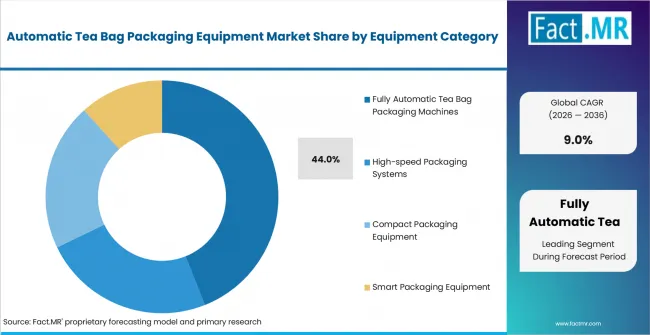
Automatic Tea Bag Packaging Equipment Market Analysis By Equipment Category | Source: Fact.MR
Processors prefer a controlled route from dosing to finished packs. Single Chamber Tea Bag Machines fit simple rectangular products with moderate output. Double Chamber Tea Bag Machines support folded formats with tag and envelope handling.
What leads the Packaging Function segment?
Tea Bag Filling & Sealing accounts for 41% share in 2026.
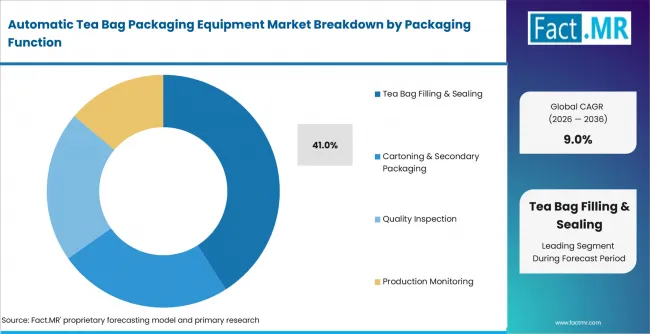
Automatic Tea Bag Packaging Equipment Market Analysis By Packaging Function | Source: Fact.MR
Tea Bag Filling & Sealing turns variable tea material into a measured unit dose. Accurate Filling must handle density and moisture changes. Filter Paper Sealing must close the bag without trapping leaf in the seam. Cartoning machines gain value when brands add envelopes and coded cartons.
Which End-use Industry creates the largest demand?
Tea Manufacturing holds 43% share in 2026.
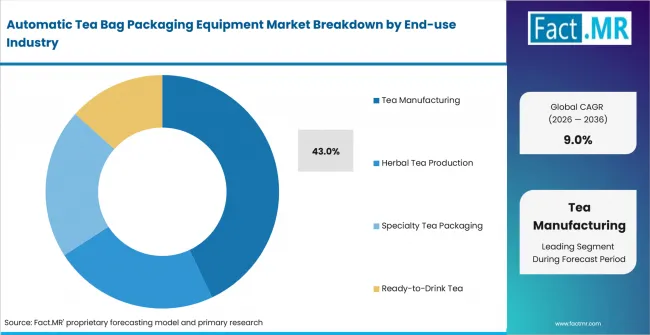
Automatic Tea Bag Packaging Equipment Market Analysis By End Use Industry | Source: Fact.MR
Tea Manufacturing leads as black tea and green tea processors run repeat products that support automation. Herbal Tea Production adds lighter ingredients and fibrous materials. Specialty Tea Packaging gives smaller batches a stronger need for clean changeover routines.
Why do Tea Processing Companies lead End User demand?
Tea Processing Companies lead with 45% share in 2026.
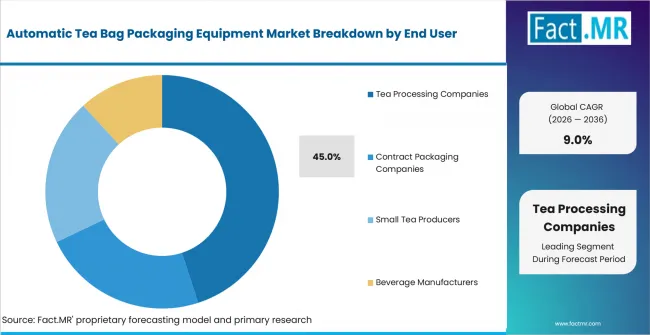
Automatic Tea Bag Packaging Equipment Market Analysis By End User | Source: Fact.MR
Tea Processing Companies make the operating choices that decide line yield. Large Tea Manufacturers spread tooling and maintenance cost across longer runs. Medium-sized Tea Producers need modular machines for export packs and seasonal blends. Contract Packaging Companies need documented control for private-label work.
Which Automation Technology leads?
Servo-driven Automation accounts for 39% share in 2026.
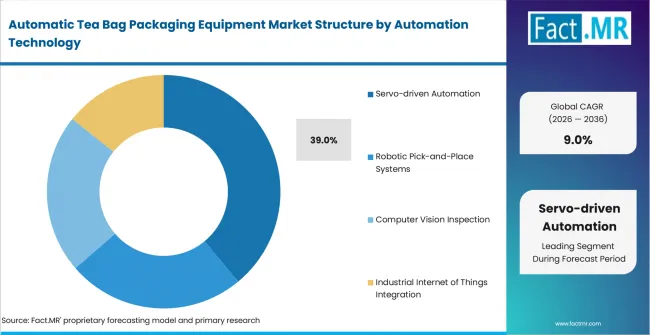
Automatic Tea Bag Packaging Equipment Market Analysis By Automation Technology | Source: Fact.MR
Servo-driven Automation helps builders control web feed and bag forming with fewer manual adjustments. PLC-based Control Systems manage repeat machine sequences. HMI Control gives operators recipes and alarms. Computer Vision Inspection and robotic handling improve fault recovery when plants want fewer stops.
What is accelerating Automatic Tea Bag Packaging Equipment Market adoption, and what is holding it back?
Adoption is expected to rise through integrated line replacement and format flexibility. Growth may slow when capital cost and material trials weaken the payback case.
Drivers Impact Analysis
| DRIVER | COMMERCIAL EFFECT | GEOGRAPHIC RELEVANCE | IMPACT TIMELINE |
|---|---|---|---|
| Manual-line replacement | Combines filling with inspection and cartoning | China, India, USA | Medium term |
| Packaged tea bag use | Supports renewal of high-volume lines | UK, Germany, USA | Current period |
| Herbal and premium formats | Raises the need for flexible dosing | Europe and Asia | Medium term |
| Coding and seal control | Adds inspection and rejection systems | South Korea, Europe, USA | Short to medium term |
| Workforce and uptime pressure | Supports servo control and remote diagnostics | Germany, Japan, USA, UK | Medium term |
Source: Fact.MR analysis. Updated Aug 6, 2026
- Manual-line replacement: Processors gain better control when filling and inspection follow one machine recipe. This lowers counting errors and makes reject causes easier to trace.
- Format flexibility: Herbal and premium tea ranges create shorter runs. Equipment demand improves when settings are tested with difficult blends before purchase.
- Uptime control: Servo drives and guided interfaces help plants recover from stops faster. This makes automation more useful during longer production days.
Opportunity Impact Analysis
| OPPORTUNITY | COMMERCIAL EFFECT | GEOGRAPHIC RELEVANCE | IMPACT TIMELINE |
|---|---|---|---|
| Modular equipment | Creates an upgrade path from compact lines | India, China, South Korea | Medium term |
| Retrofit inspection | Improves installed machines before replacement | Germany, Japan, UK, USA | Short term |
| Remote monitoring services | Helps plan maintenance around output | Global installed base | Medium term |
| Integrated case packing | Reduces manual checks for co-packers | USA, UK, Europe, Asia | Medium term |
Source: Fact.MR analysis. Updated Aug 6, 2026
- Modular equipment: Smaller tea companies can start with filling and sealing control. The upgrade path is stronger when modules remain useful after output rises.
- Retrofit inspection: Vision checks and weight verification can improve an older line. This route helps buyers address defects before a full replacement decision.
- Remote monitoring services: Connected status data helps service teams plan intervention windows. Processors gain value when maintenance does not interrupt saleable output.
Restraints Impact Analysis
| RESTRAINT | COMMERCIAL EFFECT | GEOGRAPHIC RELEVANCE | IMPACT TIMELINE |
|---|---|---|---|
| Capital cost and utilization | Extends payback when runs are short | SMEs and co-packers | Medium term |
| Variable tea flow | Raises dosing validation and reject risk | Global blends | Ongoing |
| Material changes | Requires sealing trials and tooling checks | Europe, UK, Japan | Short to medium term |
| Service capability gaps | Reduces uptime outside established hubs | Emerging clusters | Medium term |
Source: Fact.MR analysis. Updated Aug 6, 2026
- Capital utilization: A fully automatic line creates value only when enough compatible work keeps it loaded. Buyers need a payback model based on saleable bags.
- Variable tea flow: Fine particles can enter the seal area. Bulky leaves can bridge in hoppers and force extra validation before stable output begins.
- Service gaps: Plants outside established support hubs face longer downtime. This can slow purchase approval even when the machine fits the product range.
Which countries are scaling the Automatic Tea Bag Packaging Equipment Market fastest?
- The country comparison spans 2.3 percentage points across the forecast period.
- China is 0.4 percentage point above Germany through tea-production scale and domestic machinery depth.
- Germany is 0.4 percentage point above Japan as engineering review and service proof influence orders.
- Japan is 0.4 percentage point above India through quality-focused processing and compact line planning.
- India is 0.4 percentage point above the USA as branded packaged tea supports modular automation.
- The USA is 0.4 percentage point above the UK through private-label work and co-packing demand.
- The UK is 0.3 percentage point above South Korea through mature tea bag renewal and retail replenishment.
Comparable CAGRs create different entry conditions due to processing scale and service depth. Full report coverage includes North America and Europe. Asia Pacific and Central & South America follow the same regional view. The Middle East & Africa completes the scope.
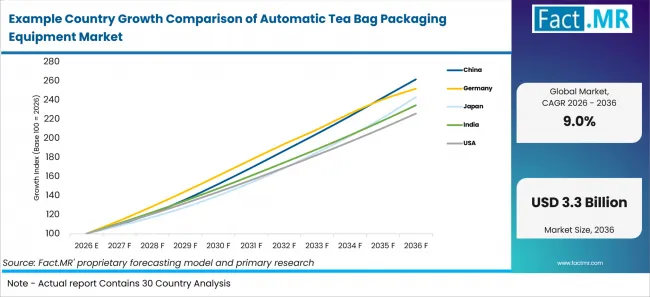
Example Country Growth Comparison Of Automatic Tea Bag Packaging Equipment Market | Source: Fact.MR
| Country | CAGR (2026-2036) |
|---|---|
| China | 10.1% |
| Germany | 9.7% |
| Japan | 9.3% |
| India | 8.9% |
| USA | 8.5% |
| UK | 8.1% |
| South Korea | 7.8% |
Source: Fact.MR analysis. Updated Aug 6, 2026
What is driving China's growth through 2036?
10.1% CAGR, driven by tea-production scale and domestic machinery depth.
China combines large tea-processing activity with local equipment supply. Buyers need lines that run black tea and green tea without losing control during format changes. Domestic service access makes approval easier during machine comparison.
What supports Germany's outlook?
9.7% CAGR, supported by tea and infusion consumption with machinery engineering depth.
German buyers place weight on reliable format control and clean documentation. The market favors suppliers that explain maintenance access before order approval. Repeatable sealing and service planning remain central to equipment selection.
What underpins Japan's growth?
9.3% CAGR, attributable to quality-focused tea processing and compact production needs.
Japan’s tea sector includes packaged brands and specialty green tea operations. Processors often work with smaller footprints and careful product handling rules. Compact systems gain preference when changeovers are frequent.
How is India scaling Automatic Tea Bag Packaging Equipment demand?
8.9% CAGR, shaped by branded packaged tea and a broad processor base.
India has large black-tea regions and a growing branded retail channel. Large processors can justify integrated lines when output is steady. Smaller producers often need modular machines with future upgrade options.
What is driving the USA's growth?
8.5% CAGR, driven by private-label portfolios and co-packing demand.
The USA is mainly a consumption and brand-development market for tea bags. Demand concentrates among importers and contract packers. Buyers value quick changeover when one line serves several labels.
Why does the UK remain an important tea bag equipment market?
8.1% CAGR, supported by mature tea bag use and replacement-led equipment needs.
The UK has a clear commercial connection between tea consumption and the tea bag format. Mature lines need renewal when retailers refresh packs. Service access remains central to purchase approval.
How is South Korea developing Automatic Tea Bag Packaging Equipment demand?
7.8% CAGR, shaped by wellness-oriented tea formats and detailed labeling needs.
South Korea’s tea and infusion market uses shorter runs for herbal blends and gift formats. Machines need recipe storage and quick cleaning. Compact digitally controlled systems fit buyers that need accuracy without oversized capacity.
Who leads the Automatic Tea Bag Packaging Equipment Market?
IMA and Teepack hold strong positions through dedicated tea bag packaging machinery, while FUSO adds specialized equipment depth.
Tecpacking Group broadens access through automated filling and sealing systems. Omag supports flexible packaging and secondary operations. Sanko Machinery contributes compact production expertise, and Universal Pack strengthens the field with integrated dosing, sealing and format-handling solutions for varied tea products and blends.
Which companies are the key providers?
Key companies include IMA Industria Macchine Automatiche S.p.A.; Teepack Spezialmaschinen GmbH & Co. KG; FUSO International Co., Ltd.; Tecpacking Group (Tianjin) Co., Ltd.; Omag S.r.l.; Sanko Machinery Co., Ltd.; Universal Pack S.r.l.
- IMA Industria Macchine Automatiche S.p.A.
- Teepack Spezialmaschinen GmbH & Co. KG
- FUSO International Co., Ltd.
- Tecpacking Group (Tianjin) Co., Ltd.
- Omag S.r.l.
- Sanko Machinery Co., Ltd.
- Universal Pack S.r.l.
Bibliography
- European Commission. (2025). Amendment to Implementing Decision (EU) 2023/1586 on harmonised standards for machinery.
- European Parliament & Council of the European Union. (2025). Regulation (EU) 2025/40 on packaging and packaging waste. Official Journal of the European Union.
- National Bureau of Statistics of China. (2026, February 28). Statistical communiqué of the People’s Republic of China on the 2025 national economic and social development.
This Report Answers
- The report provides strategic intelligence on tea bag equipment choices that shape capacity and line economics.
- Segment analysis covers Fully Automatic Tea Bag Packaging Machines and Tea Bag Filling & Sealing as 2026 leaders.
- Country outlook evaluates China and Germany with Japan and India. The USA and UK complete the comparison with South Korea.
- Competitive analysis profiles the listed machinery providers without unsupported company shares or rankings.
- Technology assessment covers servo control and computer vision. Robotics and IIoT complete the automation view.
What does the Automatic Tea Bag Packaging Equipment Market cover?
Commercial equipment is used to dose tea and form sealed tea bags.
The market covers machines whose main purchased function is automated tea bag packaging. Coverage includes single-chamber and double-chamber machines. Compact equipment and smart systems are included when they support tea bag production. Inspection and monitoring are included when sold with the line.
What is included in the scope?
Automatic tea bag production equipment is used by tea processors and contract packaging companies.
The scope includes Equipment Category and Packaging Function. End-use Industry and End User are included. Automation Technology completes the segment frame. Coverage spans filling and sealing equipment. Cartoning and inspection are included when they support a defined tea bag packaging system. Training and retrofits follow when they support the line.
What is excluded from the scope?
Tea commodities and unrelated packaging machinery remain outside the scope of this market.
The scope excludes black tea and green tea ingredients. Finished tea products and independently sold packaging materials are excluded. General-purpose machinery is excluded when it is not configured for tea bag packaging. Plant buildings and utilities are excluded. Warehouse systems and retail distribution activity are outside the scope.
How Was the Analysis Built?
The analysis draws on 120+ sources and 40+ company portfolios. It covers 25+ countries and 20+ interviews.
- Primary Research: Primary research includes discussions with manufacturers and service providers. Distributors and end users complete the interview base. Procurement teams are included. These conversations examine purchasing priorities and approval needs.
- Desk Research: Desk research covers public statistics and regulatory publications. Company materials and trade data support the review. Industry associations and standards complete the evidence base. Retained sources are documented when they support a body claim.
- Market Sizing and Forecasting: Market estimates combine historical performance and demand indicators. The model reviews pricing and volume trends. Segment shares shape the forecast. Country growth and adoption patterns are reviewed separately.
- Data Validation and Update Cycle: Findings are validated by comparing primary interviews with public data. Regular updates review product launches and capacity changes. Partnerships and approvals complete the update cycle.
Segmentation
What is the report’s scope and coverage?
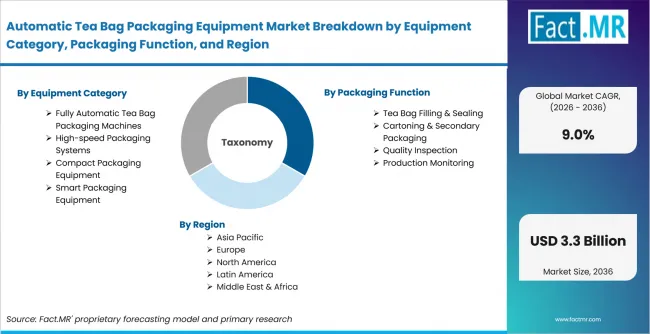
Automatic Tea Bag Packaging Equipment Market Breakdown By Equipment Category, Packaging Function, And Region | Source: Fact.MR
| Attribute | Details |
|---|---|
| Quantitative Units | USD billion |
| Market Definition | Equipment used to dose tea and form sealed tea bags. The scope covers inspection and cartoning when they support commercial tea bag output |
| Equipment Category | Fully Automatic Tea Bag Packaging Machines; High-speed Packaging Systems; Compact Packaging Equipment; Smart Packaging Equipment |
| Packaging Function | Tea Bag Filling & Sealing; Cartoning & Secondary Packaging; Quality Inspection; Production Monitoring |
| End-use Industry | Tea Manufacturing; Herbal Tea Production; Specialty Tea Packaging; Ready-to-Drink Tea |
| End User | Tea Processing Companies; Contract Packaging Companies; Small Tea Producers; Beverage Manufacturers |
| Automation Technology | Servo-driven Automation; Robotic Pick-and-Place Systems; Computer Vision Inspection; Industrial Internet of Things Integration |
| Regions Covered | North America; Europe; Asia Pacific; Central & South America; Middle East & Africa |
| Countries Covered | China; Germany; Japan; India; USA; UK; South Korea |
| Key Companies Profiled | IMA Industria Macchine Automatiche S.p.A.; Teepack Spezialmaschinen GmbH & Co. KG; FUSO International Co., Ltd.; Tecpacking Group (Tianjin) Co., Ltd.; Omag S.r.l.; Sanko Machinery Co., Ltd.; Universal Pack S.r.l. |
| Forecast Period | 2026 to 2036 |
| Approach | Hybrid top-down and bottom-up approach using installed base; replacement cycles; line speed; utilization; format mix; automation attachment; inspection configuration; service revenue |
Source: Fact.MR analysis. Updated Aug 6, 2026
How is the market segmented?
-
By Equipment Category
- Fully Automatic Tea Bag Packaging Machines
- Single Chamber Tea Bag Machines
- Double Chamber Tea Bag Machines
- High-speed Packaging Systems
- Multi-lane Packaging Systems
- Integrated Cartoning Systems
- Compact Packaging Equipment
- Tabletop Packaging Machines
- Modular Packaging Machines
- Smart Packaging Equipment
- Remote Equipment Monitoring
- Predictive Maintenance Systems
- Fully Automatic Tea Bag Packaging Machines
-
By Packaging Function
- Tea Bag Filling & Sealing
- Accurate Filling
- Filter Paper Sealing
- Cartoning & Secondary Packaging
- Labeling & Coding
- Case Packing
- Quality Inspection
- Seal Integrity Inspection
- Weight Verification
- Production Monitoring
- Operational Analytics
- Process Optimization
- Tea Bag Filling & Sealing
-
By End-use Industry
- Tea Manufacturing
- Black Tea Processing
- Green Tea Processing
- Herbal Tea Production
- Fruit & Wellness Tea
- Functional Tea Products
- Specialty Tea Packaging
- Organic Tea Products
- Premium Tea Packaging
- Ready-to-Drink Tea
- Bottled Tea Products
- Instant Tea Products
- Tea Manufacturing
-
By End User
- Tea Processing Companies
- Large Tea Manufacturers
- Medium-sized Tea Producers
- Contract Packaging Companies
- Private Label Manufacturers
- Food & Beverage Packaging Companies
- Small Tea Producers
- Artisan Tea Brands
- Co-packing Service Providers
- Beverage Manufacturers
- Beverage Processing Companies
- Industrial Food Manufacturers
- Tea Processing Companies
-
By Automation Technology
- Servo-driven Automation
- PLC-based Control Systems
- Human Machine Interface Control
- Robotic Pick-and-Place Systems
- Vision Inspection Systems
- Intelligent Motion Control
- Computer Vision Inspection
- Automated Inspection Systems
- Sensor-based Quality Control
- Industrial Internet of Things Integration
- Predictive Maintenance
- Machine Learning-enabled Optimization
- Servo-driven Automation
-
By Region
- North America
- Europe
- Asia Pacific
- Central & South America
- Middle East & Africa
Frequently Asked Questions
How big is the automatic tea bag packaging equipment market in 2026?
What is the CAGR of the automatic tea bag packaging equipment market from 2026 to 2036?
Which equipment category leads the automatic tea bag packaging equipment market?
Which end-user segment leads the automatic tea bag packaging equipment market?
Who are the leading companies in the automatic tea bag packaging equipment market?
Who worked on this report


Preview the report firsthand - request a free sample
Free SampleGet the brochure for pricing and purchase details
Download PDF