- Market Value (2025): USD 7.98 Mn
- Estimated Value (2026): USD 8.33 Mn
- Forecast Value (2036): USD 12.8 Mn
- CAGR (2026-2036): 4.4%
What is the Automobile Rear Axle Assembly Market forecast to be worth by 2036?
USD 8.33 billion in 2026 to USD 12.8 billion by 2036 at a 4.4% CAGR.
- As per Fact.MR analysis, the automobile rear axle assembly market reached USD 7.98 billion in 2025.
- The market rise from USD 8.33 billion in 2026 to USD 12.8 billion by 2036.
- The market is forecast to record 4.4% CAGR from 2026 to 2036.

Factmr Automobile Rear Axle Assembly Market Forecast Global 1 | Source: Fact.MR
| Year | Basis | Market value (USD Billion) |
|---|---|---|
| 2025 | Actual | 7.98 |
| 2026 | Estimate | 8.33 |
| 2036 | Forecast | 12.8 |
| CAGR, 2026 to 2036 | 4.4% | |
Source: Fact.MR analysis. Updated Oct 9, 2026
What are the defining numbers behind Automobile Rear Axle Assembly Market growth?
The forecast creates an absolute opportunity of USD 4.6 billion between 2026 and 2036.
- Demand Drivers in the Market
- Rear axle assemblies must carry vehicle weight and transfer power to the wheels over years of regular use. Continued production of passenger cars and commercial vehicles is expected to maintain steady orders for axle shafts, differentials, bearings and housings.
- Trucks accounted for 66% of U.S. light-duty vehicle production in model year 2024, according to the U.S. Environmental Protection Agency, with a similar share projected for 2025 [1]. As this category covers pickups, suppliers face different requirements for axle strength, load capacity and driving systems.
- Replacement sales remain an important business opportunity beyond initial vehicle production. Regular driving and heavy loads gradually wear down bearings, seals and other axle parts, keeping repair shops and parts suppliers active throughout a vehicle's service life.
- Key Segments Analyzed
- Axle Shafts are expected to account for 28.5% of the parts market in 2026, as driven rear axles rely on them to transfer power from the differential to the wheels.
- By Vehicle Type, Passenger Cars are forecast to hold a 62.3% share in 2026. Their large production volume keeps rear axle assemblies in regular use across different car models.
- OEM sales are projected to represent 73.4% of the market in 2026, since automakers select rear axle systems during vehicle development and install them directly on assembly lines.
- Under Material Type, Steel is likely to account for 54.8% of the market in 2026. Its ability to withstand repeated turning force and heavy loads makes it suitable for axle shafts and other weight-bearing components.
- Analyst Opinion at Fact.MR
- Shambhu Nath Jha, Principal Consultant at Fact.MR, states, “Automakers are expected to choose rear axle systems based on vehicle structure, power requirements and how the axle works with other drivetrain components. Suppliers can serve more vehicle models by developing axle designs that handle different loads and fit both conventional and electric vehicles.”
- Strategic Implications
- Rear axle manufacturers can develop one housing design that works with different differentials and drive units across several vehicle models. Using common parts can lower tooling costs and make production planning easier when orders shift between models.
- In August 2026, the UK Department for Business and Trade updated DRIVE35, a £4 billion vehicle investment and research program running through 2035 [2]. Suppliers of electric drivetrain components can use this funding period to plan eligible product development and factory investments.
- Accurate vehicle compatibility information is becoming more important for aftermarket suppliers selling axle shafts, bearings and seals. Since axle ratios and load capacities differ between models, clear fitment details can help repair shops select the correct parts faster and reduce returns.
- Germany leads the listed outlook at 5.2% CAGR through 2036, followed by Brazil at 4.7% and the United States at 4.3%. The United Kingdom reaches 3.8%, while Japan is projected at 3.4%. Vehicle mix, local output, and electric drive-system investment create different growth paths across the five markets.
How does the Automobile Rear Axle Assembly Market break down by segment?
Axle Shafts lead part at 28.5%; Passenger Cars lead Vehicle Type at 62.3%; OEM leads Sales Channel at 73.4%; Steel leads Material Type at 54.8%.
Which Component dominates?
Axle Shafts are estimated to hold 28.5% share in 2026.
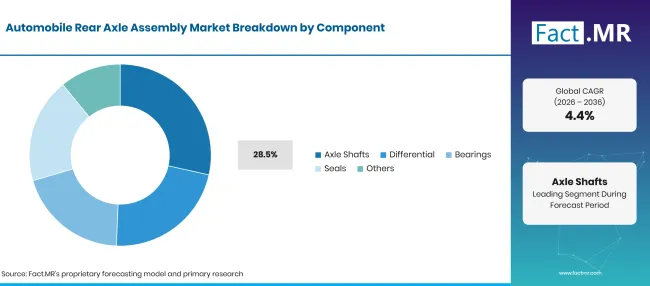
Automobile Rear Axle Assembly Market Breakdown Component | Source: Fact.MR
Automobile Rear Axle Assembly Market Breakdown by Component
Global retinaldehyde market value by year, with forecast growth rate
| Component | Share (2026) |
|---|---|
| Axle Shafts (Leading Segment) | 28.5% |
| Other Segments Combined | 71.5% |
| Total | 100.0% |
Source: Fact.MR analysis. Updated Oct 9, 2026
Axle shafts are expected to remain the leading component because they transfer power from the differential to the wheels in driven rear axle systems. Differentials distribute power between the wheels, while bearings keep moving parts properly aligned. Seals help retain lubricant and protect the gears from dirt and other materials picked up from the road.
Manufacturers will continue to adjust shaft size and strength according to vehicle weight and power requirements. Pickup trucks and heavy commercial vehicles need stronger shafts to handle higher loads, while passenger car designs focus more on reducing weight and fitting components into limited space.
What leads the Vehicle Type segment?
Passenger Cars are projected to account for 62.3% share in 2026.

Automobile Rear Axle Assembly Market Breakdown Vehicle Type | Source: Fact.MR
Automobile Rear Axle Assembly Market Breakdown by Vehicle Type
Global retinaldehyde market value by year, with forecast growth rate
| Vehicle Type | Share (2026) |
|---|---|
| Passenger Cars (Leading Segment) | 62.3% |
| Other Segments Combined | 37.7% |
| Total | 100.0% |
Source: Fact.MR analysis. Updated Oct 9, 2026
Passenger car production keeps rear axle assemblies in regular use across a wide range of vehicle models. Sedans and SUVs have different axle layouts, while commercial vehicles require stronger and larger parts to handle heavier loads. Passenger cars are therefore likely to account for the largest share of rear axle assembly sales.
Germany's Federal Statistical Office reported that the country exported around 1.5 million new passenger cars from January to May 2025 [3]. This level of manufacturing activity provides continued business for axle suppliers serving different vehicle models.
How does Sales Channel shape the market?
OEM is anticipated to capture 73.4% share in 2026.

Factmr Automobile Rear Axle Assembly Market Breakdown Sales Channel | Source: Fact.MR
Automobile Rear Axle Assembly Market Breakdown by Sales Channel
Global retinaldehyde market value by year, with forecast growth rate
| Sales Channel | Share (2026) |
|---|---|
| OEM (Leading Segment) | 73.4% |
| Aftermarket | 26.6% |
| Total | 100.0% |
Source: Fact.MR analysis. Updated Oct 9, 2026
OEM remains the leading sales channel for complete rear axle assemblies, as automakers decide mounting positions, gear ratios and load requirements during vehicle development. Suppliers are expected to receive most of their orders when these assemblies are designed and installed in new vehicles.
The aftermarket will continue to focus mainly on replacement parts such as bearings, seals and shafts. Repair shops need accurate vehicle-fit information to select the right components for different models.
What supports Steel within Material Type?
Steel is forecast to hold 54.8% share in 2026.

Factmr Automobile Rear Axle Assembly Market Breakdown Material Type | Source: Fact.MR
Automobile Rear Axle Assembly Market Breakdown by Material Type
Global retinaldehyde market value by year, with forecast growth rate
| Material Type | Share (2026) |
|---|---|
| Steel (Leading Segment) | 54.8% |
| Other Segments Combined | 45.2% |
| Total | 100.0% |
Source: Fact.MR analysis. Updated Oct 9, 2026
Steel holds the leading position in rear axle assembly materials because it can handle heavy loads and repeated turning force over long periods. Its established forging and machining processes also support large-scale production, while aluminum is used for selected housings where lower weight is needed without reducing durability.
For electric rear axle systems, manufacturers are expected to choose materials based on available space, heat control and component life. Compact designs bring motors, increasing the need for housings that save space and maintain reliable performance.
What is accelerating Automobile Rear Axle Assembly Market adoption, and what is holding it back?
Rear axle assembly sales are expected to benefit from continued vehicle production and wider use of electric rear-drive systems. However, changes in factory output, higher trade and manufacturing costs, and frequent vehicle design updates may slow market growth.
Drivers Impact Analysis
| Driver | (~) % Impact on CAGR | Geographic Relevance | Impact Timeline |
|---|---|---|---|
| Passenger-car production volume | +1.1% | Global | Long term (≥ 4 years) |
| Truck and utility-vehicle load needs | +0.9% | North America, Europe | Medium term (2–4 years) |
| Electric rear axle integration | +0.8% | Europe, East Asia, North America | Long term (≥ 4 years) |
| Local vehicle-platform engineering | +0.6% | Global | Medium term (2–4 years) |
| Replacement of worn axle parts | +0.4% | Global | Short term (≤ 2 years) |
Source: Fact.MR analysis. Updated Oct 9, 2026
Opportunity Impact Analysis
| Opportunity | (~) % Impact on CAGR | Geographic Relevance | Impact Timeline |
|---|---|---|---|
| Integrated rear e-beam modules | +0.8% | North America, Europe, East Asia | Long term (≥ 4 years) |
| Lightweight axle housings | +0.6% | Global | Medium term (2–4 years) |
| Modular axle families | +0.5% | Global | Medium term (2–4 years) |
| Commercial-vehicle electrification | +0.4% | Europe, Asia | Long term (≥ 4 years) |
Source: Fact.MR analysis. Updated Oct 9, 2026
Restraints Impact Analysis
| Restraint | (~) % Impact on CAGR | Geographic Relevance | Impact Timeline |
|---|---|---|---|
| Vehicle-production volatility | -0.8% | Global | Short term (≤ 2 years) |
| Trade and tariff costs | -0.6% | North America, Europe, East Asia | Short term (≤ 2 years) |
| Material and machining cost pressure | -0.4% | Global | Medium term (2–4 years) |
| Architecture changes during electrification | -0.3% | Global | Long term (≥ 4 years) |
Source: Fact.MR analysis. Updated Oct 9, 2026
Which countries are scaling the Automobile Rear Axle Assembly Market through 2036?
- Germany keeps a 0.5-point lead over Brazil as active electric-vehicle programs sustain rear-drive design across major vehicle platforms.
- Brazil remains 0.4 points ahead of the USA, with local vehicle investment supporting both assembly and parts output.
- The USA stays 0.5 points above the UK because pickup and SUV output keeps higher-load rear axle designs in regular use.
- The UK remains 0.4 points ahead of Japan as spare-part demand and zero-emission plant work programs support driveline activity.
- Japan closes the group at 3.4% CAGR, reflecting work-vehicle output and long-running electric drivetrain design.
Market coverage extends across North America, Latin America, Western Europe, Eastern Europe, East Asia, South Asia & Pacific, and the Middle East & Africa.
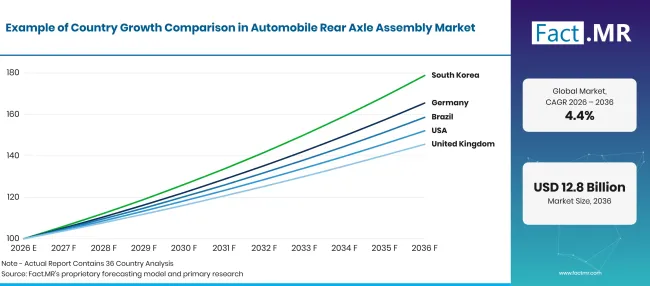
Factmr Automobile Rear Axle Assembly Market Growth Index | Source: Fact.MR
| Country | CAGR (2026-2036) |
|---|---|
| Germany | 5.2% |
| Brazil | 4.7% |
| United States | 4.3% |
| United Kingdom | 3.8% |
| Japan | 3.4% |
Source: Fact.MR analysis. Updated Oct 9, 2026
What supports Germany adoption?
5.2% CAGR, supported by EV output and a broad vehicle design base.
Germany's established automotive manufacturing industry will continue to support rear axle assembly suppliers as production moves toward more electric vehicles. The Federal Ministry for Economic Affairs and Energy reported that battery-electric vehicles accounted for 19.1% of new passenger-car registrations in Germany in 2025 [4]. German suppliers are expected to serve both conventional vehicle programs and electric models, with growing attention to compact rear-drive systems that fit electric vehicle designs.
How is Brazil scaling rear axle assembly demand?
4.7% CAGR, led by vehicle investment and local parts output.
Brazilian automakers produce passenger cars, pickup trucks and commercial vehicles, creating a need for rear axle assemblies with different load capacities. In 2025, the Brazilian Development Bank reported R$6.5 billion in approved financing for the vehicle sector [5]. This investment is expected to support vehicle and component manufacturing in Brazil, giving local rear axle suppliers more opportunities to develop axle designs and expand production capacity.
What supports the United States outlook?
4.3% CAGR, shaped by truck-heavy output and a mixed powertrain base.
Pickup trucks and SUVs are expected to remain important for rear axle assembly sales in the United States, as these vehicles need strong axle systems for towing and carrying heavy loads. The U.S. Energy Information Administration reported that electric vehicles accounted for about 22% of light-duty vehicle sales in 2025 [6]. American axle suppliers will continue serving conventional pickup and SUV models while developing integrated electric rear-drive systems for newer vehicle platforms.
How is the United Kingdom developing demand?
3.8% CAGR, backed by vehicle replacement and zero-emission plant work programs.
Vehicle registrations and investment in electric vehicle manufacturing are expected to support rear axle assembly sales in the United Kingdom. The Department for Transport reported 2,617,000 first-time vehicle registrations in 2025 [7]. This level of vehicle activity is likely to maintain business for replacement axle parts, while UK manufacturers adapt axle housings and gear designs to meet the requirements of newer electric and hybrid vehicles.
What underpins Japan growth?
3.4% CAGR, driven by work vehicle activity and steady drive-system design.
Japan's commercial vehicle industry is likely to maintain steady orders for rear axle assemblies built to carry heavy loads and last through years of regular use. The Ministry of Land, Infrastructure, Transport and Tourism reported that goods-vehicle registrations increased by 19.2% in December 2025 compared with the same month in 2024 [8]. This growth in work-vehicle registrations, together with Japan's established drivetrain manufacturing experience, provides opportunities for suppliers offering durable rear axle systems for commercial vehicles.
Who leads the Automobile Rear Axle Assembly Market?
Rear axle assembly suppliers compete across conventional vehicle systems, commercial vehicle drivetrains and electric drive units.
Dauch Corporation and Cummins offer a wide range of axle and drivetrain products, while ZF Friedrichshafen AG serves commercial vehicle manufacturers and develops electric axle systems. Hyundai WIA and Magna also compete through their electric drivetrain and integrated e-axle products.
On February 3, 2026, Dauch Corporation, formerly American Axle & Manufacturing, completed its acquisition of Dowlais Group plc, including GKN Automotive and GKN Powder Metallurgy [9]. GKN Automotive now operates within the combined Dauch Corporation, giving the business a broader range of drivetrain products and manufacturing capabilities. Cummins is expected to remain active in rear drive axles through its Meritor-branded products, while other suppliers focus on electric axle designs and integrated drive systems for newer vehicle models.
Which companies are the key providers?
Key companies include Dauch Corporation, Dana Incorporated, ZF Friedrichshafen AG, Cummins Inc., Hyundai WIA Corporation, and Magna International Inc.
- Dauch Corporation
- Dana Incorporated
- ZF Friedrichshafen AG
- Cummins Inc.
- Hyundai WIA Corporation
- Magna International Inc.
Bibliography
- [1] U.S. Environmental Protection Agency. (2026, February). The 2025 EPA Automotive Trends Report: Fuel Economy and Technology since 1975 (EPA-420-R-26-001).
- [2] Department for Business, Innovation, Science and Trade, & Department for Business and Trade. (2026, August 10). DRIVE35 Funding Programme: Scale-Up [Updated guidance].
- [3] Statistisches Bundesamt (Destatis). (2025, July 18). Exports of new passenger cars in the first five months of 2025 up 1.1% year on year.
- [4] Federal Ministry for Economic Affairs and Energy. (2026, January 27). Great prospects for electric mobility.
- [5] Brazilian Development Bank (BNDES). (2026, February 20). BNDES aprovou R$ 11,9 bilhões para o setor automotivo entre 2023 e 2025 [BNDES approved R$11.9 billion for the automotive sector between 2023 and 2025].
- [6] U.S. Energy Information Administration. (2026, February 9). Electric vehicle sales fell as hybrid vehicle sales continued to rise in 2025.
- [7] Department for Transport. (2026, April 29). Vehicle licensing statistics, United Kingdom: 2025.
- [8] Ministry of Land, Infrastructure, Transport and Tourism, Japan. (2026). Correction table: Newly registered motor vehicles].
- [9] Dauch Corporation. (2026, February 3). Dauch Corporation Completes Acquisition of Dowlais Group plc.
- [10] Dana Incorporated. (2026, April 29). Dana Incorporated reports strong first-quarter results; maintains full-year guidance; announces new business win.
This Report Answers
- The report explains rear axle assembly sales by component, vehicle type, sales channel, and material type.
- Segment analysis identifies the leading subsegment in each dimension and connects its 2026 share with torque transfer, vehicle volume, factory fit, and material requirements.
- Country analysis compares Germany; Brazil; the United States; the United Kingdom; and Japan through vehicle mix and local manufacturing activity.
- Competitive analysis reviews active axle and driveline suppliers serving passenger and work vehicle makers.
- Technology analysis assesses how electric rear drive layouts affect axle packaging and component integration.
What does the Automobile Rear Axle Assembly Market cover?
The Automobile Rear Axle Assembly Market covers complete rear axle systems and their main parts. It includes axle shafts; differentials; bearings; seals; and assembled hardware that carry wheel loads and transfer torque to rear wheels.
The check tracks passenger cars and commercial vehicles sold through OEM and aftermarket channels. It also considers how rear axle assemblies connect with wider auto part and add-on making activity across established vehicle output regions.
What is included in the scope?
The scope includes new rear axle assemblies used in vehicle output and replacement parts sold after vehicles enter service. Material coverage includes steel; aluminum; and composite parts used in the axle assembly.
Rear axle systems used with standard drivetrains and electric rear drive layouts are included when the structure carries wheel loads and transfers torque. Bearings; seals; and differential parts are counted within covered assemblies and service parts.
What is excluded from the scope?
The scope excludes front-only drive modules with no rear axle function. Complete transmissions and standalone traction motors remain outside the revenue boundary unless their value is directly included in a rear axle assembly.
Wheel hubs sold without rear axle content and separate brake systems remain outside the market boundary. Unrelated suspension hardware and complete vehicle revenue are also outside the check.
How Was the Analysis Built?
The analysis draws on 120+ sources, 35+ company portfolios, 25+ countries, and more than 20 industry interviews.
- Primary Research: Primary research includes discussions with manufacturers, service providers, technology developers, distributors, end users, and subject-matter experts. These conversations examine purchasing priorities, product adoption, operational challenges, approval requirements, competitive positioning, and the factors that influence wider market acceptance.
- Desk Research: Desk research covers government statistics, regulatory publications, company filings, trade data, technical studies, industry associations, standards, public policy, and other authoritative sources. Every source used in the analysis is documented in the bibliography.
- Market Sizing and Forecasting: Market estimates combine historical performance, demand indicators, pricing and volume trends, segment shares, company participation, country-level growth, adoption patterns, investment activity, and barriers to market expansion.
- Data Validation and Update Cycle: Findings are validated by comparing primary interviews with public data, company activity, regulatory changes, trade patterns, and industry developments. Regular updates review new product launches, capacity changes, partnerships, approvals, and shifts in commercial adoption.
Segmentation
What is the report’s scope and coverage?
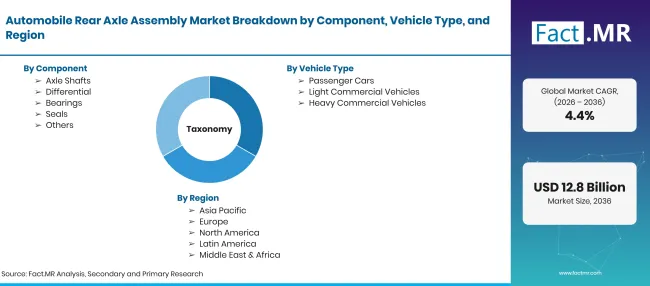
Factmr Automobile Rear Axle Assembly Market Taxonomy | Source: Fact.MR
| Attribute | Details |
|---|---|
| Quantitative Units | USD billion |
| Market Definition | Complete rear axle assemblies and core systems used to carry wheel loads and transfer torque to driven rear wheels. The scope covers axle shafts; differentials; bearings; seals; housings; and assembled hardware used in passenger and commercial vehicles. |
| Component | Axle Shafts; Differential; Bearings; Seals; Others |
| Vehicle Type | Passenger Cars; Light Commercial Vehicles; Heavy Commercial Vehicles |
| Sales Channel | OEM; Aftermarket |
| Material Type | Steel; Aluminum; Composite |
| Regions Covered | North America; Latin America; Western Europe; Eastern Europe; East Asia; South Asia & Pacific; Middle East & Africa |
| Countries Covered | Germany; Brazil; United States; United Kingdom; Japan |
| Key Companies Profiled | Dauch Corporation; Dana Incorporated; ZF Friedrichshafen AG; Cummins Inc.; Hyundai WIA Corporation; Magna International Inc. |
| Forecast Period | 2026 to 2036 |
| Approach | Hybrid top-down and bottom-up approach using vehicle production; axle content per vehicle; segment mix; country growth; replacement activity; and manufacturer portfolio review. |
Source: Fact.MR analysis. Updated Oct 9, 2026
How is the market segmented?
-
By Component:
- Axle Shafts
- Differential
- Bearings
- Seals
- Others
-
By Vehicle Type:
- Passenger Cars
- Light Commercial Vehicles
- Heavy Commercial Vehicles
-
By Sales Channel:
- OEM
- Aftermarket
-
By Material Type:
- Steel
- Aluminum
- Composite
-
By Region:
- North America
- Latin America
- Western Europe
- Eastern Europe
- East Asia
- South Asia & Pacific
- Middle East & Africa
Frequently Asked Questions
How big is the automobile rear axle assembly market in 2026?
What is the CAGR of the automobile rear axle assembly market from 2026 to 2036?
Which part leads the automobile rear axle assembly market?
Which vehicle type leads the automobile rear axle assembly market?
Who are the main companies in the automobile rear axle assembly market?
Who worked on this report


Preview the report firsthand - request a free sample
Free SampleGet the brochure for pricing and purchase details
Download PDF