- Market Value (2025): USD 5.54 Bn
- Estimated Value (2026): USD 5.77 Bn
- Forecast Value (2036): USD 8.7 Bn
- CAGR (2026-2036): 4.2%
What is the Automotive Hydraulic Actuators Market forecast to be worth by 2036?
USD 5.77 billion in 2026 to USD 8.7 billion by 2036, at a 4.2% CAGR.
- According to Fact.MR analysis, automotive hydraulic actuator market reached USD 5.54 billion in 2025.
- Demand will increase from USD 5.77 billion in 2026 to USD 8.7 billion by 2036 as vehicle manufacturers continue buying hydraulic motion-control components.
- A 4.2% CAGR from 2026 to 2036 reflects a market shaped by vehicle build schedules and the longer qualification cycle for safety-related hardware.
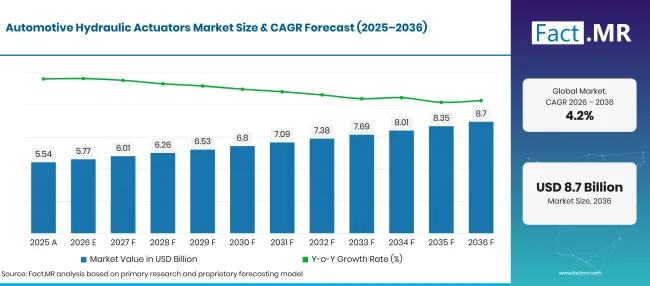
Automotive Hydraulic Actuators Market Forecast Global | Source: Fact.MR
| Year | Basis | Market Value (USD billion) |
|---|---|---|
| 2025 | Actual | 5.54 |
| 2026 | Estimate | 5.77 |
| 2036 | Forecast | 8.7 |
| CAGR 2026 to 2036 | Forecast period | 4.2% |
Source: Fact.MR analysis. Updated Oct 22, 2026
What are the defining numbers behind Automotive Hydraulic Actuators Market growth?
USD 2.9 billion absolute opportunity between 2026 and 2036, with linear actuators and passenger cars forming the main sales base.
- Demand Drivers in the Market
- Brake system engineers rely on fluid-operated actuation where accurate pressure transfer is required. Supplier selection involves response time, sealing performance and evidence that the assembly behaves consistently during repeated brake events.
- Passenger-car manufacturers need compact hydraulic components that fit inside crowded chassis and brake assemblies. Matching actuator dimensions to each platform helps avoid costly packaging changes late in the vehicle programme.
- Commercial-vehicle builders evaluate components for repeated high-load operation and service accessibility. A longer operating cycle makes durability records and replacement-part support relevant to lifetime ownership cost.
- Component purchasing teams compare validated actuator assemblies with separate hydraulic parts. Complete units can reduce assembly work when the actuator is already matched to its intended brake or motion-control function.
- Key Segments Analyzed
- By Product Type: Linear Actuators account for 64.7% share in 2026, because buyers need straight-line movement in many hydraulic brake and motion assemblies.
- By Vehicle Type: Passenger Cars hold 58.2% share in 2026, supported by the scale of car production and the variety of actuator locations on vehicle platforms.
- By Application: Braking Systems represent 42.3% share in 2026, where precisely controlled hydraulic force remains central to component selection.
- By Sales Channel: OEM captures 82.1% share in 2026 as actuator designs are commonly approved during vehicle-system development.
- Analyst Opinion at Fact.MR
- Shambhu Nath Jha, Principal Consultant at Fact.MR, states, “Automotive hydraulic actuator suppliers are judged on how consistently their components convert fluid pressure into controlled mechanical movement under changing vehicle loads. Automakers and system integrators place strong emphasis on sealing performance, response accuracy, and durability over repeated operating cycles. Suppliers that can maintain tight tolerances and provide dependable validation support are better positioned for long-term vehicle programs.”
- Strategic Implications
- Actuator manufacturers should organize testing around the pressure range and movement profile of each intended automotive application.
- Automotive OEM teams should review hydraulic circuit compatibility before fixing the actuator package within a new vehicle platform.
- Parts distributors should distinguish exact-fit service replacements from industrial actuators that share similar dimensions but have different qualification needs.
- System integrators should coordinate control software checks with fluid-pressure tests when the actuator forms part of an electronically managed assembly.
Germany is forecast to grow at 4.5% CAGR, while Brazil is projected to record 5.1% as domestic vehicle production provides demand for hydraulic assemblies. Japan carries a 4.8% outlook tied to established component engineering. The UK is estimated at 3.6%, while the USA is forecast at 3.2%, reflecting different production mixes and vehicle-service conditions.
How does the Automotive Hydraulic Actuators Market break down by segment?
Linear Actuators 64.7%; Passenger Cars 58.2%; Braking Systems 42.3%; OEM 82.1% in 2026.
Which Product Type dominates?
Linear Actuators holds 64.7% share in 2026.
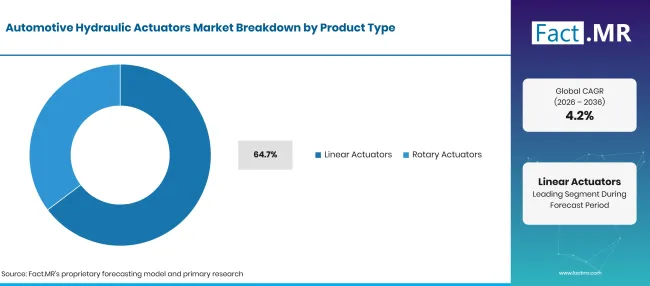
Automotive Hydraulic Actuators Market Breakdown Product Type | Source: Fact.MR
| Product Type | Share (2026) |
|---|---|
| Linear Actuators (Leading segment) | 64.7% |
| Other segments combined | 35.3% |
| Total | 100.0% |
Source: Fact.MR analysis. Updated Oct 22, 2026
Linear actuators generate straight-line movement through a pressurized piston and cylinder. Vehicle designers specify their stroke and force around the job the component performs. Rotary actuators instead produce angular movement and serve applications where the output must turn a shaft or linkage. In a braking assembly, the actuator’s working fluid and seal design need to remain compatible with the wider hydraulic system.
What leads the Vehicle Type segment?
Passenger Cars account for 58.2% share in 2026.
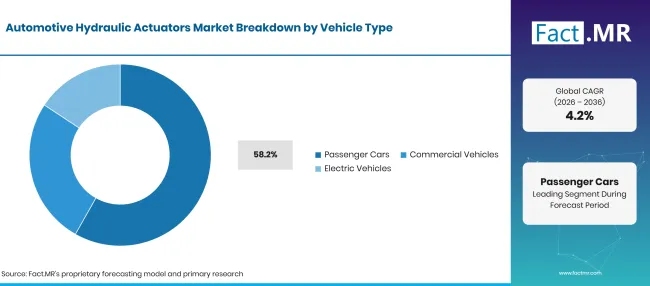
Automotive Hydraulic Actuators Market Breakdown Vehicle Type | Source: Fact.MR
| Vehicle Type | Share (2026) |
|---|---|
| Passenger Cars (Leading segment) | 58.2% |
| Other segments combined | 41.8% |
| Total | 100.0% |
Source: Fact.MR analysis. Updated Oct 22, 2026
Passenger cars use hydraulic actuation across selected braking and chassis functions. Manufacturers often develop these systems for high-volume platforms, which places close attention on repeatable assembly and supply consistency. Commercial vehicles have different duty cycles because their loads and service patterns differ from those of cars. Electric vehicles remain a vehicle category within the analysis, although individual electric architectures vary in their use of hydraulic systems.
Which Application accounts for the main share?
Braking Systems capture 42.3% share in 2026.
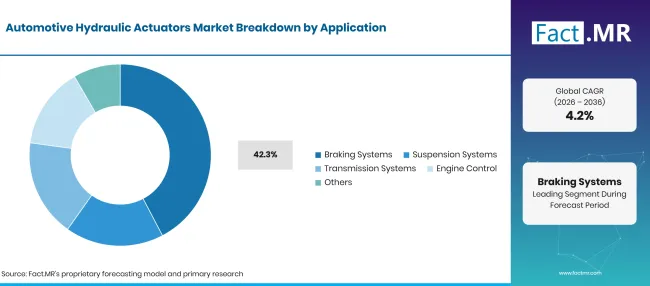
Automotive Hydraulic Actuators Market Breakdown Application | Source: Fact.MR
| Application | Share (2026) |
|---|---|
| Braking Systems (Leading segment) | 42.3% |
| Other segments combined | 57.7% |
| Total | 100.0% |
Source: Fact.MR analysis. Updated Oct 22, 2026
Braking applications depend on predictable fluid pressure and mechanical movement under changing temperatures. Actuator designs must suit the required force, packaging space and control approach of the vehicle. Suspension Systems form another use where hydraulic components may regulate movement or ride height. Transmission Systems require actuation tailored to their gear-changing mechanism, while Engine Control covers narrower fluid-operated functions. The application distinction is important because the same basic actuator form can face very different durability and response requirements.
How does Sales Channel shape purchases?
OEM represents 82.1% share in 2026.
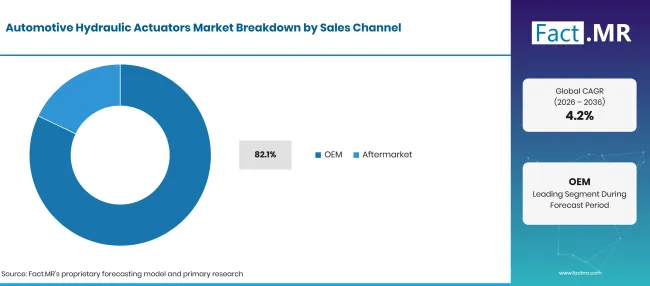
Automotive Hydraulic Actuators Market Breakdown Sales Channel | Source: Fact.MR
| Sales Channel | Share (2026) |
|---|---|
| OEM (Leading segment) | 82.1% |
| Other segments combined | 17.9% |
| Total | 100.0% |
Source: Fact.MR analysis. Updated Oct 22, 2026
Original equipment manufacturers select hydraulic actuators while developing the system in which each unit operates. That early selection links the supplier to design approval and regular parts deliveries. Aftermarket sales occur later when operators or repair workshops replace worn or failed assemblies. Replacement customers require accurate vehicle fitment and clear information about the hydraulic connections. Product interchangeability remains limited when assemblies use different pressure ratings or mounting geometry. Maintaining service documentation therefore helps protect downstream sales without treating every similar actuator as an equivalent part.
What is accelerating Automotive Hydraulic Actuators Market adoption, and what is holding it back?
Vehicle-system qualification and braking applications sustain purchases; sealing failures and integration costs constrain supplier approvals.
Drivers Impact Analysis
| DRIVER | (~) % IMPACT ON CAGR | GEOGRAPHIC RELEVANCE | IMPACT TIMELINE |
|---|---|---|---|
| Brake pressure control | +1.0% | Global | Medium term (2–4 years) |
| Passenger platform output | +0.8% | Europe, East Asia | Medium term (2–4 years) |
| Commercial-vehicle service needs | +0.7% | Brazil, USA | Short term (<= 2 years) |
| Hydraulic reliability testing | +0.5% | Global | Long term (>= 4 years) |
| System integration | +0.4% | Global | Medium term (2–4 years) |
Source: Fact.MR analysis. Updated Oct 22, 2026
Opportunity Impact Analysis
| OPPORTUNITY | (~) % IMPACT ON CAGR | GEOGRAPHIC RELEVANCE | IMPACT TIMELINE |
|---|---|---|---|
| Compact integrated units | +0.8% | Global | Medium term (2–4 years) |
| Application-specific seals | +0.6% | Global | Medium term (2–4 years) |
| Service replacements | +0.5% | USA, Brazil | Short term (<= 2 years) |
| Common platform components | +0.4% | Europe, Japan | Long term (>= 4 years) |
Source: Fact.MR analysis. Updated Oct 22, 2026
Restraints Impact Analysis
| RESTRAINT | (~) % IMPACT ON CAGR | GEOGRAPHIC RELEVANCE | IMPACT TIMELINE |
|---|---|---|---|
| Leakage and seal wear | -0.8% | Global | Short term (<= 2 years) |
| System validation expense | -0.6% | Global | Medium term (2–4 years) |
| Packaging differences | -0.5% | Global | Medium term (2–4 years) |
| Electromechanical alternatives | -0.4% | Europe, Japan | Long term (>= 4 years) |
Source: Fact.MR analysis. Updated Oct 22, 2026
Which countries are scaling the Automotive Hydraulic Actuators Market through 2036?
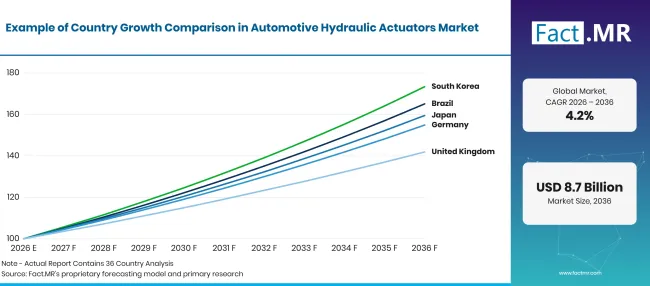
Automotive Hydraulic Actuators Market Growth Index | Source: Fact.MR
| Country | CAGR (2026–2036) |
|---|---|
| Brazil | 5.1% |
| Japan | 4.8% |
| Germany | 4.5% |
| United Kingdom | 3.6% |
| United States | 3.2% |
Source: Fact.MR analysis. Updated Oct 22, 2026
How is Brazil expanding hydraulic actuator sales?
5.1% CAGR through 2036, linked to vehicle-system requirements and supplier qualification.
Brazilian vehicle assembly gives hydraulic actuator suppliers a direct route into passenger and commercial vehicle programmes. ANFAVEA reported on January 15, 2026 that factories built 2.644 million vehicles in 2025 [1]. Vehicle makers are expected to continue reviewing actuator pressure control and seal life before accepting parts for repeat production. A separate ANFAVEA release dated February 6, 2026 recorded 170,500 new registrations in January 2026 [5]. These vehicles provide an indication of domestic assembly and service activity without measuring actuator shipments.
What supports the Japan outlook?
4.8% CAGR through 2036, linked to vehicle-system requirements and supplier qualification.
Japanese vehicle engineering teams place close attention on predictable hydraulic movement and precise mounting dimensions. The Ministry of Land, Infrastructure, Transport and Tourism published vehicle recall information in April 2026 [2]. The country's recall framework creates a reason for actuator suppliers to maintain clear traceability and validation records throughout a component's service life. Car manufacturers are expected to compare compact hydraulic assemblies against electric alternatives for each braking or chassis task.
Why does Germany retain a role in hydraulic actuation?
4.5% CAGR through 2036, linked to vehicle-system requirements and supplier qualification.
Germany's vehicle component manufacturers operate within established passenger-car production and braking-system engineering networks. The German Automotive Industry Association recorded 4,148,836 passenger cars produced in Germany in 2025 [3]. Such manufacturing activity provides an assembly base for validated hydraulic components, with orders still depending on the design of each vehicle programme. The Federal Statistical Office reported on February 6, 2026 that German automotive industry production declined 1.7% in 2025 [6].
How is the United Kingdom shaping actuator purchases?
3.6% CAGR through 2036, linked to vehicle-system requirements and supplier qualification.
United Kingdom component suppliers serve a production base shaped by export programmes and specialist vehicle engineering. The Society of Motor Manufacturers and Traders reported on January 29, 2026 that factories built 764,715 vehicles in 2025 [4]. Actuator orders for local assembly depend on the hydraulic equipment retained within each programme and on technical approval by vehicle makers. The same industry body reported on February 27, 2026 that January 2026 vehicle production reached 67,415 units [7].
What influences the United States outlook?
3.2% CAGR through 2036, linked to vehicle-system requirements and supplier qualification.
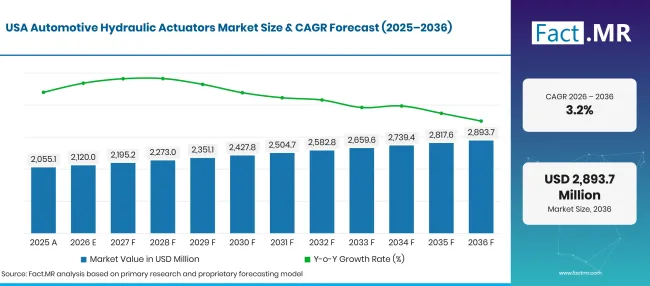
Automotive Hydraulic Actuators Market Forecast Usa | Source: Fact.MR
United States hydraulic actuator sales draw on vehicle assembly contracts alongside an extensive repair and fleet-service network. Brake system engineers evaluate operating pressure and repeat performance before confirming whether a hydraulic device suits a particular platform. The U.S. Bureau of Economic Analysis reported in February 2026 that the value of imported automotive vehicles, parts and engines declined by USD 52.0 billion in 2025 [8]. That trade movement forms part of the wider sourcing environment and does not measure hydraulic actuator purchases.
Who leads the Automotive Hydraulic Actuators Market?
Robert Bosch GmbH / Bosch Mobility offer hydraulic technology portfolios relevant to actuator selection. Their relevance depends on the product line and the exact automotive duty cycle. The buyer must establish whether each part is approved for use on a vehicle rather than assume that industrial hydraulic performance is sufficient.
Schaeffler AG work in broader automotive motion and chassis fields. Danfoss Power Solutions and Eaton Corporation have established fluid-power activities, with particular relevance to mobile equipment and selected vehicle applications. These different roles should be read as competitive or adjacent capabilities rather than evidence of identical finished hydraulic actuator portfolios.
What is the report’s scope and coverage?
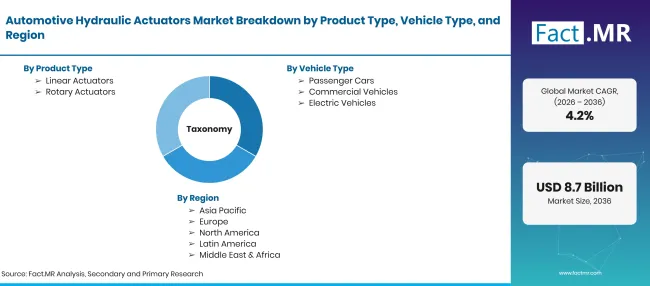
Automotive Hydraulic Actuators Market Taxonomy | Source: Fact.MR
| Attribute | Details |
|---|---|
| Quantitative Units | USD billion |
| Market Definition | Hydraulic actuator assemblies intended to create mechanical movement in defined automotive systems. |
| Product Type | Linear Actuators; Rotary Actuators |
| Vehicle Type | Passenger Cars; Commercial Vehicles; Electric Vehicles |
| Application | Braking Systems; Suspension Systems; Transmission Systems; Engine Control; Others |
| Sales Channel | OEM; Aftermarket |
| Regions Covered | North America; Latin America; Western Europe; Eastern Europe; East Asia; South Asia & Pacific; Middle East & Africa |
| Countries Covered | Germany; Brazil; USA; UK; Japan |
| Companies Profiled | Robert Bosch GmbH / Bosch Mobility; Danfoss Power Solutions; Eaton Corporation; Valeo SE; Schaeffler AG; and BorgWarner Inc |
| Forecast Period | 2026 to 2036 |
| Approach | Vehicle output context, actuator design boundaries, application purchasing and first-hand industry statistics |
Source: Fact.MR analysis. Updated Oct 22, 2026
Bibliography
- [1] Associação Nacional dos Fabricantes de Veículos Automotores. (2026, January 15). Produção e venda de autoveículos crescem em 2025 e Anfavea projeta nova alta em 2026.
- [2] Ministry of Land, Infrastructure, Transport and Tourism. (2026, April 28).[Total number of recall notifications and affected vehicles in fiscal 2025: Preliminary figures].
- [3] Verband der Automobilindustrie. (2026, February 16). Automobile production. https://www.vda.de/en/news/facts-and-figures/annual-figures/automobile-production VDA
- [4] Society of Motor Manufacturers and Traders. (2026, January 29). Tough year for auto but new models and Industrial Strategy can deliver growth.
- [5] Associação Nacional dos Fabricantes de Veículos Automotores. (2026, February 6). Emplacamentos de veículos se destacam em janeiro, mesmo com recuo na produção e nas exportações.
- [6] Statistisches Bundesamt (Destatis). (2026, February 6). Production in December 2025: -1.9% on the previous month.
- [7] Society of Motor Manufacturers and Traders. (2026, February 27). Vehicle production down in January amid weak global markets.
- [8] U.S. Bureau of Economic Analysis. (2026, February 19). U.S. international trade in goods and services, December and annual 2025.
This Report Answers
- The analysis compares straight-line and rotary hydraulic actuator designs in automotive uses.
- Application assessment examines braking systems separately from suspension and transmission uses.
- The vehicle comparison considers how car and commercial-vehicle duty cycles affect supplier selection.
- Country outlook reviews five automotive production markets and the qualification needs of each.
- Competitive analysis separates hydraulic actuator products from neighboring sealing and chassis component activities.
What does the Automotive Hydraulic Actuators Market cover?
The market covers hydraulic actuator assemblies designed to convert fluid pressure into controlled mechanical movement in automotive systems. It includes products used in braking, suspension, transmission, and selected engine-control applications across passenger cars, commercial vehicles, and electric vehicles. Related component coverage includes automotive shock absorbers and other vehicle motion-control systems where hydraulic actuation supports the required movement or pressure-control function.
What is included in the scope?
Finished hydraulic actuation assemblies are included when they form part of a passenger-car or commercial-vehicle system.
Sales at the original-equipment stage and relevant service replacements both enter the channel comparison. The analysis covers applications only where hydraulic actuation performs the specified motion or pressure-control task. General-purpose hydraulic cylinders belong in this market only when they are intended and qualified for use on vehicles.
What is excluded from the scope?
Purely electric linear motors and electronic controllers sold without hydraulic actuation hardware fall outside the defined product boundary.
General industrial hydraulic cylinders are also excluded unless their design and intended use are automotive. Brake pads and passive mechanical links are distinct parts even when they connect to a hydraulically actuated mechanism.
How Was the Analysis Built?
The analysis draws on 120+ sources, 35+ company portfolios, 25+ countries, and more than 20 industry interviews.
- Primary Research: Primary research includes discussions with manufacturers, service providers, technology developers, distributors, end users, and subject-matter experts. These conversations examine purchasing priorities, product adoption, operational challenges, approval requirements, competitive positioning, and the factors that influence wider market acceptance.
- Desk Research: Desk research covers government statistics, regulatory publications, company filings, trade data, technical studies, industry associations, standards, public policy, and other authoritative sources. Every source used in the analysis is documented in the bibliography.
- Market Sizing and Forecasting: Market estimates combine historical performance, demand indicators, pricing and volume trends, segment shares, company participation, country-level growth, adoption patterns, investment activity, and barriers to market expansion.
- Data Validation and Update Cycle: Findings are validated by comparing primary interviews with public data, company activity, regulatory changes, trade patterns, and industry developments. Regular updates review new product launches, capacity changes, partnerships, approvals, and shifts in commercial adoption.
Segmentation
Which companies are the key providers?
Key companies include Robert Bosch GmbH / Bosch Mobility; Danfoss Power Solutions; Eaton Corporation; Valeo SE; Schaeffler AG; and BorgWarner Inc.
- Robert Bosch GmbH / Bosch Mobility
- Danfoss Power Solutions
- Eaton Corporation
- Valeo SE
- Schaeffler AG
- BorgWarner Inc.
How is the market segmented?
-
By Product Type
- Linear Actuators
- Rotary Actuators
-
By Vehicle Type
- Passenger Cars
- Commercial Vehicles
- Electric Vehicles
-
By Application
- Braking Systems
- Suspension Systems
- Transmission Systems
- Engine Control
- Others
-
By Sales Channel
- OEM
- Aftermarket
-
By Region
- North America
- Latin America
- Western Europe
- Eastern Europe
- East Asia
- South Asia & Pacific
- Middle East & Africa
Frequently Asked Questions
How big is the automotive hydraulic actuators market in 2026?
What is the CAGR from 2026 to 2036?
Which product type leads?
Which vehicle type accounts for the larger specified share?
Who are the main companies in the automotive hydraulic actuators market?
Who worked on this report


Preview the report firsthand - request a free sample
Free SampleGet the brochure for pricing and purchase details
Download PDF