
- Market Value (2025): USD 592.1 Mn
- Estimated Value (2026): USD 630.0 Mn
- Forecast Value (2036): USD 1171.5 Mn
- CAGR (2026-2036): 6.4%
Traction Control Modules Market Forecast and Outlook 2026 to 2036
As per the Fact.MR analysis, the traction control modules market crossed a valuation of USD 592.1 million in 2025 and is projected to grow from USD 630.0 million in 2026 to USD 1171.5 million by 2036. Demand for traction control modules is likely to grow at a CAGR of 6.4% over the forecast period.
Demand for traction control modules is rising as electric motors deliver full torque instantly, and vehicles, aircraft and vessels need controllers that detect wheel slip within milliseconds and cut or redistribute torque before grip is lost. Manufacturers of traction control modules are offering motor torque controllers that act through the inverter, all-wheel-drive torque distribution units and modules integrated with anti-lock braking and stability control. For example, in November 2026, Germany's KBA reported that battery-electric cars made up 37.0% of new registrations in October, with volumes up 79.5%. Similar electric vehicle growth is projected to drive sales of traction control modules.
Key Takeaways from the Traction Control Modules Market
- Traction Control Modules Market Value (2025): USD 592.1 million in 2025
- Traction Control Modules Market Value (2026): USD 630.0 million
- Traction Control Modules Market Forecast Value (2036): USD 1171.5 million
- Traction Control Modules Market Forecast CAGR (2026-2036): 6.4%
- Leading Product Type: Motor torque traction controller (27.9%)
- Key Market Participants: Bosch, Continental, ZF, Denso, Hitachi Astemo, Hyundai Mobis
- Key Growth Regions: Germany, Sweden, Italy, France, United Kingdom
In October 2026, Volvo Group reported third-quarter net sales of SEK 119.5 billion with 7% organic growth, and said orders for fully electric trucks rose 163% to 1,928 units. Demand for traction control modules is growing as heavy vehicles electrify and need slip control tuned for high torque and changing loads. Manufacturers of traction control modules are adapting control software to trucks and buses. Similar commercial vehicle electrification is projected to drive sales of traction control modules across Europe.
Traction Control Modules Market
| Metric | Value |
|---|---|
| Estimated Value in (2026) | USD 630.0 million |
| Forecast Value in (2036) | USD 1171.5 million |
| Forecast CAGR (2026 to 2036) | 6.4% |
Source: Fact.MR analysis.
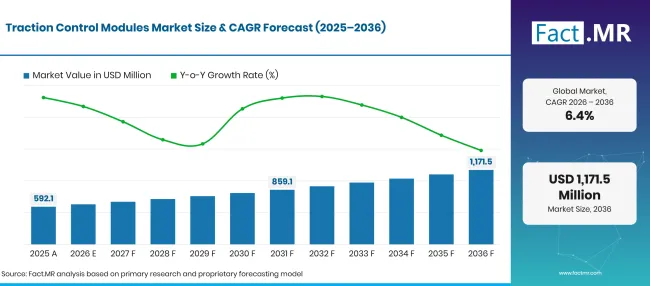
Traction Control Modules Forecast Global | Source: Fact.MR
Category
| Category | Segments |
|---|---|
| Product Type | Motor torque traction controller, AWD traction distribution, ABS-integrated traction ECU, ESC integrated module, Standalone traction ECU |
| Vehicle Platform | Aircraft, Specialty and other, Marine vessel, Passenger car, Commercial vehicle |
| Integration | Component, OEM integrated, Aftermarket and retrofit, Module, Subsystem |
| Control Type | Mechanical, Hybrid, Electronic, Electromechanical, Electrohydraulic |
| Region | Germany; Sweden; Italy; France; United Kingdom |
Source: Fact.MR analysis.
Segmental Analysis
What is driving motor torque traction controllers demand in the Traction Control Modules Market?
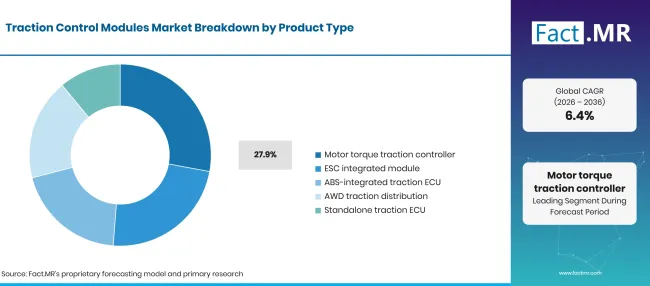
Traction Control Modules Breakdown Product Type | Source: Fact.MR
Demand for motor torque traction controllers estimated to represent 27.9% of the traction control modules market in 2026, about USD 175.8 million. Demand is increasing as electric vehicle manufacturers adopt motor-based torque management to control wheel slip, improve traction and reduce unnecessary braking losses. The European Alternative Fuels Observatory reported that battery-electric vehicle registrations across 13 EU member states reached 259,726 in October 2026, increasing 64.0% year over year. This expansion of electric vehicle adoption creates opportunities for traction management technologies integrated with electric drive systems. Manufacturers are increasingly focusing on inverter-linked controls that improve vehicle stability and power delivery.
Which factors are making aircraft a leading platform in the Traction Control Modules Market?
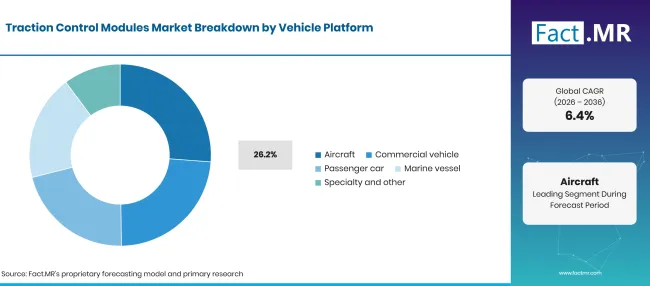
Traction Control Modules Breakdown Vehicle Platform | Source: Fact.MR
Sales of aircraft account for 26.2% of traction control modules revenue in 2026, about USD 165.1 million, reflecting the importance of certified anti-skid and wheel-speed management systems in aviation braking architectures. Aircraft require reliable braking control to maintain directional stability during landing and ground operations, creating demand for specialised electronic and mechanical components. Airbus reported 547 commercial aircraft deliveries during the first nine months of 2026, compared with 507 in the corresponding period of 2025. This increase demonstrates continued aircraft manufacturing activity and creates opportunities for suppliers of aviation braking and traction-control equipment.
How is component-level supply influencing integration demand in the Traction Control Modules Market?
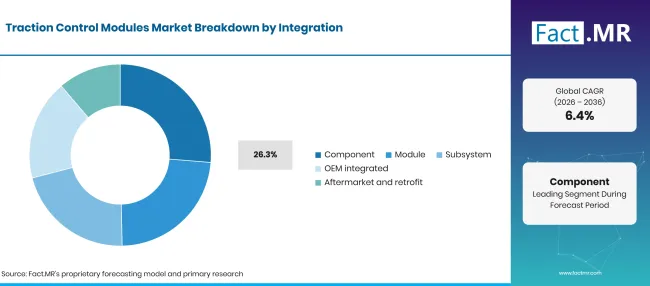
Traction Control Modules Breakdown Integration | Source: Fact.MR
Component-level supply represents 26.3% of traction control modules revenue in 2026, about USD 165.7 million. Automotive manufacturers increasingly source wheel-speed sensors, electronic control units, hydraulic valve assemblies and related hardware separately to maintain flexibility in vehicle development and system integration. This approach also allows manufacturers to customise control software while retaining compatibility with existing braking architectures. The European Alternative Fuels Observatory recorded 27,788 new battery-electric light commercial vehicles and 6,106 plug-in hybrid vans in Germany during 2026. Expanding electrified vehicle production creates additional opportunities for suppliers of individual traction-control components and replacement hardware.
What is sustaining mechanical control demand in the Traction Control Modules Market?
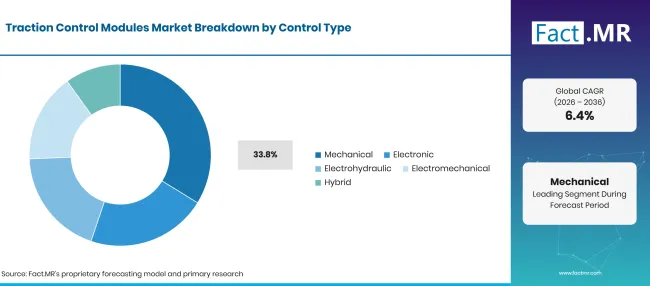
Traction Control Modules Breakdown Control Type | Source: Fact.MR
Demand for mechanical control accounts for 33.8% of traction control modules revenue in 2026, about USD 212.9 million. Limited-slip differentials, locking differentials, clutch packs and torque-biasing mechanisms remain important in vehicles requiring dependable torque distribution across challenging driving conditions. These systems are particularly relevant to heavy-duty trucks, off-road equipment, agricultural machinery and performance vehicles. Germany's Federal Motor Transport Authority (KBA) reported 46,230 new registrations of heavy commercial vehicles exceeding 16 tonnes during January to October 2026, representing a 4.6% increase year over year. Continued heavy-vehicle activity supports the need for durable mechanical traction solutions alongside electronically managed control systems.
Traction Control Modules Market-Drivers, Restraints & Trends
Drivers:
Demand for traction control modules is rising as electrified vehicles take a larger share of sales. For example, Volvo Cars reported that fully electric cars made up 32% of its third-quarter 2026 sales, up from 22% a year earlier, and electrified models 53%. Manufacturers of traction control modules are supplying controllers for dual-motor and all-wheel-drive electric models. Similar mix change is projected to drive sales of traction control modules.
Restraints:
Sales of traction control modules is constrained by integration of traction functions into central vehicle computers and by weak vehicle volumes at some makers. For example, Volvo Cars reported that third-quarter 2026 global sales fell 10.7% to 141,609 cars, and Aumovio's adjusted sales fell 12%. Similar pressures are projected to reduce stand-alone module demand. Manufacturers of traction control modules must move value into software and actuators.
Opportunity: Integrated Vehicle Motion Control
Demand for traction control that is coordinated with braking, steering and suspension is rising. Manufacturers are offering central motion control software. ZF announced in November 2026 an agreement for volume production of brake-by-wire and steer-by-wire in one vehicle class. Similar integration is projected to drive sales of traction control modules, alongside systems in the brake-by-wire system market.
Trend: Electric Truck Traction
In the third quarter of 2026, Volvo Trucks was named International Truck of the Year 2027 for its electric range. Demand for slip control suited to electric axles and heavy loads is rising. Similar products are projected to drive sales of traction control modules. Manufacturers of traction control modules are also active in the heavy-duty EV regenerative braking systems market and the automotive safety market.
Traction Control Modules Market by Analysis by Key Country
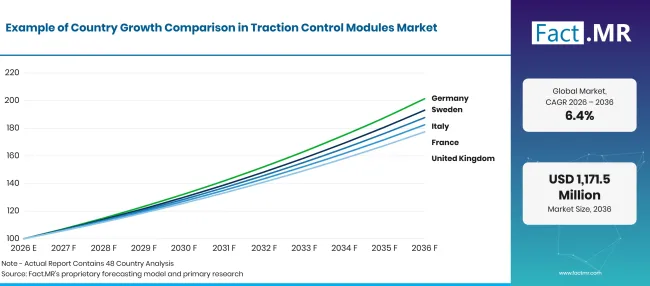
Traction Control Modules Growth Index | Source: Fact.MR
| Country | CAGR (2026-2036) |
|---|---|
| Germany | 7.2% |
| Sweden | 6.8% |
| Italy | 6.5% |
| France | 6.2% |
| United Kingdom | 5.9% |
Source: Fact.MR analysis.
What is driving traction control modules demand in Germany?
In November 2026, the KBA reported 94,086 new battery-electric car registrations for October, about 16 percentage points more market share than a year earlier.
Demand for traction control modules in Germany is anticipated to grow at a 7.2% CAGR, the fastest among the five key countries, as German premium carmakers launch high-torque electric models and suppliers Bosch, Continental and ZF develop integrated motion control. Manufacturers of traction control modules are supplying domestic platforms. Similar electric growth is projected to drive sales in Germany.
How are electric trucks and cars supporting traction control modules sales in Sweden?
Sales of traction control modules in Sweden are anticipated to grow at a 6.8% CAGR through 2036, supported by the electrification of passenger cars and commercial vehicles.
Statistics Sweden reported 25,828 new passenger car registrations in October 2026, representing a 2.5% increase year over year. Sweden's Transport Analysis agency also tracks the expanding adoption of electric vehicles across passenger cars and commercial fleets. Electric vehicle manufacturers require precise torque distribution and wheel-slip management to maintain stability on snow-covered and icy roads. These requirements create opportunities for traction control suppliers serving domestic automotive manufacturers and electric truck platforms.
What is shaping traction control modules demand in Italy?
Demand for traction control modules in Italy is projected to record a 6.5% CAGR through 2036, supported by automotive production, vehicle electrification and performance-oriented applications.
According to Italy's Ministry of Infrastructure and Transport, passenger car registrations reached 131,921 in October 2026, increasing 4.81% compared with October 2025. Electrified vehicle adoption is also expanding, creating opportunities for advanced traction management systems that coordinate wheel-speed sensors, braking components and engine or motor output. Italian manufacturers of sports cars and motorcycles further contribute to demand for sophisticated vehicle stability technologies. Automotive production and rising electrified registrations are strengthening the country's component supply opportunities.
How are aerospace shaping traction control modules sales in France?
Sales of traction control modules in France are estimated to increase at a 6.2% CAGR through 2036, supported by automotive electrification and specialised aerospace braking applications.
INSEE reported that more than half of passenger cars manufactured in France during 2025 featured fully or partially electric powertrains, compared with approximately 40% in 2021. However, French manufacturing production declined by 1.4% in the third quarter of 2026, while transport equipment production decreased by 3.5%. These contrasting developments indicate opportunities in electrified vehicle platforms alongside pressure on industrial output. Manufacturers are focusing on electronically controlled traction and specialised braking technologies for automotive and aviation applications.
Why is growth slower for traction control modules in the United Kingdom?
Demand for traction control modules in the United Kingdom is projected to grow at a 5.9% CAGR through 2036, reflecting comparatively measured vehicle manufacturing expansion and demand concentrated in specialist automotive applications.
According to the Department for Transport, 147,000 zero-emission cars were registered for the first time during April to June 2026, representing a 40.5% increase year over year. These vehicles accounted for 27.3% of new car registrations during the quarter. Although electrification is creating opportunities for advanced traction technologies, suppliers remain dependent on vehicle production volumes and specialist platform requirements. This limits the pace of market expansion compared with faster-growing automotive applications.
Competitive Landscape for Traction Control Modules Market
Competition in the traction control modules market is led by brake and chassis control suppliers. Bosch competes as the originator of traction and stability control, Continental's former automotive business competes with brake control and motion software, ZF competes with integrated brake control and driveline systems, Denso and Hitachi Astemo compete from Japan, and Hyundai Mobis competes within Hyundai Motor Group. Buyers select traction control modules on response time, integration with braking and powertrain, functional safety and cost.
From 2025 onward, competition shifted toward motor-based control and central software. Electric shares rose sharply in Germany and at Volvo Cars in 2026, Volvo Group's electric truck orders jumped, and ZF announced by-wire production agreements. Manufacturers that combine fast motor control with proven safety software are best placed to grow.
Recent Developments
- In November 2026, Germany's KBA reported a 37.0% battery-electric share of October registrations.
- In November 2026, Brembo reported third-quarter revenue of EUR 961.6 million.
- In October 2026, Volvo Group reported a 163% rise in electric truck orders.
- In October 2026, Volvo Cars reported a 32% fully electric share of third-quarter sales.
Key Players in Traction Control Modules Market
Key companies operating in the market include Bosch, Continental, ZF, Denso, Hitachi Astemo, and Hyundai Mobis.
- Bosch
- Continental
- ZF
- Denso
- Hitachi Astemo
- Hyundai Mobis
Traction Control Modules Market by Segments
-
Product Type
- Motor torque traction controller
- AWD traction distribution
- ABS-integrated traction ECU
- ESC integrated module
- Standalone traction ECU
-
Vehicle Platform
- Aircraft
- Specialty and other
- Marine vessel
- Passenger car
- Commercial vehicle
-
Integration
- Component
- OEM integrated
- Aftermarket and retrofit
- Module
- Subsystem
-
Control Type
- Mechanical
- Hybrid
- Electronic
- Electromechanical
- Electrohydraulic
-
Region:
- North America
- United States
- Canada
- Mexico
- Europe
- Germany
- United Kingdom
- France
- Italy
- Spain
- Rest of Europe
- Asia Pacific
- China
- India
- Japan
- South Korea
- Australia
- Rest of Asia Pacific
- Latin America
- Brazil
- Mexico
- Argentina
- Rest of Latin America
- Middle East & Africa
- GCC Countries
- South Africa
- Rest of Middle East & Africa
- North America
Bibliography
- AUMOVIO SE. (2026, November 5). AUMOVIO improves operating margin in third quarter despite significant sales decline and confirms full-year guidance.
- Brembo N.V. (2026, November 5). I risultati del 3° trimestre e dei primi 9 mesi 2026.
- Kraftfahrt-Bundesamt. (2026, November). Fahrzeugzulassungen im Oktober 2026 (Pressemitteilung Nr. 44/2026).
- Safran. (2026, October 23). Safran reports its third quarter 2026 revenue.
- Volvo Car AB. (2026, October 23). Volvo Cars Q3 2026: Taking decisive action to navigate a very tough environment.
- Volvo Group. (2026, October 23). Volvo Group: The third quarter 2026.
Segmentation
Scope of Report
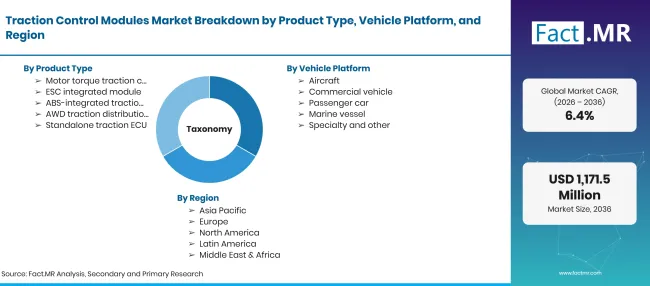
Traction Control Modules Taxonomy | Source: Fact.MR
| Items | Values |
|---|---|
| Quantitative Units (2026) | USD 630.0 Million |
| Product Type | Motor torque traction controller, AWD traction distribution, ABS-integrated traction ECU, ESC integrated module, Standalone traction ECU |
| Vehicle Platform | Aircraft, Specialty and other, Marine vessel, Passenger car, Commercial vehicle |
| Integration | Component, OEM integrated, Aftermarket and retrofit, Module, Subsystem |
| Control Type | Mechanical, Hybrid, Electronic, Electromechanical, Electrohydraulic |
| Regions Covered | North America, Latin America, Europe, East Asia, South Asia and Pacific, Middle East & Africa |
| Countries Covered | Germany, Sweden, Italy, France, United Kingdom, and other countries |
| Key Companies Profiled | Bosch, Continental, ZF, Denso, Hitachi Astemo, Hyundai Mobis |
| Additional Attributes | Dollar revenue in the Traction Control Modules Market is segmented by product type (motor torque controller, AWD traction distribution, ABS-integrated ECU, ESC integrated module, standalone ECU), vehicle platform, integration, control type and region. |
Source: Fact.MR analysis.
Table of Contents
Key Takeaways
- Market Size and CAGR
- Top Growth Driver
- Fastest Growing Segment
- Leading Region
- Key Companies
- Emerging Opportunities

