
- Market Value (2025): USD 2.38 Bn
- Estimated Value (2026): USD 2.48 Bn
- Forecast Value (2036): USD 3.81 Bn
- CAGR (2026-2036): 4.4%
OAT Coolant Market Forecast and Outlook 2026 to 2036
As per the Fact.MR analysis, the OAT coolant market crossed a valuation of USD 2.38 billion in 2025 and is projected to grow from USD 2.48 billion in 2026 to USD 3.81 billion by 2036. Demand for OAT coolants is likely to grow at a CAGR of 4.4% over the forecast period.
Demand for OAT coolants is rising as vehicle and equipment owners choose organic acid technology antifreeze for longer service life and corrosion protection of aluminum engines. The key players are offering concentrates, 50/50 pre-diluted fluids and heavy-duty and extended-life products based on ethylene or propylene glycol.
Key Takeaways from the OAT Coolant Market
- OAT Coolant Market Value (2025): USD 2.38 billion
- OAT Coolant Market Value (2026): USD 2.48 billion
- OAT Coolant Market Forecast Value (2036): USD 3.81 billion
- OAT Coolant Market Forecast CAGR (2026-2036): 4.4%
- Leading Product Form: 50/50 pre-diluted (40.0%)
- Key Market Participants: Shell, ExxonMobil, Chevron, TotalEnergies, BASF
- Key Growth Countries: India, Brazil, China, South Korea, United States
Aluminum-rich engines, longer drain intervals and the need to cool batteries and power electronics are expected to support steady demand, with fluids made for electric vehicles an emerging niche. Demand for automotive thermal management fluids and lubricants is expected to remain steady as manufacturers address higher engine operating temperatures, aluminum-rich engine designs and extended service intervals. Growing electrification is creating an additional opportunity for specialized fluids used in battery cooling, electric motors and power electronics. The U.S. Department of Energy also identifies advanced fluid-based cooling as important for managing heat in electric motors and power electronics. These developments are encouraging suppliers to develop application-specific coolants and high-performance fluids for conventional, hybrid and electric vehicles. International Energy Agency's Global EV Outlook 20261.2 TWh in 2025, increasing almost 30% year over year.
OAT Coolant Market
| Metric | Value |
|---|---|
| Estimated Value in (2026) | USD 2.48 billion |
| Forecast Value in (2036) | USD 3.81 billion |
| Forecast CAGR (2026 to 2036) | 4.4% |
Source: Fact.MR analysis.
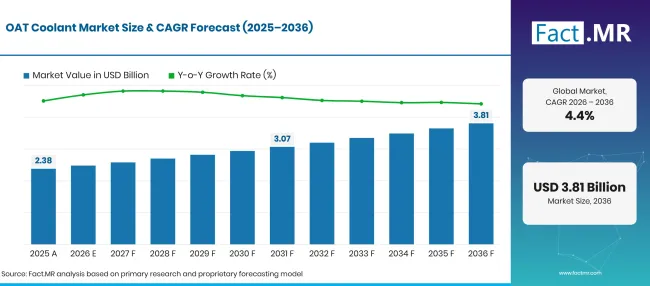
Oat Coolant Market Forecast Global | Source: Fact.MR
Category
| Category | Segments |
|---|---|
| Product Form | 50/50 pre-diluted, Concentrate, Pre-mixed heavy-duty, Extended life specialty |
| Base Fluid | Ethylene glycol, Propylene glycol, Bio-based glycol, Glycerin-based |
| Powertrain | Gasoline engines, Diesel engines, Hybrid vehicles, Battery electric and fuel cell vehicles |
| Sales Channel | Professional service and garages, OEM first fill, Retail do-it-yourself, Fleet and industrial direct |
| Region | India; Brazil; China; South Korea; United States |
Source: Fact.MR analysis.
Segmental Analysis
What is driving customer preference and sales of 50/50 pre-diluted OAT coolant?
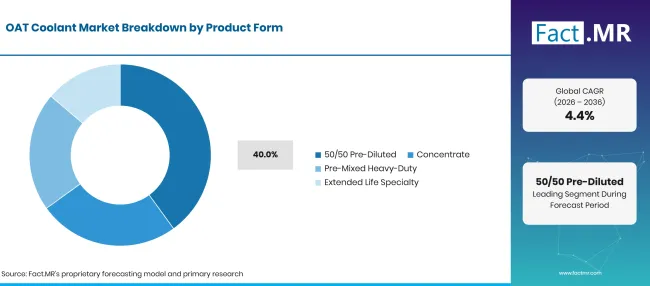
Oat Coolant Market Breakdown Product Form | Source: Fact.MR
Demand for 50/50 pre-diluted OAT coolant is increasing as vehicle owners and service technicians prioritize convenient coolant replacement without additional mixing or dilution requirements. This product form accounts for 40.0% of market revenue in 2026, about USD 992.0 million. Supporting demand conditions are visible in the US automotive aftermarket, where the Census Bureau reported that automotive repair and maintenance services revenue reached approximately USD 49.55 billion at the latest plotted quarterly observation in 2026. Rising maintenance expenditure supports demand for ready-to-use fluids across professional servicing and independent repair facilities.
Which market conditions are reinforcing ethylene glycol's dominance in OAT coolant formulations?
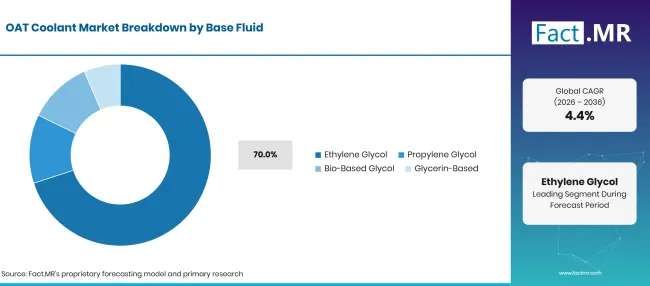
Oat Coolant Market Breakdown Base Fluid | Source: Fact.MR
Sales of ethylene glycol-based OAT coolant benefit from its established position as a cost-effective heat-transfer and freeze-protection fluid in automotive cooling systems. The segment represents 70.0% of market revenue in 2026, about USD 1.74 billion. India's Annual Survey of Industries 2024–25, released by the Ministry of Statistics and Programme Implementation in September 2026, reported 7.81% growth in registered manufacturing industrial output. Chemical products and motor vehicles were among the five leading contributors to manufacturing gross value added. This industrial expansion supports the broader supply ecosystem for glycol-based coolant formulations.
How is gasoline vehicle production sustaining demand for OAT coolant?
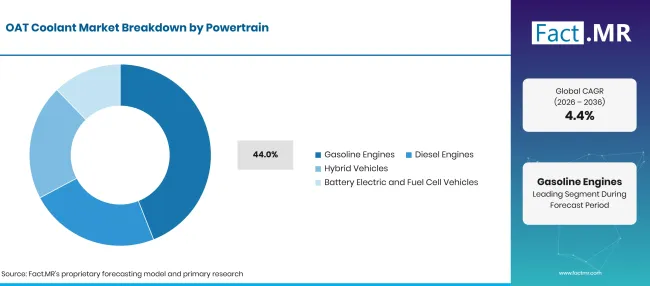
Oat Coolant Market Breakdown Powertrain | Source: Fact.MR
Adoption of OAT coolant in gasoline-powered vehicles is driven by the large installed passenger-vehicle base and recurring requirements for cooling-system maintenance. The gasoline engine segment accounts for 44.0% of market revenue in 2026, about USD 1.09 billion. India's Ministry of Statistics and Programme Implementation reported that motor vehicle, trailer and semi-trailer manufacturing output increased by 19.0% year on year in September 2026. Passenger cars and commercial vehicles were among the significant contributors to this industrial growth. Higher vehicle production creates additional opportunities for original-equipment coolant supply and subsequent aftermarket replacement demand.
What is strengthening professional garages' position in OAT coolant distribution and sales?
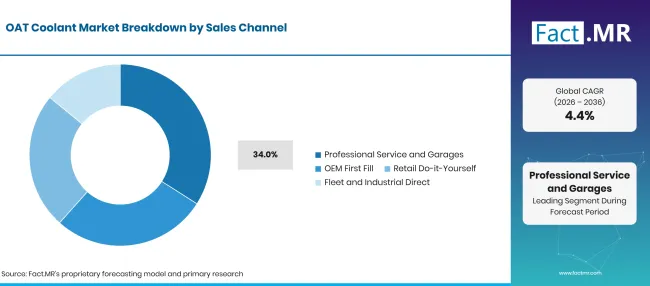
Oat Coolant Market Breakdown Sales Channel | Source: Fact.MR
Demand through professional service centres and garages is shaped by scheduled coolant replacement, cooling-system flushing and routine vehicle maintenance. This sales channel holds 34.0% of OAT coolant market revenue in 2026, about USD 843.2 million. The US Census Bureau reported that construction spending on automotive service and parts establishments reached a seasonally adjusted annual rate of USD 6.1 billion in September 2026. This investment indicates continued development of automotive servicing infrastructure. Greater workshop capacity supports commercial opportunities for coolant manufacturers supplying bulk containers, approved formulations and ready-to-use products to professional maintenance providers.
OAT Coolant Market-Drivers, Restraints & Trends
Drivers: Expansion of the Global Vehicle Fleet and Increasing Vehicle Utilization
Demand for OAT coolants is supported by the expanding vehicle population and the continued use of internal combustion engine vehicles requiring engine-cooling fluids. According to the US Federal Highway Administration (FHWA), its 2026 publication reports approximately 298 million registered motor vehicles in the United States in 2024, representing a 5% increase over 2023. The same dataset records approximately 3.3 trillion vehicle-miles travelled during 2024, demonstrating substantial vehicle utilization. A larger operating fleet increases requirements for engine cooling, corrosion protection and routine coolant maintenance. OAT formulations benefit from their application in modern cooling systems containing aluminum components and their extended service-life characteristics, supporting demand among automotive manufacturers, maintenance facilities and vehicle owners.
Restraints:
Sale is constrained by long service intervals, mixing problems with older coolant types, the shift to electric vehicles with smaller cooling needs and price swings in glycol feedstocks. OAT coolant demand faces constraints from extended replacement intervals, coolant compatibility requirements and the gradual transition toward electric vehicles. The US Department of Energy's Alternative Fuels Data Center reports that US light-duty electric vehicle registrations increased by approximately 21.0% between 2024 and 2025. This transition creates a structural challenge for conventional engine-coolant consumption because battery-electric vehicles do not require conventional engine cooling systems. Additionally, the US Environmental Protection Agency identifies coolant testing, including freezing-point, boiling-point and pH checks, as methods for extending antifreeze service life. Longer replacement intervals can reduce fresh coolant purchases. Mixing incompatible coolant formulations can also compromise system performance.
Opportunity: Development of Coolants for Electric Vehicles
Electric vehicle thermal management presents opportunities for coolant manufacturers developing specialized fluids for battery packs, electric motors and power electronics. The US National Renewable Energy Laboratory (NREL) reports that battery-electric vehicle thermal-management systems require coordinated heating and cooling of batteries, power electronics and motors. Its technical research identifies existing battery thermal-management systems typically ranging from 1–5 kW, with future fast-charging applications potentially requiring 15–25 kW systems. The research also identifies dielectric-fluid immersion as a potential advanced thermal-management approach. These developments create opportunities for manufacturers offering application-specific fluids with suitable electrical, thermal and material-compatibility properties.
Trend: Increasing Preference for Pre-Mixed and Heavy-Duty Coolant Solutions
Fleet operators and vehicle maintenance facilities are emphasizing coolant quality, compatibility and maintenance efficiency to reduce servicing errors and vehicle downtime. The US Environmental Protection Agency (EPA), through its Comprehensive Procurement Guidelines for Vehicular Products, recommends establishing engine-coolant reclamation and reuse programmes for government vehicle fleets. The agency also reports that properly recycled engine coolants can meet nationally recognized ASTM and SAE performance specifications. This supports the growing importance of coolant quality management and standardized maintenance practices across vehicle fleets. For OAT coolant suppliers, these requirements create opportunities to offer ready-to-use formulations, extended-life heavy-duty products and coolant management services.
Competitive Landscape for OAT Coolant Market
The OAT coolant market is relatively concentrated, with Shell, ExxonMobil, Chevron, TotalEnergies and BASF together hold about 67% of 2026 revenue, based on Fact.MR estimates. Competition centers on approvals from vehicle makers, brand reputation in service garages, price and distribution reach. Oil majors and chemical groups lead through branded and OEM channels, with regional blenders serving price-sensitive buyers.
Recent Developments
- In September 2025, BASF launched GLYSANTIN ELECTRIFIED low electrical conductivity coolants for electric vehicle battery protection. The formulations reduce fluid decomposition and hydrogen generation under high-voltage exposure, comply with China's GB 29743.2-2025 standard and entered production at its Shanghai facility.
- In March 2026, Shell introduced Rotella ELC HD, an extended-life OAT coolant designed for heavy-duty diesel, gasoline, natural gas and LNG engines. The formulation provides corrosion protection, extended drain intervals and improved heat transfer while meeting Caterpillar EC-1 and Cummins OEM requirements.
- In October 2026, TotalEnergies introduced Coolant Keep Plate (CKP), a passive technology for immersion-cooled lithium-ion batteries. It retains dielectric cooling fluid around exposed battery cells during venting events, helping prevent fire and thermal runaway propagation. Company testing reported no propagation in tested configurations using CKP.
Key Players in OAT Coolant Market
Key companies operating in the market include Shell, ExxonMobil, Chevron, TotalEnergies, and BASF.
- Shell
- ExxonMobil
- Chevron
- TotalEnergies
- BASF
OAT Coolant Market Analysis by Key Country
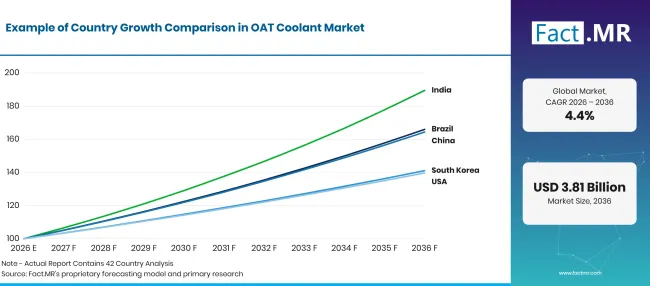
Oat Coolant Market Growth Index | Source: Fact.MR
| Country | CAGR (2026-2036) |
|---|---|
| India | 6.6% |
| Brazil | 5.2% |
| China | 5.1% |
| South Korea | 3.5% |
| United States | 3.4% |
Source: Fact.MR analysis.
What is accelerating OAT coolant adoption and aftermarket sales in India?
Demand for OAT coolants in India is projected to rise at a 6.6% CAGR through 2036, making the country the fastest-growing market among the five profiled economies.
Increasing vehicle production, expanding passenger mobility and a growing vehicle servicing ecosystem are creating opportunities for coolant manufacturers. India's Ministry of Heavy Industries reported that passenger vehicle production reached 5.061 million units in FY 2024–25, compared with 4.902 million units in the previous year. Additionally, the Ministry of Statistics and Programme Implementation reported 19.0% year-on-year growth in motor vehicle manufacturing output in September 2026. These developments support long-term automotive fluid demand.
Which automotive market developments are supporting OAT coolant sales growth in Brazil?
Sales of OAT coolants in Brazil are estimated to expand at a 5.2% CAGR through 2036, exceeding the global market growth rate of 4.4%.
Vehicle production, commercial transportation and aftermarket maintenance create opportunities for coolant suppliers serving passenger cars and heavy-duty vehicles. Brazil's Ministry of Development, Industry, Trade and Services reported passenger vehicle exports worth USD 452.7 million in September 2026. However, export value declined 34.3% year on year, while exported quantities decreased 36.6%. This indicates a mixed automotive trade environment, making domestic vehicle circulation and replacement demand important considerations for the country's coolant market.
How is China's extensive vehicle population influencing OAT coolant demand?
Demand for OAT coolants in China is projected to grow at a 5.1% CAGR through 2036, outperforming the global rate of 4.4%.
The country's extensive passenger vehicle population and established automotive manufacturing ecosystem provide a substantial base for original-equipment and aftermarket coolant sales. China's National Bureau of Statistics reported that civilian motor vehicle ownership reached 366.11 million units at the end of 2025, increasing by 13.43 million vehicles over the previous year. Passenger cars accounted for 197.73 million units. This expanding vehicle population creates recurring requirements for cooling-system maintenance and replacement fluids.
What is influencing the pace of OAT coolant adoption in South Korea's automotive industry?
Adoption of OAT coolants in South Korea is estimated to increase at a 3.5% CAGR through 2036, below the global market rate of 4.4%.
Automotive manufacturing, hybrid vehicle production and advanced thermal-management requirements provide opportunities for specialized coolant formulations. South Korea's Ministry of Trade, Industry and Resources reported that automobile production increased by 3.7% year on year to 347,000 units in September 2026. Eco-friendly vehicle exports also increased by 5.9% to USD 2.89 billion.
Which factors are keeping United States OAT coolant sales steady despite slower market growth?
Demand for OAT coolants in the United States is forecast to increase at a 3.4% CAGR through 2036, the slowest among the five profiled countries.
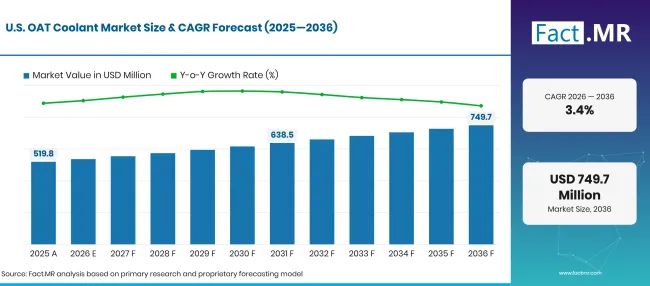
Oat Coolant Market Forecast Usa | Source: Fact.MR
A large installed vehicle population, relatively mature automotive aftermarket and recurring cooling-system maintenance requirements sustain replacement-fluid sales. The Federal Highway Administration's 2026 report, Our Nation's Highways, recorded 298 million registered motor vehicles in 2024, while the median vehicle age was eight years. Furthermore, its August 2026 traffic report estimated cumulative vehicle travel at 2,235.5 billion miles, up 0.5% year on year. These indicators support continuing maintenance-related coolant demand.
Bibliography
- Federal Highway Administration. (2026, August). Traffic volume trends: August 2026 [PDF]. U.S. Department of Transportation.
- Federal Highway Administration. (2026, July 31). Our nation’s highways 2026: Travel. U.S. Department of Transportation.
- Federal Highway Administration. (2026, July 31). Our nation’s highways 2026: Vehicles. U.S. Department of Transportation.
- Ministry of Development, Industry, Trade and Services. (n.d.). Brazilian foreign trade results: Consolidated data. Government of Brazil.
- Ministry of Heavy Industries. (2026, February 6). Impact of Make in India on automobile industry. Press Information Bureau, Government of India.
- Ministry of Statistics and Programme Implementation. (2026, September 30). Release of the Annual Survey of Industries (2024–25) results. Press Information Bureau, Government of India.
- Ministry of Statistics and Programme Implementation. (2026, October 28). Quick estimates of Index of Industrial Production and use based index for the month of September 2026 (Base 2022–23=100). Press Information Bureau, Government of India.
- Ministry of Trade, Industry and Resources. (2026, October 19). Automobile exports fall 5.5%, production rises 3.7% in September 2026. Government of the Republic of Korea.
- National Bureau of Statistics of China. (2026, February 28). Statistical communiqué of the People’s Republic of China on the 2025 national economic and social development. Government of China.
- U.S. Census Bureau. (2026, November 16). Automotive statistics: Consumer spending. U.S. Department of Commerce.
- National Renewable Energy Laboratory. (2025). Change in U.S. light duty vehicle registration counts (2024–2025). Alternative Fuels Data Center, U.S. Department of Energy.
Segmentation
Scope of Report
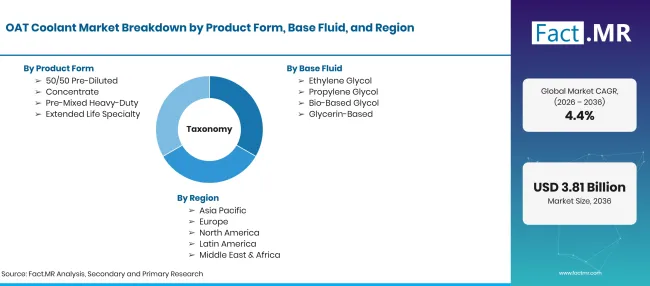
Oat Coolant Market Taxonomy | Source: Fact.MR
| Items | Values |
|---|---|
| Quantitative Units (2026) | USD 2.48 Billion |
| Product Form | 50/50 pre-diluted, Concentrate, Pre-mixed heavy-duty, Extended life specialty |
| Base Fluid | Ethylene glycol, Propylene glycol, Bio-based glycol, Glycerin-based |
| Powertrain | Gasoline engines, Diesel engines, Hybrid vehicles, Battery electric and fuel cell vehicles |
| Sales Channel | Professional service and garages, OEM first fill, Retail do-it-yourself, Fleet and industrial direct |
| Regions Covered | North America, Latin America, Europe, Asia Pacific, Middle East & Africa |
| Countries Covered | India, Brazil, China, South Korea, United States, and other countries |
| Key Companies Profiled | Shell, ExxonMobil, Chevron, TotalEnergies, BASF |
| Additional Attributes | Dollar revenue in the OAT Coolant Market is segmented by product form, base fluid, powertrain and sales channel and region. |
Source: Fact.MR analysis.
OAT Coolant Market by Segments
-
Product Form
- 50/50 pre-diluted
- Concentrate
- Pre-mixed heavy-duty
- Extended life specialty
-
Base Fluid
- Ethylene glycol
- Propylene glycol
- Bio-based glycol
- Glycerin-based
-
Powertrain
- Gasoline engines
- Diesel engines
- Hybrid vehicles
- Battery electric and fuel cell vehicles
-
Sales Channel
- Professional service and garages
- OEM first fill
- Retail do-it-yourself
- Fleet and industrial direct
-
Region:
- North America
- United States
- Canada
- Mexico
- Europe
- Germany
- United Kingdom
- France
- Italy
- Spain
- Rest of Europe
- Asia Pacific
- China
- India
- Japan
- South Korea
- Australia and New Zealand
- Rest of Asia Pacific
- Latin America
- Brazil
- Argentina
- Rest of Latin America
- Middle East & Africa
- GCC Countries
- South Africa
- Rest of Middle East & Africa
- North America
Table of Contents
Key Takeaways
- Market Size and CAGR
- Top Growth Driver
- Fastest Growing Segment
- Leading Region
- Key Companies
- Emerging Opportunities

