- Market Value (2025): USD 24.7 Bn
- Estimated Value (2026): USD 26.2 Bn
- Forecast Value (2036): USD 47.7 Bn
- CAGR (2026-2036): 6.2%
What is the Baseband Processor Market forecast to be worth by 2036?
USD 26.2 billion in 2026 to USD 47.7 billion by 2036 at a 6.2% CAGR.
- As per Fact.MR analysis, the baseband processor market was valued at USD 24.7 billion in 2025.
- Demand will grow from USD 26.2 billion in 2026 to USD 47.7 billion by 2036.
- The forecast records a 6.2% CAGR from 2026 to 2036 as demand for advanced cellular connectivity and high-speed data transmission increases.
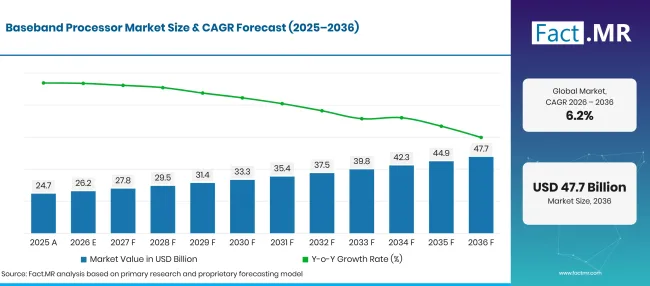
Factmr Baseband Processor Market Forecast Global | Source: Fact.MR
| Year | Basis | Market Value (USD billion) |
|---|---|---|
| 2025 | Actual | 24.7 |
| 2026 | Estimate | 26.2 |
| 2036 | Forecast | 47.7 |
| CAGR 2026 to 2036 | Forecast period | 6.2% |
Source: Fact.MR analysis. Updated Oct 15, 2026
What are the defining numbers behind Baseband Processor Market growth?
USD 21.5 billion absolute opportunity between 2026 and 2036.
- Demand Drivers in the Market
- Smartphone manufacturers and chipset suppliers continue to improve mobile data speeds and network performance. In March 2026, Qualcomm introduced its X105 5G Modem-RF with peak download speeds of 14.8 Gbps and support for 5G-Advanced technology, showing how modem capabilities are developing [1]
- Mobile network operators continue expanding 5G networks, supporting adoption of compatible processors in smartphones and connected devices. The European Commission reported in June 2026 that basic 5G coverage reached 96.8% of EU households, while coverage in the 3.4–3.8 GHz mid-band reached 74.8%, showing scope for further network upgrades. [2]
- Connected-device manufacturers seek processors that provide reliable connections while using less power and board space. In March 2026, Qualcomm reported that the 6-nm RF transceiver in its X105 Modem-RF system uses up to 30% less power and requires a 15% smaller board footprint than the previous generation.[3]
- Key Segments Analyzed
- By Processor Type: As per Fact.MR analysis, Multi-core Processor and Many-core Processor will account for 68.4% of the baseband processor market in 2026, reflecting growing demand for enhanced processing capabilities and efficient cellular communication.
- By Application: Fact.MR forecasts that Tablets will account for 56.3% of the baseband processor market in 2026, driven by demand for reliable wireless connectivity, high-speed data transmission, and seamless mobile internet access.
- Analyst Opinion at Fact.MR
- Shambhu Nath Jha, Principal Consultant at Fact.MR, states, “Baseband processors are likely to attract interest where growing connectivity needs require reliable and efficient signal processing. Device manufacturers still need application-specific specifications and a practical integration plan before choosing a suitable processor.”
- Strategic Implications
- Manufacturers should highlight supported cellular standards, processor capabilities, and power-efficiency specifications alongside clear integration guidelines.
- Device manufacturers should distinguish connectivity requirements for smartphones, tablets, and other connected devices before selecting a suitable baseband processor.
- Network operators and chipset developers should evaluate compatibility with evolving 4G, 5G, and 5G-Advanced technologies before implementing new connectivity solutions.
- Device manufacturers should assess processor performance, power consumption, integration costs, and expected connectivity benefits against specific product requirements.
Germany is set to record a 6.7% CAGR through 2036. Brazil is set to post 6.1%, followed by the USA at 5.5%. The UK is estimated to advance at 4.9%, while Japan is forecast at 4.4%. Different levels of 5G adoption and demand for advanced connectivity create different growth opportunities across regional markets.
How does the Baseband Processor Market break down by segment?
Fact.MR finds that Multi-core Processor and Many-core Processor lead Processor Type at 68.4%; Tablets lead Application at 56.3%.
Which Processor Type dominates?
According to Fact.MR estimates, multi-core and many-core processors are forecast to hold a combined 68.4% share in 2026.
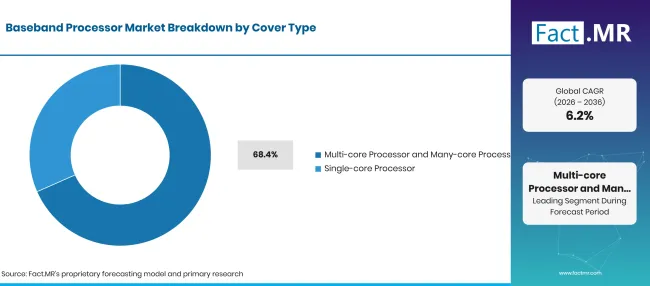
Factmr Baseband Processor Market Breakdown Cover Type | Source: Fact.MR
| Cover Type | Share (2026) |
|---|---|
| Multi-core Processor and Many-core Processor (Leading segment) | 68.4% |
| Other segments combined | 31.6%* |
| Total | 100.0% |
Source: Fact.MR analysis. Updated Oct 15, 2026
Multi-core and many-core architectures can perform parallel signal-processing tasks while handling complex cellular communication protocols. Qualcomm introduced its X105 5G Modem-RF in March 2026 with support for 5G-Advanced and peak download speeds of 14.8 Gbps, demonstrating progress in modem performance without independently establishing the estimated segment share.[4]
What leads the Application segment?
According to Fact.MR estimates, tablets are forecast to represent 56.3% of the market under the supplied application classification in 2026.
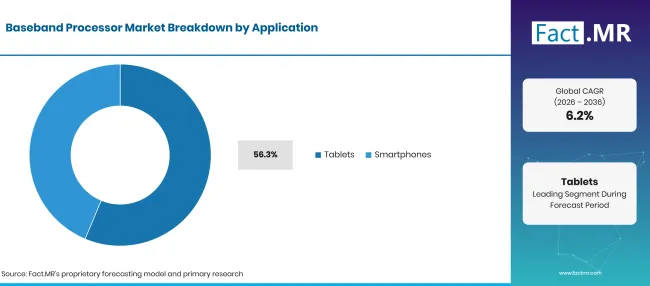
Factmr Baseband Processor Market Breakdown Application | Source: Fact.MR
| Application | Share (2026) |
|---|---|
| Tablets (Leading segment) | 56.3% |
| Other segments combined | 43.7%* |
| Total | 100.0% |
Source: Fact.MR analysis. Updated Oct 15, 2026
Fact.MR assigns a 56.3% share to tablets under the supplied application classification, although this estimate requires confirmation against the underlying market model. Tablet manufacturers assess cellular network support, connectivity performance, and battery efficiency when selecting baseband processors.
What is accelerating Baseband Processor Market adoption, and what is holding it back?
Growth in 5G networks and connected devices supports baseband processor adoption, while design costs, power requirements, and supply chain risks can slow wider uptake.
Drivers Impact Analysis
| DRIVER | (~) % IMPACT ON CAGR | GEOGRAPHIC RELEVANCE | IMPACT TIMELINE |
|---|---|---|---|
| Expansion of 5G network infrastructure | +1.0% | Asia-Pacific, North America, Europe | Medium term (2–4 years) |
| Rising demand for high-speed mobile connectivity | +0.9% | Global | Short term (≤ 2 years) |
| Increasing adoption of advanced smartphones and tablets | +0.7% | Global | Medium term (2–4 years) |
| Integration of advanced modem and processor technologies | +0.5% | Global | Short term (≤ 2 years) |
| Growing demand for connected IoT devices | +0.4% | Global | Long term (≥ 4 years) |
Source: Fact.MR analysis. Updated Oct 15, 2026
Opportunity Impact Analysis
| OPPORTUNITY | (~) % IMPACT ON CAGR | GEOGRAPHIC RELEVANCE | IMPACT TIMELINE |
|---|---|---|---|
| 5G and 6G network deployment | +0.8% | Global | Medium term (2–4 years) |
| Rising demand for high-performance smartphones | +0.6% | Asia, Americas | Medium term (2–4 years) |
| Integration of AI and power-efficient baseband processors | +0.5% | Global | Long term (≥ 4 years) |
| Expansion of IoT and connected devices | +0.4% | Global, Europe, Asia | Short term (≤ 2 years) |
Source: Fact.MR analysis. Updated Oct 15, 2026
Restraints Impact Analysis
| RESTRAINT | (~) % IMPACT ON CAGR | GEOGRAPHIC RELEVANCE | IMPACT TIMELINE |
|---|---|---|---|
| High baseband processor design and manufacturing costs | -0.8% | Global | Short term (≤ 2 years) |
| Semiconductor supply chain disruptions and component shortages | -0.6% | Global | Medium term (2–4 years) |
| High power consumption and thermal management challenges | -0.5% | Global | Short term (≤ 2 years) |
| Intense competition and pricing pressure | -0.4% | Global | Medium term (2–4 years) |
Source: Fact.MR analysis. Updated Oct 15, 2026
Which countries are scaling the Baseband Processor Market through 2036?
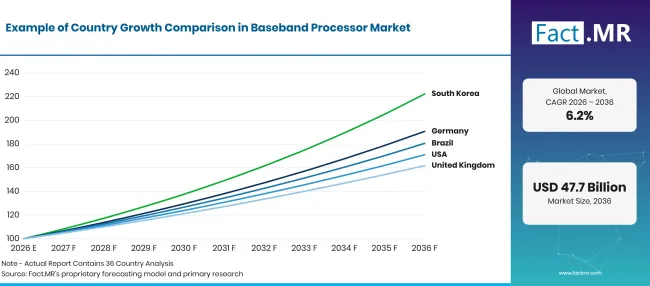
Factmr Baseband Processor Market Growth Index | Source: Fact.MR
| Country | CAGR (2026-2036) |
|---|---|
| Germany | 6.7% |
| Brazil | 6.1% |
| USA | 5.5% |
| UK | 4.9% |
| Japan | 4.4% |
Source: Fact.MR analysis. Updated Oct 15, 2026
What supports Germany adoption?
6.7%, supported by expanding 5G usage and rising mobile data consumption.
Germany's mobile communications market supports the use of advanced baseband processors as cellular services expand. According to the Bundesnetzagentur, the country's four mobile network operators recorded approximately 225.9 million registered SIM profiles in Q2 2026, including inactive and machine-to-machine profiles. Its telecommunications annual report recorded 10.9 billion GB of mobile data traffic in 2025, compared with 9.6 billion GB in 2024. This rising traffic supports the need for reliable cellular connectivity in mobile devices [6] [7].[6][7]
How is Brazil developing baseband processor adoption?
6.1%, driven by expanding 5G connections and a large mobile communications market.
Brazil recorded 276.4 million mobile access connections in Q2 2026, an annual increase of 3.7%, according to the National Telecommunications Agency (Anatel). Of these, 66.1 million connections used 5G, representing 23.9% of the total. Expansion of 5G access supports the adoption of compatible smartphones and other cellular-connected devices that require baseband processing [8].[8]
What supports United States adoption?
5.5%, supported by extensive 5G network availability and demand for connected devices.
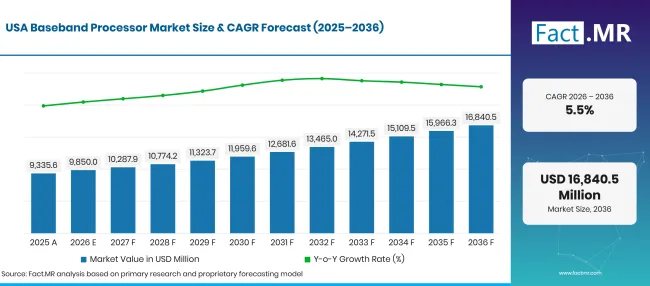
Factmr Baseband Processor Market Forecast Usa | Source: Fact.MR
The U.S. Federal Communications Commission's 2026 broadband deployment report found that approximately 311.0 million people, or 90.5% of the evaluated population, lived in areas with access to both fixed wireline broadband at 100/20 Mbps and mobile 5G-NR service at 35/3 Mbps as of June 2025. These coverage figures describe network availability, which can support the use of compatible cellular devices and baseband processors [9].[9]
How is the United Kingdom building adoption?
4.9%, shaped by expanding 5G coverage and the transition toward standalone 5G networks.
Ofcom's Connected Nations update for spring 2026 reported that predicted outdoor 5G coverage from all UK mobile network operators increased from 47% to 64% of the geographic area in the six months ending January 2026. Individual operators' outdoor coverage ranged from 76% to 94%, showing how wider 5G availability can support the use of compatible mobile devices and baseband processors [10].[10]
What supports Japan adoption?
4.4%, supported by an established mobile communications market and continued 5G adoption.
Japan's established mobile communications market supports wider use of advanced baseband processors as 5G connections grow. According to the Statistics Bureau of Japan's Statistical Handbook of Japan 2025, drawing on Ministry of Internal Affairs and Communications data, 5G mobile phone subscriptions reached 92.367 million in March 2024, compared with 69.809 million in March 2023. These historical figures show the scale of 5G adoption, but they do not measure 2026 market conditions [11].[11]
Who leads the Baseband Processor Market?
Fact.MR identifies Qualcomm Technologies, MediaTek, Samsung Electronics, Apple, HiSilicon (Huawei Technologies), UNISOC Technologies and Sequans Communications among the companies profiled in the Baseband Processor Market.
Qualcomm Technologies and MediaTek are prominent participants in mobile chipset and modem solutions. Samsung Electronics develops semiconductor and mobile connectivity technologies, while Apple designs processors and wireless technologies for its device ecosystem. HiSilicon contributes to Huawei's semiconductor and communications technology portfolio. UNISOC serves mobile chipset markets, while Sequans Communications focuses on cellular IoT and 4G/5G connectivity solutions. Their product portfolios should be assessed by processor type, network standards, device compatibility and target application before making direct comparisons.
Commercial competition depends on modem performance, power efficiency, network compatibility and integration with device platforms. Device manufacturers need reliable chipsets that support evolving connectivity standards and deliver consistent performance. Network operators and technology partners prioritize interoperability and efficient data transmission. Chipset suppliers must also balance research and development costs, supply-chain reliability and demand across smartphones, tablets and connected devices.
Which companies are the key providers?
Key companies in the global baseband processor market include Qualcomm Technologies, Inc.; MediaTek Inc.; Samsung Electronics Co., Ltd.; Apple Inc.; HiSilicon (Huawei Technologies Co., Ltd.); UNISOC Technologies Co., Ltd.; and Sequans Communications S.A.
- Qualcomm Technologies, Inc.
- MediaTek Inc.
- Samsung Electronics Co., Ltd.
- Apple Inc.
- HiSilicon (Huawei Technologies Co., Ltd.)
- UNISOC Technologies Co., Ltd.
- Sequans Communications S.A.
Bibliography
- [1] Qualcomm Technologies, Inc. (2026, March 2). Qualcomm announces 5G-Advanced leap with Qualcomm X105 5G Modem-RF—World’s first R19-ready modem, laying the foundation for 6G.
- [2] European Commission. (2026, June 17). Digital Decade 2026—5G Observatory Report.
- [3] Qualcomm Technologies, Inc. (2026, March 2). Qualcomm announces 5G-Advanced leap with Qualcomm X105 5G Modem-RF—World’s first R19-ready modem, laying the foundation for 6G.
- [4] Qualcomm Technologies, Inc. (2026, March 2). Qualcomm announces 5G-Advanced leap with Qualcomm X105 5G Modem-RF—World’s first R19-ready modem, laying the foundation for 6G.
- [5] Bundesnetzagentur. (2026, September 14). Teilnehmerentwicklung im Mobilfunk [Mobile subscriber development, data updated September 14, 2026].
- [6] Bundesnetzagentur. (2026, June 5). Telecoms Annual Report 2025.
- [7] Agência Nacional de Telecomunicações. (2026, July 15). Anatel divulga Relatório de Monitoramento da Competição do segundo trimestre de 2026.
- [8] Federal Communications Commission. (2026, August 14). Inquiry Concerning Deployment of Advanced Telecommunications Capability to All Americans in a Reasonable and Timely Fashion: 2026 Section 706 Report (FCC 26-55).
- [9] Ofcom. (2026, May 13). Connected Nations update: Spring 2026.
- [10] Statistics Bureau of Japan. (2025, September). Statistical handbook of Japan 2025.
- https://www.stat.go.jp/english/data/handbook/pdf/2025half_1.
- [11] Statistics Bureau of Japan. (2025, December 25). Japan Statistical Yearbook 2026.
This Report Answers
- The report describes how baseband processors enable cellular communication across smartphones, tablets, connected devices, and other cellular-enabled electronic equipment.
- Segment analysis compares the specified baseband processor types and their respective 2026 market shares.
- Country analysis examines Germany, Brazil, the USA, the UK, and Japan alongside official telecommunications statistics and 5G deployment indicators.
- The competitive overview profiles Qualcomm Technologies, MediaTek, Samsung Electronics, Apple, HiSilicon (Huawei), UNISOC, and Sequans Communications.
- Application analysis distinguishes baseband processor use across smartphones, tablets, IoT devices, connected vehicles, and other cellular-connected applications.
What does the Baseband Processor Market cover?
The market covers semiconductor components that process cellular signals in smartphones, tablets, IoT devices, connected vehicles, and industrial equipment. The scope includes baseband solutions for 4G LTE and 5G, alongside technologies under development for future 6G networks.
What is included in the scope?
The scope includes baseband processors and cellular modem chipsets used in cellular communication. The report groups them by processor architecture and application, while retaining wider connected-device uses in its qualitative discussion.
What is excluded from the scope?
The market excludes standalone application processors, Wi-Fi-only and Bluetooth-only chips, RF components, antennas, network infrastructure equipment, and finished-device sales.
How Was the Analysis Built?
The analysis draws on official telecommunications statistics, company product information, and industry evidence to evaluate connectivity trends and related baseband processor opportunities. The internal research counts and interview totals require supporting records before publication.
- Primary Research: Primary research includes discussions with manufacturers, service providers, technology developers, distributors, end users, and subject-matter experts. These conversations examine purchasing priorities, product adoption, operational challenges, approval requirements, competitive positioning, and the factors that influence wider market acceptance.
- Desk Research: Desk research reviews government statistics, regulatory publications, company filings, industry data, technical studies, and other relevant material. The bibliography identifies the external sources explicitly cited in this report.
- Market Sizing and Forecasting: Market estimates combine historical performance, demand indicators, pricing and volume trends, segment shares, company participation, country-level growth, adoption patterns, investment activity, and barriers to market expansion.
- Data Validation and Update Cycle: Findings are validated by comparing primary interviews with public data, company activity, regulatory changes, trade patterns, and industry developments. Regular updates review new product launches, capacity changes, partnerships, approvals, and shifts in commercial adoption.
Segmentation
What is the report’s scope and coverage?
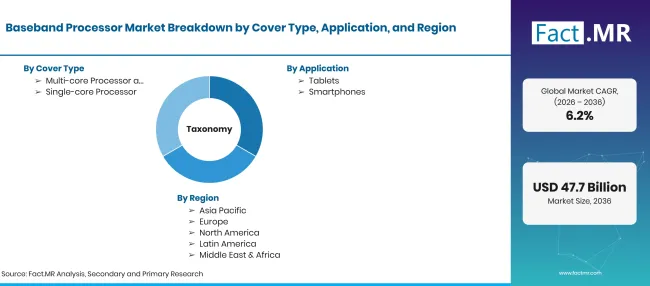
Factmr Baseband Processor Market Taxonomy | Source: Fact.MR
| Attribute | Details |
|---|---|
| Quantitative Units | USD billion: 2026 valuation, 2036 forecast and CAGR |
| Market Definition | Baseband processors are semiconductor components that process and manage cellular communication signals, enabling voice, data, and wireless connectivity in smartphones, tablets, connected devices, and other cellular-enabled electronic equipment. |
| Processor Type | Multi-core Processor and Many-core Processor; Single-core Processor |
| Application | Tablets; Smartphones |
| Regions Covered | North America; Latin America; Western Europe; Eastern Europe; East Asia; South Asia & Pacific; Middle East & Africa |
| Countries Covered | Germany; Brazil; USA; UK; Japan |
| Companies Profiled | Qualcomm Technologies, Inc.; MediaTek Inc.; Samsung Electronics Co., Ltd.; Apple Inc.; HiSilicon (Huawei Technologies Co., Ltd.); UNISOC Technologies Co., Ltd.; and Sequans Communications S.A. |
| Forecast Period | 2026 to 2036 |
| Approach | Market segmentation and scenario-based analysis supported by official telecommunications statistics, semiconductor industry data, and 5G network deployment indicators. |
Source: Fact.MR analysis. Updated Oct 15, 2026
How is the market segmented?
-
By Processor Type:
- Multi-core Processor and Many-core Processor
- Single-core Processor
-
By Application:
- Tablets
- Smartphones
-
By Region:
- North America
- Latin America
- Western Europe
- Eastern Europe
- East Asia
- South Asia & Pacific
- Middle East & Africa
Frequently Asked Questions
How big is the baseband processor market in 2026?
What is the CAGR from 2026 to 2036?
Which Processor Type has the largest stated share?
Which Application leads?
Which companies are covered?
Who worked on this report


Preview the report firsthand - request a free sample
Free SampleGet the brochure for pricing and purchase details
Download PDF